André Samora-Arvela1 João Ferrão2 Jorge Ferreira3 Thomas Panagopoulos4 Eric Vaz5 AbstrAct
Climate change will further induce a generalized rise in temperature, heat waves, exacerbation of heat island effect, alteration of the precipitation regime variability with higher occurrence of high precipitation and flood events, reduction of quantity and quality of freshwater resources, disruption of agricultural production, leading to food security risk, degradation of recreational and aesthetic amenities, and loss of biodiversity.
On other hand, Green Infrastructure, that is, the network of natural and semi-natural spaces within and around urban spaces, brings a constructive and protecting element that may mitigate and adapt to the local level impacts of climate change, strengthening local resilience.
This paper presents a comparative study of various green infrastructures’ implementation based on analytics in the United States of America, United Kingdom and Portugal, and focuses on the degree of its alignment with the public policies of mitigation and adaptation to the impacts of climate change. Pursuant to the identification of successes and failures, this paper infers common strategies, goals and benchmarking on outcomes for more adequate decision implementation and sustainable spatial planning, considering the importance of green infrastructure.
Keywords: Green Infrastructure, Climate Change, Spatial Planning. JEL Classification: Q01, R52
1. INtrODUctION
Climate change will imply, with greater confidence a generalized increase in temperature, heat waves and exacerbation of the heat island effect, alteration of the variability of precipitation regime with higher occurrence of high precipitation and flood events (IPCC, 2012), reduction of quantity and quality of water resources, disruption of agricultural production with food security risk, loss of biodiversity and degradation of the landscape’s aesthetic and recreational amenities (IPCC, 2014).
In turn, the Green Infrastructure, that is, the network of natural and semi-natural spaces within and around urban spaces, presents itself as a structuring element, whose enhancement
1 CIEO – Research Centre for Spatial and Organizational Dynamics, Faculty of Economics, University of Algarve, CICS.NOVA - Interdisciplinary
Centre of Social Sciences, Faculty of Social Sciences and Humanities, New University of Lisbon ([email protected])
2 ICS - Social Science Institute, University of Lisbon ([email protected])
3 CICS.NOVA - Interdisciplinary Centre of Social Sciences, Faculty of Social Sciences and Humanities, New University of Lisbon (jr.ferreira@
fcsh.unl.pt)
4 CIEO – Research Centre for Spatial and Organizational Dynamics, Faculty of Economics, University of Algarve ([email protected])
contributes, offensive, defensively and opportunistically, to combat to the impacts of climate change, either in the order of mitigation or in the adaptation perspective.
Therefore, this article reviews the evolution of the Green Infrastructure (GI) concept, studies what elements can constitute a GI and its beneficial contributions to mitigation and adaptation, and compares the American and European GI Implementation Strategy through the analysis of three case studies (United Stated of America, United Kingdom and Portugal) in order to find learning opportunities across borders to inform the current spatial planning approach in Portugal.
2. GrEEN INFrAstrUctUrE AND cLIMAtE cHANGE 2.1 concept
Although the concept of Green Infrastructure is relatively recent, it has underlying notions that go back to the beginning of Environmentalism, Nature Conservation and the intervention of Landscape Architecture in 19th century urbanism (Sussams, Sheate & Eales, 2015).
In the nineteenth century, the industrial revolution led to an enormous demographic and urban growth, which was associated with a growing increase in insalubrity in cities. Thus, it emerged the foundation of the first hygienist doctrines in urbanism (Campos & Ferrão, 2015). Patrick Geddes, botanist and urbanist, progenitor of modern urban planning, noted the important interdependence between cities and the surrounding territory, attempted to understand city-region relations and proposed, for England, the Town Planning Movement (Fadigas, 2010), a system of regional inventories based on the complex relationships between the actions of Man and the Environment.
The Green Infrastructure has its origin in two basic concepts, namely the establishment of connections between green spaces and parks, in order to benefit populations and biodiversity preservation through the delineation of counterpoint corridors the habitat fragmentation. This was the corollary of the architect Frederick Law Olmsted through the introduction of the concept of “green lungs” and park systems: Central Park in New York (1857) and the Boston Parks System (Emerald Necklace, 1887) (Benedict & MacMahon, 2001).
Later, Ebenezer Howard presented the concept of garden city in 1898, proposing a model of urban organization through a symbiotic structure between city and countryside, where a polynuclear constellation of low density settlements, self-sufficient in agricultural production linked by green corridors and railroads, surrounded the large cities, providing them with the necessary inputs (Fadigas, 2010; Scott & Lennon, 2016). Howard’s ideas propelled the Greenbelts Movement, being expressed in the radial and concentric green rings of Vienna (1859-1872) and in the linear city concept of Madrid, idealized by Arturo Soria (1894). All these movements would be the origin of the concept of Continuum Naturale between urban and rural space, as a link between the respective landscapes, approaching the two respective modes of life (Magalhães, 2001).
In the 1920s and 1930s, the modernist functional city model, really popularized by Le Corbusier in his proposal of Ville Radieuse, emerged in an attempt to segregate large areas through distinct functionalities, based on the renunciation of Baroque urban continuity and the densification of the residential, commercial industrial and services buildings, neglecting green spaces, mainly destined to recreation and leisure, which were allocated between urban areas dedicated to labour and housing (Correia, 2012). Functional cities were drawn without respect for topographic and climatic conditions, resulting in grotesque concrete landscapes (Scott & Lennon, 2016).
If this was the model adopted in Europe, the United States demarcated by the adoption of a new one, postulated by the architect Frank Lloyd Wright, namely the Broadacre City,
a dispersed city, consigning the dissolution between the rural-urban binomial and the organization of an efficient system of highways (Scott & Lennon, 2016).
One might think that the benefits of this intertwinement with Nature would find their climax through the scattered city of Wright, but the praxis proved somewhat different.
The oil crisis of the 1970s denounced the unsustainability of this dispersed city, since urban expansion had been made in such a vast space extent and sparse density, that is, a suburbanization oriented by the stimulus of locomotion became unbearable due to to the costs of management and living within it (Scott & Lennon, 2016).
Postmodernism introduced a concept of New Urbanism, an approach that advocated the compact city, driven by a dense transport network, creating a city of locomotion at short distances. Urban intensification has had obvious benefits, such as conserving rural areas, reducing the need for car transport, and consolidating greater efficiency in city infrastructure (Scott & Lennon, 2016).
This renunciation of urban dispersion was followed by the ecology crisis of the 1960s and by the rise of landscape ecology in the 1980s. Phill Lewis (1964) introduced the concept of Environmental Corridors, delineated along hydrographic lines, wetlands and coastal zones, ensuring the mobility of species through the interconnection of habitats and safeguarding the areas with the highest ecological sensitivity to anthropogenic degradation (Correia, 2012), a reference that would be homologous to the evolution of the concept of Green Corridors and Greenways. As a result of the emergence of Geographic Information Systems, biophysical planning emerges in this period, influencing all planning approaches since then, of which the McHarg method of landscape attributes layer overlapping is the ultimate example.
Citing Correia (2012), the recognition of the need to reverse the growth paradigm through the emergence of the concept of sustainable development emanated from the Brundtland
Report and, since then, the environmental component in planning has been increasing (Partidário, 1999).
In 1991, the State of Maryland developed a plan to delineate an GI, the first with the intent of permeable biodiversity movement, conservation of sustainable land use structure, establishment of recreational pathways and alternatives to human locomotion within a context of urban expansion that tended to govern this US state (Benedict & MacMahon, 2006).
However, in addition to stimulating connectivity between habitats, other concerns came up within green infrastructure planning, such as mitigation and adaptation to climate change, for which the new compact city was found to be deeply vulnerable (Scott & Lennon, 2016). The urban model did not fail to have a high energy and emitter of greenhouse gases (GEE) consumption profile. Therefore, it is not surprising that the concept of Green Urbanism (Beatley, 2012) grew up, which states that human systems must exist through their ecological limits and in self-sufficiency, functioning analogously to Nature and developing nature-based solutions to solve the present and future problems through a biophilic relationship between Nature and Man. This idea was idealized also by the concept of Global Landscape, in which “the organic interpenetration between the building and the outer space, urban or rural, complement each other, through the continuity of existing mass and energy flows in them and between them”(Magalhães, 2001: 320).
Benedict & MacMahon (2006) define Green Infrastructure as an interconnected network of natural areas and other spaces that conserve the values and functions of natural ecosystems, sustaining the purification of air and water, providing a series of benefits for the population and protecting biodiversity.
The European Union have used a concept more focused at the scale of the regional landscape, and, at urban level, the term has been deprecated by the recurrence of “Green Spaces” and “Green Systems” (EEA, 2011: 33).
Matthews, Lo and Byrne (2015) and Sussams et al. (2015) assume the difficulty of conceptualizing the term of Green Infrastructure and the problem of communication among the spatial planning experts and stakeholders, since there are many examples of the definition of Green Infrastructure that have appeared in the scientific and technical literature (EEA, 2011).
Sussams et al. (2015) points out that the Green Infrastructure concept is in line with the ecosystem approach developed in the Convention on Biological Diversity (CBD) COP5, which adopted a strategy for integrated management of soil, water and living resources, emphasizing the need for increased cooperation at all levels. The Millennium Ecosystem Assessment (MEA), by bringing the importance of ecosystem services to the economic sphere, represented an opportunity to recognize the importance of green infrastructure planning. The converging bridge between the concept and the adaptation to climate change was made by the White Paper on Adapting to Climate Change, which recognized Green Infrastructure as crucial for the provision of social and economic benefits in extreme climatic conditions.
Drawing on concepts emanated from various academic and institutional forums, the European Commission, in 2013, delineate the Green Infrastructure Strategy and defined GI as a strategically planned network of natural and semi-natural areas, designed and managed to provide a wide range of ecosystem services. It incorporates green spaces (or blue, involving aquatic ecosystems), and the terrestrial green infrastructure is present in both rural and urban space. Today, it is considered a “Europe 2020” priority and is reiterated by the European Union’s Biodiversity Strategy for 2020 (EC, 2013).
Thus, the pertinence of defining which concept of Green Infrastructure will guide the development of the work that is here presented. As such, it is understood that Green Infrastructure can be defined as a network of natural and semi-natural spaces within and around urban spaces including gardens, lakes, parks, cycle paths, green roofs, green corridors, rivers, wetlands, agricultural fields and forest areas of sustainable use, among others, whose interconnection confers additional benefits and strengthened resilience (EEA, 2011). This network is based on the preservation and enhancement of ecosystem connectivity in order to maintain or increase the provision of ecosystem services and their resilience, including mitigation and adaptation to climate change. It is, of course, a territorial strategy to minimize the risks of natural disasters, based on solutions inspired by the integration of Nature, rather than heavy engineering solutions. The delineation of GI is part of the identification of multifunctional areas that incorporate not only the regeneration and the perpetuation of ecosystems, but also the food and forest production, recreation and leisure of the populations (EEA, 2011).
2.2 constituent elements
It is now important to uncover and systematize the potential components of the green infrastructures (EC, 2010), both on regional landscape or urban scale:
• Protected areas;
• Healthy ecosystems and areas of great natural value beyond protected areas, such as flood plains, wetlands, coastal areas, forests, among others;
• Natural landscape elements, such as waterways, wooded areas, hedges and natural passages that function as ecological corridors;
• Areas of recovered habitats for the preservation of certain species, either by the expansion of the protected areas or areas of feeding, rearing, resting and of favouring migration and geographical distribution;
• Ecoducts and ecobridges, that is, artificial elements designed and constructed to allow the movement of species through insurmountable landscape obstacles;
• Urban elements, such as parks, walls and green roofs, which are still niches of biodiversity and provide a series of urban services, linking urban, peri-urban and rural areas;
• Multifunctional areas, where the sustainable agricultural and sylvicultural used is practiced, allowing the maintenance and regeneration of ecosystems, based on the prohibition of practices that lead to their degradation.
2.3 benefits
Green Infrastructure provides a series of multiplicity of abiotic, biotic and cultural benefits, such as (Ahern, 2007; Boyd & Banzhaf, 2007; Madureira, 2012): provision of food, provision of raw materials, pharmaceutical products and others, provision of drinking water, assimilation of waste and pollutants, benefits for public health, lower the risk of natural disasters, existence of habitats and biodiversity, recreation and tourism, landscape aesthetic quality, inspiration, cultural, religious and emotional value, education and knowledge.
The main mitigation benefits of GI are: atmospheric gas regulation through carbon sequestration (Nowak, Greenfield, Hoehn & Lapoint, 2013), reduction of energy use in heating and/or cooling of buildings by increasing the area in green spaces, green roofs and green walls (Alexandri & Jones, 2008; Demuzere, Orru, Heidrich, Olazabal, Geneletti, Orru, Bhave, Mittal, Feliu & Faehnle, 2014), proximity agricultural and other materials production (Beatley, 2000) and encouraging sustainable locomotion (NDRA, 2010). On other hand, the essential adaptation benefits based on GI are: reduction of urban heat island effect and increased thermal comfort (Gill, Handley, Ennos & Pauliet, 2007), regulation of water quantity and quality (NDRA, 2011), storage and drainage of water, reducing floods (Demuzere et al., 2014), connectivity between habitats (NDRA, 2010; EEA, 2011), alternative recreational and leisure opportunities beyond sun and beach, public health contribution, stimulation of adaptive capacity and education (Tzoulas, Korpela, Venn, Yli-Pelkonen, Kazmierczak, Niemela & James, 2007; Demuzere et al., 2014).
2.4 American strategy
The United States Environmental Protection Agency (EPA) is the institution that ensures that federal environmental protection laws approved, in Congress, are implemented within each state through the formulation of regulations, programs, scientific research, education and information.
In the absence of a respective GI federal strategy, the implementation of urban and rural green infrastructures has been essentially oriented and encouraged by the EPA GI Municipal Handbook and, at the level of each state and municipality, by policies, laws and funding programs focused on the capacity of the same GI mitigate the risk of weather damage, reduce the runoff, gray water volumes that reach sanitation systems and floods, and filtrate pollutants. So, Green Infrastructure, as a tool for territorial management, has been, mainly, assumed on storm management regulations, in which the more or less ambitious implementation has depended, immensely, on the good will of each state and/or municipality.
Already focused on the interrelationship between Green Infrastructure and Climate Change, the EPA in its report “Green Infrastructure and Climate Change - Collaborating to Improve
Community Resilience” (2016) already signalizes several initiatives that, in the absence of a binding federal strategy, have emerged in the country by voluntarism of some states and municipalities:
• City of Albuquerque, New Mexico: in order to face the expected impacts, namely and mainly, the continued flooding, hotter temperatures, longer and more severe droughts,
significant stream flow reductions and reduced surface water allocation, green infrastructure has been enhanced on public and private property as a way of meeting stormwater permit for on-site detention and treatment, supplying irrigation water, reducing impacts of flooding and peak stormwater flow, shading and cooling buildings, providing parking areas and increasing habitat areas through the identification of potential and permit compliance projects and the education of stakeholders about the concept and benefits of green infrastructure and funding programs (EPA, 2016);
• City of Grand Rapids, Michigan: green infrastructure practices have been used to increment climate resilience through the storage of rainwater for groundwater reserves, harvest of rainwater on site for irrigation or other uses, usage of green engineering solutions like bioretention areas that mitigate floods and improve the water quality, and trees and green roofs for lowering the energy use consumption, and reducing heat island effect (EPA, 2016). Therefore, to reinforce community resilience, the city of Grand Rapids implemented a series of plans, such as the Gran Rapids Master Plan (2002), Green Grand Rapids (Grand Rapids, 2012), Grand Rapids Climate Resiliency Report (2013), Grand Rapids Forward – Downton and River Action Plan (2015) and the Sustainability Plan (2015);
• City of Los Angeles, California: presently, the City imports an average from 385,500 acre-feet of water from Northern California and the Colorado River, an unsustainable system and ineffective due to the persistent drought. Thus, the Mayor’s Sustainable City Plan defined the goal to reduce imported water by 50 percent by 2025, increase the percentage of water sourced locally by 50 percent by 2035 and reduce overall water consumption by 20 percent by 2017. To achieve these goals, it has been planned to use green transportation corridors to capture, treat and store stormwater for multiple uses and to infiltrate runoff into the aquifers for eventual use as drinking water, enhancing, simultaneously, recreation spaces (EPA, 2016);
• City of New Orleans, Louisiana: with a huge vulnerability to sea level rise, storm surge, extreme heat and intense precipitation, impacts that will increase wetland loss, New Orleans planned a green infrastructure throughout the enhancement of parks and recreation lands, schools and other institutional sites, public right-of-way corridors and city-owned vacant lots for reduce water pollution, flood volume, energy use, greenhouse gas emissions, and urban heat island impacts (EPA, 2016).
2.5 European strategy
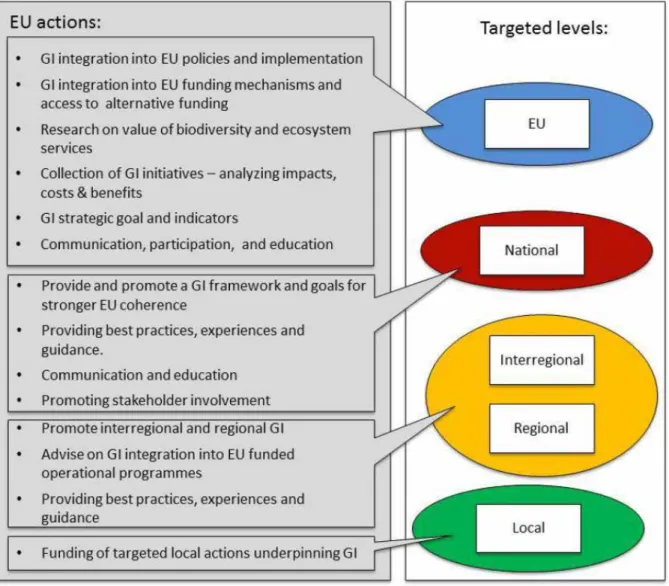
With 82% of Europe’s territory outside the Natura 2000 Networks and through the risks inherent to climate change, the European Green Infrastructure Strategy (EC/CIRCABC, 2012), defined by the European Union in 2013, is an approach to stimulate interconnectivity between ecosystems and to encourage nature-based solutions to meet environmental, economic and social needs through the fulfilment of the challenging objectives of mitigation and adaptation to climate change, biodiversity conservation and the delivering of provision, regulation, support and cultural ecosystem services.
Figure 1. Multiscale tasks of European Green Infrastructure strategy implementation
Source: EC/CIRCABC (2012). Recommendations for an EU Green Infrastructure Strategy. GI tasks – Recommendations. Accessed in 4th January 2017 in:
https://circabc.europa.eu/d/a/workspace/SpacesStore/bd0f71b6-e38f-4580-8d50-3dcb16eecc1b/GI%20TASK%201%20RECOMMENDATIONS.pdf.
In addition to the strict mapping of the constituent elements of the Green Infrastructure, this territorial figure should be guided by its strategic integration, not only, in environmental policies. It should be sought for integrated management in the energy, transport, agriculture and territorial cohesion policies, the study of best practices, communication, education and promoting the participation of all stakeholders. Beyond the convergence of this strategy within each national legal structure, other mechanisms and strategies may also promote GI as territorial management tool, namely the White Paper on Adaptation to Climate Change, Habitats Directive, Birds Directive, Directive Water Framework, Flood Risk Assessment and Management Directive, and Environmental Impact Assessment and Evaluation.
The planning of green infrastructures is, therefore, not only been guided by the school of modern Land Use Planning, but also integrating a strategic and flexible approach where different actors interact and cooperate, namely through the Spatial Planning approach (Ferrão, 2014).
But at to what extent this strategy influenced the recognition of the importance of GI? Two case studies are studied in the present article: United Kingdom (UK), by the analysis of the kingdom of England, and Portugal.
2.5.1 Case study: England (UK)
Despite the referendum over the past months, the United Kingdom is an example of recognizing the interrelationship between green infrastructure and climate change. It’s Natural England, a non-departmental public institution, that oversees England’s environment protection. This kingdom is the only one to be analysed, since it’s the most representative of United Kingdom territory, where spatial planning policy is very diversified between England, Wales, Scotland and Northern Ireland kingdoms.
Natural England distinguishes the design of the green spaces dedicated to sport and recreation from GI, considering the “big picture”, that is, GI at regional landscape scale. There are a number of policy instruments for GI spatial planning and adaptation to climate change (Natural England, 2010):
• Planning Policy Statement 1 (PPS1): defined in 2007, green infrastructure and biodiversity as key factors in mitigation and adaptation;
• Local Spatial Planning (PPS12): request local authorities to establish a green infrastructure at local level (2008);
• Climate Change Act: this 2008 law also assumes GI’s as a structuring element in mitigation and adaptation to climate change;
• The North West England region assumed the recognition of green infrastructure services in climate change mitigation, since 2007, when defined North West Climate Change Action Plan.
2.5.2 Case study: Portugal
The Green Infrastructure, conceptually, are homologous to the Portuguese territorial management instrument of Ecological Structure (Magalhães, 2013). The Green Infrastructure consists of a structure of natural and semi-natural areas, urban green spaces, agricultural and forest non-disruptive areas, rivers, wetlands, green hedges, ecobridges, ecoducts and bicycle paths (Naumann et al., 2011). Coinciding with the same objectives, the Ecological Structure is understood as areas and fundamental systems for the protection and environmental enhancement of rural and urban spaces, namely the ecological reserve areas (article 14 of Decree-Law n.º 46/2009 of February 20th). Both converge in the contribution to the conservation of the biodiversity and the enhancement of the ecosystems services provided to the populations. There are, already, several territorial management instruments (IGT) that assume GI’s environmental safeguard assumptions (Magalhães, 2013):
• Water Public Domain (DPH): comprises the public domain of the sea, lake and rivers and its contiguous areas, as well as lakes, lagoons and navigable or floatable waterways;
• National Agricultural Reserve (RAN): it includes the areas that, in terms of agro-climatic, geomorphological and pedological suitability, are more apt for agricultural activity;
• National Ecological Reserve (REN): it is considered as a biophysical structure that integrates the set of areas that, due to ecological value and sensitivity or susceptibility to natural hazards, are protected;
• National System of Protected Areas (SNAC): including the National Network of Protected Areas, Sites of the National List of Sites, Natura 2000 Networks and other protected areas under international commitments assumed by the Portuguese State, namely Important Bird and Biodiversity Areas, Ramsar Sites, Biosphere Reserves, Biogenetic Reserves and Goessites.
The Ecological Structure was inserted in the Portuguese legal framework, through Decree-Law n.º 380/99 of September 22th, recognizing the urgency of its integration at
national, regional and municipal level, and was later amended by Decree-Law n.º 46/2009, of February 20th.
The attempt to delineate a national ecological structure was carried out within the scope of the scientific project PTDC/AUR-URB/102578/2008 - “National Ecological Structure - a
proposal of delimitation and regulation” of Superior Institute of Agronomy, University of Lisbon. At the regional level, this aim was fulfilled through the delimitation of the Regional Structure of Environmental Protection and Enhancement (ERPVA) in the Regional Strategic Plans.
Regarding the municipal scope, the ecological structure was defined just in some municipalities. The 1992-93 Lisbon Green Plan was the first to use the concept of ecological structure, and, today, the Ecological Structure is delimited for the Lisbon Metropolitan Area (Magalhães, 2013). However, the definition of a Municipal Ecological Structure, a gap evident in most portuguese municipalities, is still an unreached goal.
Following the establishment of the general bases, land use planning and urbanism by the Law n.º 31/2014 of May 30th, the revision of the Legal Regime of Territorial Management Instruments (IGT) by the drafting of Decree-Law n.º 80/2015, of May 14th, stipulates that in regards to Ecological Structure, so that “territorial programs and plans should identify the
areas, values and fundamental systems to the protection and environmental in rural and urban spaces, including regional and municipal environmental protection and enhancement networks”.
In the future, an effective systematization of all the concepts and instruments related to the ecological structure is expected. That should be made through the alignment of GI’s territorial management instruments with the strategic axes and sectoral measures of the National Adaptation Strategy to Climate Change (ENAAC) (APA, 2015).
2.6. comparative analysis
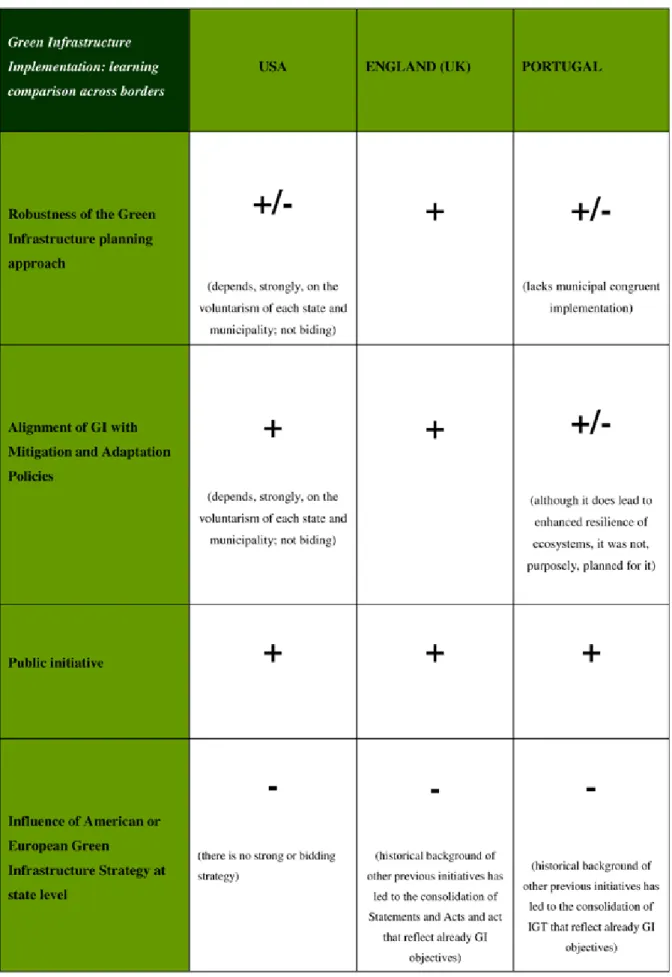
The following table presents a learning comparison between the implementation of Green Infrastructure in United of States of America, England (UK) and Portugal.
table 1. Learning comparison of Green Infrastructure implementation in UsA, England (UK) and Portugal
3. cONcLUsION
As final reflection, it is assumed that the concept of Green Infrastructure is not, at all, new, since it comes from the very historicity of the schools of Landscape Architecture, Urbanism and Geography in the praxis of Spatial Planning.
Such convergence does not contribute to the loss of the variety of approaches that are more regulating, sometimes more strategic, which are increasingly efficient and enrich the current territorial planning policy (Ferrão, 2014).
It’s acknowledgeable that USA doesn’t have a congruent strategy, depending, in this matter, on the voluntarism of each state and/or municipality, with few examples of Green Infrastructure being used in mitigation and adaptation to climate change.
It has been found that England is the only case study that already outlines a strategy of enhacing green infrastructures as a factor of mitigation and adaptation of the territory, whereas Portugal do not yet conjugate the recognition of this interrelation. This premise derives from the existence of different cultures of territory and still persistent land-use planning approach, which are inherent to different cultural backgrounds and respective governmental structures (Ferrão, 2014).
The converging influence and stimulus of the European Green Infrastructure Strategy was not strong, because it, at that time, was already, in a sense, fulfilled in the States studied, before the definition of this strategy implementation.
However, the greatest challenge now, for Portuguese spatial planning policies, is the combination of territorial management instruments that shape green infrastructure with the measures envisaged by ENAAC as a counterpoint to the inherent environmental, economic and social degradation of climate change.
In this line of thought, which is also consonant with the restructuring of the legal framework of Portuguese IGT to an increasingly strategic approach, green infrastructures are reiterated as factors of territorial flexibility, as opposed to the strict and former prohibitive character of use in order to allow development through the sustainable production of region’s endogenous resources, ecotourism, recreation, generation of renewable energy among many, redefining the paradigm between the old and new values in regional spatial planning, that is, building the transition from the idea of the static constraint into its transformation in an opportunity for sustainable development (Correia, 2012).
In Portugal, being the Green Infrastructure already mapped at national and regional level, the greatest challenge now will be its delineation at local level through the design of Municipal Ecologic Structures at the revision of Master Plans, in line with the strategy of mitigation and adaptation to climate change, similarly how it’s done in England. This implementation should not, strictly, focus on the building prohibition, but fundamentally on planning the biophysical and economic suitability to green roofs, green walls and green spaces in urban areas, while in rural areas it’s capital to plan and manage a proximity agricultural and forestry production and to unveil, sustainably, recreation, leisure and tourism spaces based on nature and landscape as a diversifying alternative to the sea level rise highly vulnerable sun and beach cluster. Without waiting for voluntarisms, the public initiative for planning these municipal green infrastructures must, under the risk of not going beyond the former and strict land-use planning approach, go forward strategically, not only mapping, but also assuming incentive mechanisms, education programs and auscultating the concerns of private stakeholders, an eminent condition for the public policy success.
That said and despite the fact that the multifunctionality of green infrastructures appears as a shield to climate degradation, it should be noted that their contribution is not unlimited. As such, only a transformative biophilic approach to the planetary ecological limits (Wilson, 1986; Beatley, 2000) and the reach of a circular metabolism of human systems can solve the ultimate question, a resolution of which Green Infrastructure can, to some extent, assist.
ACKNOWLEDGEMENTS
This study was financed by FCT- Foundation for Science and Technology through the Ph.D. grant SFRH/BD/102328/2014. The authors thank the support given by ICS - Social Science Institute, University of Lisbon, CICS.NOVA - Interdisciplinary Centre of Social Sciences, Faculty of Social Sciences and Humanities, New University of Lisbon, CIEO – Research Centre for Spatial and Organizational Dynamics, Faculty of Economics, University of Algarve, and Laboratory for Geocomputation, Department of Geography and Environmental Studies, Faculty of Arts, Ryerson University.
REFERENCES
Ahern, J. (2007). Green Infrastructure for cities: the spatial dimension. In V. Novonty, P. Brown (eds.), Cities of the future: towards integrated sustainable water and landscape management. IWA Publishing. London.
Alexandri, E. and Jones, P. (2008). Temperature decreases in na urban canyon due to green walls and green roofs and diverse climates. Building and Environment. 43(8): 480-493. APA (2015). Estratégia Nacional de Adaptação às Alterações Climáticas 2020. Agência Portuguesa
do Ambiente. Amadora.
Beatley, T. (2000). Green Urbanism: Learning from European Cities. Island Press. Washington. Benedict, M. A. and McMahon, E. T. (2006). Green Infrastructure: Linking Landscapes and
Communities. Island Press. Washington.
Boyd, J. and Banzhaf, S. (2007). What are ecosystem services? The need for standardized environmental accounting units. Ecological Economics. 63: 616-626.
Campos, V. and Ferrão, J. (2015). O Ordenamento do Território em Portugal: Uma Perspetiva Genealógica. ICS Working Papers. ISSN: 2183-6930.
CE (2010). Green Infrastructure - Brochure. European Comission. Brussels.
CE (2013). Comunicação da Comissão Europeia ao Parlamento Europeu, ao Conselho, ao Comité
Económico e Social Europeu e ao Comité das Regiões. European Comission. Brussels.
CFN (2011). Green Infrastructure to Combat Climate Change. Community Forest Northwest. Warrington.
Correia, I. P. (2012). Das Estruturas Ecológicas Municipais às Infraestruturas Verdes. Non published master thesis, Instituto Superior Técnico, Lisboa.
Demuzere, D., Orru, K., Heidrich, O., Olazabal, E., Geneletti, D., Orru, H., Bhave, A.G., Mittal, N., Feliu, E. and Faehnle, M. (2014). Mitigating and adapting to climate change: Multifunctional and multisscale assessment of green infrastructure. Journal of Environmental
Management. 146: 107-115.
EC/CIRCABC (2012). Recommendations for an EU Green Infrastructure Strategy. GI tasks
– Recommendations. Accessed in 4th January 2017 in: https://circabc.europa.eu/d/a/ workspace/SpacesStore/bd0f71b6-e38f-4580-8d50-3dcb16eecc1b/GI%20TASK%20 1%20RECOMMENDATIONS.pdf.
EEA, (2011). Green Infrastructure and Territorial Cohesion. The concept of green infrastructure
and its integration into policies using monitoring systems. EEA Technical Report n.º 18/2011. European Environment Agency. Copenhagen.
EPA (2016). Green Infrastructure and Climate Change, Collaborating to Improve Community
Resiliency. United States Environmental Protection Agency, Report n.º 832-R-16-004. Washington.
Fadigas, L. (2010). Urbanismo e Natureza – Os Desafios. Edições Sílabo. Lisbon.
Ferrão, J. (2014). O Ordenamento do Território como Política Pública. Fundação Calouste Gulbenkian. Lisbon.
Gill, S. E., Handley, J. F., Ennos, A. R. and Pauliet, S. (2007). Adapting Cities for Climate Change: The Role of Green Infrastructure. Built Environment. 33(1): 115-133.
IPCC (2012). Managing the Risks of Extreme Events and Disasters to Advance Climate Change
Adaptation. Cambridge University Press. Cambridge, 1-502.
IPCC (2014). AR5 – Climate Change 2014 – Impacts, Adaptation and Vulnerability. Cambridge University Press. Cambridge. 59-60.
Madureira, H. (2012). Infraestrutura Verde na paisagem urbana contemporânea: o desafio da conectividade e a oportunidade da multifuncionalidade. Revista da Faculdade de Letras
– Geografia – Universidade do Porto. 3(1): 33-43.
Magalhães, M. R. (2001). Arquitetura Paisagista – Morfologia e Complexidade. Editorial Estampa. Lisbon.
Magalhães, M. R. (2013). Estrutura Ecológica Nacional – Proposta de Delimitação e Regulamentação. Centro de Estudos de Arquitectura Paisagista “Professor Caldeira Cabral”, ISAPress. Lisbon.
Maryland Green Infrastructure (2016). Maryland Green Infrastructure. Accessed in 21th January of 2017 in: http://www.dnr.state.md.us/forests/planning/sfla/indicators/green_ infrastructure.htm
Matthews, T., Lo, A. and Byrne, J. (2015). Reconceptualizing green infrastructure for climate change adaptation: Barriers to adoption and drivers for uptake by spatial planners.
Landscape and Urban Planning. 138: 155-163.
NATURAL ENGLAND (2016). Green Infrastructure Guidance. Accessed in 5th june 2016 in: www.naturalengland.org.uk
Nowak, D. J., Greenfield, E., Hoehn, R. and Lapoint, E. (2013). Carbon storage and sequestration by trees in urban and community. Environmental Pollution. 178: 229-236. NRDA (2010). Green Infrastructure: How and where can it help the Northwest mitigate and adapt
to climate change? Northwest Regional Development Agency. Warrington.
Partidário, M. (1999). Introdução ao Ordenamento do Território. Universidade Aberta. Lisbon. Scott, M. and Lennon, M. (2016). Renaturing the city. Planning Theory and Practice. 17(2):
267-300.
Sussams, L. W., Sheate, W. R. and Eales, R. P. (2014). Green Infrastructure as climate change adaptation policy intervention: Muddying the waters or clearing a path to a more secure future? Journal of Environmental Management. 147: 184-193.
Tzoulas, K., Korpela, K., Venn, S., Yli-Pelkonen, V., Kazmierczak, A., Niemela, J. and James, P. (2007). Promoting ecosystem and human health in urban áreas using Green Infrastructure: A literature review. Landscape and Urban Planning. 81: 167-178.