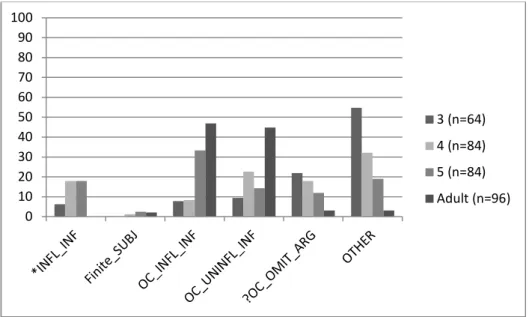
1
Aspects of the acquisition of object control and ECM-type verbs in European Portuguese1 Ana Lúcia Santos, Anabela Gonçalves, Nina Hyams
Running head: acquisition of object control and ECM-type verbs
1
This work was developed within the project Complement Clauses in the Acquisition of Portuguese (CLAP), PTDC/CLE-LIN/120897/2010, funded by Fundação para a Ciência e Tecnologia (FCT).
2
Abstract:
We investigate the acquisition of sentential complementation under causative, perception, and object control verbs in European Portuguese, a language rich in complement types including the typologically marked inflected infinitives. We tested 58 children between 3 and 5 years and 24 adults on a sentence completion task. The results support two main hypotheses concerning children’s initial biases in representing complement structure. The first pertains to argument structure - a verb selects only one internal (propositional) argument (Single Argument Selection Hypothesis), the other to syntactic structure – propositional complements are complete functional complements (Complete Functional Complement Hypothesis). These initial biases lead children to avoid raising-to-object and object control structures, in favor of finite complements and inflected infinitive complements, the latter appearing in both target and non-target contexts.
3
1. Introduction
In this paper we explore the child’s acquisition of sentential complements, focusing in particular on infinitival complements of various sorts. There has been a great deal of research into aspects of language development that crucially depend on children having knowledge of complementation structures, but surprisingly little work has been done on the development of complements per se.2 We view our study as a largely exploratory investigation into this central (but neglected) area of linguistic knowledge. We focus on complement acquisition in European Portuguese, a language that is rich in complements types, including the well-known, but typologically unusual, inflected infinitive.
Few would doubt that recursion is a defining characteristic of human grammars, the function responsible for limitless expressive power. We assume that the property of recursion (discrete infinity) is not itself learned but a core component of the biologically determined language faculty (what Hauser, Chomsky & Fitch 2010 call the FLN, faculty of language -narrow sense, that is, the computational component of language).3 But languages vary in their inventories of complement types (finite indicative/subjunctive, bare, (un)inflected infinitives, small clauses and so on). Also, within languages verbs clearly differ with respect to the particular
2 Some notable exceptions include Limber (1973), Bloom, Tackeff & Lahey (1984), Hyams (1984, 1985), and more recently, Landau & Thornton (2011). Each of these papers discusses aspects of the acquisition of complementation. However, they are all based on very small samples of spontaneous production data and with the exception of Landau & Thornton the data are not quantified and largely impressionistic. We discuss the proposals in Landau & Thornton in more detail below. There is also work specifically on the acquisition of control (namely Chomsky 1969; Goodluck 1981; McDaniel, Cairns & Hsu 1990, a.o.) and raising (Becker 2005, 2006; Hirsch, Orfitelli & Wexler 2008; Kirby 2011; Orfitelli 2012a,b), which we will review later in this section.
3 Indeed, Hauser et al. argue that the FLN, and recursion in particular, is the only uniquely human component of language, separating it from other animal communication systems.
4
complements they select. So while recursion is a UG property, there is still much learning that takes place in this domain.
Interestingly, several approaches to language acquisition center on children´s (prior) knowledge of the complementation patterns associated with particular verb classes. Syntactic bootstrapping (Gleitman 1990) is a case in point. In this kind of bootstrapping (as distinct from semantic bootstrapping) children use their knowledge of the syntactic frames of a verb to infer aspects of its meaning. Papafragou, Cassidy & Gleitman (2007) suggest that information about sentential complementation is especially helpful in the learning of mental verbs such as think, know, believe, etc. whose meaning is not easily inferable from non-linguistic context. Thus, to the extent that mental and perceptual contents are not open to inspection, the learning burden falls more heavily on internal linguistic evidence, complement structure in particular.
Just as the syntactic bootstrapping hypothesis holds that verb complements, especially sentential arguments, are crucial to word learning, there are proposals that complement acquisition is critically important to theory of mind (ToM) development. Jill de Villiers and colleagues (de Villiers 2000, de Villiers & de Villiers 2000, de Villiers & Pyers, 1997) argue that sentential complements are a necessary prerequisite to the child’s acquisition of a representational theory of mind. This is because the syntax and semantics of sentential complements allow for the explicit representation of a falsely embedded proposition, and are therefore uniquely suited to illustrate contradictions between mental states and reality. Various studies have demonstrated a significant correlation between children´s knowledge of sentential complements and performance on theory of mind tasks (e.g., de Villiers & Pyers, 1997, Tager-Flusberg, 1997, 2000, Hale & Tager-Flusberg 2003).
5
There is also a long tradition of research into children’s interpretation of control in infinitival complements (Chomsky 1969; Goodluck 1981; McDaniel, Cairns & Hsu 1990 among others), and also significant work on extraction from embedded clauses, both A-movement/raising (Becker 2005, 2006; Hirsch, Orfitelli & Wexler 2008; Kirby 2011; Orfitelli 2012a,b) and A’/wh movement and constraints thereof (de Villiers, Roeper & Vainikka 1990; de Villiers & Roeper 1995; Thornton 1990, among others). Performance on control and long distance movement tasks clearly implicates a representation of clausal complement structure, even though the representation of clausal complement structure is not the main focus of these studies. Most relevant to the ensuing discussion is the finding by McDaniel et al. (1991) that only 2 of the 20 children they tested (ages 3;9 – 5;4) on object control tell sentences (e.g. Grover told Ernie to jump over the fence) allowed both subject and object control of PRO; all the others had the more restrictive adult interpretation. McDaniel et al. propose that the two non-target-like children have an arbitrary interpretation of PRO and a non-target representation of the subordinated structure, hence no control on PRO (following ideas of Tavakolian 1981). In general, however, control into complement clauses (in contrast to adjunct clauses) seems unproblematic.4 We return to this issue below.
Becker (2005, 2006) addresses the learnability of complement selection more directly and specifically the problem of how children come to distinguish subject control (SC) vs. raising to subject (RtS) verbs. Becker observes that the well-known string identity associated with control/raising verbs, shown in (1), poses a serious learning problem.
4 Eisenberg & Cairns (1994) found about 10% error rate in which children allowed an unmentioned NP to be the referent of PRO in subject control clauses under want and try. This contrasts with the roughly 77% correct unmentioned NP responses under say (e.g. Mary says to sing). See also Goodluck, Terzi & Díaz (2001), who find similarly good results on subject control in Spanish and Greek 4-7 year olds.
6
(1) a. Janine tends [t to eat sushi]. (raising to subject) b. Janine likes [PRO to eat sushi]. (subject control )
Becker’s first point is that there is no “control bias”, which is to say that despite the availability of positive evidence in the form of expletive subjects for the raising case (e.g. There tend to be storms this time of the year vs. *There try to be storms this time of the year) children do not initially entertain a control analysis of all verbs. Rather, she argues, children use multiple probabilistic cues to decide whether a verb is raising or control, including expletive subjects (raising yes / control no), animacy of the matrix subject (animate preferred for control / inanimate for raising), eventivity of the embedded verb (eventive preferred for control / stative for raising), occurrence in monoclausal structures (control yes / raising no) (see also Becker, 2014). She shows further that the 43 children (ages 3-5) in her study perform better on raising (seem, appear) than on control (want, try) in a modified grammaticality judgment task.5
In a similar vein, Kirby (2011) focuses on the learning problem associated with object control (OC) vs. raising to object (RtO), which also show string identity, as illustrated in (2).
(2) a. Janine wanted Paul [t to eat sushi]. (raising to object) b. Janine asked Paul [PRO to eat sushi] (object control)
5 But see Hirsch, Orfitelli & Wexler (HOW) (2007) and Orfitelli (2012a,b) for an opposing view and critique of Becker’s experimental task. HOW find that the children in their study often misconstrued raising sentences with
seem (e.g. Ken seems (to Barbie) to be wearing a hat) as meaning roughly ‘Ken thinks to be wearing a hat’ or ‘Ken
thinks Barbie is wearing a hat’). In other words, they assign the matrix verb an external argument, as if a control verb.
7
Kirby argues that because RtO verbs select (theta mark) a single internal argument (sentential) they impose a lighter cognitive load than OC verbs, which select (theta mark) two internal arguments (an NP and sentential argument). According to Kirby, RtO is therefore easier for young children and represents the default case. We return to Kirby’s ‘cognitive load hypothesis’ below.
Landau & Thornton (2011) present a case study of one child’s acquisition of the verb want. They too address the string identity problem in an indirect way. They note that the child first masters control with want and then RtO, hence a result that goes counter to Kirby’s predictions. Landau & Thornton propose that children initially avoid defective structures such as that involved in RtO, and prefer instead a full CP complement.6
As we will see, the ‘string identity problem’ exists for children acquiring European Portuguese as well and in general presents a clear challenge to the language learner. But there are other problems associated with learning complement selection. First, languages vary with respect to the type of complements they permit and second within a language a verb may select for multiple complement types and verbs clearly differ in their complement choices (even within a particular verb class such as RtS). For instance, even though both seem and tend select for non-finite RtS complements, only seem selects for a non-finite complement. There is no one-to-one or non-trivial mapping from the meaning of a verb to the range of complement types it selects. We refer to this as the ‘multiple frames problem’. It is possible of course that children deal with the multiple frames problem by using a ‘sit and wait’ strategy. In other words, a conservative learning approach according to which the child only productively uses a particular (complement)
6 See Hyams (1985) for a similar proposal.
8
structure once he has clear evidence for it in the input (Snyder 2011). It is equally possible that the child comes to the task with certain biases or unmarked assumptions, for example, a default raising analysis, as Kirby proposes, or an initial preference for CPs over defective structures as proposed by Landau & Thornton. Additionally, he may prefer certain complement types over others because of independent constraints - for example, an inability to form A-chains (Borer & Wexler 1987) would imply that children acquire control before raising (as also noted by Becker 2006).7
The goal of this paper is to address these issues in the context of the acquisition of European Portuguese, a language that is rich in complement types and that well illustrates the two learning problems outlined above. The children in our study performed an elicited production task (and we also looked at spontaneous production). This methodology allows us to see the child’s preferences. In this respect it contrasts with many of the comprehension and production studies discussed above that probe children’s interpretation of sentence types such as raising and control. The central role that recursion, hence sentential complementation plays in human language (Hauser, Chomsky & Fitch 2010), and the decades of research into the acquisition of control into, and movement out of complement clauses makes the development of complementation an important topic to investigate in its own right.
In the section that follows we discuss the syntax of sentential complementation in European Portuguese (EP). We then review some previous acquisition literature that informs our study (section 3) and briefly discuss on the spontaneous production of the structures of interest (section 4). Finally, in section 5 we turn to our experimental study.
7 On the assumption that control is movement, as proposed in Hornstein (1999) and elsewhere, there would be an entirely different set of predictions.
9
2. Complementation in European Portuguese
In this section we describe the properties of two groups of EP verbs: object control and perception and causative verbs. Perception and causative verbs form a syntactic class distinguishable from object control by the number of internal arguments selected in the context of infinitival complementation: one argument in the case of perception and causative verbs; two arguments in the case of object control verbs. The different argument structures will be discussed in section 2.1. Section 2.2 shows how object control and perception and causative verbs illustrate the two learnability problems mentioned in the previous section: the string identity problem and the multiple frames problem.
2.1. Complementation with EP object control, perception and causative verbs
2.1.1 Object control verbs
In EP, object control verbs select for an object DP complement and an uninflected infinitival complement introduced by a preposition:
(3) O Manuel ensinou os meninos a nadar. the Manuel taught the kids PREP swim.INF ‘Manuel taught the kids to swim.’
In this construction, the embedded DP – os meninos (‘the kids’) in (3) – is marked for accusative Case and when pronominalized, cliticizes onto the matrix verb, as in (4):
10
(4) O Manuel ensinou-os a nadar. the Manuel taught-themCL.Acc PREP swim.INF ‘Manuel taught them to swim.’
Although the canonical object control structure requires the uninflected infinitive in its complement (3,4), EP speakers generally also allow an inflected infinitive, as in (5). In this case as well the embedded DP is marked for accusative:
(5) O Manuel ensinou-os a nadarem. he Manuel taught-themCL.Acc to swim.INF.3PL
The object DP and the infinitival complement form two separate constituents, that is, control verbs select for two internal arguments. Thus, the DP and the infinitival complement cannot be clefted as a whole (6a); on the contrary, each one of the arguments may be independently clefted (6b, c):8
(6) a. *Os meninos a nadar(em) é que ele ensinou. the kids PREP swim.INF(.3PL) is that he taught
b. Os meninos é que ele ensinou a nadar(em). the kids is that he taught PREP swim.INF(.3PL)
c. A nadar(em) é que ele ensinou os meninos. PREP swim.INF(.3PL) is that he taught the kids
11
In addition, because they are two independent arguments, the DP plus the prepositional infinitival complement cannot constitute the answer to an object question (7):
(7) Q: Sabes o que ele ensinou? know.2SG what he taught A: *Os filhos a nadar(em). the children PREP swim.INF(.3PL)
The sentential structure associated with object control verbs is schematized in (8), where the subject of the infinitival complement corresponds to a controlled empty category: 9
(8) DP V [DP] [PP a /dePREP [CP/TP PRO/pro VP]]
2.1.2 Perception and causative verbs
Perception and causative verbs also select for infinitival complements. However, they occur in different structures than shown in (8). First, these two classes of verbs select for a single
9 We leave open the debate concerning the CP/TP nature of the infinitival complement, as this is not central to the discussion in this paper. The reference of the embedded null subject is controlled by the matrix object both with inflected and uninflected infinitive. We will not discuss here the nature of this empty category in the object control construction with inflected infinitive, but we hypothesize that a controlled pro is possible, in line with Raposo (1989), Barbosa & Cochofel (2005) and Modesto (2011).
12
internal argument which may be either an uninflected (9) or inflected (10) infinitive; second, the complement does not contain a preposition.
(9) a. A mãe viu os miúdos comer bolos. the mother saw the kids eat.INF cakes ‘Mommy saw the kids eat(ing) cakes.’
b. A mãe deixou os miúdos comer bolos. the mother let the kids eat.INF cakes ‘Mommy let the kids eat(ing) cakes.’
(10) a. A mãe viu os miúdos comerem bolos. the mother saw the kids eat.INF.3PL cakes ‘Mommy saw the kids eat(ing) cakes.’
b. A mãe deixou os miúdos comerem bolos. the mother let the kids eat.INF.3PL cakes ‘Mommy let the kids eat(ing) cakes.’
In (9), the embedded subject is accusative, as shown in (11a), in which the pronoun subject takes the form of an accusative clitic (the nominative pronoun is illicit in this context (11b)).
(11) a. A mãe {viu-os / deixou-os} comer bolos. the mother saw-CL.Acc let.CL.Acc eat.INF cakes
13 ‘Mommy saw / let them eating / eat cakes.’
b. *A mãe {viu eles / deixou eles} comer bolos. the mother saw they let they eat.INF cakes
Chomsky (1981) identifies sentences like the one in (11a) as involving exceptional case marking (ECM), a structure in which the embedded subject does not get its Case within its own clause; rather the matrix verb assigns accusative Case to this DP. However, there is no clear consensus on the ECM analysis. In fact, Postal (1974), Raposo (1981), Lasnik & Saito (1991), and Chomsky himself (Chomsky 2008), claim that the DP raises to the relevant object position of the main clause in order to get (accusative) Case, a construction known as Raising-to-Object (RtO).
The fact that actives and passives embedded under “ECM” verbs are synonymous (that is, truth-conditionally equivalent) shows that the embedded DP is generated as the logical subject of the lower clause (Rosenbaum 1967) - see (12a) and (12b):10
10 Actually, as one reviewer remarked, not all passives are allowed, especially in the context of causative verbs: (i) O João deixou a Maria ler o livro.
the João let the Maria read.INF the book ‘João let Maria read the book.’
(ii) *O João deixou o livro ser lido pela Maria. the João let the book be.INF read by.the Maria
In fact, causative verbs impose selectional restrictions on the causee, which explains the ungrammaticality of (ii). Thus, the active/passive comparison only holds for the cases in which the selectional properties of both the matrix and the embedded verbs are satisfied.
14
(12) a. {Deixei / vi} o João convencer o Paulo. let.1SG / saw.1SG the João convince.INF the Paulo ‘I let João convince /saw João convince Paulo.’
b. {Deixei / vi} o Paulo ser convencido pelo João. let.1SG / saw.1SG the Paulo be.INF convinced by.the João ‘I let / saw Paulo be convinced by João.’
However, there is also evidence that under perception and causative verbs the embedded DP is not the syntactic subject of the infinitival complement. In particular, this complement cannot be clefted as a whole, which suggests that the DP has been raised out of it (13):
(13) a. *[Os meninos sair de casa] é que ele viu. the children leave.INF PREP home is that he saw b. * [Os meninos sair de casa] é que ele deixou. the children go.out from home is that he let
We therefore assume that the uninflected infinitival complements to perception and causative verbs involve RtO. The structure we assume for RtO is presented in (14), where the infinitival complement corresponds to a TP which is defective with respect to phi-features and Case (Gonçalves 1999, and to some extent Pires 2006):11
11We are assuming that Case-valuation of the goal is related to the probe’s phi-features: “In the simplest case of two-membered probe-goal match (say [φ-features]-N), intrinsic features of the goal value those of the probe, and also value the structural Case feature of the goal (in a manner determined by the probe)” (Chomsky 2008:142).
15 (14) DP V [DP]i [TPdef DPi VP]
In the inflected infinitival complements illustrated in (10), the DP inside the embedded domain is marked with Nominative, behaving like a subject (see (15), where this subject takes the form of a nominative pronoun).
(15) A mãe viu / deixou eles comerem bolos. the mother saw / let they eat.INF.3PL cakes ‘Mommy saw / let them eat(ing) / eat cakes.’
We argue that in this case the infinitival complement corresponds to a full CP or, at least, to a non-defective TP; in fact, there is some discussion concerning the CP/TP nature of inflected infinitives (see Raposo 1987, Madeira 1994, Duarte, Gonçalves & Santos 2012, a.o.), but this is not central here; in either case, what is crucial is that T is non-defective. The simplified structure of an inflected infinitive complement is represented in (16).
(16) DP V [CP/TPnon-def DP VP]
Inflected infinitival complements (16) are similar in structure to finite complements, which can also be selected by perception (17a) and causative (17b) verbs (indicative with the former and subjunctive with the latter); in the case of perception verbs, the finite complement conveys indirect perception:
16
(17) a. A mãe viu que a Maria lavou o carro. the mother saw that the Maria washed.IND the car ‘Mommy saw that Maria washed the car.’
b. A mãe deixou que a Maria lavasse o carro. the mother let that the Maria washed.SUBJ the car ‘Mommy let Maria wash the car.’
Perception verbs like ver ‘to see’ also select a different type of complement: the Prepositional Infinitival Construction, henceforth PIC (Raposo 1989). In this construction the infinitival domain may be inflected or uninflected and is headed by a preposition-like element – the aspectual marker a (Duarte 1993, Barbosa & Cochofel 2005) which is homophonous to the preposition a ‘to’:
(18) O Manuel viu os meninos a nadar(em).
the Manuel saw the kids ASP swim.INF(.3PL) ‘Manuel saw the kids swimming.’
In spite of the inflection on the infinitive, in this case the DP os meninos is always marked with accusative, as the contrast in (19) shows:
(19) a. O Manuel viu-os a nadar(em). the Manuel saw-themCL.Acc ASP swim.INF(.3PL) ‘Manuel saw them swimming.’
17 b. *O Manuel viu eles a nadar(em). the Manuel saw they ASP swim.INF(.3PL)
The PIC counts as a single internal argument, with the DP and the a-infinitive forming one constituent. This contrasts with the object control construction, where the infinitival domain is also headed by a preposition but contains two internal arguments. The claim that the PIC corresponds to a single constituent is empirically motivated by the following facts (see Raposo 1989, Duarte 1993):
(i) The PIC can be clefted as a whole (cf. the object control sentence in (6)).
(20) Os meninos a nadar(em) é que ele viu. the kids ASP swim.INF(.3PL) is that he saw
‘What he saw was the kids swimming.’
(ii) The PIC can occur as the answer to an object question (cf. object control sentence in (7)).
(21) Q: Sabes o que ele viu? know.2SG what he saw ‘Do you know what he saw?’ A: Os filhos a nadar(em). the children ASP swim.INF(.3PL) ‘The children swimming.’
18
We assume that the PIC corresponds to a small clause whose predicate is headed by the aspectual marker a, with control also applying within the small clause, as the accusative marked lexical DP controls the null subject of the CP/TP complement (PRO/pro), as schematized in (22).12
(22) DP V [SC DP [ASPP aASP [CP/TP PRO/pro VP]]
This approach is also taken by Barbosa & Cochofel (2005), who follow Duarte (1993) in assuming that in perception verb contexts a is an aspectual marker instead of a true preposition. This aspectual marker assigns a progressive value to the construction; thus the a-INF complement denotes an on-going situation in the time interval in which the matrix clause is located, and therefore the PIC involves direct perception.13
Finally, causative and perception verbs can occur in a complex predicate (the faire-Inf construction in Kayne’s 1975 terms; see Gonçalves 1999 for complex predicates in EP), as illustrated in (23) and (24):
(23) a. A mãe deixou saltar os miúdos. the mother let jump the kids ‘Mommy let the kids jump.’ b. A mãe viu saltar os miúdos. the mother saw jump the kids
12 On the PRO/pro nature of the embedded null subject, see Raposo (1989) and Barbosa & Cochofel (2005).
13 Again, we leave open the debate concerning the CP/TP nature of the infinitival complement, as this is not central to the discussion in this paper.
19 ‘Mommy saw the kids jump(ing).’
(24) A mãe deixou comer o gelado aos miúdos. the mother let eat the ice cream to.the kids ‘Mommy let the kids eat the ice cream.’
In the complex predicate construction, (i) the matrix and the embedded verbs are adjacent; (ii) only uninflected infinitives are allowed; (iii) the embedded subject occurs after the V-V string and cliticizes onto the matrix verb, displaying the accusative or the dative case, depending on the class of the embedded verb (accusative with one-place predicates; dative with two-place predicates).
Summarizing this section:
(i) Object control verbs select for two internal arguments: a DP object and an infinitival complement (with uninflected or inflected infinitive).
(ii) Causative and perception verbs select for one internal (clausal) argument, which may be: (i) a finite complement; (ii) a bare inflected infinitival complement (with a nominative DP inside this complement); (iii) a bare uninflected infinitival complement (the RtO construction, where the embedded DP is accusative and cliticizes onto the matrix verb, or the complex predicate construction).
(iii) Perception verbs also select for a small clause – the PIC construction, with either uninflected or inflected infinitive.
20
2.2. Learning problems in the acquisition of object control, perception and causative verbs
Object control, perception and causative verbs illustrate the two acquisition problems noted earlier: the string identity and the multiple frames problem.
The string identity problem arises when we compare object control and the PIC. In these cases, children have to deal with two superficially similar strings – V DP Prep VP:
(25) a. O Manuel ensinou os meninos a nadar.
the Manuel taught the kids PREP swim.INF ‘Manuel taught the kids to swim.’
b. O Manuel viu os meninos a nadar.
the Manuel saw the kids ASP swim.INF ‘Manuel saw the kids swimming.’
As we showed in the previous section, the surface similarity in (25) belies their different structures, depicted in (26):
(26) a. DP V [DP] [PP a /dePREP [CP/TP PRO/pro VP]] b. DP V [SC DP [ASPP aASP [CP/TP PRO/pro VP]]
21 (27) a. A Ana ouviu o menino cantar.
the Ana heard the child sing.INF ‘Ana heard the child sing(ing).’
b. A Ana mandou o menino cantar.14 the Ana made the child sing.INF ‘Ana made the child sing.’
The fact that the inflected infinitive lacks visible morphology for 3rd person singular in sentences like (27) makes it impossible to determine whether the infinitive is uninflected or inflected and therefore to decide whether it corresponds to the RtO structure in (28a), or the structure in (28b).
(28) a. DP V [DP]i [TPdef DPi VP]
b. DP V [CP/TPnon-def DP VP]
Notice that in such cases, the embedded DP may be replaced either by an accusative pronoun, as in (29) (the RtO case (28a)) or by a nominative pronoun, as in (30) (the inflected infinitive case (28b)):
14 The meaning of the verb mandar is close to English (non causative) order. In EP, this is a causative verb, in the sense that a relation cause-effect between the matrix and the embedded infinitival domain is established, that is, someone (denoted by the matrix subject) causes another one (the embedded logical subject – the causee) to do something (the situation described by the infinitive). The causative interpretation corresponds to the English causative make.
22 (29) a. A Ana ouviu-o cantar.
the Ana heard-CL.Acc sing ‘Ana heard him sing(ing).’ b. A Ana mandou-o cantar. the Ana made-CL.Acc sing ‘Ana made him sing.’
(30) a. A Ana ouviu ele cantar. the Ana heard he sing ‘Ana heard him sing(ing).’ b. A Ana mandou ele cantar. the Ana made he sing ‘Ana made him sing.’
The second problem that perception and causative verbs raise for the acquisition of complementation is that they select for a wide range of complements - the multiple frames problem. As showed in the previous section, in addition to the infinitival complements (inflected infinitive complements, RtO complements, complex predicates and PIC under perception verbs), they also select for finite complements. This will be explored in the next section.
23
3. The acquisition problem for Portuguese complements: hypotheses
In the previous section, we saw how European Portuguese RtO verbs and object control verbs give rise to both the string identity problem and the multiple frames problem. In general the child must determine which complements are possible with which verbs in a particular language. In the EP case in particular the number of possible structures is increased as a result of the availability of inflected infinitive clauses.
The learning task for a child faced with a novel verb in a string of the form in (31) is to map this string into one of two different argument structures, represented in (31a) and (31b) in a very simplified way (namely, abstracting from the presence of a preposition or a homophonous aspectual marker - see 26).
(31) V DP VP
a. V [DP] [VP] (ditransitive control verbs)
b. V [DP VP] (RtO / PIC / Inflected Infinitive clause)
The structure in (31a), the double internal argument structure, corresponds to a (object) control structure (with either the uninflected infinitive and a controlled PRO, the canonical control case, or with the inflected infinitive and a controlled pro). The structure in (31b) corresponds to a case in which the verb selects for a single internal argument. This case may correspond to different derivations in EP: RtO (see 14), PIC (a possibility restricted to perception
24
verbs) (as in 22) or a CP/TP inflected infinitive clause with a nominative subject (see the representation of the structure in 16).15
So the question is, does the child has an initial hypothesis about such structures: will he first assign strings of the sort in (31) a raising, control, or an inflected infinitive analysis? The raising vs. control question is posed by Becker (2005, 2006, 2009), for subject control and RtS, and Kirby (2011), for object control and RtO in English. Both Becker (2009) and Kirby (2011) suggest that raising is not problematic for children. Kirby suggests that raising is an “initial” default.
This question about the child’s initial hypothesis is linked to another one: at which point in development is the child able to analyze a raising or a control structure? This is an issue that has been widely addressed in the literature (e.g. McDaniel & Cairns 1990; Cairns et al. 1994; Borer & Wexler 1987; Wexler, 2004; Hirsch & Wexler 2007; Hirsch, Orfitelli & Wexler 2007, 2008; Landau & Thornton 2011; Orfitelli 2012a,b).
Arguments have been proposed in favor of both a ‘raising first’ hypothesis and a ‘control first’ hypothesis. Hirsch & Wexler (2007), Hirsch, Orfitelli & Wexler (2008) and, under different assumptions, Landau & Thornton (2011) suggest that control is acquired earlier than raising.16 Hirsch & Wexler (2007) and Hirsch, Orfitelli & Wexler (2007, 2008) propose an
15 Of course, in the case of RtO the DP raises to the matrix clause, thus (31b), which is intended to show the number of arguments, represents the structure before raising.
16 Another related question focuses on the role of the experiencer phrase in the acquisition of raising structures. Orfitelli (2012) compares children’s performance on seem sentences with their performance on sentences with other raising predicates (e.g. tend, be about to, be going to) that do not take an experiencer phrase. She concludes that the existence of the experiencer phrase, whether phonologically present or absent, affects comprehension and gives rise to poorer results with seem than with tend, etc. This leads Orfitelli to argue that children do not have a problem with subject to subject raising per se; rather, they are unable to raise over an intervening argument overtly or covertly present in the structure (see also Hyams & Snyder 2005, 2006; Snyder & Hyams, to appear).
25
explanation of children’s difficulties with raising to subject with seem in terms of Wexler’s (2004) Universal Phase Requirement (UPR). According to this analysis, the v of matrix verb seem is defective in the adult grammar and therefore does not define a phase. Thus, the subject of the complement to seem can raise to matrix Spec, T. Children’s grammars, on the other hand, are constrained by the UPR, which specifies that v (whether defective or not) defines a phase, thereby blocking RtS in seem sentences.17
Landau & Thornton (2011) analyze the development of the complements of want in the grammar of one child (based on diary data). They find that want emerges later in structures which they analyze as RtO (32b) than in the subject control structure (32a) with the same verb.18 (32) a. I want to see paper. (1;08,10) (Landau & Thornton 2011: 926)
b. I just want somebody to play with me. (2;05,02) (Landau & Thornton 2011: 928)
They argue on this basis that children start by assuming that the complement of want is a CP and only later produce RtO, when they can truncate the embedded CP. Their central claim is that “more defective” complements are acquired later (an idea we also adopt under somewhat different assumptions – see below).19
17 The UPR analysis diverges from former analyses, such as Borer & Wexler (1987), who suggested that all types of A-movement are delayed in acquisition, and offers a solution for raising (at least RtS).
18 Whether want is an RtO verb or not is controversial (see discussion in e.g. Pesetsky 1991 ). We do not take a position on this issue here, but rather simply report the Landau &Thornton’s assumptions.
19 According to Landau & Thornton, before acquiring RtO, the child produced want with a non-finite complement containing a non-obligatorily controlled null subject, in exactly the discourse contexts that would require a RtO structure, as in (i).
(i) Context: Laura wanted mother to push her in the stroller. Laura: I want __ push Laura. (1;07,19)
26
Interestingly, despite their different approaches, Hirsch and colleagues and Landau and Thornton both relate the late acquisition of raising to the “defectiveness” of a raising structure although defining this defectiveness in very different ways.
The facts reported thus far suggest a general hypothesis that may be tested when eliciting complements of perception and causative verbs in Portuguese, viz. less defective complements are more productive earlier. We will define a non-defective clausal complement as a “complete functional complement”, the definition of which is given in (33).
(33) Complete Functional Complement
A complement clause whose subject values its structural Case feature through agreement with a probe inside the clause.
An inflected infinitive or a finite complement of a causative is a complete functional complement, but an RtO complement is not. Although the term ‘complete functional complement’ may be reminiscent of Chomsky’s (1986) “Complete Functional Complex”, the notion is not exactly the same. Chomsky’s “Complete Functional Complex” is characterized as following: “the relevant feature is (…) the presence of a subject, hence of a ‘complete functional complex’ with all functional roles satisfied” (Chomsky 1986: 15)). In our case, the relevant
Landau & Thornton additionally propose that children first assume the complement to want is subjunctive. We return to this in section 6. We note also that facts such as the one in (i) are not completely surprising in light of previous literature. McDaniel & Cairns (1990:316), for instance, say “We consider our most important finding in this range of data to be that there is a stage, previously unattested as far as we know, during which children lack control.”
27
property is not the satisfaction of functional roles, but whether the features of the embedded subject are internally valued.20 Our hypothesis for child language is now stated in (34).
(34) Complete Functional Complement Hypothesis (CFC): Children prefer a complement clause which is a complete functional complement (defined in 33).
Returning to the control / raising debate, some authors have questioned the claim that children have difficulties with raising structures. Indeed Becker (2009) and Kirby (2011) argue that children may misanalyze control structures as involving raising. Specifically with regard to RtO, Kirby suggests that the reason for the initial raising preference is that RtO verbs carry fewer internal theta-roles than object control verbs. If this is correct and there is an early preference for fewer theta-roles, children might prefer to categorize a verb as selecting a single internal argument. This is what we will call the “single argument selection hypothesis” (35).
(35) Single Argument Selection Hypothesis (SASH): Children will initially assume a verb selects a single internal argument, if the relevant syntactic structure can be generated by the child’s grammar.
20 Our definition of Complete Functional Complement also does not correspond to the idea of a phase (Chomsky 1998), because v would not qualify as a complete functional complement, even though it may be a phase. For discussion of the similarities between the notions of “complete functional complex” and “phase”, see Boeckx & Grohmann (2007). In addition, we assume that PRO has Null Case (Chomsky & Lasnik, 1993; Martin 2001) or no case at all.
28
SASH is a hypothesis about the child’s initial analysis of verb argument structure. SASH will lead the child to map input such as (31) onto the structure in (31b) if his grammar has a way to derive (31b), namely if he can derive the DP in (31) as the subject of the embedded clause.
SASH will lead to errors with object control structures, while the CFC (34) will render RtO problematic in the initial stages. On the other hand, the inflected infinitive structure is predicted to be unproblematic.
The status of the PIC is less obvious. It is clearly consistent with SASH as it corresponds to the structure in (31b) (see the analysis of PIC as a small clause in (22)). But the external argument in the PIC small clause bears accusative Case when embedded under perception verbs (examples in (19)), which means it is not a CFC according to our definition.21 However, PIC also occurs in root exclamative contexts (as in 36), either preceded or not by the imperative of a perception verb, and in these cases the subject of the small clause is nominative.22 It is thus possible that the child - faced with input of the sort in (36) - would analyze the PIC as a complete functional complement even when it occurs under perception verbs. In this case, we would expect it to be an early acquisition.
(36) (Olha!) Os meninos / Eles a nadar(em)! (look!) the children they ASP swim.INF(.3PL)
21 In EP, all prepositions assign oblique case, not accusative (or nominative). Thus, even if the aspectual marker in the PIC was analyzed as a true preposition, it could not be the source of case in the DP.
22 The cases of root PIC seem close to Root Infinitives (RIs) in adult languages. In Portuguese and other Romance languages, the RI subject is nominative (see i). So it is possible that the subject gets nominative in these root contexts by the same mechanisms RIs subjects get nominative.
(i) Eu comer polvo? Nunca. I eat.INF octopus never ‘Me eat octopus? Never.’
29 “(Look!) The children are swimming.”
In our study, described in the next sections, we do not pit raising and control structures against each other and hence we do not directly test the ‘raising first/control first’ hypotheses.23 Rather, in looking at a broader range of structures, our goal is to determine the extent to which early preferences for complete functional complements or for a single internal propositional argument may result in what descriptively looks like a preference for raising or for control. More generally, we are interested in understanding the child’s initial preferences in the domain of complement structure because this may inform us as to what constitutes “complexity” for the learner. The CFC hypothesis and SASH are our best guess as to what structures children find simpler.24
This study thus intends to address the following questions. When given a relevant discourse context:
(i) Do children prefer complete functional complements?
If so, they will prefer an inflected infinitive complement (or finite clause) over RtO as the complement of perception and causative verbs and will show no difficulties with object control structures.
(ii) Do children prefer structures in which a verb selects only a single (propositional) argument (according to the SASH)?
23 We also did not test raising to subject (RtS) verbs and so our study does not speak to the subject raising vs. subject control debate at all, though as we will see below children in our study have no difficulty producing subject control structures.
24 Alternatively, it might be that children find the complement types that adults are most likely to use to be the simplest to acquire or those that are typologically least marked (Jakobson 1968). We will see that neither of these hypotheses is supported by our data.
30
If so, object control structures will be problematic. (iii) Do children adhere to both the CFC and SASH initially?
If so, children will show a general preference for inflected infinitive complements where they are possible and will show difficulties both with RtO and object control.
Before turning to our elicited production study we briefly discuss some results from spontaneous speech. If Snyder (2011) is right and a delayed acquisition of a structure may result in avoidance of the structure in spontaneous production but not in errors of commission, we expect the most telling results to come from elicited production, where children’s responses are partially structured for them. We have thus designed a production experiment to test these hypotheses, which we report in section 5. First, however, we briefly discuss children’s spontaneous production of the verbs used in the experiment.
4. A note on spontaneous production
We conducted a search in the spontaneous production corpus of Santos 2006, extended version. This corpus contains 27,586 child utterances produced by three children (3;11, 1;6-3;10, 1;5-2;9, MLUw 1.2-3.8) (67 files corresponding each to 45 to 50 minutes of child-adult interaction)
Looking first at the spontaneous production of control structures, we find that subject control is well attested. In the 27,586 utterances produced by children in the corpus, we found 224 occurrences of querer ‘want’ in subject control structures as well as 31 occurrences of
31
conseguir ‘be able to’25. The data thus provide ample evidence of production of subject control. This contrasts sharply with object control. There is only one occurrence of ensinar a ‘teach’ and no occurrences of proibir de ‘forbid’ in child spontaneous production; ensinar a ‘teach’ also occurs in child directed speech, contrary to proibir de ‘forbid’ (even though children may hear proibido ‘forbidden’ in structures such as está proibido ‘is forbidden’).26 These facts may suggest that acquisition of the argument structure of ensinar a ‘teach’ is some steps ahead relative to the acquisition of proibir, justifying avoidance of proibir.
In the spontaneous production data complements of perception and causatives were also found. We found 39 occurrences of ver ‘see’, 5 had non-finite complements, but no RtO cases were found.
In the case of causative verbs, we found 77 occurrences of deixar ‘let’ and two occurrences of
mandar ‘make’. Mandar occurs once with an omitted Causee and in another case in an ambiguous
structure compatible with an inflected infinitive analysis. The occurrences of deixar ‘let’ include 13 cases with an omitted Causee and four clear cases of inflected infinitive, with a nominative pronoun as subject. They also include 53 cases with an accusative subject (37), which might be analyzed as cases of RtO. However, all these cases have a 1st singular accusative subject, and thus we believe that these cases might be frozen structures and not necessarily evidence for productive use of RtO.
(37) T: deixa me # pe(r)guntar quem é! (TOM 2;09,27)
let me ask who is
Thus, the spontaneous production data we analyzed did not give us absolute evidence for RtO or of object control in the early stages, consistent with the predictions of SASH and CFC, under the assumption that “hard” structures are avoided in spontaneous production, as Snyder proposes. Still, the ultimate test
25 Some were elliptical structures.
26 According to our data, object control verbs in general are not very frequent in either child speech or child-directed speech.
32
will be to put the child in a position where he must produce something and to then ascertain what his preferences are. This we do in our elicited production study.
5. The experiment
In this section we report the results of an elicited production task in which the child is asked to help a puppet by completing the puppet’s statement about a story that the experimenter acts out. We tested 58 children and 24 monolingual adult speakers of EP with no background in linguistics. Information on the subjects is provided in table 1.
Table 1. Subjects
Age (in years) Range (Mean) Number
3 3;5 – 3;11 (3;8) 16
4 4;0 -4;11 (4;5) 21
5 5;0 – 5;10 (5;5) 21
Adults 18-49 (24) 24
All the child subjects included in the study were monolingual children exposed to EP with no previous report of language impairment (one child was excluded because his father was found to be a speaker of Brazilian Portuguese; 8 other children were excluded because they did not complete the task). Data collection took place in a quiet room in the different kindergartens attended by children. All the interviews were recorded and children’s answers were annotated during the session and transcribed.
33
The elicited production task was made up of a set of stories which the experimenter presented to both the child and to a “silly” puppet while acting them out with props. The stories consisted of several different situations and the child was asked to help the puppet by completing what he says about what happened. The contexts were designed to elicit perception, causatives and control verbs. These were the 3 experimental conditions. In addition, two control conditions were included, subject control verbs in permissible and impermissible subject control contexts. The five conditions are provided in Table 2, along with the verbs tested in each condition. The verbs were preferably selected from the set of verbs occurring in a corpus of child and child directed speech (Santos, 2006, extended version).27
Table 2. Conditions
Condition Verb class Verbs tested Possible complements 1 Causative verbs mandar ‘make’;
deixar ‘let’
Finite (subjunctive) Inflected infinitive RtO
Complex predicate 2 Perception verbs ver ‘see’ Finite (indicative)
Inflected infinitive RtO
PIC
Complex predicate (only with embedded unergative or unaccusative verbs) 3 Object Control verbs ensinar a ‘teach’; Object control
34
proibir de ‘forbid’ (uninflected infinitive)
Object control (inflected infinitive)28
4 Subject control verbs (in subject control contexts)
querer ‘want’; conseguir ‘be able
to’
Subject control (uninflected infinitive)
5 Subject control verbs (with disjoint reference of the main and the embedded subject in finite complements)
querer ‘want’; conseguir ‘be able
to’
Finite (subjunctive)
In conditions 3 to 5, two test items were included for each verb tested. In the case of conditions 1 and 2, four items were included for each matrix verb: two items with an embedded transitive, one item with an embedded unaccusative, one item with an embedded unergative.29 This results in 24 test items. The test also included two training items and 12 fillers. The uneven number of test items per verb in the different conditions was a function of the number of structures allowed in the complement of the different types of verbs (see table 2 above). In conditions involving perception and causative verbs, more items should give the children the opportunity to produce the wider variety of complement structures allowed by these verbs.
Conditions 1 to 3, targeting structures under causative and perception verbs and object control structures, directly allowed us to address the hypotheses laid out in the previous section. Specifically, conditions 1 and 2 (causative and perception verbs, respectively) test the CFC;
28 The verb proibir ‘forbid’ also accepts a finite subjunctive complement.
29 Perception and causative verbs present different restrictions on the formation of complex predicates: in the case of perception verbs, complex predicates with embedded transitive verbs are ruled out by most EP speakers, whereas the same restriction is not observed in the case of complements to causatives (Gonçalves 1999).
35
condition 3 (object control verbs) test SASH. The results of the two other conditions, which target subject control verbs in subject control contexts and contexts where control is not possible, will be compared to the results in the object control condition. This will allow us to determine whether children have problems with control in general or specific problems with object control structures.
In (38) we present an example of a test item from condition 1 (causative verbs), followed by a figure representing the context for the item. In (39) we provide an item targeting a structure with a matrix perception verb (condition 2). Figure 2 represents the context for (39).
(38) Example from condition 1
Policeman: O meu carro não anda, preciso da vossa ajuda. the my car NEG works need.1sg Prep+the your help ‘My car doesn’t work, I need your help.’
Big elephant: Eu sou grande e tenho muita força e os meus filhos são pequenos, I am big and have a lot strength and the my kids are small
mas também têm força. Vá, tem de ser! Empurrem. Vá, lá. but also have.3pl strength come on must PREP be push come on ‘I’m big and strong and my kids are small but they are strong too. Come on, it must be done. Push. Come on.’
Small elephants: Sim, pai, nós conseguimos. yes dad we can
36
Experimenter: O pai é que manda nos elefantezinhos. the father is that gives orders Prep+the little elephants ‘Dad is the one who tells the little elephants what to do.’ Puppet: O pai mandou o quê? O pai…
the father made what? The father…
Target answers: a. RtO
(O pai) mandou os elefantezinhos / mandou-os empurrar o carro. the father made the little elephants made CL.Acc push.INF the car b. Complex predicate
(O pai) mandou empurrar o carro aos elefantezinhos. the father made push.INF the car to.the little elephants
c. Inflected infinitive complement
(O pai) mandou os elefantezinhos / eles empurrarem o carro. the father made the little elephants they push.INF.3PL the car d. Finite complement (subjunctive)
(O pai) mandou que os elefantezinhos / eles empurrassem o carro. the father ordered that the little elephants they push.SUBJ.3PL the car
37
Figure 1 – Context for the item in (38)
(39) Example from condition 2
Situation: Two pigs push a shopping cart. A dog is watching the scene. Experimenter: O cão viu o que aconteceu. Os porcos…
The dog saw what happened. The pigs… Puppet: O que é que o cão viu? O cão…
what is that the dog saw? the dog ‘What did the dog see? The dog…’
Target answers: a. RtO
(O cão) viu os porcos / viu-os empurrar o carro de compras the dog saw the pigs saw CL.Acc push.INF the shopping cart b. PIC
38
the dog saw the pigs saw CL.Acc ASP push.INF(.3PL) the shopping cart c. Inflected infinitive complement
(O cão) viu os porcos / eles empurrarem o carro de compras the dog saw the pigs / they push.INF.3PL the shopping cart d. Finite complement (indicative)
(O cão) viu que os porcos empurraram o carro de compras. the dog saw that the pigs push.IND.3PL the shopping cart
Figure 2 – Context for the test item in (39)
In (40) we provide a test item with a matrix object control verb (condition 3). In this case, the puppet’s question does not contain the object control verb (even though the target verb is primed by the experimenter) for reasons that we made explicit below.
(40) Example from condition 3
39
Oh please we want is so fun dive ‘Oh please, let us do it, we want it. Diving is fun.’ Big elephant (dad): Não, estão proibidos.
no are forbidden ‘No, you are forbidden.’ Experimenter: O pai proibiu.
the dad forbade ‘Dad forbade it.’
Puppet: O que é que o pai fez? O pai… what is that the dad did? the dad ‘What did dad do? Dad…’
Target answers:
a. Object control (uninflected infinitive)
(O pai) proibiu os elefantes / proibiu-os de mergulhar. the father forbade the elephants forbade them PREP dive.INF b. Object control (inflected infinitive)
(O pai) proibiu os elefantes / proibiu-os de mergulharem. the father forbade the elephants forbade them PREP dive.INF.3PL
Two features of the test items should be highlighted. First, in all items the lower DP (e.g. the pigs in (39) or the elephants in (40)) is plural, making visible the contrast between inflected and uninflected infinitives (the 3rd singular form of the inflected infinitive does not take overt inflection and is therefore indistinguishable from the uninflected infinitive). Second, the puppet’s
40
(eliciting) sentence only contains the matrix subject, not the verb. This was done in order to be able to also elicit structures containing clitics, such as (38a) or (39a), since the clitic would be clear evidence of accusative case.
Because only the matrix subject is provided, the targeted matrix verb had to be salient in the preceding discourse. In the case of causative and perception verbs (and also in the case of subject control verbs), the verb occurs in the puppet’s question and thus primes an answer corresponding to a structure with a matrix causative or a matrix perception verb. In the case of object control verbs, this would not be an option because we wanted to elicit a clear object control structure, with both the DP complement and the infinitival complement; as shown in (7) (repeated below for ease of exposition), the answer to an object question cannot contain both the DP and infinitival complements with an object control verb, precisely because these are two arguments (see section 2.1.1).
(41) b. Q: Sabes o que ele ensinou? know.2SG what he taught A: *Os filhos a nadar(em). the children PREP swim.INF(.3PL)
In this case, the experimenter used the verb in order to prime it before the puppet asks a question, and the puppet’s question, which was presented immediately after, contains the predicate fazer ‘do’, which anaphorically recovers a predicate (see 40).
41
6. Results and discussion
We begin with the results of the two first conditions, which target matrix causative and perception verbs, respectively, and which most clearly illustrate the multiple frames problem (see the list of possible complements of causatives and perception verbs listed in table 2). These conditions allowed us to specifically evaluate the CFC hypothesis (see 34). We then turn to the results obtained with object control verbs (section 6.3), which allow us to evaluate our second hypothesis, SASH (see 35). Finally, in section 6.4. we discuss children’s performance in conditions 4 and 5, as a means to compare children’s performance in object control with their performance in other control structures. For ease of exposition, we discuss the results along with their presentation.
6.1. Causative verb target
Figure 3 shows the results for matrix causative verbs (condition 1). The total number of test items presented to each group of speakers is indicated in the graph. The percentages represented in the graphs were calculated over this number (and knowing that the items received an answer in 97% to 100% of the cases). In the case of Condition 1, answers were coded according to their syntactic structure: inflected infinitive (INFL_INF) when an overtly inflected infinitive verb form was used, either with an overt nominative pronoun, a null subject or a lexical DP subject; Raising-to-Object (RtO) when an uninflected infinitive was used with either an accusative pronoun or a lexical DP subject; infinitive with no Causee (Inf_no_Causee) when an uninflected infinitive was used with no overt subject; complex predicate when the structure was
42
compatible with such an analysis; finite clause with a subjunctive (Finite_SUBJ) when a target finite complement with subjunctive mood was used. All remaining cases were coded as Other, including sentences consisting of only the verb (e.g. deixou ‘let.Past.3sg’) or with no clausal complement, cases in which the child avoided the target verb and used another verb (e.g. mandar ‘make’ replaced by dizer para ‘tell’ or chamar para ‘beckon’), or cases in which he repeats a part of the story but does not perform the intended sentence completion.
Figure 3 – Results with matrix causative verbs (Condition 1)
The results show that for all age groups except the 3 year-olds, the most frequent answer is the inflected infinitive (INFL_INF), illustrated in (42).30 This is also the answer preferred by adults.
30 In some of these cases, children insert the prepositional complementizer para ‘for’ introducing the inflected infinitive clause, which results in a non-target structure (i). This is interesting in light of the fact that inflected infinitives were shown to first emerge in child spontaneous speech in purpose clauses introduced by para (Santos, Rothman, Pires & Duarte 2013). Notice that in cases such as (i) we have an inflected infinitive and a nominative
0 10 20 30 40 50 60 70 80 90 100 3 (n=128) 4 (n=168) 5 (n=168) Adult (n=192)
43
(42) O pai mandou os outros tigres saírem da casota. (3;08,23) the father ordered the other tigers leave.INF.3PL of.the kennel
‘The father ordered the other tigers to leave the kennel.’
The 3-year-old group, and to a lesser extent the other child groups, also produce a structure which was not expected in the context: an uninflected infinitive without an overt Causee (Inf_no_Causee), illustrated in (43).
(43) a. … mandou dormir. (3;09,09) ordered sleep
‘… ordered someone to sleep.’
b. … deixou comer a cenoura. (3;06,21) let eat the carrot
‘… let someone eat the carrot.’
A Kruskal-Wallis test confirms a general difference between the groups in the rate of production of this structure (H(3) = 21.467, p < 0.001), a Mann-Whitney test shows that even at age 5 the children still produce significantly more Inf-no-causee than adults (U=160, p < 0.05).
subject (nominative is visible in the pronominal subject), excluding an account in terms of case marking by the complementizer, similar to what was suggested for want in so-called ECM structures (Chomksy 1981 suggests case marking by an unpronounced complementizer for – see also discussion in Pesetsky 1991).
(i) O pai deixou para eles empurrarem o carrinho de compras. (4;5.17) the father let COMP they push.INF.3PL the shopping cart
44
When such a structure is produced in the adult grammar, it is generally interpreted with an arbitrary subject reading, but this was not the relevant reading in the context. It is true that some adults also produced this structure, though in much smaller proportion. Cases such as (43) could be analyzed as cases of object omission – an object omission stage has been observed in the acquisition of several languages (see Pérez-Leroux, Pirvulescu & Roberge 2008). In this case, the structure in (43) could be seen as an attempt to produce a RtO structure, but with an omitted DP. However, the cases of object omission described in the literature target logical objects and not constituents generated as logical subjects - Pérez-Leroux, Pirvulescu & Roberge (2008) analyze these object omissions as null cognate objects. On the other hand, if object omission is seen as object clitic omission and attributed to a difficulty in producing accusative clitics, this would not explain why children do not produce RtO structures with a lexical DP subject (see 9, in section 2.1.2). We instead interpret these cases of omission in the complement of causatives as a result of a difficulty in valuing the Case feature of a DP in this syntactic environment. We return to the discussion of this structure later in section 7.
Another relevant result concerns the production of RtO in this condition, illustrated in (44). Even though some children, including 3-year olds, do produce RtO, Figure 3 shows that the rates are very low in the child groups. Again, a Kruskal-Wallis test confirms a general difference between the groups in the rate of production of this structure (H(3) = 17.202, p = 0.001). A Mann-Whitney test shows that the difference between 4 year-olds (the group with the higher RtO rate) and adults is marginally significant (U=335.5, p =.049).
(44) a. …mandou os filhos empurrar o carro do polícia. (3;10,21) ordered the children push the car of the policeman
45
‘… ordered the children to push the policeman’s car.’
b. O pai deixou-os sair da casa um bocadinho. (3;07,08) the father let-ACC.CL leave.INF of.the house a bit
‘The father let them leave the house for a while.’
It is worth noting that finite subjunctive complements are produced almost exclusively by the adult group and complex predicates are hardly produced by any group.
Summarizing, child answers to Condition 1 show a clear preference for inflected infinitives and a general avoidance of RtO. Both these results are consistent with the CFC, viz. children show a preference for complements in which all argument features – including Case in the embedded subject DP - have been internally valued.
6.2. Perception verb target
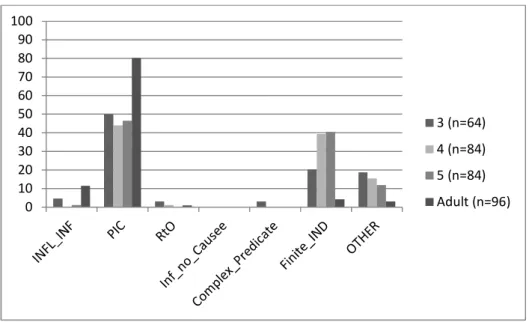
Figure 4 presents the results for matrix perception verbs (condition 2). The categories used to code these data were the same as in Condition 1, with the addition of the category PIC and the difference that in this condition finite clauses take indicative (Finite_IND). We coded as PIC all cases in which the complement corresponded to a small clause with the aspectual marker a (as described in section 2), whether the embedded infinitive is inflected or uninflected. The category Other groups all other answers, mostly sentences with no clausal complement or cases in which the child repeats a part of the story but does not perform the intended sentence completion.
46
Figure 4 – Results with matrix perception verbs (Condition 2)
The most striking results in this condition are (i) the clear preference for PIC by adults and (ii) the split between the PIC and finite clauses for the children. Examples of the PIC and finite clause responses are given in (45) and (46), respectively.
(45) a. … viu estes dois cavalos a dançarem. (3;08,23) PIC saw these two horses PREP dance.INF.3PL
‘… saw these two horses dancing.’
b. O pai tigre viu os filhotes a cair. (3;09,12) PIC the father tiger saw the children ASP fall.INF
‘The father saw the children falling.’
(46) … viu que eles tinham comido o bife. (3;05,16) Finite saw that they had eaten the steak
‘… saw that they had eaten the steak.’ 0 10 20 30 40 50 60 70 80 90 100 3 (n=64) 4 (n=84) 5 (n=84) Adult (n=96)