TY NETW
ORK MANUAL: HO
W TO BUILD THE INTERNET YOURSELF
Official Outcome of the UN IGF Dynamic
Coalition on Community Connectivity
Preface by
Bruno Ramos
The Community Network
Manual: How to Build the
Internet Yourself
How to Build the Internet Yourself
Official Outcome of the UN IGF Dynamic Coalition on
Community Connectivity
Presented at the United Nations Internet Governance Forum
Rio de Janeiro | RJ | Brasil | Zip code: 22250-900 55 (21) 3799-5445
How to Build the Internet Yourself
Official Outcome of the UN IGF Dynamic Coalition on
Community Connectivity
Edited by Luca Belli Preface by Bruno Ramos
Attribution — NonCommercial — NoDerivs
Printed in Brazil
1st edition finalized in 2018, November
This book was approved by the Editorial Board of FGV Direito Rio, and is in the Legal Deposit Division of the National Library.
Coordination: Rodrigo Vianna, Sérgio França e Thaís Mesquita Book cover: Andreza Moreira – Tangente Design
Layout: Andreza Moreira – Tangente Design Reviewer: Luca Belli
The opinions expressed in this book are the responsibility of the authors. This book is jointly published by Fundação Getulio Vargas (FGV), the International Telecommunication Union (ITU) and the Internet Society (ISOC). This volume is the result of the annual Call for Papers Dynamic Coalition on Community Connectivity (DC3), which is open to all interested stakeholders. DC3 is a component of the United Nations Internet Governance Forum and this book is the official 2018 outcome of the DC3. Paper submissions have been evaluated for their novelty and their academic rigor as well as for the impact that the initiatives described in the paper may have. All accepted submissions have been peer-reviewed.
For further information on DC3, see www.comconnectivity.org Ficha catalográfica elaborada pela Biblioteca Mario Henrique Simonsen/FGV The community network manual : how to build the Internet yourself : official
Outcome of the UN IGF Dynamic Coalition on Community Connectivity / Edited by Luca Belli ; preface by Bruno Ramos. - Rio de Janeiro : FGV Direito Rio, 2018.
256 p. : il. Inclui bibliografia. ISBN: 978-85-9597-029-8
1. Internet - Administração. 2. Redes de computadores - Aspectos sociais. 3. Conectividade - Políticas de acesso. I. Belli, Luca. II. Escola de Direito do Rio de Janeiro da Fundação Getulio Vargas. III. Internet Governance Forum. IV. Dynamic Coalition on Community Connectivity.
This book reflects many of the ideas discussed by the members of the Dynamic Coalition on Community Connectivity (DC3) of the United Nations Internet Governance Forum, between 2017 and 2018. The Editor would like to express gratitude to all the DC3 members for their precious inputs.
The editor would like to thank the Fundação Getulio Vargas (FGV)1 Law School, for being a source of intellectual stimulation and guidance, inspiring this research effort; the Internet Society (ISOC),2 for generously supporting the publication of this book and for its commitment to strengthening and promoting community networks globally; and the International Telecommunication Union (ITU),3 for showing openness in exploring the incredible potential of community networks to foster connectivity and for demonstrating perceptiveness in supporting this publication.
1 FGV is a world-renowned institution of research and quality education. In 2018, FGV was deemed as one of the top 10 think tanks in the world, according to the Global Go To Think Tanks Index 2017, produced by the Pennsylvania University. Besides being the 7th most influential think tank globally, FGV has been ranked as the most influential think tank in Latin America over the past nine years. Currently, FGV has 10 Schools and more than 50 Applied Research Centres in the areas of economics, business administration, public administration, law, social sciences, applied mathematics and international relations. See <http://portal.fgv.br/>.
2 ISOC is a global cause-driven organisation governed by a diverse Board of Trustees that is dedicated to ensuring that the Internet stays open, transparent and defined by the users. ISOC currently features more than 140 member organisations and 130 local and regional chapters, bringing together ISOC members and facilitating a number of programmes and activities. See <https://www.internetsociety.org/>.
3 ITU is the United Nations specialised agency for information and communication technologies. ITU is committed to connecting the entire world’s people – wherever they live and whatever their means. ITU is organisation based on public-private partnership since its inception and currently has a membership of 193 countries and almost 800 private-sector entities and academic institutions. Through its work, ITU protects and supports everyone’s fundamental right to communicate. See <https://www.itu.int/>.
CONTENT
PREFACE by Bruno Ramos ... 9 ABOUT THE AUTHORS ... 13
1 Community Networks: Bridging Digital Divides through the Enjoyment of Network Self-determination ... 23
Luca Belli
PART I: How to Build your Community Network ... 41 2 Building Community Wireless Networks: A How-to Guide
for the Curious ... 43
Steven Mansour and Sascha Meinrath
3 Building Community LTE Networks with CoLTE... 75
Spencer Sevilla, Pathirat Kosakanchit, Matthew Johnson and Kurtis Heimerl
4 The MAZI Toolkit for Do-It-Yourself Networking ...103
Harris Niavis, Stavroula Maglavera, Aris Dadoukis and John Mavridis
5 LibreRouter: the Hardware and Software Platform for
Community Networking ... 119
Nicolas Echániz and Florencia López Pezé
PART II: Scalable, Sustainable and Law-compliant Community Networks ... 131 6 Multiple Dimensions of Community Network Scalability ...133
Roger Baig Viñas, Leandro Navarro and Ramon Roca i Tió
7 Federating Community Networks:
A Case-study from France ...159
Félix Tréguer
8 Fostering Sustainability of Community Networks:
Guidelines to Respect the European Legal Framework ...177
Virginie Aubrée and Mélanie Dulong de Rosnay
9 Complementary Networks Meet Complementary Currencies: Guifi.net Meets Sardex.net ...189
Panayotis Antoniadis, Jens Martignoni, Leandro Navarro and Paolo Dini
10 What Could Blockchain do for Community Networks ...223
Panayotis Antoniadis and Jens Martignoni
PREFACE
by Bruno Ramos
Encouraging New Formulas for an Inclusive
Information Society
The International Telecommunication Union (ITU) has in its DNA the vision1 of an Inclusive Information Society, where Information and Communication Technologies (ICTs) foster social and economic development and collaborate for the sustainable growth of the environment, which results in improving the quality of life for everyone.
In this modern Information Society, the ways of social interaction and cultural and economic development are being rapidly altered, due to the new technologies’ evolution. Connectivity enables the exchange of information and knowledge between individuals and communities, enhancing human development in a global sphere. The main driving force behind the change in the way people interact is therefore education through access to knowledge. The exchange of information between people allows us to reflect on the stage in which the communities are in comparison with the others, resulting in a qualified view of the world in which we live and to which we want to go.
However, in particular in developing countries, not all people have access to ICTs, being left out of this new Information Society and therefore without any possibility of choice, including to be able to choose another growth and development path.
This lack of access to the Information Society ensues from the difficulties in the provision of telecommunication services, resulting from the economic incapacity or technical inability to implement it. Therefore, it is necessary to think alternatives to the current forms of telecommunication service provision, either through proposals
1 ITU Vision: “An information society, empowered by the interconnected world, where telecommunication/information and communication technologies enable and accelerate social, economic and environmentally sustainable growth and development for everyone”.
of new governmental public policies, by stimulating competition and the entrance of new private agents or by encouraging new formulas of social organisation in favour of a common goal.
Within the many available options to narrow the access gap, Community Networks have the ability to gather some important items for sustainable development: social organisation with shared objectives, cultural and educational balance, government definitions – with specific regulatory measures aimed at motivating interconnection to the backhaul and backbone of already consolidated companies in the Market – and cost and benefits sharing among the related communities.
As an alternative to the traditional private investment options, these initatives make this possibility of building access networks in regions with low financial returns well adapted to the cases of establishment of access networks, both wireless and by fiber, particularly in isolated and rural areas. This phenomenon is justified by the fact that regions with low attractiveness to conventional investment establish themselves as an ecosystem of similar characteristics, both in terms of resources and demands.
In this way, the establishment of a specific solution expands to the whole community, allowing the growth of a common mechanism to support the construction of networks, such as the use of local manpower for deployment and maintenance of the networks, user support service, among others.
It is in this context that this Manual is inserted.
The solutions and experiences presented are an inspiring and transparent guide to how communities wishing to undertake this digital inclusion mechanism can organise themselves to this end. The terms presented in the handbook deal with how to build Community Networks and how to make Community Networks scalable, sustainable and legally based.
The Manual serves as the basis for starting the creation of a Business Plan that will analyse the best way of implementing the networks in the community and, more importantly, the viability and sustainability of the chosen technological solution.
The ITU, in its work to support its Members in bridging the digital divide, implements technical cooperation projects and this Handbook will be one of the inputs in the implementation of projects in the Americas region with concrete results for the construction of access networks for the inclusion of isolated and vulnerable communities.
For the four-year period 2018-2021, ITU has as a priority the implementation of practical actions to achieve the results expected by its Members, especially through the Regional Initiatives – priority areas for ICT development, defined for each world region during the World Telecommunication Development Conference (WTDC-2017), held in Buenos Aires, Argentina, in October 2017.
One of these actions considers the implementation of a project to assess models of cooperative and community networks, including the legal, regulatory and technical aspects, in order to identify the best practices that can be replicated in the Americas Region and to promote alternative models of provision of broadband access in currently unattended or under supervision areas.
The goal is to implement pilot solutions in many Latin American countries, with an in-depth analysis of each solution vis-a-vis its deployment location, and also generate toolkits to replicate identified solutions in other areas of the region.
This Manual will be an important part as input in the implementation of this Project, which has as ITU partners, the other two participants in its elaboration, the FGV2 and ISOC3.
The reading and use of this Manual has more than an academic character, and can bring real results so that we can increasingly work towards the inclusion of all in the modern Information Society.
2 Fundação Getulio Vargas 3 Internet Society
About the Authors
Luca Belli, PhD is Professor of Internet Governance and Regulation
at Fundação Getulio Vargas (FGV) Law School and associated researcher at Centre de Droit Public Comparé of Paris 2 University. Before joining FGV, Luca worked as an agent for the Council of Europe Internet Governance Unit; served as a Network Neutrality Expert for the Council of Europe; and worked as a consultant for the Internet Society. Over the past decade, Luca has authored and edited more than 30 research outputs in English, French, Italian, Portuguese and Spanish, amongst which “De la gouvernance à la régulation de l’Internet” (Berger-Levrault, 2016); the “Net Neutrality Compendium” (Springer, 2016); “Platform Regulations: How Platforms are Regulated and How They Regulate Us” (FGV, 2017); “Community Networks: the Internet by the People, for the People” (FGV, 2017); and “Gobernanza y Regulaciones de Internet en América Latina” (FGV, 2018). Luca’s works have been i.a. quoted by the Organization of American States Report on Freedom of Expression and the Internet (2013); used by the CoE to elaborate the Recommendation of the Committee of Ministers on Network Neutrality (2016); featured in the French Telecoms Regulator (ARCEP) Report on the State of the Internet (2018), and published or quoted by various media outlets, including Le Monde, BBC, The Hill, O Globo, El Pais and La Stampa. He holds a PhD in Public Law from Université Panthéon-Assas, Paris 2 and a JD in Law from the University of Turin.
Bruno Ramos is the Regional Director of the Americas Regional
Office of the International Telecommunication Union. Bruno graduated in electronic engineering from the Escola Politécnica da Universidade de São Paulo (USP) and holds two Master’s degrees, one in telecom regulation and the other in Electronic Engineering, from the University of Brasilia (UnB). He worked for companies such as TELESP (Telecomunicações de São Paulo) and TELEBRÁS (Telecomunicações Brasileiras) before joining the Brazilian regulatory body, Anatel where he worked for over 16 years as Superintendent for data, mobile and satellite communication. Since 2013 Bruno Ramos is the ITU Regional Director for the Americas Region, He is the responsible for the direct supervision
of all the work of ITU in the Americas, highlighting assistance and support to countries related to telecom/ICTs regulation, manage and monitoring of the radio electric spectrum, strengthening of telecom institutions and capacity building in telecom/ICTs in Americas among others.
Panayotis Antoniadis is the co-founder of NetHood Zurich. He
has an interdisciplinary profile with background on the design and implementation of distributed systems (Computer Science Department, University of Crete), Ph.D. on the economics of peer-to-peer networks (Athens University of Economics and Business), post-doc on policies for the federation of shared virtualized infrastructures (Pierre and Marie Curie University, UPMC, Paris), and interdisciplinary research on the role of ICTs for bridging the virtual with the physical space in cities (ETH Zurich). NetHood is a transdisciplinary non-profit organization that aims to design and develop tools for self-organization and conviviality, bringing together different forms of commoning in the city like community networks, complementary currencies, and cooperative housing. It also aims to bridge academic research with civic action, through its participation in three EU Horizon2020 projects: MAZI (A DIY networking toolkit for Location-Based Collecive Awareness) <http://mazizone.eu>, netCommons (Network Infrastructure as Commons), <http:// netcommons.eu>, and Heteropolitics (Refiguring the Common and the Political), <http://heteropolitics.net>.
Virginie Aubrée is a legal researcher for the University of Trento.
She is part of netCommons, a European Commission-sponsored Horizon2020 research project, utilising a transdisciplinary methodology to study network infrastructure as commons, for resiliency, sustainability, self-determination, and social integration. Virginie’s research focusses on digital commons, telecommunication law and access to knowledge. She also works on data retention obligations and intelligence legal frameworks within the European Union.
Roger Baig Viñas joined the guifi.net community network in
2006 as a volunteer and since 2011 is an employee of the guifi. net Foundation, the organisation responsible for promoting and developing the guifi.net network. His current activities include the
coordination of international collaborations, the organisation of community events and talks, the development of infrastructure projects, etc. As a researcher, he is doing his PhD at Universitat Politècnica de Catalunya. His current research interests are on business models, sustainability and governance of community networks. He holds a degree in industrial engineering, one in industrial electronics and automation and one on computer science.
Aris Dadoukis is currently a Research Engineer at the Department
of Electrical and Computer Engineering, University of Thessaly, Greece. He received the diploma of Computer and Communication Engineering from the University of Thessaly (UTH) in 2007 and the M.Sc in Science and Technology of Electrical and Computer Engineering, from the same department, in 2008. From 2012 until now, he is a Researcher Engineer in University of Thessaly (UTH). He has participated in several of EU projects including Fed4FIRE, Fed4FIRE +, FLEX, ForLab, MAZI and eCOMPASS. He is experienced in the development of testbed related frameworks for monitoring and management, as well as the implementation of OMF extensions for testbed management. His research interests lie in the area of Testbed management, Cloud Computing, DIY networks and Wireless
Paolo Dini received a PhD in Aerospace Engineering from Penn
State University in 1990. He taught undergraduate physics at Carleton College and St Olaf College, Minnesota, while consulting and researching in wind turbine aerodynamics. In 1997, he started working as a Senior Scientist for a wearable computer company and continued working in hardware R&D at Philips Research Laboratories, in Redhill UK, until 2001. He was then a research group leader at the MIT Media Lab Europe in Dublin. In 2003, he joined the Department of Media and Communications at LSE, working on and leading many EU projects. He currently divides his time between LSE, where he pursues mainly social science research topics, and the School of Computer Science at the University of Hertfordshire, where he pursues mainly theoretical computer science research topics. In social science, Paolo is interested in studying social theory, economic theory, and political theory and how they apply to bottom-up socio-economic phenomena such
as complementary currencies, which can be seen as “laboratories of institutional learning”. He is also interested in the study of epistemology and interdisciplinarity, and in the social construction of technology. Since 2016, Paolo has also been working as an R&D consultant for Sardex S.p.A.
Melanie Dulong de Rosnay, PhD in law (University Paris 2, 2007)
is an associate research professor (permanent researcher since 2010) at the French National Centre for Scientific Research (CNRS). She heads the Information and Commons Research Group at the Institute for Communication Sciences of CNRS/Sorbonne University. Melanie’s research focuses on the techno-legal infrastructure and policy for information and digital commons. She is a work package lead of the H2020 CAPS project netCommons on community wireless networks. She also works on algorithmic regulation, distributed architectures, peer production, open access and licensing (public sector information, scientific data and publications, public domain works and digital native heritage). She was a visiting fellow at London School of Economics, Department of Media and Communications from 2013 to 2017. She co-founded in 2011 Communia association on the digital public domain, which she represented at the World Intellectual Property Organization (WIPO). She was Creative Commons France co-founder and legal lead (2003-2013) at CERSA CNRS/University Paris 2, and was employed as a researcher staff member by the Berkman Center for Internet & Society at Harvard Law School, Nexa Center for Internet & Society at Politecnico di Torino, and the Institute for Information Law of the University of Amsterdam.
Nicolás Echániz, president of AlterMundi, has been involved
in Community Networks for the past 15 years. He co-designed the multi-radio mesh network model that AlterMundi shares with communities willing to build their own communications infrastructure. He co-designed the LibreMesh firmware, the Librenet6 mesh tunel broker and the LibreMap federated mapping tool. Nicolás is project manager for the ongoing LibreRouter project funded by FRIDA (LANCIC), FIRE (Afrinic) and the Internet Society. He is project leader for the Descentralized Culture Repository (funded by APC). He co-founded the Dynamic
Coalition on Community Connectivity (DC3). He is the current Chair of the Internet Society Community Networks Special Interest Group (CNSIG). He is a regular speaker in connectivity-related events and he has authored numerous articles on Community Networks on printed as well as online media.
Kurtis Heimerl is an assistant professor of Computer Science
at the University of Washington working on Information and Communication Technology and International Development (ICTD), specifically universal Internet access. Before that, he received his PhD from the University of California, Berkeley, working under Professors Eric Brewer and Tapan Parikh. Kurtis has published widely, including top conferences such as ICTD, CHI, and NSDI. He was a recipient of the 2014 MIT “35 under 35” award, the 2018 UW early career Diamond Award, and won “Best Paper” awards at both CHI and DySPAN.
Matthew Johnson is a graduate student in the ICTD lab at the Paul
G. Allen School for Computer Science and Engineering, where he works with Kurtis Heimerl on the challenges of rural Internet access. He earned his BSEE at Rice University in Houston Texas. He is a current NSF Graduate Research Fellow, and previously received the Gaetano Borriello Endowed Fellowship at the University of Washington and the President’s Engineering Fellowship at Rice University. He is most interested in the networking challenges associated with building high performance networks that can be maintained sustainably by non-experts.
Pathirat Kosakanchit is a third-year undergraduate student
studying Computer Engineering at the University of Washington. Pathirat is working at the ICTD lab on developing community LTE networks where she is supervised by Spencer Sevilla. Her areas of interest are web development and wireless networking.
Florencia López Pezé participates in QuintanaLibre, a community
network in Argentina, since 2012. She is a member of AlterMundi, contributing as a communicator and graphic designer. She is part of the documentation team for the LibreRouter project and it’s software tools. She is also a member of the Training Group of the CNSIG. She is is based in the sierras of José de la Quintana and
participates in experiences of social and collective organization in the territory that are grouped around the defense of environmental rights, land for a dignified life and gender equality.
Stavroula Maglavera, is Electrical and Computer Engineer,
B.Sc. She focuses on high-level coordination and on strategic developments. She is specialised in the field of ICT and she gained expertise on designing and executing international scale events in ICT. Her skills encompass exploitation, promotion, and dissemination of technology, and IPR issues. Extensive experience in providing consulting services supporting Public Administration and organisations in the formation and implementation of national and regional strategies for the development and management of ICT applications. With more than twenty-seven years of hands-on experience in European, National & Regionally funded programmes and in project management, she still maintains an active interest on design and implementation of research projects in the field on ICT. Her current research interests comprise Networked Information Systems, ICT for Health, e-Inclusion, and e-Government. She is involved in scientific and business committees dealing with medical informatics. She was the coordinator of several EC funded projects. Participates is SMARTFIRE, FLEX, EINS, MED-GOLD, DREDBOX, MAZI and CHIC projects.
Steven Mansour is a well-known expert on cyber-infrastructure,
cyber-activism, Internet privacy policy, and knowledge transfer on the web. Steven provides training and support to scientists, non-profits and community groups throughout the U.S., Canada and Latin America since 2004. He has given Linux & Open Source Software workshops in Cuba, and worked closely with the Fundación Canguro in Colombia, developing knowledge transfer strategies for doctors and researchers working with premature & low birth weight (LBW) infants. He was Director of Technology & Partnerships at the World Association of Young Scientists, a UNESCO project to support young scientists and early-career researchers. Steven worked closely with the McGill University Health Center, the Centre Hospitalier Universitaire Sainte-Justine and the Alberta Children’s Hospital to develop social research and e-learning tools for professors and students in Mother-Child
research. His work on Internet privacy and security has been featured in international media. Steven currently works with the X-Lab think tank on tech policy issues, and is also involved with a number of local technology startups, creative writing organizations and non-profit projects in Montreal, Canada.
John Mavridis holds a degree in Electrical and Computer
Engineering, University of Thessaly, Greece (2018). At present, he is a M.Sc. student in Science and Technology of Electrical and Computer Engineering. From 2015 until now, he is an Assistant Research Engineer in University of Thessaly (UTH). He was involved in the EU Project MAZI (A DIY networking toolkit for location-based collective awareness) and more specifically in the design and development of the backend software. He is also fully experienced in the control, management and operation of experimental infrastructures for implementing wireless networking experiments for academic and research purposes.
Sascha Meinrath is the Palmer Chair in Telecommunications
at Penn State and director of X-Lab, an innovative think tank focusing on the intersection of vanguard technologies and public policy. Professor Meinrath is a renowned technology policy expert and is internationally recognised for his work over the past two decades as a community internet pioneer, social entrepreneur and angel investor. He was elected as an Ashoka Fellow for Social Entrepreneurship in 2012, and has been named to the Time Magazine “Tech 40” as one of the most influential figures in technology, to the “Top 100” in Newsweek’s Digital Power Index, and is a recipient of the Public Knowledge IP3 Award for excellence in public interest advocacy. Professor Meinrath is widely published in both academic and media outlets, including Critical Studies in Media Communications, International Journal of Communications, Journal of Communications Law and Policy, Journal of Internet Law, Journal for Community Informatics, IEEE Internet Computing Magazine, IEEE Spectrum, Foreign Policy, The Hill, Time Magazine, Politico, Slate, The Guardian and many others. Prior to founding X-Lab, Meinrath was vice president of the New America Foundation, where he founded the Open Technology Institute in 2008 and built it into one of the largest public interest
tech policy organizations in Washington, D.C. He also founded the Commotion Wireless Project.
Jens Martignoni is a cooperative and currency researcher working
on community currencies, commons based economic models and game design for networks and cooperatives. He is a co-founder of the Zurich-based nonprofit organization nethood.org and is doing a PhD on cooperative currencies at Cologne University, Germany. He serves also as a lecturer for management at the Swiss Distance University for Applied Science, Brig. Above that he is engaged in the discussion about monetary innovations, ethical banking and the future of finance in Switzerland. His background includes a degree in mechanical engineering from Technikum Winterthur and later on an executive master of business administration in nonprofit-organisation-management from the University of Fribourg, Switzerland.
Leandro Navarro is associate Professor at the Universitat Politècnica
de Catalunya (UPC) in Barcelona. Ph.D. in Telecommunication from UPC in 1992. His research interests include the design of scalable and cooperative Internet services and applications. He coordinates the Computer Networks and Distributed Systems (CNDS) research group at UPC. He coordinated the FP7 CONFINE IP project from 2011-2015 about community networks and the Community-Lab. net testbed. Currently, he coordinates the Erasmus Mundus Joint Doctorate in Distributed Computing (EMJD-DC), and is co-chair of the IRTF.org working group GAIA (Global Access to the Internet for All). He is also executive board member of the Association for Progressive Communications (https://www.apc.org/).
Harris Niavis is a Research Engineer at University of Thessaly,
Greece, where he focuses his research activities on community networks and technologies that could complement them, such as blockchain. He received the diploma of Computer and Telecommunication Engineering from the University of Thessaly, Volos, Greece and the M.Sc in Science and Technology of Electrical and Computer Engineering, from the same department, in 2011 and 2013 respectively. From 2012 until now, he is a Researcher Scientist in Centre for Research and Technology Hellas (CERTH) and in University of Thessaly (UTH). He has participated in a lot
of EU research projects including OpenLab, FLEX, SmartFIRE, EINS, Fed4FIRE, MAZI leading the development of open source software platforms. He is experienced in control and management of wireless experimental facilities and in the programming of wireless, open source drivers. His research interests lie in the area of experimentally driven research, including the provision of experimental infrastructures, and in the areas of community networks, blockchain, social computing and wireless mesh networks.
Ramon Roca i Tió is co-founder and the President of Fundació
Privada per a la Xarxa Oberta, Lliure i Neutral guifi.net (The Foundation for the Open, Free and Neutral Network -guifi.net). He has always been involved in IT social projects. In 2003 he had set up the first link of what few months later became the guifi. net community network. That wireless link was his proposal to overcome the lack of ISPs Internet supply in his village located in the rural area in the countryside of Catalonia. Immediately after, he started promoting his solution among his neighbours and started enhancing the Free Networks’ model. Nowadays he is repeating that process with optical fibre, deploying it according to what he has called the FFTF model, i.e. Fibre From The Farm, a wordplay to stress that the Fibre deployment is made by active common people, From The Farm, instead of by the telcos, To The Home. This model, called as “Bottom-up Broadband initiative” by himself, was one out of eight selected ideas of the The Digital Agenda Stakeholder Day on 25 October 2010. His professional career has always been related to international IT companies.
Spencer Sevilla is a postdoctoral researcher at the University of
Washington, where he works with Kurtis Heimerl and the ICTD lab on expanding Internet access via community cellular networks. Previously, Spencer did his PhD at the University of California at Santa Cruz, where he was advised by J.J. Garcia-Luna-Aceves. Spencer has published 13 peer-reviewed papers, is the author of 10 US patents, and has received numerous awards for his work, including two best paper awards (IFIP 2013, ICNP 2015), a UC Presidential fellowship, third place in the Mozilla WINS Challenge, and an Amazon Catalyst fellowship.
Félix Tréguer is a post-doctoral researcher at ISCC-CNRS
Paris-Sorbonne. His research looks at power struggles surrounding the Internet and more generally communication technologies, at the intersection of political history, law as well as media and technology studies. He holds a PhD in political studies from the School for Advanced Studies in the Social Sciences (EHESS), and is a founding member of the advocacy group La Quadrature du Net.
1 Community Networks: Bridging Digital
Divides through the Enjoyment of
Network Self-determination
Luca Belli
Abstract
This chapter provides an introductory framework to understand this book, exploring why the emergence of community networks (CNs) has been particularly beneficial by nurturing multistakeholder cooperation, fostering sustainable expansion of connectivity and promoting the advancement of fundamental rights. The first section of this chapter briefly explores the idea of a right to Network Self-determination, providing concrete evidence of why the development of CNs allows individuals to enjoy this right. The second section, offers an overview of the strategies that can be adopted to develop CNs, by exploring the contributions featured in this book, while emphasising the great public-interest role that such contributions play, by sharing the knowledge necessary not only to build new CNs but also to make such initiatives scalable, sustainable and legally compliant.
CNs are collaborative networks, developed in a bottom-up fashion by groups of individuals that conceive, deploy and manage the new network infrastructure a common good. At the centre of CNs and the socio-economic ecosystems they generate lay the communities who are essential to initiate, maintain and guarantee the success of these connectivity efforts. This chapter argues that CNs provide tangible examples of valuable alternative approaches to expand connectivity – and, consequently, to fulfil the United Nations Sustainable Development Goals – in a bottom-up fashion. It stresses that the raise of CNs also offers a solid demonstration of how Internet governance processes can allow different stakeholders to cooperate, achieving common goals and concretely influencing the evolution of the Internet.
1.1
Introduction
This chapter provides an introductory framework to understand this volume, exploring why the emergence of community networks (CNs) has been particularly beneficial by nurturing multistakeholder cooperation, fostering sustainable expansion of connectivity and promoting the advancement of fundamental rights. The first section of this chapter briefly explores the idea of a right to Network Self-determination,4 providing concrete evidence of why the development of CNs allows individuals to enjoy this right.5 The second section, offers an overview of the strategies that can be adopted to develop CNs, by exploring the contributions featured in this book, while emphasising the great public-interest role that such contributions play, by sharing the knowledge necessary not only to build new CNs but also to make such initiatives scalable, sustainable and legally compliant.
CNs are collaborative networks, developed in a bottom-up fashion by groups of individuals – i.e. communities – that conceive, deploy and manage the new network infrastructure as commons. It important to stress that, at the centre of CNs and the socio-economic ecosystems they generate lay the communities and their members, who are essential to initiate, maintain and guarantee the success of these connectivity efforts.6 Furthermore, such initiatives represent a long-awaited solution for members7 of the International Telecommunication Union to implement concretely its Recommendation D.19 on Telecommunication for Rural and Remote Areas.
Indeed, while considering “that the provision of telecommunications, ICT services and applications can make significant contribution to
4 Network Self-determination can be defined as “the right to freely associate in order to define, in a democratic fashion, the design, development and management of network infrastructure as a common good, so that all individuals can freely seek, impart and receive information and innovation.” (Belli 2017a). The right to free development of network infrastructure stems from the fundamental rights to freely associate, to freedom of expression, to self-determination of peoples as well as to enjoy the benefits of scientific progress and its applications and can be seen as an instrumental condition to allow the full exercise of individuals’ fundamental rights. (Belli 2017a and 2018). An introduction to Network Self-determination is also provided by the TED talk “From Network Neutrality to Network Self-determination” delivered by the author of this paper at TEDxRoma 2018. See <https://www.youtube.com/watch?v=2-xlBqbNzGU>.
5 This section is based on the work previously published in on Luca Belli. (28 March 2018) Network self-determination: When building the Internet becomes a right. IETF Journal.
6 In this perspective, the 2017 DC3 Report was tellingly dedicated to “Community Networks: the Internet by the People for the People.” See <http://communityconnectivity.xyz/>.
the quality of life of the population living in rural and remote areas [and] that access to telecommunications/ICTs for all will maximise social welfare, increase productivity, conserve resources and will contribute to safeguarding human right”, the ITU recommends to its members “that local institutions, such as village committees should be involved in planning and implementing ICT” stressing that “[b]usiness models which can achieve financial and operational sustainability can be operated by local entrepreneurs supported by a variety of initiatives […] including Universal Service Funds […].”8 Besides offering a significant example of the existence of alternative and valuable approaches to expand connectivity – and, consequently, to fulfil the United Nations Sustainable Development Goals9 – in a bottom-up fashion, the raise of CNs also offers a demonstration of how Internet governance processes can allow different stakeholders to cooperate, achieving common goals and concretely influencing the evolution of the Internet. Indeed, although CNs have started to be developed and studied more than twenty years ago,10 the appearance and the rapid gain of prominence of CN discussions in the international policy arena is mainly due to the United Nations Internet Governance Forum (IGF) and the work spearheaded by the IGF Dynamic Coalition on Community Connectivity (DC3).11 Undeniably, DC3 has provided a much needed platform through which various individuals and entities interested in the advancement of CNs have the possibility to associate, organise and develop, in a bottom-up participatory fashion collective “principles, rules, decision-making procedures and shared programs that give shape to the evolution and use of the Internet.”12
In this sense, since the creation of DC3, a growing number of individuals and organisations from all over the world have come together to
8 See ITU Recommendation D.19 (03/10) <https://www.itu.int/rec/D-REC-D.19-201003-I/en>. 9 Notably, Goal 9 establishes the United Nations members’ commitment to “build resilient
infrastructure, promote sustainable industrialization and foster innovation.” See <https://www. un.org/sustainabledevelopment/infrastructure-industrialization/>.
10 See the seminal work of Schuler (1996) and Flickenger (2002).
11 See <https://comconnectivity.org/> members For an overview of the DC3 outcomes and activities, see <https://www.intgovforum.org/multilingual/content/dynamic-coalition-on-community-connectivity-dc3-0?qt-dynamic_coalition_on_community_c=4#qt-dynamic_coalition_on_community_c>. 12 This is indeed the very definition of Internet Governance as provided by paragraph 34 of the
organise joint programmes and actions, conduct research, elaborate policy suggestions and advocate for such policy, with the goal of facilitating the development of CNs and increase visibility of the CN potential to bridge existing digital divides. It is important to note that the development of the Declaration on Community Connectivity, through an open and participatory multistakeholder process,13 offers a telling example of the fact that the IGF is not a mere “talking-shop” and can produce concrete outcomes and policy recommendations, as foreseen by its mandate.14 Indeed, the Declaration, which is a non-binding “living document”, periodically updated by DC3 members, represents the first example of an international consensual document dedicated to the characteristics of CNs, the CN users and policy elements that allow such networks to thrive.
According to the Declaration, CNs are “structured to be open, free and respect network neutrality. These networks rely on the active participation of local communities in the design, development, deployment and management of shared infrastructure as a common, community-owned and democratically operated resource.” These initiatives give rise to new infrastructures, new governance models and new business opportunities and facilitate the free flow of information, filling the lacunae left by the traditional Internet access-provision paradigm. As argued by the following section, CNs empower individuals, giving them the tools to stop being digital outcasts and become the protagonists of their digital futures, by enjoying their right to Network Self-determination.
1.2
When building the Internet becomes a right
Access to well-functioning network infrastructure on affordable and non-discriminatory terms facilitates significantly the full enjoyment of one’s fundamental rights as Internet users can easily access knowledge and education, conduct businesses, and utilise digital public services, ranging from paying taxes to applying to schools and receiving remote medical consultations. As connected individuals,
13 This process began with an open consultation online, between July and November 2016, continued with a public debate and a collection process during the IGF 2016, and ended with a new online consultation between December 2016 and March 2017. The Declaration is available at <https://www.intgovforum.org/multilingual/index.php?q=filedepot_download/4391/1316>. 14 See Tunis Agenda paragraph 72.g <https://www.itu.int/net/wsis/docs2/tunis/off/6rev1.html>.
we can safely state that the Internet has become an integral part of our lives and our environment, affecting substantially how we form our opinions, how we socialise and learn and, ultimately, what opportunities we are able to grasp over the course of our lives. Such observation, though, makes even deeper the divides between those who can enjoy unrestricted and affordable connectivity and those who cannot, and demands the adoption of innovative thinking to give to the currently unconnected a credible chance to enjoy the same opportunities that the connected are already enjoying. This section briefly explores how CNs allow groups of unconnected and scarcely connected individuals to regain control over their digital futures, building their own infrastructure and enjoying Network Self-determination. The section also stresses that, by developing CNs, the affected communities foster a distributed, interoperable and generative Internet, while also enjoying a number of positive externalities in socio-economic terms. In this perspective, CNs provide concrete examples proving that “the design and development of the Internet infrastructure have a growing impact on society”15 and foster a digital environment that enables human rights. After having provided a brief introduction to CNs and the positive externalities that these initiatives generate, this section will argue that Network Self-determination, as a right to free development of network infrastructure, stems from already existing fundamental rights, consecrated in binding international-law instruments as well as in the majority of national Constitutions. Indeed, as argued in previous publications (Belli 2017a and 2018), the concept of Network Self-determination finds its solid juridical bases in the fundamental rights to freely associate, to freedom of expression, to self-determination of peoples as well as to enjoy the benefits of scientific progress and its applications.
1.2.1 Mainstream networks are not so mainstream
In almost every country in the world, Internet connectivity predominantly relies on the existence of network infrastructure built and managed by for-profit operators. Such infrastructure is primarily composed of “mainstream networks,” which are those networks that
RFC 796216 characterises as controlled in a top-down fashion by the operators; spanning large areas; requiring a substantial investment to be built and maintained; and not foreseeing the possibility for users to participate in the network’s governance.
Not surprisingly, mainstream networks are mainly deployed and operationalised in densely populated areas, where return on investments can be quite fast and straightforward, due to the high demand for connectivity by thousands – or millions – of city dwellers. The situation, however, is not the same in rural areas or in the peripheries of major metropolises, where the scarce density and lower standards of living cannot guarantee immediate and sufficient return on investment for operators.
In rural and peripheral areas, which are home to the 48% of the world population that is currently unconnected,17 the sole reliance on mainstream networks does not prove to be an effective strategy to expand connectivity. Indeed, the lack of return on investment discourages development of infrastructure, leading to lack of coverage or to such high prices and low quality of service that potential or existing users might be discouraged from subscribing to available Internet access offerings. In this context, several studies have pointed out that limited coverage and lack of competition can make Internet access offerings so prohibitively expensive that locals need to sacrifice food to afford communications.18
Most importantly, individuals living in unconnected or scarcely connected areas may rightfully fail to see the appeal of Internet access because any services or content that would improve their welfare – such as local government services, information and educational material in local languages and platforms making available local products and services – are not available online. In other words, the lack of locally developed, locally accessible and locally comprehensible – i.e. understandable by individuals only speaking local languages – makes internet connectivity uninteresting for the local population. (Belli, 2018)
16 See RFC 7962 <https://www.rfc-editor.org/rfc/rfc7962.txt>.
17 See e.g. <https://www.itu.int/en/ITU-D/Statistics/Documents/facts/ICTFactsFigures2017.pdf>. 18 See e.g. Rey-Moreno et al. (2016).
1.2.2 Do-It-Yourself Internet
Despite the above scenario, many individuals living in unconnected or scarcely connected communities have realised that Internet connectivity is a vector for the economic, social and cultural development to which they have a fundamental right.19 For this reason, they have taken action to stop being digitally marginalised, due to market failures and inefficient public policies, and start building their own CNs, to become the active designers and implementers of their digital futures. Concretely, such reasoning has become possible thanks to the steady reduction in infrastructure costs – particularly, regarding bandwidth and network equipment – that, over the past decade, has facilitated the deployment of CNs with reasonably low investments. CNs are crowdsourced initiatives. Described by RFC 7962 as “alternative networks […] that do not share the characteristics of mainstream network deployments.” On the contrary, as already emphasised, CNs are better characterised by their bottom-up development and by the fact they are managed by the local community as a commons. Importantly, besides representing a viable solution to fill the connectivity gaps left by mainstream networks, CNs also ensure that Internet traffic is managed with no commercially motivated discrimination, thus respecting net neutrality20 by default. Indeed, all network users are partners in the provision of connectivity and in the development of services for the local community, thus making it much less likely that the provider – which is the community itself – will discriminate against content, applications or services based on commercial considerations, as the greatest interest of the community is to have access and be able to share all possible content and applications.
Therefore, the raise of CNs demonstrates that connectivity, openness, free choice and full enjoyment of fundamental rights are not amenities reserved to opulent city-dwellers but basic needs to which everyone is entitled and that everyone can and must enjoy. Moreover, they prove that “connectivity increases the capacity for individuals to exercise their rights.”21
19 See art. 1 Universal Declaration of Human Rights, art 1.3 of both the International Covenant on Civil and Political Rights and art 1.3 of the International Covenant on Economic, Social and Cultural Rights. 20 For an ample collection of analyses exploring the net neutrality debate, see <http://www.
networkneutrality.info/>.
1.2.3 When the last mile becomes the first mile
Community networking shows that in many circumstances the unconnected can connect themselves as long as they have information on how to build22 their network infrastructure and the freedom to choose this option. It is precisely in these circumstances that a wide range of CNs have emerged in many countries presenting radically different socio-economic and geographic contexts.23 Broadband for the Rural North or B4RN24 (pronounced “barn”), for example, was initiated in 2011 by a group of farmers in Lancashire, U.K., who decided to overcome the lack of connectivity by starting to self-install fibre. Today the B4RN network connects about 5000 properties, where thousands of individuals enjoy speeds as high as 10 gigabit per second.
The non-governmental organisation (NGO) AlterMundi,25 which is behind QuintanaLibre, a community network in the Argentinian province of Córdoba, prides itself on having successfully developed a “geek-free” model to overcome the main challenges posed by rural environments, the scarcity of engineers and reduced incomes, by developing an easy to implement and cost-efficient network technology. Importantly, the connectivity brought by QuintanaLibre has stimulated the development of several applications by the locals for the locals, including information portals, chat services, Voice-over-IP (VoIP) servers, community radio streaming services, file sharing systems and gaming applications.
The AlterMundi-affiliated networks also provide Internet access to three schools, giving students – who otherwise would be totally disconnected – the opportunity to access online resources, train online and, potentially, share the fruit of their creativity as entrepreneurs. Similarly, the Brazilian NGO Coolab26 provides connectivity and training to dozens of children through the Casa dos Meninos project while connecting an entire village via the Fumaça community network in Rio de Janeiro state. It is important to reiterate that, besides being
22 The first part of this book offers a selection of resources explicitly aimed at providing such information to all interested individuals. See Part I.
23 For a thorough, although non-exhaustive, list of existing CNs, see Navarro (2016:84-98). 24 See <https://b4rn.org.uk/>.
25 See <http://altermundi.net/>.
a direct fruit of the local community engagement, the development of CNs has provided access to opportunities the newly connected communities were completely excluded from.
Importantly, the development of CNs has also demonstrated that such initiatives can be scalable27 and reach relevant size and number of users. The most successful example in this sense is guifi.net28 that, besides being the biggest CN in the world with over 85,000 users, is particularly outstanding for its common-pool-resource philosophy that favours the establishment of “a disruptive economic model based on the commons model and the collaborative economy,”29 encouraging small, local entrants to develop new applications and to extend the network themselves.30 Indeed, Guifi.net members have generated a variety of services31, amongst which are VoIP servers, chat servers, videoconference and mail servers, and broadcast radio. Importantly, besides expanding the Internet and promoting innovation in a decentralised fashion, CNs like guifi.net have created dozens of new jobs related to network maintenance and entirely new digital ecosystems. Indeed community networking generally features capacity-building programs for locals to acquire the skills they need to be developers, creators and online entrepreneurs. This generative effect deploys a further positive externality, making the locally developed Internet more interesting (Belli, 2018) for the local population that, finally, has the possibility to find content and services catering the local needs and in the local languages. In this perspective, it can be stated that CNs are built by the people for the people,32 and the access network they provide should not be considered as the last mile of the Internet but rather as the first mile. Indeed, these networks play a vital role in maximising the generative nature of the Internet, decentralising innovation at the edges and empowering the unconnected by providing new learning, networking and employment opportunities.
27 See chapter 6 of this book for a discussion on CN scalability. 28 See <http://guifi.net/>.
29 See <https://guifi.net/en/what_is_guifinet>. 30 See Baig et al. (2015).
31 A complete list of services developed by the guifi.net community can be found at <https://guifi. net/en/node/3671/view/services>.
1.2.4 Network self-determination
These examples of CNs briefly explored in the previous section provide a sample of the positive externalities triggered by such initiatives and offer sound evidence based on which a right to Network Self-determination can be constructed. The concept of Network Self-determination equals to the right to freely associate to define, in a democratic fashion, the design, development and management of network infrastructure as a common good, in order to freely seek, impart and receive information and innovation.33 While community networking proves that Network Self-determination already exists de facto even without being explicitly consecrated de
jure, it is important to stress that this concept is also solidly grounded
in international human rights law.34 Indeed, the first article of both the Charter of the United Nations and the two International Covenants of Human Rights decisively affirm that, by virtue of the fundamental right to self-determination, all peoples are free to pursue their economic, social and cultural development as well as self-organisation. According to both Articles 1(3) of both Covenants, all states have an obligation “to promote the realisation of the right to self-determination,” which is considered the collective right of a given community to determine its own destiny. The first part of the Network Self-determination concept corresponds to the right to freely associate, which is explicitly protected by art. 22 of the International Covenant on Civil and Political Rights (ICCPR), numerous binding international law instruments and the majority of national constitutions. Th last fragment of the concept, on the other hand, is a simple rephrasing the right to freely seek, impart and receive information and ideas, enshrined in ICCPR, art. 19 and many regional and national binding instruments creating enforceable rights and obligations.
CNs clearly foster Network Self-determination, for they allow individuals to decide how to pursue their economic, social and cultural development, choosing which kind of technology, applications and content are best suited to meet the needs of the local community and using and developing them in a quintessentially distributed fashion. The goal of community networking is indeed
33 See Belli (2017a).
to empower individuals who will become new, active participants in the Internet, thus enjoying the benefits of connectivity while contributing to the evolution the network of networks as “a large, varied and evolving space of technology.”35
Crucially, Network Self-determination empowers individuals rather than creating additional burdens on them. This means that every individual must be free to create new Internet infrastructure, as well as new applications and new content, but it does not mean that governments should be relieved from their universal service obligations nor that operators willing to provide access service should be impeded from doing so. Indeed, we must consider Network Self-determination as a right and an opportunity rather than an obligation to develop new network infrastructure.
1.2.5 Rights, as technologies, are the product of history
As mentioned above, the enjoyment of Network Self-determination through the development of CNs can prompt several positive externalities, fostering a decentralised Internet and allowing previously unconnected or scarcely connected individuals to access knowledge and education, create new applications and find occupations, having access to the entire spectrum of opportunities to which any individual should be entitled.
Enthusiasm and optimism regarding community networking should be tempered with a good dose of pragmatism, though. Indeed, alternative networks should be seen as a valuable complement to existing approaches rather than a silver bullet that can solve all connectivity problems. As mentioned in the second part of this book, CNs require sound planning and good governance to be successful, scalable and sustainable, and may face many technical and policy obstacles over their path.
As the Italian philosopher Norberto Bobbio famously argued, human rights are the product of historical evolutions.36 In this spirit, everyone should be free to enjoy Network Self-determination, associating and building new pieces of the Internet. Communities around the
35 See RFC 1958 <https://tools.ietf.org/html/rfc1958>. 36 See Bobbio (1996).
globe are discovering they have the potential to create alternative networks and many of them are already doing so, thus concretely enjoying their right to network-self-determination. There is no doubt that Network Self-determination reinforces the distributed nature of the Internet and there is no reason why individuals should not have the possibility to build the Internet themselves, improving their standards of living while bridging digital divides. For these reasons, the first section of this book provides concrete instructions on how to build CNs, as underlined by the next section.
1.3
How to enjoy Network Self-determination
The fundamental goal of this volume is to provide to any interested person a manual offering instructions, strategies and useful suggestions to create CNs, make them sustainable and scalable, while being mindful of complying with regulation, thus keeping networks as spaces for the enjoyment and promotion of rights and respect of legislation. This section offers an overview of the content of the volume in this respect.
1.3.1 Instructions for aspirant community network builders
The first part of this book is opened by Steven Mansour and Sascha D. Meinrath’s analysis on “Building Community Wireless Networks: A How-to Guide for the Curious”, providing concrete
instructions helping the reader to take the first steps towards building a community wireless network. The Guide is a starting point for understanding the basic building blocks to community wireless networks, which digitally connect communities, and allow neighbours to share Internet access or use locally hosted applications. The authors stress that there are many ways to design a community wireless network, but many options can lead to confusion. Based on the experience of several CNs and Wireless Internet Service Providers, Mansour and Meinrath provide initial guidance on how to build community wireless networks, starting from the very basics of Wi-Fi and networking (such as IP addresses, 2.4GHz vs 5GHz wireless frequencies) and identifying concrete steps that any interested group of individuals should follow in order to successfully establish a community wireless network.
Subsequently, Spencer Sevilla, Pathirat Kosakanchit, Matthew Johnson, Kurtis Heimerl deliver an excellent complement to the previous chapter with their study on “Building Community LTE Networks with CoLTE”, which provides detailed, step-by-step
instructions on how to build, deploy, and operate a small-scale community Long Term Evolution (LTE) network. The manual assumes a reader who is somewhat familiar with networking concepts – and the reader of this book will be thanks by reading the previous chapter – but is explicitly not a technical expert or knowledgeable about the cellular space. The authors provide a brief overview of LTE architecture; cover the need-to-know topics for a network operator; provide suggestions for selecting and buying hardware; discuss the variables around band selection and corresponding licensing concerns; and provide step-by-step instructions for installing, configuring, and running our community LTE network-in-a-box project, which the authors define as “CoLTE”. In “The MAZI Toolkit for Do-It-Yourself Networking,” Harris Niavis,
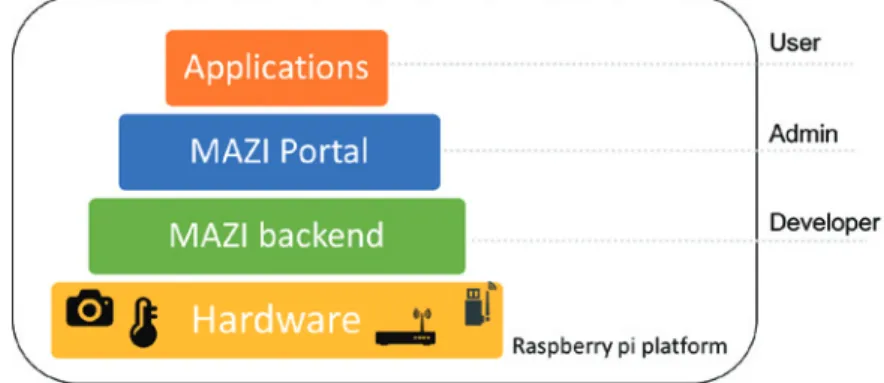
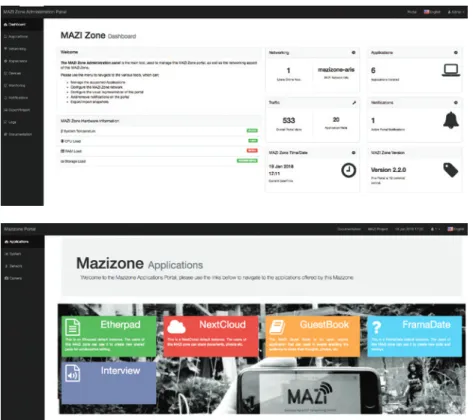
Stavroula Maglavera, Aris Dadoukis and John Mavridis describe, from a system design point of view, the MAZI toolkit, which consist of a Do-It-Yourself networking toolkit for enabling the easy deployment, operation, configuration and maintenance of local wireless networks by communities. The MAZI toolkit encompasses diverse Free-Libre / Open Source Software (FLOSS) applications and services for social innovation and addresses generic social challenges towards shaping a more human-centric Internet. Importantly, the MAZI toolkit is based on low-cost open hardware and open-software platforms, like the Raspberry Pis, sensors and other Internet of things (IoT) devices. The authors stress that the conceptualisation, design and development of the toolkit was a crowdsourced community effort, taking place within participatory processes that were open to engaging researchers, developers and actors of diverse communities.
This bottom-up approach facilitated the emergence of ideas that rapidly materialised into applications and tools towards addressing real community needs and challenges. In this perspective, the MAZI toolkit integrates popular already existing open-source, self-hosted applications (such as NextCloud, Etherpad, LimeSurvey and Wordpress) thus including existing open-source communities in the MAZI ecosystem.
In “LibreRouter: the Hardware and Software Platform for Community Networking”, Nicolás Echániz and Florencia López Pezé describe
the emergence and materialisation of the LibreRouter project. The authors emphasise that, for a large part of the disconnected population – eminently rural, poor and living in the global south – the business and networking models that have connected the first half of the world population will not be viable. In this scenario, CNs have acquired prominence, as a promising solution to expand connectivity in disadvantaged areas, a model that can reach where others cannot. The authors stress that challenges to deploy these CNs “on the field” are still very significant – especially in the global south – and, to provide concrete solutions to this challenges, the LibreRouter project has been conceived. LibreRouter is a device, which would finally allow community mesh networks to count on a hardware and software platform, designed with their specific needs in mind.
This chapter explores the challenges and successes of the LibreRouter project. The design and development process of LibreRouter combined the efforts of more than 20 specialists from all over the world, long time CN activists from different continents, electronic engineers, hackers, and communicators. The chapter briefly describes the multiple stages of prototyping of LibreRouter and provides an overview of the results that, to date, seem promising.
1.3.2 Scalable, sustainable and law-compliant community networks
The second part of this book explores some critical dimensions of CNs: scalability, sustainability and legality. These dimensions have to be pondered carefully by would-be CN developers, as they are critical for the success of any CN.
Roger Baig Viñas, Leandro Navarro, Ramon Roca i Tió open this part with their analysis of “The Multiple Dimensions of Community Network Scalability”, which deliver some essential food for
thoughts for aspiring CN developers. The authors stress that diverse initiatives around the world show the feasibility to build bottom-up community networking infrastructures to join the Internet. However, they admit that an experimental network by and for hackers has very different implications, at all levels, compared to a
general-purpose production network for an entire population. Scalability in the design of CNs makes the difference between clubs, with entry barriers of complexity and limited service, and extensible network commons able to accommodate and serve every user in an area. To foster such reflection, the authors tackle scalability from what they consider the four main dimensions of CNs: social, legal, economic and technological. Importantly, the authors utilise the experience and lessons learned by guifi.net and other CNs to illustrate the discussion and ways to achieve scalability in CNs.
Successively, in “Federating Community Networks: A case study from France”, Félix Tréguer explores the challenges of
coordinating various CNs with different models and governance features. Tréguer considers the case study of Fédération French Data Network (FFDN), an acknowledged success of the CN movement, created in 2011 and federating CNs across the country. The chapter notes that, when FFDN was established, interest in grassroots communication networks managed as a commons was booming, and rather than growing existing ones, swarming (i.e. the creation of several independent local organisations) was deemed a better strategy. Although communities in other states have explored other forms of coordination, this process of federation provides an interesting model for ensuring the coordination of various CNs with different models, and for establishing solidarity and fostering resiliency in the face of the many challenges entailed buy the maintenance and defence of CNs.
The author posits that, despite some difficulties, FFDN represents an interesting precedent for other national and regional CN environments willing to foster collective cohesion. After offering a brief history of the CN movement in France, up to the creation of Fédération FDN in 2011, Tréguer explores the federation’s main organisation features and accomplishments.
In “Fostering Sustainability of Community Networks: Guidelines to Respect the European Legal Framework” Virginie Aubrée
and Mélanie Dulong de Rosnay propose guidelines to help CNs to cope with the applicable European legal framework and mitigate legal risks while protecting users’ rights and enforcing core values such as privacy. The authors cover three main topics that are key to the activity of CNs: civil liability, data protection, data retention