http://www.uem.br/acta ISSN printed: 1679-9291 ISSN on-line: 1807-8648
Acta Scientiarum
Doi: 10.4025/actascihealthsci.v36i1.16251
Analysis of the self-care of diabetics according to by the Summary of
Diabetes Self-Care Activities Questionnaire (SDSCA)
Samuel Soares Freitas1, Grazielle Roberta Freitas da Silva2*, Dinah Sá Rezende Neta2 and Ana
Roberta Vilarouca da Silva1
1
Universidade Federal do Piauí, Teresina, Piauí, Brazil. 2
Programa de Pós-graduação em Enfermagem, Universidade Federal do Piauí, Campus Universitário Ministro Petrônio Portella, Bairro Ininga, s/n, 64049-550, Teresina, Piauí, Brazil. *Author for correspondence. E-mail: [email protected]
ABTRACT. This is a cross-sectional correlational study that analyzed the self-care of diabetic patients according to the SDSCA. The sample was made up by 96 people distributed into 32 health-care teams from the east/southeast region of Teresina, Piauí State. The results showed the predominance of female people, aged 70 to 79 years, education lower than 5 years, average monthly income of one minimum wage, with complications due to Diabetes (70.8%). A significant portion of the sample presented an inadequate foot care, inappropriate checking of glycemic index (92.7%), physical inactivity (63.5%), and food intake without professional monitoring (53.1%). Correlation was inversely proportional to patient educational level. In conclusion, the adherence to the treatment by these participants was unsatisfactory, showing that the need for an approach from health professionals close to their reality in order to provide them more independence and reduce the risks of complications due to Diabetes.
Keywords: Diabetes Mellitus, self care, nursing.
Análise do autocuidado de diabéticos por meio do
Questionário de Atividades de
Autocuidado com o Diabetes (QAD)
RESUMO. Estudo descritivo correlacional, de corte transversal que teve como objetivo: analisar o autocuidado de pacientes com diabetes segundo o QAD. A amostra constitui-se de 96 participantes distribuídos em 32 equipes de saúde da regional leste/sudeste de Teresina, Estado do Piauí. Os resultados apresentaram, em sua maioria, população do sexo feminino, com idade entre 70 e 79 anos, escolaridade inferior a 5 anos de estudo, renda mensal média de 1 salário mínimo e presença de complicações decorrentes do diabetes (70,8%). O cuidado com os pés foi insatisfatório em significativa parcela da amostra, a monitorização dos índices glicêmicos mostrou-se indesejável (92,7%), o sedentarismo presente (63,5%) e a ingesta de alimentação sem acompanhamento profissional (53,1%). Houve correlação inversamente proporcional a escolaridade. Conclui-se que a adesão ao tratamento desses participantes é insatisfatória e que se torna necessário a aproximação dos profissionais de saúde com a realidade da população assistida a fim de lhes proporcionarem maior independência e assim diminuir os riscos de complicações decorrentes do Diabetes.
Palavras-chave: Diabetes Mellitus, autocuidado, enfermagem.
Introduction
The Diabetes Mellitus type 2 (DM-2) is today a great challenge to authorities and health professionals as a result of its high incidence and prevalence, reflecting in high social and economic costs, possibly explained by the ageing of the population associated with the unhealthy practices of living, such as the sedentary lifestyle and a carbohydrate-rich diet.
According to data published by the Surveillance of Risk and Protective Factors for Chronic Diseases by the Ministry of Health, the average occurrence of diabetes in the adult population is 6.3%, and many are also affected by Systemic Arterial Hypertension (SAH).
These associated diseases contribute to the greatest number of deaths, hospitalizations and amputations of lower limbs in Brazil. Also are highlighted as chronic complications: diabetic nephropathy, diabetic retinopathy – main type of irreversible blindness in Brazil – as well as macrovascular complications such as coronary artery disease, cerebrovascular and peripheral vascular disease (BRASIL, 2011).
decompensation, frequent causes for hospitalization (BRASIL, 2006). Thus, it can be understood the magnitude of the DM-2 and its socioeconomic impacts in Brazil. Although preventable and controllable, simple measures can be adopted by the patients, such as monitoring the glucose levels, proper feeding and correct use of medications to regulate the metabolic control.
The development of such practices promotes the living with the disease, the knowledge of its effects and, consequently, the decision-making to prevent its complications, emphasizing the importance of actions focused on the self-care, particularly (RODRIGUES et al., 2009).
The association between self-care practices with significant changes in lifestyle are essential to maintaining desirable levels of blood glucose should be used as prevention during all stages of treatment.
Santos Filho et al. (2008) divide the self into four categories: health maintenance, prevention of acute and chronic complications; diagnosis, self-healing and self-medication in DM, and finally, active participation in health services. And the patient was the main actor in the process, run in positions of responsibility and autonomy.
The formation process of self-care in diabetic patients is complex because it involves multiple factors that can compromise the success of treatment. It is believed that measurement instruments are used or assessment to quantify the results obtained in an education program to the diabetic patient.
Thus, there must be more in the habit of using self-care measures as a tool capable of preventing the progress of the disordered DM-2 and alteration of normal glycemia.
The evaluation of the self-care practices can show the level of adherence to the treatment in distinct aspects, such as clinical, social and mental. Currently, among the tests, scales and/or forms used to evaluate the self-care in diabetic patients, the Summary of Diabetes Self-Care Activities Questionnaire (SDSCA) has been used more extensively by allowing a broader and satisfactory evaluation of the patient. The SDSCA is valid and used in several English, Spanish or Portuguese speaking countries, which allows its safe use. In Brazil, in Portuguese Questionário de Atividades de Autocuidado com o Diabetes (QAD), this instrument was translated according to international standards for adjustment and evaluation of the psychometric properties, enabling thus, its effective and reliable application (MICHELS et al., 2010). This questionnaire allows the evaluation of adherence to the treatment by the diabetic patient in the following self-care
dimensions: feeding, physical activity, glucose monitoring, foot care, adherence to medication and smoking. The evaluation is parameterized in days of the week, on a scale of 0 to 7, corresponding to the behaviors related to the last seven days.
The nurse appears as a fundamental axis linking the diabetic patient to the health services. Due to their close proximity to the reality, these professionals have easy interaction with the patient/family and establish links of trust that enable increases of personal motivation, disease acceptance and the use of practices of self-care. These factors together certainly may lead to a greater efficacy of the treatment (MOREIRA; SALES, 2010).
In the actual context, the theme is highlighted by the high rates of complications occurring in diabetic patients, commonly found in developing countries, such as Brazil, and frequent reasons of deaths and hospitalizations, and by its high annual incidence. Such a reality justify the present study, in which may be conducted the planning of actions aimed at education for the self-care in order to minimize complications arising from DM-2. Thus the present study has as objective: To analyze the self-care of patients with DM-2 according to the Summary of Diabetes Self-Care Activities Questionnaire (SDSCA).
Material and methods
This is a cross-sectional descriptive correlational study, with a quantitative approach, developed in one of the five regional health divisions in the city of Teresina, Piauí State, which embraces 58 health teams, in which are conducted activities of basic care by the teams of the Family Health Strategy (FHS). This health unit was chosen by the geographical proximity of the authors, easing the extensive data collection.
The population was composed of patients with DM-2 without regard to sex and age attended by the 58 health teams. The whole city has 8,709 diabetics registered in the SIS-HIPERDIA. In order to reach the sample, it was stipulated the intentional sample for 3 months of sampling. In this period, were selected 32 teams, being researched 3 individuals in each team, during the consultation period of the SIS-HIPERDIA, reaching a total of 96 patients.
deceased or not found, people with marked functional dependence, people that could compromise the behaviors of self-care.
Data collection occurred from Augusto to October 2011, in which were used two forms, composed by closed questions, i.e.: form to survey the sociodemographic and clinical profile (complete anamnesis and physical examination with obtaining of anthropometric measures and vital signs) and the SDSCA in Portuguese, translated and adapted version, Michels et al. (2010). This version is composed of 6 dimensions: feeding, physical exercise, medication, glucose monitoring, foot care, and smoking habits. The evaluation is parameterized in days of the week, on a scale of 0 to 7, corresponding to the behaviors related to the last seven days. The SDSCA was applied only once for each patient. Initially was carried out the survey in the records of the units and the search for the patients to make up the sample and respective addresses. They were addressed to the research during the working days at the unit and, it not present, we performed a home visit.
The relationship between the scores of SDSCA and numerical variables (age, years of education, income per capita) was analyzed by Pearson's correlation coefficient, when normal distribution, or the Spearman correlation coefficient, when the test distribution does not normality of the data showed. The strength of correlations was observed following classification: weak (r < 0.3), moderate (0.3 < r < 0.6) and strong (r > 0.6). The significance level was 0.05. The results related to the study questions proposed in the present study were presented by means of graphics and tables, analyzed in the light of the literature, having as criterion the critical comparison.
The present study, after due appreciation and approval (CAAE no. 0046.0.045.000-10), followed all the standards of research ethics as recommended by the Resolution 196/96.
Results
The distribution of the 96 diabetics, according to their socioeconomic characteristics is listed in the Table 1.
Among the patients, 82 (85.5%) were elderly and 49 (51.1%) were within the age range between 70 and 79 years old, predominantly female (63; 65.7%), of the brown race (40; 41.6%). The most present marital status was married or in stable union, corresponding to 64 (66.7%). The Catholicism was
the most common religion with 76 (79.1%) and only one (1%) said to be religionless. As for the occupation, 31 (32.2%) were retired. Half of the people mentioned schooling of only one to five years (96%) and 30 (31.2%) possessed the family income up to the minimum wage.
Table 1. Distribution of patients with DM-2, according to the socioeconomic characteristics. (n = 96). Teresina, Piauí State, 2011.
Variables Nº %
3 3.1
11 11.4
33 34.4
Age (years) 40 - 49 50 - 59 60 - 69
70 - 79 49 51.1
40 41.6
26 27.1
22 23.0
7 7.3
Skin color Brown Black White Yellow
Marital status
64 66.7
16 17.7
8 8.3
Married/stable union Widow
Single Divorced/separate
7 7.3
Religion
76 79.1
19 19.9
Catholic Protestant
Religionless 1 1.0
Ocupation
31 32.2
24 25.0
19 19.6
10 10.4
6 6.4
Retired Housewife Employee Pensioner Unemployed
Other 6 6.4
Sschooling (years)
18 18.8
48 50.0
23 23.9
Illiterate 1 - 5 6 - 10
Over 10 7 7.3
Family Income**
Up to 1 MW 30 31.2
1 - 2 MW 28 29.1
2 - 3 MW 21 21.8
3 - 4 MW 11 11.4
> 4 MW 6 6.5
*MW=Minimum wage of R$ 545.00.
The patients were inquired about the existence of some form of complication resulting from the diabetes, whether acute or chronic, in which 68 (70.8%) had already presented some complication.
The Figure 1 highlights the acute complication reported by 68 participants that mentioned to have some complication.
It was observed that 49 (72.1%) had episodes of hyperglycemia and 17 (25%) had already presented hyperglycemia.
Figure 1. Acute complications reported by patients with DM- 2 (n = 68). Teresina, Piauí State, Brazil, 2011.
Figure 2. Chronic complications reported by the patients with DM- 2 (n = 68). Teresina, Piauí State, Brazil, 2011.
Among the chronic complications, 23 (33.8%) have mentioned retinopathy and 18 (26.5%) presented peripheral neuropathy. The presence of ‘diabetic foot’ occurred in eight (11.8%) cases among the cases of chronic complications.
The adherence to the therapeutic regime was evaluated and described in the Tables 2 and 3, using the SDSCA. The responses of the participants varied between 0 and 7, depending on the frequency in which the self-care was carried out. In order to facilitate the results presentation, the frequencies were categorized, according to the recommendations, i.e.: 0 days, 1-3 days, 4-6 days and every day (7 days).
It was observed that 51 (53.1%) did not follow the nutritional guidelines from a health professional; 66 (68.8%) did not eat candies throughout the seven days of the week, while seven (7.3%) said that they ingested candies every days of the week. As for the practice of physical activity (for at least 30 minutes), 48 (50%) did not perform any activity and 24 (25%) reported to perform physical activities every day of the week. In relation to glucose monitoring, 89 (92.7%) answered that have not tested in none days of the week. None of the interviewees answered to have tested the blood glucose every days of the week.
Table 2. Distribution of the dimensions Feeding, Physical activities and Glucose Monitoring according to the frequency reported by the patients with DM- 2. (n = 96). Teresina, Piauí State, Brazil, 2011.
QAD Items Frequency Nº %
0 days 19 19.8
1 - 3 days 17 17.7
4 - 6 days 25 26.0
Every day 35 36.5
1. General alimentation
1.1 In how many of the last SEVEN DAYS did you follow a healthy diet?
0 days 51 53.2
1 - 3 days 13 13.5
4- 6 days 12 12.5
1.2 During the last month, HOW MANY DAYS A WEEK, on average, did you follow the nutritional guidelines from a health professional (nurse)?
Every day 20 20.8
2. Specific Diet
0 days 32 33.3
1 - 3 days 24 25.0
4- 6 days 19 19.8
2.1 In how many of the last SEVEN DAYS did you eat five or more portions of fruit and/or vegetables?
Every day 21 21.9
0 days 52 54.1
1 - 3 days 32 33.3
4- 6 days 6 6.3
2.2 In how many of the last SEVEN DAYS did you eat fat-rich foods, such as red meat or foods with whole
milk or derived? Every day 6 6.3
0 days 66 68.7
1 - 3 days 21 21.9
4- 6 days 2 2.1
2.3 In how many of the last SEVEN DAYS did you eat candies?
Every day 7 7.3
3. Physical Activity
0 days 48 50.0
1 - 3 days 19 19.8
4- 6 days 5 5.2
3.1 In how many of the last SEVEN DAYS did you perform physical activity during at least 30 minutes? (Total minutes of continuous activity, including walking)
Every day 24 25.0
0 days 61 63.5
1 - 3 days 12 12.5
4- 6 days 5 5.2
3.2 In how many of the last SEVEN DAYS did you participate in some specific physical exercise (swimming, walking, riding a bicycle), excluding your activities at home or at work?
Every day 18 18.8
4. Glucose Monitoring
0 days 89 92.7
1 - 3 days 6 6.3
4.1 In how many of the last SEVEN DAYS did you test the blood sugar?
4- 6 days 1 1.0
0 days 79 82.3
1 - 3 days 15 15.7
4- 6 days 1 1.0
4.2 In how many of the last SEVEN DAYS did you test the blood sugar in number of times as recommended
by the nurse? Every day 1 1.0
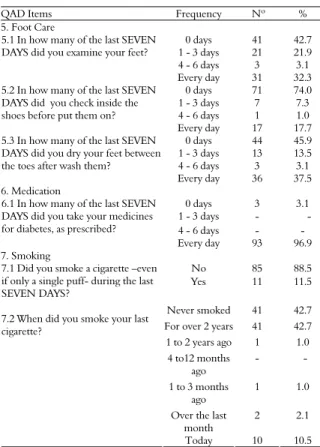
As for the foot evaluation in the last week, 41 (42.7%) stated that they did not examine the feet in any day, and 71 (74%) stated did not verify inside the shoes before put them on, in any day. Regarding medications, 93 (96.9%) use them daily and only three (3.1%) mentioned not to use them in any day. Regarding smoking, 11 (11.5%) smoked at least one cigarette in the last week. When inquired about the last time they had smoked, 41 (42.7%) affirmed to have smoked for over 2 years and 10 (10.4%) stated to have smoked on the day of the interview.
Table 3. Distribution of the SDSCA dimensions Foot care, Medication and Smoking according to the frequency reported by the patients with DM- 2. (n=96). Teresina, Piauí State, Brazil, 2011.
QAD Items Frequency Nº %
5. Foot Care
0 days 41 42.7
1 - 3 days 21 21.9
4 - 6 days 3 3.1
5.1 In how many of the last SEVEN DAYS did you examine your feet?
Every day 31 32.3
0 days 71 74.0
1 - 3 days 7 7.3
4 - 6 days 1 1.0
5.2 In how many of the last SEVEN DAYS did you check inside the shoes before put them on?
Every day 17 17.7
0 days 44 45.9
1 - 3 days 13 13.5
4 - 6 days 3 3.1
5.3 In how many of the last SEVEN DAYS did you dry your feet between the toes after wash them?
Every day 36 37.5
6. Medication
0 days 3 3.1
1 - 3 days - -
4 - 6 days - -
6.1 In how many of the last SEVEN DAYS did you take your medicines for diabetes, as prescribed?
Every day 93 96.9
7. Smoking
No 85 88.5
Yes 11 11.5
Never smoked 41 42.7
For over 2 years 41 42.7
1 to 2 years ago 1 1.0
4 to12 months ago
- -
1 to 3 months ago
1 1.0
Over the last month
2 2.1
7.1 Did you smoke a cigarette –even if only a single puff- during the last SEVEN DAYS?
7.2 When did you smoke your last cigarette?
Today 10 10.5
Table 4. Correlation between the scores of SDSCA and the socioeconomic characteristics. (n = 96). Teresina, Piauí State, Brazil, 2011.
SDSCA (n = 96) r p
Age 0,03 0,57
Schooling (years) -0,10 0,01
Family Income - 0,05 0,80
The schooling was statistically significant, with weak and inverse correlation.
Discussion
Sociodemographic and clinical profile of the patients
As observed, there was a predominance of elderly people due to the evident population ageing and the involvement, due to the diabetes, of a larger portion of people in this phase of life, than in the other age ranges.
About two thirds of the sample was composed of female. This may be related to the higher demand for health system, by women, and also due their majority in population, in relation to male, in the oldness phase (GRILLO; GORINI, 2007). As for the color there was no predominance of DM-2 among the brown population, with similar numbers between whites and blacks. This was similar to the findings by other studies carried out in Brazil, in
which there was a high miscegenation of the population, hampering the comparison with studies of other countries, which requires studies with more refined method to examine this variable in Brazil (BOSI et al., 2009; TORQUATO et al.,2003).
There was the predominance of people with one to five years of education, as well as was shown in a study carried out in Porto Alegre, Rio Grande do Sul State, Brazil, where 65.5% of the sample said to possess this same time of education (GRILLO; GORINI, 2007). In the present study there was a significant portion of illiterate (18.7%). These numbers are under the Northeast average for adults over the age of 25, 23.8%, but far above the national average of 12.0% (IBGE, 2010).
The education is the sustaining basis for the promotion of a satisfactory self-care (RODRIGUES et al., 2009). There was statistical significance was between the scale SDSCA and education (Table 4), this was reversed and weak, ie, lower educational level, greater adherence to treatment and consequent self-care.
The schooling interfere significantly with the adherence to the treatment of DM, constituting a major challenge for health professionals. According to Cranor et al. (2003) was a 50% reduction in HbA1c in diabetic patients who received pharmaceutical care. Thus, it was proved that the pharmaceutical supervision is suggested as a relevant factor in self-care of diabetic patients. Whereas the Pharmaceutical Professional is also a member of the multidisciplinary health care team of the Family Health Centers.
The carriers of DM-2 presented the higher applicability and acceptability of the orientation provided by the health professionals, as the higher their level of education. Under these assumptions, the respondents had a greater difficulty to maintain a satisfactory adherence to the treatment, facilitating the occurrence of possible complications.
which also refers to the knowledge of the level of education of both: elderly person and caregiver.
Associated with a good education, the carriers of DM-2 should have appropriate conditions of life, with healthy feeding and use of proper medication. To that end, it is necessary an income compatible with the needs that the treatment requires. The major risk for developing metabolic syndromes was recently showed by studies involving needy populations and Brazilian women. It has been suggested that the socioeconomic status influences alimentary and sedentary habits, which are highly related to the appearance of the DM-2 (GRONNER et al., 2011; MARQUEZINE et al., 2008). The prevalence of 60.3% of the participants with family income up to two minimum wages can compromise considerably the adherence to the treatment, however it does not impede that simple measures such as the change in the menu and access to government programs, help in the treatment and control of the disease.
Among the participants with some type of chronic complication, we found the predominance of retinopathy. In a study carried out in a primary health care center in Chile (TORRES; STROBL, 2003), were studied 105 patients residents in the urban area, being observed 23.5% of cases of diabetic retinopathy. That prevalence was 20.5% and 19.5%, in Chile (VALDÉS et al., 2004) and Campos dos Goytacazes, Rio de Janeiro State (GUEDES et al. (2009), respectively. The occurrence of this complication is superior in the present research, indicating the involvement of 1/3 of the total.
Moreover, the visual impairment is irreversible, and in developing countries such as the Brazil, DM-2 is among the first causes of blindness. When talking about of an adult who was been blinded, it should be considered the negative consequences, since the adaptation and the social, economic and emotional reintegration of these people and their families.
The neuropathy was the second most frequent chronic complication. Tavares et al. (2009) registered only 2.8% of the sample of diabetics with neuropathy. In Porto Alegre, Rio Grande do Sul State, BRAZIL it was observed a linear increase of the frequency of the microangiopathic complications according to the number of risk factors (SCHEFFELet al., 2004). There was a more significant prevalence of these cases in our study, leading to more damages, because the most important risk factor for the appearance of foot ulcers is the peripheral diabetic neuropathy.
Self-care according to SDSCA
The majority of the patients did not follow the nutritional guidelines from a health professional in none days of the week. Thus, it is understood that such information, if not insufficient, at least becomes inappropriate, because even with deficiency in the level of education, it is possible to implement strategies which facilitate the self-care.
In contrast, most of the sample also reported to eat five or more portions of fruits or vegetables at least one day a week. This demonstrates that the participants ingested reasonable amounts of healthy foods. Given the reality, this is not satisfactory, because the patient begins to have the false sense of autonomy and labels certain foods as healthy, without, however, having the real information of their risks or benefits. The utilization of workshops with groups of diabetics, the involvement of relatives through home visits and the elaboration of feeding plans specific for each individual (guided by a nutritionist) can promote changes in this behavior.
The low ingestion of sweet foods by the respondents should also be considered. But before, it is necessary to make a proviso and ask: what is sweet food for this population? Would it be only foods that give that feeling to the taste? Or could all other carbohydrates be included in this definition regardless of this characteristic? If the answer was this last assertive, it would certainly be a relevant fact in order to favor the reduction in the glycemic indices. However, it is known that most population with low education level does not know this information and, thus, may compensate the absence of ingestion of sweet flavored foods, without knowing, with other carbohydrates abundantly present on the table of many Brazilians: rice, bean and pasta. Adding also the need for a cultural adaptation to the Brazilian regions of the SDSCA, this possibly may have compromised the self-care evaluation on this aspect.
Regarding the frequency the participants perform specific activities such as swimming, running, walking or riding a bicycle, the majority declared not perform in any day during the week, revealing that the sedentary lifestyle is significantly present. The physical activity is as an essential component of the treatment (TAVARES et al., 2009). The regular practice of exercises assists to reduce or stabilize the body weight, to reduce the need for using oral medication, contributing to the improvement of the glycemic control and, thus, reducing the risk of complications. Then, once again was stressed the need for an interdisciplinary team work in the primary care in Teresina, where the participation of a physical educator could result in more benefits to this type of customers.
Despite of the advantages to perform physical activity, a large portion of the population is sedentary or exercises insufficiently to reach satisfactory results. About 50% of the individuals that begins an exercise program quit during the first six months (FECHIO; MALERBI, 2004). Several factors can influence this, such as the difficulty in locomotion, visual deficit, inappropriate footwear or even the absence of a companion to perform physical exercises, absence of appropriate area to perform it and the direct supervision of a qualified professional. Many participants during the period of interviews have complained about this factor and the indifference of the public managers in many districts of Teresina, which need more security and areas to perform physical activity. It is also necessary that the population with diabetes becomes more informed about the risks of extreme or poorly performed physical activity.
All the types of physical activity can be performed by diabetic people, because the benefits of the exercises operate as a counterweight for the factors of risk which complicate the disease (RAMALHO; SOARES 2008). However, the patient must have the understanding that there is a very close threshold between the benefits and the risks of activities without the supervision of a physical educator, such as the hypoglycemia.
Regarding the frequency of monitoring glycemic indices, 89 (92.7%) of the sample answered none day. Only seven (7.3%) of the participants performed this monitoring over the week. In a recent study carried out in São Paulo, São Paulo State, it was used a group of intensive monitoring of the normal blood glucose in three days a week for eight weeks. It was observed that the significant change in the self-care of the patients provided a significant improvement of the glycemic control, reducing the risks of abrupt alterations of blood
glucose, and provided for the health professionals, through the records of glycemic indices, tools for possible changes in the therapeutic plan (PIMAZONI-NETTO et al., 2011).
In a study carried out in Rio de Janeiro, Rio de Janeiro State, 78.4% reported to know the importance of checking the capillary blood glucose daily, however the majority did not know the desirable parameters for healthy levels (PACHECO et al., 2007). In order to change this reality, it is essential the training of more health professionals able to guide the patients, using as strategy the understanding of the socioeconomic and cultural reality, because, it is of general knowledge that this disease requires time and high costs for the home monitoring.
It can be said that the sample percentage that evaluate the feet in some day of the week was 55 (57.3%). For the level of education of the participants, this percentage is very relevant, showing that the guidelines for this care are followed by the majority of the sample. However, there are also patients that do not perform this activity and are at continuous risk of presenting complications, such as wounds of difficult healing or even amputation.
Other fact that shows the unsatisfactory practice of the self-care is revealed when the patients are inquired about the frequency they checked inside the shoes before put them on. In comparison to a research performed in the United States, using the same questionnaire, it was verified that 60% of the participants checked inside their shoes less than three days a week (BELL et al., 2005).
In a study of cohort was observed that the risk of hospitalization of diabetic individuals with feet infection was 55.7 times higher than those who did not develop it. The foot infection contributed for the hospitalization in 71.7% of the cases and the risk of amputation was 154.5 times higher (LAVERY et al.,2006). The diabetic foot was also reported among the chronic complications.
Good practices of hygiene and feet care can reduce the complications and prevent an insidious advance of the disease. A diabetic person with a feet complication can becomes more sedentary due to the difficulty in ambulation, promoting the weight gain and a higher difficulty of going to the health center and, thus, to complicate the adherence to the treatment. This cycle can follow the diabetic patient, until all the capacities of self-care become unable.
In relation to the medication, the great majority reported to take the medicines for diabetes, as recommended, every day. This fact, when observed in isolation, draws attention, because it demonstrates the significant adherence to the medical treatment of the patients. However, the isolated use of the medication is not effective in reducing acute complications such as the hyperglycemia. Based on these data, it is necessary a more appropriate evaluation of the patients during the consultations and an increase in the annual frequency of visits of these patients to the Health Center, since not only this medicalized point of view brings benefits, being also essential the change of behavior and the empowerment of the patient and family in the whole process.
Conclusion
To the monitoring of the glycemic indices, which proved to be unsatisfactory in 92.7% of the sample, also the sedentary lifestyle (63.5%) and the food ingestion without professional supervision(53.1%). The foot care was characterized as unsatisfactory in a significant portion of the sample, not being observed routine practices that ensure the prevention of the diabetic foot. It was found this type of injury in the diabetics with some type of complication(11.8%).
The use of medication was observed in most participants. However, the reevaluation of the patients in shorter periods of time, with the use of individualized therapeutic plans, combined with the education focused on the self-care can favor the adherence to the treatment and thus maintain the glycemic levels of the assisted population within safe concentrations.
In Teresina, it is evident the need for more effective participation of nutritionists and physical educators in order to prescribe specific therapeutic plans.
References
BARBUI, E. C.; COCCO, M. I. M. Conhecimento do cliente diabético em relação os cuidados com os pés.
Revista da Escola de Enfermagem da USP, v. 36, n. 1, p. 97-103, 2002.
BARSAGLINI, R. A.; CANESQUI, A. M. A alimentação e a dieta alimentar no gerenciamento da condição crônica do diabetes. Saúde e Sociedade, v. 19, n. 4, p. 919-932, 2010.
BELL, R. A.; ARCURY, T. A.; SNIVELY, B. M.; SMITH, S. L.; STAFFORD, J. M.; DOHANISH, R.; QUANDT, S. A. Diabetes foot self-care practices in a rural, triethnic population. TheDiabetes Educator, v. 31, n. 1, p. 75-83, 2005.
BOSI, P. L; CARVALHO, A. M.; CONTRERA, D.; CASALE, G.; PEREIRA, M. A.; GRONNER, M. F.; DIOGO, T. M.; TORQUARTO, M. T. C. G.; OISHI, J.; LEAL, A. M. O. Prevalência de diabetes melito e tolerância à glicose diminuída na população urbana de 30 a 79 anos da cidade de São Carlos, São Paulo. Arquivos Brasileiros de Endocrinologia e Metabolismo, v. 53, n. 6, p. 726-32, 2009.
BRASIL. Ministério da Saúde. Diabetes Mellitus: cadernos de Atenção Básica. Secretaria de Atenção à Saúde. Brasília: Ministério da Saúde, 2006.
BRASIL. Ministério da Saúde. Vigitel Brasil 2010: vigilância de fatores de risco e proteção para doenças crônicas por inquérito telefônico. Secretaria de Gestão Estratégica e Participativa. Brasília: Ministério da Saúde, 2011.
CRANOR, C. W.; BUNTING, B. A.; CHRISTENSEN, D. B. The Asheville Project: long-term clinical and economic outcomes of a community pharmacy diabetes care program. Journal of the American Pharmacy Association, v. 43, n. 2, p. 173-84, 2003.
FECHIO, J. J.; MALERBI, F. E. K. Adesão a um Programa de Atividade Física em Adultos portadores de diabetes. Arquivos Brasileiros de Endocrinologia e Metabolismo, v. 48, n. 2, p. 267-275, 2004.
GONZALEZ, J. S.; SAFREN, S. A.; DELAHANTY, L. M.; CAGLIERO, E.; WEXLER, D. J.; MEIGS, J. B.; GRANT, R. W. Symptoms of Depression Prospectively Predict Poorer Self-Carein Patients with Type 2 Diabetes.
Diabetic Medicine, v. 25, n. 9, p. 1102-1107, 2008. GRILLO, M. F. F.; GORINI, M. I. P. C. Caracterização de pessoas com Diabetes Mellitus Tipo 2. Revista Brasileira de Enfermagem, v. 60, n. 1, p. 49-54, 2007. GRONNER, M. F.; BOSI, P. L.; CARVALHO, A. M.; CASALE, G.; CONTRERA, D.; PEREIRA, M. A.; DIOGO, T. M.; TORQUATO, M. T. C. G.; SOUZA, G. M. D.; OISHI, J.; LEAL, A. M. O. Prevalence of metabolic syndrome and its association with educational inequalities among Brazilian adults: a population-based study. Brazilian Journal of Medical and Biological Research , v. 44, n. 7, p. 713-719, 2011.
Família. Revista Brasileira de Oftalmologia, v. 8, n. 2, p. 90-95, 2009.
IBGE-INSTITUTO BRASILEIRO DE GEOGRAFIA E ESTATÍSTICA. Indicadores sociais municipais: uma análise dos resultados do universo do censo demográfico. Rio de Janeiro: IBGE, 2010.
LAVERY, L. A.; ARMSTRONG, D. G.; WUNDERLICH, R. P.; MOHLER, M. J.; WENDEL, C. S.; LIPSKY, B. A. Risk factors for foot infections in individuals with diabetes.
Diabetes Care 2006, v. 29, n. 6, p. 1288-1293, 2005. MARQUEZINE, G F.; OLIVEIRA, C. M.; PEREIRA, A. C.; KRIEGER, J. E.; MILL, J. G. Metabolic syndrome determinants in an urban population from Brazil: social class and gender-specific interaction. International Journal of Cardiology, v. 129, n. 2, p. 259-265, 2008.
MICHELS, M. J.; CORAL, M. H. C.; SAKAE, T. M.; DAMAS, T. B.; FURLANETTO, L. M. Questionário de Atividades de Autocuidado com o Diabetes: tradução, adaptação e avaliação das propriedades psicométricas.
Arquivos Brasileiros de Endocrinologia e Metabolismo, v. 54, n. 7, p. 644-651, 2010.
MOREIRA, R. C.; SALES, C. A. O cuidado de enfermagem para com o ser portador de pé diabético: um enfoque fenomenológico. Revista da Escola de Enfermagem da USP, v. 44, n. 4, p. 896-903, 2010.
PACHECO, G. S.; SANTOS, I.; BREGMAN, R. Clientes com doença renal crônica: avaliação de Enfermagem sobre a competência para o autocuidado. Escola Anna Nery. Revista de Enfermagem, v. 11, n. 1, p. 44-51, 2007. PIMAZONI-NETTO, A.; RODBARD, D.; ZANELLA, M. T. Rapid improvement of glycemic control in type 2 diabetes using weekly intensive multifactorial interventions: Structured glucose monitoring, patient education, and adjustment of therapy - a randomized Controlled Trial.
Diabetes Technology and Therapeutics, v. 13, n. 10, p. 997-1004, 2011.
RAMALHO, A. C. R.; SOARES, S. O papel do exercício no tratamento do diabetes melito tipo 1. Arquivos Brasileiros de Endocrinologia e Metabolismo, v. 52, n. 2 , p. 260-267, 2008.
RODRIGUES, F. F. L.; ZANETTI, M. L.; SANTOS, M. A.; MARTINS, T. A.; SOUSA, V. D.; TEXEIRA, C. R. S. Conhecimento e atitudes: componentes para a educação em
diabetes. Revista Latino-Americana de Enfermagem, v. 17, n. 4, p. 468-473, 2009.
SANTOS FILHO, C. V.; RODRIGUES, W. H. C.; SANTOS, R. B. Papéis de autocuidado: subsídios para enfermagem diante das reações emocionais dos portadores de Diabetes Mellitus. Escola Anna Nery. Revista de Enfermagem , v. 12, n. 1, p. 125-129, 2008.
SCHEFFEL, R. S.; AGUIAR, D. C.; PINHEIRO, R. P.; MORAES, C. C.; PIMENTEL, I. R. S.; FERRAZ, C. L. H.; FERRAZ, T. M. B. Prevalência de complicações micro e macrovasculares e de seus fatores de risco em pacientes com Diabetes Melito do tipo 2 em atendimento ambulatorial. Revista da Associação Medica Brasileira de São Paulo, v. 50, n. 10, p. 263-267, 2004.
TAVARES, D. M. S; DIAS, F. A.; ARAÚJO, L. R.; PEREIRA, G. A. Perfil de clientes submetidos a amputações relacionadas ao Diabetes Mellitus. Revista Brasileira de Enfermagem,v. 62, n. 6, p. 825-830, 2009. TORQUATO, M. T. C. G.; MONTENEGRO JUNIOR, R. M.; VIANA, L. A. L.; SOUZA, R. A. H. G.; LANNA, C. M. M.; LUCAS, J. C. B.; BIDURIN, C.; FOSS, M. C. Prevalence of Diabetes Mellitus and impaired glucose tolerance in the urban population aged 30-69 years in Ribeirão Preto (São Paulo), Brazil. São Paulo Medical Journal, v. 121, n. 6, p. 224-30, 2003.
TORRES, A. C.; STROBL, V. A. Estrategia de detección de retinopatia diabética en un centro de salud primario.
Revista Brasileira de Oftalmologia, v. 60, n. 1, p. 47-52, 2003.
VALDÉS, N. C.; GONZÁLEZ, J. P.; FERNÁNDEZ, R. G.; MOJENA, N. C.; CASALES, M. R.; BEGUIRISTAIN, J. D. Prevalencia de la retinopatía diabética en pacientes del nivel primario de salud. Revista Cubana de Medicina General Integral, v. 20, n. 2, p. 40-45, 2004.
Received on March 5, 2012. Accepted on July 30, 2012.