Maria da Luz Rosário de SousaI Maria Paula Maciel Rando-MeirellesI
Luísa Helena do Nascimento TôrresI
Antonio Carlos FriasII
I Departamento de Odontologia Social.
Universidade Estadual de Campinas. Campinas, SP, Brasil
II Departamento de Odontologia Social.
Universidade de São Paulo. São Paulo, SP, Brasil
Correspondence:
Maria da Luz Rosário de Sousa Universidade Estadual de Campinas Av. Limeira, 901- Areião
13414-903 Piracicaba, SP, Brasil E-mail: [email protected] Received: 05/03/2012
Approved: 04/18/2013
Article available from: www.scielo.br/rsp
Dental caries and treatment
needs in adolescents from the
state of Sao Paulo, Brazil
ABSTRACT
OBJECTIVE: To estimate the prevalence of dental caries and treatment needs in 12-year-olds and adolescents.
METHODS: Cross-sectional study based on results from the epidemiological surveys: Oral Health Conditions in the State of Sao Paulo, 2002 and the Brazilian Oral Health Survey (SBBrasil) 2010. Secondary data for 5,782 (2002) and 369 (2010) 12-year-olds and 880 (2002) and 300 (2010) 15- to 19-year-olds were analyzed. Dental caries attack was evaluated using the DMFT (decayed, missing or fi lled teeth) index and the need for treatment verifi ed using the criteria proposed by the World Health Organization. The Signifi cant Caries Index was used to measure the severity of the decay in the tercile of the group with the highest prevalence of the disease. In order to analyze the results, the Chi-squared and Mann-Whitney tests were used, with a 5% signifi cance.
RESULTS: There was a decrease of 39.3 percentage points in the DMFT index for 12-year-olds (p < 0.001) and of 41.1 percentage points for the adolescents (p < 0.001) between 2002 and 2010, and an increase of around 161.0 and 303.0 percentage in the group which was free from dental caries respectively. The percentage of restored teeth decreased in both age groups, although the prevalence of dental caries did not change in the group more affected by dental caries. In the group with few dental caries, there was a decrease in the component ‘tooth loss’ for adolescents and increase in the component ‘decayed teeth’ for the 12-years-old and the adolescents. There was an increase in the need for dental treatment in the group as a whole and in the group of 12-year-olds more affected by dental caries; and among the adolescents, the need for restoration on two or more surface decreased in the group as a whole and also in the group which suffered least from dental caries.
CONCLUSIONS: The decreasing need for non-complex treatment in adolescents suggests that promotion and prevention activities are having a positive effect on this group. Moreover, the two epidemiological surveys in the state of Sao Paulo show improvements in oral health conditions in both age groups studied and calls for monitoring aimed also at the group least affected by dental caries.
Monitoring oral health over the years, through collec-ting epidemiological data contributes to verifying trends and aids in health care planning and decision making.19 Thus, analyzing epidemiological data enables it to be seen whether the actions carried out are effective in decreasing the pathologies, especially when they are carried out with age groups not traditionally included in public health measures.
With the change in distribution patterns of dental caries, the DMFT (Decayed, Missing and Filled Teeth) index has become a less signifi cant population descriptor than when this distribution was more homogenous.9 One of the indices which demonstrates this change is the Signifi cant Caries Index (SiC), which allows the polarization of dental caries4 and socio-economic disparities in suffering from dental caries between population groups to be identifi ed. Using these two indicators together means that inequalities in oral health between different population groups within the same community can be highlighted, identifying the needs of each group and guiding health care activities.9
Epidemiological surveys in different countries have shown a signifi cant decrease in the number of 12 to 18-years-old suffering from dental caries over the last few decades. However, from 2000 onwards, this trend changed for certain population groups. In a national survey in China and a local survey in Zurich, Switzerland, it was observed that the prevalence of the disease remained stable or increased in groups of 12 to 14-years-old between 2000 and 2005.23,24 The same was observed in the state of Nevada in the United States, where the prevalence increased in the 12 to 14 and 16 to 19-years old age groups, both overall and in the groups who suffered most from dental caries, in 2007 and 2008.10
Population surveys have been carried out in Brazil since 1986.a The fi rst study in the state of Sao Paulo was in 1998.b In 2002, another population based study was carried out in the state of São Paulo,c part of the Brazilian Oral Health Survey (SBBrasil) 2003 sample. In 2010d the Brazilian Ministry of Health carried out another national survey sampling the state capitals and the macro regions.
The 2008 study by Gushi et al15 showed a marked reduc-tion in the occurrence of dental caries in 12-years-old children in the state of Sao Paulo over a four year period (1998 to 2002), both in the group which suffered most from dental caries and in the groups which suffered least. However, in the same period, the percentage of INTRODUCTION
components with caries in the group with low levels of caries and the percentage of restorations in the group with the highest levels of caries both increased, showing the importance of the SiC analysis. On that occasion there was no comparative data on dental caries for the 15 to 19-years-old age group in the state of Sao Paulo.
The aim of this study is to estimate the prevalence of dental caries and need for treatment in 12-years-old children and adolescents in the state of Sao Paulo
METHODS
This was a cross-sectional study. The data used are the results from the epidemiological survey Oral Health Conditions in the State of São Paulo – Condições de
Saúde Bucal no Estado de São Paulo, 2002 and the
SBBrasil 2010.
The probabilistic sampling process and the methodology used in 2002 were described by Gushi et al14 (2005). In 2010, the sample size was defi ned based on data on dental caries obtained in the SBBrasil 2003. For each age group the mean and respective standard deviation of the decayed, missing and fi lled teeth index was used as the basis for the calculation. Considering that the research was carried out in the home, a set number of residences were selected to be visited, from which the sample size and respective margin of error were calculated.
In 2002, 15 municipalities in the interior were randomly selected, plus the state capital, and 5,782 12-years-old children and 880 adolescents aged 15 to 19 were examined. In 2010, 15 municipalities were randomly selected in each state, plus the capital, and the secon-dary data of 369 12-years-old and 300 adolescents were analyzed.
The fi eld work teams were trained and instructed; 16-hour training workshops aimed to discuss the operationalization of the stages, the attributes of each participant and to ensure the acceptable level of confor-mity with the procedures. The examiners participated in 32-hour training workshops, containing theoretical and practical content, which took place in various cities around the country. In order to standardize the team, the consensus technique was used.13 The model proposed by the World Health Organization (WHO)26 was used as a reference, with only those examiners who obtained a kappa statistic for inter-observer concordance of 0.65 or above approved to participate in the survey.
a Ministério da Saúde (BR). Divisão Nacional de Saúde Bucal. Levantamento Epidemiológico em Saúde Bucal: Brasil, zona urbana. Brasília
(BR); 1986.
b Secretaria de Estado da Saúde de São Paulo. Levantamento epidemiológico em saúde bucal: Estado de São Paulo, 1998. São Paulo; 1999. c Ministério da Saúde (BR). Secretaria de Atenção à Saúde. Departamento de Atenção Básica. Projeto SB Brasil 2003: condições de saúde
bucal da população brasileira 2002-2003. Resultados principais. Brasília (BR); 2004.
d Ministério da Saúde (BR). Coordenação Geral de Saúde Bucal. Banco de dados da Pesquisa Nacional de Saúde Bucal – Projeto SBBrasil
no. 15,498, 7th January 2010. The 2002 Condições
de Saúde Bucal no Estado de São Paulo project was
approved by the Research Ethics Committee (Process no. 581/2000).
RESULTS
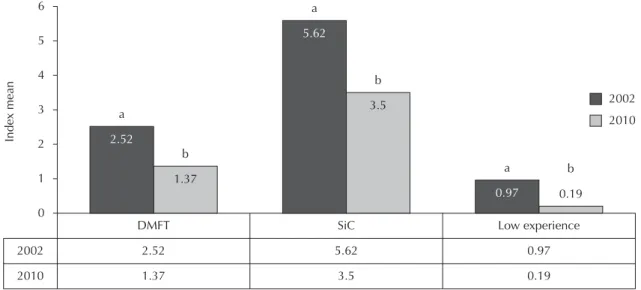
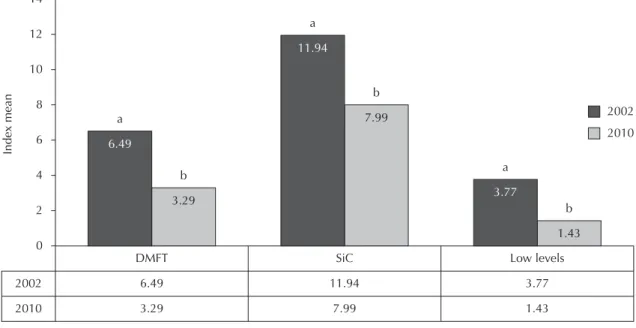
There was a decrease of 39.3 percentage points in the DMFT at age 12 (p < 0.001) and of 41.1 percentage points in the adolescents (p < 0.001) between 2002 and 2010. The decrease in the groups who suffered most from dental caries was similar for the 12-years-old (37.7%) and the 15 to 19-years-old (33.0%). In the group who suffered least from dental caries, the DMFT decreased by 80.45 and 62.1% respectively for each age group (Figures 1 and 2).
In 2002, 32.9% of the 12-years-oldand 9.6% of the adolescent had no dental caries. In 2010 this percentage was 53.0% and 29.1% respectively, an increase of approximately 161% and 303% in the group which with no dental caries.
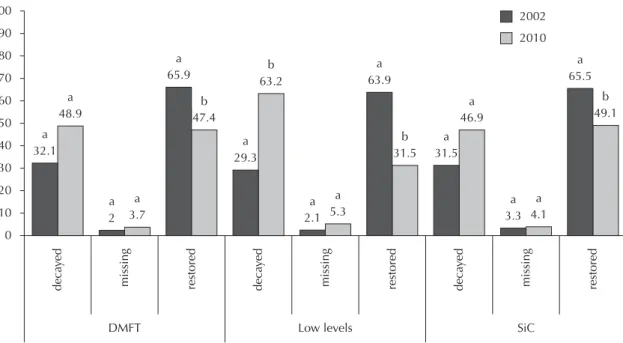
Figures 3 and 4 show the percentage differences for each component of the DMFT index in each age group in 2002 and 2010.
In 2010, for those aged 12, there was a decrease in the percentage of the restored component in the group overall and in the group who suffered most from dental caries (p < 0.001); between 1998 and 2002 there had been an increase. In the group with the lowest expe-rience of caries, in addition to the decrease in this component, dental caries increased, the difference being statistically signifi cant.
The orthodontic examinations followed the methodo-logy proposed by the WHO.26 A dental mirror and WHO dental probe (CPI type) were used in natural light with both examiner and individual seated.
The SiC index was used to defi ne the severity of the dental caries in the tercile of the group who had the highest levels of the disease. The sample was divided into two groups for the statistical analysis: the fi rst group contained the tercile of individuals who suffered most from dental caries (SiC group, highest experience of caries group) and the other made up of the rest of the indi-viduals who suffered least (low levels of dental caries).
In addition to levels of dental caries, evaluated using the DMFT index, during the exam need for orthodontic treatment according to the criteria proposed by the WHO were also verifi ed: restoration of one surface, restoration of two or more surfaces, crown, veneers, endodontics, extraction, remineralization and use of sealants.
The STATA version 12 statistical program was used to analyze the data from the 2002 and 2010 surveys. To analyze the results, the chi-squared and Mann-Whitney tests were used, with a 5% level of significance. Descriptive analyses of the conditions in question were carried out considering the weighting, as in 2010 complex sampling was used and the primary sampling unit and the weighting were taken into consideration when analyzing the data.
The SBBrasil 2010 Projects followed the standards set by the Declaration of Helsinki and was approved by the Conselho Nacional de Ética em Pesquisa, record
Note: numbers for the same variable followed by different letters differ at the 5% level of signifi cance. DMFT: Decayed, Missing and Filled Teeth
SiC: Signifi cant Caries Index.
Figure 1. Comparison of the decayed, missing and fi lled teeth index in the group overall, in the tercile with severe dental caries (Signifi cant Caries Index) and in the two terciles with those with low levels of dental caries at 12-years-old. State of São Paulo, 2002 and 2010.
2002
2010
SiC Low experience
2.52
1.37
5.62
3.5
0.97
0.19 2002
2010
DMFT
Index mean
5
4
3
2
1 6
0
b
1.37 a
2.52
b
3.5 a
5.62
0.19 b a
For the adolescents, the decayed component increased for the group overall and in the group who suffered least from dental caries. The restored component decreased in all three groups between 2002 and 2010. The only group which showed any difference in the extract component was the group who suffered least from dental caries, in which the percentage decreased in the period studied.
The table shows the needs for treatment which were statistically different between 2002 and 2010: need for endodontics and application of sealant at age 12, and for the adolescents, the need for restoration on one surface and on two or more surfaces. The percentage of the other needs (crowns, veneers, extraction and remineralization of white spots) did not change in the period in question.
DISCUSSION
Epidemiological surveys are key in monitoring oral health trends. In the last few decades, there has been a reduction in the number of children and adolescents suffering from dental caries in the state of São Paulo, and an increase in the percentage with no dental caries.15 The results of this study show that this trend continues as, between 1998 and 2002 the mean DMFT index in 12-years-old decreased from 3.72 to 3.53 and in 2010 it was 1.37. In the same age group, the percentage of those with no dental caries increased by 20% to 32.9% (1998-2002) and in 2010 this percentage was 53%.
For the adolescents, the data available for the period between 1986 and 2002 for the state of Sao Paulo also suggest a tendency for levels of dental caries to decrease. Between 2002 and 2010 the mean DMFT index decreased from 6.44 to 3.29, and the percentage of individuals with no dental caries increased from 9.6% to 29.1%. Studies of this trend in various countries have also shown reductions in the numbers suffering from dental caries.
This decrease occurred in countries on different conti-nents and with different socioeconomic conditions, such as England, the United States, China, Italy and Brazil.5,7,12,24 The studies in China and the United States were carried out every two years and showed that, even with a notable reduction in the condition of children and adolescents’ oral health, at the end of a long period, 14 years and 8 years respectively, the tendency to decrease was inverted and an increase in prevalence occurred, both in the group overall and in the group of those had the highest experience of caries (SiC). In a study of Nigerian children with DMFT below 1.5 at age 12, a tendency for the prevalence of dental caries to increase was also observed.25 For Bagramian et al3 (2009), in a review of the epidemiological literature in various countries, the causes of this increase in prevalence are still unclear, although the fi ndings suggest that the benefi ts of prevention are not available to all, and that coordinated education and programs promoting oral health are necessary in order to counter the threat of an explosion in levels of dental caries.25
Note: numbers for the same variable followed by different letters differ at the 5% level of signifi cance. DMFT: Decayed, Missing and Filled Teeth
SiC: Signifi cant Caries Index
Figure 2. Comparison of the decayed, missing and fi lled teeth index in the group overall, in the tercile with severe dental caries (Signifi cant Caries Index) and in the two terciles with those with low levels of dental caries in adolescents. State of São Paulo, 2002 and 2010.
2002
2010
SiC Low levels
6.49
3.29
11.94
7.99
3.77
1.43 2002
2010
DMFT
Index mean
10 12
8
6
4
2 14
0
b
3.29 a
6.49
b
7.99 a
11.94
1.43 b a
According to our results, the tendency to decrease continued even when the DMFT means for the groups with the highest and lowest experience of dental caries
were verifi ed. This suggests that, in the state of Sao Paulo, the benefi ts are reaching all groups homogenously, both those aged 12 and those aged 15-19. These results
Note: numbers for the same variable followed by different letters differ at the 5% level of signifi cance. DMFT: Decayed, Missing and Filled Teeth
SiC: Signifi cant Caries Index
Figure 3. Frequency of the decayed, missing, restored components for the decayed, missing and fi lled index, the low level group and the Signifi cant Caries Index at age 12. State of São Paulo, 2002 and 2010.
2002
2010 100
90
80
70
60
50
40
30
20
10
0
3.7 a 2 a
63.2 b
65.5 a
b 49.1 46.9
a
a 31.5 63.9
a
b 31.5 b
47.4
a 29.3 65.9
a
48.9 a
a 32.1
deca
yed
missing restored deca
yed
missing restored deca
yed
missing restored 3.3
a 4.1
a 5.3
a
2.1 a
SiC Low levels
DMFT
Note: numbers for the same variable followed by different letters differ at the 5% level of signifi cance. DMFT: Decayed, Missing and Filled Teeth
SiC: Signifi cant Caries Index
Figure 4. Frequency of the decayed, missing, restored components for the decayed, missing and fi lled index, the low level group and the Signifi cant Caries Index for adolescents. State of São Paulo, 2002 and 2010.
2002
2010 100
90
80
70
60
50
40
30
20
10
0
8.5 a 7.6
a
32.2 b
69 a
b 64.7
24.9 a a 22.5 66
a b
63.6 b
64.4
a 28.1 67.8
a
27.1 b a 24.7
deca
yed
missing restored deca
yed
missing restored deca
yed
missing restored 8.5
a 10.4
a
4.2 b 5.3
a
SiC Low levels
corroborate those of Ditmyer et al9 (2011) in Nevada (USA) for 13-15 and 16-18-years-old, and Steiner et al23 (2010) in Zurich (Switzerland) at age 12. The latter study showed a 90% reduction in the DMFT for the whole group and an 83% reduction in the group who suffered most form dental caries over a period of 45 years. Over a 25 year period in Australia (1977 to 2002), Armfi eld et al2 (2009) observed a decrease of approximately 79.6% in the DMFT and 68% in the SiC in the permanent teeth of schoolchildren aged 11 and 12. The study observed greater reductions over this period and detected growing inequalities in suffering from dental caries. Likewise, Constante et al6 (2010) reported the experience of 12 to 13-years-old school children in a public school in Florianópolis, SC, with a 91.5% descrease in the DMFT mean, in other words, from 9.2 in 1971 to 0.78 in 2009 and SiC of 3.4 in 2002 to 2.8 in 2009, representing a 47% decrease. In Bilac, in the interior of Sao Paulo, a decrease in the DMFT and an increase in those free of dental caries was verifi ed between 1998 and 2004, even though the municipality did not fl uoridate the public water supply.17
In addition to the decrease in the disease in the same age group, this study showed that the percentage of the DMFT decrease was similar between the age groups (41.1% for adolescents and 39.3% for 12-years-old). The natural history of dental caries suggests that increasing age is accompanied by an increased number of lesions, although it was observed that the decrease was propor-tional between the age groups in question. Once again, oral health care activities appear not to distinguish between the age groups, at least with regards to the age groups studied here, in contrast to former models of health care which prioritized specifi c age groups.
When the components are analyzed in isolation, a decrease in the percentage of the restored component is noted at age 12 in all groups. In the group overall and in that with the highest experience of dental caries the percentage of the decay component underwent no change in the period in question although it increased in
the group with the lowest experience of dental caries, as also occurred in the study by Gushi et al15 (2008). In other words, the fi ndings of the study indicate that, at age 12, there was an increase in the number of teeth with dental caries and a decrease in restorations in the group with the lowest dental caries score. On that occasion, there was a decrease in the percentage of teeth with dental caries and an increase in those which were restored both for the group overall and for the group which suffered most from dental caries, which differs from the results of this study. Constante et al6 (2010), in a longitudinal study of schoolchildren aged 12 to 13, observed that in the latter years of 38 years of monitoring, there was an increase in component D, suggesting that the use of orthodontic services in the region of Florianópolis had declined, or that professionals were adopting a less invasive approach.
At fi rst glance, the results of the DMFT components in this study may suggest that neither curative nor preventa-tive treatments were effecpreventa-tively carried out. The increase in the component decayed in just the group with the lowest dental caries experience in the two periods (1998-2002 and (1998-2002-2010) suggests that attention should be directed primarily at the group with the highest preva-lence (SiC) in an effort to reduce the disease in the state of Sao Paulo. Contrary to what might have happened in Florianopolis, where use of services may have declined. This effort in Sao Paulo had positive results, shown in the analyses in this study, but the importance of integrated oral health care actions which link the individual with the collective, promotion and prevention with treatment and recovering the health of the population needs to be highlighted. Thus, activities promoting health care should also be aimed at those groups deemed to be at low risk of developing the disease because, if they are not cared for, they will become part of the high risk group.
In the three groups, there was a decrease in the restored component; however, only the group with the highest experience of dental caries showed no increase in the decayed component. In the group with the lowest Table. Percentage of treatment needs in children and adolescents. State of São Paulo, Brazil, 2002 and 2010.
Age group Need for treatment 2002
% (95%CI)
2010
% (95%CI) p
12 years old Endodontics DMFT 4.3 (3.2;5.2) 7.0 (4.2;9.9) 0.012
Highest experience 6.6 (4.6;8.6) 10.0 (2.3;17.7) 0.0001
Lowest experience 3.1 (2.2;4.0) 1.6 (0.0;3.1) 0.072
Sealant DMFT 0.5 (0.2;0.8) 0.5 (0.0;1.3) 0.001
Highest experience 0.6 (0.2;0.9) 0.3 (0.0;0.9) 0.014
Lowest experience 0.5 (0.2;0.8) 0.4 (0.0;1.1) 0.002
15 to 19 years old Restoration of 1 surface DMFT 41.4 (35.1;47.7) 31.4 (21.9;40.9) 0.077
Highest experience 49.5 (41.4;57.6) 46.8 (31.7;61.9) 0.650
Lowest experience 37.3 (30.6;44.0) 25.3 (15.8;34.8) 0.005
Restoration of 2 or more surfaces DMFT 22.6 (16.9;28.3) 14.4 (9.6;19.4) 0.038
Highest experience 37.2 (26.2;48.2) 27.6 (17.0;38.1) 0.362
1. Al-Haddad KA, Al-Hebshi NN, Ak’hali MS. Oral health status and treatment needs among school children in Sana’a City, Yemen. Int J Dent Hyg. 2010;8(2):80-85. DOI: 10.1111/j.1601-5037.2009.00398.x
2. Pesquisa Nacional de Saúde Bucal (SBBrasil) Armfi eld JM, Spencer AJ, Slade GD. Changing inequalities in the distribution of caries associated experience of dental caries, there was a decrease in the missing component. Even so, it should be emphasized that the restored component, in this age group, represents more than 60% of the DMFT in both the group as a whole and those who suffered most and least from dental caries.
Between 1998 and 2002, an increase in the need for restorations and a decrease in sealants were observed, and, between 2002 and 2010 there was an increase in the need for endodontic treatment in the group as a whole and in the group with the highest experience of caries, and the need for sealant continued to decrease in all groups at age 12. Indications of sealant use changed during this period, which may have been brought about by changes in the examiners’ behavior. This indication may have been underestimated due to diffi culties in detecting early-stage dental caries in epidemiological studies, especially in the in posterior teeth.21 The increase in the percentage of indications of endodontics may be related to decreases in the quantity of restored teeth in the DMFT, in other words, at some point these teeth are no longer restored and now need less conservative treatment. On the other hand, it could be speculated that, with greater access to information and to specialist oral health care services, there may have been a cultural change in this population with regards the type of treatment chosen, avoiding the extraction of teeth which could be saved.
A study in young people aged 11 to 15 showed a greater need for restoration treatment (approximately 60%) on one surface, demonstrating an initial stage with regards treatment. However, it can be observed that the needs to apply sealants decreased and that of endodontics and extraction increased with in the older age group, reve-aling a distribution of dental caries that increases with age and progression of already established lesions.16 In the Yemen, children aged 6 to 14 showed a higher need for restoration on one or more surfaces, followed by the need for extraction. This fi nding was attributed to possible low levels of knowledge and/or beliefs, to poverty and/or reduced access.1
In the adolescent group, the need for restoration on one surface decreased in the group with the lowest experience of dental caries and the need for restoration on two or more surfaces decreased in the group as a whole and also in the group with the lowest experience of dental caries. The other needs studied, such as extraction, endo-dontics and dental prostheses have remained unchanged over the last eight years. These data reinforce those of
previous studies, in which oral health care activities have positively affected this group, as the decreasing need for non-complex treatment suggests that promotion and prevention activities are achieving their objective. Dash et al8 (2002) showed that the need for restoration on one or more surfaces and extractions were responsible for 81.2% and 16% of 15-years-old adolescents’ total treatment needs in an Indian state. Another study with a group of Indian workers aged 15 to 24 found a decreased need for restoration on one surface as age increased.11
The decreasing prevalence of dental caries in Brazil and worldwide has been reported;18,19 however, considerable inequalities in oral health are found between regions of Brazil, within other countries10,20,22 and in the state of Sao Paulo. However, due to the design of the study, it was not possible to infer the reasons for the decrease in dental caries. Moreover, although the SBBrasil 2010 sample was only representative of the state capitals and the regions, the use of the data for the state of Sao Paulo as a whole enables the fi ndings to be discussed, although this limita-tion should be borne in mind when evaluating the results.
Although the WHO objective of DMFT below 1.0 for 12-years-old was not met, there was notable progress in the state of Sao Paulo. The data found should be used to guide oral health care activities, aiming to meet the needs of all, both those who suffer most from the disease and have greater need for treatment as well as those with a lower prevalence of dental caries. Another goal, proposed for 2015, is having DMFT below 3 for 12-years-old in the SiC group.4 However, the fi nding for the state of São Paulo in 2010 was 3.5, which reinforces the fact that measures still need to be taken to provide more equal access to ortho-dontic services, as well as preventative measures and those promoting health care, aimed at the population with the highest concentration of the disease. There are signifi cant variations over time between populations with levels of social and economic development11 in the levels of dental caries. Ultimately, inequalities in oral health care will always exist while children still suffer from dental caries.2
To conclude, there was a decrease in the prevalence of dental caries in the populations studied, but also the group with the lowest experience of dental caries still needs to be monitored. Thus, the aspects of this reduction should be analyzed in order for effective measures to be designed, aiming not only at better oral health but also at decreasing the inequalities which affect children and adolescents’ quality of life.
REFERENCES
with improving child oral health in Australia.
J Public Health Dent. 2009;69(2):125-34.
DOI: 10.1111/j.1752-7325.2008.00110.x
The Pesquisa Nacional de Saúde Bucal 2010 (SBBrasil 2010, Brazilian Oral Health Survey) was fi nanced by the General Coordination of Oral Health/Brazilian Ministry of Health (COSAB/MS), through the Centro Colaborador do Ministério da
Saúde em Vigilância da Saúde Bucal, Faculdade de Saúde Pública at Universidade de São Paulo (CECOL/USP), process
no. 750398/2010.
This article underwent the peer review process adopted for any other manuscript submitted to this journal, with anonymity guaranteed for both authors and reviewers. Editors and reviewers declare that there are no confl icts of interest that could affect their judgment with respect to this article.
The authors declare that there are no confl icts of interest.
4. Bratthall D. Introducing the Signifi cant Caries Index together with a proposal for a new global oral health goal for 12-year- olds. Int Dent J. 2000;50(6):378-84. DOI: 10.1111/j.1875-595X.2000.tb00572.x 5. Campus G, Sacco G, Cagetti M, Abati S. Changing
trend of caries from 1989 to 2004 among 12-year old Sardinian children. BMC Public Health. 2007;7:28. 6. Constante HM, Bastos JL, Peres MA. Trends in dental
caries in 12- and 13-year-old schoolchildren from Florianópolis between 1971 and 2009. Braz J Oral Sci. 2010;9(3):410-4.
7. Davies GM, Jones CM, Monaghan N, Morgan MZ, Neville JS, Pitts NB. The caries experience of 11 to 12 year-old children in Scotland and Wales and 12 year-olds in England in 2008-2009: reports of co-ordinated surveys using BASCD methodology.
Community Dent Health. 2012;29(1):8-13.
DOI: 10.1111/j.1471-4159.2012.07745.x
8. Dash JK, Sahoo PK, Bhuyan SK, Sahoo SK. Prevalence of dental caries and treatment needs among children of Cuttack (Orissa). J Indian Soc Pedo Prev Dent.
2002;20(4):139-43.
9. Ditmyer M, Dounis G, Mobley C, Schwarz E. Inequalities of caries experience in Nevada youth expressed by DMFT index vs. Signifi cant Caries Index (SiC) over time. BMC Oral Health. 2011;11:12. DOI: 10.1186/1472-6831-11-12
10. Do LG. Distribution of caries in children: Variations between and within Populations. J Dent Res.
2012;91(6):536-43. DOI: 10.1177/0022034511434355 11. Duraiswamy P, Kumar TS, Dagli RJ, Chandrakant,
Kulkarni S. Dental caries experience and treatment needs of green marble mine laborers in Udaipur district, Rajasthan, India. Indian J Dent Res. 2008;19(4):331-4. DOI: 10.4103/0970-9290.44537
12. Dye BA, Arevalo O, Vargas CM. Trends in paediatric dental caries by poverty status in the United States, 1988–1994 and 1999–2004. Int J Paediatr Dent. 2010;20(2):132-43. DOI: 10.1111/j.1365-263X.2009.01029.x
13. Frias AC, Antunes JLF, Narvai PC. Precisão e validade de levantamentos epidemiológicos em saúde bucal: cárie dentária na Cidade de São Paulo, 2002. Rev Bras Epidemiol. 2004;7(2):144-54. DOI: 10.1590/S1415-790X2004000200004
14. Gushi LL, Soares MC, Forni TIB, Vieira V, Wada RS, Sousa MLR. Cárie dentária em adolescents de 15 a 19 anos de idade no Estado de São Paulo, Brasil,
2002. Cad Saude Publica. 2005;21(5):1383-91. DOI: 10.1590/S0102-311X2005000500010
15. Gushi LL, Rihs LB, Soares MC, Forni TIB, Vieira V, Wada RS, et al. Cárie dentária e necessidades de tratamento em adolescentes do estado de São Paulo, 1998 e 2002. Rev Saude Publica. 2008;42(3):480-6. DOI: 10.1590/S0034-89102008005000015 16. Kulkami SS, Deshpande SD. Caries prevalence and
treatment needs in 11-15 year old children of Belgaum city. J Indian Soc Prev Dent. 2002;20(1):12-5. 17. Martins RJ, Garbin CAS, Garbin AJI, Moimaz SAS,
Saliba O. Declínio da cárie em um município da região noroeste do Estado de São Paulo, Brasil, no período de 1998 a 2004. Cad Saude Publica. 2006;22(5):1035-41. DOI: 10.1590/S0102-311X2006000500016
18. Mashoto KO, Astrom AN, Skeie MS, Masalu JR. Socio-demographic disparity in oral health among the poor: a cross sectional study of early adolescentes in Kilwa district, Tanzania. BMC Oral Health. 2010;10:7. DOI: 10.1186/1472-6831-10-7
19. Narvai PC, Frazão P, Roncalli AG, Antunes JLF. Cárie dentária no Brasil: declínio, iniqüidade e exclusão social. Rev Panam Salud Publica. 2006;19(6):385-93. DOI: 10.1590/S1020-49892006000600004 20. Piovesan C, Mendes FM, Antunes JPF,
Ardenghi TM. Inequalities in the distribution of dental caries among 12-year-old Brazilian schoolchildren. Braz Oral Res. 2011;25(1):69-75. DOI: 10.1590/S1806-83242011000100012 21. Rihs LB, Sousa MLR, Cypriano S, Abdalla NM.
Desigualdades na distribuição da cárie dentária em adolescents de Indaiatuba (SP), 2004.
Cienc Saude Coletiva. 2010;15(4):2173-80.
DOI: 10.1590/S1413-81232010000400031 22. Schulte AG, Momeni A, Pieper K. Caries
prevalence in 12-year-old children from Germany. Results of the 2004 national survey.
Community Dent Health. 2006;23(4):197-202.
DOI: 10.1590/S1413-81232010000400031 23. Steiner M, Menghini G, Marthaler TM, Imfeld T.
Changes in dental caries in Zurich school-children over a period of 45 years. Schweiz Monatsschr Zahnmed. 2010;120(12):1084-104.
24. Tang J, Yu Y, Ma Y. The Epidemic Tendency of Dental Caries Prevalence of School Students from 1991 to 2005 in China. J Huazhong Univ Sci Technol. 2010;30(1):132-7. DOI: 10.1007/s11596-010-0124-2 25. Umesi-Koleoso DC, Ayanbadejo PO, Oremosu OA.
Dental caries trend among adolescents in Lagos, South-west Nigeria. WAJM. 2007;26(3):201-5.