Absenteeism - disease in the nursing staff:
relationship with the occupation tax
*ABSENTEÍSMO - DOENÇA NA EQUIPE DE ENFERMAGEM: RELAÇÃO COM A TAXA DE OCUPAÇÃO
AUSENTISMO- ENFERMEDAD EN EL EQUIPO DE ENFERMERÍA: RELACIÓN CON LA TASA DE OCUPACIÓN
* Extracted from the thesis “Absenteísmo por doença na equipe de enfermagem: taxa, diagnóstico médico e perfil dos profissionais”, School of Nursing at University of São Paulo, 2009. 1 RN, PhD in Nursing. Director of the External Patient Division at University Hospital at University of São Paulo. São Paulo, SP, Brazil. [email protected] 2 RN. Associate Professor at Professional Orientation Department of School of Nursing at University of São Paulo. Research Advisor. São Paulo, SP, Brazil. [email protected] 3 RN. Associate Professor at Professional Orientation Department of School of Nursing at University of São Paulo. São Paulo, SP, Brazil. [email protected] 4 RN, PhD. Professor at Professional Orientation Department of School of Nursing at University of São Paulo. São Paulo, SP, SP, Brazil. [email protected] 5 RN, PhD. Professor at Professional Orientation Department of School of Nursing at University of São Paulo. São Paulo, SP, Brazil. [email protected] 6 RN. Full Professor at Professional Orientation Department of School of Nursing at University of São Paulo. São Paulo, SP, Brazil. [email protected] 7 RN. Full Professor at Professional Orientation Department of of School of Nursing at University of São Paulo. São
O
RIGINAL
A
R
TICLE
RESUMO
Estudo de natureza quantitativa, descriti-va, transversal, elaborado com o objetivo de analisar a quantidade e as causas de afastamentos por doença dos profissionais de enfermagem e sua relação com taxa de ocupação das unidades de internação de um hospital de ensino. A metodologia foi desenvolvida em duas etapas: caracteriza-ção demográfica dos profissionais e identi-ficação e análise das ausências quanto à quantidade e tipos de afastamento por doença, aos diagnósticos médicos e à rela-ção com a taxa de ocuparela-ção do Hospital. Os técnicos de enfermagem apresentaram a maior quantidade de licenças por doença. As doenças do sistema osteomuscular e do tecido conjuntivo representaram 4.957 dias (41,5%) de ausências e os transtornos mentais e comportamentais 3.393 dias (28,4%). O percentual mensal de licenças por doença foi inversamente proporcional à taxa de ocupação, sugerindo que os pro-fissionais ausentaram-se por doença após terem sido submetidos a ritmos maiores de trabalho.
DESCRITORES
Enfermagem. Absenteísmo.
Administração de recursos humanos. Recursos humanos de enfermagem no hos-pital.
Tania Regina Sancinetti1, Raquel Rapone Gaidzinski2, Vanda Elisa Andres Felli3, Fernanda Maria Togeiro
Fugulin4, Patricia Campos Pavan Baptista5, Maria Helena Trench Ciampone6, Paulina Kurcgant7, Fabio
José da Silva8
ABSTRACT
This is a qualitative descriptive, transver-sal study aiming to analyze the amount and causes of sick leave of nursing profession-als and its relationship with the occupation tax of the hospitalization units in a teach-ing hospital. The methodology was divided into two phases: demographic character-ization of professionals and identification and analysis of absences regarding the amount and type of sick leaves, medical diagnosis and its relationship with the oc-cupation tax of the Hospital. The nursing professionals presented the greatest amount of sick leaves. Diseases of the osteomuscular system and of the connec-tive tissue represented 4,957 days (41.5%) of absences and mental and behavioral dis-orders 3,393 days (28.4%). The monthly percentage of sick licenses was inversely proportional to the occupation tax, suggest-ing that professionals were absent due to diseases after being submitted to greater work load.
KEY WORDS
Nursing. Absenteeism.
Personnel management. Nursing staff, hospital.
RESUMEN
Estudio de naturaleza descriptiva, transver-sal, elaborada con el objetivo de analisar la cantidad y las causas del afastamiento por enfermedad de los profesionales de enfer-mería y su relación com la tasa de ocupa-ción de las unidades de internaocupa-ción de un hospital de enseñanza. La metodología fue desarrollada en dos etapas: caracterización demográfica de los profisionales y la identi-ficación y análisis de las ausencias en rela-ción a la cantidad y tipos de afastamiento por enfermedad, a los diagnósticos médicos y en relación con la tasa de ocupación en el hospital. Los técnicos de enfermería fueron los que presentaron la mayor cantidad de licencias por enfermedad. Las enfermeda-des del sistema osteomuscular y del tejido conjuntivo representaron 4,957 días (41.5%) de ausencias y los trastornos mentales y comportamentales 3.393 días (28.4%). El percentual mensal de licencias por enferme-dad fue inversamente proporcional a la tasa de ocupación, sugeriendo que los profesio-nales se ausentaron por enfermedad des-pués de haberen sido sometidos a ritmos mayores de trabajo
DESCRIPTORES
Enfermería. Absentismo.
INTRODUCTION
Absenteeism among nursing professionals, mainly in public health organization, is a fact that calls attention, as both research results and service managers’ reports appoint high levels of absent professionals.
Nursing workers inserted in health production suffer from different health problems, due to several determinant factors. Research in this respect reveals the range and grav-ity of health problems in this professional group, evidenc-ing biopsychic exhaustion processes workers are submit-ted to, either due to the nature of work itself or the condi-tions it is performed in. In recent decades, experts have characterized nursing work as unhealthy and laborious(1-4).
A range of health problems affect nursing workers, in-cluding infectious, contagious infection and parasitic dis-eases; musculoskeletal disorders; cardiovascular and res-piratory problems; allergies; mental and behavioral dis-orders; accidents involving exposure to body fluids and a range of symptoms, including pains, anxiety and others(5).
However, relating workers’ health problems with the way they work is not that obvious and implies complex stud-ies, capable of establishing links and
appre-hending determinants.
Workloads are elements of the work pro-cess which dynamically interact both mutu-ally and with the worker’s body, creating pro-cesses of adaptation that manifest them-selves as exhaustion, conceived as the loss of effective and/or potential body and psy-chic capacity. These processes are charac-teristic of the group and define the patho-logical profile of specific worker groups(6).
Countless studies have reported on the occurrence of accidents and work-related diseases in nursing workers, evidencing a serious public health problem that directly affects workers’ quality of life and the quality of care de-livery. That is so because the workers are resources for this care and exhaustion processes, by generating limita-tions and commitments, often imply leave of absence from work, leading to absenteeism(2-3).
Studies involving nursing professionals have evidenced similar results, calling attention to the high frequency of absences, motivated by sick leave, in different hospital units(7-9). Based on these concerns, the following
theoreti-cal premise is outline to guide this research: the nursing work process allows for the workers’ interaction with workloads that produce different exhaustion processes and imply the worker’s absence from work. Absenteeism due to disease does not only affect nursing workers’ qual-ity of life, but also the qualqual-ity of care delivered to users. According to this premise, the hospital occupancy rate can be considered an expression of the rhythm imposed on work; disease as a concrete exhaustion process and absenteeism as the consequence.
OBJECTIVE
To analyze the quantity and causes of sick leave among nursing workers and their relation with the occupancy rate of hospitalization units at a teaching hospital.
METHOD
This quantitative and descriptive research was devel-oped at the Nursing Department (ND) of the University Hospital at the University of São Paulo (HU-USP), consid-ered a referral institution for medium complexity care with excellent nursing services in the context of public teach-ing hospitals.
The study population covered the 647 nursing workers at the ND: 174 nurses, 257 nursing technicians, 208 nurs-ing auxiliaries and eight nursnurs-ing attendants. The informa-tion of interest for this research referred to sick leaves between January and December 2007.
Methodological research phases
To identify absenteeism due to disease, a data collection instrument was elaborated for the demographic characterization of nursing professionals absent due to dis-ease and recording of the number and de-scription of absences caused by disease (type of absence due to disease, start date of leave, number of days and motive, i.e. the medical diagnosis mentioned or indi-cated on the statement). The researchers filled out the instrument every month, when-ever any nursing professional was absent due to disease, in the period from January to December 2007.
The mean monthly occupancy rate of hospitalization units was obtained from the Medical Archives and Statis-tics Service-SAME.
After the project’s approval by the Research Ethics Com-mittee at HU-USP (protocol No 731/07), information was obtained from the monitoring worksheets of nursing pro-fessionals’ absence from the ND units, which head nurses filled out every month.
In data analysis, absenteeism due to disease was cat-egorized as follows: leave authorized by head (FA) – ab-sence authorized by the head of the nursing service; leave authorized by head and compensated (FC) – absence au-thorized by the head of the nursing service, with the professional’s commitment to catch up the lost day; medi-cal leave = 15 days (LM) – absence authorized by a physi-cian; medical leave > 15 days occurred in 2007 (INSS) – absence authorized by physician taking more than 15 days; medical leave > 15 days, occurred before 2007 (IN) – absence authorized by physician similar to INSS, but
Absenteeism due to disease does not
only affect nursing workers’ quality of life, but also the
granted before the start of the research, that is, in earlier years. Leaves due to occupational accident were treated as medical leaves, due to the low notification and regis-tration rates.
The number of sick leaves among nursing profession-als; the causes of absenteeism due to disease and the oc-cupancy rate of hospital units were identified and com-pared in terms of absolute and relative frequencies.
To compare the profile of absent professionals with that of other team workers, significance tests (p<0.0001) were performed for proportions.
RESULTS AND DISCUSSION
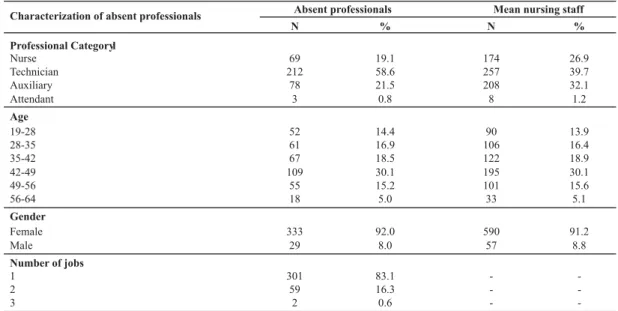
Results related to the profile of absent professionals and other team professionals are shown in Table 1.
Table 1 - Demographic profile of nursing professionals at HU-USP between January and December 2007 - São Paulo - 2007
Absent professionals Mean nursing staff Characterization of absent professionals
N % N %
Professional Categoryl
Nurse 69 19.1 174 26.9
Technician 212 58.6 257 39.7
Auxiliary 78 21.5 208 32.1
Attendant 3 0.8 8 1.2
Age
19-28 52 14.4 90 13.9
28-35 61 16.9 106 16.4
35-42 67 18.5 122 18.9
42-49 109 30.1 195 30.1
49-56 55 15.2 101 15.6
56-64 18 5.0 33 5.1
Gender
Female 333 92.0 590 91.2
Male 29 8.0 57 8.8
Number of jobs
1 301 83.1 -
-2 59 16.3 -
-3 2 0.6 -
-Source: Sancinetti, 2009(10)
In the group of 647 professionals, 362 (56%) presented at least one sick leave during the period.
The comparison between the proportions of nursing team professionals who did not go on a sick leave with those who did evidences a significant difference (p<0.0001). The nursing technician category showed the largest number of absent professionals due to disease, which is similar to results from other studies(11).
The mean age of the 362 professionals who were ab-sent due to disease was 40.2 years, within the confidence interval (CI) of 95% (39.2 to 41.2 years) and the 647 pro-fessionals’ mean age, representing the entire nursing team, was 40.3 years, within the 95% CI (39.5 and 41.1 years). Therefore, it can be affirmed that, in statistical terms, no significant difference (p>0.5) was found between the age
distributions of these two nursing team segments. Thus, it can be affirmed that sick leaves were not conditioned by age. A recent study(12) found that 40.6% of nursing
profes-sionals with absenteeism were between 41 and 50 years old, similar to the present research results.
The comparison between the characteristics of profes-sionals on sick leave and other nursing team members did not show any significant difference (p>0.5), indicating that gender did not influence absenteeism due to disease either. Eighty-three percent of professionals on sick leave reported having only one job. This finding is remarkable, as this category’s remuneration has obliged workers to submit to double or triple work journeys to guarantee their budget(2-3).
Data in Table 2 refer to the number of professionals on sick leave.
Absent Professionals Leave Time of Absence Type of Leave of Absence
Leave authorized by head (FA)
Leave authorized by head and compensated (FC) Medical leave > 15 days before 2007 (IN) Medical leave > 15 days in 2007 (INS) Medical leave <= 15 days (LM)
SUM
Nº %
50 10.8
56 12.1
21 4.5
23 5.0
313 67.6
463 100.0
Nº %
61 7.0
68 7.8
0 0.0
28 3.2
710 81.9
867 100.0
Nº dias %
68 0.6
101 0.8
5757 48.2 3552 29.7% 2470 20.7%
11948 100.0
Table 2 - Distribution of total professionals on sick leave, number of leaves granted per type and time (in days) of absence at HU-USP,
between January and December 2007 - São Paulo - 2007
The total number of absent professionals is not 362, as the same professional on sick leave may have been absent more than once.
Leaves granted in 2007 were calculated, so that IN leaves granted before January 2007 in which the profes-sional remained absent were not included, as they had already been initiated outside the defined study period. However, the days this professional remained absent in 2007 as part of and IN leave were considered, inserted and identified in the type of IN leave started before Janu-ary 2007.
Thus, between January and December 2007, 463 pro-fessionals were absent on different types of sick leave, totaling 867 leaves and 11,948 days of absence, 6,191 days of which were granted in 2007 and 5,757 days of IN leaves, initiated before 2007.
Data in Table 2 reveal that IN leaves granted by physi-cians before the study period contribute to practically half of the total absence time in days.
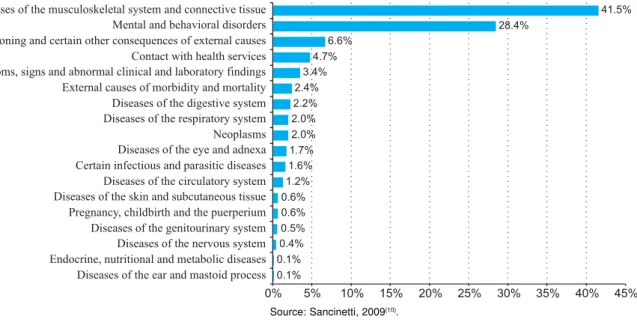
The time in days of absence related to leaves >15 days (INS and IN), considering both professionals who started their leave before and during 2007, represented approxi-mately 77.9% of total sick leave time in days. Medical leaves =15 (LM) represent 81.9% of the total but contribute to approximately 20.7% of the time in days of absence. FA and FC leaves granted by heads represent only 14.8%, and contribute to a mere 1.4% of total time in days of absence. As to the main disease groups, two (Diseases of the musculoskeletal system and connective tissue and men-tal and behavioral disorders) were responsible for the largest number of days of absence from work, represent-ing 4,957 and 3,393 days, respectively (Figure 1).
Figure 1 - Proportion of disease groups listed in ICD-10 that generate days of absence from work at HU-USP between January and
December 2007 - São Paulo - 2007
0% 5% 10% 15% 20% 25% 30% 35% 40% 45%
Diseases of the ear and mastoid process Endocrine, nutritional and metabolic diseases Diseases of the nervous system Diseases of the genitourinary system Pregnancy, childbirth and the puerperium Diseases of the skin and subcutaneous tissue Diseases of the circulatory system Certain infectious and parasitic diseases Diseases of the eye and adnexa Neoplasms Diseases of the respiratory system Diseases of the digestive system External causes of morbidity and mortality Symptoms, signs and abnormal clinical and laboratory findings Contact with health services Injury, poisoning and certain other consequences of external causes Mental and behavioral disorders Diseases of the musculoskeletal system and connective tissue
Disease Group
0.1% 0.1% 0.4% 0.5% 0.6% 0.6% 1.2%
1.6% 1.7% 2.0% 2.0% 2.2% 2.4% 3.4%
4.7% 6.6%
28.4%
41.5%
Source: Sancinetti, 2009(10).
The groups of diseases of the musculoskeletal system and connective tissue and mental disorders, with 41.5% and 28.4%, respectively, most strongly affected the num-ber of days of leave. Recent studies(11,13) confirm higher
frequencies of musculoskeletal diseases, followed by men-tal and behavioral disorders in nursing workers.
The predominance of physiological burdens, evidenced by weight handling and inadequate postures in patient movement, as well as psychic burdens, related to the na-ture of work itself and to control and supervision mecha-nisms, are appointed as responsible for stress, depres-sion and other mental disorders in nursing workers, lead-ing to high rates of absenteeism(2-3).
With regard to musculoskeletal diseases, the World Health Organization designated the decade 2000-2010 as
the bone and joint decade, due to their growing
impor-tance among bone and joint diseases and injuries in the global population. For 2015, these are estimated to be-come the primary cause of higher health spending, as they constitute one of the most frequent causes of occupational absenteeism and permanent disability(14).
Table 3 - Mean occupancy rate and monthly number of absences due to disease among nursing professionals between January and December 2007 - São Paulo - 2007
Absences per month in 2007 Month
FA FC IN INS LM TOTAL %
January 2 5 0 3 53 63 7.3 70.3
February 5 4 0 4 39 52 6.0 79.1
March 4 3 0 2 50 59 6.8 80.2
April 10 9 0 2 65 86 9.9 72.7
May 8 8 0 6 92 114 13.2 74.7
June 8 10 0 1 60 79 9.1 74.9
July 8 8 0 2 62 80 9.2 74.6
August 6 5 0 1 59 71 8.2 76.2
September 0 4 0 1 60 65 7.4 78.5
October 4 4 0 4 53 65 7.5 76.4
November 4 2 0 1 53 60 6.9 79.5
December 2 6 0 1 64 73 8.4 72.6
2007 61 68 0 28 710 867 100.0 75.8
Mean occupancy rate in %
FA = leave authorized by head; FC = leave authorized by head and compensated; IN = medical leave > 15 days, occurred before 2007; INS = medical leave > 15 days occurred in 2007; LM = medical leave <=15 days.
Source: Sancinetti, 2009(10)
Figure 2 shows that the frequency polygon of the monthly percentage of leaves was inversely proportional to that of the occupancy rate. As a result, it can be inferred that professionals got a leave of absence after having been submitted to higher work rhythms.
Based on this information, it is appointed that intense work rhythm characterizes nursing workers’ exposure to different workloads, particularly physiological burdens deriving from increased work demands, and psychic bur-dens, originating in organizational pressure to comply with
needs and activities within a given period. In this context of intense activity when the occupancy rate is higher, work-ers suffer a wide range of exhaustion processes, but tend not to be absent from work. However, in periods when the occupancy rate and work rhythm decrease, greater ab-sence from work due to disease is observed. In other words, during occupancy peaks, absences caused by disease were lower, which may demonstrate these workers’ commitment to care and the time needed for exposure to workloads to produce processes of exhaustion and diseases.
Figure 2 - Distribution of sick leaves and mean monthly occupancy rate, HU-USP, between January and December 2007 - São Paulo - 2007
7%
6% 7%
10% 13%
9% 9%
8%
7% 8%
7% 8%
70% 79%
80%
73%
75% 75% 75% 76%
79%
76% 80%
73%
0% 1% 2% 3% 4% 5% 6% 7% 8% 9% 10% 11% 12% 13% 14%
JAN FEB MAR APR MAY JUN JUL AUG SEPT OCT NOV DEC
Proportion
of
absences
65% 66% 67% 68% 69% 70% 71% 72% 73% 74% 75% 76% 77% 78% 79% 80% 81%
Mean
occupancy
rate
Absence due to disease Mean monthly occupancy Polygon of mean rate Polygon of mean rate of absence
FINAL CONSIDERATIONS
Nursing professionals’ work process has entailed countless consequences, including accidents and work-related diseases. In this context, absenteeism caused by disease has called attention due to its high occurrence rate. This research aimed to compare the number of sick leaves among nursing professionals with the occupancy rate of hospitalization units at a teaching hospital.
Although the number of leaves was more expressive in periods with lower occupancy rates, a relation may exist between the nursing work process and workers’ exposure to different workloads, resulting in exhaustion and ab-sences due to work-determined disease. These research results can contribute to argue in favor of the temporary replacement of professionals on sick leave by the social security system (INSS), avoiding overloads for the nursing team and protecting the physical and mental health of care professionals.
REFERENCES
1. Gutierrez BAO, Ciampone MHT. O processo de morrer e a morte no enfoque dos profissionais de enfermagem de UTIs. Rev Esc Enferm USP. 2007;41(4):660-7.
2. Welsh D. Predictors of depressive symptoms in female medical-surgical hospital nurses. Issues Ment Health Nurs. 2009;30(5):320-6.
3. Leite PC, Silva A, Merighi MAB. A mulher trabalhadora de enfermagem e os distúrbios osteomusculares relacio-nados ao trabalho. Rev Esc Enferm USP. 2007;41(2):287-91.
4. Shimizu HE, Ciampone MHT. As representações dos téc-nicos e auxiliares de enfermagem acerca do trabalho em equipe na Unidade de Terapia Intensiva. Rev Lat Am Enferm. 2004; 12(4):623-30.
5. Felli VEA, Marzialle MHP, Robazzi MLC, Alexandre NMC. Assistência à saúde do trabalhador no contexto da saú-de do adulto. In: Programa saú-de Atualização em Enferma-gem Saúde do Adulto (PRROENF) - Ciclo 1, Módulo 4; 2007; Porto Alegre, BR. Porto Alegre: ABEn/ArtMed/ Panamericana; 2007. p. 9-44.
6. Laurell AC, Noriega M. Processo de produção e saúde: trabalho e desgaste operário. São Paulo: Hucitec; 1989.
7. Becker SG, Oliveira MLC. Study on the absenteeism of nursing professionals in a psychiatric center in Manaus, Brazil. Rev Lat Am Enferm. 2008;16(1):109-14.
8. Rogenski KE. Tempo de assistência de enfermagem: identificação e análise em instituição hospitalar de ensino [dissertação]. São Paulo: Escola de Enfermagem, Universidade de São Paulo; 2006.
9. Fugulin FMT, Gaidzinski RR, Kurcgant P. Ausências pre-vistas e não prepre-vistas da equipe de enfermagem das unidades de internação do HU-USP. Rev Esc Enferm USP. 2003; 37(4):109-17.
10. Sancinetti TR. Absenteísmo por doença na equipe de enfermagem: taxa, diagnóstico médico e perfil dos pro-fissionais [tese]. São Paulo: Escola de Enfermagem, Universidade de São Paulo; 2009.
11. Reis RJ, La Rocca PF, Silveira AM, Bonilla IML, Giné AM, Martin M. Factors related to sickness absenteeism among nursing personnel. Rev Saúde Pública. 2003;37(5):616-23.
12. Riboldi CO. Dimensão do absenteísmo entre trabalha-dores de enfermagem do Hospital de Clínicas de Porto Alegre [dissertação]. Porto Alegre: Universidade Fede-ral do Rio Grande do Sul; 2008.
13. Parada EO, Alexandre NMC, Benatti MCC. Lesões ocupa-cionais afetando a coluna vertebral em trabalhadores de enfermagem Rev Lat Am Enferm. 2002;10(1):64-9.