(1) Escuela Ciencias de la Salud, Universidad de Viña del Mar, Viña del Mar. Chile.
(2) Escuela de Enfermería. Facultad de Medicina. Universidad de Valparaíso, Viña del Mar, Chile.
Conlict of interest: non-existent
Social representation of speech therapists’ ethos
in the metropolitan and Valparaiso regions of Chile
La representación social del êthos profesional en fonoaudiólogos de las
regiones de Valparaíso y metropolitana Chile
Marcelo Sandoval Ramírez(1)
Josephine Bratz(2)
Received on: April 19, 2016 Accepted on: November 02, 2016
Mailing address:
Marcelo Sandoval Ramírez Casa Central UVM. Campus Rodelillo, Agua Santa 7055. Escuela Ciencias de la Salud. Viña del Mar. Chile
E-mail: [email protected] [email protected]
ABSTRACT
Purpose: to describe the social representation of Speech Therapists’ ethos.
Methods: qualitative research based on content analysis. The method consisted in focalized interviews to
speech therapists from Valparaíso and the Metropolitan regions of Chile.
Results: the data collected from the interviews was divided into seven categories called: experiences,
skills, professional actions, beliefs, values, ethical foundation and professional identity. This information let us see the need the Speech Therapy discipline has to deepen its relective practice.
Conclusion: for Speech Therapy to become part of the bioethical discussion and have its own ethic
dis-course it is necessary to continue developing the relective practice in order to strengthen the professional
ethos.
Keywords: Ethos; Social Representation; Speech, Language and Hearing Sciences; Ethics; Moral Education
RESUMEN
Objetivo: describir la representación social del êthos de la fonoaudiología.
Métodos: investigación de tipo cualitativo, por medio de análisis de contenido a entrevistas focalizadas,
realizadas a fonoaudiólogas/os de las regiones de Valparaíso y Metropolitana de Chile.
Resultados: del análisis de las entrevistas se levantaron 7 categorías de análisis denominadas:
experien-cias, habilidades, actuaciones profesionales, creenexperien-cias, valores, fundamentación ética e identidad profe-sional que permiten visualizar la existencia de un desafío en la disciplina fonoaudiológica en profundizar sus bases relexivas.
Conclusiones: para que la fonoaudiología se integre a la discusión bioética y asuma su propio discurso
ético se hace necesario continuar estudiando las bases relexivas de la disciplina y enriquecer así su êthos profesional.
INTRODUCTION
Professions are subject to constant change and challenges, and that is closely related to how they progressively build and strengthen their own identities. Along this professional development the shaping of the discipline’s ethos becomes a key task to give the
profession an ethical orientation. Thus, this relective
and deliberative task has to be seen as a collective responsibility by the professionals who belong to a given discipline so as to encourage the building of a moral dimension. This responsibility needs to be taken by institutions which train future professionals, in this case, speech therapists.
While other health professions such as medicine
and nursing have been able to mark off, deine and
publish the ethical foundation and principles that guide their practice, little literature is found regarding the way in which speech therapy develops its ethical guide-lines and builds its professional êthos. Therefore, this research aims to contribute to speech therapy’s ethical
relection by proposing a research line and collective
discussion; a pending and essential task to establish the principles and values which constitute the moral character of this profession. This way, from a speech
therapy’s perspective, relection will be done on how to
identify a speech therapist’s moral status, and how they
deine “their being a therapist” for themselves.
Consequently, and as a irst approach, this quali -tative research seeks to describe, through social repre-sentation, the current ethos of speech therapists, with
the belief that by doing so, a relection process will be
started on how speech therapy’s moral dimension is expressed.
In the coming sections of this work, the main themes which constitute the theoretical framework for this research will be presented. Social Representations
will be briely referenced; a deinition of Ethics and its
relationship with values will also be included in order to relate this with the process of therapeutic relationship and intersubjectivity.
Social representations
Social representations understood as1: “a particular
modality of knowledge whose function is to shape
inter-individual behaviors and communication” can be the foundation to encourage relection on how the êthos
of a given profession can be described, analyzed and further developed. Moscovici1 coined and deined the
term “social representation” as: “formed by socialized
igures and expressions. At the same time, social repre -sentations organize images and language because they identify and symbolize acts and situations which are or will become, common to us all. If we consider it in the passive mode, we can grasp a
represen-tation because it is a relection, within an individual or
collective consciousness, of an object or a bundle of
ideas that exist outside that consciousness.” These
representations are dynamic, they create behaviors and relations with the environment, thus becoming a modifying action both for the subject and the object; therefore, representations become theories which interpret and build reality at the same time.
Ethics
The word Ethics comes from the greek word êthos2,
which originally meant a place of dwelling; later, it was understood as the character or personality that a person or group of people acquire along their lives.
When the deinition of êthos is applied to professional
life, Risco3 states that: “êthos becomes the ontological
foundation of a profession and the essential element which determines how someone needs to prepare to practice that profession and how those who do it need to behave to reach the full performance of their
art or science.” In the same line, Maliandi4 states
that êthos is “ a set of beliefs, attitudes, norm codes, customs”. This author divides êthos into two different moments, pre-relective and relective êthos, yet none
of those moments is hierarchically superior to the other. Maliandi4 states that: “ This is not about some
levels being “better” than others, differences lie in the way the relective action is performed, the purpose of
such action and, particularly regarding ethics, the level
of normativeness present in the relection.” According
to this author4, pre-relective êthos is characterized
by conducts adapted to a normative system in which there is not a clear reason underlying a norm. In other words, the set of moral beliefs, moral attitudes, norm
codes and customs is not questioned, no relection
is present. Another moment comes when we go from
pre-relective to relective êthos because it becomes necessary to learn about the application of a speciic
norm or when questions arise regarding our own moral
judgement. This marks the transition to the irst stage of relective êthos, which brings moral relection with it,
raising questions about the reasons for the norm being referenced. Then, Maliandi4 points, knowing what to do
the question “why”; no more norms will be accepted
without questioning.
Êthos and values
Professional êthos entails the integration of values.
Much has been written about values, from different theoretical perspectives; therefore, in this research, considering the constraints of addressing an issue such as values, the proposals by bioethicist Diego Gracia will be adopted, as presented in his work5 < La cuestión
del valor> (The question of value) .
Gracia5 points out that ethics is the very realization
of values, where an interdependence between objective and subjective moments appears. According to this author, values must become the object of our individual and collective activity, which are realized through delib-eration. Gracia5 adopts Zubiri’s perspective, where
values are built through the relationship between the ‘perceived’ and the ‘appreciated’. What is perceived is appreciated, values are engendered from this appre-ciation, as a product of our emotional perception. Then, value judgements are cognitively made and those judgements are accompanied by conceptualizations. It could be derived then, that values belong to the world of relativism, since they are the product of a construction; however, Gracia5 does not agree with that since the
construction of values comes from reality, what makes
it richer. Values inish its construction process when
they are realized; its realization occurs through
deliber-ation which leads to relective exchange5. Deliberation
is deined by the author as5: “a process which is intel
-lectual as well as emotional. The emotional moment is particularly important for this issue, given that values are emotionally acquired. Consequently, the construction
of values needs certain emotional education”. Based
on Gracia’s5 perspective then, the realization of values
is a personal and collective task and responsibility. We can thus infer that the values which constitute a given
professional êthos must be co-constructed through
deliberation, among the members of that profession. In this value constructing process, higher education institutions take part, unquestionably; the professional formation they offer should not only be centered on theoretical and technical aspects of their professional practice, but also promote the personal development of their students. Based on this, universities must concern about the personal moral quality of their students and take an active role in this process, not merely relying on the students’ previous personal history.
Therapeutic relationship and intersubjectivity
Nowadays, as Camps6 puts it, professional careers
have become ways to achieve monetary success and they have also regarded technical knowledge as the most important aspect. For this reason, professions, especially those healthcare-related, have diverted from an orientation towards developing certain necessary virtues for excellence in professional practice. Conill7
agrees with this when he states that: “ Professions
are legitimized for their purposes. In order to achieve those purposes, the individuals have to acquire certain values; that is to say, every professional activity creates their own êthos, which anyone who becomes a member needs to adhere to. This allows those who become part of a collective body to know what it is that they have to aspire to; in other words, be guided by
those speciic values are the foundation for the profes -sional practice, to be able to develop a given êthos. The professional êthos has to be worked on by the collective bodies, nourishing moral aspects through a collaborative construction process, consciously taking individual responsibility, as part of the process, to become a professional. This way, it is possible to create guidelines for such profession, both individually and collectively taking the responsibility of practicing their profession with excellence. This, however, demands a
relective exercise, different from what is expected from
formation centered on technical knowledge. When it comes to health professions, technical knowledge is
deinitely not enough. Excellence cannot be achieved
merely based on technical mastery, but rather on the combination of technical command as supported
by êthos, which provides the foundation to achieve a
good practice. On this regard, Martínez8, presents the
dichotomy between competent and excellent profes-sional; competent would be the professional who has and masters the technical knowledge of their profession, and whose professional decision-making is based on their knowledge and information, whereas the excellent professional, who has developed the same profes-sional competences, also expresses moral feelings which they blend with their technical knowledge. In Martínez’8 words: “Being a professional of excellence
means being both competent and upstanding, and in order to achieve this, three basic requirements need to be met: being knowledgeable about one’s profes-sional area, making sensible decisions regarding one’s profession, and showing moral feelings in agreement
teaching objectives which include the progressive
development of speciic professional competences as well as the promotion of: “the balance between values of specialized technical-scientiic knowledge
and the values of a person’s global and humanistic
knowledge.”, highlighting too the necessary synergy
between the health policy objectives and the way in which means and resources to bring them to fruition
are implemented.”
METHODS
This study was carried out through the application of a qualitative approach, since it aimed at describing
the social representation of speech therapists’ êthos
from the professionals’ subjective perspective; taking meaning from their narrations in order to obtain what Canales12 calls: “the understanding of the other,
which does not imply measuring according to the researcher’s judgement, but according to their own
sense of judgement, that which is part of them.”
The sample was selected by means of discretionary sampling, which is used to make content analysis easier, as indicated by Andréu13, where the selection of
the participants is not relied upon probability or calcu-lations. It was estimated that the sample should cover wide age ranges and professionals working in the Metropolitan and Valparaíso regions.
During ield work similar information began to be
collected, with no new perspectives and the repetition of certain topics. Because of this, after 9 interviews,
ield work was stopped and considered completed,
based on a saturation criterion. The group to be studied included 9 professional speech therapists, 6 female subjects and 3 male subjects. Their age ranged from 25 to 80 years, 39 as the average age. They all obtained their degrees from traditional Chilean univer-sities. Some of them worked both in the Valparaíso and the Metropolitan regions. All of them were somehow related to higher education institutions. They had either administrative or academic positions or were involved in professional training supervision. Except for 3 of the interviewees, all of them performed clinic practice.
The technique that was used for the data collection was focalized interviews. The interviews were recorded
in audio format, also including ield notes. The day
of the interview an Informed Consent, authorized by the corresponding faculty’s Ethics Committee, was
obtained. Conidentiality was assured, and all records
were digitally stored anonymously, only having a date code given by the researcher.
Excellence in health professions lies in the profes-sional’s capacity to establish intersubjective relation-ships with the user. In every health profession, to achieve the excellence Martinez8 describes, an
intersubjectivity process is necessary, which means acknowledging the other. Intersubjectivity is under-stood, according to Giannini9, as the meeting place
where acknowledgement of the other occurs, based on communication.
The relationship that is created during speech therapy is one of those meeting places, where the therapist/subject and the patient/subject share a given moment and space. Then, ethical excellence is strongly manifested in the establishment of a intersubjective therapeutic relationship.
According to Giannini9, intersubjectivity requires
reciprocity, which manifests through communication, a communicative action which implies the acknowl-edgement of the other based on three aspects: there is something which involves both of them (therapeuti-cally speaking, that something would be providing and requiring care); another aspect would be the act
of being before the other, and inally, counting on the
autonomous response of that otherness.
Consequently, the therapeutic relationship becomes an ethical-political space, where the therapist/subject and the patient/subject should mutually acknowledge each other. Giannini9 states that: “such acknowl
-edgement, implicit in the interaction, opens and legitimizes the whole dialogic process through which a common space, based on the ethical- political principle of reciprocity, is created. It opens and legitimizes the
citizen’s space.”
Another factor which takes part in the ethical practice of intersubjectivity is the own therapist’s subjectivity, in this case, the speech therapist. This subjectivity comes from their symbolic representations, which determine how they see the world and how they act in it10. Thus,
the part-takers of this intersubjective meeting are deter-mined by their life story, their previous experiences and personal contexts.
The afore-mentioned aspect poses a dificult
challenge in the formation of speech therapists. This implies guiding them through a curriculum that encourages the students’ ethical and bioethical
bringing their emotions, life story and experiences. Therefore, those who had more enriching stories may better understand certain aspects of the ‘other’ taking part in the care context. Working on the balance between the characteristics that the therapist who is a ‘subject-person’ and a ‘subject-professional’ requires becomes a challenge for the profession, where, as mentioned by Gracia5 emotional education becomes
relevant since subject objectivization14 does not occur
only in the person who receives the care; the profes-sional can self-objectify, taking their subject qualities away, what makes them human, in order to keep an optimal clinic relationship, but by doing so, they are at risk of becoming dehumanized and dehumanizing the other in the act.
Skills
In this category, the professionals highlighted the characteristics that a speech therapist seeking profes-sional practice of quality should have, especially regarding empathy, which is regarded as a key element in the therapeutic relationship and the relationship with other professionals:
I.1-PS1: “They need to have empathy, at the very least.”
I.8-PS2 “ Empathy is fundamental, a therapist who does not understand the needs of others is of no use.”
For the interviewees, empathy is established as an ability that the therapist and speech therapy students must have. Based on this, the challenge is to create an interpersonal work plan directed to the speech therapist so they can develop their therapeutic self.
Another skill mentioned by the participants is the communication capacity, also referred to as the capacity for personal exchange and being a good listener. In the responses provided this skill is regarded as a personal skill rather than a professional skill to be acquired; even as a skill to be acquired prior to the speech therapy professional formation:
I.3-PS1: “luent interpersonal communication, because when irst year students arrive, you can tell or have an
a priori opinion that a given student can be a good speech therapist based on their communication skills, whereas when they are shy you wonder how they are going to deal with a patient. I think they should bring that skill from home, because we also assume it
comes with them, besides, it’s hard to develop eficient communicative skills in 5 years.”
To ensure rigor in this study and reliability in the categorization system, all data collected and catego-rizations created were examined by two collaborators, from the areas of health and humanities respectively, both having a formation in bioethics. Besides, the categorization matrix was checked and corrected by the methodology advisor for this research.
For data interpretation the content analysis technique was used. This qualitative technique combines production and interpretation of collected data in order to make replicable and valid inferences by interpreting and coding textual material.
RESULTS
During ield work, the participants were interviewed
about: characteristics of êthos, professional practice, professional identity, role of university formation, among others. Seven categories were derived from the participants’ answers and were organized by growing
relection levels, moving from those which refer to
more concrete and practical aspects to those related to
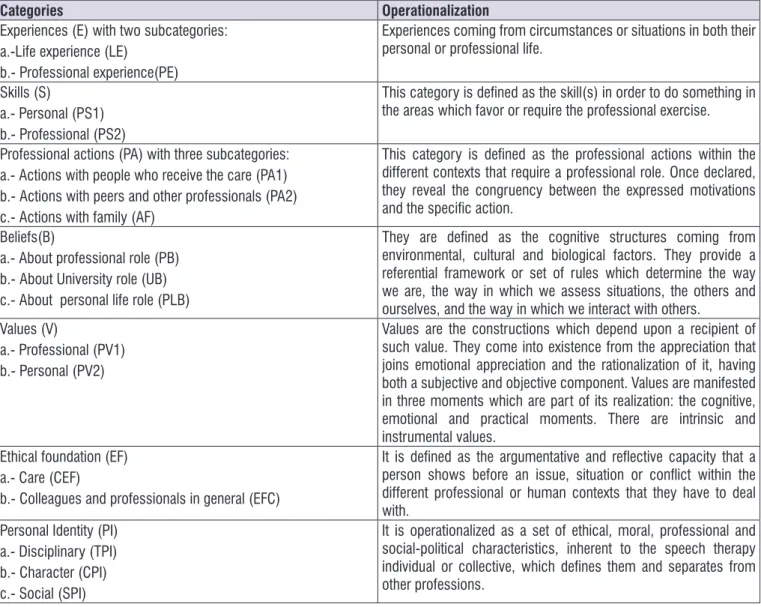
more relective and abstract aspects. In Figure 1 (SEE)
Presentation of Categories categories and subcat-egories are shown together with their operational
deinition.
Experiences
In this category information appeared regarding how the interviewees mentioned and highlighted personal or professional experiences which have trans-versely contributed the way in which they see life, and that have had an impact on their professional area.
I.3-LE: “I feel empathy before any speech pathology or just any dificulty, because my mother suffered from
cancer when I was 11, and that period of my life left a
mark, I tried to ind an answer somewhere, but I never found it.”
I.6-LE: “In my case, during my primary education I
studied at a Jesuit school and they have a strong commitment with social causes, so when you’re very young, since kindergarten, they take you to the streets to give away food, and they instill that in you, that you
have the duty of giving to others”.
I.4-PS1: “I think they should have communicative skills
as a base. They should be people that when
commu-nicating, it comes natural to them, as a part of them”, “anything linguistic should come natural to them.”
Among the interviewees, a great number of skills which are not related to the technical area were mentioned; all of them related to the cognitive and emotional domain, which the professional is expected to develop. In this respect, a serious challenge is posed regarding the extent to which the curricula allows for these skills to be developed and whether they provide room for these skills to be discussed, socialized and worked on. From the interviewees’ responses it can be derived that the speech therapist-individual needs a set of characteristics as a base in order to be able to practice his profession. These characteristics entail a profound ethical development which the speech
therapist student is expected to develop or have already developed. Thus, skills prominently mentioned included being: empathic, sensitive to the needs of others, proactive, studious, receptive, mature, warm,
lexible, a good communicator, motivated, respon -sible, someone who cares about developing a healthy personality, who can establish limits, who is a good listener, someone who has tolerance to frustration, is prepared for unexpected situations and works well in teams.
Professional actions
This third category contributes to the achievement
of one of the speciic objectives, which seeks to identify
the values and beliefs around the speech therapist’s
êthos through their professional actions.
Categories Operationalization
Experiences (E) with two subcategories: a.-Life experience (LE)
b.- Professional experience(PE)
Experiences coming from circumstances or situations in both their
personal or professional life.
Skills (S)
a.- Personal (PS1) b.- Professional (PS2)
This category is deined as the skill(s) in order to do something in the areas which favor or require the professional exercise.
Professional actions (PA) with three subcategories: a.- Actions with people who receive the care (PA1) b.- Actions with peers and other professionals (PA2) c.- Actions with family (AF)
This category is deined as the professional actions within the different contexts that require a professional role. Once declared, they reveal the congruency between the expressed motivations and the speciic action.
Beliefs(B)
a.- About professional role (PB) b.- About University role (UB) c.- About personal life role (PLB)
They are deined as the cognitive structures coming from environmental, cultural and biological factors. They provide a referential framework or set of rules which determine the way we are, the way in which we assess situations, the others and ourselves, and the way in which we interact with others.
Values (V)
a.- Professional (PV1) b.- Personal (PV2)
Values are the constructions which depend upon a recipient of such value. They come into existence from the appreciation that joins emotional appreciation and the rationalization of it, having both a subjective and objective component. Values are manifested in three moments which are part of its realization: the cognitive, emotional and practical moments. There are intrinsic and
instrumental values. Ethical foundation (EF)
a.- Care (CEF)
b.- Colleagues and professionals in general (EFC)
It is deined as the argumentative and relective capacity that a person shows before an issue, situation or conlict within the different professional or human contexts that they have to deal with.
Personal Identity (PI) a.- Disciplinary (TPI) b.- Character (CPI) c.- Social (SPI)
It is operationalized as a set of ethical, moral, professional and
social-political characteristics, inherent to the speech therapy individual or collective, which deines them and separates from
other professions.
Within this category, the interviewees highlighted the need, during the clinic relationship, to motivate and get the commitment of the patient and their family in the therapeutic process:
I.1-PA “ this needs to translate into taking care of
others, listening to them, making suggestions, but they
also need to be active”; “ So, that’s when they need to
be creative, pushing the family to tell them ‘look, this is something different, there are other issues that have
to be addressed’, and inally, being able to keep that credibility and trust.”
I.2-PA “They need to be extremely motivating during
the intervention, and not only during the intervention because when it a long-term therapy they need to connect with the patient and the family, keeping them
hooked.”
It was also mentioned that the speech therapist’s action has its own pace and rhythm, different from other professions such as that of the doctor. The speech therapist builds a particular therapeutic relationship, which needs to be managed appropriately not only
to fulill the care purpose, but also to create a warm
environment for the patient and their family, to keep them engaged and to explain the possible stages the therapy might have:
I.2-FA: “I think it has to do with having an effective
communicative style. They need to be warm, provide the family with information that is clear, and yet be available in case there is any question. I think that the more assertive and close one is to the family, the better and more long-lasting bonds one creates… We need to explain what is going to happen, the good and the bad things to come… understand and empathize with what
is going on in the family.”
Beliefs
This category presents what the participants mentioned with respect to their role as a professional, the role of the institutions which form speech therapists and their role as people. This category addresses the
speciic objective which aims at describing the beliefs
represented in the professional êthos. This category includes the belief that a speech therapist needs to possess empathy, as a professional characteristic. Together with this characteristic, social vocation and the desire to help others are other attributes that the speech therapist is expected to have, as an innate condition that they bring with them before entering
college, qualities which are not taught there but should be used in their professional practice:
I.3-PB: “I believe speech therapists, in general, are
people who always empathize with different kinds of people and situations. We do this on a daily bases with people who are close to us or new people we
encounter, not necessarily patients or people we treat.”
I.6-UB: “You see, speech therapists have a personality
which is typical, it’s like there’s no unpleasant speech therapist. Like some say, it’s a more direct role, which is
well-received by the person.”
I.6-UB: “I don’t think universities should start formation
of a student when they begin their major. At university they should become involved with the professional environment, for instance, through health plan opera-tions. When they get to university, I think they have to reinforce that feeling of social service and vocation that they bring with them. The fact you feel the need or have the ability to empathize with the other is something that
comes from birth; it is in someone’s DNA.”
It was also mentioned by the interviewees that a common characteristic of speech therapists is that they have a pleasant personality. If there are individuals who have a personality which hinders proximity with the person being treated, it is recommended working in
other speciic areas of speech therapy where personal
qualities are not so relevant. They also noticed the fact that attitudinal aspects are not given much importance when evaluating a student and are rarely a reason to fail them.
I.6-UB: “Regardless of the university you study at,
nobody is going to fail you because you are unpleasant or because you don’t have a good relationship with a patient. They will tell you ‘work as an audiologist’ as
you will have less interaction with the patient.”
The participants highlighted their perception that society still does not have a clear understanding of their role and their career projections:
I.1-PB: “but, in society, I feel people still have questions
as to what it is that we do. I’m referring to how I think
they see us. I think we are undervalued in that sense.”
Regarding university as the provider of a model of professional practice, a variety of beliefs were observed:
I.9-UB: “I believe the teaching is not important but the
practice model, when they do research, as they have a cup of coffee with their professor. They take all those conducts as an example or a reference. The model has a big responsibility, because there is someone being
modelled.”
The lack of clarity with respect to the university role indicates a poor job done in the attitudinal aspect,
which implies the need to develop a better deined
curriculum in that area, as seen in the following extract:
E5-UB: “But in our formation, the attitudinal aspect,
for example, has been quite disorganized. That thing about communicating with the patient. Very little of that was covered in our curriculum, which is something psychologists do have. This emphasis on
the relationship with the patient.”
Values
This category presents the responses by the inter-viewees with respect to the values that they believe speech therapists need to have; this relates to the
speciic objective aiming at describing the values
represented in the professional êthos. The respon-dents’ opinions showed that it is relevant for the speech therapist to own values inherent to their profession; however, they had no clarity as to what those values might be. In relation to this, they mentioned that personal values had to be applied to the speech therapy practice; yet, the values to be considered inherent to the profession were not described.
I.1-PV1:” the most important value is respect for life.
Respect for the person’s life, whatever their condition,
to respect them as people.”
I.8-PV1: “the value of responsibility, giving the other a
sense of happiness and faith. Regardless of who the user is, it’s about giving them hope in the face of their
prognosis.”
I.6-PV1: “I think the most important value that a speech
therapist must have is the capacity to empathize with others, even if that is something which can never be
fully achieved.”
A similar situation to the previous case is seen here, where there is no clarity as to where these values belong. They could be regarded either as personal or professional values, if the latter is the case, then educa-tional institutions which form speech therapists should be responsible for teaching them:
I.1-PV1: “These are qualities that we as teachers should
try to make sure these youngsters somehow develop, but also allowing them to have their own individual
qualities. “
I.7-PV2: “This is a complex matter, because I think that
values, their moral formation must come from home. Families cannot leave the responsibility of certain things
to kindergarten, schools and later on, universities.”
If we relate the current state of speech therapy in our country to Gracia’s5 theoretical perspective, which
states that values are constructed through deliberation, we can derive that there is a pending task regarding the deliberation of values inherent to speech therapy’s
êthos. From the data collected, it is only clear that
values are important. This situation poses the challenge of how to create instances for the realization of values, as proposed by Gracia. Ethics implies the realization of values, which in turn requires education for them to be constructed.
Ethical foundation
In order to identify the presence of values and beliefs in the speech therapist’s professional practice
represented in the professional êthos, the data from
the interviews was analyzed within the category ‘ethical foundation’.
The interviewees associated the ethical dimension only with complying with the established rules and
norms, but leaving aside the relective component
that it should have. This action is similar to what, from
Maliandi’s perspective, would conform the pre-relective êthos, where norms to be obeyed exist yet the reason
why they exist is not questioned. The ethical founda-tions which contribute to shaping the professional character of the speech therapist are not clear or
speciic because ethics is mentioned as something
generic.
I.1-CEF “It’s about being ethical, showing ethics in your
profession. We have laid down a series of rights, the patient’s rights. Ethical in terms of not breaking the norms, not infringing upon the rights of the patients, not lying to them, letting them know where they stand with regards to their disease, giving them all the information available to us without bending the truth. In any way, written, spoken, etc. All ethical codes that theoretically revolve around the health professions have to be put
A lack of relection regarding the ethical dimension
and its impact on the therapeutic relationship is highlighted:
I.5-CEF: “autonomy, the capacity of not imposing. That
is something I feel is lacking here, knowledge from an ethical practice. We sort of impose a treatment, you see, constantly. Let the patient decide whether they want to be here or not, whether they want to do it one way or the other way. That means that we need to show them all the alternatives and ways; I feel like we impose
things on the patient and their autonomy is lost there.”
Professional Identity
This last category to be presented can be related to others which have already been described. This category addresses the general objective of our research which seeks to describe the social
represen-tation of the professional êthos. Within this category
it can be seen that the speech therapist’s identity is shaped based on the exercise of their profession, that
is to say, it comes from their “doing” not their “being”:
I.1-TPI: “I think the work environment is what it really
is, the specializations we have, that’s what I think is our
self”…” the way it is deined everywhere else, like those communication professionals.”
I.5-TPI: “We don’t have a well-deined protocol. We
are pretty amateurish… the Chilean speech therapist, I mean. This situation I tell you of not having contact with others, because the Chilean society does that, the union of speech therapists does establish that. They are all about trade-union things, not science… In order to say what we are. I mean if you ask people about it, the answer will be related to procedures, we are whatever
area we treat… coming from values, the proile. I think
few people talk about it, precisely because it is a little
discussed topic.”
In addition to this, it can be observed in the discourses that the convergence of different disciplines in speech therapy creates a sense of confusion with respect to their professional identity, which, from an ethical perspective, can hinder the construction of self,
that is to say, a characteristic professional êthos:
I.4-TPI: “It’s just that the speech therapist is a profes -sional hybrid, a mix of the different disciplines which
nourish it”. “See, I believe that one of the things that deine it is that it is in that intersection between health,
social sciences, psychology, education, in that
overla-pping of areas.”
DISCUSSION
The results obtained in this research show that the social representation of speech therapists’ professional
êthos currently relects an unclear êthos, lacking a common relective base. In this regard, it is necessary to address two aspects which should conigure the speech therapist’s êthos; the ‘being’ and the ‘doing’; the being should be relected in the practice.
Nonetheless, the data obtained account for a profes-sional practice which is more competent tan excellent8.
Thus, in speech therapy, what is done in direct care, be it giving a prognosis, providing therapy, working on a communicative dysfunction, can become an activity deprived of ‘being’ (even if one is competent). This
situation can be identiied as a pre-relective êthos4
and this invites the speech therapy community to discuss the philosophical foundations that it should be built upon, in order to develop disciplinary theories of their own. Such as those developed by medicine and nursing.
To achieve this, it is essential to have the commitment on part of the Speech Therapist’s Unions, which are responsible for laying down the profes-sional ethical codes and regulating their observance. Currently, an international consensus regarding speech therapy’s ethical guidelines has not been achieved. There actually is an absence of international ethical guidelines, and the national ethical codes are mere lists of rights and duties, with corresponding sanctions15. In
this aspect, disciplinary efforts which establish a new representation of the professional êthos’s state should be made, thus generating dialogues internationally with the aim of creating ethical codes based both on the ‘being’ as well the ‘doing’ of the profession. This idea is further supported by the ‘beliefs and values’ categories in this investigation, where the participants express the idea that there is no shared professional base on which to build the different professional roles. It is also voiced that speech therapists should have certain values,
however, there is no agreement about the speciic
values that should be constitute the ‘professional self/ being’.
this major or be promoted as part of the curriculum
remains a matter to relect upon. Having an excellent
therapeutic relationship entails it being based on an intersubjective exchange, both between the therapist and the user and the therapist and other subjects taking part in the multi and interdisciplinary care. It is important to point out that intersubjectivity is related to communication; therefore, if the communicative skills were only seen as a pre-requisite and not further developed during the person’s professional formation, there is the risk that the therapeutic relationship lacks intersubjectivity, and it turns into an objective exchange (during which the therapist regards the users as a care object and not as a subjective- subject). It is also important to remember that, in intersubjectivity, an encounter of subjectivities occurs. These are deter-mined by the life story and personal experiences of those who interact. In this respect, Franco10 points
out that a subject has access to different <semiotic
ields>, which determine their interaction and attitude
towards the environment, in this case, the healthcare work environment. These attitudes, in turn, depend on the person’s symbolic representations, and this gives certain subjectivity to their caring actions and interac-tions within the health care organizational network. These subjectivities will have an impact on the profes-sional’s therapeutic relationship style, since16: “care
practices are determined by the singularities of every
professional.” Therefore, these subjectivities and their
capacity to create intersubjectivity, have to undoubtedly be considered in the professional’s formation.
It is the speech therapist’s character which, faced with the speech alterations that the subject being treated has, contributes to making the therapeutic experience a part of the user’s happiness project. Then, we need to ask the question posed by Ayres17: “What is
our contribution in the construction of those happiness
projects we are helping conceive?”
It is seen here how the act of providing therapy becomes a great ethical responsibility; it becomes a moment which greatly contributes to the good living projects the users have. Merhy and Franco point out that, in healthcare, people who take part in the care process16: “can create an invisible energy ield which
works in circulating lows that surround the act of care and conigure <life lines> or <death lines> depending
on whether the therapist- user relationship engenders acceptance, bonds, autonomy and satisfaction, or a time-limited, bureaucratic relationship causing
heteronomy and dissatisfaction.” In order to be a
contribution, the therapist needs to have a capacity for ethical inner leadership18 causing them to observe their
practice in a self-relective and self-analytical manner: to
observe the care process paying attention to the effects it has on themselves and the other. These are the
relection levels which generate real intersubjectivity.
In addition to what has already been mentioned, it is important to point out that the speech therapy practice also entails political and social responsibility roles which should be part of the professional êthos. These roles, however, were not clearly established by the interviewees in this study. If speech therapists can successfully develop their ethical inner leadership, they will be able to use their knowledge to create networks of change in the social fabric, starting in their workplace, where they would tend to form intersub-jective, creative and compassionate bonds. According to Franco10, self-analysis, at the healthcare collective
level, can be understood as the process through which this community produces and takes ownership of knowledge about themselves. This knowledge is applied to their real work environment, which includes their needs, desires, requirements, problems, solutions and limitations. This knowledge also gives the subjects the possibility to modify and build reality in order to encourage healthcare services to be solidary and warm, based on positive bonds, feeling responsible for the user’s wellbeing10.
At the individual level, the speech therapist’s political role manifests through strategies that contribute to the development of skills the users need. The therapist creates instances that foster participation in citizen’s spaces of interaction, encouraging the user’s autonomy, which in turn, allows them to develop or recover tools favoring the collective coexistence. Therefore, being a therapist who works in the commu-nicative area inevitably becomes a political act, as it has an impact on life as a community.
Ultimately, the political therapy role constitutes a great social responsibility because this role enables the subjects, including those with different capacities, to make full use of their citizenship. This is why the political dimension of communication should be better developed from the speech therapist’s êthos. This poses a challenge for current speech therapy regarding how this socio-political knowledge19 can be
incorpo-rated in the therapeutic relationship. It seems pertinent to reference Couceiro – Vidal 20 ,who deine healthcare
maximize their autonomy, which create relationships characterized by integrity, ethical practice, social justice
and teamwork.”
All the above mentioned cannot spontaneously be developed in the students during their speech therapy formation, much less is it possible to be present a priori, as a result of their life story. It is necessary then to resume discussion about the role of professionals who
form speech therapists and the need to relect and work
on the professional êthos the speech therapy professor should have. This is a key element for success in the development of the future speech therapists’ character. The formation of the professionals needs to be wholesome, taking the multidimensional quality of humans into account. In this regard, Gracia5 states
that emotional education is something that has to be
present in all educational levels, including university. He
states that this kind of education provides the tools to be able to undergo deliberation processes. Emotional education addresses the construction of personal and professional êthos. Therefore, it can be deduced, that the formation of future professionals should be left in the hands of professionals who are not only speech therapists but who also have a pedagogical formation, and are trained especially in moral and affective education. This would allow for the creation of curricula which include learning outcomes incorporating the students’ moral and affective dimensions (not just the cognitive and technical dimensions), apart from the corresponding teaching and learning contents and strategies. To achieve this, León 11 suggests three basic
aspects the educator should consider: getting to know their students, encouraging attitudes and capacity for dialogue, and creating educational actions aiming for attitudinal change.
Currently, the number of speech therapists is progressively on the rise, we, as a professional
body, need to make a pause to relect on the way we
should build speech therapy’s critical base, in order to have professional coherence along speech therapy instruction, with a resulting impact on the profes-sional practice. Thus, the speech therapist will have more than just technical knowledge at the moment of establishing a relationship with those they treat, with their work teams and society in general. This way, a professional can construct a wholesome professional
êthos, preventing the occurrence of mere
procedure-following, relection-lacking, behavior,
In relation to the professional formation of speech therapists, educators should keep the responsibility of
modelling and relecting in mind when forming profes
-sionals, since being an educator of this kind of majors implies constant learning not only about technical matters but also at the personal level. From Domingo’s
21 perspective, both the development of the
profes-sional’s practical wisdom as well as their relection
capacity has to be fostered, this, however, cannot be achieved only through case studies or by replicating principles. This requires establishing relationships with people from an integral, critical standpoint. When educators make use of this practical wisdom it allows for the strengthening of a profession’s character and gives those who practice it the possibility to overcome
the bureaucratic êthos which has taken over profes -sions, turning them into businesses, diminishing their ethical richness. Consequently, during the professional formation process, the speech therapy professor must prevent falling into a teaching model which objectivizes the student22, the same way sometimes users are
objectivized in the therapeutic practice. Treating the student as a patient-student can then be a double risk in healthcare instruction.
The invitation is then for speech therapy to review its disciplinary ethical foundations. Other healthcare professions such as nursing have done this before. They questioned the way care would be looked at
and deined, reshaping their paradigms based on
experience, changing the way they refer to the
patient-subject and building their relection around the way
they understand the person and their environment, aspects which have nourished and formed their êthos.
In this collective and relective manner the nursing
profession has been able to establish its own nomen-clature, creating an ethical code which is valid inter-nationally; taking the care in their hands. The example set by nursing, when compared to the results obtained in this study, poses a challenge for speech thera-pists regarding how and from what perspective do we understand the other, the therapeutic relationship, the communicative exchange process and our role in society.
CONCLUSIONS
It can be concluded from this research that the speech therapy ethical dimension requires a deeper
relection process because it is mostly related to
stemming from this, regarding how the theoretical
relection will be incorporated in the research and disci -plinary development process, so that the profession does not only center around the different areas of technical performance ( language, speech, voice, swallowing, hearing, orofacial mobility, etc.). There are some actions which could encourage the construction of a professional êthos collectively. First of all, creating
relection and deliberation instances such as a Latin
American ethics and speech therapy congress, to form a Latin American or international council which
deines the ethical guidelines for the profession. Apart
from that it would be necessary to create a Latin American network for speech therapy and ethics. These actions would allow for the description of
profes-sional values, the therapist’s skills, and deining the
political, social and clinical communication dimension.
Together with this, we need to work on the deinition
of our social role and carry out theoretical research
to strengthen relection. Similarly, educational institu -tions which form speech therapists should discuss the progressive establishment of the moral dimension in
their instruction. It is important, therefore, to deine a
common ethical support for the speech therapist; this could happen by creating spaces or courses which further develop personal characteristics. This would allow the new professional to continue developing
speciic characteristics their professional practice
requires. Another option would be post-degree studies according to performance area to develop a
speciic êthos depending on the specialization area.
All these actions aim at promoting an excellent not only competent professional character in the speech therapist.
REFERENCES
1. Moscovici S. El psicoanálisis su imagen y su
Público. 2 ed. Huemul, editor. Buenos Aires,
Argentina1979.
2. Cortina A. Ética. Akal, editor. Madrid, España 2008.
3. Risco L. Apuntes sobre la coniguración actual del êthos médico. Acta Bioethica. 2009;15(2).
4. Maliandi R. Niveles de Relexión ética. Ética:
Conceptos y Problemas. Buenos Aires, Argentina2003.
5. Gracia D. La cuestión del valor. Madrid: Real academia de ciencias morales y políticas; 2010. 6. Camps V. La excelencia en las profesiones
sanitarias. Humanitas humanidades médicas.
2007;21.
7. Conill J. Ética hermenéutica de las profesiones. In: M Correa PM, editor. La riqueza Ética de las profesiones. 1 ed. Santiago, Chile2010.
8. Martínez E. La ética profesional como proyecto personal y compromiso de ciudadano. In: M Correa PM, editor. La Riqueza Ética de las Profesiones. Santiago, Chile 2010.
9. Giannini H. La metafísica eres tú. Una relexión ética
sobre la intersubjetividad. 2 ed. Catalonia, editor. Santiago, Chile2012.
10. Franco TB. As redes na micropolitica do proceso de trabalho en suade Gestao em redes. CEPESC-IMS/ UERJ-LAPPIS. 2006.
11. Leon FJ. Enseñar Bioética: cómo transmitir conocimientos, actitudes y valores. Acta Bioethica. 2008;14:11-8.
12. Canales M. Metodologías de Investigación Social,
Introducción a los Oicios. LOM, editor. Santiago,
Chile 2006.
13. Andreu J. Las Técnicas de Análisis de Contenido. Una revisión actualizada.
14. Kottow M. Antropología Médica. Santiago: Mediterráneo; 2010.
15. Colegio de Fonoaudiólogos Chile A.G. Código de Ética de Fonoaudiología Chile. [Internet]. 1983[cited 2016 09-09-2016]
16. Merhy T, Franco E. El reconocimiento de la producción subjetiva del cuidado. Salud Colectiva. 2011;7(1):9-20. Epub enero-abril 2011.
17. Ayres J. Sujeito, intersubjetividade e prácticas de saúde. Ciencias Salud Colectiva. 2001; 6, (1): pp.63-72
18. Gallagher A. Educating for ethical leadership. Nurse Education Today [Internet]. 2010 [cited 2016 Agosto 2016]; 30:[224 - 7 pp.].
19. White J. Patterns of knowing: Review, critique, and update Adv Nurs Sci. 1995;17(4):73-86.
20. Vidal AC-. Enseñanza de la Bioética y planes de estudios basados en competencias.5. EDUC MED [Internet]. 2008 [cited 2016 09-09-2016]; 11(2):[69-76 pp.].
21. Domingo A. Ética de las profesiones y formación universitaria: tres modelos de responsabilidad profesional. In: M Correa PM, editor. La Riqueza Ética de las Profesiones. Santiago, Chile 2010. p. 91-111.