“KING ARCHIE, WHO WAS QUITE GROUCHY” –
A VOCAL DYSPHONIA HEALTH EDUCATION PROJECT
O rei Sebastião que era muito resmungão
Maria Rosário Dias (1), Cátia da Silva Pedrosa(2)
ABSTRACT
Purpose: one major cause of dysphonia can be linked to the presence of vocal folds nodules – a
condition commonly seen in children due to vocal misuse and/or vocal abuse. The present health education project, also directed to parents and educators, aims at making children (the project’s chief target-population) aware of how to make a correct use of their voice. Method: the target population
includes parents, educators and children from both sexes and aged between ive and eight years old.
Result: a health education initiative was developed, which main instrument consists in a children’s
literature book, supplemented by an interactive CD. The instrument relies on a simple and easy-to-follow story where the issue of child dysphonia is addressed. Conclusions: the developed health education instrument is substantial for its chief target-population; it works as a suitable vehicle for promoting, in children, access, sensibility and awareness regarding aspects of one’s voice one should be attentive to.
KEYWORDS: Dysphonia; Voice Disorders; Speech Therapy; Voice Training
(1) Psychologist; Associate Professor at Egas Moniz,
Coope-rativa de Ensino Superior; Coordinator of the Egas Moniz Multidisciplinary Research Centre in Health Psychology; Doctor in Clinical Psychology.
(2) Speech Language Therapist. Researcher on Egas Moniz
Multidisciplinary Research Centre in Health Psychology. Egas Moniz – Centro de Investigação Multidisciplinar em Psicologia da Saúde.
Conlict of interest: non-existent
strained. The occurrence of this condition in chil-dren is associated with speaking loudly and at a fast rate, continuingly (i.e., with no pauses) and during extended periods of time, as well as with reproducing animal sounds and noises. Several authors have pointed out that children presenting vocal alterations
of this nature are prone to experience dificulties in
communicating or in engaging with their peers2,14-16,
as well as in making themselves heard and under-stood in contexts of socialisation17.
The identiied psychological proile indicates
that children affected by dysphonia show,
person-ality-wise, noticeable traits of anxiety, luctuating
aggressiveness, lack of self-control, weak sociali-sation abilities13-15,17-20, a pronounced dependency
on others, a poor relation with their parents, and a marked immaturity2,21. Parents of dysphonic children
report that their child frequently resorts to shouting and yelling when expressing him/herself, is hyper-active, and exhibits low tolerance to frustration.
Relevant literature in the ield reports that, although there are school-aged children identiied
with vocal disorders34-39, a considerable number
amongst such children is not, paradoxically, referred to or undergoing vocal therapy; to lead parents to acknowledge the importance of seeking help from
INTRODUCTION
The larynx is a signiicant organ in voice
production. The larynx conines several functions,
amongst which breathing, deglutition and phona-tion are especially noteworthy1. When breathing,
the opening of the larynx ensures the bidirectional
low of air; where phonation is concerned, it stands
as an inborn physiological function2, although voice
undergoes several changes throughout the vital cycle. The voice is the most peculiar form of human communication, with major repercussions in social relations3,4. Dysphonia, commonly referred to as
hoarseness5-7, is characterised by conspicuous
LITERATURE REVIEW
Incidence of dysphonia in children 2,8-11
repre-sents 6 to 9 % of children regularly attending elemen-tary school. The state that child dysphonia may be caused by nodules (bilateral protrusions) 2, which
more likely causes are mechanical stress, exces-sive impact force on the vocal folds, constant
dehy-dration, laryngopharyngeal relux, and inlamma -tions such as allergies and recurrent infec-tions12,13.
The vocal folds nodules as belonging in the same category as psychogenic conditions, arguing that children with vocal folds nodules differ from other children at personality and family history levels21. It is
therefore important for such children to be followed by a multidisciplinary team, and for the therapeutic intervention to be led by a speech therapist3,6. In
the context of the relation that speech therapist and child established with each other in the visit setting, the former can use play activities to emphasise and mediate the adopted therapeutic 9,22-25.
The ludic activity, based on the symbolic play, constitutes a natural means of expression for chil-dren and supplements and structures thought26,27,
action and verbal discourse, thus contributing to the development of the child’s imaginary world and creativity28,29. On this subject, some authors, state
that children’s play enables them to learn about
external reality without requiring speciic training or
repetition30. When seeing children diagnosed with
dysphonia, speech therapists can thus avail them-selves of diverse ludic materials, such as games, stories and play activities, creating or adapting instruments to the therapeutic setting16.
The pertinence of our intervention project results from the absence, in the reviewed literature, of
health education instruments speciically directed to
address child dysphonia.
Some studies report that most children (70%) diagnosed with dysphonia presented with vocal nodules8,31. A study points out that, in their favourite
play games and activities, children aged between
ive and seven years old make incessant use of
their voice, and that, on the whole, 24,2% of children engage in voice imitating behaviour when playing. Interestingly enough, they also saw that, while acknowledging that their children displayed abusive voice behaviour, most parents nevertheless consid-ered that their child’s voice was normal, and only 18,2% of parents had sought professional help32.
In light of these facts, and given the additional fact the children have no real notion of how important it is to be mindful of their voice, it becomes crucial to involve parents and educators in the acquisition of healthy vocal habits9,16,31,33.
a speech therapist is still somewhat of an ambitious goal. Raising school educators’ awareness to this issue is, also, a crucial element, for their awareness
will make early identiication of children with vocal dificulties possible40.
Through the proposed health education project, our purpose is to make parents and educators aware of, and knowledgeable about, pre-emptive strategies aimed at promoting a correct use of voice by their children/students. That said, the preferred target-population, i.e., those the project is set to
reach in its irst-tier approach, are children aged between ive and eight years old. It is to them that
we wish to convey the notion that vocal misuse
and vocal abuse can cause serious vocal modiica -tions; it is to them that we hope to provide incentive that will lead them to change their day-to-day vocal behaviours.
METHOD
The target-population selected for this project comprises two supplementary sub-groups, namely Parents and Teachers/Educators – two groups who are to be assumed as veritable strategists of health education41, in that both play an active and leading
role in bringing the child to adopt salutogenic behav-iours. Children constituting the target-population should represent both genders, be aged between 5 and 8 years old, and attend kindergarten or elemen-tary school – the paradigmatic stage of hoarseness manifestation due to vocal misuse and/or abuse. Interestingly, incidence of child dysphonia is shown to be more frequent in males than in females, and to occur around 6/7 years of age, when the child begins attending school7. The children suffering
from dysphonia stand out among their peers for being very energetic, and for shouting and speaking in a very loud voice1,7,14,16. When entering school,
children naturally expand their relationships circle, which means that, for purposes of relational commu-nication, the use of their voice becomes subject to a higher level of demand. Around this time, chil-dren also begin to gain awareness of their “voice” as a vehicle of power and authority before younger children.
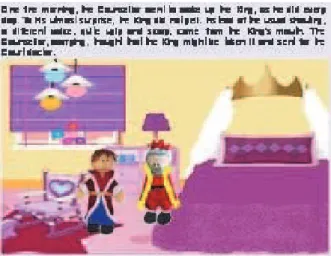
Royal Counsellor is standing by the King’s bed. This scene aims at representing the King’s vocal misuse and abuse, showing him “starting his day yelling”. The instrument designed was a children’s
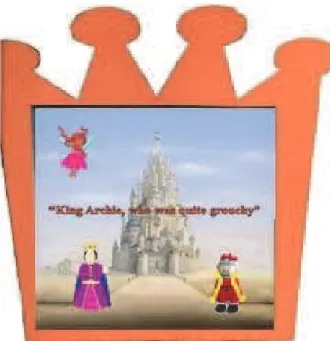
liter-ature book. Format-wise, the book is shaped as a royal crown, aimed at promoting resource to fantasy and to the symbolic as integral part of children’s imaginary world. The content of the narrative, which title is King Archie, who was quite grouchy, assumes that 7-year-olds are already capable of reading, and therefore able to read the instrument autonomously. The instrument also presents itself as contributing to the fostering and instilling of early reading habits. Children under 7 years old can nevertheless also
beneit from this instrument; parents and educators
are encouraged to use it as a fairy tale book, for
both listening to and (re)telling stories signiicantly
enhances the child’s verbal resources42. Along the
same line, the development of an interactive CD, using new technologies, will promote, in a playful manner, reading habits in children who are not inclined to engage in spontaneous reading.
The book cover (hard-cover, in Kapaline) shows the drawing of a castle in the background, and illus-trations of some of the story’s characters (namely, the King, the Queen, the Fairy.
Figure 1 – Book Cover
The tale of the story begins in Scene 2 (Figure 2) with the classical opening “Once upon a time, there was a King who lived in a big castle”. The scene illustrates the moment where the counsellor wakes up the King. The action takes place in the King’s bedroom chamber; the King is depicted lying in bed with an ill-humoured, grouchy countenance, and the
Figure 2 – Scene 2: The counsellor waking up the King
Scene 3 (Figure 3) takes place in the castle’s kitchen, showing the cook with a platter on his hand. The King’s vocal abuse is once again highlighted: it is mentioned that “even when he was about to have his breakfast, King Archie kept on yelling, and not even the Queen could endure all the King’s racket”.
Figure 3 – Scene 3: The cook, on his way to bring breakfast to the King
Putting his mirror back in his sachet, the doctor began to explain:
In scene 12, the King inquires the doctor on the seriousness of his clinical condition and on the possi-bility of ever recovering his voice. In scene 13, the
doctor answers the question conidently, saying that the King’s future improvement is speciically contin -gent on the behaviours His Majesty would choose to adopt in his daily life, in that “were he to persist on yelling, as he did every day, his voice would grow increasingly uglier and unbearable”.
From scenes 7 to 14, the plot is centred on the Court doctor’s visit to the King, who expresses grave concern with what was happening to his voice. The doctor then asks the King to open his mouth and proceeds to examine it with a “little mirror”, eventu-ally arriving at a diagnosis: there were nodules in the King’s vocal folds (scene 9).
In scene 10, the King asks the doctor what nodules and vocal folds are and, in scene 11, the doctor provides a detailed explanation in reply, saying that “when we speak loudly, yell or scream
over a long period of time, our vocal folds lap
violently against one another, and this causes nodules to appear”.
Figure 4 – Scene 5: The Counsellor decides to send for the doctor
Figure 5 – Scene 11: The doctor enlightens the King on the subject of Vocal Folds
Figure 6 – Scene 13: The King’s improvement is contingent on his changing his behaviour
The narrative continues to unfold in the royal chambers, and the Court doctor eventually recom-mends that the King should enlist the services of a Speech Therapist (scene 14), who will help him improve his vocal use, saying that “this healthcare practitioner will give you advice and teach you phonation exercises”.
In scene 15, the King surrenders to his “grouchy condition” and asks the Counsellor to send for a Speech Therapist, so that he can immediately begin speech therapy sessions. Scenes 16 to 18 illustrate the Counsellor sending for the “Speech Therapist Fairy”, who will later conduct a vocal assessment and start the recommended therapy.
the Kingdom of the King who ceased to be grouchy, everyone lived happily ever after – and with healthy voices”.
law for the Kingdom, where everyone is forbidden to yell or shout because it is bad for one’s voice”. And so, in keeping with the traditional fairytale ending, “in
Figure 7 – Scene 19: The King’s vocal rehabilitation
CONCLUSION
The present health education instrument, fash-ioned as a children’s literature book, emerges within the context of creating ludic-pedagogic instruments aimed at restructuring “clinical tools” which can be used in the relational and pedagogic communica-tion established in speech therapy settings. Further-more, in view of a broader intervention designed to promote vocal health educational in school contexts, the proposed instrument presents itself as a tool anchored in a ludic-relational intervention between parents and children, and between educators and educatees. The story’s narrative brings the reader back to the imaginary world of traditional fairy-tales, which facilitates story retelling and children’s comprehension concerning the issue of “vocal misuse and abuse”. The option for a fairly tale serves the purpose of making the target-population of the project aware of risk behaviours through a persua-sive message, established upon the “symbolic tenor of play activities”.
Putting this health education project into practice will show that a close cooperation amongst speech therapist, parents and educators is a crucial element, in that the manifestation of vocal folds nodules qua
clinical condition is frequent among school-age chil-dren. Considering that those nodules’ etiology lies on vocal misuse and vocal abuse, it is relevant to make children sensitive to preventing pathogenic behaviours, such as shouting, yelling and speaking loudly, and, conversely, to instil in them, at an early age, voice protection measures they should be mindful of when playing and interacting with their peers.
and therapy. Philadelphia: W. B. Saunders Company; 1973.
15. Navas DM. Disfonia Infantil. Vox Brasilis. 2003;9:11-2 from http://www.ablv.com.br/vox/ vox%207%20-%20pdf.pdf
16. Penteado RZ, Camargo AMD, Rodrigues CF, Silva CR, Rossi D, Silva JTC, Silva SLS G. Vivência de voz com crianças: análise do processo educativo em saúde vocal. Distrib. Comum. 2007;19:237-46 from http://www.pucsp.br/revistadisturbios/artigos/ Artigo_547.pdf
17. Connor NP, Cohen SB, Theis SM, Thibeault SL, Heatley DG & Bless DM. Attitudes of children with dysphonia. Journal of Voice. 2008; 22:197-209. 18. Behlau M & Gonçalves MIR. Considerações sobre Disfonia Infantil. In: L. P. Ferreira (Org.), Trabalhando a Voz - Vários Enfoques Fonoaudiológicos. São Paulo: Summers editorial; 1987.
19. Boone DR & McFarlane SC. A voz e a terapia vocal. Porto Alegre: Artes Médicas; 1994.
20. Toohill RJ. The psychosomatic aspects of children with vocal nodules. Arch Otolaryngol. 1975; 101: 591-5.
21. Aronson A. Clinical voice disorders: an interdisciplinary approach. New York: Thieme Medical Publishers; 1990.
22. Fish S & Shelly J. Cuidado espiritual do paciente. São Paulo: Umhe; 1986.
23. Ricou M, Salgado J, Alves C, Duarte I, Teixeira Z, Barrias J & Nunes R. A comunicação e a alteração de comportamentos. Psicologia, Saúde e Doenças. 2004; 5: 131-44.
24. Tschudin V. Counselling skills of nurses. London: Bailliére; 1988.
25. Waddington L. The therapy relationship in cognitive therapy: a review. Behavioural and Cognitive Psychoterapy. 2002; 30: 179-91.
26. Dias MR, Cardoso J & Soares FA. Uma “árvore
caixa-ludo” em isioterapia pediátrica. In I. Leal, & S.
N. Jesus (Orgs), Actas do 6º Congresso Nacional de Psicologia da Saúde, Lisboa: ISPA; 2006. p. 621-7. 27. Dias M, Soares F & CarrãoL. O Bafo do Gigante: Projecto de Ludoterapia em educação para a saúde. In I. Leal, & S. N. Jesus (Orgs), Actas do 6º Congresso Nacional de Psicologia da Saúde, Lisboa: ISPA; 2006. p. 667-72.
28. Barbosa A. Educação para a saúde: determinação individual ou social? Revista crítica de ciências sociais. 1987; 23: 169-84.
29. Lebovici S & Diatkine R. Signiicado e Função do
Brinquedo na Criança. Porto Alegre: Artes Médicas; 1988.
30. Macedo L, Petty ALS & Passos NC. Aprender com jogos e situações-problema. Porto Alegre: Artes médicas; 2000.
REFERENCES
1. Behlau, M. Voz: o livro do especialista. Vol. I. Rio de Janeiro: Revinter; 2004.
2. Maia AA, Gama ACC & Michalick-Triginelli MF.
Relação entre transtorno do déit de atenção/
hiperatividade, dinâmica familiar, disfonia e nódulo vocal em crianças. Rev. Ciências Médicas. 2006; 15: 379-89 from http://www.puc-campinas.edu.br/ centros/ccv/revcienciasmedicas/artigos/v15n5a02. pdf.
3. Guimarães I. Ciência e Arte da Voz Humana. 1ª edição, Alcabideche: ESSA; 2007.
4. Vieira AC & Behlau M. Análise de voz e comunicação oral de professores de curso pré-vestibular. Rev. Soc. Brasileira de Fonoaudiologia. 2009; 14: 346-51 from http://www.scielo.br/pdf/rsbf/v14n3/v14n3a10. pdf
5. Behlau M & Pontes P. Avaliação e tratamento das disfonias. São Paulo: Editora Louvise; 1995. 6. Gindri G, Cielo CA & Finger L. Disfonia por nódulos vocais na infância. Salusvita. 2008; 27: 91-110 from http://www.slideshare.net/jullidias/ salusvita-v27-n12008art08
7. Le Huche F & Allali R. A patologia vocal de origem funcional. São Paulo: Artmed Editora; 2005.
8. Freitas MR, Weckx LLM & Pontes PAL. Disfonia na infância. Rev Bras. de Otorrinolaringol. 2000; 66: 257-65.
9. Gielow I. Disfonia Infantil: Terapia da disfonia infantil e o processamento auditivo. Vox Brasilis. 2003; 9: 13 from http://www.ablv.com.br/vox/ vox%207%20-%20pdf.pdf
10. Hersan R. Disfonia Infantil: A disfonia típica da infância. Vox Brasilis. 2003; 9: 12 from http://www. ablv.com.br/vox/vox%207%20-%20pdf.pdf
11. Koishi HU. Disfonia Infantil: Avaliação e tratamento otorrinolaringológico na disfonia infantil. Vox Brasilis. 2003; 9:10 from http://www.ablv.com. br/vox/vox%207%20-%20pdf.pdf
12. Pontes P, Kyrillos L, Behlau M, Biase N & Pontes P. Vocal nodules and laryngeal morphology. Jounal of voice. 2002; 16: 408-14 from http://www.sciencedirect.com/science?_ ob=ArticleURL&_udi=B7585-488XV1P-D&_ user=7740324&_coverDate=09%2F30%2F2002&_ r d o c = 1 & _ f m t = h i g h & _ o r i g = g a t e w a y & _ origin=gateway&_sort=d&_docanchor=&view=c&_ acct=C000072707&_version=1&_urlVersion=0&_ userid=7740324&md5=8e5be0e2a5337799d88b7a 2a3179ef5d&searchtype=a
13. Roy N, Holt KI, Redmon S & Muntz H. Behavioral characteristics of children with vocal fold nodules. Journal of Voice. 2007; 21: 157-68.
36. Shearer WM. Diagnosis and treatment of voice disorders is school children. Journal of Speech and Hearing Dis. 1972; 37: 215-21.
37. Silverman EM & Zimmer CH. Incidence of Chronic Hoarseness among School-Age Children. Journal of Speech and Hearing Disorders. 1975; 40: 211-5.
38. Warr-Leeper GA, Mcshea RS & Leeper HA. The incidence of voice and speech deviations in a middle school population. Language, Speech, and Hearing Services in Schools. 1979; 10: 14-20. 39. Wilson DK. Voice problems of Children. Williams and Wilkins; 1979.
40. Andrews ML. Terapia Vocal para crianças: os primeiros anos escolares. Porto Alegre: Artes Médicas; 1998.
41. Dias MR. Serão os mass media Estrategas de Saúde?. Lisboa: Climepsi; 2005.
42. Amarilha M. Estão mortas as fadas? Literatura infantil e prática pedagógica. Petrópolis: Editora Vozes; 1997.
31. Melo ECM, Mattioli FM, Brasil OCO, Behlau M, Pitaluga ACA & Melo DM. Disfonia infantil: aspectos epidemiológicos. Revista Brasileira de Otorrinolaringologia. 2001; 67: 804-7 from http:// www.scielo.br/pdf/rboto/v67n6/8448.pdf
32. Takeshita TK, Ricz LA, Isaac ML, Ricz H & Lima WA. Comportamento vocal de crianças em idade pré-escolar. Arq. Int. Otorrinolaringologia. 2009; 13: 252-8 from http://www.arquivosdeorl.org.br/ conteudo/acervo_port.asp?id=624
33. Souza DPD, Silva APBV, Jarrus ME & Pinho SMR. Avaliação Fonoaudiológica vocal em cantores infanto-juvenis. Rev. CEFAC.2006;8:216-22 from http://www.revistacefac.com.br/revista82/artigo10. pdf
34. Baynes RA. An incidence study of chronic hoarseness among children. Journal of Speech and Hearing Disorders. 1966; 31: 172-6.
35. Senturia BH & Wilson FB. Otorhinolaryngologic
indings in children with voice deviations. Ann Otol.
1968; 77: 1027-41.
http://dx.doi.org/10.1590/S1516-18462012005000080
Received on: September 02, 2011 Accepted on: January 12, 2012
Mailing Address:
Maria Rosário Dias, Egas Moniz
Centro de Investigação Multidisciplinar em
Psicologia da Saúde, Campus Universitário, Quinta da Granja, Monte de Caparica
Caparica – Portugal 2829-511