CONSTITUTION OF THE EXPERIENCE OF MOTHERHOOD
AND INFANT DEVELOPMENT RISK
Constituição da experiência da maternidade
e risco ao desenvolvimento infantil
Luciane Beltrami (1), Anaelena Bragança de Moraes (1), Ana Paula Ramos de Souza (1)
(1) Universidade Federal de Santa Maria – UFSM, Santa
Maria, RS, Brasil.
Project accomplished at Universidade Federal de Santa Maria – UFSM
Conlict of interest: non-existent
This possibly occurs due to the relection of the
maternal emotional state on the mother’s respon-siveness to the child’s demands. The maternal responsiveness is characterized by maternal behaviors contingent, appropriate and
immedi-ately related to the behavior of the child, such
as synchrony, reciprocity in the responses, the
repetition of the sequences of games, the focus of mutual attention and sharing of affective states. She suffers from multiple inluences and must be understood in a wide reference system involving biological and contextual variables of the history of the dyad, as well as broader cultural aspects3.
A study of 21 mother-infant dyads revealed this multiplicity by comparing the responsiveness from seven single mothers and fourteen married ones, which demonstrated greater responsiveness from
married mothers with regard to crying babies and vocalization. These results support the theory that
indicates that single mothers may experience more stress when they need to meet the demands of the
INTRODUCTION
Caring for a child takes energy, affection and
attention. The mother needs to be psychologically
available to convey affection and upbringing, which implies an emotional parenting involvement for the child to develop in a more self-assured way1. If
the mother is having any emotional symptoms, it
can lead to consequences for the development of
the child, as demonstrated by a cohort study in the Norwegian public health services. Conducted with
900 families, this study stated that children subjected to an environment of stress and anguish are more
vulnerable to developing emotional problems in the
future2.
ABSTRACT
Purposes: to analyze the possible relation between diiculty on maternal experience constitution and
the presence of developmental risk indexs, as well the interference of phsycosocial and obstetric
variables in this aspects. Methods: the quantitative descriptive type, comparative casual about
behavioral manifestations of the mother-baby interactive process. The sample was made up of 182
moms and their babies, these born in term or pre-term, in a University Hospital in the central region
of Rio Grande do Sul, whose babies spent/passed by neonatal hearing screening in the period from March to June 2010. It was held an interview, applied protocol IRDIs and ilmed the dyad interaction.
Results: showed that diiculties on maternal experience constitution were statistical correlated with
the presence of developmental risks. The psychosocial and obstetric variables didn’t inluence this
correlation. Conclusions: systematize highlight that the dificulties in the constitution of the experience
of motherhood have serious risk of factors for the emergence of risk indicators for child development, because behavioral alterations in the people who exercise the maternal function relected on the initial proto conversation of the mother-child dyad, what may created the risk for the child development in general, and for child language acquisition in a speciic way.
instrumental aspects of the development, such as
the psychomotor aspect and language as a
commu-nicative function11,12.
A Brazilian multicenter study, with psychoana-lytic theoretical bases, showed that 18 indicators,
proposed for children up to 18 months, and investi
-gated in a cohort study of 1-36 month-old children, allowed to predict risks to child development, and some were more speciic to predict psychic risk12.
This research investigated sociodemographic, obstetric and psychosocial variables, as well as
speciic aspects of child development. The outcome of this research was given by the psychoanalytic and psychiatric assessment of children aged three. The research makes clear that the analysis of the risk
indices to child development (IRDls) occurs in the
observation of the relationship between those who exercise parental functions and the baby. The inter
-actional focus, adopted in the indices mentioned, allows for the hypothesis of this research that the analysis of the IRDls could relect problems in the baby’s symbolic appetite and the presence of difi
-culties in setting up the experience of motherhood. These dificulties may relate to changed maternal
emotional states13-15, or the dificulty of imagining
the maternal role, among other elements that can
interfere with this establishment7,9,16,17.
Considering these aspects highlighted in previous research, this study aims to analyze the
association between the dificulty in setting up the experience of motherhood and the presence of risk indices to child development, as well as interference or not of socioeconomic, demographic, obstetric and
psychosocial variables, in the studied association.
METHODS
This study was approved by the institutional ethics committee under number CAAE 0284.0.243.000-09,
of Universidade Federal de Santa Maria – RS. This research is of a descriptive quantitative
type, with a comparative casual character on the
behavioral manifestations of the mother-infant
interactive process18. The sample consisted of
182 mothers and their babies, these born at term or preterm, at a university hospital in the central
area of the Brazilian southern state of Rio Grande
do Sul, whose babies passed by the neonatal hearing screening in the period March-June 2010.
The calculation of this sample was made using as a basis the average annual attendance of 900 babies
in neonatal hearing screening and the prevalence
of maternal emotional states such as anxiety and/
or depression, estimated at 15% in various studies
of the Brazilian reality, which could explain, at least in part, the dificulties in setting up the experience of babies by themselves, especially in their irst year
of life4. Therefore, not only the maternal position is
important in the relationship between mother and baby, but also the spousal support, which generally occupies the paternal position.
Children who experience a dysfunctional mother-child relationship can manifest diminished affective responses, dificulties in socializing with strangers, sleep disturbances, exacerbated separation anxiety, gastrointestinal disorders, lack of appetite or constant episodes of vomiting5, as well as dificulties
in the acquisition and development the language6.
Researches say that the baby imagined during
pregnancy has an important impact on the future mother-infant interaction, because the mother
invests her libido in order to constitute a subjective space to receive the reality baby. It is necessary,
therefore, to also examine the baby’s condition at
birth, its symbolic appetite, this one conceptualized
as an innate drive to seek another human being, and the possibility of this having an effect on maternal
responses7,8. It is known that the baby undergoes
signiicant changes in the irst few months, such as the emergence of social smile, a form of intentional communication, based on the irst intersubjective interactions with adults that have effects on social cognition and language acquisition7. These
charac-teristics of the babies combine in a unique and complex way with the possibilities of the adult to care for and interact, in different styles, anchored in
various cultural bases9,10.
These theoretical observations allow us to
understand the enormous importance of setting and meeting basic relationships, the possibility of a baby having for itself an engaged mother and
symbolically having appetite. This will be relected in a protoconversation in the irst years of life. The
protoconversation is characterized by the dialogue
in which the adult speaker holds the baby while enunciating, not yet speaking, by offering senses to the baby’s bodily manifestations (vocalizations,
crying, smiling, babbling, bodily gestures, gaze). The “momish”6 is an evidence of this initial protocon
-versation10,11. When this protoconversation does not
occur satisfactorily, there is the possibility of the baby presenting psychological or development risks11.
The psychological risk is deined as the presence of signs of psychological distress evidenced in
noisy series (inconsolableness, sleep disorders such as not sleeping well, eating disorders, etc.) or in silent series (sleeping all the time, not showing any initiative to interact with others, etc.), which
directly affect the psychic structure. As for the risk to the development, it relates to the effects of the baby ‘s psychological risks or biological changes
coded as presence or absence of dificulty, without measuring its severity or lack thereof. To encode the presence of dificulty in the establishment of maternal experience, it was observed in the interview: lack of handling the baby, feeling of inability to care for them, excessive fatigue, hopelessness, apathy, tension and irritability, as well as family conlicts
(the mother-in-law wants to separate, the husband
was arrested, dificulty in relationships with parents), and even marital conlict (constant bickering with
the husband, recent separation, the husband is
depressed). On the other hand, the coding for the lack of dificulty was identiied in the interview, in
which mothers showed good interaction with the
baby, had good social support, had no history of mental illness in the family nor evident situational
crisis.
As babies assessed were at ages 0-4 months,
the ive risk indices of the irst phase of the initial
IRDls were observed in the interaction between
mother and baby. In the absence of an index in the
interaction with the mother, it was tested with the
researcher, especially index 3, which deals with the child reaction to “momish”. The ive indices analyzed
were:
1 – When the child cries or screams, the mother knows what she wants. This index was
observed from situations in which the mother
assumed the baby wanted something and she could assign a possible interpretation to this demand, e.g., eating, sleeping, changing positions, etc.
2 – The mother talks to the child in a style particularly directed to it (momish). Here the interaction between mother and child was analyzed
in terms of harmony, not only if the mother spoke in momish, but if her speech was attuned to the baby’s
productions.
3 – The child reacts to the momish. In this item
it was observed if the child engaged in protocon
-versation, and especially if such participation was
actively sought. As some mothers, depending on the
depressive and/or anxious emotional states, were unable to talk to their children in such an attuned
way, the researcher tried to do that with the babies and analyze such a response when it occurred.
4 – The mother offers something to children and awaits its reaction. Here the mother’s capacity
for waiting for the child’s response was observed, i.e., of giving it a chance during the protoconversation.
5 – There is exchange of glances between the child and the mother. This item was observed
only with the mother during the times of protocon
-versation and/or silent exchanges between mother
and baby.
The methodology of this study followed the IRDls marks of the multicenter survey of risk factors motherhood. Studies of the prevalence of dificulties
in setting up the experience of motherhood in the Brazilian and international reality were not found.
Babies born with malformations or syndromes and hearing loss were excluded from the study due to the commitment that these factors lead to the development of children and also babies whose
mothers had a very compromised psychic structure, such as psychosis, etc.
According to the Regulatory Guidelines and Standards for Human Research (Resolution 196/96 of the National Health Council), mothers were
contacted at the neonatal hearing screening service and invited to participate in the research. They were
informed about the objectives and procedures of the research and, after reading the Statement of Free and Informed Consent, they signed it as volunteers. Data collection was performed by the psychol
-ogist/researcher in a room set aside for this purpose, in the hospital itself, for approximately
30 minutes, through a semi-structured interview
about the experience of motherhood, developed
and standardized by Schwengber and Piccinini18.
This interview aims to investigate the obstetric
history of mothers and get the socioeconomic,
demographic, obstetric and psychosocial data.
During the interview, the psychologist/researcher identiied the need to exclude or not the dyad from the observation of the mother’s psychic commitment and/or the baby’s evident biological limit.
Socioeconomic variables were family income, education and profession. The demographic
variables were age, marital status and number
of children. Obstetric variables were the number of pregnancies, number of parturitions, history of miscarriage, preterm delivery, mode of delivery, number of prenatal consultations, planning of
the pregnancy, low birth weight, complications in
newborns and type of breast-feeding. Psychosocial variables were social support, history of mental illness in the family and dificulty in the formation of the maternal experience.
The data obtained in this interview was coded
and a database was built in a spreadsheet (Excel). Among them, a coding for the presence or absence of dificulty in the establishment of maternal experience (DCEM) was created. This data was assessed from two open questions present in the interview protocol, which were: if there was a history of mental illness in the family (family of the mother, of the husband or someone close), and if the
mother was going through some situational crisis,
i.e., if there were any family or personal problems, at the time, that generated feelings and dificulties
in relation to maternity. The answers to these
for the child development11, which consists of the
annotation of the presence of the index as absence of risk to development, or in its absence, as an indicator of the presence of risk. The presence of psychological risk was considered only when the ive indices of the phase were jointly absent, as
provides the mentioned multicenter survey. It is worth noticing that the indices were observed during the interview with the mother and soon
thereafter. Then, a brief interaction of the mother with the baby was ilmed for 10 minutes. This ilm was made at a distance so as to interfere as little
as possible in the dyadic relation. The instruction
given to mothers is that they talked and/or played
with their babies as they did at home. The purpose
of this was to record the interaction so that there was a second assessment of the ive indexes by another experienced reviewer. As some babies were sleeping during and after the interview, within a week reassessment of the indices in their home was sought. Therefore, all risk indices were checked until a (present or absent) value for each could be
obtained.
The quantitative data analysis was performed using descriptive and inferential statistics. The non-parametric test of independence of chi-square with a signiicance level of 5% was used. These analyses were performed using the Statistica 9.0
computer package.
RESULTS
Table 1 shows the frequencies of absence and presence of the Dificulty In The Establishment Of Maternal Experience (DCEM).
Table 1 – Frequency of absence and presence
of dificulty in the formation of the maternal
experience
DCEM f (%)
No Yes
116(63,7) 66(36,3)
Total 182(100,0)
Caption: DCEM - Dificulty in the Formation of the Maternal Experience
It is observed in Table 1 that 36.3% of mothers had some dificulty in maternal role.
The levels of risk for the child development are
shown in Table 2.
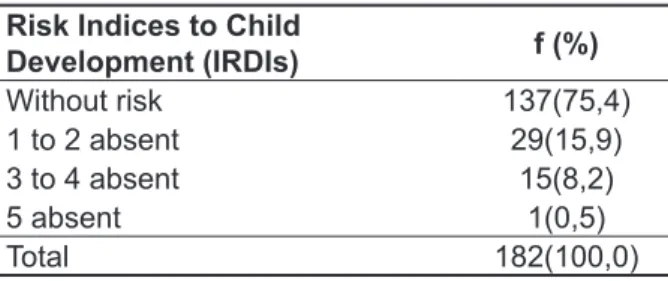
Table 2 – Percentage representation of the risk levels to child development
Risk Indices to Child
Development (IRDIs) f (%)
Without risk 137(75,4) 1 to 2 absent 29(15,9) 3 to 4 absent 15(8,2)
5 absent 1(0,5)
Total 182(100,0)
Caption: IRDIs – Risk Indices to Child Development
It can be seen in Table 2 that the majority of the sample (75.4%) showed no risk indices, i.e., the
dyads have good interaction and are healthy. It is
observed that 24.6% of the dyads in this study had at least one risk indicator.
Table 3 depicts the frequency of the IRDls in relation to the socioeconomic and demographic risk factors.
It is observed that there is no signiicant difference in the proportions of IRDls in the socioeconomic and
demographic variables ranges tested.
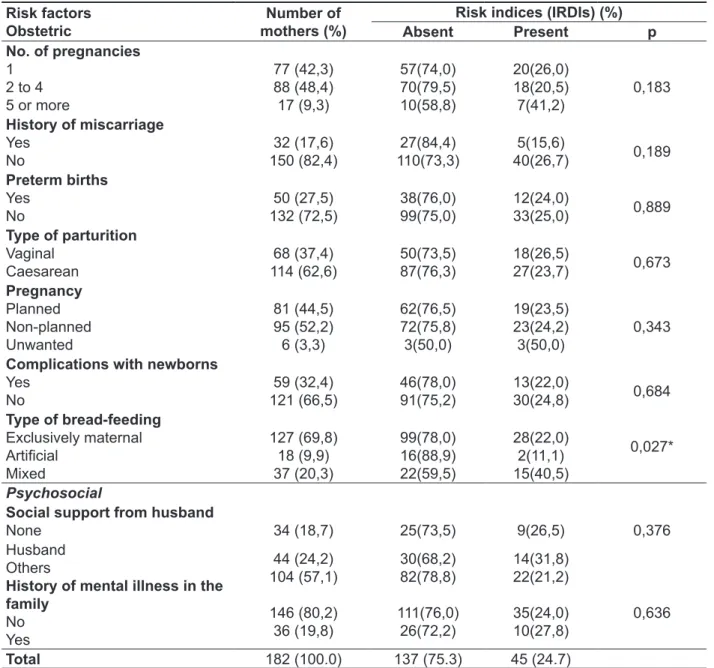
The frequencies of IRDls regarding obstetric and psychosocial risk factors are presented in Table 4.
It is observed that, in most of the variables, there is no signiicant difference in the proportions of IRDls in the obstetric and psychosocial variables ranges tested. Only on the type of breast-feeding it
is observed that mothers who use more than one
way of feeding both had a higher proportion of risk indices (40.5%), which was statistically different compared to mothers who only breast-fed naturally or artiicially (p = 0.027).
Table 3 – Distribution of the risk indices to child development and their socioeconomic and demographics risk factors for the sample (n = 182) of the study
Risk factors Socioeconomic
Number of mothers (%)
Risk indices (IRDIs) (%)
Absent Present p
Family income (minimum wage)
Less than 1 More than 1
52(28,6) 125(68,7)
35(67,3) 98(78,4)
17(32, 7)
27(21,6) 0,120
Schooling
Basic education/illiterate
High school education College education
78 (42,9) 90 (49,5) 13 (7,1)
56(71,8) 70(77,8) 10(76,9)
22(28,2) 20(22,2) 3(23,1)
0,662
Profession
Homemaker
Other
98 (53,8) 84 (46,2)
70(71,4) 67(79,8)
28(28,6)
17(20,2) 0,194
Demographics
Age (years)
Under 20 20 to 34 35 or more
34 (18,7) 117 (64,3)
31 (17,0)
26(76,5) 90(76,9) 21(67,7)
8(23,5) 27(23,1) 10(32,3)
0,565
Marital status
Married/consensual marriage
Single
156 (85,7) 26 (14,3)
120(76,9) 17(65,4)
36(23,1)
9(34,6) 0,207
Number of children
1 or 2 3 or more
1421 (77,5) 41 (22,5)
108(76,6) 29(70,7)
33(23,4)
12(29,3) 0,444
Total 182 (100.0) 137 (75.3) 45 (24.7)
m. w. = minimum wage. Missing data: family income (5); schooling (1). Non-parametric statistical test of independence of chi-square. *Signiicant p ≤ 0.05.
Table 4 – Distribution of the risk indices to child development and their obstetric and psychosocial risk factors for the sample (n = 182) of the study
Risk factors Obstetric
Number of mothers (%)
Risk indices (IRDIs) (%)
Absent Present p
No. of pregnancies
1 2 to 4 5 or more
77 (42,3) 88 (48,4) 17 (9,3)
57(74,0) 70(79,5) 10(58,8)
20(26,0) 18(20,5) 7(41,2)
0,183
History of miscarriage
Yes No
32 (17,6) 150 (82,4)
27(84,4) 110(73,3)
5(15,6)
40(26,7) 0,189
Preterm births
Yes No
50 (27,5) 132 (72,5)
38(76,0) 99(75,0)
12(24,0)
33(25,0) 0,889
Type of parturition
Vaginal Caesarean
68 (37,4) 114 (62,6)
50(73,5) 87(76,3)
18(26,5)
27(23,7) 0,673
Pregnancy
Planned Non-planned Unwanted
81 (44,5) 95 (52,2) 6 (3,3)
62(76,5) 72(75,8) 3(50,0)
19(23,5) 23(24,2) 3(50,0)
0,343
Complications with newborns
Yes No
59 (32,4) 121 (66,5)
46(78,0) 91(75,2)
13(22,0)
30(24,8) 0,684
Type of bread-feeding
Exclusively maternal Artiicial
Mixed
127 (69,8) 18 (9,9) 37 (20,3)
99(78,0) 16(88,9) 22(59,5)
28(22,0) 2(11,1) 15(40,5)
0,027*
Psychosocial
Social support from husband
None 34 (18,7) 25(73,5) 9(26,5) 0,376 Husband
Others
History of mental illness in the family
No Yes
44 (24,2) 104 (57,1)
146 (80,2) 36 (19,8)
30(68,2) 82(78,8)
111(76,0) 26(72,2)
14(31,8) 22(21,2)
35(24,0) 10(27,8)
0,636
Total 182 (100.0) 137 (75.3) 45 (24.7)
NB = newborn; DCEM = dificulty in the establishment of maternal experience. Missing data: complications with newborns (2). Non
--parametric statistical test of independence of chi-square. * Signiicant p ≤ 0.05. Caption: IRDIs – Risk Indices to Child Development
Table 5 – Frequency distribution of the risk indices to child development based on the presence or
absence of dificulty in the establishment of maternal experience
DCEM No. of dyads (%) IRDIs (%)
Without risk 1 or more absent p
Absent 116(63,6) 98(84,5) 18(15,5) 0,000* Present 66(36,3) 39(59,1) 27(40,9)
Total 182(100,0) 137(75,3) 45(24,7)
Non-parametric statistical test of independence of chi-square. * Signiicant p ≤ 0.05.
causes that, during pregnancy, the mother
antic-ipate the birth of the child, from the marks left by her own history, and personify the fetus through the attribution of characteristics and personality. Once
the baby is born, this image will be more or less
conirmed, which leads the mother to interpret and guess its needs, because the birth of a baby never fully corresponds to what the mother was expecting before the birth7. Therefore, the mother needs to
mourn the fetus and the pregnancy to focus her
attention on the relationship with the baby, who
should have the reference in the child’s father and its name. Possibly, many factors, still not detailed in this analysis, have inluenced mothers of this sample with DCEM to present dificulties in making
such a transition. For now, it can be said, however,
that these factors have a statistically signiicant
relationship with the change in the initial protocon-versation between mother and baby, viewable by
the presence of risk to development, measured by the non-parametric statistical test of independence of the chi-squared.
Further analysis of the data will be needed, since it is known that multiple factors are interfering in each area of the mother’s care in relation to her baby. This is clear from studies on breastfeeding22,
on eating disorders1, and on the initial interactions23.
It is worth noting, inally, the element of the qualitative analysis of the indices most frequently altered, such as the identiication by the mother of what the baby wants (IRDI 1), the use of a particular
language directed by the mother to the baby (IRDI
2) and the exchange of glances between mother
and baby (IRDI 5), which indicate problems in the
axis of supposition of subject, establishing demand
and alternation between presence and absence. It
is known that the dialogue is made of alternation between the interlocutors and, in the case of the
interaction between an adult and a baby who does
not yet speak, by the assumption of a subject, the speaker, it is observed in such changes the risk for the acquisition of the baby’s language, when considered clinic proposals that take the interaction as central to the acquisition and development of
language24,25. Perhaps the dificulty in the transition
between pregnancy and dealing with the newborn
baby are factors involved in establishing these axes. The changed IRDIs suggest mothers that are excessively present or absent and that have difi -culties in dialogic investment with the baby, by the
absence of a particular style of language directed to the child. This fact is of particular relevance for the development of language and communication, if the
psycholinguistic and psychoanalytic studies on the
importance of momish are considered6,10,25.
Regarding the DCEM risk factor, it was observed that the IRDls are signiicantly higher (p = 0.000) between the mothers with presence of dificulty in performing the maternal role than those that did not have this dificulty, i.e., there is a higher proportion of babies with the presence of risk factors in mothers with dificulty performing the maternal role.
DISCUSSION
The results of this study, despite the low frequency of DCEM in the sample studied, showed that the dificulty in the establishment of maternal experience correlates signiicantly to the presence of IRDls, i.e., these mothers’ babies had a higher risk than the babies of the mothers who did not have such dificulty.
These results suggest that several factors
contribute to the psychological and development
risks, including some constitutional of the babies19,
which shows that the dificulty in setting up the experience of motherhood can affect the commu
-nicative exchanges between mother and baby, but does not constitute the sole factor to be considered in the explanation of the presence of risk to child
development.
In another study, it was shown that children of
mothers who have postnatal depression, compared
with those of non-depressed mothers, show decreased frequency of positive facial expressions and more negative expressions and are more likely
to develop depression at an early age5. In relation
to male depression (father), research shows that it originates in feelings of exclusion in view of the mother-infant dyad. As an effect of this exclusion, the man would see himself only as a provider, who must work and meet the requirements of the postpartum
woman20, which would limit the good family life. Both
studies show that parents’ emotional states can
affect the family dynamics and hinder the formation of the couple in their parental duties. However, such states are not signiicantly relected in the estab
-lishment of the experience of motherhood if there are family protection factors, such as spousal support. As for factors such as non pregnancy planning, they seem to have much more harmful effects on the emergence of maternal emotional states changed and on the establishment of the experience of
motherhood20,21. In this research, this effect was not
observed when obstetric and psychosocial variables
were analyzed in relation to the difference between
mothers with and without DCEM.
Several authors have emphasized that the
Some of the IRDIs assessed may be more directly related to the acquisition of language, such as the use of speech and momish and of the speech attuned to the baby’s actions, the possibility of the mother proposing something and waiting for the baby’s response, which allows the afirmation of the importance of early identiication of dificulties of the establishment of the experience of motherhood to the ield of speech-language pathology.
CONCLUSION
The dificulty in the establishment of maternal experience is a serious risk factor for the onset of risk indicators to child development, i.e., mothers with these dificulties are more likely not to establish some basic axes of the relationship with the baby such as the assumption of a subject, establishment of demand and switching between presence and
absence.
REFERENCES
1. Souza LV, Santos MA. A família e os transtornos
alimentares. Medicina. 2006; 39(3):403-9.
2. Karevold E. Family stress and child’s temper
extremes contribute to anxiety and depression in children and young people. Relatório de Pesquisa. Norwegian Institute of Public Health (NIPH), 2008. Disponível em: http://www.fhi.no/eway. Acesso em:
01 dez 2010.
3. Ribas AFP, Seidl-De-Moura L. Responsividade Materna: Aspectos biológicos e variações culturais.
Psic Relex Crit. [periódico na internet]. 2007 [acesso em 01 dez 2013];20(3):368-75. Disponível em: http:// dx.doi.org/10.1590/S0102-79722007000300004.
4. Piccinini CA, Marin AH, Alvarenga P, Lopes RCS,
Tudge JR. Responsividade materna em famílias de mães solteiras e famílias nucleares no terceiro mês
de vida da criança. Estud Psicol. 2007;12(2):109-17.
5. Smith ME, Jaffe J. Postpartum depression: signs, symptoms, and help for new moms. Guia de Orientação, 2007. Disponível em: http://www. helpguide.org/mental/postpartumdepression.htm.
Acesso em: 30 nov 2010.
6. Flores MR, Beltrami L, Ramos-Souza AP. O
manhês e suas implicações para aquisição da
linguagem. Distúrb.Comun. 2011;23(2):143-52.
7. Ferrari AG, Piccinini CA, Lopes RCS. O bebê imaginado na gestação: aspectos teóricos e
empíricos. Psicol Estud. 2007;12(2):305-13. 8. Aquino FSB, Salomão NMR. Contribuições da
habilidade de atenção conjunta para a cognição
social infantil. Psicol Estud. 2009;14(2):233-41.
9. Lavelli M, Fogel A. Developmental changes in
the relationship between the infant’s attention and emotion during early face-to-face communication:
The 2-month transition. Develop Psychol. 2005;41:265-80.
RESUMO
Objetivos: analisar a possível relação entre diiculdade na constituição da experiência da materni
-dade e a presença de índices de risco ao desenvolvimento infantil, bem como a interferência ou não
de variáveis psicossociais e obstétricas em ambos aspectos. Métodos: tipo quantitativo descritivo,
com caráter casual comparativo sobre as manifestações comportamentais do processo interativo mãe-bebê. A amostra foi constituída de 182 mães e seus bebês, estes nascidos a termo ou pré-termo, em um hospital universitário da região central do Rio Grande do Sul. Foi realizada uma entrevista semi-estruturada sobre a experiência da maternidade com as mães e aplicado um protocolo de índi
-ces de desenvolvimento infantil com a díade. A análise estatística deu-se sobre o cruzamento dos
resultados de ambas avaliações. Resultados: a presença de diiculdades na constituição a expe
-riência da maternidade relacionou-se estatisticamente com a presença de risco ao desenvolvimento infantil. As variáveis psicossociais e obstétricas não apresentaram interferência signiicante nos resul -tados. Conclusões: sistematizam os argumentos apresentados e destacam que as diiculdades na
constituição da experiência da maternidade são fatores de risco grave para o aparecimento de indica
-dores de risco para o desenvolvimento infantil, pois alterações no comportamento de quem exerce a função materna se reletem já na protoconversação inicial da díade mãe-bebê, o que pode gerar risco ao desenvolvimento infantil de um modo geral, e à aquisição da linguagem em particular.
researchers and practitioners. Boston: Kluwer Academic Publishers. 2001.
18. Schwengber DDS, Piccinini CA. Depressão
materna e interação mãe-bebê no inal do primeiro ano de vida. Psic. Teor. e Pesq. [online].
2004;20(3):233-40.
19. Guedenay A, Mintz AS, Dugravier R. Risques développementaux chez le nourrisson de la naissance à 18 mois. Rev Psychiatri/Pédopsychiatry. [periódico na internet]. 2007 [acesso em 01 de dezembro de 2013];37:195-200. Disponível em: http://www.em-consulte.com/article/66569/risques-developpementaux-chez-le-nourrisson-de-la-
20. Guedes-Silva DG, Souza M, Moreira V,
Genertra M. Depressão pós-parto: prevenção e consequências. Rev mal-estar subjetivid. [periódico na internet]. 2003 [aceso em 13 jun 2010];III(2):439-50. Disponível em: http:// pepsic.bvsalud.org/scielo.php?pid=S1518-61482003000200010&script=sci_artt
21. Pretto JP. A Inluência do desejo parental nas altas habilidades/superdotação: uma abordagem psicanalítica. Rev. CEFAC. 2010;12(5):859-69.
22. Cardoso L, Bianchi JJP. Aleitamento materno: uma prática de educação para a saúde no âmbito
da enfermagem obstétrica. [Dissertação]: Braga,
Portugal - Universidade do Minho; 2007.
23. Seidl-de-Moura ML, Ribas AFP, Seabra KC, Pessôa LF, Nogueira SE, Mendes DMLF, et al.
Interações mãe-bebê de um e cinco meses: aspectos afetivos, complexidade e sistemas parentais predominantes. Psicol Relex Crít.
2008;21(1):66-73.
24. Wiethan FM, Souza A, Klinger EF. Abordagem
terapêutica grupal com mães de crianças
portadoras de distúrbios de linguagem. Rev Soc Bras Fonoaudiol. 2010;15(3):442-51.
25. Catão I. O bebê nasce pela boca: voz, sujeito e clínica do autismo. São Paulo: Instituto Langage.
2000.
10. Parlato-Oliveira É. Como falam os bebês? Explorações sobre a fala e o campo da linguagem na clínica de bebês. In: Barbosa DC, Parlato-Oliveira É. (orgs). Psicanálise e clinica com bebês:
sintoma, tratamento e interdisciplina na primeira
infância. São Paulo: Instituto Langage. 2010. 11. Lerner R, Kupfer MCM (Org.). Psicanálise com crianças: clínica e pesquisa. São Paulo: FAPESP/
Escuta. 2008.
12. Kupfer MC. Pesquisa multicêntrica de indicadores clínicos de risco para o desenvolvimento infantil. Relatório Final da Pesquisa ao Ministério da Saúde, 2008. Disponível em: http://www.fmcsv.org.br/pdf/ FMCSV_pesquisa_multicentrica_indicadores_ cl%C3%ADnicos_DI.pdf. Acesso em: 08 maio 2010.
13. Faisal-Cury A, Menezes PR. Ansiedade no
puerpério: prevalência e fatores de risco. Rev Bras Ginecol Obstetr. 2006;28(3):171-8.
14. Correia LL, Linhares MBM. Ansiedade materna
nos períodos pré e pós-natal: revisão da literatura. Rev Lat Am Enfermagem. 2007;15(4):1-9.
15. Favero MS, Peres RS. Avaliação de ansiedade
e depressão em mães de bebês prematuros e mães de bebês a termo, Encontro Interno 8, Seminário de Iniciação Cientíica, 12, Anais. Convênios CNPQ/ UFU & FAPEMIG/UFU. 2008.
16. Couto ER, Couto E, Vian B, Gregório Z, Nomura ML, Zaccaria R, et al. Qualidade de vida,
depressão e ansiedade em gestantes com má
história gestacional. Med. J. [periódico na internet]. 2009 [acesso em 27 mar 2010];127(4):185-9. Disponível em: http://www.scielo.br/pdf/spmj/ v127n4/v127n4a02.pdf
17. Fraga DA, Linhares MBM, Carvalho AEV,
Martinez FE. Desenvolvimento de bebês nascidos
pré-termo e indicadores emocionais maternos. Rev
Psicol Relex. Crit. 2008;21(1):33-41.
18. Webby R, O’connor M. Judgmental time-series
forecasting using domain knowledge. In: Armstrong J.(org) Principles of forecasting: a handbook for
Received on: September 17, 2012 Accepted on: May 16, 2013
Mailing address: Luciane Beltrami
Rua: Mal. Floriano Peixoto, 1000/33
Ed. Rio da Prata - Centro Santa Maria, RS – Brasil CEP: 97015-370