2010 May-Jun; 18(3):406-12 www.eerp.usp.br/rlae
Corresponding Author: Maria Bernadete Junkes
Fundação Universidade Federal de Rondônia. Campus Cacoal Rua da Universidade, 920. Brizon
CEP: 78975-155 Cacoal, RO, Brasil
E-mail: [email protected] e [email protected]
Financial Expense Incurred by Medical Leaves of Health
Professionals in Rondonia Public Hospitals, Brazil
Maria Bernadete Junkes
1Valdir Filgueiras Pessoa
2The study investigates the additional payroll expense caused by absenteeism due to illness
among nursing professionals and physicians at two public hospitals at Cacoal, Rondonia,
Brazil. Non-programmed absences of up to 15 days which occurred at the hospital units
between 2004 to 2007 were verified in the database of the institutions’ human resource
sector. From 1,704 non-programmed absences, 1,486 were justified by medical declarations.
It was verified that absenteeism caused by illness was responsible for 87.2% of all
non-programmed absences. When these data are grouped by professional categories, it was
observed that the nurse absenteeism due to illness reached 83.3%, when compared with
16.7% for physicians. The general absenteeism index, adding up nurses and physicians,
corresponded to 0.85%, resulting in an additional payroll expense of 5.2% and 7.4% in the
salaries of nursing professionals and physicians, respectively.
Descriptors: Absenteeism; Hospitals, Public; Nurses, Male; Physicians.
1 Doctoral Student in Nursing Sciences, Faculdade de Ciências da Saúde, Universidade de Brasilia, DF, Brazil. Faculty, Fundação Universidade Federal de Rondônia, AC, Brazil. E-mail: [email protected].
Gasto inanceiro ocasionado pelos atestados médicos de proissionais da saúde em hospitais públicos no Estado de Rondônia, Brasil
O objetivo deste estudo foi investigar o gasto adicional na folha de pagamento, causado pelo absenteísmo doença de proissionais de enfermagem e médicos, em dois hospitais públicos da cidade de Cacoal, Rondônia, Brasil. Foram veriicadas ausências não programadas de até 15 dias nas unidades hospitalares, no período de 2004 a 2007, observadas no banco de dados do setor de recursos humanos das instituições. Constatou-se 1.704 ausências não programadas, das quais 1.486 são justiicadas por atestados médicos. Veriicou-se que o absenteísmo por motivo de doença foi responsável por 87,2% das ausências não programadas. Se for descrito por categoria de proissional, o absenteísmo doença dos proissionais de enfermagem atingiu índice de 83,3% e dos médicos 16,7%. O índice do absenteísmo geral dos proissionais de enfermagem e médicos foi de 0,85%, enquanto que o gasto adicional na folha de pagamento no período atingiu 5,2% nos vencimentos dos proissionais de enfermagem e 7,4% dos médicos.
Descritores: Absenteísmo; Hospitais Públicos; Enfermeiros; Médicos.
El gasto inanciero causado por las licencias médicas de profesionales
de la salud en los hospitales públicos en Rondonia, Brasil
El objetivo de este estudio fue investigar el gasto adicional en la planilla de pago, causado por el absentismo enfermedad de profesionales de enfermería y médicos, en dos hospitales públicos de la ciudad de Cacoal, en Rondonia, Brasil. Fueron veriicadas ausencias no programadas de hasta 15 días en las unidades hospitalarias, en el período
de 2004 a 2007, constatadas en el banco de datos del sector de recursos humanos de
las instituciones. Se constató 1.704 ausencias no programadas, de las cuales 1.486 son justiicadas con certiicados médicos. Se veriicó que el absentismo por motivo de enfermedad fue responsable por 87,2% de las ausencias no programadas. Si fuese
descrito por categoría profesional, el absentismo enfermedad de los profesionales de enfermería alcanzaría el índice de 83,3% y el de los médicos 16,7%. El índice de absentismo general de los profesionales de enfermería y médicos fue de 0,85%, en cuanto que el gasto adicional en la planilla de pago en el período alcanzó 5,2% en los salarios de los profesionales de enfermería y 7,4% de los médicos.
Descriptores: Absentismo; Hospitales Públicos; Enfermeros; Médicos.
Introduction
The causes of absenteeism in hospitals, such as diseases, non-programmed or unjustiied absences, locomotion problems, family motives, demotivation,
inadequate policies, precarious supervision by managers
and occupational accidents, among others, may indicate
that professionals reject the job, due to the fact that,
in most cases, these absences are short. Factors like insuficient staff though, in combination with lack of medication and equipment, demonstrate that public hospitals face economic and inancial dificulties(1).
In the inancial situation, spending control is a fundamental work instrument to optimize hospital
operations. Cost is considered as spending related to goods
or services used to produce other goods and services.
Hence, any payment to health professionals working in hospitals is classiied as workforce spending(2).
Absenteeism is the absence from work due to
programmed (holidays, maternity leave, congress leave
a crucial problem for public organizations and their
managers. It causes not only direct but also indirect
costs, due to decreased productivity, care quality and
administrative problems(3).
In a country like Brazil, whose salary standard
does not permit losses, some causes of absenteeism are
disguised as absenteeism due to disease. This stimulates
indiscriminate forms of justifying these absences by
means of medical declarations. Spending on absenteeism
due to disease is higher than the salary paid to the ill
worker, who does not attend the workplace, affecting
productivity(3).
In this context, Cacoal, a city in the Central-South
of Rondônia, a Brazilian state, with an approximate
population of 78 thousand inhabitants, offers six
hospitals, two of which are public and attend to the largest
part of service demands. The city also faces problems to
deal with its health professionals. Management normally
does not question absenteeism at these public hospitals,
resulting from non-programmed absences, particularly short ones, and justiied by medical declarations of up to 15 days, with signiicant frequencies.
It should be reminded that public hospitals are
funded by the actions and services performed, as they
need to present productivity reports, showing what
procedures were carried out. Therefore, registration
and control mechanisms need to be adopted, based on
worksheets provided by the Ministry of Health. Thus,
workers’ absence can mean decreased productivity and
fewer resources to be applied.
Hospitals in general are far from being model
organizations, as they expose their workers to situations
marked by work overload, chronic and lethal diseases, infrastructural deiciencies, repetitive strain injuries and work related musculoskeletal disorders (RSI/
WRMD(4), thus contributing to the strengthening of non-programmed absences. Several studies have conirmed these facts, as follows.
In the United Kingdom, in 2005 for example, at
an eye hospital, 26% of postoperative problems were due to nursing professionals’ absenteeism, who justiied their absences by low remuneration levels(5).
At two asylum institutions in the USA in 2003 and
2004, health professionals practiced absenteeism due
to the salaries they received and the precarious work
conditions. In another research in Minnesota, carried
out in 1996, absenteeism due to physical injury at the
workplace predominated, generating US$ 11,417 of
public spending per person per year for nurses and US$
6,822 for physicians(6-7).
In some states in India, health professionals’
absence reached 67% between 1991 and 2001, due to decreased investments in health. In Venezuela, in 2001, the ratio of absenteeism due to disease registered for
resident physicians was around 13% and for nurses
7%. As a result, in 2003, the World Bank disseminated
absenteeism ratios in health in underdeveloped countries
like Bangladesh (42%), Honduras (27%), India (43%),
Peru (26%) and Uganda (35%)(8-9).
In Brazil, absenteeism research among health
professionals is more concentrated in the South and
Southeast. To give an example, at Complexo Hospitalar
Santa Casa, in 12 months (2003-2004), 68% of
professionals were absent due to health problems or
medical appointments, during the following periods:
33.3% up to nine days, 21.8% between 10 and 24 days,
10.3% between 25 and 99 days and 2.6% declared
absences of more than 100 days. At a university hospital in the State of Paraná, among 494 health leaves (between July 1997 and June 1998), absences represented 1,491
days not worked(4,10).
At a hospital in São José do Rio Preto, a city in São Paulo State, 75.4% of absences from work were due to
health problems. At the Hospital das Clínicas in Ribeirão
Preto, in 1998, absenteeism due to headache, which 91%
of employees presented, resulted in a 56.9% productivity
loss, and an average of 6.5 days lost per month. The total
estimated cost per year was US$ 815,622.54, i.e. US$
199.42 per employee per year(11-12).
In the North, at a psychiatric center in Manaus,
AM, 298 non-programmed absences were registered in 2004-2005, 57.05% of which were justiied by a medical declaration, resulting in 464 days of absence. Hence,
the nursing professionals mean absenteeism ratio was
2.9%(13).
Based on the above data and publications about absenteeism, it was veriied that most research results present causal factors of absenteeism among
In view of the above, this research aimed to
demonstrate the scenario of implicit payroll expenses caused by non-programmed absences justiied by a medical declaration, lasting up to 15 days, without taking
into account the description of the nursing professionals
and physicians’ disease.
This research among nursing professionals and
physicians is considered relevant because they are
responsible for almost 90% of productivity in hospital
institutions.
Methods
The research was carried out at two public hospitals in Cacoal, at 485km from the state capital Porto Velho, in Rondônia, Brazil, between January and April 2008.
Quantitative and qualitative variables were addressed
with a retrospective and analytic approach, through an
information survey in the database of the institutions’
human resource department.
The information collection instrument was adapted(1)
and included the following variables: reason for leave,
functional category, time of absence, gender and time
on the job. In compliance with Resolution 196/96 by the
Ministry of Health’s National Health Council, approval
for the research was obtained from the Research Ethics
Committee at Faculdade de Ciências Biomédicas de
Cacoal – FACIMED, in March 2007.
The research sample included all nursing
professionals and physicians working at these
hospitals between 2004 and 2007. Non-programmed
absences for up to 15 days were detected in frequency
worksheets. The amounts described to support
additional payroll expenses correspond to each
category’s initial baseline salary in 2007, together
with the basic gross salary received and distinguishing gratiications and bonuses.
To facilitate result descriptions, hospitals were called
H1 and H2. H1 is a hospital unit with 47 active beds
and 204 collaborators, with 28 physicians, 7 nurses, 6
nurse technicians and 56 nurse auxiliaries. The hospital
delivers care to children and pregnant women, including
high-risk patients.
H2 in turn is a hospital unit with 45 active beds and
228 collaborators, with 38 physicians, 3 nurses, 1 nurse
technicians and 33 nurse auxiliaries; it is an urgency
and emergency unit that performs medium-complexity
procedures.
Frequency worksheet notes supported the calculation
of absenteeism ratios due to non-programmed absences
and percentages related to additional expenses due
to these professionals’ replacement on the respective
workdays.
Signiicant variation was observed in contractual salaries, depending on the period the professional was hired in, such as inclusion of overtime, gratiications due to specialization and incentives determined by law. Thus, besides the oficially registered basic salary, some advantages and gratiications are added to the paycheck, offering professionals an increased income
at the end of the period, which in some cases exceeds
500%. Therefore, the researchers decided to use the initial baseline salary and the total initial salary with
additions.
To calculate additional payroll expenses, for nursing
professionals, the number of days was multiplied by the
hours worked on that day, in this case eight hour, and
again multiplied by the overtime payment per hour. Physicians, on the other hand, receive a ixed amount of R$ 700.08 (seven hundred reais and eight cents)
for 24-hour shifts. The human resource departments
at the hospitals informed the nursing professionals and
physicians’ salaries.
The absenteeism ratio was based on the formula
below(3) and calculated in Microsoft Ofice Excel 2007.
In this case, the total number of unforeseen days of
absence from work is divided by the total number of
workdays worked during the period, discounting days
related to vacations, holidays and weekends, which adds
up to 272 days per year, multiplied by the number of
professionals in the category under analysis. This result
was multiplied by 100 to achieve the percentage ratio.
Absenteeism ratio= Total days of unforeseen absence from work
Mean number of employees * Number of workdays during period x 100
Results
The survey revealed 1,704 non-programmed
absences of nursing professionals and physicians at the
left unjustiied, that is, simply described as absences.
It should be reminded that the number of workdays
during the four-year period was 1,088 (one thousand
eighty-eight). Multiplied by the number of professionals
included in this research, this resulted in 176,256 (one hundred seventy-six thousand two hundred and ifty-six) days, reaching an absenteeism ratio of 0.85%. Speciically with regard to absenteeism with a medical declaration, this was responsible for 87.2% of all
non-programmed absences. If described per professional
category, the ratio for nursing professionals was 83.3%
and for physicians 16.7%.
Two hundred ninety medical declarations were
issued over four years, 63% for up to three days, 12.8%
up to six days, 6% up to nine days, only 2% up to 12 days
and the remaining 16.2% up to 15 days of absence from
labor activities. Based on the number of declarations
issue, during the four years, there were 1,088 workdays
worked, with 904 non-programmed absences at H1 and
582 at H2.
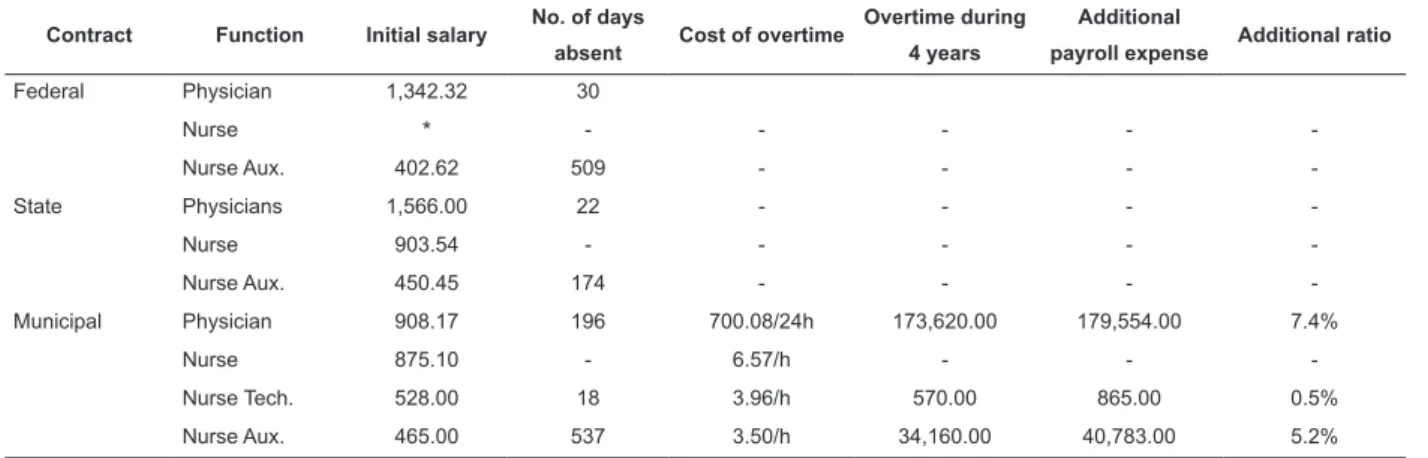
Based on the collected information, additional
payroll expenses between 2004 and 2007 were
simulated, spent on workers at the two study hospitals.
It should be highlighted that, when absent workers
need to be replaced, only municipal workers can replace
them. Thus, for the sake of calculations, the salaries
of municipal public servants were considered, as contractually established and speciicied in Table 1.
Table 1 – Health Ofice’s additional payroll expense in R$ to cover unprogrammed absence between 2004 and 2007
Contract Function Initial salary No. of days
absent Cost of overtime
Overtime during
4 years
Additional
payroll expense Additional ratio
Federal Physician 1,342.32 30
Nurse * - - - -
-Nurse Aux. 402.62 509 - - -
-State Physicians 1,566.00 22 - - -
-Nurse 903.54 - - - -
-Nurse Aux. 450.45 174 - - -
-Municipal Physician 908.17 196 700.08/24h 173,620.00 179,554.00 7.4%
Nurse 875.10 - 6.57/h - -
-Nurse Tech. 528.00 18 3.96/h 570.00 865.00 0.5%
Nurse Aux. 465.00 537 3.50/h 34,160.00 40,783.00 5.2%
Source: Human Resources Dept. at H1 and H2 – adapted by the authors (2008).
The amounts paid during four years result from
adding up the professionals’ absences, multiplied by the
cost of overtime. In the case of physicians, for example,
all days of absence were added up and multiplied by one
single value, due to the fact that the category receives
per shift (30+22+196=248*700.08=R$173,620.00).
Next, the normal salary they were entitled to was added
up, resulting in 179,554.00 (one hundred seventy-nine thousand ive hundred ifty-four reais). As for other nursing professionals, days of absence were added up and multiplied
by eight hours, due to the fact that salaries are determined
in hours instead of days, like for physicians (e.g. Nurse
Aux.=509+174+537=1,220 * 8 =9,760 * R$ 3.50=R$
34,160.00). To reach the additional payroll expense, the
normal amount that was not discounted during the period
of justiied absences was added up.
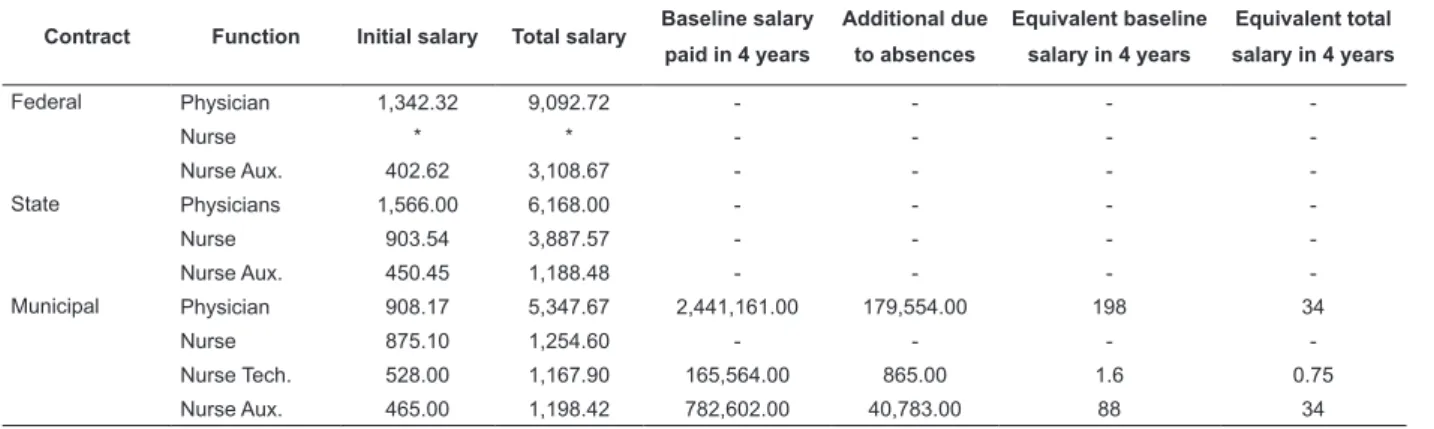
The additional expense ratio was found based on
the remuneration by the municipal professionals’ initial
baseline salary during the study period, as demonstrated
in Table 2. Table 2 also presents the amount of salaries that is not paid to cover for absenteeism justiied by medical declarations, showing both the initial baseline
salary for the category and the average salary received
in each category, in 2007. With regard to physicians,
the ratio was 7.4% higher than the category’s entire
remuneration, that is, 198 baseline salaries were not paid, equivalent to 34 salaries with gratiications and bonuses. Second are nurse auxiliaries, with a 5.2%
Table 2 – Salaries paid to cover absenteeism due to disease between 2004 and 2007
Contract Function Initial salary Total salary Baseline salary paid in 4 years
Additional due
to absences
Equivalent baseline
salary in 4 years
Equivalent total
salary in 4 years
Federal Physician 1,342.32 9,092.72 - - -
-Nurse * * - - -
-Nurse Aux. 402.62 3,108.67 - - -
-State Physicians 1,566.00 6,168.00 - - -
-Nurse 903.54 3,887.57 - - -
-Nurse Aux. 450.45 1,188.48 - - -
-Municipal Physician 908.17 5,347.67 2,441,161.00 179,554.00 198 34
Nurse 875.10 1,254.60 - - -
-Nurse Tech. 528.00 1,167.90 165,564.00 865.00 1.6 0.75
Nurse Aux. 465.00 1,198.42 782,602.00 40,783.00 88 34
Source: Human Resources Dept. at H1 and H2 – adapted by the authors (2008).
Despite the limitations of the notes made in nursing professionals and physicians’ iles, some medical declarations showed the occupational illnesses that led to these absences, through the identiication of the ICD – International Classiication of Diseases. These data indicate that 48% of absenteeism caused by disease
was related to musculoskeletal disorders, known as RSI/ WRMD. Moreover, 12% presented mild inlammation (tonsilitis) and 15% depression, with absences of more
than 10 days. Dengue fever was responsible for 5% of
absences and headache for the remaining 20%.
At the two hospitals, no predominance of
absenteeism after holidays was found, but at weekends,
when professionals were supposed to be on duty. In
addition, some professionals bring on frequent notes
during the study periods, that is, absences were
registered in most months.
Data analysis showed that the average productivity
at the two hospitals in Cacoal was 300 thousand procedures during the study period. More speciically in 2007, considering the resident population, this meant a
cost per inhabitant of R$ 214.33 (two hundred fourteen
reais and thirty-three cents). Among the factors involved
in these results, the collaborators stand out, as these
contributed to the generation of these expenses during
the research period, corresponding to 61%.
Discussion
The ratios found in this research are high when
compared with other countries in South America, like Venezuela with 13% for resident physicians and 7% for nurses(9), or even with India (67% for health
professionals)(8), where investments in the health
area decreased between 1991 and 2001. However,
absenteeism ratios at the study hospitals in Cacoal
are comparable to ratios reported in some hospitals in the South and Southeast: 79.2% in Porto Alegre(4), 75.4% in São José do Rio Preto(11). Medical declaration
percentages are also high when compared with surveys
at the Complexo Hospitalar Santa Casa in Porto Alegre in 2003-2004(10), and in Manaus, corresponding to
2.9%(13).
Although the cause of non-programmed absences was not a fundamental goal in this research, data related
to the origins of absenteeism are in line with research
performed at the University Hospital in São Paulo State in 2000 where, out of 1988 medical declarations issued,
84.2% was related to diseases of the digestive system. At
the Teaching Hospital in Uberaba, MG, in 2002, medical
declarations indicated 21.57% of back pain, 13.73% of headache, 8.82% of rhinitis and respiratory problems,
5.9% of hypertension and limb pain and the remainder
occupational accidents due to biological hazards(14-15).
While the ratio of absenteeism due to disease
was 0.85%, when considered in days not worked,
additional payroll expenses varied considerably. The ratio corresponded to 5.2% for nurse auxiliaries, which
is six times higher when related with the absenteeism
ratio. The ratio for medical professionals corresponded
to expenses 8.5 times higher.
This difference between the ratio of absenteeism due
to disease and the ratio of additional payroll expenses is
not evidenced in most cases. Another fact that stands out is that the most severe absenteeism due to disease is concentrated in professionals with more than ive years at the research institutions, perhaps because they are keeping the stability of their job in mind. This observation
is based on informal conversations with the researchers
and perceived in some frequency worksheets, which
Absenteeism could be minimized at the municipal
hospitals by putting in practice and adapting policies that
allow for a better work environment, bonus practices
by managers, cultures that privilege participation, as
well as interventions in occupational health promotion
and in adequate health staff dimensioning, in line with
strategies previously suggested in research in the North
of Brazil(13).
One example of changes in job policies comes from the Hollywood Conidential Hospital in Western Australia, which reduced absenteeism ratios to 2.24% by using the
EEO – Equal Employment Opportunity – a federal law
that established the family-friendly program, in which
patients’ relatives help hospital workers(16).
Final considerations
The research revealed the payroll expenses caused by non-programmed absences and absences justiied by medical declarations, for periods of up to 15 days,
without leading to remuneration losses. The results
can also contribute to statistics about the expenses
absenteeism generates at hospital institutions in Brazil,
which have stood out in the last two decades, and join extremely important data to support managers in
strategic planning, with a view to setting up policies needed for adequate inancial resource allocation in the health area.
Based on the premise that it is through hard and
responsible work that institutional results are achieved,
which in this case means attending to the population’s health needs, absenteeism is essentially understood as a
management problem. In a recent study about absence
from nursing work, the authors argue that data obtained in that type of research can support interventions to
improve current work conditions, decreasing economic
and social costs in this context. The authors also hope
that the present research can somehow contribute for hospital managers in Cacoal to turn the demonstrated
expenses into strategies that motivate their collaborators,
such as a career plan, reduced spending on medication
and assiduity awards, among others.
References
1. Murofuse NT. O adoecimento dos trabalhadores de enfermagem da Fundação Hospitalar do Estado de Minas Gerais: reflexo das mudanças no mundo do trabalho. [tese]. Ribeirão Preto (SP): Escola de Enfermagem de Ribeirão Preto/Universidade de São Paulo; 2004. [acesso em: 02 mar. 2007]. Disponível em www. teses.usp.br/teses
2. Martins E. Contabilidade de custos. 9ª ed. São Paulo (SP): Atlas; 2006.
3. Chiavenato I. Gestão de Pessoas. Edição compacta. 2ª ed. São Paulo (SP): Atlas; 2004.
4. Silva DPP, Marziale MHP. Problemas de saúde responsáveis pelo absenteísmo de trabalhadores de enfermagem de um hospital universitário. Rev Latino-am Enfermagem. 2000; 8(5):44-51. 5. Baylis OJ,Adams WE, Allen D,Fraser SG. Do variations in the theatre team have an impact on the incidence of complications? [serial online] 2006. BMC Ophthalmol. 2006. 6:13.[Acesso em: 13 ago. 2006]. Disponível em: http://www. pubmedcentral.nih.gov/
6. Mc Govern P, Kochevar L, Lohman W, Zaidman B, Gerberich SG, Nyman J, et al.The Cost of Work Related Physical Assaults in Minnesota. HSR: Health Serv Res. 2000; 35(3):663-86. 7. Castle N, Degenholtz H, Rosen J. Determinants of staff job satisfaction of caregivers in two nursing homes in Pennsylvania. BMC Health Serv Res 2006; 60(6):1-11.
8. Varatharajan D. Provision of Health Care by the Government. Indian J Med Ethics. [acesso em: 16 nov 2006]. Disponível em: http://www.issuesinmedicalethics.org/
9. Garcia-Prado A, Chawla M. The impact of hospital management reforms on absenteeism in Costa Rica. Healthy Police Plan. [serial online]. 2006. 21(2):91-100. [Cited 2008 nov 16]. Disponível em: http://heapol.oxfordjournals.org/cgi/content/ abstract/21/2/91
10. Raffone AM, Hennington EA. Avaliação da capacidade funcional dos trabalhadores de enfermagem. Rev Saúde Pública. 2005; 39(4):669-76.
11. Barboza DB, Soler ZASG. Afastamento do trabalho na enfermagem: ocorrência com trabalhadores de um hospital de ensino. Rev. Latino-Am. Enfermagem. 2003; 11(2):177-83. 12. Bigal ME, Moraes FA, Fernandes LC, Bordini CA, Speciali JG. Indirect Cost of Migraine in a Public Brazilian Hospital. Headache. 2001; 41(5):503-8.
13. Becker SG, Oliveira MLC. Estudo do absenteísmo dos profissionais de enfermagem de um centro psiquiátrico em Manaus, Brasil. Rev. Latino-Am. Enfermagem. 2008; 16(1):109-14.
14. Reis JR, La Rocca PF, Silveira AM, Bonilla IML, Giné NA, Martín M. Fatores relacionados ao Absenteísmo por doença em profissionais de enfermagem. Rev Saúde Pública 2003; 37(5):616-23.
15. Rezende MP. Agravos à saúde de auxiliares de enfermagem resultantes da exposição ocupacional aos riscos físicos [dissertação]. Ribeirão Preto (SP): Escola de Enfermagem de Ribeirão Preto, Universidade de São Paulo; 2003. [acesso em: 10 jul 2007]. Disponível em www.teses.usp.br/teses
16. Cass-Ryall K. Hollywood Private Hospital. [acesso em: 13 ago 2006]. Disponível em: http://www.eowa.gov.au/