HANDING DOWN AND ADAPTION: THE CONSTRUCTION OF THE
mATERIAl WORlD OF HEAlTH CARE TECHNOlOGY IN SPAIN (1855-1955)
Claudia Patricia Arredondo-González1, Carmen De la Cuesta-Benjumea2, José Antonio Ávila-Olivares3
1 Ph.D. in Nursing and Culture Care. Professor, Departamento de Psicología de la Salud, Facultad de Ciencias de la Salud, Universidad de Alicante. Alicante, España. E-mail: [email protected]
2 Ph.D. in Nursing. Professor, Departamento de Psicología de la Salud, Facultad de Ciencias de la Salud. Universidad de Alicante. Alicante, España. E-mail: [email protected]
3 Ph.D. in Nursing and Culture Care. Presidente, Consejo de Enfermería de la Comunidad Valenciana. Alicante, España. E-mail: ja.avila@ wanadoo.es
ABSTRACT: This historical study uses qualitative methods to analyze and describe the components of the material world of nursing care in Spain between 1855 and 1955 based on the analysis of eight nurse training manuals. A total of 360 objects and 45 procedures were recorded. Manual analysis was carried out concurrently with data collection based on the Grounded Theory approach. Findings show that the material world of health care was composed of objects that were handed down by the medical profession to health care professionals and adapted objects, improvised mainly out of everyday household items. While the handing down of medical tools and
instruments could be said to be a theoretical and technical achievement, it is not clear whether it was also a scientiic accomplishment.
The improvisation of objects out of everyday household items promoted by the manuals highlights the artisan-like and ingenious nature of nursing practice, which should be explored further in future studies to provide a greater understanding and promote the recognition of these objects as a health care technology.
DESCRIPTORS: Nursing history. Biomedical technology. Working environment. Qualitative research. Spain.
HEREDAR Y ADAPTAR: lA CONSTRUCCIóN DE UN mUNDO
mATERIAl-TECNOlóGICO PARA lOS CUIDADOS EN SAlUD EN ESPAñA (1855–1955)
RESUmEN: Estudio histórico que utiliza técnicas cualitativas, cuyo objetivo es describir y analizar componentes del mundo material para los
cuidados en España entre 1855 y 1955, relejados en manuales de formación profesional de la época. Se estudiaron ocho manuales completos,
se registraron 360 objetos y 45 procedimientos. El análisis fue concurrente con la recolección de información, siguiendo procedimientos de la Teoría Fundamentada. Los resultados muestran que el mundo material para los cuidados estaba formado por objetos heredados de la práctica médica y objetos de carácter doméstico adaptados. Así, mientras la herencia de objetos de la práctica médica podría representar
una conquista teórica y técnica, no está claro si también cientíica. La adaptación de objetos terapéuticos, a partir de cosas corrientes que
los manuales promovían, indica un trabajo artesanal e ingenioso de los profesionales del cuidado que estudios posteriores podrían ampliar y contribuir a su reconocimiento como tecnología para cuidar.
DESCRIPTORES: Historia de la enfermería. Tecnología biomédica. Ambiente de trabajo. Investigación cualitativa. España.
HERDAR E ADAPTAR: A CONSTRUçãO DE Um mUNDO
mATERIAl-TECNOlóGICO PARA OS CUIDADOS Em SAÚDE NA ESPANHA (1855–1955)
RESUmO: Estudo histórico que utiliza técnicas qualitativas com objetivo de descrever e analisar os componentes do mundo material para os
cuidados na Espanha entre 1855 e 1955, expressos nos manuais de formação. Foram estudados oito manuais para formação de proissionais
do cuidado. Registaram-se 360 objetos e 45 procedimentos. A análise foi simultânea à coleta de informação, seguindo os procedimentos da Teoria Fundamentada no Dados. Os resultados mostraram que o mundo material dos cuidados estava formado por objetos herdados da prática médica e objetos de caráter doméstico adaptados. Assim, enquanto o legado de objetos da prática médica poderia representar
uma conquista teórica e técnica, não está claro se também cientíica. A adaptaçao de objetos terapêuticos a partir de coisas comuns que os manuais promoviam, indica um trabalho artesanal e engenhoso dos proissionais do cuidado, que estudos posteriores podem ampliar e
contribuir para o seu reconhecimento como tecnologia para cuidar.
INTRODUCTION
The material world of nursing practice is in-tegrated by objects in movement that have varying meanings according to the society in which they are set.1 The technology of the material world of
care-giving practice has changed over time, as has the nursing profession. However, throughout the his-tory of Spanish nursing, the meanings and symbol-ism surrounding the material world of care-giving practice have not been scrutinized, and the role of technological objects in nursing and the status of
the profession has not been explored or suficiently
recognized. This article explores the material world of care-giving in Spain between 1855 and 1955.
Though a relatively new concept associated with Modernism, technology has always existed and it may be considered as any instrument used to sat-isfy human needs.1 Technology is therefore a way of
naming the material world and the objects, tools and instruments created and used by people in all types of activities.2 It is the underlying purpose or intention
of use of an object that makes it technology and gives its meaning within a given context.2 Objects have
therefore played an important role throughout both the history of civilization and the history of nursing.
Care-giving technology is implicitly recognized in the vast historiography of Spanish nursing and the material world of health care. Different studies have focused on the contributions made by religious or-ders to the professionalization of Spanish nursing.3-4
A study about the Hijas de la Caridad (the Daughters of Charity)3 focused on the theoretical content of
nurse training manuals and the physical, moral and intellectual attributes expected of nurses in the early nineteenth century, suggesting that changes in medicine, technology and science had repercus-sions throughout the profession.3 A study
regard-ing the knowledge and practices of the Orden de los Enfermeros Pobres (the Poor Brothers Inirmarians), founded by Bernardino de Obregon in the sixteenth century,4 shows that, although the use of instruments
in the procedures described by the Order is implied,
intruments are not speciically mentioned; while
another study only mentions the stock of dental care instruments most used by bleeders and care practi-tioners in the eighteenth and nineteenth centuries.5
Other studies show the use of household objects by nurses, such as spoons, plates and cups,6
and the pitcher has been historically described as a tool for feeding the sick in both domestic and health settings.7 However, household objects are
not considered here as technology, and their use by nurses in the world of nursing practice and how
this inluenced the profession has not been studied
in depth. Thus, the material world of nursing has been generally overlooked in the literature.
An exception to this rule are present-day criti-cal or intensive care units. The impact of these units on the nursing profession has been the subject of a number of investigations, historical studies and
re-lections on the discipline and practice of nursing.8-10
Numerous studies have been undertaken in Spain regarding the work and experiences of nurses in intensive care units.11 Although studies concerning
the historical evolution of these units in the country do not exist, recent research focuses on modern intensive care unit facilities and technology, and the health professionals dedicated to care delivery in these settings.12
Some historical works concerning Spanish
nursing recognize the inluence that different types
of training and health care practices among care practitioners and nurses - both doctors’ assistants in the nineteenth and twentieth centuries. Care practitioners, who generally had broader training and technical skills, gained greater prestige and social recognition than nurses, whose training was more natural, vocational and feminine.13-14 However,
little is known about the role that objects played in this process. Therefore, an exploration of the mate-rial world of health care throughout the history of nursing and nursing technology may help provide a deeper understanding of key issues facing the nursing profession.
This article presents the results of a broader study that has resulted in other publications15-16 and
whose question was: what was the material world of health care like in Spain between 1855 and 1955? The aim of this broader study was to contribute towards the knowledge of the use of nursing care tools and instruments in Spain between 1855 and 1955. The aim of the present study is to identify these health care objects as elements of the material world of nursing care and recognize the use and transformation of everyday objects for care-giving during the period in question.
mETHOD
This is a historical study that uses grounded theory procedures to sample and analyze data.17-18
The past cannot be explained, but must rather be
understood; thus, the present study is grounded in
hermeneutic tradition, which implies the need to describe the past.19 Eight training manuals used
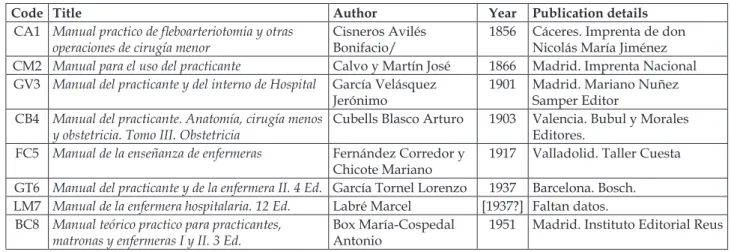
of information (Table 1). Access to four manuals from the Historical Museum of Nursing was granted by the trustees of the José Llopis Foundation in Alicante, Spain. The other four documents are in the public domain and available on the website of
the Oficial College of Nursing of Madrid (Colegio
Oicial de Enfermería de Madrid). These manuals were purposefully sampled according to study objectives.
The main inclusion criteria were: written in Spanish;
published between 1855 and 1955, and addressed
at nurses or other igures historically recognized as
being dedicated to the care of sick. In addition, the researchers sought to use manuals that illustrated the material world, technology and health care practices during the period in question. Four of the manuals were illustrated, seven were written by Spanish doctors, and one was written by a French doctor and translated by Spanish doctors (LM7).
Table 1 – Information sources
Code Title Author Year Publication details
CA1 Manual practico de leboarteriotomia y otras operaciones de cirugía menor
Cisneros Avilés Bonifacio/
1856 Cáceres. Imprenta de don Nicolás María Jiménez CM2 Manual para el uso del practicante Calvo y Martín José 1866 Madrid. Imprenta Nacional GV3 Manual del practicante y del interno de Hospital García Velásquez
Jerónimo
1901 Madrid. Mariano Nuñez Samper Editor
CB4 Manual del practicante. Anatomía, cirugía menos
y obstetricia. Tomo III. Obstetricia Cubells Blasco Arturo 1903 Valencia. Bubul y Morales Editores. FC5 Manual de la enseñanza de enfermeras Fernández Corredor y
Chicote Mariano
1917 Valladolid. Taller Cuesta
GT6 Manual del practicante y de la enfermera II. 4 Ed. García Tornel Lorenzo 1937 Barcelona. Bosch. LM7 Manual de la enfermera hospitalaria. 12 Ed. Labré Marcel [1937?] Faltan datos. BC8 Manual teórico practico para practicantes,
matronas y enfermeras I y II. 3 Ed. Box María-Cospedal Antonio
1951 Madrid. Instituto Editorial Reus
Three of the manuals (GT6, LM7, BC8) were successively reedited during the period in
ques-tion, two are part of an oficial training program
for care practitioners (CM2, CB4), and one was part of a course held between 1917 and 1918 by the Red Cross in Valladolid (FC5). Manul BC8, addressed at midwives and nurses, was granted a quality award by the National Academy of Medicine (Academia Nacional de Medicina) in 1944.
Data were collected between March 2012 and June 2013 and sampled using discriminate or theoretical sampling.18 A total of 3,043 pages were
analyzed, whereby 360 objects and 45 procedures described by the manuals were recorded. The analy-sis was conducted using historical and qualitative methods, regarding index card and memo writ-ing18,20 resulting in 423 index cards and 150 memos.
Analysis was carried out manually and concurrently with data collection in two stages: open coding, and focused coding.18 The data was coded, compared,
and conceptualized at increasingly more abstract levels to form categories.15 The elaboration of the
analytical memos and the literature review made it possible to move beyond data description to interpretation, while the development of diagrams throughout the study enabled the observation of the relationships between emerging concepts. 21
RESUlTS
The analysis of the training manuals revealed that the material world of nursing care was made up of objects “handed down” by the medical profes-sion and by therapeutic instruments improvised by caregivers from mainly household objects to satisfy patients’ care needs. Hence, health professionals of that time received from the training manuals the mandate to “inherit” and adapt objects, thus shaping the technological material world of nursing care was shaped. The following paragraphs outline the hand-ing down of medical technology and the adaptation and improvisation of instruments in the material world of nursing care during the period in question.
The handing down of medical technology
The material world of health care during the period in question was composed of objects exclusively used by doctors, such as soft urinary catheters, thermometers and sphygmomanometers, that later began to be used by caregivers.
of health care professionals: “care should be taken to write a brief and compendious description of matters
of science; and when it is necessary to vulgarize in
order to make it more intelligible, technical language should be economized with utmost care, because only those who follow other kinds of studies will be able to understand it” (CM2:2).
The complex use of objects such as soft urinary catheters was, in principle, reserved for doctors and was not taught to other health care professionals as the following quote shows: “urinary retention - very common, especially among recently operated
patients (urine suppression); it is necessary to cath -eterize, about which we say nothing to the nurse, since we judge that she is currently unable to per-form this procedure... [the procedure] is not without serious dangers, and nurses’ current grounding in medicine does not authorize them to address these needs” (FC5:149).
As training for care givers became broader based, technical concepts were vulgarized to fa-cilitate understanding and complex objects, whose use had previously been said to be dangerous, were handed down and incorporated into practice as harmless procedures. Therefore, by the twentieth century, care givers were already applying soft
uri-nary catheters: “The most preferable lexible (“soft”)
red rubber catheter is the Nelaton catheter, which
has a diameter of between ive and six millimeters
and is suitable for both sexes and totally harmless to the urethra” (BC8:103).
Another example is the clinical thermometer. Previously limited to assessing body temperature by using their hands, the clinical thermometer was handed down to caregivers after it had become well
known and simpliied and the magic of the mercury
rising up the tube was no longer surprising. At the beginning of the twentieth century, blood pressure was measured using a sphygmomanometer. Nurses at the time were not allowed to use this instrument, let alone interpret its recordings, because they were not taught how to: “the graphs produced by this
apparatus are called sphygmograms; special knowl
-edge is required for this technique and interpreta-tion [of the recordings], which nurses can neither be taught or learn how to interpret” (FC5:107).
The sphygmomanometer was described by
the manuals as dificult to use and understand, and
only stopped being the exclusive domain of doctors
after it was suficiently simpliied and health care
professionals were trained how to use it. The sphyg-momanometer and blood pressure measurement procedure was only handed down in the middle of
the twentieth century: “there are a number of
differ-ent devices for measuring blood pressure; however
we will limit ourselves to mentioning the funda-mental parts that are common to all... the following technique is used to measure blood pressure... now
we have both numbers; in any case the measurement
should be repeated several times” (BC8:386-387). Before handing down procedures and the use
of medical instruments to care givers, irst the tech
-nical complexity that the instrument gained in the hands of doctors had to cease to exist. This happened
in one of two ways: techniques were simpliied so
they could be easily taught to health care
profes-sionals; or the instruments became seen as vulgar.
Instruments were thus presented as being common and not very glamorous, as was the case with the thermometer, whose description in the manuals became limited to its use: “I do not believe that it is necessary to describe the thermometer since it is well known and it is only necessary to explain its use and the techniques herewith so that nurses may
understand its scientiic use” (FC5:105).
Several procedures and objects exclusively used by the medical profession were handed down to health care professionals. However, the prestige associated with their use was not handed down with them. Paradoxically, despite representing a major accomplishment for care givers, advances in training and increased autonomy, this process
exempliies the subordination of nurses to the medi
-cal profession.
When caregivers became authorized and fre-quent users of handed down objects, these instru-ments and procedures also became devoid of the symbolic meaning they held when they were used ex-clusively by doctors. Thus, when caregivers received them they were already considered vulgar objects.
The adaptation and improvisation of health
care instruments
Apart from the technological instruments handed down by the medical profession, the manu-als mentioned another group of objects: everyday items that were manipulated to improvise thera-peutic solutions.
Therapeutic procedures such as the moxa,
which involves producing a supericial scab by
be slow and steady [...]. A blow pipe is helpful for this purpose or, in its absence, we can improvise one with paper rolled into a narrow cone-shaped tube” (CM2:61).
Eye drops were administered using a dropper bottle, in the absence of which a pen barrel could be used, while ointment could be applied to the eyelid using cigarette rolling paper: “ocular medications can be dry, soft, liquid or gaseous. Dry medications
are composed of an ultraine powder, which is ad
-ministered using a pen barrel by opening the eye and gently blowing a very small quantity... Liquids are instilled in drops inside the eye using a pen bar-rel [...]. Soft medications are commonly ointments. About the size of a hempseed of ointment should smeared along the edges of the eyelids, or inside the lids using cigarette rolling paper” (CM2:13).
Likewise, in an emergency, any type of ob-ject, such as a clean handkerchief, could be used as dressings instead of cotton wool, sterile bandages, and compresses: “the nurse, in the case of an emer-gency, [...]. But, in the unfortunate case of the lack of any other means, the wound should be covered to protect it from microbial agents using a piece of cloth or handkerchief, provided they are perfectly clean” (FC5:127-128).
The use of everyday items, such as pens, cigarette paper, and handkerchiefs, which were otherwise alien to the material world of nursing care, made them part of it. Such items were often more readily available than the clinical instruments that existed at the time. Furthermore, certain clinical instruments, such as suction cups, were expensive and therefore common glasses were often used in-stead: “a suction cup is a conical, round-based glass or crystal cup of varying diameters with a circular
opening and rounded rim; although not the most
ideal option, in the absence of this instrument a common glass, bowl, etc., may be used” (CA1:34).
Safety pins were used in procedures such as wound drainage to hold the surgical drain in place: “clamp the surgical drain [with a safety pin] so that it does not disappear into the wound” (LM7:235).
Safety pins were also used for serum therapy to facilitate the practitioner’s work and make it less tiring: “the ampoule is held at a certain height after it has been punctured and the liquid seeps under its own weight, emptying the ampoule, which usually comes with a wire, frame or tape to fasten it the sup-port with safety pins or bandage, thereby avoiding the tiring task of holding the ampoule up” (BC8:619).
Apart from facilitating the work of caregivers and meeting the needs of sick people, the use of
com-mon everyday objects was also intended to ensure the safety of procedures. An example is the use of the nurse’s apron as a support during cauteriza-tion, as illustrated by the following quote: “general handling and maintenance of the cauterizer. Place a spirit lamp, as free as possible from chlorides, to one side. On the other side, at a distance, place the bellow bottle half, or at the most two-thirds, full of
mineral spirits; then irmly close with a rubber stop
-per with two tubes – one connected to the air intake and the other to hydrocarbon vapor-air mixture...
The cauterizer is now set up. The insuflator bulb
is entrusted to another person with the express rec-ommendation not begin compression until directed [...]. The nurse should then take the bottle and hang it in her apron, or better, in one of the upper but-ton holes of her dress, rather than holding it in her hands, which would heat up the bottle and lead to the formation of an excessive amount of vapor...” (FC5:133).
The use of everyday objects in nursing care
reveals that the nurse’s work was manual and relex
-ive, motived by immediate needs. The artisan-like adaptation of common everyday objects for clinical use meant that the material world was transformed
into a world of unquantiiable resources between
1855 and 1955. One manual illustrates how an um-brella, a piece of wood or cardboard were used as splints to immobilize and protect a fractured leg due to the lack of available instruments: “an apparatus is improvised to transport the injured patient that consists of two splints or boards placed on either side of the leg and tied together in some way [...] carefully covered with linen or cotton to avoid further injury to the member. The split should be made with a piece of wood, zinc or cardboard, etc., a cane, umbrella or board” (LM7:309).
Likewise, a bottle could replace a breathing
apparatus lask and a tie and piece of wood became
a hemostatic tourniquet. The improvisation of
ob-jects arose from speciic needs, and the creation of
solutions in response to these needs detailed by the manuals reveals that nurse training involved both artisanal techniques and technical skills. Therefore, nursing care depended not only on existing techno-logical resources, but also the creative capacity of care givers, who should seek alternative materials and adapt and improvise everyday objects that gained value and therapeutic meaning in their hands.
The scientiic and technical aspects of nurs
recognized as technology represented acquired knowledge and technical skills, while the use of therapeutic instruments improvised out of every-day items emphasized care-giving labor as natural labor within the context of available, homemade and simple resources. Thus, technological innovation was overshadowed by the everyday simplicity of the objects used.
DISCUSSION
The handing down of medical technology and the improvisation of therapeutic instruments out of everyday objects are components of the technologi-cal world of nursing during the period in question and show that the construction of this material world was motivated by advances in science and clinical needs. Although the reviewed manuals were
not intended to relect clinical practice, the detailed
description of procedures and approaches to com-mon clinical situations provides a plausible indica-tion of what the material world was like during this period and, more importantly, the contribution that health care professionals were expected to make to this world. Thus, through the handing down of technological objects used in clinical practice and by improvising solutions to address care needs using household objects, professional caregivers constructed the material world of technology.
The analysis of the training manuals shows that there is a linkage between the scientific knowledge, technical skills and objects used by professional care-givers and the material world. The knowledge of professional caregivers in the nineteenth century was limited and merely practi-cal, while the use of health care instruments required few technical skills. By the twentieth century, the
technological stock had expanded signiicantly,
partly due to the handing down of medical technol-ogy. This represented an accomplishment in terms of theoretical knowledge and technical practice. Therefore, the handing down of instruments and procedures that were initially reserved for the medical profession could be said to be an historical situation that may help to explain the sophistication of current nursing practice.
Studies regarding the history of intensive care units also show that certain instruments and functions that previously belonged to doctors were handed down and that nurses working in these units incorporated these procedures into their practices, widening their knowledge and taking on more re-sponsibilities.9-10 The technological sophistication of
the nursing practice that occurred in Spain between
1855 and 1955, marked by the handing down of
medical instruments and procedures exempliied
by the manuals, led to advances in the training and technical status of health care professionals. However, it appears that this did not occur in the
scientiic side of the profession, since the handing
down of medical technology subtly conditioned the
development of a care-related scientiic ield and
reinforced nursing’s subordination to medicine.22
The analysis of the training manuals provided
an insight into another group of objects that relected
the art of caring for the sick and the resourcefulness and creativity expected from those dedicated to their care between 1855 and 1955. Though these objects were more simple than those that were handed down to caregivers, they were effective in nursing care. Improvisation and invention have always been part of everyday expert nursing practice.2 One of the
objects mentioned by the manuals that is particular-ly worth mentioning is the nurse’s dress, as nurses’
uniforms were called in the manuals. At irst sight,
the nurse’s dress does not seem to bear any relation to the material world of nursing care. The nurse’s dress has drawn the attention of some historians of the nursing profession in Spain, who mention the strict requirements of appearance for nurses and describe this garment as a distinctive, and even a symbol of collective submission.13 The present study
shows that this garment is an element of the material
world of nursing care; an instrument that has been
created and used.2 The practical and instrumental
function of the nurse’s dress as a support for another therapeutic object turns it into a technological device with which professionals interact.
Apart from demonstrating resourcefulness and creativity, the adaption of the objects described in the manuals also reveal the technical aspects of nursing practice, whereby technological solutions were provided in response to the contingencies and needs of the sick. Likewise, it could be said that the technical skills and professional status of nurses during this period were forged not only through increasing knowledge, delegated functions, and the handing down of objects used by the medical profession, but also due to their creative capacity to provide material answers to real needs.
It is apparent that previous historical studies do not consider improvised instruments as health care technology. However, given that technology is any
instrument that satisies human needs,1 this study
to care for the sick in different periods,5-6 the
improvi-sation of instruments has not been duly recognized. The practical and representative function of these objects - referred to as the double edge of technology,2 and the various meanings assigned to
them23 are evident in the manuals. Furthermore, the
fact that these objects were speciically mentioned in
training manuals shows that the use of a combina-tion of handed down clinical instruments and
every-day household objects inluenced the development
of nursing in Spain during this period. However, the use of handed down objects reinforced the social image of nursing as being subordinate to medicine, while the use of improvised objects generated an unstable balance in the social image of these profes-sionals, given that the practice was neither wholly clinical nor wholly domestic.
CONClUSION
The analysis of the training manuals provides a deeper understanding of the material world of nursing care in Spain between 1855 and 1955 and thus contributes to our understanding of the history of nursing. By identifying and analyzing the use of handed down and improvised objects, this study provides an insight into how professionals act on the material world: a world that was evolving - just as the nursing profession was – and whose borders were open to the incorporation of handed down ob-jects and any adapted or improvised object. Obob-jects that professional caregivers could use, elaborate, hold in their hands and complement. Neverthe-less, this study has limitations that derive from the sources of information: the manuals were written by doctors and therefore present only a partial view of the material world of nursing care.
Hence, while the handing down of objects from the medical profession may represent a theo-retical and technical accomplishment, it is not clear
whether it also represents a scientiic achievement,
and this is a possible path for future studies. The artisan-like and ingenious nature of nursing prac-tice promoted in the training manuals, could be explored further in future studies to contribute to the recognition of therapeutic objects improvised out of everyday items as a nursing care technology.
Apart from learning how to be an assistant and
to use healthcare-speciic objects handed down by
other disciplines, tcaregivers undergoing training were expected to design and improvise instruments and materials. This image was projected by the doctors who wrote these manuals, adding a new
dimension to doctor/nurse relationship that is also worth exploring.
It is hoped that this study provides an insight into the material world of the nursing profession in Spain between 1855 and 1955 and how nurses interacted with and shaped this world. It comprises
an invitation to look at and relect on the practice of
nursing, its relationships and physical environment. Additional historical studies about technology to care for the sick and its value and meaning to the nursing profession in Ibero-America might seek to explore the issues raised by this study in greater depth and contribute towards providing a greater understanding of the use of this type of technology and its effect on nursing practice and the social im-age of the profession.
REFERENCES
1. Arredondo-González CP, De la Cuesta-Benjumea C, Ávila-Olivares JA. El Mundo material para los cuida-dos de enfermería. Index Enferm. 2013; 22(1-2):65-9. 2. Sandelowski M. Devises & desires gender, technology
and american nursing. Chapel Hill and London (US): The University of North Carolina Press; 2000. 3. Hernández MF, Moreno RM, Pinar GM. De las hijas
de la caridad y su formación. Híades. 1995;(2):169-79. 4. García M A. Las constituciones manuscritas elaboradas por Bernardino de Obregón para la Congregación de los Enfermeros Pobres (¿1592-1598?). Híades. 2008; 2(10):203-54.
5. Buendía MA, García MI. ¡Que dolor de muelas!. Barberos, sangradores y practicantes. El cuidado de las enfermedades dentarias en la Almería de los siglos XVIII y XIX. Híades. 2008; 1(10):413-26.
6. Eseverri C. Historia de la enfermería española e
hispanoamericana. 2nd ed. Barcelona (ES): Salvat; 1995.
7. Miralles SMT, Casas MMªF. El pistero. Híades. 2008; 1(10):439-52.
8. De Sá NJA, Deusatá RBM. Tecnología como fundamento do cuidar en neonatologia. Texto Contexto Enferm. 2010; 19(2):372-7.
9. Zulumas J. Caring in crisis: an oral History of critical care Nursing. Philadelphia (US): University of Pennsyvania Press; 1995.
10. Fairman J, Lynaugh J. Critical care nursing a History. Philadelphia (US): University of Pennsylvania Press; 1998.
11. Argilaga ME, Arias RS. Práctica avanzada de enfermería en las unidades de cuidados intensivos de España. Enferm Intensiva. 2013; 24(4):135-6.
13. Domínguez AC. Para una sociología de la profesión de enfermería en España. REIS. 1979; (8):103-32. 14. Siles González J. Historia de la enfermería en España.
Madrid: Difusión y Avances en Enfermería; 2011. 15. Arredondo-González CP, De la Cuesta-Benjumea
C, Ávila-Olivares JA. Material world and social recognition: nursing care in Spain (1855-1955). Invest Educ Enferm. 2015; 33(1):128-37.
16. Arredondo-González CP, De la Cuesta Benjumea C, Ávila Olivares JA. Un mundo en transición: los objetos para los cuidados en España entre 1855 y 1955. Aquichán. 2015; 15(3):426-39.
17. De la Cuesta-Benjumea C. La teoría fundamentada como herramienta de análisis. Cul Cuid. 2006; (10):136-40.
18. Charmaz K. The Power and potential of grounded theory. Medical Sociology [internet] 2012 [cited
2013 Oct 02]; 6(3): Available from: http://www. medicalsociologyonline.org/resources/MSo-&-MSN-Archive/MSo_v.6/MSo-Volume-6-Issue-3.pdf 19. von Wright G. Explicación y comprensión. Madrid
(ES): Alianza; 1987.
20. Elliot JH. Haciendo Historia. Madrid (ES): Santillana ediciones Generales; 2012.
21. De la Cuesta-Benjumea C, Aredondo-González CP. Analizar cualitativamente: de las consideraciones generales al pensamiento relexivo. Index Enfer. 2015; 24(3):154-8.
22. Moya JLM, Backes VMS, Prado ML, Sandin MP. La enfermería como grupo oprimido: las voces de las protagonistas. Texto Contexto Enferm. 2010; 19(4):609-17.
23. Lemmonier P. Mundane objects. Materiality and non-verbal communication. USA: Left Coast Press; 2012.
Correspondence: Claudia Patricia Arredondo-González Campus de Sant Vicent del Raspeig, ap. 99
E-03080 Alicante.
E-mail: [email protected]