Reconnaissance Pb-Pb dating of single mineral phases by
the step-leaching method: results from the Caledonides of
East Greenland
Kristine Thrane
Reconnaissance Pb-Pb step-leaching analyses have been carried out on garnet and kyanite from the Krummedal supracrustal sequence in East Greenland, yielding respectively Neoproterozoic and Caledonian ages. These data support previous analyses suggesting that the Krummedal supracrustal sequence, widespread in southern parts of the East Greenland Caledonides, was affected by both an early Neoproterozoic and a Caledonian thermal event. Titanite and apatite fractions from the underlying crystalline basement rocks were analysed in order to obtain meta-morphic ages, as a contrast and supplement to the numerous existing protolith ages on ortho-gneisses. The titanite yielded a date of 486 ± 15 Ma which, if interpreted as a true age, is older than the usual range of Caledonian ages in East Greenland. The significance of this date is uncertain, but one possibility is that it reflects extension and subsidence taking place prior to Caledonian collision. The apatite, in contrast, yielded a very young Caledonian date of 392 ± 24 Ma that may reflect the cooling of the basement gneisses to < 500°C subsequent to collision.
Keywords: Caledonian, East Greenland, geochronology, Neoproterozoic, step-leaching
Geological Survey of Denmark and Greenland, Øster Voldgade 10, DK-1350 Copenhagen K, Denmark. Present address: Geological Institute, University of Copenhagen, Øster Voldgade 10, DK-1350 Copenhagen K, Denmark. E-mail: [email protected]
The Pb-Pb step-leaching (PbSL) method of Frei & Kamber (1995) makes it possible to date a range of rock-forming minerals that are normally difficult to date due to the low parent to daughter isotope ratios. Stepwise leaching of the mineral phases increases the data spread in uranogenic (207Pb/204Pb – 206Pb/204Pb)
and thorogenic vs. uranogenic (208Pb/204Pb – 206Pb/ 204Pb) diagrams, and as a consequence the precision
of Pb/Pb isochrons is improved (Frei et al. 1997). Another advantage of the method is that the corre-sponding uranogenic and thorogenic Pb ratios of the different leach solutions can be observed, and a sig-nature of Pb-containing microscopic mineral inclusions revealed. Leach solutions that do not follow a linear pattern in the 208Pb/204Pb vs. 206Pb/204Pb diagram
re-veal sources with different Th/U ratio from that of the host mineral. If all the analyses fall on a linear trend
in the uranogenic diagram then the mineral inclusions are in isotopic equilibrium with the host mineral.
Group, and Lower Palaeozoic rocks. These rock units have been variably reworked during the Caledonian orogeny.
Samples
In this study, PbSL analyses were carried out on gar-net and kyanite from samples 426050 and 422766 of the late Mesoproterozoic – early Neoproterozoic Krum-medal supracrustal sequence (Kalsbeek et al. 2000), with the objective of constraining the age of meta-morphism which produced these minerals. In addi-tion, PbSL analyses were undertaken on titanite from a garnet amphibolite (426037) and a gabbroic gneiss (426018), and on an apatite fraction from a tonalitic basement gneiss (426008). The latter three samples all derive from the crystalline basement complex
under-lying the Krummedal supracrustal sequence (Fig. 1), and the aim was to determine metamorphic ages for the mineral phases in the samples. Whole-rock Pb analyses were also carried out on samples 426008, 426018 and 426050.
Zircon grains from the crystalline basement com-plex in the study area analysed by ion microprobe have hitherto only yielded Archaean and Palaeoprot-erozoic magmatic ages. Although the rocks form parts of Caledonian thrust sheets and have undergone ex-tensive Caledonian deformation and metamorphism, so far not a single Caledonian age has been obtained from zircon (Thrane 2002). While Caledonian K-Ar mineral ages have previously been recorded from all rock types in the study area (e.g. Rex & Higgins 1985), the spread in ages and uncertainties inherent in the method is indicative only of a metamorphic overprint of approximately Caledonian age.
27 27º
Nathorst Land
Charcot
Land
Gletscher-land
Suess Land
Andrée Land
CALEDONIAN FOLD BELT
Archaean mainly gneiss complexes
Palaeoproterozoic mainly gneiss complexes Neoproterozoic (Eleonore Bay Supergroup) to Ordovician Caledonian granites
Post-Caledonian
Mesoproterozoic Krummedal supracrustal sequence
72º
426008
426018 426050 422766
50 km
Extensional fault
Archaean–Palaeoproterozoic boundary
Thrust
Detachment
456037
FF
Methods
For the samples analysed in the present study, a 200 mm sieve fraction of each mineral separate was puri-fied by hand-picking. The samples were digested in a series of steps using procedures documented in Table 1; the method used was modified after that of Berger & Braun (1997) and Frei et al. (1997). The purified Pb was loaded on Re filaments with silica gel and H3PO4, and the isotopic ratios analysed on the VG sector 54-IT instrument at the University of Copenhagen. Most analyses were performed using the Faraday multi-col-lector; a few steps that contained very little Pb were analysed with the single collector (ion counting Daly detector). Fractionation of Pb was monitored by re-peated analyses of the NBS 981 standard (values of Todt et al. 1993) and amounted to 0.103 ± 0.016 %/ amu. The calculations of regression lines follow the method of Ludwig (1999). Errors quoted are 2 F.
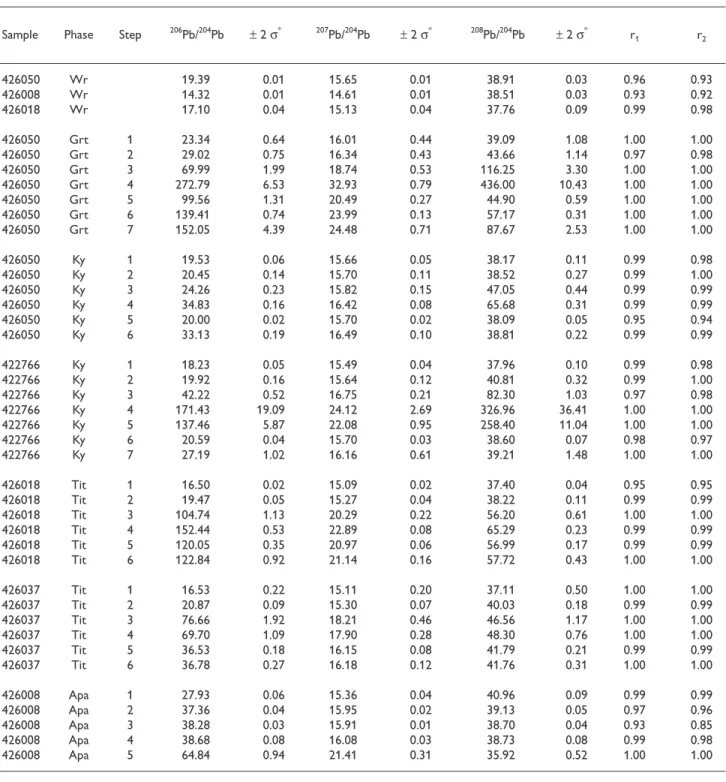
Five to seven acid-leach steps were undertaken on each mineral separate. Whole-rock Pb and PbSL iso-tope data are listed in Table 2 and plotted in Figs 2–5.
PbSL results
Krummedal supracrustal sequence
The late Mesoproterozoic – early Neoproterozoic Krummedal supracrustal sequence is widely distribu-ted in the southern part of the East Greenland Cale-donides between 70° and 74°N (Fig. 1; Higgins 1988). Sample 426050 was collected from the Krummedal supracrustal sequence south of innermost Forsblad Fjord, close to the faulted contact with the crystalline basement complexes (Fig. 1). The general metamor-phic grade of the Krummedal supracrustal sequence is amphibolite facies, and the sample consists of quartz + plagioclase + K-feldspar + garnet + biotite + kyanite + sillimanite + amphibole + muscovite + titanite. The garnet and biotite represent early phases, while kyanite is a later phase that overgrows the deformation fabric of the biotite. Kyanite and K-feldspar crystallised at the same time, demonstrating that the rock has been exposed to high P–T conditions; during cooling, silli-manite, titanite and secondary biotite crystallised, and part of the kyanite was consumed during formation of muscovite.
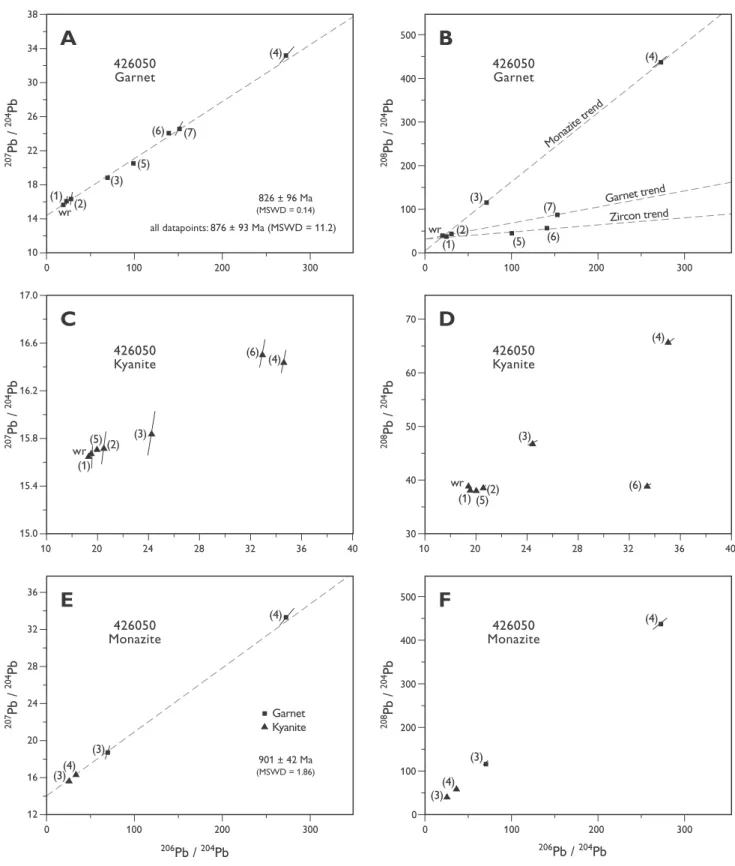
Garnet and kyanite were analysed by PbSL (Fig. 2). Seven steps were performed on the garnet; all the steps, together with the whole-rock analysis, fall on a linear array in the 207Pb/204Pb vs. 206Pb/204Pb diagram
Table 1. Sample data stepwise dissolution procedures
Mix = 1.5N HBr – 2N HCl 12:1 mixture. All steps except number 1 were left on the hotplate during the dissolution time.
236 Mix 10 4.4N HBr 45 8.8N HBr 3 8.8N HBr 24 conc. HF 48 conc. HF 260 8.8N HBr 290
97 Mix 10 4.4N HBr 45 8.8N HBr 3 8.8N HBr 24 conc. HF 48 conc. HF 260
719 Mix 30 1.0N HBr 60 4.0N HBr 3 8.8N HBr 6 8.8N HBr 12 conc. HF 24 conc. HF 340
195 Mix 10 4.4N HBr 45 8.8N HBr 3 8.8N HBr 24 conc. HF 48 conc. HF 260
71 Mix 10 4.4N HBr 90 8.8N HBr 3 8.8N HBr 24 conc. HF 50 conc. HF 340
139 10 60 1.0N HBr 3 1.5N HBr 3 8.8N HBr 3 7N HNO3 9
Sample Weight Step 1 Time Step 2 Time Step 3 Time Step 4 Time Step 5 Time Step 6 Time Step 7 Time
mg min. min. hrs hrs hrs hrs hrs
426050 Garnet
426050 Kyanite
422766 Kyanite
426018 Titanite
426037 Titanite
426008 50% mix + 50% mix +
Table 2. Pb-Pb step leaching (PbSL) data
Sample Phase Step 206Pb/204Pb ± 2 σ* 207Pb/204Pb ± 2 σ* 208Pb/204Pb ± 2 σ* r1 r2
426050 Wr 19.39 0.01 15.65 0.01 38.91 0.03 0.96 0.93
426008 Wr 14.32 0.01 14.61 0.01 38.51 0.03 0.93 0.92
426018 Wr 17.10 0.04 15.13 0.04 37.76 0.09 0.99 0.98
426050 Grt 1 23.34 0.64 16.01 0.44 39.09 1.08 1.00 1.00
426050 Grt 2 29.02 0.75 16.34 0.43 43.66 1.14 0.97 0.98
426050 Grt 3 69.99 1.99 18.74 0.53 116.25 3.30 1.00 1.00
426050 Grt 4 272.79 6.53 32.93 0.79 436.00 10.43 1.00 1.00
426050 Grt 5 99.56 1.31 20.49 0.27 44.90 0.59 1.00 1.00
426050 Grt 6 139.41 0.74 23.99 0.13 57.17 0.31 1.00 1.00
426050 Grt 7 152.05 4.39 24.48 0.71 87.67 2.53 1.00 1.00
426050 Ky 1 19.53 0.06 15.66 0.05 38.17 0.11 0.99 0.98
426050 Ky 2 20.45 0.14 15.70 0.11 38.52 0.27 0.99 1.00
426050 Ky 3 24.26 0.23 15.82 0.15 47.05 0.44 0.99 0.99
426050 Ky 4 34.83 0.16 16.42 0.08 65.68 0.31 0.99 0.99
426050 Ky 5 20.00 0.02 15.70 0.02 38.09 0.05 0.95 0.94
426050 Ky 6 33.13 0.19 16.49 0.10 38.81 0.22 0.99 0.99
422766 Ky 1 18.23 0.05 15.49 0.04 37.96 0.10 0.99 0.98
422766 Ky 2 19.92 0.16 15.64 0.12 40.81 0.32 0.99 1.00
422766 Ky 3 42.22 0.52 16.75 0.21 82.30 1.03 0.97 0.98
422766 Ky 4 171.43 19.09 24.12 2.69 326.96 36.41 1.00 1.00
422766 Ky 5 137.46 5.87 22.08 0.95 258.40 11.04 1.00 1.00
422766 Ky 6 20.59 0.04 15.70 0.03 38.60 0.07 0.98 0.97
422766 Ky 7 27.19 1.02 16.16 0.61 39.21 1.48 1.00 1.00
426018 Tit 1 16.50 0.02 15.09 0.02 37.40 0.04 0.95 0.95
426018 Tit 2 19.47 0.05 15.27 0.04 38.22 0.11 0.99 0.99
426018 Tit 3 104.74 1.13 20.29 0.22 56.20 0.61 1.00 1.00
426018 Tit 4 152.44 0.53 22.89 0.08 65.29 0.23 0.99 0.99
426018 Tit 5 120.05 0.35 20.97 0.06 56.99 0.17 0.99 0.99
426018 Tit 6 122.84 0.92 21.14 0.16 57.72 0.43 1.00 1.00
426037 Tit 1 16.53 0.22 15.11 0.20 37.11 0.50 1.00 1.00
426037 Tit 2 20.87 0.09 15.30 0.07 40.03 0.18 0.99 0.99
426037 Tit 3 76.66 1.92 18.21 0.46 46.56 1.17 1.00 1.00
426037 Tit 4 69.70 1.09 17.90 0.28 48.30 0.76 1.00 1.00
426037 Tit 5 36.53 0.18 16.15 0.08 41.79 0.21 0.99 0.99
426037 Tit 6 36.78 0.27 16.18 0.12 41.76 0.31 1.00 1.00
426008 Apa 1 27.93 0.06 15.36 0.04 40.96 0.09 0.99 0.99
426008 Apa 2 37.36 0.04 15.95 0.02 39.13 0.05 0.97 0.96
426008 Apa 3 38.28 0.03 15.91 0.01 38.70 0.04 0.93 0.85
426008 Apa 4 38.68 0.08 16.08 0.03 38.73 0.08 0.99 0.98
426008 Apa 5 64.84 0.94 21.41 0.31 35.92 0.52 1.00 1.00
Wr = whole-rock, Grt = garnet, Ky = kyanite, Tit = titanite, Apa = apatite.
r1=
206
Pb/204Pb vs.207Pb/204Pb error correlation (Ludwig 1988).
r2=206Pb/204Pb vs.208Pb/204Pb error correlation (Ludwig 1988).
(3) (2) wr (6) (7) (1) (1) 426050
Garnet 426050Garnet
426050
Kyanite 426050Kyanite
A
826 + 96 Ma
(MSWD = 0.14)
207
Pb /
204
Pb
(5)
0 100 200 300
C
207 Pb / 204 Pb 208 Pb / 204 Pb (3) 2010 24 28 32 36 40
70 60 50 40 30 500 400 300 200 100 0 208 Pb / 204 Pb
all datapoints: 876 + 93 Ma (MSWD = 11.2)
(3)
(3)(4)
426050
Monazite Monazite426050
E
207
Pb /
204
Pb
206Pb / 204Pb 206Pb / 204Pb
0 100 200 300
500 400 300 200 100 0 208 Pb / 204 Pb 34 38 26 30 22 14 18 10 17.0 16.2 16.6 15.8 15.4 15.0 36 28 32 24 16 20 12 (3) (5) (7) (6) (2) (1)
B
0 100 200 300
(4) (2) (5) (6) (1)
D
(3) (4) (4) (5) (6) ▲ ▲ ▲ ▲ ▲ ▲ ▲ (2) ▲ ▲ ▲ ▲ ▲ ▲ ▲ ▲ ▲▲ ▲ wr Monazite tr endGarnet trend
Zircon trend
(3)
(4) (3)
F
0 100 200 300
(4) wr ▲ wr Garnet Kyanite (4) (4) 20
10 24 28 32 36 40
901 + 42 Ma
(MSWD = 1.86)
Fig. 2. Uranogenic (207Pb/204Pb – 206Pb /204Pb) and thorogenic vs. uranogenic (208Pb/204Pb – 206Pb /204Pb) Pb isotope diagrams with
(Fig. 2A) yielding a 207Pb/206Pb date of 876 ± 93 Ma
(MSWD = 11.2). The 208Pb/204Pb vs. 206Pb/204Pb diagram
(Fig. 2B) reveals the presence of mineral inclusions in the garnet. The different Th/U ratios of the host min-eral and the inclusions may explain the large MSWD value of the errorchron. Steps 3 and 4 have very high Th/U ratios, interpreted as representing monazite in-clusions (Th/U > 3; DeWolf et al. 1996). All the mona-zite is leached out in step 4, causing the observed drop in the Th/U ratio. The very low Th/U ratio in steps 5 and 6 is characteristic of zircon leach steps (Th/U < 1; DeWolf et al. 1996). All the zircon is dis-solved in step 6. Step 7 was undertaken because of the red colour of the residue after step 6, showing that garnet was still present.
The only leach steps dominated by garnet are the two first, where all the most primitive Pb is extracted,
and step 7. These three steps together with the whole-rock analysis yield an isochron date of 826 ± 96 Ma (MSWD = 0.14). The large error of the date is due to the low precision of step 7.
The same procedure was carried out on kyanite, and again there is evidence for the presence of both monazite and zircon inclusions (Fig. 2D). Steps 3 and 4 are dominated by monazite, and step 6 by zircon. Three steps (1, 2 and 5) are interpreted as represent-ing kyanite, but while the individual analyses are very precise they do not form a sufficiently wide spread in the Pb ratios to yield a precise date. The Pb whole-rock analysis and the kyanite-dominated steps define a slope which yields an isochron date of 1219 ± 790 Ma (MSWD = 0.24). Given the large uncertainty, this date does not yield any useful chronological informa-tion. The monazite-dominated steps from the garnet (3 and 4) and the kyanite (3 and 4) plot on a linear trend in both the 207Pb/204Pb vs. 206Pb/204Pb and 208Pb/ 204Pb vs. 206Pb/204Pb diagrams (Fig. 2E, F). The four
monazite steps yield an isochron date of 901 ± 42 Ma (MSWD = 1.86).
The monazite and garnet dates are in general ac-cordance with the ion microprobe analyses of meta-morphic zircon rims from the Krummedal supracru-stal sequence that have yielded Neoproterozoic ages around 940 Ma (Thrane et al. 1999a, b; Kalsbeek et al.
2000). The cores of detrital zircons from the same study yielded ages ranging from c. 1100 to 1900 Ma, and it therefore serves no practical purpose to calculate an age from the zircon steps, as these will represent a mixture of ages.
Sample 422766, also derived from the Krummedal supracrustal sequence, was collected by J.C. Escher and K.A. Jones in the southern part of Andrée Land, very close to the contact with the structurally underly-ing crystalline basement (Fig. 1). The sample contains garnet and kyanite crystals up to 5 cm in diameter.
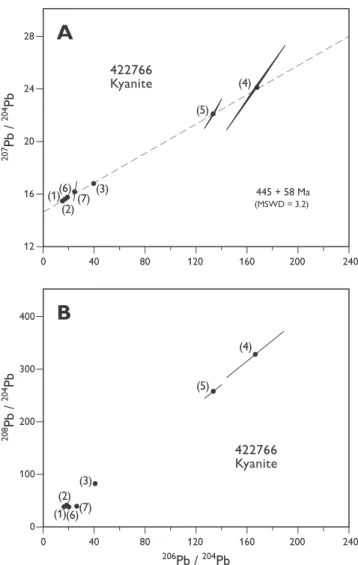
The kyanite was analysed by PbSL, while the gar-net was considered too altered to justify analysis. Seven steps were undertaken on the kyanite, and the analy-ses represent an almost perfect leaching pattern (Fig. 3); all fall on a linear array in both the 207Pb/204Pb vs. 206Pb/204Pb and 208Pb/204Pb vs. 206Pb/204Pb diagrams,
except for step 7 which has a lower 208Pb/204Pb ratio
that probably indicates the presence of zircon inclu-sions. A 207Pb/206Pb date of 437 ± 62 Ma (MSWD = 2.6)
is obtained using all the steps, while if step 7 is ex-cluded a date of 445 ± 58 Ma (MSWD = 3.2) is ob-tained. The large error is due to the analytical error of steps 4 and 5.
(3) (7) (2) (6) (1)
(3)
(7) (2)
(6) (1)
422766 Kyanite
28
24
20
16
12
A
445 + 58 Ma
(MSWD = 3.2)
207
Pb /
204
Pb (5)
(4)
0 40 80 120 160 200 240
422766 Kyanite
400
300
200
100
0
B
208
Pb /
204
Pb (5)
(4)
0 40 80 120 160 200 240
206Pb / 204Pb
Fig. 3. Uranogenic (207Pb/204Pb – 206Pb /204Pb) and thorogenic
vs. uranogenic (208Pb/204Pb – 206Pb /204Pb) Pb isotope diagrams
Crystalline basement
The East Greenland Caledonian orogen is dominated by major thrust sheets of reworked orthogneiss com-plexes. The crystalline basement is divided into an Archaean terrain to the south of 72°50′N and a Pal-aeoproterozoic terrain to the north (Fig.1; Thrane 2002).
PbSL analyses on titanite from a metagabbroic gneiss (426018) in the Archaean crystalline basement com-plex west of innermost Forsblad Fjord (Fig. 1) were undertaken. This gabbroic gneiss has yielded a Sm-Nd model age (tDM) of 3.25 Ga (Thrane 2002). The whole-rock analysis has the same Pb ratios as step 1, indicating that the whole-rock and titanite are in equi-librium. The six leach steps together with the
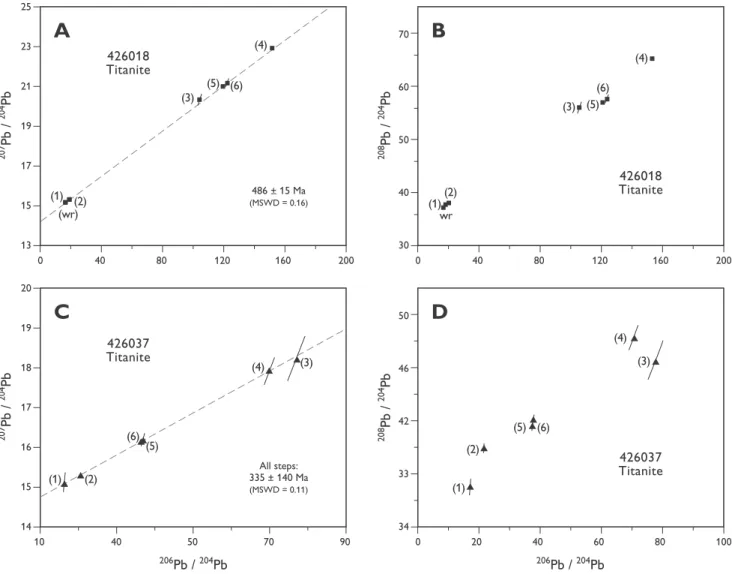
whole-rock analysis yield an isochron date of 504 ± 48 Ma (MSWD = 1.81). However, the 208Pb/204Pb vs. 206Pb/ 204Pb diagram (Fig. 4B) suggests that the titanite
con-tains small amounts of monazite inclusions, which result in slightly elevated Th/U ratios for steps 3 and 4 compared with the titanite trend. If steps 3 and 4 are excluded, an isochron date of 486 ± 15 Ma (MSWD = 0.16) is obtained (Fig. 4A).
Titanite from a sheared garnet amphibolite (426037) cutting the basement gneisses of Nathorst Land (Fig. 1) was also analysed. All six data points define an isochron date of 335 ± 140 Ma (MSWD = 0.11; Fig. 4C); the large error of the date is due to the limited spread in the data points, as well as the large analyti-cal errors of steps 3 and 4. In the 208Pb/204Pb vs. 206Pb/ 204Pb diagram (Fig. 4D) the analyses show an unusual
(3)
(2) (wr)
(6)
(1)
(1)
426018 Titanite
426037 Titanite
A
486 + 15 Ma
(MSWD = 0.16)
All steps: 335 + 140 Ma
(MSWD = 0.11)
207
Pb /
204
Pb
(5)
0 40 80 120 160 200
C
207
Pb /
204
Pb
206Pb / 204Pb 206Pb / 204Pb
208
Pb /
204
Pb
(3)
40
10 50 70 90
50
46
42
33
34 70
60
50
40
30
208
Pb /
204
Pb
(4)
23 25
19 21
17
15
13
19 20
17 18
16
15
14
0 20 40 60 80 100
(3)
(2)
wr
(6)
(1)
B
(5)
0 40 80 120 160 200
(4)
426018 Titanite
(3)
(2)
(6)
(1)
D
(5)
(4)
426037 Titanite (4)
(5)
(6)▲ ▲
▲ ▲
▲ ▲
▲ ▲
(2)
▲
▲
▲
▲
Fig. 4. Uranogenic (207Pb/204Pb – 206Pb /204Pb) and thorogenic vs. uranogenic (208Pb/204Pb – 206Pb /204Pb) Pb isotope diagrams with
pattern: step 2 has an elevated Th/U ratio compared to the general trend while step 3 has a lower Th/U ratio. These features cannot be explained by the pres-ence of monazite and zircon inclusions. If steps 2 and 3 are excluded from the isochron an even less precise date of 309 ± 230 Ma (MSWD = 0.03) is obtained.
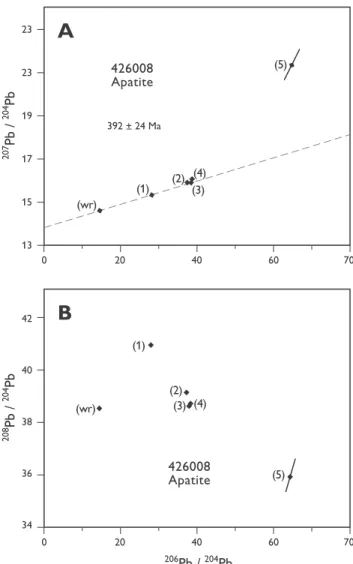
Apatite from a tonalitic basement gneiss (426008) collected west of innermost Forsblad Fjord (Fig. 1) was also analysed. Zircon crystals from this sample have yielded U-Pb ages of c. 2800 Ma (Thrane 2002). Apatite dissolves much more easily than silicate phases, so a weaker acid and shorter leaching times were used in this experiment. The analyses form a complex pat-tern (Fig. 5). Step 1 is too thorogenic to derive from apatite, and it is interpreted instead as influenced by allanite since this is very easily dissolved and has a
higher Th/U ratio than apatite. Step 2 is less thorogenic than step 1, but more so than step 3, and is therefore interpreted as a mixture between allanite and apatite. Step 3 is the only step dominated by apatite. The only possible way to obtain a date is thus by combining the whole-rock analysis and step 3, which yields a date of 392 ± 24 Ma (Fig. 5A). Step 1 falls on the isochron, while step 2 falls slightly above, demon-strating that the two mineral phases were almost in equilibrium, with the presumed allanite being slightly older corresponding to its higher closure temperature. In the 208Pb/204Pb vs. 206Pb/204Pb diagram it seems that
both steps 3 and 4 are apatite steps, but in the 207Pb/ 204Pb vs. 206Pb/204Pb diagram it is clear that step 4 is
older and must be influenced by zircon inclusions which were leached out in the strong acid of step 5. The whole-rock analysis and step 5 yield a date of 2159 ± 46 Ma.
Summary and discussion
The analyses reported in this paper are the first PbSL analyses reported on rocks from the Caledonian orogen of East Greenland. All the samples have been analysed only once. Several of the dates obtained are not consistent with existing ages from the area, and some of the new dates are also somewhat controver-sial; replicate analyses should therefore be made for all the samples, to confirm that the dates are consist-ent, before any definite interpretations can be made. Thus different interpretations are presented in the dis-cussion that follows.
The reliability of the PbSL method is still an open question. The main concern is the importance of the micro-inclusions contained in the mineral being ana-lysed, and whether it is possible to be certain which combination of minerals is dissolved and affect the individual steps. This important point has not yet been resolved, and must be kept in mind when evaluating the new dates.
Supracrustal rocks
The PbSL study demonstrates that Neoproterozoic monazite and garnet are present in the Krummedal supracrustal sequence; evidence of Caledonian mona-zite has previously been reported (Kalsbeek et al.
2000). Zoned garnets have often been recorded (Elvevold & Gilotti 1999; Thrane et al. 1999b), of which
23
23
19
17
15
13
A
426008 Apatite
392 + 24 Ma
207
Pb /
204
Pb
42
40
38
36
34
B
426008 Apatite
208
Pb /
204
Pb
206Pb / 204Pb
(wr)
(wr)
(1) (2)
(5)
(4) (3)
(1)
(2) (3) (4)
(5)
0 20 40 60 70
0 20 40 60 70
Fig. 5. Uranogenic (207Pb/204Pb – 206Pb /204Pb) and thorogenic
vs. uranogenic (208Pb/204Pb – 206Pb /204Pb) Pb isotope diagrams
the outer rims are interpreted to be Caledonian whereas there has previously been doubt as to whether the cores were Neoproterozoic or early Caledonian. In contrast, the presence of Neoproterozoic kyanite has not been demonstrated in this study. Petrograph-ically it is often difficult to determine to which min-eral paragenesis the kyanite belongs, and thus it can-not be ruled out that some of the kyanite in parts of the Krummedal supracrustal sequence may be Neo-proterozoic (Elvevold & Spears 2000).
Evidence of early Caledonian metamorphism
in the crystalline basement?
The closure temperature for titanite is estimated by Dahl (1997, and references therein) to be in the range of 620–680°C, and by Cherniak (1993) in the range of 575–707°C, depending on the grain size. The titanite date of 486 ± 15 Ma for sample 426018, together with the date of the monazite inclusions, suggest that the crystalline basement did experience Caledonian me-dium to high-grade metamorphism.
No other ages of c. 486 Ma have yet been obtained in East Greenland. The age of the Caledonian colli-sion in East Greenland is usually referred to the inter-val 430–425 Ma, on the basis of zircon ages from granite intrusions and the time of migmatite formation in the Krummedal supracrustal sequence (Watt et al. 2000; Kalsbeeket al. 2000, 2001). No comparable zircon ages have been recorded in the crystalline basement rocks in the study area, where evidence of the Caledonian overprint is restricted to imprecise lower concordia intercept ages ranging from 467 ± 18 Ma to 443 ± 25 (Thrane et al. 1999a). It is not possible to determine whether these lower intercept ages correspond to the ‘traditional’ East Greenland Caledonian range of events, or to a potential earlier event. In North-East Green-land Caledonian zircons have been recorded in some Palaeoproterozoic gneisses (Kalsbeek et al. 1993), which is in line with the assumption that the crystal-line basement complexes of this northern region were more strongly reworked during the Caledonian oro-geny.
It might be speculated that the titanite date of 486 ± 15 Ma is a cooling age, while the slightly older mona-zite micro-inclusions in the titanites could represent the peak of a collision event – comparable to the early Caledonian event in Scandinavia (Mørket al.1988; An-dréasson 1994, 2000). However, this is not possible in East Greenland, since Ordovician carbonates were still
being deposited in the Iapetus-margin basin that lay east of the Laurentian crystalline basement at this time; there is no associated clastic input that would be pected if a collision had taken place nearby. The ex-ceptionally thick Ordovician carbonate succession in East Greenland (Smith 1991) is indicative of a signifi-cant increase in the rate of subsidence, and it is pos-sible that the c. 500 and 486 Ma dates are instead related to extension. The c. 430 Ma ages are thus still the best indication of the main Caledonian collision phase in East Greenland. Apatite, yielding the young-est Caledonian date of 392 ± 24, could be interpreted to represent the time where the basement gneisses cooled to < 500°C (Dahl 1997).
Acknowledgements
The isotope data described in this paper were acquired at the Geological Institute, University of Copenhagen. Robert Frei is thanked for introducing and guiding me in the Pb-Pb step-leaching method. Jan C. Escher and Kevin A. Jones kindly provided sample 422766. Critical comments on the manuscript by Adam A. Garde, A.K. Higgins and Feiko Kalsbeek are greatly appreciated. This project was based on funding from the Danish Natural Science Research Council. Minik Rosing and Martin Whitehouse are thanked for re-viewing the manuscript.
References
Andréasson, P.G. 1994: The Baltoscandian Margin in Neoprot-erozoic – early Palaeozoic times. Some constraints on terrane derivation and accretion in the Arctic Scandinavian Caledo-nides. Tectonophysics 231, 1–32.
Andréasson, P.G. 2000: Finnmarkian deep-seated imbrication of a margin of Baltica: evidence from high-grade deformation zones in the Kebnekaise Mts., Swedish Caledonides. 24. Nordiske geologiske vintermøte, Trondheim, Norway, 6–9 January, 2000. Abstract volume. Geonytt 1, 32 only. Berger, M. & Braun, I. 1997: Pb-Pb dating of apatite by a stepwise
dissolution technique. Chemical Geology 142, 23–40. Cherniak, D.J. 1993: Lead diffusion in titanite and preliminary
results on the effects of radiation damage on Pb transport. Chemical Geology 110, 177–194.
Dahl, P.S. 1997: A crystal-chemical basis for Pb retention and fission-track annealing systematics in U-bearing minerals, with implications for geochronology. Earth and Planetary Science Letters150, 277–290.
geochronology: step-wise dissolution experiments and trace uranium mapping by fission track analysis. Geochimica et Cosmochimica Acta 60, 121–134.
Elvevold, S. & Gilotti, J.A. 1999: Reaction history of metapelitic rocks from Goodenough Land, East Greenland. In: Frederik-sen, K.S. & Thrane, K. (eds): Second symposium on East Green-land geology, mainly Caledonian. Abstract volume. Danmarks og Grønlands Geologiske Undersøgelse Rapport 1999/21, 31 only.
Elvevold, S. & Spears, F.S. 2000: Garnet zoning and reaction his-tory of anatectic pelites in the East Greenland Caledonides. 24. Nordiske geologiske vintermøte, Trondheim, Norway, 6– 9 January, 2000. Abstract volume. Geonytt 1, 62 only. Frei, R. & Kamber, B.S. 1995: Single mineral Pb-Pb dating. Earth
and Planetary Science Letters 129, 261–268.
Frei, R., Villa, I.M., Nagler, T.F., Kramers, J.D., Przybylowicz, W.J., Prozesky, V.M., Hofmann, B.A. & Kamber, B.S. 1997: Single mineral dating by the Pb-Pb step-leaching method: assessing the mechanisms. Geochimica et Cosmochimica Acta 61, 393– 414.
Henriksen, N. 1998: North-East Greenland 1997–1998: a new 1:500 000 mapping project in the Caledonian fold belt (72°–75°N). Geology of Greenland Survey Bulletin 180, 119–127. Henriksen, N. 1999: Conclusion of the 1:500 000 mapping project
in the Caledonian fold belt in North-East Greenland. Geology of Greenland Survey Bulletin 183, 10–22.
Higgins, A.K. 1988: The Krummedal supracrustal sequence in East Greenland. In: Winchester, J.A. (ed.): Later Proterozoic stratigraphy of the northern Atlantic regions, 86–96. Glasgow and London: Blackie and Son Ltd.
Higgins, A.K. & Leslie, A.G. 2004: The Eleonore Sø and Måle-bjerg foreland windows, East Greenland Caledonides, and the demise of the ‘stockwerke’ concept. In: Higgins, A.K. & Kalsbeek, F. (eds): East Greenland Caledonides: stratigraphy, structure and geochronology. Geological Survey of Denmark and Greenland Bulletin 6, 77–93 (this volume).
Kalsbeek, F., Nutman, A.P. & Taylor, P.N. 1993: Paleoproterozoic basement province in the Caledonian fold belt of North-East Greenland. Precambrian Research 63, 163–178.
Kalsbeek, F., Thrane, K., Nutman, A.P. & Jepsen, H.F. 2000: Late Mesoproterozoic to early Neoproterozoic history of the East Greenland Caledonides fold belt: evidence for Grenvillian orogenesis? Journal of the Geological Society (London) 157, 1215–1225.
Kalsbeek, F., Jepsen, H.F. & Nutman, A.P. 2001: From source migmatites to plutons: tracking the origin of ca. 435 Ma S-type granites in the East Greenland Caledonide orogen. Lithos 57, 1–21.
Ludwig, K.R. 1988: A computer program to convert raw U-Th-Pb isotope ratios to blank-corrected isotope ratios and concen-trations with associated error-correlations. United States Geo-logical Survey, Open File Report OF-82-820.
Ludwig, K.R. 1999: Isoplot/Ex version 2.00: a geochronological toolkit for Microsoft Excel. Berkeley Geochronology Center, Special Publication 2.
Mørk, M.B., Kullerud, K. & Stabel, A. 1988: Sm-Nd dating of Seve eclogites, Norrbotten, Sweden – evidence for early Caledo-nian (505 Ma) subduction. Contributions to Mineralogy and Petrology99, 344–351.
Rex, D.C. & Higgins, A.K. 1985: Potassium–argon mineral ages from the East Greenland Caledonides between 72° and 74°N. In: Gee, D.G. & Sturt, B.A. (eds): The Caledonide Orogen: Scandinavia and related areas, 1115–1124. Chichester: John Wiley & Sons.
Smith, M.P. 1991: Early Ordovician conodonts of East and North Greenland. Meddelelser om Grønland Geoscience 26, 81 pp. Thrane, K. 2002: Relationships between Archaean and Palaeo-proterozoic basement complexes in the southern part of the East Greenland Caledonides: an ion microprobe study. Pre-cambrian Research 113, 19–42.
Thrane, K. 2004: Palaeoproterozoic age of the basement gneiss complex in the Charcot Land tectonic window, East Green-land Caledonides. In: Higgins, A.K. & Kalsbeek, F. (eds): East Greenland Caledonides: stratigraphy, structure and geochro-nology. Geological Survey of Denmark and Greenland Bulle-tin6, 57–66 (this volume).
Thrane, K., Kalsbeek, F. & Watt, G.R. 1999a: Evidence for a Grenville event in the East Greenland Caledonian fold belt. In: Frederiksen, K.S. & Thrane, K. (eds): Second symposium on East Greenland geology, mainly Caledonian. Abstract vol-ume. Danmarks og Grønlands Geologiske Undersøgelse Rap-port1999/21, 37 only.
Thrane, K., Watt, G.R., Kinny, P.D., Jones, K.A. & Escher, J.C. 1999b: Early Neoproterozoic breakup of Rodinia: SIMS U-Pb ages from the East Greenland Caledonides. EUG 10, Terra Abstracts4, 119 only.
Todt, W., Cliff, R.A., Hanser, A. & Hofmann, A.W. 1993: Recalibration of NBS lead standards using a 202Pb + 205Pb
dou-ble spike. Terra Abstracts 5 (Supplement 1), 396 only. Watt, G.R., Kinny, P.D. & Friderichsen, J.D. 2000: U-Pb