*Correspondence: P. M. Pauletti. Universidade de Franca. Av. Dr. Ar-mando Salles de Oliveira, 201, 14404-600 – Franca – SP, Brasil. E-mail: [email protected]
A
vol. 49, n. 4, oct./dec., 2013
Antibacterial evaluation of
Styrax pohlii
and isolated compounds
Camila Spereta Bertanha
1, Susane Hellen Utrera
1, Valéria Maria Melleiro Gimenez
2,
Milton Groppo
3, Márcio Luis Andrade e Silva
1, Wilson Roberto Cunha
1,
Carlos Henrique Gomes Martins
1, Ana Helena Januário
1, Patrícia Mendonça Pauletti
1,*1Center for Research in Exact and Technological Sciences, University of Franca, 2Claretiano University Center, 3Faculty of Philosophy, Sciences and Literature of Ribeirão Preto, University of São Paulo
The antibacterial activity of the compounds egonol (1) and homoegonol (2), of the crude ethanolic extract of Styrax pohlii (Styracaceae) aerial parts (EE), and of its n-hexane (HF), EtOAc (EF), n-BuOH (BF), and hydromethanolic (HMF) fractions was evaluated against the following microorganisms:
Streptococcus pneumoniae (ATCC 6305), S. pyogenes (ATCC 19615), Haemophilus inluenzae (ATCC 10211), Pseudomonas aeruginosa (ATCC 27853), and Klebsiella pneumoniae (ATCC 10031). The broth microdilution method was used for determination of the minimum inhibitory concentration (MIC) during preliminary evaluation of antibacterial activity. The EE yielded MIC values of 400 µg/mL for
S. pneumoniae and P. aeruginosa and 300 µg/mL for H. inluenzae. The HFand EF fractions exhibited enhanced antibacterial activity, with MIC values of 200 µg/mL against S. pneumoniae, but only EF displayed activity against H. inluenzae (MIC 200 µg/mL). The best MIC value with compounds 1 and 2 (400 µg/mL) was obtained for (1) against S. pneumoniae and P. aeruginosa. Therefore, 1 exhibited weak antibacterial activity against these standard strains.
Uniterms: Styrax pohlii/pharmacognosy. Styracaceae/pharmacognosy. Styrax pohlii/ethanolic extract/ antibacterial activity. Egonol/antibacterial activity. Homoegonol/antibacterial activity. Natural products/ evaluation.
As atividades antimicrobianas das substâncias egonol (1) e homoegonol (2), do extrato etanólico das partes aéreas de Styrax pohlii (Styracaceae) (EE), bem como das frações n-hexano (HF), AcOEt (EF), n-BuOH (BF) e hidrometanólica (HMF) foram avaliadas frente aos seguintes microorganismos:
Streptococcus pneumoniae (ATCC 6305), S. pyogenes (ATCC 19615), Haemophilus inluenzae (ATCC 10211), Pseudomonas aeruginosa (ATCC 27853) e Klebsiella pneumoniae (ATCC 10031). O método de microdiluição em caldo foi utilizado para a determinação da concentração inibitória mínima (CIM) na avaliação preliminar da atividade antimicrobiana. EE mostrou valores de CIM de 400 µg/mL para S. pneumoniae e P. aeruginosa, e 300 µg/mL para H. inluenzae. As frações HF e EF apresentaram melhora na atividade antimicrobiana, com valores de CIM de 200 µg/mL frente S. pneumoniae, mas apenas EF apresentou ação contra H. inluenzae (200 µg/mL). Em relação às substâncias 1 e 2, o melhor valor de CIM (400 µg/mL) foi obtido por 1 frente a S. pneumoniae e P. aeruginosa, que exibiu fraca atividade antimicrobiana contra estas cepas padrões.
Unitermos: Styrax pohlii/farmacognosia Styracaceae/farmacognosia. Styrax pohlii/extrato etanólico/ atividade antimicrobiana. Egonol/atividade antimicrobiana. Homoegonol/atividade antimicrobiana. Produtos naturais/avaliação.
INTRODUCTION
A major concern in the public health ield is the ease
of development of antibiotic resistance by bacteria, since infectious diseases caused by resistant microorganisms
Natural medicinal products have been used for millennia to treat various ailments. Although many have been superseded by conventional pharmaceutical approaches, there is a resurgence of interest in natural products by physicians (Boukraa, 2008; Shimizu et al., 2001). In addition, the existence of resistant bacterial strains reinforces the need for development of novel safe and effective antibacterials that can combat infectious diseases caused by bacteria (Gangoué-Piéboji et al., 2009; Coutinho et al., 2009).
The literature describing traditional Brazilian medicine contains references to the use of plant species belonging to the genus Styrax (Styracaceae), which have been mainly employed in the treatment of gastrointestinal diseases and fevers. Styrax pohlii A. DC., known in Brazil as “pindaíba”, “pindaúba”, “benjoeiro”, “estoraqueiro”, and “árvore-de-bálsamo”, is used as a folk medicine to relieve fever (Lorenzi, 1998; Rodrigues, Carvalho, 2008). It grows in the States of São Paulo, Minas Gerais, Goiás, and Mato Grosso do Sul, mainly in the Cerrado region, a biome characterized by rich biodiversity but threatened by agriculture (Lorenzi, 1998; Ratter et al., 1997). Phytochemical investigations of Styrax species have revealed a predominance of shikimate derivatives, such as lignan derivatives of 3,7-dioxabicyclo[3.3.0]octane, butanolide, and tetrahydrofuran; neolignan derivatives of dihydrobenzofuran; nor-neolignan derivatives of benzofuran, phenylpropanoids, and phenolic acids; and pentacyclic saponins and triterpenes (Pauletti et al., 2006). Previous studies have shown that some lignans, neolignans and nor-neolignansfrom Styrax and their derivatives
display signiicant antimicrobial and cytotoxic activities
(Pauletti et al., 2000; Teles et al., 2005; Hirano et al., 1994; Öztürk et al., 2008).
Therefore, as part of our ongoing biological studies into the antibacterial activity of natural compounds (Pauletti et al., 2000; Scalon Cunha et al., 2007; Cunha et al., 2010; Silva et al., 2009), we now provide a preliminary report on the antibacterial activities of compounds 1-2, the crude ethanolic extract (EE), and the n-hexane (HF), EtOAc (EF), n-BuOH (BF), and hydromethanolic(HMF) fractions of Styrax pohlii against the microorganisms Streptococcus pneumoniae, S. pyogenes, Haemophilus influenzae, Pseudomonas aeruginosa, and Klebsiella pneumoniae, which have not yet been described.
MATERIAL AND METHODS
Collection and identification
S. pohlii A. DC. was collected in the municipality of
Luis Antonio, state of São Paulo, Brazil, in October 2008,
and identiied by Prof. V. M. M. Gimenez and Prof. M.
Groppo. A voucher specimen (SPFR12168) was deposited
in the Herbarium of the Faculdade de Filosoia, Ciências
e Letras de Ribeirão Preto, Universidade de São Paulo.
Extraction and isolation
The air-dried, powdered stems and leaves (2.43 kg) of S. pohlii were extracted with EtOH by maceration at room temperature. After filtration, the solvents were removed under reduced pressure to yield 87.2 g of extract. The EE (20.3 g) was then dissolved in MeOH/H2O (1:4, v/v) and successively partitioned with n-hexane, EtOAc, and n-BuOH. After solvent removal using a rotary evaporator, each partition phase yielded 1.39, 2.97, and 3.80 g of extract respectively. Additionally, the residual hydromethanolic phase furnished 4.12 g. In a previous study, our research group had fractionated the n-hexane fraction and obtained compounds 1 (27.3 mg) and 2 (22.0 mg) (Bertanha et al, 2012).
Antibacterial assay
The following microorganisms were used for evaluation of antibacterial activity: Streptococcus pneumoniae (ATCC 6305), S. pyogenes (ATCC 19615), Haemophilus inluenzae (ATCC 10211), Pseudomonas aeruginosa (ATCC 27853), and Klebsiella pneumoniae (ATCC 10031). Minimum inhibitory concentration (MIC) values for each sample were determined in triplicate by using the broth microdilution method (CLSI, 2009). The samples were dissolved in DMSO (Merck) at 0.5 mg/mL and then diluted in Brain Heart Infusion broth or, for H. inluenzae only, BD Haemophilus Test Medium Agar (Difco Labs), to concentrations ranging from 400 to
20 μg/mL. The inal DMSO concentration in the culture
medium was 5% (v/v), which was used as a negative control. The inoculum was adjusted to each organism to yield a cell concentration of 5×10⁵ colony forming units
(CFU/mL). One inoculated well was included to control the adequacy of the broth for organism growth. One non-inoculated well, free of antibacterial agent, was also included to ensure medium sterility. Chloramphenicol and vancomycin were used as controls, dissolved in DMSO (Merck) at 0.1 and 10 mg/mL respectively, and then diluted in Brain Heart Infusion broth or BD Haemophilus Test Medium Agar to 0.02 mg/mL. The controls were evaluated at final concentrations ranging from 0.01 to
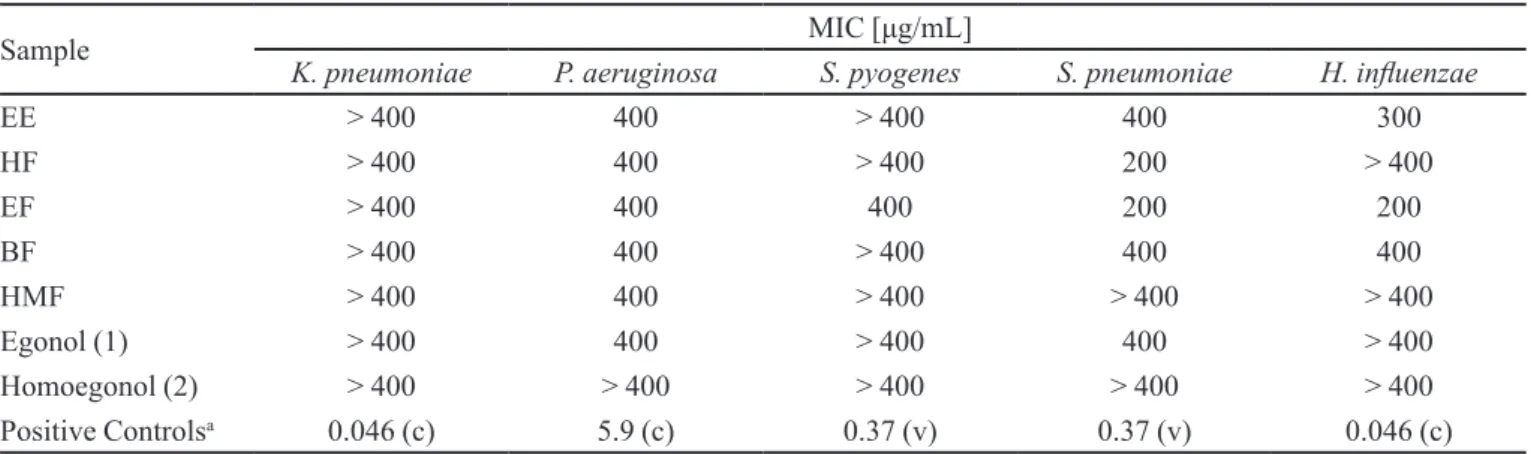
TABLE I - Minimum inhibitory concentration values (MIC) obtained for the crude ethanolic extract of S. pohlii,fractions and isolated compounds
Sample MIC [μg/mL]
K. pneumoniae P. aeruginosa S. pyogenes S. pneumoniae H. inluenzae
EE > 400 400 > 400 400 300
HF > 400 400 > 400 200 > 400
EF > 400 400 400 200 200
BF > 400 400 > 400 400 400
HMF > 400 400 > 400 > 400 > 400
Egonol (1) > 400 400 > 400 400 > 400
Homoegonol (2) > 400 > 400 > 400 > 400 > 400
Positive Controlsa 0.046 (c) 5.9 (c) 0.37 (v) 0.37 (v) 0.046 (c)
aPositive Controls: (c)- Chloranphenicol (v)- Vancomycin
solution (Sigma-Aldrich) was added to determine microorganism viability (Sarker et al., 2007). The MIC was determined as the lowest concentration of the sample capable of inhibiting microorganism growth.
RESULTS AND DISCUSSION
A previous study on the CH2Cl2-CH3OH (2:1, v/v) crude extract from the leaves of S. ferrugineus demonstrated antimicrobial activity, as detected by inhibition of Cladosporium sphaerospermum, Candida albicans, and Staphylococcus aureus (Pauletti et al., 2000). This inding has encouraged us to conduct biological and chemical investigations of metabolites isolated from other species of this genus.
Regarding the antibacterial assay, the crude EtOH extract (EE), as well as the n-hexane (HF), EtOAc (EF), n-BuOH (BF), and hydromethanolic(HMF) fractions of S. pohlii, were screened for their antibacterial activity against five different bacterial strains, three of which were Gram-positive and two were Gram-negative. The preliminary antibacterial activities, expressed as the MIC, are shown in Table I.
The EtOH extract (EE) yielded MIC values of
300 μg/mL against H. inluenzae and 400 μg/mL against
S. pneumoniae and P. aeruginosa. EEdid not inhibit the growth of the two other tested strains. Therefore, EE exhibits moderate activity against H. inluenzae, S. pneumoniae and P. aeruginosa, as described by Holetz et al. (2002).
Compared with EE,the n-hexane fraction (HF) provided superior antibacterial activity against the Gram-positive S. pneumoniae, with a MIC value of 200 μg/mL. However, unlike EE, HFdid not signiicantly reduce the
growth of H. inluenzae. In addition, HFdisplayed an MIC of400 μg/mL against P. aeruginosa, butwas considered ineffective againstS. pyogenes, H. influenzae, and K. pneumoniae. According to these results, the HF fraction exhibits promising activity against S. pneumoniae.
The best MIC value obtained for the EtOAc fraction
(EF) was 200 μg/mL, against the Gram-negative H. inluenzae and the Gram-positive S. pneumoniae. This result is superior to those obtained with EEagainst the
same strains (MIC = 300 and 400 μg/mL, respectively).
In addition, EFdisplayed an MIC of400 μg/mL against P. aeruginosa and S. pyogenes. Thus, EF was the only assayed sample that exhibited moderate antibacterial activity against S. pyogenes, as compared with the data obtained by Holetz et al. (2002).
The n-BuOH fraction (BF) exhibited moderate a n t i b a c t e r i a l a c t i v i t y a g a i n s t P. a e r u g i n o s a, S . pneumoniae, and H. inluenzae (MIC = 400 μg/mL), and
did not signiicantly inhibit the growth of the two other
tested strains, just as found for EE. The hydromethanolic fraction (HMF) displayed moderate antibacterial activity against P. aeruginosa.Thus, the BF and HMF fractions are not promising antibacterials against the strains tested in this work when compared with the HF and EF fractions.
In conclusion, differences in antibacterial effect were more evident for the HFfraction when assayed against the tested Gram-positive bacteria. HF was not effective against Gram-negative bacteria, perhaps due to the presence of the outer membrane in the latter microorganisms (Horiuchi et al., 2007). The HFfraction was thus selected for a further
Regarding the antibacterial activity of the isolated compounds (Table I), egonol (1) displayed weak activity against P. aeruginosa and S. pneumoniae
(MIC = 400 μg/mL), according to Ríos and Recio
(2005). As HF displayed the same activity as 1 against P. aeruginosa, it might be suggested that 1 is the compound responsible for the activity initially observed for the HF fraction, at least against P. aeruginosa. However, data for S. pneumoniae showed that 1 displayed half of the activity found for HFagainst this same strain. Similar indings are frequently observed in the area of natural product research after fractionation processes (Harvey, 2009; Yeh et al., 2012). Homoegonol (2) was considered inactive, at least in the present assay conditions.
Compounds 1 and 2 are quite similar, differing mainly in the presence of a methylenedioxyl group or two methoxyl groups at the phenyl ring connected to C-2 of the 5-propylbenzofuran core, respectively. Therefore, considering their antibacterial activity, it can be suggested that the presence of a methylenedioxyl group in compound 1 may improve its activity, since it was more active than compound 2. The mechanism whereby benzofuran derivatives exert their in vitro antibacterial effect is unclear. However, 1, 2, and some semi-synthetic egonol derivatives have been shown to possess antifungal and antibacterial activities against several species, including Staphylococcus aureus, Candida albicans, Cladosporium sphaerospermum, Bacillus subtilis, and Escherichia coli (Pauletti et al., 2000; Öztürk et al., 2008). Nevertheless, further studies are still required to improve the antibacterial activity of these natural products and obtain a better understanding of the mode of action of benzofuran derivatives.
CONCLUSION
The EtOH extract (EE) of S. pohlii showed moderate activity against the Gram-negative bacterial species H. influenzae. Chemical analysis of the EE yielded four fractions. The n-hexane fraction exhibits promising activity
FIGURE 1 - Chemical structures of the compounds isolated.
against the Gram-positive S. pneumoniae bacterium and
was thus selected for further puriication, which yielded
egonol (1) and homoegonol (2). Furthermore, biological assay results suggested that compound 1 inhibitsthe growth of P. aeruginosa and S. pneumoniae. Further studies are ongoing to assess other potentially important biological effects of this plant species.
ACKNOWLEDGEMENT
The authors are grateful to São Paulo Research F o u n d a t i o n ( FA P E S P ) ( G r a n t # 2 0 0 9 / 0 2 5 3 5 - 3 ) , Coordenadoria de Aperfeiçoamento de Pessoal do Ensino Superior (CAPES), and Conselho Nacional de Desenvolvimento Científico e Tecnológico (CNPq) for fellowships. FAPESP is also acknowledged for its
inancial support (grants #2008/01268-9, #2008/10283-1
and #2013/09280-6).
REFERENCES
BERTANHA, C.S.; BRAGUINE, C.G.; MORAES, A.C.;
GIMENEZ, V.M.; GROPPO, M.; SILVA, M.L.;
CUNHA, W.R.; JANUÁRIO, A.H.; PAULETTI, P.M.
Cyclooxygenase inhibitory properties of nor-neolignans
from Styrax pohlii. Nat. Prod. Res., v.26, n.24,
p.2323-2329, 2012.
BOUKRAA, L. Additive activity of royal jelly and honey
against Pseudomonas aeruginosa. Altern. Med. Rev., v.13,
n.4, p.330-333, 2008.
C L I N I C A L A N D L A B O R AT O R Y S TA N D A R D S
I N S T I T U T E . Methods for dilution antimicrobial
susceptibility tests for bacteria that grow aerobically M7-A8. Wayne: CLSI, 2009. 10 p.
COUTINHO, H.D.; VASCONCELLOS, A.; LIMA, M.A.;
ALMEIDA-FILHO, G.G.; ALVES, R.R. Termite
usage associated with antibiotic therapy: enhancement of aminoglycoside antibiotic activity by natural products of Nasutitermes corniger (Motschulsky 1855). BMC Complem. Altern. Med., v.9, n.35, p.1-4, 2009.
CUNHA, W.R.; DE MATOS, G.X.; SOUZA, M.G.; TOZATTI,
M.G.; ANDRADE E SILVA, M.L.; MARTINS, C.H.; DA
SILVA, R.; DA SILVA FILHO, A.A. Evaluation of the
antibacterial activity of the methylene chloride extract of
Miconia ligustroides, isolated triterpene acids, and ursolic
G A N G O U É - P I É B O J I , J . ; E Z E , N . ; N G O N G A N G DJINTCHUI, A.; NGAMENI, B.; TSABANG, N.; P E G N Y E M B, D.E.; B I Y I T I, L.; N G A S S A M, P.;
KOULLA-SHIRO, S.; GALLENI, M. The in-vitro
antimicrobial activity of some medicinal plants against
beta-lactam-resistant bacteria. J. Infect. Dev. Ctries.,v.3,
n.9, p.671-680, 2009.
HARVEY, A.L. The continuing value of natural products for
drug discovery. Rev. Salud Anim.,v.31, n.1, p.8-12, 2009.
HIRANO, T.; GOTOH, M.; OKA, K. Natural lavonoids and
lignans are potent cytostatic agents against human leukemic
HL-60 cells. Life Sci., v.55, n.13, 1061-1069, 1994.
HOLETZ, F.B.; PESSINI, G.L.; SANCHES, N.R.; CORTEZ,
D.A.G.; NAKAMURA, C.V.; D I A S F I L H O , B.P.
Screening of some plants used in the brazilian folk medicine
for the treatment of infectious diseases. Mem. Inst. Oswaldo
Cruz., v.97, n.7, p.1027-1031, 2002.
HORIUCHI, K.; SHIOTA, S.; HATANO, T.; YOSHIDA, T.; KURODA, T.; TSUCHIYA, T. Antimicrobial activity of oleanolic acid from Salvia officinalis and related
compounds on vancomycin-resistant enterococci (VRE).
Biol. Pharm. Bull., v.30, n.6, p.1147-1149, 2007.
LORENZI, H. Árvores brasileiras I. 2.ed. Nova Odessa:
Plantarum, 1998. 368 p.
N I C K E R S O N , E . K . ; H O N G S U W A N , M . ;
LIMMATHUROTSAKUL, D.; WUTHIEKANUN, V.; SHAH, K.R.; SRISOMANG, P.; MAHAVANAKUL, W.; WACHARAPRECHASGUL, T.; FOWLER, V.G.;
WEST, T.E.; TEERAWATANASUK, N.; BECHER, H.; W H I T E, N.J.; C H I E R A K U L, W.; D AY, N.P.;
PEACOCK, S.J. Staphylococcus aureus bacteraemia in a
tropical setting: patient outcome and impact of antibiotic
resistance. PLoS One, v.4, n.1, p.e4308, 2009a.
NICKERSON, E.K.; WEST, T.E.; DAY, N.P.; PEACOCK,
S.J. Staphylococcus aureus disease and drug resistance in
resource-limited countries in south and east Asia. Lancet
Infect. Dis., v.9, n.2, p.130-135, 2009b.
O Z T Ü R K, S.E.; A K G Ü L, Y.; A N I L, H. Synthesis and
antibacterial activity of egonol derivatives. Bioorg. Med.
Chem., v.16, n.8, p.4431-4437, 2008.
PA U L E T T I , P. M .; A R A Ú J O , A . R .; Y O U N G , M . C .;
GIESBRECHT, A.M.; BOLZANI, V.D. Nor-Lignans
from the leaves of Styrax ferrugineus (Styracaceae) with
antibacterial and antifungal activity. Phytochemistry, v.55,
n.6, p.597-601, 2000.
PAULETTI, P.M.; TELES, H.L.; SILVA, D.H.S.; ARAÚJO,
A.R.; BOLZANI, V.S. The Styracaceae. Rev. Bras.
Farmacogn.,v.16, n.4, p.576-590, 2006.
RATTER, J.A.; RIBEIRO, J.F.; BRIDGEWATER, S. The Brazilian cerrado vegetation and threats to its biodiversity.
Ann. Bot., v.80, n.3, p.223-230, 1997.
RÍOS, J.L.; RECIO, M.C. Medicinal plants and antimicrobial
activity. J. Ethnopharmacol., v.100, n.1-2, p.80-84, 2005.
RODRIGUES, V.E.G.; CARVALHO, D.A. Florística de
plantas medicinais nativas de remanescentes de loresta
estacional semidecidual na região do Alto Rio Grande –
Minas Gerais. Cerne, v.14, n.2, p.93-112, 2008.
SARKER, S.D.; NAHAR, L.; KUMARASAMY, Y. Microtitre plate-based antibacterial assay incorporating resazurin as an
indicator of cell growth, and its application in the in vitro
antibacterial screening of phytochemicals. Methods,v.42,
n.4, p.321-324,2007.
SCALON CUNHA, L.C.; ANDRADE E SILVA, M.L.; CARDOSO FURTADO, N.A.; VINHÓLIS, A.H.; GOMES MARTINS, C.H.; DA SILVA FILHO, A.A.;
CUNHA, W.R. Antibacterial activity of triterpene acids
and semi-synthetic derivatives against oral pathogens. Z.
Naturforsch. C, v.62, n.9-10, p.668-722, 2007.
SHIMIZU, M.; SHIOTA, S.; MIZUSHIMA, T.; ITO, H.; HATANO, T.; YOSHIDA, T.; TSUCHIYA, T. Marked potentiation of activity of beta-lactams against
methicillin-resistant Staphylococcus aureus by corilagin. Antimicrob.
Agents Chemother., v.45, n.11, p.3198-3201, 2001.
SILVA, M.L.; MARTINS, C.H.; LUCARINI, R.; SATO, D.N.; PAVANB, F.R.; FREITAS, N.H.; ANDRADE, L.N.; PEREIRA, A.C.; BIANCO, T.N.; VINHOLIS, A.H.; CUNHA, W.R.; BASTOS, J.K.; SILVA, R.; DA
SILVA FILHO, A.A. Antimycobacterial activity of natural
and semi-synthetic lignans. Z. Naturforsch. C, v.64, n.11-12,
p.779-784, 2009.
STEFANI, S. Evolution in the antibiotic susceptibility and
T E L E S , H . L .; H E M E R LY, J . P.; PA U L E T T I , P. M .;
PANDOLFI, J.R.; ARAUJO, A.R.; VALENTINI, S.R.;
YOUNG, M.C.; BOLZANI, V.S.; SILVA, D.H. Cytotoxic
lignans from the stems of Styrax camporum (Styracaceae).
Nat. Prod. Res., v.19, n.4, p. 319-323, 2005.
YEH, J.-C.; GARRARD, I.J.; CHO, C.-W.C.; BLIGH, S.W.A.; LU, G.; FAN, T.-P.; FISHER, D.
Bioactivity-guided fractionation of the volatile oil of Angelica sinensis
radix designed to preserve the synergistic effects of the
mixture followed by identiication of the active principles.
J. Chromatogr. A., v.1236, n.4, p.132-138, 2012.
Received for publication on 20th September 2012