Temporal analysis of the relationship between
dengue and meteorological variables in the
city of Rio de Janeiro, Brazil, 2001-2009
Análise temporal da relação entre dengue e
variáveis meteorológicas na cidade do Rio de
Janeiro, Brasil, no período de 2001 a 2009
1 Escola Nacional de Saúde Pública Sergio Arouca, Fundação Oswaldo Cruz, Rio de Janeiro, Brasil.
2 Programa de Computação Científica, Fundação Oswaldo Cruz, Rio de Janeiro, Brasil.
Correspondence A. F. Gomes
Escola Nacional de Saúde Pública Sergio Arouca, Fundação Oswaldo Cruz. Rua Jorge Lossio 246, bloco 2, apto. 05, Rio de Janeiro, RJ 25961-265, Brasil.
Adriana Fagundes Gomes 1 Aline Araújo Nobre 2 Oswaldo Gonçalves Cruz 2
Abstract
Dengue, a reemerging disease, is one of the most important viral diseases transmitted by mosqui-toes. Climate is considered an important factor in the temporal and spatial distribution of vec-tor-transmitted diseases. This study examined the effect of seasonal factors and the relation-ship between climatic variables and dengue risk in the city of Rio de Janeiro, Brazil, from 2001 to 2009. Generalized linear models were used, with Poisson and negative binomial distributions. The best fitted model was the one with “minimum temperature” and “precipitation”, both lagged by one month, controlled for “year”. In that model, a 1°C increase in a month’s minimum tempera-ture led to a 45% increase in dengue cases in the following month, while a 10-millimeter rise in precipitation led to a 6% increase in dengue cases in the following month. Dengue transmission in-volves many factors: although still not fully un-derstood, climate is a critical factor, since it facili-tates analysis of the risk of epidemics.
Dengue; Climate; Temporal Distribution
Introduction
Dengue is an acute febrile disease caused by ar-boviruses (arthropod-borne viruses) of the Flavi-viridae family, with female Aedes aegypti culicid mosquitoes as the vector. Tropical countries are the most heavily affected due to their environ-mental, climatic, and social conditions. Climate is an important factor in the temporal and spa-tial distribution of vector-transmitted diseases like dengue fever. Studies of climatic variables can improve knowledge and prediction of epi-demic seasonality 1, because the vector-climate
relationship is just as important as vector-human interaction.
Several authors have investigated the rela-tionship between climatic variables and dengue fever, often using time-series analysis to describe temporal trends, to identify patterns, and even to make predictions. The variables used in these studies have been temperature, precipitation, relative humidity, wind velocity, and El Niño Southern Oscillation (ENSO) 2,3,4,5,6,7,8. Studies
have also evaluated dengue’s relationship with socio-demographic and environmental variables in the municipality of Rio de Janeiro, Brazil, with a view to examining the effect of seasonal and an-nual factors on increases and decreases in den-gue cases, as well as to make predictions 9,10,11,12.
tem-perature and rainfall 13. Such conditions favor
an increase in the number of available breeding sites, as well as the vector’s development, and thereby increase the probability of vector-hu-man (and consequently huvector-hu-man-virus) interac-tion. According to various studies, temperature has an impact on the population size, matura-tion period, blood-sucking activity, and survival rate of Ae. aegypti14,15,16,17. The relationship to
precipitation depends on local characteristics and whether breeding sites are maintained pre-dominantly by rain 3.
Dengue is expected to be an important public health problem for many years, due to popula-tion growth and movement, disorderly urban de-velopment, deficient water supply and inappro-priate public waste disposal, proliferation of vec-tor breeding sites, and lack of an effective vaccine
18,19. Programs to prevent the disease concentrate
on developing early intervention systems. Such systems require parameters that can predict the risk of epidemics. The climatic model offers ad-vantages, as a low-cost system based on collect-ing meteorological data. The current study aimed to examine the effect of seasonal factors and how the climatic variables “temperature” and “precip-itation” were related to dengue fever risk in the city of Rio de Janeiro from 2001 to 2009.
Methodology
The study followed an analytical ecological design aimed at assessing the relationship between den-gue risk and the climatic variables “temperature” and “precipitation” in the municipality of Rio de Janeiro. Rio de Janeiro is located in Southeast Brazil at 23°04’10” latitude South and 43°47’40” longitude West. The city has an estimated popu-lation of 6,093,472 and area of 1,224.56 km2. The
climate is Atlantic Tropical, characterized by a mean annual temperature of 23°C and narrow temperature range. Average annual precipitation is about 1,000mm, with most rainfall from De-cember to March.
Monthly notifications of dengue cases are available by neighborhood of residence on the portal of the Rio de Janeiro City Health Depart-ment (Secretaria Municipal de Saúde – SMS-RJ). Temperature data were obtained from the Weath-er Forecasting CentWeath-er of the National Space Re-search Institute (Instituto Nacional de Pesquisas Espaciais – INPE), which draws its data from four monitoring stations, only one of which was used, since it offers complete data for the study period. Rainfall data, available on the portal of the Mu-nicipal Department of Public Works (Secretaria Municipal de Obras Públicas), were taken from
32 monitoring stations (Figure 1). For this study, cases were spatially aggregated, i.e., all cases in all neighborhoods were totaled by month from 2001 to 2009.
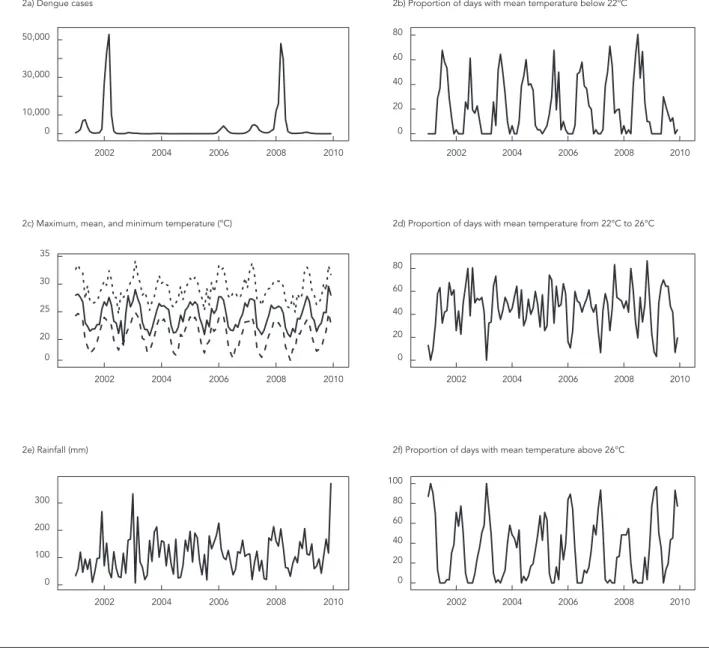
Exploratory data analysis was performed us-ing boxplots, histograms, time series decompo-sition, and auto-correlation graphics. The out-come variable was the number of dengue cases, and the independent variables were the mean monthly precipitation at the 32 stations and the mean, low, and high monthly temperatures. Af-ter exploratory analysis, cutoff points for mean temperature were evaluated using generalized additive models 20. Dengue risk was observed to
increase up to 26°C. According to the literature, the mosquito’s optimal temperature is from 22°C to 26°C, based on which the following variables were used: proportion of days in the month with mean temperature below 22°C, proportion of days in the month with mean temperature from 22°C to 26°C, and proportion of days in the month with mean temperature above 26°C.
The effect of climatic variables on the report-ed number of cases was evaluatreport-ed using gener-alized linear models 21, with a logarithmic link
function for Poisson and negative binomial dis-tribution. Time series are characterized by a se-quence of data obtained at equal time intervals. The data used here refer to months, which do not have the same number of days, so that an offset was employed in multiplying the population by the number of days in the month. Model fit was evaluated by auto-correlation and normality test of residuals.
The analyses were performed using the R program, version 2.10.1 (The R Foundation for Statistical Computing, Vienna, Austria; http:// www.r-project.org). The models were compared with the Akaike Information Criterion (AIC), which is widely used to compare nested and non-nested models. This criterion is calculated using the log-likelihood penalized by the number of parameters in the model. For models with the same dataset, the best model is the one with the lowest AIC 22.
Results
Figure 1
Map of the city of Rio de Janeiro, Brazil, showing rainfall monitoring stations (●) and temperature monitoring stations (■).
Analysis of case distribution showed that most cases were concentrated in the first half of the year, mainly in March, April, and May, un-derlining the known seasonality of dengue fever. Mean annual temperatures for the period were 24°C for monthly mean temperature, 21°C for monthly minimum temperature, and 29°C for monthly maximum temperature. Monthly accu-mulated precipitation in the period ranged from 6 to 371mm.
Since the data present over-dispersion (sample mean of 3,108 and sample variance of 84,695,150), comparison of the models’ AIC showed that negative binomial distribution was a better choice than Poisson distribution. Mod-els were initially fitted with only one variable; in these, the variable “proportion of days with temperature from 22°C to 26°C” was not sig-nificant, even when lagged, while precipitation was only significant in relation to the number of cases when lagged by one month. The other variables were significant with lags of up to two months.
On the basis of this initial analysis, all the models contained the variable precipitation, and then the inclusion of temperature-related vari-ables was evaluated. Residuals analysis of the models showed that a time structure persisted; accordingly, an annual effect was incorporated into the model. Introduction of this variable im-proved both auto-correlation of residuals and model fit.
Table 1 shows the estimated relative risk (RR), 95% confidence intervals (95%CI), and AIC for the fitted models. The RR for the variable “pre-cipitation” varies little between the models. Con-cerning the AIC criterion for comparing models, the model with the best fit was the one which (after controlling for the variable “year”) used the variables “minimum temperature” and “precipi-tation”, both lagged by one month. In that model, a one-degree rise in temperature in a month led to a 45% increase in dengue cases in the following month, while a 10mm increase in precipitation led to a 6% increase in dengue cases in the fol-lowing month. Models with the variables “mean
Rainfall monitoring stations
Temperature monitoring station N
E W
S
temperature” and “maximum temperature” pre-sented similar results.
Figure 3 shows the coefficients for the vari-able “year” in Model 1: 2002 and 2008 were the only years in which the effect was greater than in 2001, which was taken as baseline. They were the years in the study period with the most cases, but this variable was not statistically significant. Figure 4 shows the time series for dengue cases and the series as estimated by Model 1, which managed to detect the epidemic years, although underestimating the major epidemics and
over-estimating the number of dengue cases in the following year.
Discussion
Several studies have reported a positive asso-ciation between minimum temperature lagged by one month and dengue incidence 3,4,12,23,24.
Minimum temperature is thus a critical limiting factor in the development and maintenance of the vector population. Replication of the virus
Figure 2
Time series for number of dengue cases and meteorological variables in the city of Rio de Janeiro, Brazil, 2001-2009.
50,000
2a) Dengue cases 2b) Proportion of days with mean temperature below 22°C
30,000
10,000
0
2002 2002
80
60
40
20
0
2004 2006 2008 2010 2004 2006 2008 2010
2c) Maximum, mean, and minimum temperature (°C) 2d) Proportion of days with mean temperature from 22°C to 26°C
35
30
25
20
0
2002 2002
80
60
40
20
0
2004 2006 2008 2010 2004 2006 2008 2010
2e) Rainfall (mm) 2f) Proportion of days with mean temperature above 26°C
2002 300
200
100
0
2002 100
80
60
40
20
0
Figure 3
Estimated coeffi cients of variables indicating the year in Model 1.
0
-1
-2
-3
-4
Not significant
Significant Table 1
Relative risk (RR), 95% confi dence intervals (95%CI), and Akaike Information Criterion (AIC) of the proposed models for the relationship between dengue transmission and meteorological variables. Rio de Janeiro, Brazil, 2001-2009.
Models/Variables lagged by 1 month RR 95%CI AIC
1
Minimum temperature 1.452 1.338-1.576 1,568
Precipitation 1.006 1.003-1.009
2
Proportion of days with temperature > 26°C 1.092 1.068-1.115 1,577 1.008 1.005-1.011
3
Proportion of days with temperature < 22°C 0.894 0.867-0.921 1,584
Precipitation 1.007 1.003-1.010
Note: all models were controlled for variables indicating the year.
and maturation periods in the insect (extrinsic period) are shortened by increased temperature
25,26,27, while decreased virus incubation time
in-creases the likelihood that the vector will live long enough to transmit the virus, significantly boost-ing the magnitude of the epidemics. Studies have shown that Ae. aegypti, the vector for dengue in the Americas, ceases to feed when temperature falls below 17°C, and that the virus is not ampli-fied in the vector when temperature falls below
18°C, while the threshold survival temperature for the dengue virus has been estimated at 11.9°C
25,28,29. Thus, at very low temperatures the virus
develops more slowly, and the mosquito does not live long enough to become infectious and trans-mit the virus 30. Accordingly, analysis of minimum
in the literature on the correlation between rain-fall and dengue are contradictory, because the re-lationship depends on local characteristics 3,31.
Analysis of Model 3 shows that a unit increase in the proportion of days in the month when the mean temperature falls below 22°C led to an 11% decrease in the number of dengue cases in the following month, corroborating reports by other authors, because the vector’s feeding rate declines at lower temperatures (as does the viral transmission rate, consequently) 31,32.
A study by Honório et al. 32 in three
neigh-borhoods in the city of Rio de Janeiro shows that air temperature from 22°C to 24°C has a positive impact on the development of Ae. aegypti, while temperatures above 24°C produce no evident ef-fect. In the present study, that temperature range was incorporated into the variable “proportion of days in the month with mean temperature from 24°C to 26°C”, which was not statistically significant.
According to Model 2, which incorporates temperature above 26°C, a unit increase in the proportion of days in the month when mean tem-perature is above 26°C leads to a 9.2% increase in dengue cases in the following month. That result was expected, because studies have found an association between dengue risk and tempera-tures above 26°C, with temperatempera-tures from 21°C
to 29°Cfavoring the development of Ae. aegypti, and from 22°C to 30°C, the longevity and fertility of the adults 2,33.
The complexity of dengue transmission dy-namics has prompted studies on various factors that contribute to circulation of the virus. Al-though the current study emphasizes the impact of climate, other approaches beyond socio-envi-ronmental conditions must be considered. One limitation of this study was the use of reported dengue cases, which fail to represent total den-gue cases. These numbers may underestimate true incidence 34,35. Another limitation was the
lack of reliable information in each time period on the specific incidence rates for each serotype (among the circulating serotypes) 36. Some
au-thors claim that the entry of a new serotype into a non-immune population entails a risk of ex-plosive epidemics, even while the succession of serotypes can result in epidemics with more se-vere cases 10,18,37. The role of the exposed human
populations, the effect of immunity to the virus in the at-risk population, and infestation by the mosquito vector are decisive factors in maintain-ing the virus in circulation.
Figure 4
Time series of dengue cases and series estimated by Model 1.
Dengue cases
Fitted
0 20 40 60 80 100 Months (2001-2009)
50,000
40,000
30,000
20,000
10,000
Cases
Conclusion
Dengue transmission involves numerous factors, including the impact of climate, whose role is still not fully understood. Elucidating the role of cli-mate is critical, because it facilitates analysis of the risk of epidemics and assists preventive
ef-forts. This study proposed a model for examining the time series of dengue fever by which mean, maximum, and minimum temperature and pre-cipitation were associated statistically with the number of cases, while one month-lagged mini-mum temperature proved to be the strongest ex-planatory factor for the number of dengue cases.
Resumo
A dengue é doença reemergente e uma das mais im-portantes doenças virais transmitida por mosquito. O clima é considerado um fator relevante na distribui-ção temporal e espacial das doenças transmitidas por vetores. O objetivo deste trabalho foi estudar o efeito de fatores sazonais e a relação entre as variáveis climá-ticas e o risco de dengue, na cidade do Rio de Janeiro, Brasil, entre 2001 e 2009. Foram utilizados modelos lineares generalizados, com distribuição Poisson e binomial negativa. O modelo com melhor ajuste foi o controlado por variáveis indicadoras do ano, que apresentou as variáveis temperatura mínima e preci-pitação, ambas com defasagem de um mês. Nesse mo-delo, o aumento de um grau na temperatura mínima em um mês leva ao aumento de 45% no número de ca-sos de dengue no mês seguinte, enquanto o aumento em 10 milímetros na precipitação leva ao aumento de 6% no número de casos de dengue no mês seguinte. A transmissão da dengue está relacionada a muitos fato-res; o impacto do clima, apesar de ainda não ser bem entendido, é apontado como crítico ao facilitar análise de risco de epidemias.
Dengue; Clima; Distribuição Temporal
Contributors
References
1. Rosa-Freitas MG, Schreiber KV, Tsouris P, Weimann ETS, Luitgards-Moura JF. Associations between dengue and combinations of weather factors in a city in the Brazilian Amazon. Rev Panam Salud Pública 2006; 20:256-67.
2. Hii YL, Rocklöv J, Ng N, Tang CS, Pang FY, Sauer-born R. Climate variability and increase in inten-sity and magnitude of dengue incidence in Singa-pore. Glob Health Action 2009; 2.
3. Wu PC, Guo HR, Lung SC, Lin CY, Su HJ. Weather as an effective predictor for occurrence of dengue fever in Taiwan. Acta Trop 2007; 103:50-7.
4. Liang L, Hualiang L, Linwei T, Weizhong Y, Jimin S, Qiyong L. Time series analysis of dengue fever and weather in Guangzhou, China. BMC Public Health 2009; 9:395.
5. Gasparrini A, Armstrong B. Time series analysis on the health effects of temperature: advancements and limitations. Envirol Res 2010; 110:633-8. 6. Thail, KTD, Anders KL. The role of climate
variabil-ity and change in the transmission dynamics and geographic distribution of dengue. Exp Biol Med 2011; 236:944-54.
7. Earnest A, Tan SB, Wilder-Smith A. Meteorologi-cal factors and El Niño Southern Oscillation are independently associated with dengue infections. Epidemiol Infect 2012; 140:1244-51.
8. Cassab A, Morales V, Mattar S. Factores climáticos y casos de dengue en Montería, Colombia, 2003-2008. Rev Salud Pública 2011; 13:115-28.
9. Ferreira GS. Análise espaço-temporal da distribui-ção dos casos de dengue na cidade do Rio de Ja-neiro no período de 1986 a 2002 [Masters Thesis]. Rio de Janeiro: Universidade Federal do Rio de Ja-neiro; 2004.
10. Teixeira TRA. Análise espacial e temporal da den-gue no contexto sócio-ambiental do Município do Rio de Janeiro, 1996-2006 [Masters Thesis]. Rio de Janeiro: Escola Nacional de Saúde Pública Sergio Arouca, Fundação Oswaldo Cruz; 2009.
11. Luz PM, Mendes BVM, Codeco CT, Struchiner CJ, Galvani AP. Time series analysis of dengue inci-dence in Rio de Janeiro, Brazil. Am J Trop Med Hyg 2008; 79:933-9.
12. Descloux E, Mangeas M, Menkes CE, Lengaigne M, Leroy A, Tehei T, et al. Climate-based models for understanding and forecasting dengue epidemics. PLoS Negl Trop Dis 2012; 6:e1470.
13. Ribeiro AF, Marques G, Voltolini JC, Condino MLF. Associação entre incidência de dengue e variáveis climáticas. Rev Saúde Pública 2006; 40:671-6. 14. Halstead SB. Dengue. Lancet 2007; 370:1644-52. 15. Jetten TH, Focks DA. Potential changes in the
dis-tribution of dengue transmission under climate warming. Am J Trop Med Hyg 1997; 57:285-97. 16. Li CF, Lim TW, Han LL, Fang R. Rainfall, abundance
of Aedes aegypti and dengue infection in Selan-gor, Malaysia. Southeast Asian J Trop Med Public Health 1985; 16:560-8.
17. Chen SC, Hsieh MH. Modeling the transmission dynamics of dengue fever: implications of temper-ature effects. Sci Total Environ 2012; 431:385-91. 18. World Health Organization. Dengue haemorrhagic
fever: diagnosis, treatment, prevention and con-trol. 2nd Ed. Geneva: World Health Organization; 1997.
19. Holmes EC, Twiddy SS. The origin, emergence and evolutionary genetics of dengue virus. Infect Genet Evol 2003; 3:19-28.
20. Wood SN. Generalized additive models: an intro-duction with R. Boca Raton: Chapman & Hall/ CRC; 2006.
21. McCullagh P, Nelder JA. Generalized linear models. London: Chapman and Hall; 1989.
22. Akaike H. A new look at the statistical model iden-tification. IEEE Trans Automat Contr 1974; 19: 716-23.
23. Hurtado-Díaz M, Riojas-Rodríguez H, Rothenberg SJ, Gomez-Dantés H, Cifuentes E. Short commu-nication: impact of climate variability on the in-cidence of dengue in Mexico. Trop Med Int Health 2007; 12:1327-37.
24. Yasuno M, Tonn RJ. A study of biting habits of Aedes aegypti in Bangkok, Thailand. Bull World Health Organ 1970; 43:319-25.
25. Watts DM, Burke DS, Harrison BA, Whitmire RE, Nisalak A. Effect of temperature on the vector ef-ficiency of Aedes aegypti for dengue 2 virus. Am J Trop Med Hyg 1987; 36:143-52.
26. Mendonça M. Febre amarela silvestre. Rio de Ja-neiro: Gráfica Olympia; 1941.
27. Reiter P. Global warming and mosquito-borne dis-ease in USA. Lancet 1996; 348:622.
28. Reed W, Carroll J, Agramonte A. Experimental yel-low fever, 1901. Mil Med 2001; 166(9 Suppl):55-60. 29. Christy JR, Clarke RA, Gruza GV, Jouzel J, Mann
ME, Oerlemans J, et al. Observed climate vari-ability and change. In: McCarthy JJ, Canziani OF, Leary NA, Dokken DJ, White KS, editors. Climate change 2001: impacts, adaptation, and vulnerabil-ity. Cambridge: Cambridge University Press; 2001. p. 99-181.
30. Hales S, de Wet N, Maindonald J, Woodward A. Po-tential effect of population and climate changes on global distribution of dengue fever: an empiri-cal model. Lancet 2002; 360:830-4.
31. Gubler DJ, Reiter P, Ebi KL, Yap W, Nasci R, Patz JA. Climate variability and change in the United States: potential impacts on vector- and rodent-borne diseases. Environ Health Perspect 2001; 109 Suppl 2:223-33.
33. Beserra EB, Castro Júnior FP, Santos JW, Santos TS, Fernandes CRM. Biologia e exigências térmicas de Aedes aegypti (L.) (Diptera:Culicidae) provenientes de quatro regiões bioclimáticas da Paraíba. Neo-trop Entomol 2006; 35:853-60.
34. Phuong HL, de Vries PJ, Nagelkerke N, Giao PT, Hung le Q, Binh TQ, et al. Acute undifferentiated fever in Binh Thuan province, Vietnam: imprecise clinical diagnosis and irrational pharmacotherapy. Trop Med Int Health 2006; 11:869-79.
35. Thai KTD, Cazelles B, Nguyen NV, Vo LT, Boni MF, Farrar J, et al. Dengue dynamics in Binh Thuan province, southern Vietnam: periodicity, syn-chronicity and climate variability. PLoS Negl Trop Dis 2010; 4:e474.
36. Nogueira RMR, Araújo JMG, Schatzmayr HG. Den-gue viruses in Brazil, 1986-2006. Rev Panam Salud Pública 2007; 22:358-63.
37. Nogueira RMR, Eppinghaus ALF. Dengue virus type 4 arrives in the state of Rio de Janeiro: a challenge for epidemiological surveillance and control. Mem Inst Oswaldo Cruz 2011; 106:255-6.
Submitted on 03/Jan/2012