Changes in seed quality during fruit maturation of sweet pepper
Deborah de Souza Vidigal
1, Denise Cunha Fernandes dos Santos Dias
2*, Luiz Antônio dos
Santos Dias
2, Fernando Luiz Finger
21
UFV – Programa de Pós-Graduação em Fitotecnia.
2
UFV – Depto. de Fitotecnia – 36570-000 – Viçosa, MG – Brasil. *Corresponding author <[email protected]>
Edited by: Edmilson José Ambrosano
ABSTRACT: Studies regarding seed maturation are important to determine the ideal fruit development stage for harvesting in order to obtain high-quality seeds. Changes in sweet pepper (Capsicum annuum L.) seed quality were monitored during seed development in order to identify the stage of maximum quality of the seeds and the optimum harvest date. Fruits harvested from 20 to 75 days after anthesis (DAA) with step of five days were grouped according to maturity stage (green, yellow, red and intense red color outside). Before seed extraction, the fruit weigh, diameter and length were determined. Seed water content, seed dry weight, 1.000-seed weight, germination, first count, speed emergence index, seedling length, accelerated aging and electrical conductivity tests were performed. Mass maturity of the seeds was attained at 75 DAA, when seed water content was 47.3 % and the fruits were red. Sweet pepper seeds with high germination and vigour should be harvested when fruits are completely red outside, at 75 DAA.
Keywords: Capsicum annuum L., maturity, harvest, vigour
Introduction
Production of high quality seeds depends upon the ap-propriate time of harvest. In general, seed crops should be harvest when seed quality is maximal. However, the stage during seed development at which seeds attain maximum quality is subject of some controversy. Seeds developed in fleshy-fruited species generally attain maximum germination and vigor at the end of the seed-filling period, when physi-ological maturity is reached (Welbaum, 1999). However, in some those species, maximum seed dry matter accumulation and seed quality do not coincide, such as pepper (Capsicum annuum L.)(Demir and Ellis, 1992b; Oliveira et al., 1999), melon (Cucumis melo L.) (Welbaum and Bradford, 1988) and tomato (Lycopersicon esculentum Mill.) (Kwon and Bradford, 1987; Berry and Bewley, 1991; Demir and Ellis, 1992a; Demir and Samit, 2001; Dias et al., 2006a). In tomato seeds, Kwon and Bradford (1987) found that maximum germination and vigor occurred 15 days after attainment of maximum dry mass. It was also verified by Demir and Ellis (1992a), to whom the highest germination percentage was obtained at 70 DAA, while the maximum dry matter content occurred at 50 DAA. Simi-lar results were reported in pepper seeds, where maximum val-ues of germination and dry matter was attained at 60 DAA and 50 DAA, respectively (Oliveira et al., 1999).
In general, degenerative changes occur in the seeds once full physiological maturity has been attained (Harrington, 1972). Under field conditions, the transition from high quality to aged or even dead muskmelon seeds occurs swiftly over a matter of a few days (Welbaum, 1999). Then, the occurrence of maximum seed quality during development and its as-sociation with seed and fruit features are important factors to define the ideal harvest time. This study was done to verify the development stage when sweet pepper (Capsicum annuum L.) seeds acquire maximum quality and to define the optimum harvest date.
Materials and Methods
Sweet pepper seeds (Amarela Comprida cultivar) were sown in the first week of January 2007, in four trays (90 cells per tray) containing a commercial substratum in Viçosa, MG, Brazil. The 40 day-old seedlings were transplanted to the field totaling approximately 300 seedlings. Plant spacing was 1.2 m between rows and 0.8 m between plants constituting 30 plants per plot. Before planting, fertilization was applied ac-cording to Ribeiro et al. (1999). The sprinkler irrigation was applied as required and plants were tutored using sticks. The maximum and minimum temperatures during the whole growing season recorded were 32 and 14 ºC, respectively.
Flowers were tagged at anthesis, and the fruits were har-vested from 20 to 75 days after anthesis (DAA) with step of 5 days. Then, harvested fruits were classified according to the maturation stage based on fruits color on the out-side, e.g. completely green (20 to 40 DAA); yellow (45 to 50 DAA), red (55 to 65 DAA) and intense red (70 to 75 DAA). Seeds were extracted manually, and a sample freshly extracted seeds was used to determine seed water content by drying for 24 h at 105 ± 3 ºC (Brasil, 1992). The remain-ing sample was then dried to 10 % water content (fresh weight basis) at room temperature. The following param-eters were performed:
Fruit weight - Thirty fruits from each harvest time were weighed individually (0.0001 g) and fruit weight was ex-pressed as mean fruit weight (g per fruit).
Fruit length and diameter - Thirty fruits from each har-vest time were measured individually and the results were expressed as mean fruit length and diameter (mm per fruit).
Standard germination - four replicates of 50 seeds each were distributed over two sheets of paper towel moistened with 0.2 % KNO3 solution, in germination boxes (110 × 110 × 40 mm) and incubated at 25 ºC (Brasil, 1992). The normal seedlings percentage was determinated 10-day and 17-day after seeding.
Seedling length - four replicates of 20 seeds each were dis-tributed equidistant on the upper end of the paper towel in the germination boxes described previously. The boxes con-taining the seeds were placed inclined at an angle of about 45 ºC to favour radicle vertical growth in the germinator at 25 ºC. The length (mm per seedling) of the normal seed-lings was measured 10 days after seeding.
Accelerated aging - the seeds were distributed on a wire mesh screen suspended over 40 mL of water inside a germi-nation box (AOSA, 1983). Boxes were held in an incubator at 42 ± 0.5 ºC for 96 h (Bhering et al., 2006), and then four replicates of 50 seeds each were tested for germination as de-scribed previously. The evaluation was done ten days after seeding and the mean normal seedling percentage was calcu-lated.
Electrical conductivity - four replicates of 50 seeds each were weighed and then soaked in 50 mL distilled water and incubated for 24h at 25 ºC in the dark. The electrical conduc-tivity of the soak solution was measured using a conducconduc-tivity meter, and the results were expressed as mean μS cm–1 g–1 seeds (ISTA, 1995).
Speed emergence index (SEI) - in a greenhouse, four rep-licates of 50 seeds each were planted 3-mm deep in a com-mercial planting substrate in plastic trays (230 × 160 × 160 mm). Emerged seedlings were counted daily for 30 days and SEI was calculated, Equation 1 (Maguire, 1962).
SEI = E1/N1 + E2/N2 + ... + En/Nn (1)
where: E1, E2, En = number of seedlings recorded on first, second and final count; N1, N2, Nn = number of days from sowing to first, second and final count.
The study was done in the completely randomized de-sign with four replications. The data obtained for each pa-rameter were subjected to regression analysis using Statisti-cal Analysis System (SAS Institute, 1989). Models were cho-sen based on the significance of the regression coefficient us-ing the ‘t’ test at a 0.05 and 0.01 probability level.
Results and Discussion
Fruit diameter (Figure 1 a), weight (Figure 1 b) and length (Figure 1 c) increased consistently until approximately between 40 and 45 DAA followed by slightly increase. At 65 DAA fruit weight was 45.52 mg per fruit and at 75 DAA was 45.53 mg per fruit. In general, fruit size tend to stabilize or decrease at the end of the fructification process of indeterminate growth plant, as observed in tomato by Dias et al. (2006b). These authors found differences among tomato fruit weight accord-ing to fructification sequence in the plant, where fruits from 6th trusses had lower weight than first-truss fruits.
The dry matter content of seeds (Figure 1d) in-creased with fruit age up to 75 DAA, when fruits were completely red. Therefore, mass maturity described by Ellis and Pieta Filho (1992) as the end of the seed-filling period occurred around 75 DAA. In pepper seeds, Demir and Ellis (1992b) found that the maximum dry matter content was obtained approximately at 50 DAA, while fruits were 50 % red. In tomato seeds the maximum dry matter content was verified at 75 DAA, when the fruits were 90 % red (Dias et al. 2006a). The weight of one thou-sand seeds was maximum at the end of the maturation process at 75 DAA (Figure 1e), near to the highest dry matter content value (Figure 1d). These findings are simi-lar to those of Dias et al. (2006a) in which the highest values of 1,000 tomato seeds weight and dry matter con-tent were attained at same time.
At 20 DAA, when the fruits were completely immature (green color outside), the seed water content was 91.8 %, de-creasing to 49.1 % at 55 DAA (red fruits) attaining 47.3 % at 75 DAA (Figure 1f). One the main characteristics of seed de-velopment in fleshy-fruited vegetables is that seed water con-tent remains at values of about 35-40 % within the fruit (Tekrony and Egli, 1997). Then, there was a steadily decline in the seed water content while the dry matter continued to accumulate and moisture content remained high even after maximum dry matter has been accumulated, as related in sev-eral species that produce seeds inside a flesh fruit (Demir and Ellis, 1992a, b; Bewley and Black, 1994; Demir et al., 2002; Dias et al., 2006a, c; Vidigal et al., 2006). In these species the accumulation of osmotic solutes, primarily sugars, creates a low water potential inside the fruit that maintains high seed water content, but below the threshold required for germi-nation (Welbaum and Bradford, 1988).
Seed water content is not considered a good indicator of physiological maturity of the seeds, since can be affected by genotype and environmental conditions. This fact was dem-onstrated by Demir and Ellis (1992a) in experiments con-ducted in two subsequent years. These authors obtained dif-ferent moisture content values for tomato seeds at physi-ological maturity, respectively 53 % and 72 % in 1989 and 1990. Similar results were found by Demir et al. (2002) in eggplant (Solanum melongena L.) seeds.
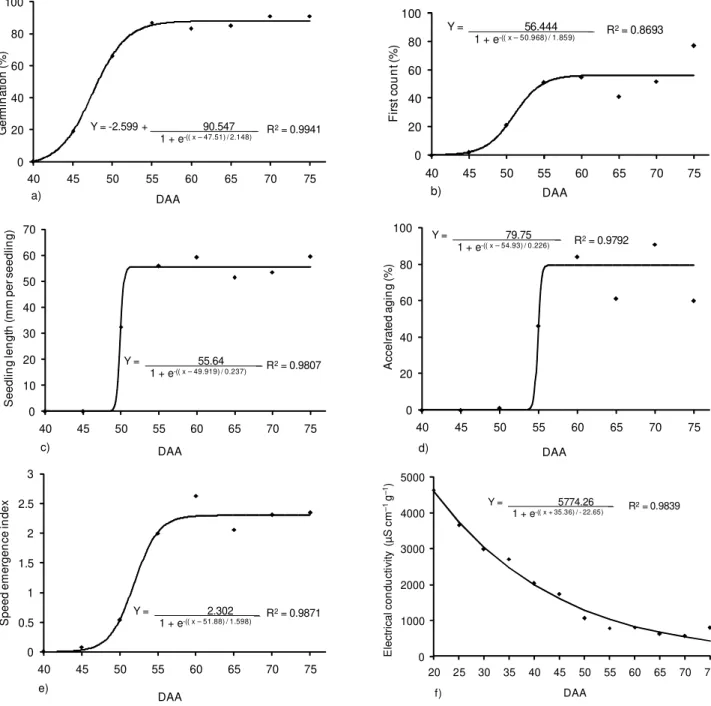
Seed vigor increased along maturation process, although there was small variation among vigor tests in relation to harvest time where seed vigor was maximum (Figures 2b to 2e). In general, the maximum seed vigor was recorded ap-proximately at 60 DAA when fruits were red. High seed ger-mination percentage was attained from 55 DAA increasing slowly until 75 DAA.
The highest electrical conductivity value was ob-tained at 20 DAA, declining gradually till 65 DAA (Fig-ure 2f). Thus maximum electrical conductivity coin-cided with the lowest germination percentage of the seeds, while lower conductivity values were recorded from 65 DAA until 75 DAA when seed vigor was high. These results suggest that there was an increase of cell
mem-branes integrity and subsequent reduction of electrolytes leak-age along seed development as reported by Demir and Ellis (1992a) and Dias et al. (2006b) in tomato. The final stage of the maturation process is marked by dehydration, in such a manner that during the reserve deposition phase, there is also accumulation of potentially protective molecules, espe-cially lea (late embryogenesis accumulated) proteins and soluble sugars, such as sucrose, raffinose, and stachyose to prevent the membrane damage caused by water removal from the seed tissues (Bewley and Black, 1994).
Maximum seed quality can be determined by a combina-tion of attributes as germinacombina-tion percentage and vigor. In general, the maximum germination and vigour of sweet pepper seeds was obtained approximately 75 DAA (Figure Figure 1 –Changes in fruit weight, diameter and length, seed dry weight, seed water content and 1000-seed weight during maturation of
sweet pepper (DAA).
20 22 24 26 28 30 32 34 36 38 40
20 25 30 35 40 45 50 55 60 65 70 75
F
ru
it
di
am
et
er
(
m
m
per
f
ru
it
)
DAA
Y = 38.0438 _
1 + e-(( x – 17.47) / 6.174) R2= 0.9466
a)
15 20 25 30 35 40 45 50
20 25 30 35 40 45 50 55 60 65 70 75
F
rui
t w
e
ig
ht
(
m
m
p
e
r
fr
ui
t)
DAA b)
Y = 45.5323 _
1 + e-(( x – 22.23) / 5.133) R2= 0.9642
0 2 4 6 8 10
20 25 30 35 40 45 50 55 60 65 70 75
1000-s
eeds
w
ei
gh
t (
g)
DAA
R2= 0.9893
e)
Y = 7.5981 _ 1 + e-(( x – 32.77) / 8.14)
110 115 120 125 130 135 140 145 150
20 25 30 35 40 45 50 55 60 65 70 75
F
rui
t l
e
ng
ht
(
m
m
p
e
r f
ru
it
)
DAA
Y = 142.1402 _
1 + e-(( x – 12.30) / 5.33) R2= 0.9037
c)
40 50 60 70 80 90 100
20 25 30 35 40 45 50 55 60 65 70 75
s
e
ed w
at
er
c
on
ten
t
(%
)
DAA f)
Y = 47.18 + 46.9907_ 1 + e-(( x – 36.83) / -5.71) R
2= 0.9903
0 2 4 6 8
20 25 30 35 40 45 50 55 60 65 70 75
S
eed
dr
y
w
ei
g
h
t (
m
g p
er
s
eed)
DAA
Y = 6.6330 _ 1 + e-(( x – 36.12) / 7.351) R
2= 0.9760
Y = 6.6330 _ 1 + e-(( x – 36.12) / 7.351) R
2= 0.9760
2), when the fruits had red color outside coinciding with mass maturity, represented by maximum dry matter content, which was attained at 75 DAA (Figure 1d). These re-sults, therefore, are consistent with the hypothesis pro-posed by Harrington (1972) that seeds attain maximum quality at the end of the seed-filling period and thereaf-ter viability and vigor decline. This hypothesis has also been supported by investigations in melon (Welbaum and Bradford, 1988) and watermelon seeds (Demir et al., 2004).
In conclusion, sweet pepper seeds of cv. ‘Amarela Comprida’ reach mass maturity at 75 DAA, when seed wa-ter content was 47.3 % (Figure 1f) and the fruits were
red. Sweet pepper seeds with high germination and vigour should be harvested when fruits are completely red outside, at 75 DAA.
References
Association of Official Seed Analysts [AOSA]. 1983. Seed Vigor Testing Handbook. East Lansing, MI, USA. (Contribution, 32). Berry, T.; Bewley, J.D. 1991. Seeds of tomato (Lycopersicon esculentum Mill.) which develop in a fully hydrated environment in the fruit switch from a developmental to a germinative mode whitout a requeriment for dessication. Planta 186: 27-34. Bewley, J.D.; Black, M. 1994. Seed: Physiology of Development
and Germination. 2ed. Plenum Press, New York, NY, USA. 445 p.
0 20 40 60 80 100
40 45 50 55 60 65 70 75
G
e
rm
in
a
tio
n
(
%
)
DAA
Y = -2.599 + 90.547 _ 1 + e-(( x – 47.51) / 2.148) R
2= 0.9941
a)
0 20 40 60 80 100
40 45 50 55 60 65 70 75
F
ir
s
t c
o
unt
(
%
)
DAA _ 444 . 56 Y =
1 + e-(( x – 50.968) / 1.859) R
2= 0.8693
b)
0 10 20 30 40 50 60 70
40 45 50 55 60 65 70 75
S
eedl
in
g l
en
gt
h
(m
m
per
s
eedl
in
g)
DAA
Y = 55.64 _ 1 + e-(( x – 49.919) / 0.237) R
2= 0.9807
c)
0 20 40 60 80 100
40 45 50 55 60 65 70 75
A
c
c
el
rat
ed agi
n
g (
%
)
DAA
Y = 79.75 _
1 + e-(( x – 54.93) / 0.226) R2= 0.9792
d)
0 0.5 1 1.5 2 2.5 3
40 45 50 55 60 65 70 75
S
peed em
er
gen
c
e i
n
dex
DAA
Y = 2.302 _ 1 + e-(( x – 51.88) / 1.598) R
2= 0.9871
e)
0 1000 2000 3000 4000 5000
20 25 30 35 40 45 50 55 60 65 70 75
E
le
c
tr
ic
a
l c
o
n
d
u
c
ti
v
ity
(
µ
S
c
m
–1
g
–1
)
DAA f)
Y = 5774.26 _ 1 + e-(( x + 35.36) / - 22.65) R
2= 0.9839
Bhering, M.C.; Dias, D.C.F.S.; Vidigal, D.S.; Naveira, D.S.P. 2006. Accelerated ageing test in pepper seeds. Revista Brasileira de Sementes 28: 64-71. (in Portuguese, with abstract in English). Brasil. Ministério da Agricultura. 1992. Rules for Seed Testing. SNDA/
DNDV/CLAV, Brasília, DF, Brazil. (in Portuguese).
Demir, I..; Mavi, K.; Ozcoban, M. 2004. Changes in germination and potential longevity of watermelon (Citrullus lanatus) seeds during development. New Zealand Journal of Crop and Horticultural Science 32:139-145.
Demir, I.; Mavi, K.; Sermenli, T.; Ozcoban, M. 2002. Seed development and maturation in Aubergine (Solanum melongena
L.). Gartenbauwissenschaft 67: 148-154.
Demir, I.; Ellis, R.H. 1992a. Changes in seed quality during seed development and maturation in tomato. Seed Science Research 2: 81-87.
Demir, I.; Ellis, R.H. 1992b. Development of pepper (Capsicum annuum L.) seed quality. Annals of Applied Biology 121: 385-399. Demir, I.; Samit, Y. 2001. Seed quality in relation to fruit maturation and seed dry weight during development in tomato. Seed Science and Technology 29: 453-462.
Dias, D.C.F.S.; Ribeiro, F.P.; Dias, L.A.S.; Silva, D.J.H.; Vidigal, D.S. 2006a. Maturation of tomato seeds in relation to fructification sequence in the plant. Revista Ceres 53: 446-456. (in Portuguese, with abstract in English).
Dias, D.C.F.S.; Ribeiro, F.P.; Dias, L.A.S.; Silva, D.J.H.; Vidigal, D.S. 2006b. Tomato seed quality harvested from different trusses. Seed Science and Technology 34:681-689.
Dias, D.C.F.S.; Ribeiro, F.P.; Dias, L.A.S.; Silva, D.J.H.; Vidigal, D.S. 2006c. Tomato seed quality in relation to fruit maturation and post-harvest storage. Seed Science and Technology 34: 691-699. Ellis, R.H.; Pieta Filho, C. 1992. Seed development and cereal seed
longevity. Seed Science Research 2: 9-15.
Harrington, J.F. 1972. Seed storage longevity. p. 145-245. In: Kozlowsky, T.T., ed. Seed biology. Academic Press, New York, NY, USA.
International Seed Testing Association [ISTA]. 1995. Handbook of Vigour Test Methods. 3ed. Zürich, Switzerland.
Kwon, O.S.; Bradford, K.J. 1987. Tomato seed development and quality as influenced by preharvest treatment with ethephon. HortScience 22: 588-591.
Maguire, J.D. 1962. Speeds of germination-aid selection and evaluation for seedling emergence and vigor. Crop Science 2: 176-177.
Oliveira, A.P.; Gonçalves, C.P.; Br uno, R.L.A.; Alves, E.U. 1999. Physiological maturation of pepper seeds in relation to fruit age after anthesis. Revista Brasileira de Sementes 21: 88-94. (in Portuguese, with abstract in English).
Ribeiro, A.C.; Guimarães, P.T.G.; Alvarez, V.H. 1999. Recomendation for the use of fertilizers in Minas Gerais: 5th approach. CFSEMG, Viçosa, MG, Brazil. (in Portuguese).
SAS Institute. 1989. Statistical User’s Guide: Version 6. 4ed. SAS Institute.,CARY, NC, USA.
Tekrony, D.M.; Egli, D.B. 1997. Acumulation of seed vigour during development and maturation. p. 369-384. In: Ellis, R.H.; Black, M.; Murdock, A.J.; Hong, T.H., eds. Basic and applied aspects of seed biology. Kluwer Academic, Boston, MA, USA.
Vidigal, D.S.; Dias, D.C.F.S.; Naveira, D.S.P.; Rocha, F.B.; Bhering, M.C. 2006. Physiological quality of tomato seeds in relation to fruit age and post-harvest storage. Revista Brasileira de Sementes 28: 87-93. (in Portuguese, with abstract in English).
Welbaum, G.E. 1999. Cucurbit seed development and production. Horticulture Technology 9: 341-348.
Welbaum, G.E; Bradford, K.J. 1988. Water relations of seeds development and germination in muskmelon (Cucumis melo L.). I. Water relations of seeds and fruit development. Plant Physiology 86: 406-411.