Schooling impacts on the overactive bladder diagnosis
in women
_______________________________________________
Larissa R. Ferreira
1, Monica O. Gameiro
2, Paulo R. Kawano
3, Hamilto A. Yamamoto
1, Rodrigo Guerra
3,
Leonardo O. Reis
3, João L. Amaro
11 Departamento de Urologia, Faculdade de Medicina de Botucatu, Universidade Estadual Paulista,
Botucatu, Brasil; 2 Serviço de Reabilitação Perineal, Faculdade de Medicina de Botucatu, Universidade Estadual de São Paulo, Botucatu, Brasil; 3 Faculdade de Medicina de Campinas, Pontifícia Universidade Católica de Campinas - PUC Campinas, Campinas, Brasil
ABSTRACT
ARTICLE
INFO
______________________________________________________________ ______________________
Objective: To evaluate the overactive bladder (OAB) diagnosis using OAB-V8 and ICIQ-OAB questionnaires in women with different schooling and cultural levels.
Materials and Methods: Three hundred and eighty six healthy women answered a clinical questionnaire filling out information about schooling, demographic and gyne-cological data. The OAB-V8 and ICIQ-OAB questionnaires were used to evaluate OAB diagnosis and symptoms; and the QS-F questionnaire, to determine the sexual func-tion. All questionnaires were validated in Portuguese.
Results: The mean age was 37.3 years-old. Regarding to schooling level, 23.1% had concluded primary education; 65.8%, secondary school; and 11.1% had higher edu-cation. Considering the OAB-V8 (score ≥8), 51.8% of evaluated women had OAB di-agnosis. There was a positive linear correlation between the OAB-V8 and ICIQ-OAB questionnaires in its sections “a” (r=0.812, p<0.001) and “b” (r=759, p<0.001). There was a positive linear correlation between age and the amount of time used to answer the OAB-V8, ICIQ-OAB and QS-F questionnaires (p<0.001).
The ICIQ-OAB was the hardest to answer for all schooling levels when compared to the other questionnaires. Women who had concluded primary and secondary education sig-nificantly demanded more help to answer all questionnaires than those with higher edu-cation (p<0.05). Furthermore, women with higher eduedu-cation took significantly less time answering all questionnaires when compared to their less educated counterparts (primary and secondary schooling), since they were quicker to answer each individual question. Conclusion: Educational level and ageing had an impact on women response using different questionnaires for OAB and sexual function evaluations.
Keywords:
Women; Urinary Bladder; Diagnosis
Int Braz J Urol. 2017; 43: 1129-35
_____________________ Submitted for publication: October 18, 2016
_____________________ Accepted after revision: April 22, 2017
_____________________ Published as Ahead of Print: June 29, 2017
INTRODUCTION
Overactive Bladder (OAB) is defined by the International Continence Society (ICS) as urinary urgency usually accompanied by an increase in urinary frequency and nocturia, with or without urinary incontinence, in the absence of other local diseases (1).
The prevalence of this condition is high, as well as its impact on quality of life. It is estimated that in 2018, approximately 546 million people will suffer of this problem (2). In southern Brazil, it is estimated that approximately 18% of the population present symptoms of overactive bladder (3).
evalua-tion and diagnosis. These quesevalua-tionnaires assess the symptoms severity, the discomfort degree, and the influence on quality of life (4). Additionally, different authors have proposed the use of specific question-naires for the evaluation of sexual function in OAB patients (5).
The OAB-V8 is a simplified version adap-ted from the symptom Bother Scale of the overactive bladder questionnaires (OAB-q), validated to Portu-guese that may be used in OAB diagnosis. It consists of eight questions with domains of 0 to 5 and OAB is considered a probable diagnosis when the score is equal to or higher than eight (6, 7).
Due to a lack of studies evaluating the agre-ement and accuracy between the questionnaires used in the OAB diagnosis, this study proposed to estimate the impact of OAB on sexual function, and the agreement between the OAB-V8 and ICIQ-OAB questionnaires in women, considering different so-cial and economic status.
MATERIALS AND METHODS
Three hundred eighty-six healthy women, aged 18 years or older, were included from three di-fferent centers: 129 participants from the Physiothe-rapy Service; 129 from the Rehabilitation Center and 128 from the Hospital Estadual. As the study was developed in three different rehabilitation centers, we estimated the proportion of responders for each of them, taking into account the amount of care in each service.
All interviewed participants were undergoing physiotherapeutic treatment for non-urological com-plains, most of them, as companions of patients who were followed in these centers. Women were simply approached in the waiting room of these physiothera-py centers while waiting for care.
All participants were informed about the re-search, and, if they agreed to participate, they signed the free informed consent approved by the Ethical Research Board. The women answered a clinical questionnaire, which filled out information about schooling, demographic and gynecological data. The OAB-V8 and ICIQ-OAB questionnaires were used to evaluate OAB diagnosis and symptoms; the QS-F questionnaire was used to evaluate sexual function. All questionnaires were validated in Portuguese.
The OAB-V8 questionnaire consists of ei-ght questions, with domains range between 0 to 5, and if the result is equal to or greater than 8 there is a probable diagnosis of overactive bladder (6).
The ICIQ-OAB evaluates the OAB symp-toms in the “a” questions, and quality of life in the “b” questions, and highest scores correspond to worse situation regarding to a particular di-sorder (8).
The QS-F consists of 10 questions that evaluate all stages related to sexual function in women; the higher the score was, more favorable the situation (9).
The participants were subsequently invited to answer three questions: 1- Which questionnaire did you find the hardest to answer?; 2- Did you need to ask for help answering them?; 3- Which questionnaire demanded the most time for you to answer, in terms of minutes? The response time of each questionnaire was always recorded by the same researcher (a physiotherapist) using a digital chronometer.
The categorization of the schooling level of participants was established according to the organization and structure of education establi-shed by the Brazilian Ministry of Education (MEC) considering the information provided by the res-pondents (10).
Statistical analysis
The sample size was determined using casual participation of the subject to the survey, considering the probability of 50% that each per-son would accept or not to participate in the stu-dy, estimating 10% standard error and 5% signifi-cance level for the conclusions.
Considering that the study was develo-ped in three different rehabilitation centers, we estimated a proportion of responders for each of them, taking into account the amount of care in each service. The total sample size was calculated as 384 (11).
when the variables were quantitative, and the Godman´s Test was applied to establish the con-trasts between qualitative variables within multi-nomial populations.
The Bonferroni Method was used to eva-luate the variance analysis for models of repeated measures in independent groups (13-15).
RESULTS
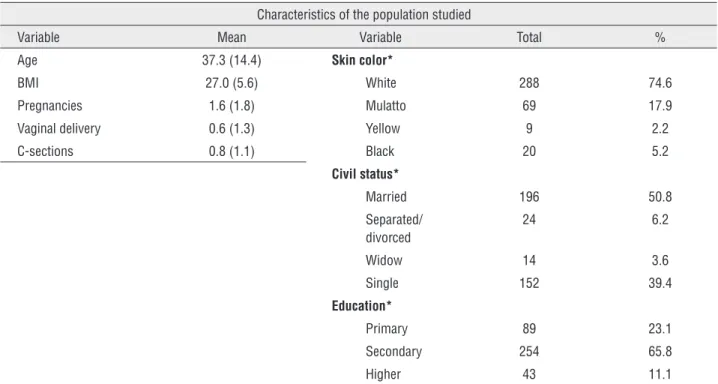
Clinical and demographic data of the stu-dy population are summarized in Table-1. Asso-ciated comorbidities were observed in 25% of par-ticipants: hypertension (10.6%), hypothyroidism (3.6%), Diabetes mellitus (2.1%), and other disea-ses (8.7%).
In 51.8%, the symptoms score was higher than or equal to 8 using OAB-V8, representing probable OAB diagnosis (6).
Average scores questions on the sections “a” and “b” of the ICIQ-OAB questionnaire was 3.08±0.16, and 7.19±0.61, respectively.
There was a positive linear correlation be-tween the OAB-V8 and OAB ICIQ-scores in both
sections “a” (r=0.812, p <0.001), and “b” (r=0.759, p<0.001).
Average QS-F score was 61.48±1.5, de-monstrating that sexual performance in the wo-men varied from regular to good (9).
There was a positive linear correlation be-tween age and response time in all questionnaires, suggesting that older women need longer time to answer these questionnaires (Table-2).
There was a negative linear correlation be-tween the OAB-V8 questionnaire as compared to the QS-F (r=-0.519, p=0.033).
ICIQ-OAB questionnaire was significantly more difficult to answer when compared to other ones in all level of education. However, there was no statistical difference among the different levels of education considering each questionnaire sepa-rately (Table-3).
Women with higher educational levels ne-eded less assistance to answer any of the ques-tionnaires when compared to other educational levels. However, in higher level about 15% of participants required some degree of help during filling out of OAB-V8 (Table-4).
Table 1 - Clinical and demographic data of the study population.
Characteristics of the population studied
Variable Mean Variable Total % Age 37.3 (14.4) Skin color*
BMI 27.0 (5.6) White 288 74.6 Pregnancies 1.6 (1.8) Mulatto 69 17.9 Vaginal delivery 0.6 (1.3) Yellow 9 2.2 C-sections 0.8 (1.1) Black 20 5.2
Civil status*
Married 196 50.8 Separated/
divorced
24 6.2
Widow 14 3.6
Single 152 39.4
Education*
Primary 89 23.1 Secondary 254 65.8 Higher 43 11.1
Table 2 - Pearson linear correlation: age versus time to answer the questionnaires.
Linear correlation
Association “r” Value “p” Value Age x Time OAB-V8 0.190 p<0.001 Age x Time ICIQ-OAB 0.281 p<0.001 Age x Time QS-F 0.291 p<0.001
Table 3 - Number and percentage of women considering ease to answer the different questionnaires according to educational levels.
Education OAB-V8 ICIQ-OAB QS-F Total Primary 20 (42.6%) aB 6 (12.8%) aA 21(44.6%) aB 47 (100%) Secondary 66 (41.0%) aB 38 (9.8%) aA 57(35.4%) aB 161(100%) Higher 10 (55.6%) aB 2 (11.1%) aA 6 (33.3%) aAB 18 (100%)
Total 96 (100%) 46(100%) 84 (100%) 226(100%)
Different lower cases mean statistically significant differences among educational level in the same questionnaire.
Different upper cases mean statistically significant difference considering different questionnaires in the same educational level.
Table 4 - Number and percentage of women who needed assistance to answer the questionnaires according to the level of education.
Education OAB-V8 ICIQ-OAB QS-F Total Primary 5 (38.4%) bA 4 (30.8%) bA 4 (30.8%) bA 13 (100%) Secondary 33 (46.4%) bA 19 (26.8%) bA 19 (26.8%) bA 71 (100%) Higher 3 (15.2%) aB 0 (0%) aA 0 (0%) aA 3 (100%)
Total 41 (100%) 23 (100%) 23 (100%) 87 (100%)
Different lower cases mean statistically significant differences among educational level in the same questionnaire.
Different upper cases mean statistically significant difference considering different questionnaires in the same educational level.
It was found a significantly shorter time to answer the questions in all questionnaires in higher education level when compared to other educational levels (Table-5). Similar results were observed when compared secondary and prima-ry education levels (Table-5), demonstrating the importance of this parameter in the evaluation of patients using specific questionnaires.
DISCUSSION
According to AUA guidelines, OAB is not a disease; it is a symptom complex that generally is not a life-threatening condition. In this con-text, in pursuing a treatment plan the clinician
should carefully weigh the potential benefit to the patient of a particular treatment against that treatment’s risk for adverse events and its seve-rity and reversibility. However, if after the asses-sment has been performed to exclude conditions requiring treatment and counseling, no treatment is an acceptable choice made by some patients and caregivers (16).
or-gasm. Different authors have demonstrated decre-ase in the orgasm in these patients (5).
For this reason, several diagnostic tools evaluating patient reported outcomes are proposed in attempt to help diagnosis. In some patients, the voiding diary may be used, as well as the measu-res of post-void measu-residual urine (4). More complex diagnostic procedures such as urodynamic study may be not necessary, and it is reserved only to specific cases such as in neurologic disease, high post-void residue or pharmacological treatment failure (17).
The ICIQ-OAB questionnaire has level “A” of evidence, and provides assessment of uri-nary symptoms such as frequency and urgency, and also measures their impact on quality of life. Bothersome related to OAB symptoms are worse when final questionnaires score is higher (8).
Some authors have reported that age, BMI, pregnancy, type of delivery, and ethnicity may in-fluence the incidence of OAB diagnosed by valida-ted questionnaires (18-20). Considering the World Health Organization (WHO) (21) classification, we noted that most of women in our study were white overweight mature adults.
In our population, the most common co-morbidities were arterial hypertension and Diabe-tes mellitus (DM). Some authors had stated that these comorbidities and depression might be asso-ciated with OAB (22, 23).
We observed a probable OAB diagnosis in more than half of women using the OAB-V8 ques-tionnaire. Davila et al. (24) reported similar re-sults (51%) using the same questionnaire, and also questioned the reliability of isolated use of this instrument for OAB diagnosis. Thus, if we consi-der only the OAB-V8 questionnaire our outcomes
may be overestimated.
Lapitan et al. (25) identified a global pre-valence of OAB of 53.1% in an Asian female po-pulation, using a questionnaire specific to the region. Other studies report a prevalence ranging from 11.8% to 18.9% using different questionnai-res (2, 26, 27). Some authors attribute this varia-tion in prevalence rates to the different definivaria-tions and questionnaires used for the diagnosis of OAB (28). Scafuri et al. (29) stated that it is difficulty to select the adequate tools for assessment and diag-nosis of OAB, impacting the divergences of OAB prevalence among different studies.
In Brazil, the questionnaires frequen-tly used for OAB prevalence are not specific. So, using a specific questionnaire, we found a high prevalence of this disorder. It’s important to re-member that in our protocol we evaluated only female participants.
In their study, Teloken et al. concluded that overactive bladder is a highly prevalent con-dition, even in young populations (3). It affects both genders, yet it is more frequently observed in women (14.0% in men versus 23.2% in women; overall 18.9%). According to the author, the lack of standardization in the diagnosis and utilization of different criteria in scientific papers may hinder a comparative analysis.
Additionally, they applied a different stra-tegy to evaluate their patients, once they use a questionnaire developed by the combination of questions from the King’s Health Questionnaire validated for OAB syndrome, the AUA Symptoms Score and original questions.
Although our study has shown a possible overestimation in the OAB prevalence, there was a positive linear correlation between the OAB-V8 Table 5 - Response time (seconds) for each questionnaire according to education level.
Education OAB-V8 ICIQ-OAB QS-F Primary 134.4±56.5 c 137.1±55.7 c 200.1±79.6 c
Secondary 107.6±40.0 b 107.2±35.8 b 146.6±46.3 b
Higher 89.7±34.7 a 91±28.5 a 123±40.6 a
p Value p<0.001 p<0.001 p<0.001
and ICIQ-OAB questionnaires, demonstrating that there was concordance in the OAB diagnosis and the answers about worsening on OAB symptoms and quality of life.
In the present study, the longer response time in all questionnaires observed in elderly wo-men may reflect a reduced cognitive capacity re-sulting from the physiological aging process and mild cognitive decline, characterized by memory and attention deficits (30).
According to Vallet (31), some alterations in perception and cognition may occur during the process of physiological aging, such as redu-ced cognitive processing ability, reduredu-ced atten-tion in the execuatten-tion of some funcatten-tions, as well as reduction in the ability of free recall and in episodic memory.
We observed that women had more diffi-culty in answering the ICIQ-OAB questionnaire in comparison to OAB-V8. This fact is in disagree-ment with other authors that have described the ICIQ-OAB as a single and objective questionnaire to assess the storage symptoms related to OAB (32, 33), suitable to use in different groups, young or elderly patients.
The QS-F questionnaire was specifically developed for the Brazilian population to evalua-te the female sexual function. Actually, the studies available so far do not discuss or compare the res-ponse time with the level of education (9, 34). We observed a clear influence of the education level and the response time, demonstrating that women with higher level of education needed short time to answer these questionnaires. To our knowledge this is the first report in the current literature to address this question.
Our results showed that women who had only primary and secondary levels of education ne-eded more assistance to answer the questionnaires. Some authors have reported that individuals with higher levels of education could solve more easi-ly some problems and specific cognitive functions (35, 36). These facts justify why women with higher levels of education had shorter response time and less assistance to answer the questions in our study.
There was a negative linear correlation be-tween the specific questionnaire for OAB symptoms and sexual function (SF), where higher scores for
OAB-related symptoms had worst results in SF. This fact demonstrates the negative influence of OAB symptoms in sexual performance.
In conclusion, educational level and ageing had an impact on women response using different questionnaires for OAB and SF evaluations.
Ethics Committee
Approval Ethics Committee: 1013798/2015. Ethics Committee: Faculty of Medicine of Botucatu – UNESP, SP, Brasil
CONFLICT OF INTEREST
None declared.
REFERENCES
1. Abrams P, Cardozo L, Fall M, Griffiths D, Rosier P, Ulmsten U, et al. Standardisation Sub-committee of the International Continence Society. The standardisation of terminology of lower urinary tract function: report from the Standardisation Sub-committee of the International Continence Society. Neurourol Urodyn. 2002;21:167-78.
2. Irwin DE, Kopp ZS, Agatep B, Milsom I, Abrams P. Worldwide prevalence estimates of lower urinary tract symptoms, overactive bladder, urinary incontinence and bladder outlet obstruction. BJU Int. 2011;108:1132-8.
3. Teloken C, Caraver F, Weber FA, Teloken PE, Moraes JF, Sogari PR, et al. Overactive bladder: prevalence and implications in Brazil. Eur Urol. 2006;49:1087-92.
4. Verdejo-Bravo C, Brenes-Bermúdez F, Valverde-Moyar MV, Alcántara-Montero A, Pérez-León N. Consensus document on overactive bladder in older patients. Ver Esp Geriatr Gerontol. 2015;50:247-56.
5. Proietti S, Giannantoni A, Sahai A, Khan MS, Dasgupta P. Overactive bladder and sexual function: a nightmare couple. BJU Int. 2012;110:921-4.
6. Coyne KS, Zyczynski T, Margolis MK, Elinoff V, Roberts RG. Validation of na overactive bladder awareness tool for use in primary care settings. Adv Ther. 2005;22:381-94.
7. Acquadro C, Kopp Z, Coyne KS, Corcos J, Tubaro A, Choo MS, et al. Translating overactive bladder questionnaires in 14 languages. Urology. 2006;67:536-40. Erratum in: Urology. 2007;69:202. Oh, Seung June [added].
9. Abdo CHN: Quociente sexual feminino: um questionário brasileiro para avaliar a atividade sexual da mulher. Diagn Tratamento. 2009; 14:89-91.
10. Governo Federal do Brasil [internet]. Saiba como é a divisão do sistema de educação brasileiro [update 2014 July 30; cited 2017 May 05]. Portal Brasil [about 2p]. Available from: <http://www.brasil.gov.br/educacao/2014/05/saiba-como-e-a-divisao-do-sistema-de-educacao-brasileiro/view>
11. Cochran WG: Técnicas de amostragem. Rio de Janeiro: Fundo de Cultura, 1965.
12. Zar JH: Biostatistical analysis, 5ed. New Jersey: Reutice-Hall, 2009; pp. 994.
13. Goodman LA: Simultaneous confidence intervals for contrasts among multinomial populations. Annals of mathematical statistics. 1964; 32:716-25.
14. Goodman LA: Simultaneous confidence intervals for multinomial proportions. Technometrics. 1965; 7: 247- 54. 15. Johnson RA, Wichern DW. Applied multivariate statistical
analysis. 6. Ed. New Jersey: Prentice – Hall, 2017; pp. 800. 16. Gormley EA, Lightner DJ, Faraday M, Vasavada SP; American
Urological Association; Society of Urodynamics, Female Pelvic Medicine. Diagnosis and treatment of overactive bladder (non-neurogenic) in adults: AUA/SUFU guideline amendment. J Urol. 2015;193:1572-80.
17. Rovner ES, Goudelocke CM. Urodynamics in the evaluation of overactive bladder. Curr Urol Rep. 2010;11:343-7. 18. Selvaraj J, Kekre AN, Varghese L, Jacob KS. Symptoms,
prevalence, and risk factors of overactive bladder in women in south India. Int J Gynaecol Obstet. 2015;129:274-5. 19. Neves RCS. Incidência e fatores de risco de bexiga hiperativa
em adultos: Resultados de um estudo prospectivo de base populacional. [tese de doutorado]. Salvador: Fundação Osvaldo Cruz. 2010.
20. Fry CH: Obesity and the Overactive Bladder. Curr Bladder Dysfunct Rep. 2013; 8: 62-68.
21. World Health Organization [homepage on the Internet]. BMI Classification. 2006. Geneva: WHO [cited 2008 nov1 12]. Available at: <http://www.who.int/bmi/index. jsp?introPage=intro_3.html>
22. Hirayama A, Torimoto K, Mastusita C, Okamoto N, Morikawa M, Tanaka N, et al. Risk factors for new-onset overactive bladder in older subjects: results of the Fujiwara-kyo study. Urology. 2012;80:71-6.
23. Uzun H, Zorba OÜ. Metabolic syndrome in female patients with overactive bladder. Urology. 2012;79:72-5.
24. Dávila HA, López V, Nieves L, Colantuono A, Guaiquirián L, Sánchez P, et al. Demographic distribution and prevalence of overactive bladder in Venezuela. Actas Urol Esp. 2010;34:176-80.
25. Lapitan MC, Chye PL; Asia-Pacific Continence Advisory Board. The epidemiology of overactive bladder among females in Asia: a questionnaire survey. Int Urogynecol J Pelvic Floor Dysfunct. 2001;12:226-31.
26. Stewart WF, Van Rooyen JB, Cundiff GW, Abrams P, Herzog AR, Corey R, et al. Prevalence and burden of overactive bladder in the United States. World J Urol. 2003;20:327-36. 27. Milson I, Irwin DE. A cross-sectional, population-based
multinational study of prevalence of overactive bladder and lower urinary tract symptoms: Results from the EPIC Study. Eur Urol. 2007; 6:4-9.
28. Herschorn S, Gibbons E. Epidemioilogia na América do Norte. In: Truzzi JC, Dambros M, editors. Bexiga hiperativa: Aspectos práticos. São Paulo: Nome da Rosa; 2009; pp. 25-35. 29. Scafuri A. Epidemiologia na América Latina. In: Truzzi JC,
Dambros M, editors. Bexiga hiperativa: Aspectos práticos. São Paulo: Nome da Rosa, 2009; pp. 21-3.
30. Gamburgo LJL, Monteiro MIB. Envelhecimento e linguagem: algumas reflexões sobre aspectos cognitivos na velhice. Rev Kairós. 2007; 10: 35-49.
31. Vallet GT. Embodied cognition of aging. Front Psychol. 2015; 16;6:463.
32. Abrams P, Avery K, Gardener N, Donovan J; ICIQ Advisory Board. The International Consultation on Incontinence Modular Questionnaire: www.iciq.net. J Urol. 2006;175(3 Pt 1):1063-6. 33. Shy M, Fletcher SG. Objective Evaluation of Overactive
Bladder: Which Surveys Should I Use? Curr Bladder Dysfunct Rep. 2013;8:45-50.
34. Bomfim IQM, Batista RPS, Lima RMC: Evaluation of sexual function in a group of mastectomized women. Rev Bras Promoç Saúde. 2014; 27: 77-84.
35. Fávero MH, Maurmann EC, Souza CMSG: Desenvolvimento adulto e escolaridade: um estudo sobre a resolução de problemas dedutivos Psicologia em Revista, Belo Horizonte, 2003; 10: 92-107.
36. Ritchie SJ, Bates TC, Deary IJ. Is education associated with improvements in general cognitive ability, or in specific skills? Dev Psychol. 2015;51:573-82.
_______________________ Correspondence address: