Fisioter. Mov., Curitiba, v. , n. , p. - , jul./set. Licenciado sob uma Licença Creative Commons DO): http://dx.doi.org. . / - . . .AO
[T]
Fear of falling and activity restriction in older adults from
the urban community of Londrina: a cross-sectional study
[)]Medo de cair e suas restrições em idosos da comunidade
urbana de Londrina: um estudo transversal
[A]
Fabiana Satiko Fucahori[a], Anália Rosário Lopes[b], Juliana Jaqueline Aparecida Correia[c], Carolina Kruleske da Silva[d], Celita Salmaso Trelha[e]
[a] Graduate, Universidade Estadual de Londrina UEL , Londrina, PR - Brazil, e-mail: [email protected] [b] MSc, professor, Faculdade União das Américas, Foz do )guaçu, PR - Brazil, e-mail: analialopes @gmail.com [c] Graduate, Universidade Estadual de Londrina UEL , Londrina, PR - Brazil, e-mail: [email protected] [d] MSc, professor, Universidade Norte do Paraná, Londrina, PR - Brazil, e-mail: [email protected]
[e] PhD, professor, Universidade Estadual de Londrina, Departamento de Fisioterapia, Londrina, PR - Brazil, e-mail:
[R] Abstract
Objective:The objective of this study was to assess the fear of falling and restriction of activities in the elderly
of the city of Londrina PR . Materials and method: A cross-sectional study was conducted with
individu-als over years old of both sexes. They were interviewed at their home with the Falls Efficacy Scale )nternational - Brazil the Survey of Activities and Fear of Falling in the Elderly a socio-demographic and health perception questionnaire. Results: The participants were elderly people mean age . ± . years with a
prevalence of women . % . The occurrence of a fall in the last year was reported by . % of the elderly, and the prevalence of the fear of falling again by . %. )n the evaluation of the Falls Efficacy Scale, . % of partici-pants reported fear of falling in at least one of the activities while . % had score ≥ points showing high risk for falls. Fifty two percent of the elders restricted their activity due the fear of falling. Conclusion: These results
show a high frequency of fear of falling associated with restriction of activities and individuals with a high risk potential for falls. The evaluation of this data contributes to establishing indicators and development of preven-tive strategies and specific interventions for the elderly with fear of falling.
[P]
Resumo
Introdução:O objetivo deste estudo foi avaliar o medo de cair e a restrição de atividades em idosos da co-munidade de Londrina (PR). Materiais e método: Foi realizado um estudo transversal com indivíduos com idade ≥ 60 anos, de ambos os sexos. Os mesmos foram entrevistados em domicílio com a Escala de eficácia de quedas internacional, o Exame de atividades e medo de cair em idosos, um questionário sócio-demográ-fico e de percepção de saúde. Resultados: Participaram 38 idosos (média 71,6 ± 6,1 anos), com prevalência do sexo feminino (68,4%). A ocorrência de queda no último ano foi relatada por 44,7% dos idosos, sendo a prevalência do medo de nova queda de 56,3%. Na avaliação da autoeficácia relacionada às quedas 97,4% dos participantes referiu medo de cair em no mínimo uma das atividades, sendo que 55,3% apresentavam mais de 23 pontos mostrando alto risco para quedas. Cinquenta e dois por cento dos idosos restringiam sua atividade devido ao medo de cair. Conclusão: Os resultados demonstram elevada frequência de medo de cair associada à restrição de atividades e indivíduos com alto risco potencial para quedas. A avaliação destes dados colabora para o estabelecimento de indicadores e elaboração de estratégias preventivas e de intervenções específicas para idosos com medo de cair. [K]
Palavras-chave: Saúde do idoso. Idoso. Medo. Acidentes por quedas.
Introduction
The Brazilian older adult population has been ex-periencing accelerated growth and tends to continue increasing in the decades to come . This process is intimately connected to low birth rates and the decreased Brazilian mortality rate, which in turn is associated with advances in the health field and the current improvement of social conditions. Therefore, we are witnessing a change of the epidemiological profile, with relevant changes in the morbimortal-ity scenario. The typical mortalmorbimortal-ity profile of a young population is changing into a context characterized by complex and more costly illnesses, specific of older age groups .
According to the Brazilian )nstitute of Geography
and Statistics )BGE , life expectancy in was .
years, and it is projected to increase to . years by . This means that adults aged years or older will compose more than . % of the population,
compared to . % in . )n Londrina, state of
Paraná, Brazil, population aging has followed national
parameters and the data in indicated that . %
of the population consisted of individuals aged or
older, being that in , they were represented by
only . % of the municipality’s total population, an
expressive increase of older adults .
)t is important to provide this older population with more care, which requires these numbers to be interpreted as more than just an economically
inactive population. They are a part of the popula-tion that requires specific care, due to the normal or abnormal process of physical, mental and social aging, so as to improve their quality of life.
The process of aging affects balance in older adults, for it affects the ability of the central nervous system to process vestibular, visual and propriocep-tive signals responsible for maintaining body balance. )t also implies a decreased capacity for modifying adaptive reflexes, hindering the individual’s com-pensatory capacity, increasing instability and,
con-sequently, the risk for falls , .
People of all ages are subject to the risk of fall-ing, however, falling is more significant for the older adult population. Falling represents one of the main causes of morbidity and mortality, leading to func-tional incapacity, lesions, hospitalization, institution-alization and expenses with social and health services
. Furthermore, it is common for the older adult’s quality of life to be diminished, due to physical inca-pacity, pain, loss of autonomy, excessive family pro-tection and fear of future falls. Falling represents an immense social cost, which becomes even greater when the older adult’s autonomy and independence are decreased and institutionalization required , .
Various factors influence the older adult’s fear of falling, such as associated chronic and irreversible diseases, polypharmacy, cognitive and psychological alterations, gait disorders, balance impairment and
381
)CC = . . The scale evaluates fear of falling for different daily activities, with scores ranging from for individuals with no concern about falling to points for individuals who are extremely con-cerned. A FES-)-Brazil score ≥ corresponds to a high falling potential, and a score > to a high risk
of recurrent falls .
The Brazilian version of the SAFFE scale present-ed reliability levels similar to those obtainpresent-ed in the original study. )n the latter, the fear of falling scale presented a Cronbach’s alpha of . , whereas for the Brazilian adaptation of the scale, the same reli-ability index was . . Relireli-ability values regarding other dimensions of the scale were not reported in
the original study .
The SAFFE was used to evaluate different levels of fear of falling and activity restriction. The instru-ment examines activities covering the following areas: Basic Activities of Daily Living BADL and )nstrumental Activities of Daily Living )ADL , and mobility tasks and social activities. The instrument displays validity and good internal consistency
Cronbach’s α = . for evaluating fear of falling
during the performance of the activities . The
types of activities evaluated included going to stores, getting out of bed without help, going on walks for exercise, walking on slippery surfaces, visiting friends or relatives, reaching an object overhead, going to places with crowds, walking several blocks in the neighborhood and fetching an object on the ground.
Still according to Freire et al. , each activity
presents the following set of questions: A Do you normally do this activity? yes/no ; B )f you do the activity, how worried are you that you might fall? = very worried, = somewhat worried = a little wor-ried and = not at all worwor-ried ; C )f you do not do the activity, is it because you are … you might fall? = very worried, = somewhat worried = a little worried and = not at all worried ; D Besides wor-rying that you might fall, are there other reasons why you do not do it? )f yes, specify ; E Why do you not do the activity? For those who do not do it and are not worried about falling ; F Compared with five years ago, how often do you do it? = more than you used to, = about the same, = less than you used to .
The questionnaires were applied during home vis-its by only one examiner, who conducted an average of seven interviews per day. Participants answered the sociodemographic questions contained in the questionnaire produced by the authors. )nformation When used to increase watchfulness, fear is a
posi-tive factor in preventing falls. (owever, it can repre-sent psychological trauma, leading to a restriction of activities due to insecurities regarding one’s capacity for maintaining balance, due to low self-efficacy or confidence of preventing falls and due to the con-sequences of a possible fall. Reduced mobility can directly affect the individual’s functional condition, in such a way that fear of falling can be understood
as a consequence as well as a cause of falling .
)n this context, the theme fear of falling can be compared to a vicious cycle, which begins with risk for falls, balance and mobility deficits, fear of falling, functional decline, which then leads to even more
fear .
The aim of the present study was to evaluate fear of falling and identify activity restriction due to fear of falling in older adults from the urban community of Londrina, state of Paraná, Brazil.
Materials and method
An observational cross-sectional study was
con-ducted between August and September of . The
sample comprised individuals aged years or older, both male and female, registered in the Family (ealth Program F(P , in the area covered by the Family (ealth Unit of Cabo Frio/)magawa, a neighborhood in the northern region of Londrina. Exclusion criteria were: unstable health conditions, neurological and cognitive diseases/deficits, physical and sensorial limitations, such as impaired comprehension, severe loss of visual acuity or auditory loss which incapaci-tated activities of daily living ADLs , amputations and the use of prostheses.
The Falls Efficacy Scale )nternational-Brazil FES-)-Brazil , the Survey of Activities and Fear of Falling in the Elderly SAFFE and a sociodemographic and health self-perception questionnaire were used for data collection.
The FES-)-Brazil scale was created by the European organization Prevention of Falls Network Europe
PRoFaNE , adapted and validated to the Brazilian
older adult population by Camargos et al. . The
in-strument displays excellent psychometric properties, with an adequate internal consistency Cronbach’s
α = . , intra-rater reliability with respect to the
Of all the participants, only three used orthotic devices canes or crutches and all three reported having fallen over the last months. Their score on the FES-)-Brazil was > points, indicating a high potential risk for falls, and they were classified ac-cording to SAFFE as afraid of falling and presenting restriction of activities.
The final FES-)-Brazil score ranged from - points for men, mean score of . ± , and - points for women, mean of . ± . points. These results indicate that women presented a greater con-cern about falling. They also reported the most falls
over the last months % . The great majority
of older adults % reported having suffered
con-sequences from their falls, the most common being
pain % , followed by fear of falling again % .
The least cited consequences were activity restriction
and reduced independence % .
For each activity on the FES-)-Brazil, minimum score was one and the maximum was four. A score of represented not at all concerned and , very concerned. )t was determined that the items which caused the greatest levels of concern were: walking
on a slippery surface mean value . ; walking on
an uneven surface . ; walking up or down a slope
. and going up or down stairs . . Activities
that presented the least concern about falling were:
visiting a friend or relative . , preparing meals
and getting in and out of chairs both with a mean
score of . . Table displays the mean scores
ob-tained from all the participants per activity in de-creasing order, i.e., from the activity which causes most concern about falling to that of least concern.
As observed, % older adults obtained ≥
points on the FES-)-Brazil, which corresponds to a high potential risk of falling. According to the SAFFE,
all presented fear of falling and %
pre-sented activity restriction. Only three individuals % of the total , obtained > points on the FES-)-Brazil, a score that corresponds to a high risk of recurring falls. These three individuals were women, and they also presented fear of falling and activity restriction on the SAFFE.
The participants were classified by SAFFE into three groups illustrated in percentages, absolute frequency by gender and mean age: - not afraid of falling %, men and woman; years ; - is
afraid of falling and does not restrict activities %,
men, women; . years ; - is afraid of falling
and restricts activities %, men, women; .
was gathered regarding sex, age, fall history and its consequences and health conditions. (ealth self-perception was expressed on a visual analog scale
VAS from - , in which zero is terrible and ten is excellent.
The research proposal was approved by the Research Ethics Committee of Londrina State
University UEL , no. / . All participants signed
a free and informed consent form and all ethical
prin-ciples of resolution / of the Brazilian National
(ealth Council were followed.
A descriptive analysis was used to characterize sociodemographic data and the scores of the vari-ables in question.
Results
Of the older adults selected for this study, % were excluded for the following reasons: one due to a left femur prosthesis, two for incapacitating visual impairment, six for neurological disorders and nine for not being found at home during the period of the study. Therefore, the sample consisted of
older adults, % of whom were female with
a mean age of . years ± . , minimum age , maximum age . The ≥ age group consisted of
% individuals.
Out of the entire sample, % participants
reported being retired. Regarding education levels,
most interviewees % , women and men, had
not completed high school. Mean health self-percep-tion score was ± . , with a minimum score of and a maximum of , for both sexes. Nineteen
par-ticipants % reported practicing regular physical
activity minimum of one hour, three times a week ,
with most of them being women n = % and
with good health perception VAS ≥ n = % .
All participants reported some type of comor-bidity, the most common being: vision disorders,
n = % ; arterial hypertension, n = % ;
and depression, n = % . Seventeen
individu-als % reported falling in the last year, most of
them women, n = % . Place of fall was n =
% at home, n = % outdoors and n =
383
Participants classified by the SAFFE as not afraid of falling presented a mean score on FES-)-Brazil = . ± . , which corresponds to individuals with no fear of falling. Older adults who were afraid of falling but did not restrict activities obtained a mean FES-)-Brazil score = . ± . . Fear of falling and activity restriction were associated with an average FES-)-Brazil = . ± . , which corresponds to a high potential risk of falling.
years , with an average of restricted activities per participant Figure .
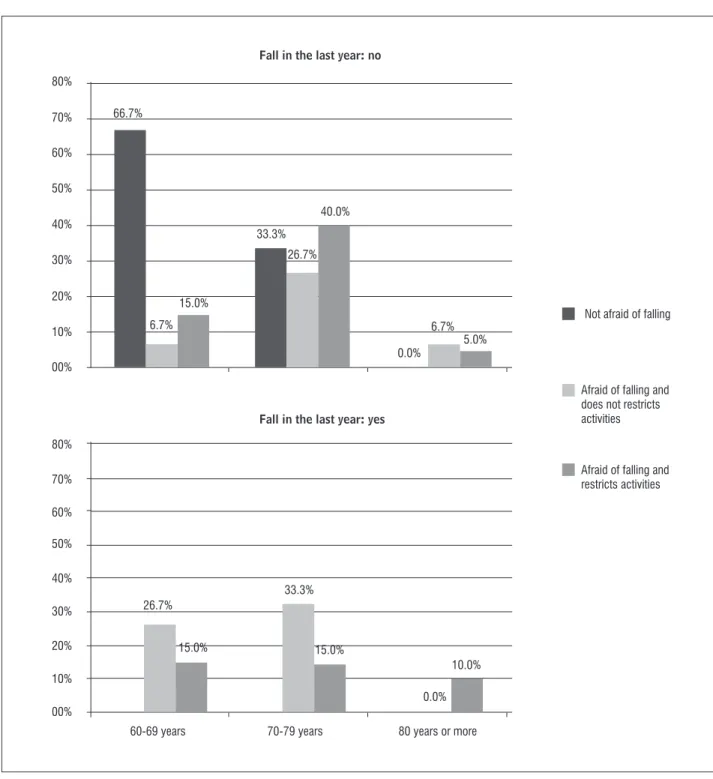
Figure displays the SAFFE data, now in the follow-ing groups: - not afraid of fallfollow-ing n = ; - is afraid
of falling and does not restrict activities n = and
- is afraid of falling and restricts activities n = ,
separated by age group and by a history of falls over the last year. )t is important to point out each SAFFE
group was represented by % of participants.
Table 1 - FES-I-Brazil mean of all participants for each activity
Activities FES-I-Brazil Mean
Walking on a slippery surface 2.55
Walking on an uneven surface 2.42
Walking up or down a slope 2.21
Going up or down stairs 1.92
Reaching for something above your head or on the ground 1.68
Cleaning the house 1.50
Taking a bath or shower 1.50
Walking in places with crowds 1.39
Walking around in the neighborhood 1.34
Going to answer the telephone before it stops ringing 1.29
Going to a shop 1.29
Going out to a social event 1.18
Getting dressed or undressed 1.16
Preparing simple meals 1.13
Getting in or out of a chair 1.13
Visiting a friend or relative 1.11
Source: Research data.
Figure 1 - SAFFE results: classification according to sex Source: Research data
25
20
15
10
5
0
Not afraid of falling Afraid of falling and does
not restricts activities
Afraid of falling and restricts activities 2
1
8 7
17 3
male
80%
70%
60%
50%
40%
30%
20%
10%
00%
80%
70%
60%
50%
40%
26.7% 6.7%
15.0% 66.7%
33.3%
26.7% 40.0%
0.0% 6.7%
5.0%
15.0%
60-69 years 70-79 years 80 years or more
Afraid of falling and restricts activities Afraid of falling and does not restricts activities
Not afraid of falling
Fall in the last year: yes Fall in the last year: no
15.0%
10.0%
0.0% 33.3%
30%
20%
10%
00%
Figure 2 - SAFFE: classification by age group in relation to history of falls Source: Research data.
Discussion
The participants of this study were predominately women; most were retired, with independence in activities of daily living ADL . A high number of older adults had not finished high school, displaying low
education levels. According to )BGE , the life
ex-pectancy of women exceeds that of men and this fact
can explain, in part, the greater proportion of older women with respect to older men.
385
insecurity, vulnerability, loss of control and anxiety related to illness and death. Thus, fear seems to be just as frequent as falling itself.
A study by Teixeira, Oliveira and Dias
inves-tigated whether there would be a difference between institutionalized older adults who have a history of falls and those who do not, in terms of demographic, clinical and functional characteristics. Fear of falling was reported by % of older adults who had a his-tory of falls and by % who did not. The incidence
of depression % and postural hypotension %
were higher among older adults who had had a his-tory of falls.
A study conducted in São Paulo, Brazil by Perracini
and Ramos found a % prevalence of falls, with
recurring falls in % of a population consisting of older adults in the community. According to Ribeiro
et al. and Fabrício, Rodrigues and Costa , the
consequences of falling were more associated with pain and the fear of falling again than with activity restriction. Other authors also indicated fear of falling as a consequence present in % and % of older adults who have fallen. On the other hand, a study
by Lopes et al. found that of the % of older
adults who are afraid of falling in at least one activity on the FES-)-Brazil, only % reported a history of falls, which means that it is not necessarily associated with prior or recurring falls.
)n the present study, we identified a greater pres-ence of fear of falling among the following activities analyzed by the FES-)-Brazil: walking on a slippery surface; walking on an uneven surface; walking up and down a slope and going up and down stairs, re-spectively. This result is similar to that described by
Lopes et al. , except for the inverted order of the
last two activities. Our hypothesis with respect to this difference is that perhaps the participants of the present study did not use the stairs as much, for most lived in buildings with elevators.
Rocha and Cunha state that the psychological
repercussions of falling, such as fear of falling, are very problematic and equally incapacitating. Fear of falling again can affect self-esteem, leading to considerable health detriments, such as dependency, the need for care and a heightened risk of institutionalization.
Over % of participants were classified as pre-senting high potential risk of falling and fear of fall-ing, mostly associated with activity restriction. The high potential risk of falling was identified in female participants, who presented fear of falling, activity self-perception has been described as an important
predictor of survival among older adults. Studies confirm that sex and age difference, regarding health self-perception, are important determinants of
healthcare-seeking behaviors .
)n a study with older women, Freitas et al. demonstrated a significant impact of regular physical exercise on the participant’s posture control, thus showing that sedentary older women presented higher posture instability when compared to their physically active counterparts.
Falls in the last year occurred in % of the sam-ple, the greatest prevalence among women, and this was related to a high potential risk of falling and fear of falling. Most falls took place at home,
corroborat-ing the results of Berg et al. , in which falls were
more likely to occur in the house than outside %
and %, respectively . Being a woman is a significant independent variable that increases the risk of falling, as is a prior history of fractures, difficulty executing
physical activities and vision disorders , .
According to Álvares, Lima and Silva , the
age group presented the highest frequency of falls % of falls ; % of falls occurred in the - age group, and % of falls among participants aged
years or older. )n a study by Siqueira et al. , age
groups were separated from to years, to years and years and older, and the prevalence of falls was higher among the to age group % . Our data demonstrate similar values, as the greatest frequency of falls was found in the to
age group % of falls , followed by % for the
to age group.
Many studies have been developed regarding the fear of falling and how it affects older adults who have already suffered a fall as well as those who have never fallen. This fear creates a greater propensity towards
falls , due to the resulting restriction of activities
and physical-functional deconditioning , . )n
our study, % of participants reported fear of fall-ing in at least one of the activities in the FES-)-Brazil.
Moreover, % of older adults presented ≥
points on the FES-)-Brazil score, which corresponds to a high potential risk of falling. Of these, all
present-ed fear of falling on the SAFFE. Kaplan reports
Acknowledgments
This study received financial support from the Fundação Araucária, through a scientific initia-tion scholarship.
References
. Carvalho JAM, Garcia RA. O envelhecimento da popu-lação brasileira: um enfoque demográfico. Cad Saude Publica. ; : - .
. Gordilho A, Sérgio J, Silvestre J, Ramos LR, Freire MPA, Espindola N, et al. Desafios a serem enfrentados no terceiro milênio pelo setor saúde na atenção integral do idoso. Rio de Janeiro: UnAT); .
. )nstituto Brasileiro de Geografia e Estatística )BGE . Projeção da População do Brasil. )BGE: população brasileira envelhece em ritmo acelerado. cited Nov . Available from: http://saladeimprensa. ibge.gov.br/noticias?view=noticia&id= &busca= &i dnoticia=
. Londrina. Secretaria Municipal do )doso. Perfil da população idosa de Londrina. Londrina: Secretaria Municipal do )doso; cited Mar . Avail-able from: http://www .londrina.pr.gov.br/dados/ images/stories/Storage/sec_idoso/publicacoes/ perfil_idoso_ _OK.pdf
. Ruwer SL, Rossi AG, Simon LF. Equilíbrio no idoso. Rev Bras Otorrinolaringol. ; : - . . Swift CG. The role of medical assessment and
in-tervention in the prevention of falls. Age Ageing. ; Suppl. :ii - .
. Masud T, Morris RO. Epidemiology of falls. Age Ageing. ; Suppl. : - .
. Fabrício SCC, Rodrigues RAP, Costa Jr. ML. Causas e consequências de quedas de idosos atendidos em hospital público. Rev Saude Publica. ; : - . . Brasil. Ministério da Saúde Brasil. Quedas de idosos: SUS gasta quase R$ milhões com fraturas em idosos em . cited Apr . Available from: http://portal. saude.gov.br/ portal/saude/visuali-zar_texto.cfm?idtxt= &janela=
restriction, a history of falls in the last year and poor health perception, all factors which possibly impact the variables analyzed by the FES-)-Brazil and the SAFFE. An important consideration to be made is that, in cultural terms, some activities are performed main-ly by women. These include cleaning the house, pre-paring meals and going to a shop. Male participants found it difficult to imagine themselves performing these activities in order to answer the questionnaires.
Some studies indicate that the prevalence of fear of falling is higher among those with a history of falls, women, long-living older adults, and those with
re-duced mobility and frailty , .
The individuals of our study were, for the most part, classified by SAFFE as afraid of falling and restricting activities , and a fewer number as not afraid of falling , a result similar to that of a study by
Freire et al. . )n their study, out of older adult
participants, % reported no fear of falling;
% were afraid, but did not restrict activities
and % reduced activities due to their fear of
falling. Such restriction of activities can cause a nega-tive impact on the older adult’s physical and mental
wellbeing .
According to Legters and Antes et al. ,
it is difficult to establish which factor can give way to the process of fear of falling and the reduction of self-efficacy or other factors caused by fear, for fear of falling is of multifactorial etiology, which includes physical, behavioral and functional influences.
One limitation of the present study was its reduced sample size. Therefore, we suggest that the study be repeated with a more representative sample. We also suggest a longitudinal study in order to follow-up the same elderly participants.
Conclusion
387
. Siqueira FV, Facchini LA, Piccini RX, Tomasi E, Thumé E, Silveira DS, et al. Prevalência de quedas em ido-sos e fatores associados. Rev Saude Publica. ;
: - .
. Legters K. Fear of falling. Phys Ther. ; : - . . Vellas BJ, Wayne SJ, Romero LJ, Baumgartner RN,
Garry PJ. Fear of falling and restiction of mobility in elderly fallers. Age Ageing. ; : - . . Kaplan (). Transtornos de ansiedade. )n: Sadock BJ,
Sadock VA. Compêndio de psiquiatria: ciência do com-portamento e psiquiatria clínica. . ed. Porto Alegre: Artmed; .
. Teixeira DC, Oliveira )L, Dias RC. Perfil demográfico, clínico e funcional de idosos institucionalizados com história de quedas. Fisioter Mov. ; : - . . Ribeiro AP, Souza ER, Atie S, Souza AC, Schilithz
AO. A influência das quedas na qualidade de vida de idosos. Cienc Saude Colet. ; : - . . Lopes KT, Costa DF, Santos LF, Castro DP, Bastone AC.
Prevalência do medo de cair em uma população de idosos da comunidade e sua correlação com mobili-dade, equilíbrio dinâmico, risco e histórico de quedas. Rev Bras Fisioter. ; : - .
. Rocha FL, Cunha UGV. Aspectos psicológicos e psi-quiátricos das quedas do idoso. Arq Bras Med.
; : - .
. Ferretti F, Lunardi D, Bruschi L. Causas e consequên-cias de quedas de idosos em domicílio. Fisioter Mov.
; : - .
. Antes DL, Schneider )JC, Benedetti TRB, D'Orsi E. Medo de queda recorrente e fatores associados em idosos de Florianópolis, Santa Catarina, Brasil. Cad Saude Publica. ; : - .
Received: / /
Recebido: / /
Approved: / /
Aprovado: / /
. Macedo BG, Marques KSF, Oliveira EB, Gomes GC, Pereira LSM. Parâmetros clínicos para identifi-car o medo de cair em idosos. Fisioter Mov. ;
: - .
. Camargos FFO, Dias RC, Dias JMD, Freire MT. Adap-tação transcultural e avaliação das propriedades psi-cométricas da Falls Efficacy Scale - )nternational em idosos Brasileiros FES-)-BRAS)L . Rev Bras Fisioter.
; : - .
. Gillespie SM, Friedman SM. Fear of falling in new long-term care enrollees. J Am Med Dir Assoc. ;
: - .
. Freire MTF. Características associadas à restrição de atividades por medo de cair em idosos comunitários dissertação . Belo (orizonte: Universidade Federal de Minas Gerais; .
. Brasil. Ministério da Saúde. Conselho Nacional de Saúde. Resolução n. , de de outubro de . Diretrizes e normas regulamentadoras da pesquisa en-volvendo seres humanos. Brasília, DF, cited Nov . Available from: http://bvsms.saude.gov.br/ bvs/saudelegis/cns/ /res _ _ _ .html . )nstituto Brasileiro de Geografia e Estatística )BGE . )ndicadores Sociodemográficos e de Saúde no Brasil. Rio de Janeiro: )BGE; .
. Freitas ERFS, Rogério FRPG, Yamacita CM, Vareschi ML, Silva RA. Prática habitual de atividade física afeta o equilíbrio de idosas?. Fisioter Mov. ;
: - .
. Berg KO, Wood-Dauphinee SL, Williams J), Maki BE. Measuring balance in the elderly: validation of an instrument. Can J Public (ealth. ; Suppl. : S - .
. Perracini MR, Ramos LR. Fatores associados a quedas em uma coorte de idosos residentes na comunidade. Rev Saude Publica. ; : - .
. Faulkner KA, Cauley JA, Studenski SA, Landsittel DP, Cummings SR, Ensrud KE, et al. Lifestyle predicts falls independent of physical risk factors. Osteoporos )nt.
; : - .