FREE THEMES
1 Departamento de Engenharia Elétrica, Faculdade de Engenharia de Guaratinguetá, Universidade Estadual Paulista. Av. Ariberto Pereira Cunha 333, Pedregulho. 12516-410 Guaratinguetá SP Brasil. luiz.nascimento@ pq.cnpq.br 2 Departamento de Medicina, Universidade de Taubaté.
Fuzzy model approach for estimating time of hospitalization
due to cardiovascular diseases
Abstract A fuzzy linguistic model based on the Mamdani method with input variables, particu-late matter, sulfur dioxide, temperature and wind obtained from CETESB with two membership functions each was built to predict the average hospitalization time due to cardiovascular diseas-es related to exposure to air pollutants in São José dos Campos in the State of São Paulo in 2009. The output variable is the average length of hospital-ization obtained from DATASUS with six mem-bership functions. The average time given by the model was compared to actual data using lags of 0 to 4 days. This model was built using the Matlab v. 7.5 fuzzy toolbox. Its accuracy was assessed with the ROC curve. Hospitalizations with a mean time of 7.9 days (SD = 4.9) were recorded in 1119 cases. The data provided revealed a significant correlation with the actual data according to the lags of 0 to 4 days. The pollutant that showed the greatest accuracy was sulfur dioxide. This model can be used as the basis of a specialized system to assist the city health authority in assessing the risk of hospitalizations due to air pollutants.
Key words Fuzzy logic, Air pollutants, Cardiovas-cular diseases, Sulfur dioxide, Particulate matter
Karine Mayara Vieira Coutinho 1
Paloma Maria Silva Rocha Rizol 1
Luiz Fernando Costa Nascimento 2
C
ou
tinho KMV Introduction
Several epidemiological studies have shown air pollution as one of the factors that has the great-est impact on human health, mainly associated
with diseases of the respiratory1-6 and circulatory
system6-10. In cities that are important industrial
centers, such as São José dos Campos, population faces serious environmental problems due to cars and trucks heavy traffic, such as high accumula-tion of air pollutants, high populaaccumula-tion density and major industrial development.
According to the Department of Information and Informatics of the Unified Health System (Datasus) in 2012 1.1 million hospital admis-sions were recorded due to cardiovascular disease in Brazil and 600,000 in São Paulo, generating an
expenditure of R$2.4 billion (1US$ ≈ R$2.50) to
the public funds11.
Particulate matter (PM10), sulfur dioxide
(SO2), nitrogen oxides (NO and NO2) and ozone
(O3) are the pollutants studied and the most
commonly associated with deleterious effects on
human health1. PM
10 is a mixture of solid and
liquid particles with a diameter less than 10µm, suspended in the air and produced by fuels and
biomass burning; SO2 is generated from the
com-bustion of fossil elements as diesel oil and O3 is
formed by reaction between the ultraviolet radi-ation, nitrogen oxides and hydrocarbons emitted
by vehicles12.
Studies show that individuals exposed to high pollution levels have increased blood pressure, heart rate variability, which provides greater risk of arrhythmia and sudden death, and heart at-tack and stroke, and a high incidence of bronchi-al inflammation, accompanied by severe decline
pulmonary function2,4,7,10.
It is believed that the particulate matter
(PM10) and sulfur dioxide (SO2) are closely
relat-ed with hospitalizations and deaths due to heart failure, risks that are more powerful in the day
that occurs exposure to pollutants7.
Statistical techniques such as logistic regres-sion and Poisson regresregres-sion (Generalized Lin-ear Models or Models-MLG Generalized Addi-tive-MAG) are currently used in many studies in
this area5. These models are able to estimate the
chance or the risk of hospitalization or death due to respiratory and cardiovascular diseases.
Nevertheless, fuzzy models emerge as a new tool of choice due to their ability to deal with
vagueness and uncertainty of information13,
where values can be classified as partially true, has ease of understanding and low
computation-al cost. This approach has been used in various
fields such as in industrial process control14-16 and
medicine2,4,17,18.
The concept of fuzzy logic was proposed by Lotfi Zadeh and its theory is based on concepts of classical logic, however with the definition of
pertinence degrees13,19.
In classical theory, the sets are called crisp, where an element of a universe of discourse may or may not belong to a certain set. In the theory of fuzzy sets, as there is a degree of pertinence of each element to a certain set, there is no border from which you can define whether an element belongs to the set in question, and so, it became an important mathematical approach to be ap-plied in the health field, probably due to its abili-ty to cope with linguistic terms.
In this area, fuzzy logic has been used in mod-eling in the process of X-ray diagnosis, fuzzy stan-dards of recognition and for X-ray photos
analy-sis in epidemiology and public health2,4,17,18,20.
The aim of this study is to build a computer model using the fuzzy logic properties to esti-mate the mean hospitalization time due to car-diovascular diseases according to air pollutants concentrations in São José dos Campos, Brazil.
Methods
This is a computational model using fuzzy logic to estimate the hospitalization mean time due to cardiovascular diseases, according to
concentra-tions of PM10 (particulate matter), SO2 (sulfur
dioxide), minimum temperatures values and wind speed obtained the Environmental Com-pany of São Paulo State (Cetesb), which has a
metering station in São José dos Campos - SP21.
The model was developed based on real data of admissions for cardiovascular disease in indi-viduals of all ages living in the city of São José dos Campos, in the period from 01/01/2009 to 31/12/2009. These data were obtained from Data-sus, referring to the diagnostics of chapter IX.
São José dos Campos is a medium-sized city in the state of São Paulo which has an important industrial park. Located in Alto Vale do Paraíba, at 660m above sea level, it has damp and tropical climate, being located between Sao Paulo and Rio de Janeiro - the two largest cities in Brazil; It is crossed by the Dutra Highway, the Brazilian most important road that has heavy traffic due to bus-es and trucks throughout the year, about 130 000 vehicles per day. Its population is estimated to be
aúd
e C
ole
tiv
a,
20(8):2585-2590,
2015
This model is based on the fuzzification of the
variables particulate (PM10), sulfur dioxide (SO2),
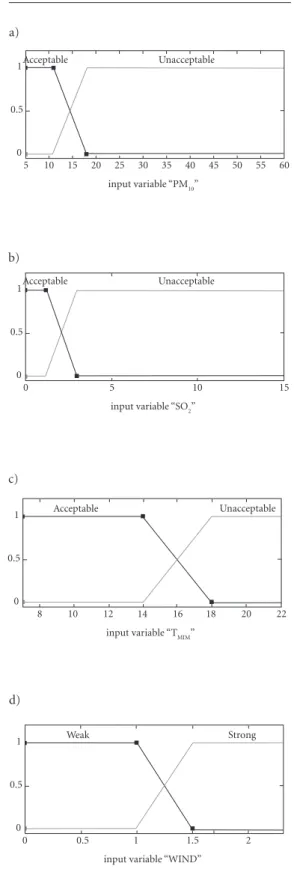
with minimum temperature and wind speed. The model was developed with the help of an expert who developed two membership func-tions, Acceptable and Unacceptable to the input
variables: particulate matter (PM10), sulfur
di-oxide (SO2), minimum temperature (TMIN) and
Weak and Strong to the input variables wind speed. The output was the mean time of hospital-ization, with six membership functions: very low, low, medium, medium high, and very high. The universes of discourse in which the contents of each variable were considered low or high were stipulated with basis on how harmful to health the element in question is.
On combining all possible inputs, each one with two pertinence functions, the construction of 16 rules was possible (2x2x2x2).
The fuzzy linguistic model procedure con-sists in calculating the degree of pertinence of the
values PM10, SO2, TMIN and wind speed. Then it is
performed the fuzzy inference process proposed by Mamdani; the number of hospitalizations is estimated by defuzzification technique based on the center area method, as described in a
previ-ous article17.
Through the routine using the MATLAB®
program, it is possible to generate a numerical output to the fuzzy model, therefore the mean hospitalization time was obtained from the input values of each variable. From these responses the hospitalization mean time obtained is compared to the real data hospitalizations, using a lag of zero up to two days.
For the evaluation of the results Pearson’s correlation was made and the accuracy was de-termined using the ROC curve.
Due to the fact that the data available were on the net and not identified the submission to the Ethics Committee on Research was dismissed.
Results
During this period 1119 hospitalizations were registered in the city of São José dos Campos due to cardiovascular disease diagnosis.
The input variables: particulate matter
(PM10), sulfur dioxide (SO2), minimum
tem-perature (TMIN) and wind, are shown in Fig-ure 1 (a-d). The output variable: hospitalization mean time due to cardiovascular diseases, with their respective membership functions, is shown in Figure 2.
Figure 1. Input variables: a) Particulate matter (PM10),
b) Sulfur dioxide (SO2) c) Minimum Temperature
(TMIN) and d) Wind for the fuzzy model to estimate the number of hospitalizations, São José dos Campos, 2009.
a)
Unacceptable Acceptable
5 10 15 20 25 30 35 40 45 50 55 60
0 0.5 1
input variable “PM10”
b)
Unacceptable Acceptable
0 5 10 15
0 0.5 1
input variable “SO2”
c)
Unacceptable Acceptable
8 10 12 14 16 18 20 22
0 0.5 1
input variable “TMIM”
d)
Strong Weak
0 0.5 1 1.5 2
0 0.5 1
C
ou
tinho KMV
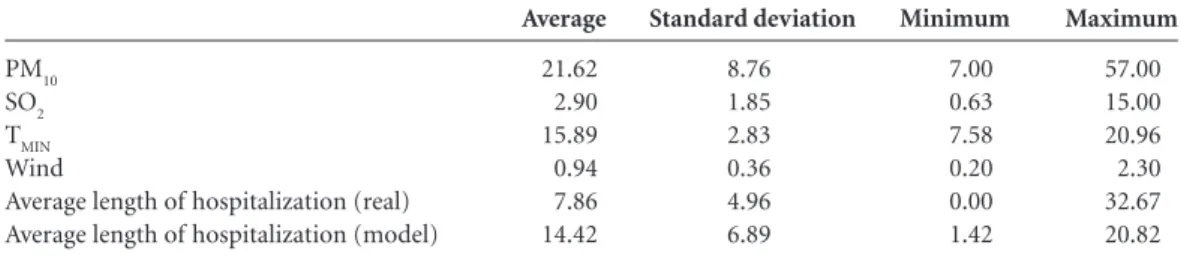
Mean values, standard deviations, minimum and maximum values of variables particulate
matter (PM10), sulfur dioxide (SO2), minimum
temperature, wind speed and mean time of hos-pitalization are shown in Table 1.
The results provided by the ROC curve are shown in Table 2. The best result was for the lag
zero, PM10 and SO2 showed best performance by
the ROC curve, with statistically significant val-ues.
The Pearson correlation between the results provided by the fuzzy model and the real data was 0.22 (p < 0.01) to lag 0, 0.15 to lag 1 and 0.23 to lag 2, although not being high values, they are significant.
Discussion
As far as is known, this is the first study conduct-ed in Brazil involving the effect of exposure to air pollutants on the hospitalization mean time due to cardiovascular disease using fuzzy logic tool.
This study deals with the construction of a computer model with fuzzy approach to estimate the hospitalization mean time due to cardiovas-cular disease related to air pollutants in an indus-trial medium-sized city, showing good accuracy to predict the hospitalization mean time when exposure occurred on the same day, even on day up until two days later.
Studies on air pollution impacts on human health usually make use of tools such as logis-tic regression and Poisson, where the patients
Figure 2. Output variable: mean hospital stay for heart disease, São José dos Campos, 2009.
VL: Very Low. L: Low. M: Medium. MH: Medium High. H: High. VH: Very High.
output variable “Lenght of hospitalization” 30 0
0.5 1
25 20 15 10 5 0 VL
L M MH H VH
length of hospitalization is generally not consid-ered; nevertheless, this constitutes a variable of extreme importance due to the fact that it rep-resents the actual cost to society.
In relation these models, the fuzzy approach has the advantage of dealing with the uncertainty of information, which imposes larger flexibility and adjustment to the model.
Large particles of particulate matter (diam-eter> 10 microns) are mainly soil derived ele-ments, while smaller particles (diameter <10 mi-crons) are usually derive from fossil fuels burn-ing and are dangerous when inhaled because it
can achieve more distal portinons of lungs1.
Typical concentrations of PM10, found in North America and Western Europe, are in the
20-50 µg/m3 range, and in industrialized areas
this range increases to 100 to 250 µg/m38.
According to Cetesb data basis, the arithmetic average of the annual average PM10 concentra-tion of the last three years lies in the range of 20
µg/m3 to 30 µg/m3, while for SO2, it is below 20
µg/m321,23.
In this study period, only one day was consid-ered to have moderate air quality for PM10 and no change on any of the days in the period
con-sidered. Considering SO2, there was no change21.
In a previous study conducted in São José dos
Campos24 average concentrations were recorded
as 40.2 µg/m3 for PM10 and 6.2 mg/m3 for SO2,
which shows a decrease of significant concentra-tions of around 50 %.
As in epidemiological studies it is common to consider the pollutants harmful effects a few days after its inhalation, a correlation was made for different time lags (from zero to two days).
The data model obtained by the ROC curve
(Table 2) showed excellent sensitivity, PM10 and
SO2 obtained good performance for zero lag,
what enables the conclusion that the effects of these pollutants become more evident on the day their inhalation happens. The bests result was for
SO2 pollutant at zero lag, with great accuracy and
area under of an 87.2% curve.
Due to lack of studies in this area using fuzzy modeling, the making of comparisons is com-promised as to a more precise conclusion, nev-ertheless, there are in Portuguese articles with fuzzy applications on: estimate of hospitalization
duration due to pneumonia2, due to asthma and
pneumonia4, establishment of neonatal death17,18
and prediction of neonatal resuscitation20.
aúd
e C
ole
tiv
a,
20(8):2585-2590,
2015
trapezoidal ones. The pollutant concentrations are considered homogeneous to implement this approach, what can be considered a limitation, since concentrations in other regions of the same city may differ from those recorded close to the monitoring station.
The best correlations were obtained for zero lag (0.22) and for the two-day lag (0.23), which shows that the hospitalization period is related to exposure to air pollutants. Thus, the higher the
PM10 and SO2 concentrations in the atmosphere,
the longer hospitalization period of patients with cardiovascular disease is expected.
The real data of hospitalization average pe-riod ranged from zero to 32.67 days and those obtained by the fuzzy model ranged from 1.42 to 20.82 days. The difference between the minimum and maximum values is due to the calculation method of the fuzzy inference system, where the final result is obtained by the area center calcu-lation, therefore it would be mathematically im-possible to obtain the area center near the dis-course universe extremes of each variable.
Possible misdiagnosis, due to obtaining sources of data whose purpose is not just statis-tical and epidemiological, and although inherent to the model, they may influence the final results. Non-discrimination of admissions, according to
gender, can be another limitation of the study25.
The model developed can be implemented efficiently in public health systems and can be applied in any locations where available data of pollutants and climatic conditions exist.
This study presents a tool of low financial cost, which can satisfactorily predict, the du-ration of hospitalization due to cardiovascular disease as a result of climatic variations and con-centrations of pollutants in the atmosphere, as-suming a role of significant importance so that medical staffs and hospitals can be prepared for a faster and effective service.
Maximum
57.00 15.00 20.96 2.30 32.67 20.82
PM10
SO2
TMIN
Wind
Average length of hospitalization (real) Average length of hospitalization (model)
Table 1. Mean values, standard deviation, minimum and maximum of the variables: particulate matter (PM10),
sulfur dioxide (SO2), minimum temperature (TMIN) and wind, according to type of output mean time of
hospitalizations, São José dos Campos-2009.
Standard deviation
8.76 1.85 2.83 0.36 4.96 6.89
Average
21.62 2.90 15.89 0.94 7.86 14.42
Minimum
7.00 0.63 7.58 0.20 0.00 1.42
PM10
SO2
Table 2. Values for ROC curve and 95% confidence intervals
to 0 lag, lag 1 and lag 2 of PM10 and SO2 pollutants, São José
dos Campos, 2009.
Lag 0
0,70 (0,61-0,77) 0,87 (0,83-0,93)
Lag 1
0,61 (0,54-0,67) 0,71 (0,64-0,77)
Lag 2
0,57 (0,50-0,67) 0,69 (0,63-0,77)
Collaborations
KMV Coutinho, PMSR Rizol, LFC Nascimen-to and APP Medeiros participated equally of all stages of the article preparation.
Acknowledgement
C
ou
tinho KMV
Sellitto MA. Inteligência Artificial: uma aplicação em uma indústria de processo contínuo. Gest Prod 2002; 9(3):363-376.
Lima MMP, Murari CAF, Pereira MA. Uma nova me-todologia para fluxos de carga fuzzy. Sba: Controle & Automação Sociedade Brasileira de Automatica 2003; 14(1):69-75.
Botura CA, Botura Junior G, Carvalho Jr JA, Mesquita L, Ferreira M A. Simulation of Active Control Using Fuzzy Logic Applied to a Pulse Combustor. Journal of the Brazilian Society of Mechanical Sciences 2002; 24(2):134-138.
Nascimento LFC, Rizol PMSR, Abiuzi LB. Establishing the risk of neonatal mortality using a fuzzy predictive model. Cad Saude Publica 2009; 25(9):2043-2052. Nascimento LFC, Ortega NRS. Fuzzy linguistic model for evaluating the risk of neonatal death. Rev Saude Pu-blica 2002; 36(6):686-692.
Zadeh LA. The concept of a linguistic variable and its application to approximate reasoning – I. Information Sciences 1975; 8(3):199-249.
Reis MAM, Ortega NRS, Silveira PSP. Fuzzy expert sys-tem in the prediction of neonatal resuscitation. Braz J Med Biol Res 2004; 37(5):755-764.
São Paulo. Companhia Ambiental do Estado de São Paulo (CETESB). Qualidade do ar no estado de São Paulo, 2012. [acessado 2014 set 30]. Disponível em: http://www.cetesb.sp.gov.br
São José dos Campos. Prefeitura Municipal. Portal Oficial. [acessado 2014 set 28]. Disponível em: http:// www.sjc.sp.gov.br
São Paulo. Decreto Nº 59.113, de 23 de Abril de 2013. Diário Oficial do Estado de São Paulo 2013; 24 abr. Nascimento LFC, Pereira LAA, Braga ALF, Módolo MCC, Carvalho Jr JA. Effects of air pollution on chil-dren’s health in a city in Southeastern Brazil. Rev Saude Publica 2006; 40(1):77-82.
Clougherty JE. A growing role for gender analysis in air pollution epidemiology. Cien Saude Colet 2011; 16(4):2221-2238.
Article submitted 27/11/2014 Approved 27/04/2015
Final version submitted 29/04/2015 14.
15.
16.
17.
18.
19.
20.
21.
22.
23. 24.
25. References
Cançado JED, Braga ALL, Pereira LAA, Arbex MA, Saldiva PHN, Santos UP. Repercussões clínicas da ex-posição à poluição atmosférica. J Bras Pneumol 2006; 32(Supl. 1):S5-S11.
Nascimento LFC, Rizol PMSR, Peneluppi AP. Estima-ting the average length of hospitalization due to pneu-monia: a fuzzy approach. Braz J Med Biol Res 2014; 47(11):977-981.
Braga ALF, Pereira LAA, Procópio M, André P, Saldiva PHN. Associação entre poluição atmosférica e doenças respiratórias e cardiovasculares na cidade de Itabira, Minas Gerais, Brasil. Cad Saude Publica 2007; 23(Supl. 4):S570-S578.
Chaves LE. Modelos computacionais Fuzzy e Neuro-fu-zzy para avaliarem os efeitos da poluição do ar [tese]. Guaratinguetá: Universidade Estadual Paulista; 2013. Cesar ACG, Nascimento LFC, Carvalho Jr JA. Associa-tion between exposure to particulate matter and hospi-tal admissions for respiratory disease in children. Rev Saude Publica 2013; 47(6):1209-1212.
Gouveia N, Freitas C, Martins LC, Marcílio IO. Hos-pitalizações por causas respiratórias e cardiovascu-lares associadas à contaminação atmosférica no mu-nicípio de São Paulo, Brasil. Cad Saude Publica 2006; 22(12):2669-2677.
Nascimento LFC, Francisco JB. Particulate matter and hospital admission due to arterial hypertension in a medium-sized Brazilian city. Cad Saude Publica 2013; 29(8):1565-1571.
Mills NL, Donaldson K, Hadoke PW, Boon NA, Mac-Nee W, Cassee FR, Sandström T, Blomberg A, Newby DE. Adverse cardiovascular effects of air pollution.
Nature Clinical Practice Cardiovascular Medicine2009;
6(1):36-44.
Martins LC, Pereira LA, Lin CA, Santos UP, Prioli G, Luiz OC. The effects of air pollution on cardiovascu-lar diseases: lag structures. Rev Saude Publica 2006; 40(4):677-683.
Nascimento LFC. Air pollution and cardiovascular hos-pital admissions in a medium-sized city in São Paulo State, Brazil. Braz J Med Biol Res 2011; 44(7):720-724. Brasil.Ministério da Saúde (MS). Portal da Saúde SUS. [acessado 2014 out 17].Disponível em: http://www2. datasus.gov.br/Datasus/index.php
Amancio CT, Nascimento LFC. Environmental pollu-tion and deaths due to stroke in a city with low levels of air pollution: ecological time series study. São Paulo Med J 2014; 132(6):353-358.
Yen J, Langari R. Fuzzy logic: intelligence, control and information. Upper Saddle River: Prentice-Hall; 1999. 1.
2.
3.
4.
5.
6.
7.
8.
9.
10.
11.
12.