AR
TICLE
1 Hospital Federal dos Servidores do Estado do Rio de Janeiro. R. Sacadura Cabral 178, Saúde. 20221-903 Rio de Janeiro RJ Brasil. [email protected] 2 Instituto Fernandes Figueira, Fiocruz.
Health team: negotiations and limits of autonomy,
belonging and the acknowledgement of others
Abstract The scope of this paper was to establish the significance of teamwork within the complex interaction in a Neonatal Unit. The techniques used for data collection were document analysis, participant observation and interviews. Twen-ty-four professionals working in a public and highly complex Neonatal Unit in the city of Rio de Janeiro were interviewed. The data were ana-lyzed using the thematic approach of the content analysis technique, based on the literature on hu-manization, health work processes, teamwork and ergology. The conclusion drawn is that even in the neonatal environment, the construction of team-work is established when the care model is geared to the logic responding to the health needs of indi-viduals, taking into consideration the babies and their families, encompassing negotiations, limits of autonomy and notions of belonging and the recognition of others.
Key words Humanization of care, Teamwork,
Neonatal Unit
Elaine Menezes da Silva 1
S
il
v
a EM,
M
o
Introduction
Several authors address the topic of health care 1-12. Other authors focus on understanding how this type of work characterizes or not as inte-grated teams3,4,6-10,13. The National Humanization Policy (NHP) emphasizes as transversal themes for the discussion of team building13: participa-tive management, welcoming, autonomy, bond and co-responsibility5,14-18.
It is essential to expand the discussion on the possibilities and difficulties to build integration of competences in the basis of healthcare team-work. Santos-Filho19 points as common problems in the healthcare environment: degeneration of bonds, lack of workers’ rights, poor working con-ditions, organization and social work relations in compliance with traditional management. Asso-ciating such considerations to Schwartz’s20 ergo-logical approach, it can be considered that a team is organized beyond the sum of individuals and accomplishment of rules. The author emphasizes that from the activity, it is possible to consider prevention, management and competence in or-ganizational settings that work with hierarchy, authoritarianism, imposition and the maximum possible normalization.
Organizational related issues are linked to in-terpersonal aspects here defined by the symbolic component of power, autonomy and recognition and belonging processes that arise in the every-day experience of multi-professional teamwork. The multidisciplinarity of the health area is si-multaneously a concrete and essential reality, and implicates challenges in the transition of a group/grouping composition for interaction, in-tegration and common project8 that would char-acterize “being a team, being in a team, feeling a team”, objective-image of the interdisciplinary project. This consideration on the construction of a common project, which in this article will address a very early life cycle that triggers differ-entiated feelings, leads us to what Schwartz20,21 denominates as measurable values, field of ap-propriation of norms, spaces, worker protocols, which produce competent performance. In other words, each situation places the worker in discus-sion with his own choices, with the product of his work in relation to other workers with whom he did not choose to work with; thus, leading him to face many unpredicted circumstances.
Working in the health area has some pecu-liarities that result from the work progress pro-cess (es) which implicates the establishment of direct relations between subjects involved in
the health-disease process6,22, which leads to the possible dialog between measurable and immea-surable values established due to the subjective conditions of the involved subjects23. We refer to measurable values, those related to the field of ethics and its choices, emotions, values – of the interpersonal universe. This universe supervenes and at the same time constitutes action in health, dialoging with the designated measurable values, which refer to formal aspects of work: norms, rules, schedules, standardized and previously agreed actions23, producing unpredictability in the performance and outcomes.
In the present article, result of a broader re-search study24, we studied teamwork in a neonatal unit (NU). Such setting is based on healthcare pro-vision to newborn babies, considering the fact that baby and family live with the challenges of pre-maturity and birth support needs. These themes outline a space where the professional needs to ac-tivate several types of knowledge, feelings and cope with them, at the same time that they need to take care of the newborn baby and family.
We analyzed the meaning of team work con-cerning negotiations, limits of autonomy, and notions of belonging and recognition of other – values present in teamwork building according to the NHP.
Methods
A qualitative case study25 was carried out in the NU of a public hospital, in the city of Rio de Ja-neiro (RJ, Brazil). The criteria for the unit choice were: recent multiprofessional team composi-tion; rota among those who work in the Inten-sive Care Unit (ICU) and Intermediate care Unit (IU); interaction between permanent and tem-porary workers, newly arrived workers and those near retirement; and existence of professionals linked with other services. Neonatal care pro-vided to low-, middle- and high-risk newborn babies, holds several complexity levels, including ICU, IU and rooming-in.
aúd e C ole tiv a, 20(10):3033-3042, 2015
The field work (including observation and interviews) occurred between May and Septem-ber of 2009. Field approach occurred through participant observation. This technique served two purposes: 1. to build a feeling of strangeness or a differentiated position due to the fact that the investigator had a history as a professional with the field team, then data was produced from a routine, which was observed in days, times and activities when the investigator was not necessar-ily involved; 2. the previous phase contributed to the choice of interviewees and the contact with them, through identification of their meeting and organization routines. The fact that the in-vestigator acted in that environment contributed so that the presence of an investigator was not initially noticed in the field. Participant obser-vation worked as a strategy so that the environ-ment, which seemed very familiar as work place as a social worker, was target of strangeness, nui-sances, doubts regarding belonging. It served as an approaching and exclusion strategy, training the research look by observing the familiar25,26.
The semi-structured interviews occurred at reserved places in the hospital setting, according to subjects’ availability and choice, following pre-vious reading of the free and informed consent form. We respected anonymity, by nominating the subjects as “interviewee” plus the interview number.
Data were analyzed according to the adjusted thematic form of the content analysis technique25, assuming the theoretical and empirical satura-tion model of Fontanella et al.27. Data were inter-preted from Yves Schwartz’s ergology approach. The author contributes with the discussion on concrete work for identification of the meanings of teamwork in everyday experiences14,19,28. The interpretation of data evaluated the symbolic aspects that permeate and constitute the optics of professionals on teamwork building. We cre-ated two thematic cores: 1. team belonging and team perception: temporal and spatial presence; 2. dialog, conflict and negotiation: team meeting. This study was approved by the Research Ethics Committee.
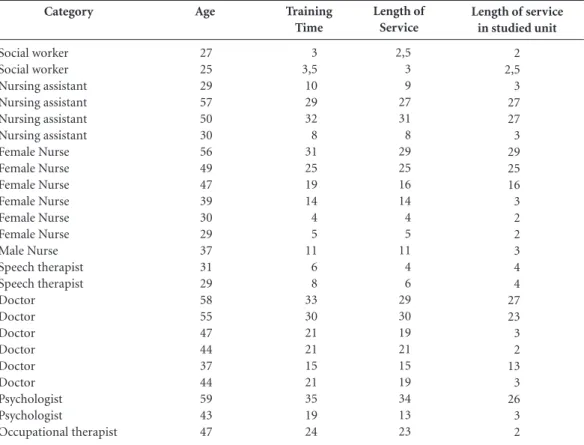
Length of service in studied unit
2 2,5 3 27 27 3 29 25 16 3 2 2 3 4 4 27 23 3 2 13 3 26 3 2 Category Social worker Social worker Nursing assistant Nursing assistant Nursing assistant Nursing assistant Female Nurse Female Nurse Female Nurse Female Nurse Female Nurse Female Nurse Male Nurse Speech therapist Speech therapist Doctor Doctor Doctor Doctor Doctor Doctor Psychologist Psychologist Occupational therapist Age 27 25 29 57 50 30 56 49 47 39 30 29 37 31 29 58 55 47 44 37 44 59 43 47
Table 1. Profile of professionals interviewed in years.
S
il
v
a EM,
M
o
Results and discussion
Team belonging and team perception: temporal and spatial presence
According to the ergological approach, the simplest task involves the production of senses revealed by who performs it6. The interviewees consider as part of the NU team only profession-als who they see, or those who remain longer in the NU.
It is essential to justify and recognize who is or not part of the team by “being seen”, which means to frequently be in the same space where nurs-es and doctors habitually are. All work requirnurs-es collectivity, a set of workers who may or may not form “collective work”, which involves individu-al and collective decision-taking3. Louzada et al.6 report that the collective dimension of teamwork
is not apparent, and becomes more difficult to be
identified when professionals do not know who the actors that form this community are.
Teamwork in the health field can rational-ize assistance and integrate disciplines and pro-fessions with sights to primary healthcare9. But how can one act collectively if professionals who structure the NU space are not defined? Who are they? What are their functions? Where are they?
The neonatal intensive care team29 has its basic structure formed by professionals with direct contact with the baby. The interviewed professionals use a similar logic, they consider the categories that spend more time in the NU as those who effectively comprise the team. This perspective leads to the construction of common values that are produced from action focused on the core-activity8, which is baby care. The closest to the place where the baby is, the most positive-ly the recognition of that professional occurs in the group, increasing the possibilities of building positive recognition relations which may lead to teamwork.
In answers on team composition, expressions such as “in there”, “present” and “shows up more” allowed an analysis that explores time and space presence as work group delineation coefficients. What registers the identity of a possible team is the possibility of being in the space where babies are, which is the purpose of the neonatal care. The space reference does not disregard the attri-bution of value to those that effectively occupy and participate in the unit on a daily basis.
Expressions that indicate that problem solu-tion depends on a spontaneous decision and/ or on “good will”, naturalizing “natural” and/or
“personal” attributes to motivate a movement of change, demonstrate poor reflection about col-lective processes.
[...] Sometimes, they are solved by themselves
[the problems] and sometimes someone gets tired of seeing the problem dragging on and literally runs
after to solve it. (Interviewee 5)
We try to do it our way. We almost always get it.
With good will, right? (Interviewee 6)
Personal will produces mobilization when the search for the other occurs, but personalist inter-pretation empties the negotiation skill, clash and conflict, traits that are part of collective actions, of generation of formal channels for problem solv-ing and referral. A priori, material adjustments are easily solved when performing is defined as cooperation. In order for work to occur as team-work, besides the good environment20, a sense of collaboration among professionals is considered, with mutual help relations. In the development of work, the professional creates strategies to deal with situations that come up, in other words, “they use themselves”, revealing a peculiar intelli-gence to all human work20. When the professional considers that he pertains to the work setting and a complication appears, he searches for possible strategies using scientific-technical knowledge to solve the question, and tries to detect in the pe-culiarity of the situation characteristics that help solve the problem, making efforts to relate with the other attempting a positive outcome21.
In the present study, only medical and nurs-ing professionals work directly in the NU; there-fore, their space is more obvious. Professionals of other categories work in different services, having to divide the workload and perform the routine in the UN in harmony with other sectors. Accumulation of different placements requires changes of schedules, causing physical absences, mismatches; thus reducing routines and people meeting each other. These factors reduce meet-ings, permanence, interactions and, consequent-ly, weaken cooperation, which is the basis for col-lective and teamwork21.
The construction of professional authority and recognition may take place during meetings, where technical capital is accessed on behalf of benefits and acquisition of information about patrons, but in our study, the significance of pro-fessional recognition follows permanence in the space.
They tend to stay in their own departments. People do not pass by each other here. People have some kind of resistance dealing with those who are
aúd
e C
ole
tiv
a,
20(10):3033-3042,
2015
[...] the nurse was like the housekeeper, a very big responsibility, and it seemed that if she did not
do her work well, the house would fall apart.
(In-terviewee 11)
Sometimes it is stressful for them to understand
what our attributions are [...] we depend on other
actors. (Interviewee 17)
The expressions about professional occu-pation and visibility in the work space activate qualifiers that compare professional activities with those of a housekeeper, contrasting with ar-guments that claim the recognition of the work process of other categories that perform activities that are not limited to physical presence. There is a resistance in valuing professional labor that does not perform directly with the baby, manipulating, examining. It suits to professionals, who structure their work processes beyond physical contact, to establish occupation strategies that allow recog-nition and expression of technical knowledge that expand the biomedical perspective.
The process of care leads to real collective which differs from prescribed collective, since the meeting between subjects is always singular. Thus, it is possible to reaffirm that micro-re
ar-rangements of collective occur in the staff 30.
Division of the unit in sectors and profes-sionals placed in other services impair contact between them. This is expressed by the lack of understanding about the function of the oth-er, by the stressful relation between those who, within the short time spent together, make ef-forts to obtain recognition as professionals of the sector. Professionals who are part of the nursing team were submitted to a rotation agreement in the NU, which was composed by three subunits (ICU, IU or rooming-in). Each one in the group had a general placement in the unit and, depend-ing on the day, was designated to work in one of the three subunits. The professional was submit-ted to constant change and to more significant unpredictability than other categories.
In work settings, the professional must be able to be permeated by the “dimension of meet-ing of meetmeet-ings” 21. However, they not always oc-cur:
It is, very fragmented. Completely cut out. I do not see sewing. The baby is there, so there are
completely different looks [...]. The little baby is
like an object, each one looks, gives their opinion.
[...] This is the routine. It is something that [seems to be] upside down, something that everyone does, it’s either in the handbook, or it is in a procedure, that what it is like. My look at them is like this, a look
down. (Interviewee 8)
The evaluations about fragmentation, non- integration or even about cohesion in the work routine are highlighted in reflections about poor team ability to direct the look toward meeting, both with the user and the co-worker. The di-mension of meeting is based on leading toward the other which is not restricted to task instru-mentality: check and write evolution in hand-book, examine baby and perform a procedure. This look down makes the world to be positioned
upside down, according to individual domain
logic poorly focused on alterity.
Integration between teams31 requires invest-ment, which is related to the field of immea-surable values, dialog between competences and ability to understand autonomy as relation between professional knowledge. Autonomy in choosing the best practice, the most appropriate technique, the limits of one’s actions in view of the user’s necessities.
Dialog, conflict and negotiation: team meeting
The performed routine is adjusted and re-built on a daily basis. There is an effort in plan-ning actions, establishing specific procedures, in advance and continuously. Such an effort is re-lated to what Merhy7 assigns as the “light-hard” dimension of healthcare work: standards, proto-cols, routines. This dimension of instrumentality and rational preparation would work by mediat-ing processes and would lead to a previous con-sensus in work management relation.
The testimonies demonstrate that the dimen-sion of work management, routine organization is not limited to leadership. However, its “micro-management” or daily processes management needs to dialog with greater processes, which are not always accessible to all, at times not social-ized in collective building. And it is in the axis of light technologies7 that negotiation processes, art of dialog, achievement for adhesion to technical processes and protocols are situated. In this axis we identify the greatest dilemmas of teamwork building.
S
il
v
a EM,
M
o
is difficult to meet with staff members to define what will be done.
Meeting and communication are even more difficult between IU and ICU doctors, and these with neonatologists in charge of service in the rooming-in. The NU of the studied hospital has many settings32, which result in three differentiat-ed spaces for service: rooming-in, neonatal ICU and neonatal IU:
There is another group also responsible for the intermediate nursery, which is another unit, not the neonatal ICU, and another group also
respon-sible for the rooming-in. (Interviewee 4)
The medical staff ends up being divided into three distinguished teams that communicate very poorly. The agreements created for organization of the work routine become fragile in view of the force of logic and apprenticeship of a
profession-al ethos where individual decision prevails. The
autonomy of these professionals, in some cases, reveals a fragmentation of actions, which are con-verted into obstacles in assisting the health needs of hospitalized babies. Too much value is attribut-ed to the negotiation power that doctors have in the hospital organization as they are the only ones who can take pacients33. The current debate on professional training in the health area of the Pub-lic Brazilian Health System (SUS) points to the re-view of doctor hegemony and to interdisciplinary practices as a way of improving healthcare quality and entirety30,34,35. There is motivation towards the transformation of higher education aiming at eq-uity and quality of assistance to recover the
essen-tial dimension of care: interpersonal relationships32.
The problems that arise in day-to-day life make professionals recreate their working prac-tice. Taking the baby as the focus of action, dialog is demonstrated as the best form of resolution of situations.
You have to listen and see what your responsi-bility is there … Finally, you have to listen and try
to solve, promote dialog. (Interviewee 2)
It is ideal to talk about them, but it is not al-ways possible, and I think that talking is the best
way of deciding. (Interviewee 19)
Besides the ICU and IU, the multiprofession-al NU team does not usumultiprofession-ally use other spaces for communication. Only some professionals, main-ly those of the nursing team, interact in different moments in the lunchroom, which is used by doctors and nurses. However, even in this space, interaction occurs in a very limited group, since there is rotation to leave the NU. Thus, the mo-ment they are acting in the unit is privileged for professional communication:
The space I see there is the space which I stay in, it is the space of my schedule and it is when the professionals are there, and in this space people
ex-change information. (Interviewee 14)
I think it occurs in the natural course of
assis-tance, there isn’t a moment. (Interviewee 23)
Communication between professionals from different categories generally occurs according to the situations that come up each day. Sá36 pres-ents hospitals as services in which the “ethics of communication” and “recognition of other” is already naturally fragile. Thus, the perception of the suffering of babies and their relatives creates distress in the professionals, allowing identifica-tion with them and mobilizaidentifica-tion around a com-mon purpose. Cases that escape the protocols require meeting/dialog in the team.
At the same time that the multiprofessional characteristic of healthcare work can be influence for interdisciplinary construction, it can contrib-ute to fragmented team actions that do not guar-antee that assistance needs are fully met30.
References to feeling alone in decision-mak-ing moments, to the need of consultdecision-mak-ing those from other categories, appear along with team qualification as small nucleuses of same-cate-gory professionals: social service, ICU doctors, IU doctors, nursing of certain night or daytime shifts. Although the existence of multiprofession-al teams in hospitmultiprofession-al units is multiprofession-already a common reality, their presence does not necessarily bring interdisciplinary work. Vasconcelos37 differenti-ates multiprofessionality from interdisciplinarity, indicating that, in the first, professional perfor-mance is isolated and without cooperation. In the second, professional (and power) relations are more horizontal, existing reciprocity between different disciplines, acknowledgement of a
com-mon problematics, with a greater degree of
coop-eration and value of knowledge. In our study, we observed a multiprofessional team which some-times, from a common problematics, created in-terdisciplinary actions.
Miranda et al.38 demonstrate that interaction among professionals depends on the recognition of different points of view and on their legitima-cy, able to evidence the needs of professionals to know their discursive, technical, epistemological and value specificities.
aúd
e C
ole
tiv
a,
20(10):3033-3042,
2015
in his totality, requiring a review in the practice of health professional training, taking entirety as one of the fundamental principles39,40.
In the professional training process, the focus is on the specificities of each profession, without demonstrating that practice in the health area is permeated by several work processes that arise, complement and can be cooperative and code-pendent. Such scenario makes the possibility of building interdisciplinarity even more distant and may cause discomfort to action that unfolds in professional interfaces daily, as well as to con-flicts derived from poor negotiation skill.
Cooperation is intertwined with collective work achievement, because this work is a result of the fusion between professional life and sub-jective courses of each subject21. Thus, Schwartz21 demonstrates the work situation as something structured in what is programmed, but that leads to unpredictable happenings and to the choices made by each one.
Communication implicates the use of princi-ples and values that are updated with the devel-opment of health practices, being this re-signifi-cation performed according to individual choice6. Cases that produce greater professional mobiliza-tion allow for meeting and dialog moments.
For Peduzzi9, communication is the main fac-tor for teamwork establishment, with the purpose of integrating practices and technical knowledge and interaction between different categories, each with their own purposes, knowledge and tools, to assist a particular subject8,22.
Work as self-use 20, of one’s abilities to per-form activities, may be use “by oneself ”, and also “for others”, if the work space is recognized as ne-gotiation space. Isolated work impacts on the dis-continuity of actions and creates weaknesses. The traditional organizational structure of health ser-vices reinforces professional isolation and repro-duces the fragmentation of work processes41, of-fering no motivation for exchange of opinions to occur among professionals of the same category, or among those of different categories.
Recognizing the importance of other profes-sionals reinforces the notion of team belonging. On the other hand, the absence of legitimation of non-medical professionals fragmentizes and impairs collective action, where rejection of these professionals as partners may occur in the health production space3. It is important that profes-sional performance occurs within the limits of respect to specificities and responsibilities of each other3, which may vary according to the so-cial, economic and political context.
Relational aspects, pointed out by the inter-viewees, are already recognized by the literature on teamwork: work together, recognition of oth-er, professionals with common purposes, respon-sibility, commitment, dialog, solidarity, cooper-ation7,8,10,21. We add that in these relations there may be the exchange of symbolic goods which outlines the social bond42.
The accomplishment of work in services requires a relative autonomy due to the unpre-dictability that involves meeting with the other33. Therefore, all health professionals reveal “reason-able autonomy” to perform a synthesis between the norms and the particular cases that occur on a daily basis.
Recognizing the importance of performance and technical autonomy of professionals from different categories becomes crucial, so that each one can assume their responsibility, making care more efficient, while understanding this autono-my not as independence, but as relationship in a dependence management network that guaran-tees our existence43,44.
The understanding that there is a difference between “being with” and “working with” or “through teams”43 can be one of the axes that derive from the perspectives presented by the interviewees. In informal meetings that happen in the work space it is possible to recognize signs of teamwork, with discussions that allow meet-ing and dialogs that favor not only work, but the easing of relations. Decisions can occur when the environment manages to associate work and pleasure. There is an idealization of “team” or “through team” work as something unachievable, very formal, but with rules that are certainly un-derstood and operated by all.
Conclusion
Professional training does not prepare individu-als to deal with the relational aspects that trigger meetings and teamwork. Awareness of the func-tion defined by training may lead to specializa-tion, which is also among the factors that make service fragmented when associated with pro-fessional sectorization, hospital architecture and subordination of professionals to hierarchy of specialties; thus compromising teamwork build-ing, and consequently, the quality of the assis-tance provided.
S
il
v
a EM,
M
o
collective work, but feelings of commitment, sol-idarity, responsibility and experience which are values that are not assumed a priori, but that are revealed in interpersonal relationships.
Although it is necessary to re-formulate pro-fessional training, focusing on learning the in-tegration between disciplines, this change alone does not guarantee the necessary conditions for integrated work. Health care is marked by unpre-dictability, due to the impossibility of defining with whom each professional will interact and who will be part of the team.
Teamwork does not come down to a set of professions, in other words, to multiprofessional-ity. The following are indicators for identification of an interdisciplinary team: recognition of oth-er, dialogued meeting, cooperation, appreciation of the technical knowledge of other, more hor-izontal and less stressful relations, and cohesive work around a common object.
An important indicator for team delineation concerns time and space presence, where
iden-tification with the service is associated with the sense of group belonging.
Collective work requires individual commit-ment, considering the work environment as his environment, since this produces greater mobi-lization of individual technical and interactional skills for problem solving. In everyday life several teams are formed: one by identification, from the corporation itself; another one by duty; and one also by direct identity regarding permanence and belonging to the NU environment.
In neonatal care, besides high technological skill and specialization required, the profile of the target-population is put into action in this seg-ment: newborn babies who depend exclusively on the translation of their needs, and their wor-ried relatives, all a priori at an unknown place.
aúd
e C
ole
tiv
a,
20(10):3033-3042,
2015
References
Barros MEB, Mori ME, Bastos SS. O desafio da huma-nização dos/nos processos de trabalho em saúde: O dis-positivo “Programa de Formação em Saúde e Trabalho/ PFST”. In: Santos-Filho SB, Barros MEB, organizado-res. Trabalhador da Saúde: muito prazer!Protagonismo
dos trabalhadores na gestão do trabalho em saúde. Ijuí:
Ed. Unijuí; 2007. p. 99-121.
Barros RB, Barros MEB. Da dor ao prazer no traba-lho. In: Santos-Filho SB, Barros, MEB, organizadores.
Trabalhador da Saúde: muito prazer!Protagonismo dos
trabalhadores na gestão do trabalho em saúde. Ijuí: Ed.
Unijuí; 2007. p. 61-71.
Bonaldi C, Gomes RS, Louzada APF, Pinheiro R. O tra-balho em equipe como dispositivo de integralidade: ex-periências cotidianas em quatro localidades brasileiras. In: Pinheiro R, Mattos RA, Barros MEB, organizadores.
Trabalho em equipe sob o eixo da integralidade:valores,
saberes e práticas. Rio de Janeiro: IMS/UERJ, Cepesc,
Abrasco; 2007. p. 53-72.
Bonet O. A Equipe de Saúde como um Sistema Ciber-nético. In: Pinheiro R, Mattos RA, organizadores.
Cons-trução Social da demanda: direito à saúde, trabalho em
equipe, participação e espaços públicos. Rio de Janeiro: Cepesc, Abrasco; 2005. p. 117-128.
Lacaz FAC, Sato L. Humanização e qualidade do pro-cesso de trabalho em saúde. In: Deslandes SF, organi-zador. Humanização dos cuidados em saúde: conceitos, dilemas e práticas. Rio de Janeiro: Ed. Fiocruz; 2006. p. 109-139.
Louzada APF, Bonaldi C, Barros MEB. Integralidade e trabalho em equipe no campo da saúde: entre normas antecedentes e recentradas. In: Pinheiro R, Mattos RA, Barros MEB, organizadores. Trabalho em equipe sob o eixo da integralidade: valores, saberes e práticas. Rio de Janeiro: IMS, CEPESC, Abrasco; 2007. p. 37-52. Merhy EE. Um dos grandes desafios para os gestores do SUS: apostar em novos modos de fabricar os mo-delos de atenção. In: Merhy EE, Magalhães Júnior HM, Rimoli J, Franco TB, Bueno WS, organizadores. O tra-balho em saúde: olhando e experienciando o SUS no coti-diano. São Paulo: Ed. Hucitec; 2007. p. 15-35. Peduzzi M. Equipe multiprofissional de saúde: concei-to e tipologia. Rev Saude Publica 2001; 35(1):103-109. Peduzzi M. Trabalho em equipe de saúde no horizonte normativo da integralidade, do cuidado e da democra-tização das relações de trabalho. In: Pinheiro R, Mattos RA, Barros MEB, organizadores. Trabalho em Equipe
sob o Eixo da Integralidade. Rio de Janeiro: IMS,
CE-PESC, Abrasco; 2007. p. 161-177.
Pinho MCG. Trabalho em equipe de saúde: limites e possibilidades de atuação eficaz. Ciências & Cognição
2006; 8:68-87.
Rollo AA. É possível valorizar o trabalho na saúde num mundo “globalizado”? In: Santos-Filho SB, Barros MEB, organizadores. Trabalhador da Saúde: muito
pra-zer!Protagonismo dos trabalhadores na gestão do
traba-lho em saúde. Ijuí: Ed. Unijuí; 2007. p. 19-59. Vieira M, Chinelli F. Relação contemporânea entre tra-balho, qualificação e reconhecimento: repercussões so-bre os trabalhadores técnicos do SUS. Cien Saude Colet
2013; 18(6):1591-1600. 1.
2.
3.
4.
5.
6.
7.
8. 9.
10.
11.
12. Collaborations
S
il
v
a EM,
M
o
Brasil. Ministério da Saúde (MS). Secretaria-Executiva. Núcleo Técnico da Política Nacional de Humanização.
Humaniza SUS: Política Nacional de Humanização – a
humanização como eixo norteador das práticas de atenção e gestão em todas as instâncias do SUS. Brasília: MS; 2004. Benevides R, Passos E. Humanização na saúde: um novo modismo? Interface(Botucatu) 2005; 9(17):389-394.
Deslandes SF. Análise do discurso oficial sobre a huma-nização da assistência hospital. Cien Saude Colet 2004; 9(1):7-14.
Deslandes SF, Mitre RMA. Processo comunicativo e humanização em saúde. Interface(Botucatu) 2009; 13 (Supl. l):641-649.
Nogueira-Martins MCF. Humanização na Saúde. Re-vista Ser Médico 2002; 5(18):27-29.
Souza WS, Moreira MCN. A temática da humanização na saúde: alguns apontamentos para debate. Interface
(Botucatu) 2008; 12(25):327-338.
Santos-Filho SB. Um olhar sobre o trabalho em saúde nos marcos teórico-políticos da saúde do trabalhador e do humaniza SUS: o contexto do trabalho no cotidia-no dos serviços de saúde. In: Santos-Filho SB, Barros MEB, organizadores. Trabalhador da Saúde: muito pra-zer!Protagonismo dos trabalhadores na gestão do trabalho em saúde. Ijuí: Ed. Unijuí; 2007. p. 73-96.
Schwartz Y. Trabalho e uso de si. Pro-Posições 2000; 5(32):34-50.
Schwartz Y. Uso de si e competência. Texto anexo ao capítulo 7. In: Schwartz Y, Durrive L, organizadores.
Trabalho e Ergologia: conversas sobre a atividade huma-na. Niterói: Eduff; 2007.
Pinheiro R, Barros MEB, Mattos RA. Introdução. In: Pinheiro R, Mattos RA, Barros MEB, organizadores.
Trabalho em Equipe sob o Eixo da Integralidade. Rio de
Janeiro: IMS/UERJ, CEPESC, Abrasco; 2007. p. 9-17. Schwartz Y. Entrevista: Yves Schwartz. Trabalho,
Educa-ção e Saúde 2006; 4(2):457-466.
Silva EM. Construção do trabalho em equipe: um estudo
no âmbito da atenção neonatal [dissertação]. Rio de
Ja-neiro: Fundação Oswaldo Cruz; 2010.
Minayo MCS. O desafio do conhecimento: pesquisa qua-litativa em saúde. São Paulo: Hucitec; 2006.
Velho G. Observando o Familiar. In: Velho G. Indivi-dualismo e Cultura: Notas para uma Antropologia da
Sociedade Contemporânea. 2ª ed. Rio de Janeiro: Jorge
Zahar Editora; 1987. p. 121-132.
Fontanella BJB, Luchesi BM, Saidel MGB, Ricas J, Tu-rato ER, Melo DG. Amostragem em pesquisas qualita-tivas: proposta de procedimentos para constatar satu-ração teórica. Cad Saude Publica 2011; 27(2):388-394. Campos GWS. Apresentação. In: Santos-Filho SB, Bar-ros MEB, organizadores. Trabalhador da Saúde: muito
prazer!Protagonismo dos trabalhadores na gestão do
tra-balho em saúde. Ijuí: Ed. Unijuí; 2007. p. 11-15. Filho FL. A equipe da UTI neonatal. In: Moreira MEL, Braga NA, Morsch DS, organizadores. Quando a vida começa diferente: o bebê e sua família na UTI Neonatal. Rio de Janeiro: Editora Fiocruz; 2003. p. 107-116. Scherer MDA, Pires D, Schwartz Y. Trabalho coletivo: um desafio para a gestão em saúde. Rev Saude Publica
2009; 43(4):721-725.
Peduzzi M. Arranjos e dispositivos de cogestão: espaços coletivos, função coordenação equipe/serviço e apoio institucional. In: 2° Seminário Nacional de Humaniza-ção; 06 ago 2009; Brasília, Brasil.
13.
14.
15.
16.
17. 18.
19.
20. 21.
22.
23. 24.
25. 26.
27.
28.
29.
30.
31.
Pereira SMP, Cardoso A. Neonatologia além da UTIN.
As Experiências das Famílias com a Prematuridade –
Narrativas Clínicas. Rio de Janeiro: Editora Revinter;
2012.
Ribeiro JM, Schraiber LB. A autonomia e o trabalho em medicina. Cad Saude Publica 1994; 10(2):190-199. Brasil. Ministério da Saúde; Ministério da Educação. Portaria Interministerial n.º 2.101, de 3 de novembro de 2005. Institui o Programa Nacional de Reorientação da Formação Profissional em Saúde – Pró-Saúde – para os cursos de graduação em Medicina, Enfermagem e Odontologia. Diário Oficial da União 2005; 4 nov. Brasil. Ministério da Saúde (MS). Ministério da Educa-ção (MEC). Pró-saúde: Programa Nacional de
Reorien-tação da Formação Profissional em Saúde. Brasília:
Edi-tora do Ministério da Saúde; 2007. (Série C. Projetos, Programas e Relatórios).
Sá MC. A fraternidade em questão: um olhar psicos-sociológico sobre o cuidado e a “humanização” das práticas de saúde. Interface (Botucatu) 2009; 13(Supl. 1):651-664.
Vasconcelos EM. Serviço Social e interdisciplinaridade: o exemplo da saúde mental. Rev Serviço Social e Socie-dade 1997; 18(54):132-157.
Miranda L, Rivera FJU, Artmann E. Trabalho em equi-pe interdisciplinar de saúde como um espaço de reco-nhecimento: contribuições da teoria de Axel Honneth.
Physis 2012; 22(2):1563-1568.
Heckert ALC, Neves CEAB. Modos de formar e modos de intervir: quando a formação se faz potência de pro-dução do coletivo. In: Mattos RA, Barros MEB, Pinhei-ro R, organizadores. Trabalho em equipe sob o eixo da integralidade: valores, saberes e práticas. Rio de Janeiro: UERJ, Abrasco; 2007. Vol. 1. p. 145-160.
Machado MFAS, Monteiro EMLM, Queiroz DT, Vieira NFC, Barroso MGT. Integralidade, formação de saúde, educação em saúde e as propostas do SUS: uma revisão conceitual. Cien Saude Colet 2007; 12(2): 335-342. Campos GWS. Equipes de referência e apoio especiali-zado matricial: um ensaio sobre a reorganização do tra-balho em saúde. Cien Saude Colet 1999; 4(2):393-403. Martins PH. Contra a Desumanização da Medicina: crí-tica sociológica das prácrí-ticas médicas modernas. Petrópo-lis: Vozes; 2003.
Moreira MCN. Uma Cartografia dos Dispositivos Insti-tucionais de Humanização da Atenção à Saúde Infanto-Juvenil em Ambientes Hospitalares: um enfoque a partir do processo de trabalho e do associativismo em saúde
[relatório de pesquisa CNPQ]. Rio de Janeiro: Fiocruz; 2009.
Soares JCRS, Camargo Júnior KR. A autonomia do pa-ciente no processo terapêutico como valor para a saú-de. Interface (Botucatu) 2007; 11(21):65-78.
Article submitted 24/07/2014 Approved 28/05/2015
Final version submitted 30/05/2015 32.
33. 34.
35.
36.
37.
38.
39.
40.
41.
42.
43.