Brief intervention for agrammatism in
Primary Progressive Nonfluent Aphasia
A case report
Thais Helena Machado1, Aline Carvalho Campanha1, Paulo Caramelli1, Maria Teresa Carthery-Goulart2
ABSTRACT. The non-fluent and agrammatic variant of Primary Progressive Aphasia (NFPPA) is characterized by reduced verbal production with deficits in building grammatically correct sentences, involving dysfunctions in syntactic and morphological levels of language. There are a growing number of studies about non-pharmacological alternatives focusing on the rehabilitation of functional aspects or specific cognitive impairments of each variant of PPA. This study reports a short-term treatment administered to a patient with NFPPA focusing on the production of sentences. The patient had significant reduction in verbal fluency, use of keywords, phrasal and grammatical simplifying as well as anomia. Using the method of errorless learning, six sessions were structured to stimulate the formation of sentences in the present and past with the cloze technique. The patient had improvement restricted to the strategy, with 100% accuracy on the trained phrases and generalization to untrained similar syntactic structure after training. These results persisted one month after the treatment.
Key words: primary progressive aphasia, treatment, speech and language therapy, intervention, cognitive rehabilitation.
INTERVENÇÃO BREVE PARA AGRAMATISMO EM AFASIA PROGRESSIVA PRIMÁRIA NÃO FLUENTE: RELATO DE CASO
RESUMO. A variante não fluente e agramática da Afasia Progressiva Primária (APPNF) caracteriza-se por redução da produção verbal com falhas para construir sentenças gramaticalmente corretas, envolvendo disfunções nos níveis sintático e morfológico da linguagem. É crescente o número de pesquisas sobre alternativas não farmacológicas enfocando a reabilitação de aspectos funcionais ou comprometimentos cognitivos específicos de cada variante das APP. Relatar um tratamento de curta-duração administrado a um paciente com APPNF enfocando a produção de sentenças. O paciente apresentava redução importante da fluência verbal, uso de palavras-chave, simplificação frasal e gramatical, além de anomia. Utilizando o método de aprendizado sem erros, foram estruturadas seis sessões para estimular a formação de frases no presente e no passado com a técnica de cloze. O paciente apresentou melhora restrita à estratégia, com 100% de acerto nas frases treinadas e generalização para as não-treinadas de estrutura sintática semelhante após o treinamento. Os resultados foram mantidos um mês após o tratamento.
Palavras-chave: afasia progressiva primária, terapia fonoaudiológica, tratamento, intervenção, reabilitação cognitiva.
INTRODUCTION
S
yndromes in which there is progressive and relatively isolated language impair-ment without other signiicant cognitive deicits are known as Primary Progressive Aphasia (PPA). Patients with PPA present preservation of function in activities that do not depend on the use of language.Clinical cases with slowly progressive
aphasia were described by Mesulam.1
Howev-er, only recently consensual diagnostic crite-ria were proposed by a committee of experts, thus allowing better comparisons across stud-ies.2 he researchers have proposed inclusion
and exclusion criteria for PPA and classiica-tion into three diferent variants: nonluent / agrammatic (NFPPA), semantic (PPAS) and logopenic (PPAL). he main symptom of the
1Grupo de Neurologia Cognitiva e do Comportamento, Departamento de Clínica Médica, Faculdade de Medicina da Universidade Federal de Minas Gerais, Belo
Horizonte MG, Brazil. 2Núcleo de Cognição e Sistemas Complexos e Centro de Matemática, Computação e Cognição da Universidade Federal do ABC, Santo André
SP, Brazil. Grupo de Neurologia Cognitiva e do Comportamento, Departamento de Neurologia, Hospital das Clínicas da Faculdade de Medicina da Universidade de São Paulo, São Paulo SP, Brazil.
Thais Helena Machado. Avenida Prudente de Moraes, 290 / sala 704 – 30380-002 Belo Horizonte MG – Brazil. E-mail: [email protected] Disclosure: The authors report no conflicts of interest.
nonluent variant is agrammatism and/or apraxia of speech. he agrammatic subtype in particular is charac-terized by reduced verbal output and impairment in the production of grammatically correct sentences, involv-ing disorders in syntactic and morphological levels of language. he comprehension of complex sentences can also be altered. However, simple sentences and words (concepts) are well understood.3,4
Efective pharmacological treatments for PPA are not currently available,5-8 which has prompted research into
non-pharmacological alternatives (behavioral) focusing on functional aspects or speciic cognitive impairments of each variant. Nonpharmacological interventions are “any theoretically based, nonchemical, focused and rep-licable intervention, conducted with the patient or the caregiver, which may potentially provide some relevant beneit”.9
Carthery-Goulart et al.,10 in a systematic review of
the literature about non-pharmacological interventions in PPA, established evidence-based recommendations for the clinical practice of cognitive rehabilitation in this population. he authors found that most studies re-viewed involved interventions directed to speciic cog-nitive deicits (especially anomia) and consisted of case studies (single or multiple) with appropriate methodol-ogy to assess therapeutic eicacy, comprising diferent item groups (trained and untrained), multiple baseline evaluation design and investigation of outcomes im-mediately after treatment and at diferent periods post-treatment (follow-up). By the number of studies with adequate experimental design, the authors concluded that interventions focusing on the naming deicit for the semantic variant of PPA can be recommended with level of evidence III. However, for all other variants and intervention techniques there are few reports and more studies on interventions that may beneit these patients are needed. Among the 39 studies analyzed, only 20% of them included NFPPA patients. Of these, only one case report focused on the treatment of agrammatism.11
In this context, the aim of the present study was to report the short-term efects of speech therapy inter-vention in a patient with NFPPA, focusing on the pro-duction of sentences.
According to the sentence production model pro-posed by Bock and Levelt,12 agrammatism may be due
to problems in the functional and/or positional levels of grammatical encoding. Problems afecting the function-al level impair lexicfunction-al selection and assignment of the-matic roles to the verb. Problems in the positional level afect the assembly of words in a sentence frame and the generation of appropriate inlections. herapy directed
to agrammatism may focus on each of these levels, ac-cording to the clinical proile of the patient.
In the current study, an extensive language assess-ment was conducted and the grammatical encoding dys-function interpreted based on Bock and Levelt’s frame-work. he implementation of the treatment, along with the immediate results post-treatment and after one month of follow-up are described.
METHOD
his study is part of a Brazilian multicentre initia-tive of validation of intervention techniques directed to speciic impairments in PPA patients. Our main goal was to gather evidence-based language interven-tion techniques which can be implemented in public health services, characterized by intensive and short-term treatment phases, with periodic follow-up and maintenance cycles. We have been developing semi-structured programs for each type of deicit (i.e. ano-mia, agrammatism) whose items can be individualized and adjusted for severity in each case. he strategies are based on Cognitive Neuropsychology and Psycho-linguistics models. he project and the free and in-formed consent form were approved by the Federal University of Minas Gerais Research Ethics Committee (protocol 666.666).
Subject. Case-report: EEP, a male right-handed patient aged 66 years with 15 years of schooling is reported. On initial assessment he reported progressive word-inding diiculties which had started three years earlier. He was still able to drive and manage his own company, report-ing no other impairment. he patient was referred for cognitive rehabilitation after receiving a diagnosis of NFPPA following extensive investigation by the mul-tidisciplinary team at the Cognitive and Behavioral Neurology Clinics of the UFMG. He presented with an isolated language deicit with relative preservation of other cognitive functions and independence in activi-ties of daily living except for those requiring language abilities. Regarding his cognitive proile, EPP scored 27 on the Mini-Mental State Exam and 12 on the Frontal Assessment Battery (maximum 18), indicating a mild impairment of executive function.
Intervention description
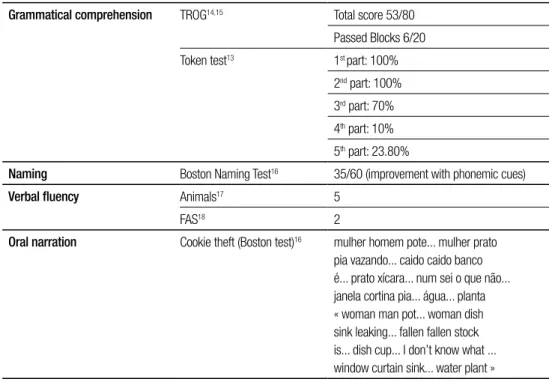
exhib-ited marked expression deicits with anomia and word-inding diiculties, signiicant output reduction using only content words (especially nouns) and simpliied phrases and grammar (omission of function words and inlections). In addition to the linguistic changes, the patient also manifested mild apraxia of speech. he re-sults of formal language tests (Table 1) were suggestive of anomia, with beneit from phonemic cues (lexical ac-cess deicit), reduced category and letter verbal luency, and sentence comprehension deicits, as evaluated by the Token Test13 and the Test for Reception of Grammar
(TROG-2).14,15 he Token Test evaluates comprehension
of commands and is useful when trying to understand the inluence of extension and syntax complexity on comprehension. Parts 1, 2 and 3 check word knowledge and syntactically simple/short commands. Part 4 tests long but simple constructions, whereas Part 5 tests syntactically complex sentences. he results of EEP in-dicated problems both related to phonological working memory (Part 4) and syntactic comprehension deicits (Part 5). To better characterize the syntactic deicit, EEP was assessed with TROG. his test contains 80 items, divided into 20 blocks, each testing a diferent lexical, morphosyntactic or syntactic structure. Each item is read aloud to the subject who has to choose from four drawings the one which best depicts the item. A block is scored as passed only if all 4 items within it are an-swered correctly. In addition, a inal score is obtained
by summing all the correct responses. EEP passed only 6/20 blocks. An analysis of error patterns, revealed four failed blocks due to attentional problems (only 1 error in the block) and genuine morphosyntactic deicits in 10 blocks (2 or more errors in blocks C,E,K,L,M,N,P,R,S,T). EEP presented diiculties with all reversible construc-tions, zero anaphora, pronouns (gender, number and binding), singular/plural inlections, relative clauses and centre embedded sentences). In speech production from visual stimuli (Cookie theft)16 a very low
occur-rence of verbs (only 3: to leak, fall and be) was observed and errors in verb inlections. In reading, the patient showed omission and transposition of phonemes and omitted articles and conjunctions, but with satisfactory comprehension. In writing, EEP committed only simple spelling errors.
We applied a sentence completion task and veriied that although the patient was unable to produce com-plete sentences spontaneously or in picture description, he was able to read and repeat short sentences of simple grammatical structure (subject-verb-complement). In a cloze task (a written sentence was presented with a gap in the position of the verb) with these types of sentenc-es, when given the verb in the ininitive form, he was able to use it in the sentence. However, he occasionally presented morphological errors, either omitting or sub-stituting inlections both referring to subject pronouns and tense. By analysing comprehension and production
Table 1. Performance on language tasks before intervention.
Grammatical comprehension TROG14,15 Total score 53/80
Passed Blocks 6/20
Token test13 1st part: 100%
2nd part: 100%
3rd part: 70%
4th part: 10%
5th part: 23.80%
Naming Boston Naming Test16 35/60 (improvement with phonemic cues)
Verbal fluency Animals17 5
FAS18 2
Oral narration Cookie theft (Boston test)16 mulher homem pote... mulher prato
tasks, we interpreted the grammatical encoding deicit as due to problems in understanding thematic roles, characterized by diiculties with reversible sentences and omission of verbs and function words (lexical ac-cess) and also problems assembling words in a sentence frame and generating appropriate inlections, charac-terized by inability to produce complex sentences and verb inlections. herefore, the deicits afected both functional and positional levels in Bock and Levelt’s framework. Our goal was to focus irst on the positional level, by practicing present and past verb inlections and production of “subject-verb-complement” sentence structures.
Phase 2: Implementation of the treatment – Six reha-bilitation sessions (twice a week, lasting for 30 minutes each, with daily workouts at home) were carried out for three weeks. he purpose was to improve his syntactic skills, more speciically, verb inlections, for construc-tion of coherent simple sentences, since the patient used nouns and simple phrases to communicate.
For regular practice, 20 high-frequency regular verbs were selected (transitive direct and indirect). he se-lection of verbs was based on common daily activities (examples: to run, eat, cook, shop, work) and verb fre-quency was conirmed at the corpus AC/DC (http://www. linguateca.pt/ACDC/). A set of 40 sentences was built to be completed with the same 20 verbs in the present and in the past (an adverb at the beginning of the sentence cued the verb tense, i.e. “Every day”; “Yesterday”). In all sessions the patient was asked to complete the gaps in all 40 sentences, always presented in the same order, us-ing a verb that was given in the ininitive form by the therapist.
Another set of 40 sentences with diferent regular verbs were selected, but was not trained, to serve as comparison and for analysis of generalization.
Phase 3: Intervention strategy – he irst goal was to achieve accurate production of Subject-Verb-Object sentences. For this, in the irst session an explanation of the rules of conjugation of regular verbs in the two diferent tenses was given. Subsequently, a written cue (verb in the ininitive) was provided by the therapist, to be used in the completion of a given written sentence. In this situation, the baseline assessment showed 85% correct responses. For treatment, the therapist ofered the model aloud (verb inlection) and the patient was asked to read the sentence and reproduce the verb form in the correct position in the sentence (blank). he sen-tence was then partially covered and the patient was
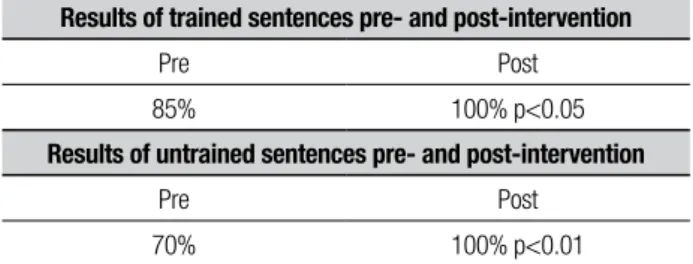
Table 2. Results of trained and untrained sentences pre- and post- intervention
Results of trained sentences pre- and post-intervention
Pre Post
85% 100% p<0.05
Results of untrained sentences pre- and post-intervention
Pre Post
70% 100% p<0.01
asked to say the full sentence aloud again. When neces-sary, a picture was presented as support. According to the technique of errorless learning, models and cue were gradually removed until the patient was able to com-plete the sentence and say it aloud without any cues. he sentences were trained in the present and past tenses.
RESULTS
Table 2 shows the results of trained and untrained items pre- and post-intervention. Pictures were removed from training in the second session. In the fourth ses-sion both models of the inlected verb and the verb in the ininitive were no longer needed for cues. he Wil-coxon signed ranks test was used to compare trained items (pre and post-treatment) and untrained items (pre and post-treatment). A signiicant increase in cor-rect sentences in the post-treatment was evident both for trained (p<0.05) and untrained items (p<0.01). It is important to highlight that pre-treatment measures refer to patient production with a verb in the ininitive ofered as a cue whereas at post-treatment and follow-up no cue was needed.
he narrative in the oral description of the “Cookie theft”15 igure after the intervention was: o menino caiu do banquinho... a menina... a menina... caiu do banquinho do biscoito... ela lavou os pratos e a torneira derrama... a cor-tina está aberta... os armários estão fechados. “he boy fell of the stool… the girl... the girl... fell of the stool of the cookie… she washed the dishes and pour the tap… the curtain is opened… the cabinets are closed”
During the month following the end of training, the patient underwent rehabilitation directed only to aprax-ia of speech. One month after the end of language train-ing the patient was reevaluated and maintained 100% accuracy in both trained and untrained phrases. On the same day the patient was submitted to grammati-cal comprehension tests. He was able to score one point on the TROG14,15 (53 pre- and 54 post-intervention), but
presented greater diiculty on the Token test13 (100%,
respec-tively), showing increased deicits in attention and pho-nological working memory.
DISCUSSION
Non-pharmacological interventions have been pro-posed as promising alternatives for the treatment of cognitive deicits following PPA (for a review see Carth-ery-Goulart et al.)10. Most studies have focused on the
treatment of lexical or semantic deicits since these are common features of the three most common variants of PPA and a frequent concern of patients. he current study describes the short-term efects of an interven-tion program designed for a patient with nonluent PPA focusing on sentence production. Although agramma-tism is a core feature of NFPPA, to our knowledge there is only one case-study describing strategies that can be applied to remediate this deicit in progressive aphasia.11
Agrammatism is characterized by three main fea-tures: omission or substitution of morphology; reduced variety of grammatical forms (constructional deicit, characterized by typically producing declarative sentenc-es with canonical word order); and slow rate of speech, even in patients without articulatory problems.19 hese
deicits are usually explained in terms of impairment of morphosyntactic knowledge or speciic restriction of grammatical processing skills.19 he deicits presented by
the patient described, and possibly by others in the ini-tial stages of NFPPA, seem to be better explained by the second description. According to Kolk,19 agrammatic
pa-tients adapt the syntactic complexity of their utterances to their limited processing capacity, which is supported by the observation of variance of performance among tasks. he patient’s output was worse in picture descrip-tion compared to sentence compledescrip-tion/cloze, which are more constrained tasks. In fact, he was able to build more accurate sentences in cued tasks, which suggests that morphosyntactic knowledge was more preserved than access to it.
he treatment proposed for EEP increased aware-ness of sentence structure and its components (meta-linguistic skills) and at the same time provided inten-sive training on building simple canonical sentences. We used principles of errorless learning by ofering cues (verb in the ininitive) and asking for repetition of tense inlections. In this sense, the treatment exploited the remaining capacity both of declarative and non-declarative memory systems. he patient was able to learn the strategy and to generalize it to trained and un-trained sentences of similar grammatical structure. He was also able to use the strategy in picture description. However, generalization was not observed in sentence
comprehension. As our treatment did not address dif-ferent (and more complex) sentence structures we did not expect this generalization to occur. In fact, what we observed was the generalization of the trained strategy. Our indings are comparable to those of Schneider et al.,11 although these researchers employed a
difer-ent type of intervdifer-ention. In their study, treatmdifer-ent was aimed at cueing verb tense inlections by the use of gestures. he investigators observed improved produc-tion of sentences on trained items and untrained verbs within trained tenses. In our study, we believe that treatment was successful by reducing adaptive behavior (or “maladaptive”, because the patient was functioning below his capabilities). In neurodegenerative diseases, avoiding maladaptation and maintaining an optimum level of functioning must also be a goal when trying to delay deterioration of language function.
Although verb retrieval was not tested before and after treatment, we believe that the strategy of inter-vention might also have contributed to facilitate verb retrieval, because after treatment the patient was able to work on the cloze task without being given the target verb. Improving verb retrieval has been shown to be a successful strategy for improving sentence production in chronic aphasia20 and this hypothesis must be
ad-dressed in future studies.
After the period of syntactic training, a treatment focused on motor programming (apraxia of speech) for a month was chosen, since it is a distinct task and was not expected to have had an impact on syntactic skills up to the re-evaluation.
Some limitations of the current work is that samples of spontaneous speech were not recorded at baseline to be compared with the levels obtained post-treatment. herefore, our conclusions are based solely on obser-vations of the improved performance on picture de-scription (which is also a constrained task) and in the generalization of the strategy to untrained sentences of similar structures but not to comprehension tasks. We also recognize that the number of items (trained and untrained) needs to be increased in future studies. Moreover, a verb naming task would have helped in the interpretation of gains in terms of improvement of verb retrieval or sentence structure awareness. For training, a ixed order of sentence presentation was used, howev-er this seemed not to afect the results of the treatment, since learning was generalized to untrained sentences and to diferent tasks (picture description).
complex sentence structures and address syntactic com-prehension.
he results of this study lend support for the use of
linguistic-based treatment strategies in PPA. Further studies in PPA are needed to gather evidence-based treatment options to assist in clinical practice.
REFERENCES
1. Mesulam MM. Slowely progressive aphasia without generalized demen-tia. Ann Neurol 1982;11:592-598.
2. Gorno-Tempini ML, Hillis AE, Weintraub S, et al. Classification of prima-ry pro gressive aphasia and its variants. Neurology 2011; 76:1006-1014. 3. Mesulam M. Primary progressive aphasia - A dementia of the language
network. Dement Neuropsychol 2013;7:2-9.
4. Weintraub S, Mesulam M, Wieneke C, Rademaker A, Rogalski EJ, Thompson CK. The Northwestern Anagram Test: Measuring Sentence Production in Primary Progressive Aphasia. Am J Alzheimer’s Dis Other Dement 2009;24:408-416.
5. Reed DA, Johnson NA, Thompson C, Weintraub S, Mesulam MM. A clinical trial of bromocriptine for treatment of primary progressive apha-sia. Ann Neurol 2004;56:750.
6. Kertesz A, Morlog D, Light M, Blair M, Davidson W, Jesso S, et al. Galantamine in frontotemporal dementia and primary progressive apha-sia. Dement Geriatr Cogn Disord 2008;25:178-185.
7. Decker DA, Heilman KM. Steroid treatment of primary progressive aphasia. Arch Neurol 2008;65:1533-1535.
8. Johnson NA, Rademaker A, Weintraub S, Gitelman D, Wienecke C, Mesulam M. Pilot trial of memantine in primary progressive aphasia. Alzheimer Dis Assoc Disord 2010;24:308.
9. Olazarán J, Reisberg B, Clare L, Cruz I, et al. Non pharmacological therapies in Alzheimer’s disease: a systematic review of efficacy. De-ment Geriatr Cogn Disord 2010;30:161–178.
10. Carthery-Goulart MT, Silveira AC, Machado TH, et al. Nonpharmaco-logical interventions for cognitive impairments following primary pro-gressive aphasia - A systematic review of the literature. Dement Neuro-psychol 2013;7:122-131.
11. Schneider SL, Thompson CK, Luring B. Effects of verbal plus gestural matrix training on sentence production in a patient with primary pro-gressive afasia. Aphasiology 1996; 10:297-317.
12. Bock K, Levelt W. Language production: Grammatical encoding. In: M.A. Gernsbacher (Ed.), Handbook of psycholinguistics, San Diego, CA: Academic Press; 1994:945-984.
13. De Renzi E, Vignolo, LA. The Token Test: a sensitive test to detect re-ceptive disturbances in aphasics. Brain. 1962;85:665-78.
14. Bishop DVM. Test for the Reception of Grammar. Age and Cognitive Performance. Research Centre, University of Manchester. Manchester; 1983.
15. Bishop DVM. The Test for Reception of Grammar, version 2 (TROG-2). London: Psychological Corporation; 2003.
16. Goodglas H, Kaplan E. The assessment of aphasia and related dosor-ders. Philadelphia: Lea & Febiger; 1983.
17. Fichman HC, Fernandes CS, Nitrini R, et al. Age and educational level effects on the performance of normal elderly on category verbal fluency tasks. Dement Neuropsychol 2009;3:49-54.
18. Machado TH, Fichman HC, Santos EL, et al. Normative data for healthy elderly on the phonemic verbal fluency task – FAS. Dement Neuropsy-chol 2009;3:55-60.
19. Kolk H. Disorders of syntax in aphasia: Linguistic–descriptive and pro-cessing approaches. In: B. Stemmer & H.A. Whitaker (Eds.), Hand-book of neurolinguistics (pp. 250 – 260). San Diego Academic Press; 1998.