Influence of bleaching and desensitizing gel on bond
strength of orthodontic brackets
Fernanda Alves Rodrigues Britto1, Adriana Simoni Lucato2, Heloisa Cristina Valdrighi2, Sílvia Amélia Scudeler Vedovello2
Objective: The objective of this study was to assess, in vitro, the influence of bleaching gel and the use of desensitizing agent over bond strength of ceramic brackets bonded to bovine enamel. Methods: One hundred bovine incisors were
selected and randomly divided into five groups (n = 20): Group 1, control group (without bleaching); Group 2, bleached with 35% hydrogen peroxide; Group 3, bleached with 35% hydrogen peroxide (three applications, 15 minutes each) and desensitizing agent applied for 10 minutes; Group 4, bleached with 35% hydrogen peroxide for 40 minutes; Group 5, bleached with 35% hydrogen peroxide for 40 minutes with desensitizing agent applied for 10 minutes. Brackets were bonded 7 days after bleaching and submitted to shear bond strength test after 24 hours at a compression rate of 1 mm/ minute. After fracture, the adhesive remnant index (ARI) was assessed under stereoscopic at 40 x magnification. Shear strength data (MPa) were submitted to one-way ANOVA and Tukey’s test with significance level set at 5%. Results:
Group 5 (29.33 MPa) showed significantly higher bond strength than Group 1 (19.19 MPa), Group 2 (20.59 MPa) and Group 4 (23.25 MPa), but with no difference in comparison to Group 3. There was no significant difference among the other groups. The adhesive remnant index showed predominance of score 3, that is, all resin remained adhered to enamel for all groups. Conclusion: Bleaching with 35% hydrogen peroxide with calcium associated with desensitizing agent
application produced higher bond strength values of brackets bonded to bovine enamel.
Keywords:Tooth bleaching. Hydrogen peroxide. Shear strength.
How to cite this article: Britto FAR, Lucato AS, Valdrighi HC, Vedovello SAS. Influence of bleaching and desensitizing gel on bond strength of orthodontic brackets. Dental Press J Orthod. 2015 Mar-Apr;20(2):49-54. DOI: http://dx.doi. org/10.1590/2176-9451.20.1.049-054.oar
Submitted: January 13, 2014 - Revised and accepted: October 13, 2014
Contact address: Fernanda Alves Rodrigues Brito Av. Dr. Maximiliano Baruto, 500 - Jd. Universitário
Araras - SP - Brazil — CEP: 13607-339 - E-mail: [email protected]
1 Master’s student in Orthodontics, Centro Universitário Hermínio Ometto
(UNIARARAS), Araras, São Paulo, Brazil.
2 Professor, Centro Universitário Hermínio Ometto (UNIARARAS),
Postgraduate program, Department of Orthodontics, Araras, São Paulo, Brazil. » The authors report no commercial, proprietary or financial interest in the prod-ucts or companies described in this article.
DOI: http://dx.doi.org/10.1590/2176-9451.20.2.049-054.oar
Objetivo: o objetivo do presente estudo foi avaliar, in vitro, a influência do gel clareador e da utilização de dessensibilizante na resistência adesiva de braquetes cerâmicos colados ao esmalte bovino. Métodos: cem incisivos bovinos foram aleatoriamente divididos em cinco grupos (n = 20). Grupo 1, sem clareamento (controle); Grupo 2, clareamento com peróxido de hidrogênio a 35%; Grupo 3, clareamento com peróxido de hidrogênio a 35%, sendo três aplicações de 15 minutos cada, e aplicação do dessensibilizante por 10 minutos; Grupo 4, clareamento com peróxido de hidrogênio a 35% durante 40 minutos; Grupo 5, clareamento com peróxido de hidrogênio a 35% durante 40 minutos e aplicação do dessensibilizante durante 10 minutos. Os braquetes foram colados sete dias após o clareamento e submetidos ao teste de resistência ao cisalhamento após 24 horas, a uma velocidade de compressão de 1mm/minuto. Após a fratura, avaliava-se o braquete, com lupa estereoscópica, com magnificação de 40x, e o Índice de Remanescente Adesivo (IRA). Os dados de resistência ao cisalhamento (MPa) foram submetidos à análise de variância e ao teste de Tukey, com nível de significância de 5%. Resultados: os resultados mostraram que as amostras do Grupo 5 apresentaram resistência de união significativamente superior à dos grupos 1, 2 e 4, mas sem diferença do Grupo 3. Não houve diferença significativa entre a resistência de união dos demais grupos. O Índice de Remanescente Adesivo mostrou predominância do escore 3, ou seja, toda resina permaneceu aderida ao esmalte, para todos os grupos. Conclusão: pôde-se concluir que o clareamento com peróxido de hidrogênio a 35%, com cálcio associado à aplicação do dessensibilizante, produziu maior resistência dos braquetes ao esmalte bovino.
INTRODUCTION
Esthetics is one of patients’ demands when seeking dental oices to change the angle, position and color of
their teeth.1 One of the most common esthetic
com-plaints involves changes in the color of teeth, in addi-tion to disproporaddi-tionate shape and misalignment. Tooth bleaching is indicated to improve the esthetics of the smile, and must be performed before restorative and
re-habilitative procedures.2
The most frequently used bleaching agents are hy-drogen peroxide and carbamide peroxide in various con-centrations, and bleaching may be performed by means
of two techniques: at-home or in-oice bleaching.3
In procedures performed at the dentist’s oice, 35% hy-drogen peroxide is usually used, and should be applied
and supervised by duly qualiied professionals.4 Both
techniques are equally efective.5
Tooth bleaching promotes rupture of the pigmented molecules impregnated in the dental structures, making them smaller, with signiicant reduction in the
tonali-ties of their color, so that the tooth becomes whiter.6,7,8
Bleaching may be redone ater 14 months.8
Various studies have demonstrated that changes oc-cur in the morphology, microhardness and
permeabil-ity of bleached enamel.10,11 This is believed to occur due
to the demineralizing potential of bleaching agents.11
Thus, some undesirable efects may be generated. One of the undesirable effects reported by patients is tooth sensitivity which occurs due to an increase in enamel and dentin permeability by the bleaching
agents.11 This allows penetration of fluids into the
dentinal tubules, stimulating nerve fibers and conse-quently leading to sensitivity. This may be reverted by the use of desensitizing agents, with emphasis on the use of potassium nitrate, which reduces sensitiv-ity by means of diminishing the abilsensitiv-ity of nerve fibers
in dental pulp to transmit pain;12 and fluorides that
obstruct dentinal tubules and, thereby, also promote
the inhibition of pain.13,14
Adding calcium to the composition of bleaching agents is another alternative to reduce the adverse ef-fects caused by bleaching. The presence of calcium in the composition of bleaching agents probably
contrib-utes, directly and indirectly, to reduce sensitivity.15
The goal of this addition is to increase the saturation of gels with ions, thereby reducing mineral losses and increasing enamel resistance to demineralization caused
by peroxides.16 Studies have evinced that the presence
of calcium in 35% hydrogen peroxide-based bleach-ing agents increased microhardness of bleached enamel,
thus resulting in remineralization of this substrate.17
Therefore, the addition of calcium and luoride helps to control mineral loss in enamel submitted to diferent
bleaching treatments.18
Studies have reported increase in resin bond strength
to enamel submitted to bleaching.19,20 The application
of bleaching agents may also cause surface porosities that change enamel permeability and interfere in bond
strength in bracket bonding.21 There is some
discrep-ancy in the results found in the literature with respect to the reduction in bond strength of brackets bonded to bleached teeth. However, changes caused by bleaching are undeniable, making it necessary to wait for a period of at least seven days in order to perform orthodontic
bracket bonding more safely.22
Patients who need orthodontic treatment and choose esthetic brackets give much importance to the smile. Some of them have stained teeth and request that bleaching treatment be performed prior to orthodontic treatment. This is because they do not want to remain with stained teeth throughout all orthodontic treat-ment, which can last more than three years. Therefore, it is important to assess the inluence of bleaching treat-ment associated with desensitizing agents on the bond strength of brackets to enamel.
Therefore, the aim of this study was to assess the inluence of bleaching agents, with and without cal-cium, and desensitizing agents on the bond strength of ceramic brackets bonded to bovine enamel, in addition to assessing the adhesive remnant index (ARI) ater the bond strength test.
MATERIAL AND METHODS
This study began after being approved by UNIA-RARAS Institutional Review Board under protocol #560/2011.
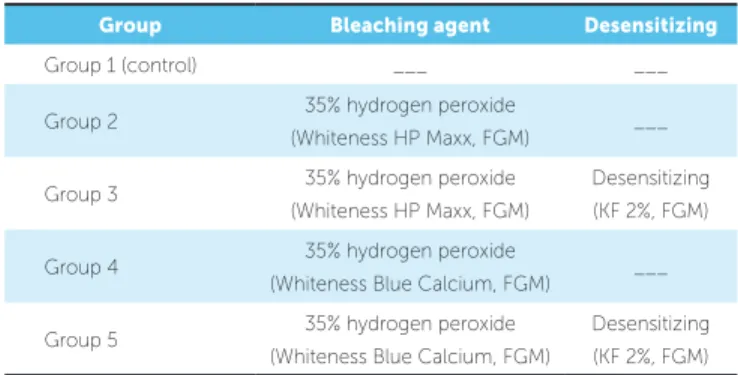
Table 1 - Study groups divided according to the bleaching agent and desen-sitizing gel.
water, using a Robson brush. Teeth were divided into five groups (n = 20), according to the bleaching and desensitizing agent.
» Group 1: control group in which specimens re-ceived no bleaching before bracket bonding.
» Group 2: bleached with 35% hydrogen peroxide (Whiteness HP Maxx 35%, FGM, Joinville, Santa Ca-tarina, Brazil), with three applications for 15 minutes each, as recommended by the manufacturer, using the light polymerizing appliance Radii (SDI, Australia). At the end of treatment, the samples were washed with water and polished with a felt disc.
» Group 3: bleached with 35% hydrogen peroxide (Whiteness HP Maxx 35%, FGM, Joinville, Santa Ca-tarina, Brazil) according to the protocol described for Group 2. Ater bleaching, teeth were washed and dried, and the desensitizing agent was applied (KF 2%, FGM, Joinville, Santa Catarina, Brazil) for 10 minutes, fol-lowed by washing and polishing with a felt disc.
» Group 4: bleached with 35% hydrogen peroxide (Whiteness Blue 35% Calcium, FGM, Joinville, Santa Catarina, Brazil) for 40 minutes, as recommended by the manufacturer, and subsequently washed, dried and polished with a felt disc.
» Group 5: bleached with 35% hydrogen perox-ide (Whiteness Blue 35% Calcium, FGM, Joinville, Santa Catarina, Brazil) for 40 minutes. After bleach-ing, teeth were washed and dried, and the desensitiz-ing agent was applied (KF 2%, FGM, Joinville, Santa Catarina, Brazil) for 10 minutes, followed by washing and polishing with a felt disc.
Ater the bleaching procedure, all samples were stored in distilled water for seven days ater which the brackets were bonded. Prophylaxis of the bonding area was performed with pumice stone and a Robson brush. The enamel was etched with 37% phosphoric acid for 15 seconds and subsequently washed and dried. Ater-wards, Transbond XT Primer (3M Unitek, Monrovia, USA) adhesive was applied and light activated for 10 seconds with the Radii (SDI, Australia) light curing ap-pliance. Transbond XT (3M Unitek, Monrovia, USA) resin was applied at the base of the Edgewise prescription ceramic brackets for maxillary central incisors (Morelli, Sorocaba, SP, Brazil). Brackets were manually posi-tioned on the tooth surface until the material lowed, and were then polymerized for 40 seconds, 10 seconds on each surface (distal, mesial, gingival and occlusal).
Specimens were stored in distilled water at 37 oC
for 24 hours23,24 and submitted to shear bond strength
test in an Instron 4411 universal testing machine (In-stron Corp, USA) at a compression speed rate of 1 mm/minute. Shear bond strength was tested for nor-mal distribution by means of Kolmogorov-Smirnov test. One-way ANOVA and Tukey’s multiple comparison tests were used to assess the inluence of bleaching on shear bond strength results at a signiicance level of 5%.
Ater the shear bond strength test, the adhesive rem-nant index (ARI) was assessed in accordance with the
method proposed by Artun and Bergland,25 and
deter-mined by scores that ranged from 0 to 3:
» Score 0 — absence of any residue of adhesive layer on enamel;
» Score 1 — presence of less than half resin rem-nant on enamel;
» Score 2 — presence of more than half resin remnant on enamel;
» Score 3 — presence of all resin remnant on enamel, together with impression of the bracket base design.
Adhesive remnant was evaluated under a stereoscopic microscope (Carl Zeiss, MC 63A, Germany) under 40 x magniication.
RESULTS
Analysis of variance showed signiicant diference among the diferent types of material (P < 0.001). Tukey’s test (Table 2) showed that the samples submit-ted to bleaching with HP Blue and later application of 2% KF desensitizing agent presented signiicantly higher bond strength in comparison to control and the samples submitted to bleaching with HP Blue and HP
Group Bleaching agent Desensitizing
Group 1 (control) ___ ___
Group 2 35% hydrogen peroxide
(Whiteness HP Maxx, FGM) ___
Group 3 35% hydrogen peroxide (Whiteness HP Maxx, FGM)
Desensitizing (KF 2%, FGM)
Group 4 35% hydrogen peroxide
(Whiteness Blue Calcium, FGM) ___
Group 5 35% hydrogen peroxide (Whiteness Blue Calcium, FGM)
Table 2 - Shear strength (MPa) of brackets bonded to enamel and subjected to different bleaching protocols.
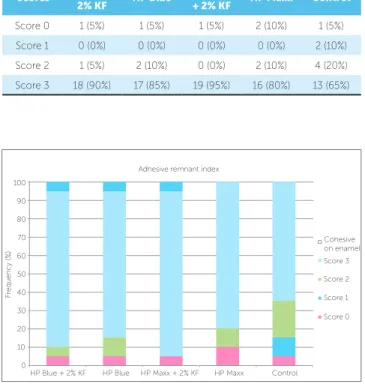
Table 3 - Frequency (%) of ARI distribution after applying different bleaching agents.
Different letters stand for significant difference (P < 0.05).
Maxx; however, no diferences were found in compari-son to those bleached with HP Maxx and later applica-tion of 2% KF desensitizing agent. There was no sig-niicant diference between the bond strength values of other groups.
Assessment of the adhesive remnant index (ARI) showed predominance of score 3; that is, all resin re-mained adhered to the enamel for all groups. For the control group, there was a trend towards scores 1 and 2 (Fig 1). The groups bleached with HP Blue, with and without desensitizing agent, and the HP Maxx group with desensitizing agent presented cohesive fracture in enamel.
DISCUSSION
Many patients have some trouble using orthodontic appliances, even ceramic ones. In order to reduce the col-or contrast between teeth and ceramic brackets, patients are subjected to bleaching procedures before bracket bonding, which leads orthodontists to question the inlu-ence of bleaching agent on the bonding procedure.
One of the most common efects resulting of hy-drogen peroxide or carbamide peroxide on bleaching treatment in Dentistry is the change in bond strength to enamel and dentin. The reduction in bond strength of resin to enamel and dentin may be related to the pres-ence of free radicals of oxygen that interfere in the
po-lymerization of resin material.26,27 Therefore, the most
used clinical approach to eliminate or reduce the efects of residual oxygen is to wait a few days ater the end of
bleaching treatment before bonding brackets.28,29
This study demonstrated that the samples submit-ted to bleaching with HP Blue Calcium and subsequent application of 2% KF desensitizing agent presented a signiicantly higher bond strength compared with non-bleached teeth and teeth non-bleached without later desen-sitizing application. Assessment of adhesive remnant index (ARI) showed predominance of score 3, failures between bracket and resin, thereby conirming that bleaching did not negatively inluence the bond strength of brackets to enamel.
The high bond strength values shown in this study are possibly due to the time interval of seven days be-tween the end of bleaching and orthodontic bracket bonding. Within this period, residual oxygen must have been neutralized, thus not interfering in polym-erization of resin composite for bonding. This may be proved by the absence of signiicant diferences between the bleached groups and the control group
(without bleaching). Some authors30,31 suggest that
orthodontic bonding should be delayed for one week ater bleaching so as to ensure adequate bond strength.
Other authors32,33 also recommend postponing
bond-ing ater bleachbond-ing for periods rangbond-ing from 24 hours
to four weeks. Thus, according to these authors,22,34
a period of at least seven days of waiting time is nec-essary so that orthodontic bracket bonding can be performed more safely. This is in agreement with the results obtained in the present study in which the wait-ing time was of seven days before bondwait-ing orthodontic brackets to bovine enamel ater bleaching.
Material Shear strength (MPa)
Group 5: HP Blue + KF a 2% 29.33 (6.03) A
Group 4: HP Blue 23.25 (6.85) B
Group 3: HP Maxx + KF a 2% 24.22 (5.45) AB
Group 2: HP Maxx 20.59 (7.17) B
Group 1: Control 19.19 (6.12) B
Scores HP Blue +
2% KF HP Blue
HP Maxx
+ 2% KF HP Maxx Control
Score 0 1 (5%) 1 (5%) 1 (5%) 2 (10%) 1 (5%) Score 1 0 (0%) 0 (0%) 0 (0%) 0 (0%) 2 (10%) Score 2 1 (5%) 2 (10%) 0 (0%) 2 (10%) 4 (20%) Score 3 18 (90%) 17 (85%) 19 (95%) 16 (80%) 13 (65%)
Figure 1 - Frequency (%) of adhesive remnant index after application of dif-ferent bleaching agents.
Adhesive remnant index
F
requency (%)
100 90 80 70 60 50 40 30
10 20
0
Cohesive on enamel Score 3 Score 2 Score 1 Score 0
The release of oxygen may cause morphological
alterations in mineralized tissues.4,8,33 The reduction
in bond strength of dentin to bleached teeth has been related to changes in the mineral and protein content
of enamel, and not to the efect of residual oxygen.35
Soares et al36 demonstrated that the addition of calcium
and luoride ions to the gel reduced mineral loss, there-by increasing resistance to demineralization.
Giannini et al16 reported that if mineral ions were
added to the gel during bleaching and ionic exchange, they could perhaps be taken up and increase enamel re-sistance to demineralization. Since luoride and calcium ions increase the saturation of the bleaching gel, lower mineral loss could occur during bleaching; therefore, gels with the addition of luoride or calcium could re-duce or overcome the adverse efects of bleaching treat-ment. This result was obtained in the present study, in which the presence of calcium in the bleaching gel and application of a desensitizing agent must have rem-ineralized this substrate, showing an increase in bond strength in teeth bleached with a bleaching agent con-taining calcium, and application of the desensitizer.
Another result found in this study was that the asso-ciation of bleaching agent with calcium and desensitizing agent produced the highest shear bond strength. Never-theless, a previous study found that bleaching with the application of desensitizing agent signiicantly reduced the bond strength of orthodontic brackets bonded to
hu-man enamel.37 Reduction in bond strength in that study
was probably due to a post-bleaching bonding time of two days, in disagreement with studies that indicate that the ideal should be waiting for at least seven days, as it was done in the present experiment. This waiting time would
be necessary for complete release of residual oxygen.29
Moreover, the calcium present in the bleaching agent could reduce demineralization during tooth bleaching,
and the luoride ions released from desensitizing agent could promote ions change with enamel and form luori-dated apatite on tooth surface that could be related to the highest shear bond strength for Group 5.
Another study reported that in order to reduce the efects of residual oxygen on bonding procedures per-formed right ater bleaching, luoride in gel could be
ap-plied to the enamel.27 The presence of sodium luoride
in the desensitizing agent may act as a remineralizing agent, thereby forming a layer of calcium luoride on
the enamel surface.38 Thus, the application of the
de-sensitizing agent may have removed the layer of residual oxygen, which did not interfere negatively in orthodon-tic bracket bonding to bleached enamel.
Although the ideal substrate for this type of study is the human tooth, bovine teeth were used as a substitute because extracted human teeth are becoming diicult to
obtain due to progress in conservative dental treatment.38
Bovine teeth are easily obtainable and are reported to be a
reliable substitute for human teeth in enamel bonding.39
Clinically, the application of desensitizing agent ater bleaching with hydrogen peroxide can be a good op-tion to reduce the negative efects of residual oxygen on bond strength of brackets bonded to bleached enamel. However, further studies must be conducted to investi-gate the efect of associating bleaching gel with calcium and desensitizing agent applied to the dental structure.
CONCLUSION
Bleaching agent with calcium associated with desen-sitizing gel increased the shear bond strength of ceramic brackets bonded to the enamel. Bleaching did not re-duce shear strength between bracket and teeth.
1. Baratieri LN, Monteiro Junior S, Andrada MAC, Vieira LCC. Clareamento dental. 2a ed. São Paulo: Ed. Santos; 1993.
2. Zanin F, Brugnera Júnior A, Zanin S, Campos DHS, Zanin VOZ. Clareamento
dental com laser e led. Rev Gauch Odontol. 2003;51(3):143-6. 3. Soares CJ, Santos Filho PCF, Barreto BCF, Mota AS. Efect of previous
desensitizer and rewetting agent application on shear bond strength of bonding systems to dentin. Cienc Odontol Bras. 2006;9(4):6-11.
4. Pinto C, Oliveira R, Cavalli V, Giannini M. Peroxide bleaching agent efects on enamel surface microhardness, roughness and morphology. Braz Oral Res. 2004;18(4):306-11.
5. Almeida LC, Riehl H, Santos PH, Sundfeld ML, Briso AL. Clinical evaluation of the efectiveness of diferent bleaching terapies in vital teeth. Int J Periodontics Restorative Dent. 2012;32(3):303-9.
6. Pécora JD, Cruzilho AM, Sousaneto MD, Silva RG. In vitro action of various bleaching agents on the microhardnesse of human dentin. Braz Dental J. 1994;5(2):129-34.
7. Baratieri LN. Clareamento dental. São Paulo: Ed. Santos; 1995.
8. Novais RCP, Toledo OA. Estudo in vitro das alterações do esmalte dentário submetido à ação de um agente clareador. J Bras Clín Estét Odontol. 2000;4(20):48-51.
9. Grobler SR, Mjeed A, Moola MH, Rossouw RJ, Van wyk kotze T. In vivo Spectrophotometric assessment of the tooth whitening efectiveness of nite White 10% with amorphous calcium phosphate, potassium nitrate and luoride, over a 6 month. Period Open Dent J. 2011;2(5):18-23.
10. Basting RT, Rodrigues Jr AL, Serra MC. The efects of seven carbamide peroxide bleaching agents on enamel microhardness over time. J Am Dent Assoc. 2003;134(10):335-42.
11. Lewinstein I, Fuhrer N, Churaru N, Cardash H. Efect of diferent peroxide bleaching regiments and subsequent luoridation on the hardness of human enamel and dentin. J Prosth Dent. 2004;92(4):337-42.
12. Ajcharanukul O, Kraivaphan P, Wanachantararak S, Vongsavan N, Matthews B. Efects of potassium íons on dentine sensitivity in man. Arch Oral Biol. 2007;52(7):632-9.
13. Addy M, Mostafa P. Dentine hypersensitivity. Efects produced by the uptake in vitro of metal ions, luoride and formaldehyde onto dentine. J Oral Rehabil. 1988;15(6):575-85.
14. Paes-Leme AF, Santos JCRG, Giannini M, Wada RS. Occlusion of dentin tubules by desensitizing agents. Am J Dent. 2004;17:368-72.
15. Matins GC, Izidora ACSA, Meister LMB, Kossatz S, Gomes OMM, Loguercio DA, et al. Avaliação clínica do uso de um dessensibilizante antes do clareamento de consultório. Rev Assoc Paul Cir Dent. 2011;65(2):119-23. 16. Giannini M, Silva AP, Cavalli V, Paes Leme AF. Efect of carbamide
peroxide-based bleaching agents containing luoride or calcium on tensile strength of human enamel. J Appl Oral Sci. 2006;14(2):82-7.
17. Amaral PG, Sales GCF, Santos RL, Magalhães DBL, Gusmão ES. Inluência da presença do cálcio em agentes clareadores e sua relação com a microdureza do esmalte dental humano. Rev Bras Ciência Saúde. 2010;14(2):37-44.
18. Cavalli V, Rodrigues LK, Paes-Leme AF, Brancalion ML, Arruda MA, Berger SB, et al. Efects of bleaching agents containing luoride and calcium on human enamel. Quintessence Int. 2010;41(8):157-65.
19. Torneck, CD, Titley KC, Smith DC, Adibfar A. Efect of water leaching on the adhesion of composite resin to bleached and unbleached bovine enamel. J Endod.1991;17(4):156-60.
REFERENCES
20. Matta ENR, Maia JAC, Chevitaresse O. Inluencia do agente clareador peróxido de carbamida a 10% na resistência mecânica da colagem de braquetes ortodônticos. Rev Dental Press Ortod Ortop Facial. 2005;10(2):69-74.
21. Souza MAL. Clareamento caseiro de dentes: ação do peróxido de carbamida sobre dentes e mucosa bucal [tese]. Porto Alegre (RS): Pontíica Universidade Católica do Rio Grande do Sul; 1993.
22. Mishima FD, Valentim RG A, Araújo MTS, Ruellas ACO, Sant’Anna EF. Clareação dentária: revisão de literatura e sua interferência na colagem de braquetes ortodônticos. Rev Dental Press Estét. 2008;5(3):100-6. 23. Romano FL, Tavares SW, Nouer DF, Consani S, Magnani MBBA. Shear Bond
strenght of metalic orthodontic brackets bonded to enamel prepared with Self-Etching Primer. The Angle Orthod. 2005;75(5)849-53.
24. Ajlouni R, Bishara SE, Oonsombat C, Soliman M, Lafoon J. The efect of porcelain surface conditioning on bonding orthodontic brackets. Angle Orthod. 2005;75(5):858-64.
25. Artun J, Bergland S. Clinical trials With crystal growth conditioning as an alternative to acid-etch enamel pretreatment. Am J Orthod. 1984;85(4):333-40. 26. Homewood C, Tyas M, Woods M. Bonding to previously bleached teeth.
Aust Orthod J. 2001;17(1):27-34.
27. Martin JM, Almeida JB, Rosa EA, Soares P, Torno V. Rached RN, Mazur RF. Efect of luoride therapies on the surface roughness of human enamel exposed to bleaching agents. Quintessence Int. 2010;41(1):71-8. 28. Godwin JM, Barghi N, Berry TG, Knight GT, Hummert TW. Time duration
for dissipation of bleaching efects before enamel bonding. J Dent Res. 1992;71(1):179-85.
29. Van der vyver PJ, Lewis SB, Marais JT. The efect of bleaching agent on composite enamel bonding. J Dent Assoc S Afr. 1997;52(10):601-3. 30. Ruse ND, Smith DC, Torneck CD, Titley KC. Preliminary surface analysis of
etched, bleached, and normal bovine enamel. J Dent Res. 1990;69(9):1610-3.
31. Miles, P. G.; Pontier JP, Bahiraei D, Close J. The efect of carbamide peroxide bleach on the tensile bond strength of ceramic brackets: an in vitro study. Am J Orthod Dentofacial Orthop. 1994;105(4):371-5.
32. Cavalli V, Reis A.F, Giannini M, Ambrosano GM. The efect of elapsed time following bleaching on enamel bond strength of resin composite. Oper Dent. 2001;26:597-602.
33. Uysal T,Basciftci A, Usumez , Sari Z, Buyukerkmen A. Can previously bleached teeth be bonded safely? Am J Orthod Dentofacial Orthop. 2003;123(6):628-32.
34. Nour El-Din AK, Miller BH, Griggs JA, Wakeied Cl. Immediate bonding to bleached enamel. Oper Dent. 2006;31(1):106-14.
35. Perdigão J, Francci C, Swift EJ Jr, Ambrose WW, Lopes M. Ultra-morphological study of the interaction of dental adhesives with carbamide peroxide-bleached enamel. Am J Dent. 1998;11(6):291-301.
36. Soares FF, Sousa JAC, Maia CC, Fontes CM, Cunha LG, Freitas AP. Clareamento em dentes vitais: uma revisão literária. Rev Saúde Com. 2008;4(1):72-84.
37. Turkkahraman H, Adanir N, Gungor Y. bleaching and desensitizer application efects on shear bond strengths of orthodontic brackets. Angle Orthod. 2007;77(3):489-93.