The influence of orthodontic fixed appliances on the
oral microbiota: A systematic review
Amanda Osório Ayres de Freitas1, Mariana Marquezan2, Matilde da Cunha Gonçalves Nojima3,
Daniela Sales Alviano4, Lucianne Cople Maia5
Objective:To investigate whether there is scientific evidence to support the hypothesis that the presence of orthodontic fixed appliances influences the oral microbiota. Methods: The search for articles was conducted in PubMed; ISI Web of Knowledge and Ovid databases, including articles published in English until May 17th, 2012. They should report human observational studies presenting the following keywords: “fixed orthodontic appliance” AND “microbiological colonization”; OR “periodontal pathogens”; OR “Streptococcus”; OR “Lactobacillus”; OR “Candida”; OR “Tannerella forsythia”; OR “Treponema denticola”; OR “Fusobacterium nucleatum”; OR “Actimomyces acti-nomycetemcomitans”; OR “Prevotella intermedia”, OR “Prevotella nigrescens”; OR “Porphyromonas gingivalis”. Articles were previously selected by title and abstract. Articles that met the inclusion criteria were analyzed and classified as having low, moderate or high methodology quality. A new detailed checklist for quality assessment was developed based on the information required for applicable data extraction for reviews. The study design, sample, follow-up period, collection and microbial analysis methods, statistical treatment, results and discus-sion were assessed. Results: The initial search retrieved 305 articles of which 33 articles were selected by title and abstract. After full-text reading, 8 articles met the inclusion criteria, out of which 4 articles were classified as having low and 4 as moderate methodological quality. The moderate methodological quality studies were included in the systematic review. Conclusions: The literature revealed moderate evidence that the presence of fixed appliances influences the quantity and quality of oral microbiota.
Keywords:Orthodontic appliances. Periodontics. Attachment sites. Microbiological. Microbiological analysis.
How to cite this article: Freitas AOA, Marquezan M, Nojima MCG, Alviano DS, Maia LC. The influence of orthodontic fixed appliances on the oral micro-biota: A systematic review. Dental Press J Orthod. 2014 Mar-Apr;19(2):46-55. doi: http://dx.doi.org/10.1590/2176-9451.19.2.046-055.oar
» The authors report no commercial, proprietary or financial interest in the products or companies described in this article.
Contact address: Amanda Osório Ayres de Freitas
Rua São Francisco Xavier, 258/704 – Tijuca – Rio de Janeiro/RJ — Brazil CEP: 20550-012 – E-mail: [email protected]
1 Doctorate student of Dentistry, Federal University of Rio de Janeiro (UFRJ). 2 Phd in Orthodontics, UFRJ.
3Postdoc in Orthodontics, Case Western Reserve University. 4 Postdoc in Microbiology and Immunology, UFRJ.
5Phd in Social Dentistry, Fluminense Federal University (UFF).
Submitted: March 05, 2012 - Revised and accepted: July 12, 2012
Objetivo:investigar se há evidências científicas para comprovar a hipótese de que a presença de aparelhos ortodônticos fixos influencia a microbiota bucal. Métodos: a busca por artigos foi realizada nas bases de dados do PubMed, ISI Web of Knowledge e Ovid, incluindo artigos publicados em inglês até 17 de maio de 2012. Esses deveriam relatar estudos observacionais humanos que apresentassem as palavras--chave: “aparelho ortodôntico fixo” e “colonização microbiológica”; ou “patógenos periodontais”; ou “Streptococcus”; ou “Lactobacillus”; ou “Candida”; ou “Tannerella forsythia”; ou “Treponema denticola”; ou “Fusobacterium nucleatum”; ou “Actimomyces actinomycetemcomitans”; ou “Prevotella intermedia”; ou “Prevotella nigrescens”; ou “Porphyromonas gingivalis”. Artigos foram previamente selecionados pelo título e resumo. Artigos que atenderam aos critérios de inclusão foram analisados e classificados como de baixa, moderada ou alta qualidade metodológica. Uma nova lista de verificação detalhada para avaliação da qualidade foi desenvolvida, com base na informação necessária para a extração de dados aplicáveis para as revisões de literatura. O desenho do estudo, a amostra, o período de acompanhamento, coleta e métodos de análise microbiana, o tratamento estatístico, resultados e discussão foram avaliados. Resultados: a busca inicial encontrou 305 trabalhos. Em seguida, 33 artigos foram selecionados pelo título e resumo. Após a leitura do texto completo, apenas oito artigos preencheram os critérios de inclusão. Desses, quatro foram classificados como artigos com baixa qualidade metodológica e quatro como moderados. Os estudos de qualidade metodológica moderada foram incluídos na revisão sistemática.
Conclusão: a literatura revelou evidência moderada de que a presença de aparelhos fixos exerce influência na quantidade e qualidade da microbiota bucal.
INTRODUCTION
Scientiic publications have demonstrated that the presence of ixed appliances in the oral cavity of orthodontic patients could alter the nature of
den-tal plaque.1 The structure, metabolism and
com-position of dental plaque would change, leading to an increase in microbial population, especially
Streptococcus and Lactobacillus.1,7
Some authors have observed that ixed appliances might hamper efective oral hygiene and cause high
cariogenic challenge.8,11 Furthermore, based on the
diiculty of maintaining oral hygiene, the subgingival microbiota may also be inluenced by orthodontic
ap-pliances,13,14 since orthodontic accessories would favor
bacterial plaque retention. These variables would pos-sibly lead to pathogenic bacteria colonization, which are responsible for gingival inlammation, periodontal
sup-port destruction13,14 and changes in enamel surface.7,8,11,12
Published literature has shown that conditions fa-voring microbial colonization and establishment of
Streptococcus spp, Lactobacillus spp, fungi and periodontal
pathogens increase microbial population growth and plaque accumulation. Therefore, the following ques-tion arises: What is the real inluence of orthodon-tic ixed appliances over balance of oral microbiota in
orthodontic patients?7,10,13-17
Thus, the aim of this systematic review was to evaluate whether there is scientiic evidence to sup-port the hypothesis that the presence of orthodontic ixed appliances alters the composition of oral micro-biota and, as a consequence, favors the development of caries and periodontal disease.
MATERIAL AND METHODS
The search for articles was conducted in PubMed; ISI
Web of Knowledge and Oviddatabases.
Articles pub-lished in English from 1945 to May 2012 were included. The following keywords were used in the preliminary
search: “ixed orthodontic appliance” AND
“microbi-ological colonization”; OR “periodontal pathogens”;
OR “Streptococcus”; OR “Lactobacillus”; OR “Candida”;
OR “Tannerella forsythia”; OR “Treponema denticola”;
OR “Fusobacterium nucleatum”; OR “Actimomyces
actino-mycetemcomitans”; OR “Prevotella intermedia”, OR “
Pre-votella nigrescens”; OR “Porphyromonas gingivalis”. As for
the Ovid database, the keyword “periodontal patho-gens” was replaced by “periodontal disease”, since
the former was not indexed. The search strategy and the low of information through the diferent phases of the systematic review were established according to the PRISMA statement for systematic reviews and
metanalysis.18 The articles were selected, evaluated and
classiied by two independent readers. The results of both readers were compared and eventual diferences were solved by common accord.
Initially, all articles were selected by title and abstract. Should articles repeat in diferent data-bases, they were considered only once. The publica-tions selected were essentially observational clinical studies conducted in humans. They were required to describe the microbial colonization in orthodontic ixed appliances in individuals submitted to correc-tive orthodontic treatment. Aterwards, inclusion and exclusion criteria were applied. The following inclu-sion criteria were applied: observational clinical studies in humans; presence of orthodontic ixed appliances
placed onto the buccal tooth surface; standardization
and training in oral hygiene; microbiological analysis of collected material. Conversely, the exclusion crite-ria were: absence of baseline investigation before
appli-anceswere placed; inclusion of patients with systemic
diseases or under any condition that could inluence oral microbiota or periodontal support tissues; antibi-otic therapy three months before and during the study; use of mouth rinse during investigation; no standard-ization and training in oral hygiene; ixed or removable orthodontic appliances on the lingual dental surface. The articles that did not fulil all the inclusion criteria in the abstract section, but did not meet any exclusion criteria were not excluded at this stage.
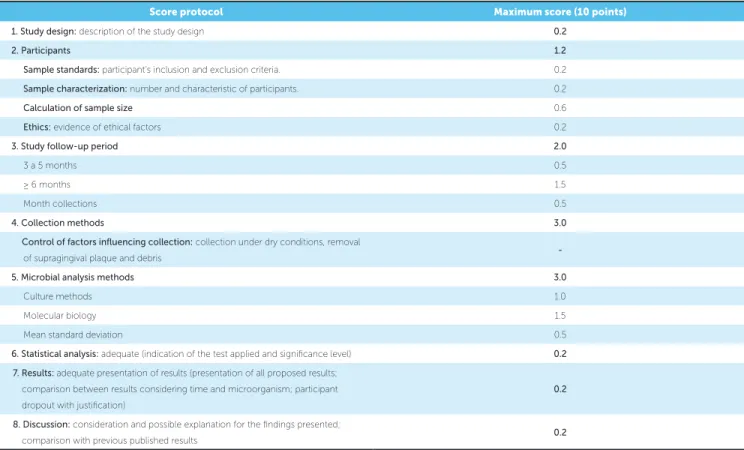
Subsequently, full text articles were read and those that met the inclusion and exclusion criteria were care-fully analyzed and qualiied according to their method-ological aspects, as described in Table 1. A new detailed checklist for quality assessment was developed specii-cally for this review, based on the information required
for data extraction applicable for reviews.19 The selected
Table 1 - Methodological quality score.
RESULTS
A total of 305 titles and abstracts retrieved from the selected databases were screened. There were 136 from PubMed, 104 from Ovid and 65 from ISI Web of Knowledge. However, the duplicates were consid-ered only once, thus totaling 250 articles.
Initially, the titles and abstracts not connected with the topic were excluded. Aterwards, the articles were
selected according tothe inclusion and exclusion
cri-teria,thus totaling 33 articles. At this stage, all studies
that presented at least one inclusion criterion in the abstract section, but presented none of the exclusion criteria, were kept. If any pre-selected article was in-accessible or not written in English, a direct request was made to the authors. Ater two months waiting for contact, 10 studies were excluded. Thus, 23 full texts were analyzed considering all selection criteria. The absence of any inclusion criteria at this stage de-termined the exclusion of 16 studies.
A hand search was performed with the references of the 7 remaining articles in order to screen additional publications not retrieved by the databases used. Thus, 23 new titles were retrieved. Ater reading the abstract,
12 articles were excluded. Subsequently, the texts of 11 articles were fully read and 10 other articles were also excluded. Therefore, 1 article obtained by hand search was added to the 7 previously selected articles.
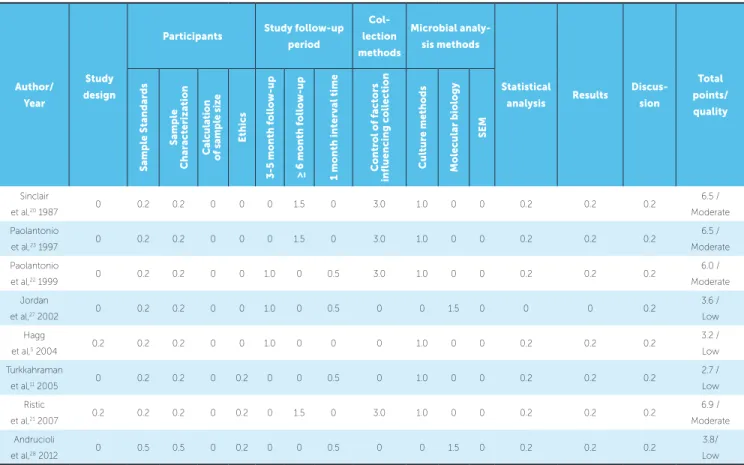
Thus, the 8 selected articles were carefully read and ranked based on the quality assessment previously described, as shown in Table 2. Ater qualiication, 4 articles were considered as having moderate scientiic evidence whereas 4 were classiied as having low sci-entiic evidence. All articles classiied as having low scientiic evidence were excluded from this systematic review. Consequently, 4 studies were included (Fig 1). The distribution of articles is detailed in Table 3.
DISCUSSION
Dental caries and periodontal diseases are recog-nized as consequences of inadequate oral hygiene
during orthodontic treatment.20 Fixed appliances and
rough-surfaced adhesives in the oral cavity create new retentive sites favorable to plaque accumulation and
inlammatory response.20,21
Although new appliances as well as new bonding techniques and material have been developed, it has
Score protocol Maximum score (10 points)
1. Study design: description of the study design 0.2
2. Participants 1.2
Sample standards: participant’s inclusion and exclusion criteria. 0.2 Sample characterization: number and characteristic of participants. 0.2
Calculation of sample size 0.6
Ethics: evidence of ethical factors 0.2
3. Study follow-up period 2.0
3 a 5 months 0.5
≥ 6 months 1.5
Month collections 0.5
4. Collection methods 3.0
Control of factors influencing collection: collection under dry conditions, removal
of supragingival plaque and debris
-5. Microbial analysis methods 3.0
Culture methods 1.0
Molecular biology 1.5
Mean standard deviation 0.5
6. Statistical analysis: adequate (indication of the test applied and signiicance level) 0.2 7. Results: adequate presentation of results (presentation of all proposed results;
comparison between results considering time and microorganism; participant dropout with justiication)
0.2
8. Discussion: consideration and possible explanation for the indings presented;
Table 2 - Quality assessment.
Author/ Year
Study design
Participants Study follow-up
period
Col-lection
methods
Microbial
analy-sis methods
Statistical
analysis Results
Discus-sion
Total points/
quality
Sample Standards
Sample
Characterization
Calculation of sample size
E
thics
3-5 month follow-up ≥ 6 month follow-up 1 month inter
val time
Control of factors
in
fluencing collection Cul
ture methods
Molecular biology
SEM
Sinclair
et al,20 1987 0 0.2 0.2 0 0 0 1.5 0 3.0 1.0 0 0 0.2 0.2 0.2
6.5 / Moderate Paolantonio
et al,23 1997 0 0.2 0.2 0 0 0 1.5 0 3.0 1.0 0 0 0.2 0.2 0.2
6.5 / Moderate Paolantonio
et al,22 1999 0 0.2 0.2 0 0 1.0 0 0.5 3.0 1.0 0 0 0.2 0.2 0.2
6.0 / Moderate Jordan
et al,27 2002 0 0.2 0.2 0 0 1.0 0 0.5 0 0 1.5 0 0 0 0.2
3.6 / Low Hagg
et al,5 2004 0.2 0.2 0.2 0 0 1.0 0 0 0 1.0 0 0 0.2 0.2 0.2
3.2 / Low Turkkahraman
et al,11 2005 0 0.2 0.2 0 0.2 0 0 0.5 0 1.0 0 0 0.2 0.2 0.2
2.7 / Low Ristic
et al,21 2007 0.2 0.2 0.2 0 0.2 0 1.5 0 3.0 1.0 0 0 0.2 0.2 0.2
6.9 / Moderate Andrucioli
et al,28 2012 0 0.5 0.5 0 0.2 0 0 0.5 0 0 1.5 0 0.2 0.2 0.2
3.8/ Low
not yet been possible to decrease dental plaque
reten-tion.20,21 Therefore, plaque retention is considered a
real problem in Corrective Orthodontics.21 Diiculties
in maintaining oral hygiene around the appliances may result in hyperplastic marginal gingivitis which can
ad-vance to periodontitis.20,22
There is a consensus that oral microorganisms are the primary etiologic agents of periodontal diseases, and their diferent species are responsible for the dif-ferent forms of the disease. Periodontal health is as-sociated with supragingival gram-positive microbiota
that consists mainly of diverse species of Streptococci and
Actinomyces. They are also predominant in gingivitis,
however, the amount of gram-negative bacteria, such
as Fusobacterium and Bacteroides, increases. On the other
hand, in periodontitis, the microlora is dominated by gram-negative facultative anaerobes, with increases spirochetes. The pathogenic potential of these micro-organisms is related to their virulence and capacity to act in gingival tissues. Moreover, the virulence of bac-teria depends on many factors, especially bacbac-terial
se-rotype and individual host susceptibility.20,22
In the retrieved articles, diferent microbiologi-cal studies were developed, revealing diferent aspects of supragingival plaque and important changes in the composition of subgingival plaque of orthodontic
pa-tients.21 These studies also reported the clinical
impli-cations of environmental disturbances caused by ixed appliances, considering the following as determinant factors of periodontal conditions: presence/absence of dental plaque, gingival bleeding index, pocket probing
depth and attachment levels in orthodontic patients.20-23
Although the articles considered for this review re-ported that ixed orthodontic appliances inluence the oral microbiota, it is relevant to point out that insuf-icient methodological information was provided.
Only two publications described the study design and the ethical aspects used for conducting the
re-search.5,21 The diversiied results observed can be
at-tributed to the distinct methods applied. The diferent follow-up periods and collection times, as well as spec-iicity and sensitivity of microbiological analysis were
the major factors behind data diversity.24,25However,
Figure 1 - PRISMA Flow diagram of literature search.
Identifica
tion
Scr
eening
Eligibility
Included
136 records identiied through PubMed
Hand search carried out with the references of the selected articles : 23
12 records were excluded after reading the abstract
11 full-text articles were accessed by reading
10 full-text articles were excluded: Klohn and Pfeifer, 1974: did not mention the nonuse of antibiotic therapy 3 months before the study.
Alstad and Zachrisson, 1979; Zachrisson, 1976; Trossello and Gianelly, 1979: periodontal analysis, only.
Scheie et al, 1984; Mattingly et al, 1983; Petti et al, 1997: did not mention the exclusion of patients with systemic disease or under use of oral antiseptic solutions.
Lo ba et al, 2008: did not mention inclusion and exclusion criteria of subjects.
Naranjo et al, 2006: the subjects did not receive oral hygiene instructions.
Ai H et al, 2005: focused on bonding material.
104 records were identiied through Ovid
250 records were removed after duplicates
33 records were screened by title and abstract
23 full-text articles were accessed for eligibility according to inclusion
criteria
07 studies were included in the qualitative synthesis
01 study obtained from the hand search was included in the
qualitative synthesis
04 studies classiied as having low evidence were excluded after the
qualitative synthesis
04 studies were included in the systematic review
10 records excluded for language restriction and lack of
accessibility
16 Full-text articles excluded:
Liu et al, 2011; Peros et al, 2011; Lara-Carrilo et al,2010; Liu et al, 2004: inadequate period and lack of previous antibiotic therapy; Ulukapi et al, 1997; Kim et al, 2010: absence of baseline microbiological analysis. Sukontapatipark et al, 2001: focused on bonding material.
Pandis et al, 2010; Forsberg et al, 1991: did not mention the exclusion of patients with systemic disease or under antibiotic therapy. Leung et al, 2006; Addy et al, 1982: did not mention the exclusion of patients under antibiotic therapy.
Thornberg et al, 2009: the research subjects did not receive oral hygiene instructions. Arslan et al, 2008; Souza et al, 2008; Chang et al, 1999: did not mention the nonuse of antiplaque and oral antiseptic solutions during investigation.
Ristic et al, 2008: similar to Ristic et al, 2007. After ranking both researches, only the one with the highest score was included in the systematic review.
Author/ Year Study design Participant Material collection time Collection methods Microbial analysis methods Statistical analysis Conclusion Sample Standards General sample description Total study time/ interval times Control of factors influencing collection Culture methods/ molecular biology/ SEM Sinclair et al,20
1987
Not mentioned.
No history of orthodontic treatment, systemic disease or use of antibiotic
therapy within the preceding 6 months; no luoride rinse or gel was used before or during
the study.
13 subjects, 8 males and 5 females, aged between 12 and
16 years old.
Collection at baseline and 1 year after placement of orthodontic appliance / Material from maxillary and mandibular central incisors, maxillary and mandibular right irst permanent molars. Plaque collected with 0.016’ stainless
steel orthodontic wire 20 mm in length inserted in the gingival cervices/
Under dry ield conditions with cheek retractors,
cotton rolls and aspiration. Culture methods. Two- way ANOVA for comparison between the sampling periods and Student’s- t test for unmatched
data.
Increase in the percentage of Streptococci and decrease in the percentage of Aa in the subgingival plaque;
no increase in the percentage of potentially pathogenic Gram-negative organisms. Paolantonio et al,23
1997
Longitudinal study.
Subjects were not afected by systemic diseases,
nor had taken antibiotics during
the 3 months preceding each microbiological examination.
70 subjects, 27 males and 43 females, aged between 12 and
20 years old.
Collection before placement of ixed orthodontic
appliance and 3 years after/ Sampling was performed at mesio-buccal sites of 1st molars
and disto-buccal sites of lateral
incisors.
Plaque samples: insertion of 3 sterile
paper points at the deepest part of each gingival sulcus/ Removal of supragingival plaque by a sterile curette, gingival surface dried
by gentle air low.
Culture methods.
Mean % of Aa* in the total anaerobic lora
from sampled sites was calculated for each individual;
c2 analysis to test
the statistical signiicance of diferences in the number of Aa* in orthodontic and control subjects. The presence of orthodontic appliances signiicantly increases subgingival colonization by Aa among individuals
presenting initial healthy periodontium.
Paolantonio et al,22
1999
Not mentioned.
No loss of periodontal attachment, no systemic disease, no antibiotics taken during the 3 months before study or during it, and no mouthwash rinse.
24 subjects, 11 males and 13 females, aged between 18 and
22 years old.
Collection at baseline, 4, 8 and
12 weeks after bonding/ Material from mesiobuccal sites of the irst
molars and distobuccal sites of lateral incisors.
Plaque obtained by insertion of 3 sterile paper points at gingival sulcus/ Collected after removal of supragingival plaque with a sterile curette, gingival surface dried
with air low.
Culture methods.
Percentage of sites with positive results
for Aa* mean values. Placement of orthodontic appliance favors subgingival growth of Aa.
Table 3 - Characteristics of studies included in the review (detailed quality information).
carefully collected so as to avoid interference from
other sites in the oral cavity.13,21-24,26,27
The articles classiied as having low methodological
quality5,11,27,28 presented similarities that contributed
to their low score and subsequent exclusion from the present review. Follow-up periods did not last for more than three months. Short-term researches are not suit-able for investigating the inluence of environmental
changes in oral microbial colonization.21,29 These
stud-ies did not describe the control of inluential factors that could interfere in biological material collection, a critical aspect in the research. Isolation of the area and previous removal of other biological material
sur-rounding the collection site is essential.13,21-24,26
Despite the difficulty of isolating and maintaining microbial culture in laboratory, three articles used
this method of investigation.5,11,24,27
One of them presented the results in an
inappro-priate manner.24 There was no comparison among
re-sults yielded at different times and no statistical
treat-ment was applied. Andrucioli et al28 was the only one
who provided an article that employed molecular bi-ology techniques, however, it was excluded for con-ducting a one month follow-up. There was a lack of well-designed clinical trials using molecular biology techniques. It is worth noting that they are effective, but expensive methods that should be applied with
betterdefined criteria.
The studies included in this systematic review were classified as having moderate
methodologi-cal quality.20,23 Two of them22,23 were conducted by
the same author, however, they presented different objectives, distinct samples and different
follow-up periods. Both studies22,23 implemented similar
* Aa = Actinobacillus actynomicetemcomitans
Table 3 (continuation) - Characteristics of studies included in the review (detailed quality information).
Author/
Year
Study
design
Participant Material
collection
time
Collection methods
Microbial analysis
methods
Statistical
analysis Conclusion
Sample
standards
General sample
description
Total study time/ interval
times
Control of factors influencing
collection
Culture methods/
molecular biology/ SEM
Ristic et al,21
2007
Prospective longitudinal controlled
study.
Indication for ixed orthodontic
therapy; good initial general and periodontal
health; lack of antibiotic therapy 3 months before and during the study and nonuse of antiplaque and oral antiseptic solutions during
investigation.
32 subjects, 13 males and 19 females aged between 12 and
18 years old.
Collected just before placement of ixed appliances,
and 1, 3 and 6 months after/ Collected from mesio-vestibular points
of subgingival sulcus of maxillary right
irst molar, maxillary left central incisor and maxillary left
irst premolar.
Subgingival plaque: inserting two sterile paper points (ISO 45)/ Collected in dry
ield conditions.
Culture methods.
Descriptive statistical measures, Student’s- t test and chi-square test combined with McNemar
test.
In adolescents, ixed orthodontic
treatment increases the values of periodontal indices
methods to control the factors that could influence microbial collection. They conducted prior remov-al of supragingivremov-al plaque with a sterile curette and gingival surface drying with gentile air flow. Culture and subculture methods were selected for bacterio-logical analysis and definitive bacteria identification. Non-selective as well as selective culture media for
Actinobacillus actinomycetemcomitans (Aa) were used.
After incubation, the agar plates with selective cul-ture media (trypticase soy-serum bacitracin van-comycin hydrochloride — TSBV) were examined
and the colony-forming unit characteristics of Aa
were subcultured. Definitive bacteria identification was carried out by means of the following methods: Gram-stain; nitrate reduction; production of catalase; urease and indole; growth on MacConkey agar and fermentation reactions to carbohydrates supplement-ed with the profiles of the enzymes ussupplement-ed.
The irst study,23 carried out in 1997, aimed to
as-sess the occurrence of Actinobacillus
actinomycetemcomi-tans (Aa) in 70 young patients and to determine if the
presence of Aa at the baseline could inluence the
peri-odontal status 3 years ater orthodontic treatment had been performed with ixed appliances. The clinical index for gingival bleeding revealed a signiicant de-crease in the percentage of bleeding sites in orthodon-tic patients, although they presented more deteriorated gingival status. This could be explained by impaired plaque control caused by the presence of appliances. The mean percentage of positive plaque index re-mained stable among orthodontic patients during the study, although it was higher when compared with
subjects withoutappliances. The study suggested that
the presence of orthodontic appliances decreased the
percentage of positive sites for Aa among treated
pa-tients (from 47.5% at baseline to 25.3% ater 3 years). This fact may be associated with a successful host
re-sponse, able to reduce and control Aa in the
subgingi-val sites. The lack of association between subgingisubgingi-val
Aa and inlammation in orthodontic patients can be
due to the overgrowth of other bacterial species that
could interfere in the virulence factors of Aa.
In 1999, Paolantonio et al22 aimed at
establish-ing a direct relationship between orthodontic
appli-ance placement and subgingival colonization by Aa.
They also aimed at determining whether Aa
coloniza-tion occurred only on teeth with appliances, or whether
the presence of appliances could cause the isolation of
Aa in teeth without appliances. A total of 24 individuals
were observed from baseline to 1, 2 and 3 months ater appliances had been placed. Results showed a
signii-cant increase in Aa until the irst month of therapy and
a stable mean of Aa prevalence between the irst and the
third month. Aa was isolated in 83.3% of sites ater one
month of therapy. Placement of orthodontic appliances was followed by worse gingival conditions with a ten-dency to bleeding and increase in plaque accumulation. The authors emphasized that the short period during which the study was conducted could have inluenced the results, since another longitudinal 3-year study
re-ported marked changes in the proportions of Aa.
Among all articles classiied as having moderate methodological quality, only one described the study design and the ethical aspects considered for the
re-search.21 The authors collected biological material
at four diferent time intervals. There were baseline, one, three and six month observations of
periodonto-pathic anaerobe colonizations: Prevotlla intermedia (Pi),
Aa, Porphyromonas gingivalis (Pg) and Fusobacterium
nu-cleatum (Fn). Ater isolation, bacteria were incubated
for later semi-quantitative detection of anaerobe colo-nies using direct counting and density comparison. Subculturing, Gram-stain and identiication tests of biochemical reactions were performed for accurate identiication of bacterial species. According to this study, the maximum microbiological values were ob-tained three months ater the beginning of the ixed orthodontic therapy. There was a decrease in mi-crobiological parameters between the third and the sixth month ater the appliances had been placed, which was explained based on the re-establishment of host-microorganism balance ater the third month of therapy. The results of clinical parameters de-scribed an increase in the values of all clinical indices. Plaque index should be emphasized, since it increased until the third month of therapy, when the maximum score was recorded. Subsequently, the index decreased during the last months of investigation. The results conirmed the growth of periodontopathic bacteria in adolescents treated with ixed appliances, however, it was a transient condition.
In the last research included in this review,20
were collected using 0.016-in stainless steel orthodon-tic wire 20 mm in length inserted into gingival crev-ices. Ater preparation, each sample was plated onto ive diferent selective media for subgingival bacteria. Plates were cultured in an anaerobic chamber at 37°C for four days and the total count of viable bacteria was determined. Results did not show signiicant changes in subgingival microbiota during investigation, however, the percentage of the ive types of bacteria was altered,
especially Streptococci (17.5% of oral microbiota ater one
year). The increase in these bacteria is generally related to higher incidence of caries. On the other hand, there
was a decrease in the percentage of Actinomyces (13.3%
decrease in the total lora), and smaller reduction in
Fusobacterium and Bacteroides species. Spirochetes had a
statistically insigniicant increase. These are potential-ly pathogenic gram-negative bacteria associated with periodontal disease. The insigniicant increase in the number of gram-negative anaerobic bacteria was attrib-uted to relatively good oral hygiene and consequently little increase in plaque accumulation. Therefore, no signiicant gingival pockets were formed. Clinical indices for periodontal health were used to comple-ment the study. The supragingival index did not
sig-niicantly change ater one yearof treatment, however,
there was a correlation between orthodontic appliance use and plaque level for both time intervals. The gin-gival index showed an important increase for bonded teeth. The lack of correlation between gingival index and subgingival changes was also determined, which suggests that subgingival bacteria are not the only type directly responsible for gingival inlammation. The
in-crease in streptococci in the supragingival plaque might
have contributed to gingival inlammation. Therefore, the authors concluded that the efect of orthodontic ixed appliances on periodontal health should be fur-ther investigated and conirmed by studies conducted over longer periods of time.
Moreover, the hypothesis that orthodontic ap-pliances create an ecologic environment favorable to qualitative alterations in the subgingival microbiota, and that orthodontic appliances were associated with
poor oral hygiene and produced transitory gingival
alterations incompatible with permanent damage to
periodontal structures was accepted.22 It is extremely
important to keep orthodontic patients under strict control of oral hygiene and plaque accumulation in order to favor rebalance between host and
microor-ganism ater appliance placement.21 Proper hygiene
control leads to little increase in plaque accumulation in orthodontic patients, minimizing the possibility of tooth decalciication and development of
inlammato-ry periodontal disease.20 Professional monitoring may
motivate patients to maintain better self-performed
plaque control and proper oral health.23
The results presented in this systematic review indicate that there is moderate scientific evidence that orthodontic fixed appliances influence the oral microbiota, given that no study was classified as pre-senting high methodological quality. Placement of appliances increases quantity and quality of oral microbiota. Apparently, this is a transitory effect which depends on oral hygiene. However, further
well-designed studies conducted within longer
pe-riods of investigation, lower interval time between collections and more sensitive and specific micro-biological analysis methods are needed to confirm the influence of orthodontic fixed appliances over oral microbiota. This strategy would confirm wheth-er thwheth-ere is a critical pwheth-eriod of time for the increase in microbiological colonization after the placement of orthodontic appliances. Therefore, orthodontists should reinforce the need for special oral hygiene control during orthodontic treatment.
CONCLUSIONS
1. Campbel CHCT. Alterações da microlora bucal em pacientes portadores de aparelho ortodôntico ixo [tese]. Rio de Janeiro (RJ): Universidade Federal do Rio de Janeiro; 2001.
2. Balenseifen JW, Madonia JV. Study of dental plaque in orthodontic patients. J Dent Res. 1970;49(2):320-4.
3. Chin MYH, Busscher HJ, Evans R, Noar J, Pratten E. Early bioilm formation and the efects of antimicrobial agents on orthodontics bonding materials in a parallel plate low chamber. Eur J Orthod. 2006;28(1):1-7.
4. Friedman M, Harari D, Raz H, Golomb G, Brayer L. Plaque Inhibition by sustained of Chlorhexidine from removable appliances. J Dent Res. 1985;64(11):1319-21.
5. Hagg U, Kaveewatcharanont P, Samaranayake YH, Samaranayake LP. The efect of ixed orthodontic appliances on the oral carriage of candida species and enterobacteriaceae. Eur J Orthod. 2004;26(6):623-9. 6. Olympio KPK, Bardal PAP, Henriques JFC, Bastos JRM. Prevenção da
cárie dentária e doença periodontal em Ortodontia: uma necessidade imprescindível. Rev Dental Press Ortodon Ortop Facial. 2006;11(2):110-9. 7. Sukontapatipark W, El-Agroudi MA, Selliseth NJ, Thunold K, Selvig KA.
Bacterial colonization associated with ixed orthodontic appliances. A scanning electron microscopy study. Eur J Orthod. 2001;23(5):475-84. 8. Brêtas SM, Macari S, Elias AM, Ito IY, Matsumoto MAN. Efect of 0.4%
luoride gel on Streptococci mutans in relation to elastomeric rings and steel ligatures in orthodontic patients. Am J Orthod Dentofacial Orthop. 2005;127(4):428-33.
9. Chun M, Shim E, Kho E, Park K, Jung J, Kim J, et al. Surface modiication of orthodontic wires photocatalytic titanium oxide for its antiadherent and antibacterial properties. Angle Orthod. 2007;77(3):483-8. 10. Souza RA, Magnani MBBA, Nouer DF, Silva CO, Klein MI, Sallum EA, et
al. Periodontal and microbiologic evaluation of 2 methods of archwire ligation: ligature wires and elastomeric rings. Am J Orthod Dentofacial Orthop. 2008;134(4):506-12.
11. Tukkahraman H, Ozgur S, Bozkurt FY, Yetkin Z, Kaya S, Onal S. Archwire ligation techniques, microbial colonization, and periodontal status in orthodontically treated patients. Angle Orthod. 2005;75(2):231-6. 12. Gorelick L, Geiber AM, Gwinnett AJ. Incidence of white spot
formation after bonding and banding. Am J Orthod Dentofacial Orthop.1982;81(2):93-8.
13. Naranjo AA, Triviño ML, Jaramillo A, Betancourth M, Botero JE. Changes in the subgingival microbiota and periodontal parameters before and 3 months after bracket placement. Am J Orthod Dentofacial Orthop. 2006;130(3):275.e17-22.
14. Thornberg MJ, Riolo CS, Bayirli B, Riolo ML, Van Tubergen EA, Kulbersh R. Periodontal pathogen levels in adolescents before, during and after ixed orthodontic appliance therapy. Am J Orthod Dentofacial Orthop. 2009;135(1):95-8.
15. Bloom RH, Brown LRJR. Study of the efects of orthodontic appliances on the oral microlora. Oral Surg Oral Med Oral Pathol. 1964;17:658-67. 16. Uetenabaro T. Acúmulo de placa bacteriana em pacientes portadores
de colagem direta e anéis convencionais [tese]. Rio de Janeiro (RJ): Universidade Federal do Rio de Janeiro; 1980.
REFERENCES
17. Walker MP, Ries D, Kula K, Ellis M, Fricke B. Mechanical properties and surface characterization of beta titanium and stainless steel orthodontic wire following topical luoride treatment. Angle Orthod. 2007;77(2):342-8. 18. Moher D, Liberati A, Tetzlaf J, Altman DG, The PRISMA Group (2009).
Preferred Reporting Items for Systematic Reviews and Meta-Analyses: The PRISMA Statement. PLoS Med. 2009 [Access in August 15 2010];6(6):e1000097. Available from: http://www.prisma-statement.org/ statement.htm.
19. Centre for Reviews and Dissemination. Systematic reviews: CRD’s guidance for undertaking reviews in health care. 1st ed. Heslington (York): Centre for Reviews and Dissemination, University of York; 2009. [Access in August 23 2010]. Available from: http://www.york.ac.uk/inst/crd/index_ guidance.htm.
20. Sinclair M, Berry CW, Bennet CL, Israelson H. Changes in gingival and gingival lora with bonding and banding. Angle Orthod. 1987;57(4):271-8. 21. Ristic M, Vlahovic SM, Sasic M, Zelic O. Clinical and microbiological
efects of ixed orthodontic appliances on periodontal tissues in adolescents. Orthod Craniofac Res. 2007;10(4):187-95. 22. Paolantonio M, Festa F, Di Placido G, D’ Attilio M, Catamo G,
Piccolomini R. Site-speciic subgingival colonization by Actinobacillus actinomycetencomitans in orthodontic patients. Am J Orthod Dentofacial Orthop. 1999;115(4):423-8.
23. Paolantonio M, Pedrazzoli V, Di Muro C, di Placido G, Picciani C, Catamo G, et al. Clinical signiicance of actinobacillus actinomycetemcomitans in young individuals during orthodontic treatment. J Clin Periodontol. 1997;24(9 Pt 1):610-7.
24. Morikawa M, Chiba T, Tomii N, Sato S, Takahashi Y, Konishi K, et al. Comparative analysis of putative periodontopathic bacteria by Multiplex Polymerase Chain Reaction. J Periodont Res. 2008;43:268-74. 25. Sakamoto M, Takeuchi Y, Umeda M, Ishikawa I, Benno Y. Rapid detection
and quantiication of ive periodontopathic bacteria by Real-Time PCR. Microbiol Immunol. 2001;45(1):39-44.
26. Jervoe-Storm PM, Alahdab H, Koltzscher M, Fimmers R, Jepsen S. Comparison of curet and paper point sampling of subgingival bacteria as analyzed by real-time polymerase chain reaction. J Periodontol. 2007;78(5):909-17.
27. Jordan C, Leblanc DJ. Inluences of orthodontic appliances on oral populations of mutans streptococci. Oral Microbiol Immunol. 2002;17(2):65-71.
28. Andrucioli MCD, Nelson-Filho P, Matsumoto MAN, Saraiva MCP, Feres M, Figueiredo LC, et al. Molecular detection of in-vivo microbial contamination of metallic orthodontic brackets by checkerboard DNA-DNA hybridization. Am J Orthod Dentofacial Orthop. 2012;141(1):24-9. 29. Heuer W, Elter C, Demling A, Neumann A, Suerbaum S, Hannig M, et