Personalized Training in Romanian SME’s ERP Implementation Projects
Iuliana DOROBĂT, Floarea NĂSTASE
Department of Economic Informatics
Academy of Economic Studies, Bucharest, Romania [email protected], [email protected]
Many practitioners and IS researchers have statedthat the overwhelming majority of Enter-prise Resource Planning (ERP) systems implementations exceed their training budget and their time allocations. In consequence many Romanian SMEs that implement an ERP system are looking to new approaches of knowledge transfer and performance support that are better aligned with business goals, deliver measurable results and are cost effective. Thus, we have begun to analyze the training methods used in ERP implementation in order to provide a so-lution that could help us maximize the efficiency of an ERP training program. We proposed a framework of an ERPTraining module that can be integrated with a Romanian ERP system and which provides a training management that is more personalized, effective and less ex-pensive.
Keywords: ERP Systems, Training Methods, Blended Learning
Introduction
Nowadays global business environments are characterized by unprecedented competi-tive pressures and sophisticated customers who demand innovative and speedy solu-tions. Over the past few years, many compa-nies have embraced planning and resource management software systems to integrate processes, enforce data integrity, and better manage resources. These package systems are broadly classified as Enterprise Resource Planning (ERP) systems [15].
Research studies and industry reports indi-cate that both practitioners and information systems (IS) researchers place a lot of inter-est in this software [22]. Yet, despite the popularity of ERP systems globally, many adopting organizations have come to realize that the deployment of such systems were not as effective as expected [35]. The main rea-son is that an ERP system implementation is a complex process, and it is considerably dif-ferent from any traditional information sys-tem implementation [5].
To avoid costly failures, much effort has been expended to identify the key factors ne-cessary for successful ERP implementation [30], [17], [1]. Researchers have identified a list of 22 critical success factors (CSFs) among which are: top management support, clear goals and objectives, communication,
effective project management, business process reengineering, data accuracy and in-tegrity, suitability of software and hardware, vendor support, education, training and user involvement [4] [8] [24] [36].
Many practitioners and IS researchers have stated that user training, education and user involvement [21] are critical success factors in the implementation of an ERP system be-cause they are expensive, time consuming and require an accurate human resource management [37] [32].
Due to its complexity, an ERP system quality of use is often limited and the organization members often prove to have a decreased in-dividual performance [2]. Because the per-sonnel reduced efficiency on the job affects the overall quality of the ERP system imple-mentation, in this paper, we investigated the training methods used in this kind of projects. We highlighted the advantages and disadvantages of applying these training me-thods in an ERP system implementation project. Then we propose a training method that could help maximize the efficiency of a training program. This study reveals a con-struct of an ERPTraining module worthy of further development and investigation.
2 ERP systems training
Education and training refers to the process
of providing management and employees with the logic and overall concepts of ERP system. Training in an ERP system imple-mentation project is a difficult task because the entire staff has to assimilate knowledge about both the interface of the ERP system as well as about the new business process emerged from the BPR (Business Process Reengineering) [14]. In consequence, train-ing strategies should be developed in ad-vance and continually updated during the implementation [27]. To make end user train-ing successful, the traintrain-ing should start early, preferably well before the implementation begins and continue during the latter stages of ERP system implementation in order to enhance employee skills. This can be achieved by selecting an appropriate plan for end-user training and education [31] that should consider all the difficulties emerged from global ERP system implementations, for example language and cultural barriers [20].
2.1 Training methods used in ERP systems implementations
Usually ERP vendors offer to the organiza-tions several oporganiza-tions concerning training forms. The most common ones are computer based training or on-the-job training. They also often offer training modules that aim to train the organization members.
By studying the IS literature we identified 26 training methods that can be used in an ERP implementation to support the training activi-ty.
The diversity of these training forms is ana-lyzed from 5 different perspectives (as it is shown in Table 1):
• Retention. Usually the level of retention is higher when the user is studying at his own pace. Many people learn well in a face to face environment, but the retention
is limited due to the fact that if a user misses a step in the training program the overall learning experience is compro-mised. Yet, in a web based learning envi-ronment a user has the opportunity to study at his own pace and re-access the training content as many times necessary to reinforce his knowledge.
• Flexibility. In a face to face environment the trainer does not pay too much atten-tion to each individual learning style, is pushed to meet the time allocation and usually assumes that the user has or has not a pre-existent knowledge. In compari-son, other environments are particularly flexible because are developed using the principles of the Adult Learning Theory, are usually based on interactivity and demonstrations and do not rely on the per-sonal skill of any trainer.
• Availability. Face to face training needs a lot of planning because of staff require-ments and significant extra costs in multi-site ERP system implementations (due to travel costs and language barriers) and it cannot be organized at a short notice to meet specific user requirements. Comput-er based learning environments offComput-er to the organization member the possibility to study whenever he wants or has time to do so.
• Investment. Face to face training is an on-going expense while other environments are long term investments that allow new users to immediately access learning con-tent at no extra costs.
Table 1. Analysis of the current training methods.
Perspective Retention Flexibility Availability Investment Expandability Training method
Classroom instruction
Limited Limited Limited Ongoing ex-pense
New costs and staffing
requirements Print-based
material
Improved Flexible Limited Ongoing ex-pense
New costs
e-Learning (asynchronous)
Improved Flexible Always avail-able
Extra costs Relatively easy to achieve
Conference calls Limited Limited Limited Extra costs New costs Email Limited Flexible Always
avail-able
Extra costs New staffing re-quirements
In person mentoring tutoring
Good Limited Limited Ongoing ex-pense
New costs and staffing
requirements Online assessment
and testing
Improved Flexible Always avail-able
Extra costs Easily achieved
Online references
Improved Flexible Always avail-able
Extra costs New costs
e-Learning (syn-chronous)
Limited Limited Limited Ongoing ex-pense
New staffing requirements Simulations Improved Flexible Limited Extra costs New costs Portals Improved Flexible Always
avail-able
Extra costs Easily achieved
Video broadcasts
Limited Limited Limited Extra costs New costs
Learning manage-ment systems (LMS).
Improved Flexible Limited Ongoing ex-pense
New costs and staffing
requirements Learning content
management sys-tems (LCMS)
Improved Flexible Limited Ongoing ex-pense
New costs and staffing
requirements Knowledge
man-agement systems (KMS).
Improved Flexible Limited Ongoing ex-pense
New costs and staffing
requirements Instant
messaging
Limited Limited Limited Extra costs New staffing requirements Online mentoring
tutoring
Limited Limited Limited Ongoing ex-pense New staffing requirements Electronic Perfor-mance Support Systems (EPSS).
Improved Flexible Limited Ongoing ex-pense
New costs and staffing
requirements Games Limited Limited Limited Ongoing
ex-pense
New costs and staffing
requirements Communities of
practice
Improved Flexible Always avail-able
No extra costs Easily achieved
Wikis Improved Flexible Always avail-able
No extra costs Easily achieved
Virtual laboratories Improved Flexible Limited Extra costs New costs Chat rooms Limited Limited Limited Extra costs New staffing
requirements Mobile learning Limited Limited Limited Extra costs New staffing
requirements Blogs Improved Flexible Always
avail-able
No extra costs Easily achieved
Podcasts Improved Flexible Always avail-able
eLearning Guild research has made a com-prehensive study in 2008 (by interrogating 3000 respondents), regarding the trends in using the above mentioned training methods for corporative training. The results prove that traditional training methods like class-room instruction or with print-based mate-rials are still widely used compared with the computer based training methods [12]. Many researchers and practitioners stated that none of these training methods guaran-tees the success of an ERP training program [38]. Yet, some of them believe that maybe a combination of these techniques is required to guarantee the success of ERP project [11]. After studying the academic literature we compile that the efficiency of the training and education activity in ERP implementation projects comes from applying training strate-gies that:
• Mix the training methods mentioned above;
• Are based on the learning by doing theory [19], a concept that was initially prolife-rated by Kolb in his Experiential Learning Theory (ELT).
2.2. Kolb’s ELT
Most researchers favor the idea of persona-lized training [28]. In consequence we choose to focus on Kolb’s model as the con-cept of individual learning style proliferated by Kolb seems to be extensively applied in theoretical and empirical studies. ELT de-fines learning as „the process whereby know-ledge is created through the transformation of experience. Knowledge results from the combination of grasping and transforming experience”.
The ELT model portrays [23] [34] [33]:
• Two dialectically related modes of grasp-ing experience:
1. Concrete Experience (CE) where learn-ing from feellearn-ings or reactions to expe-rience influence your learning;
2. Abstract Conceptualization (AC) where
learning from thinking or analyzing problems in a systematic method influ-ence your learning;
• Two dialectically related modes of trans-forming experience:
1. Reflective Observation (RO) where learning from watching and listening influence your learning;
2. Active Experimentation (AE) where learning by doing or results driven in-fluences your learning.
„Experiential learning is a process of con-structing knowledge that involves a creative tension among the four learning modes that is responsive to contextual demands. This process is portrayed as an idealized learning cycle or spiral that will vary by individuals’ learning style and learning context” [13].
Kolb’s Learning Style Inventory (LSI), as de-fined by Kolb, includes four learning styles [9] [6] [26]:
• Converger who can be classified as some-one who wants to solve a problem and who relies heavily upon hypothetical-deductive reasoning to focus on specific problems;
• Diverger who can be classified as some-one who solves problems by viewing situ-ations from many perspectives and who relies heavily upon brainstorming and generation of ideas;
• Assimilator who can be classified as someone who solves problems by induc-tive reasoning and ability to create theo-retical models;
• Accommodator who can be classified as someone who solves problems by carrying out plans and experiments and adapting to specific immediate circumstances.
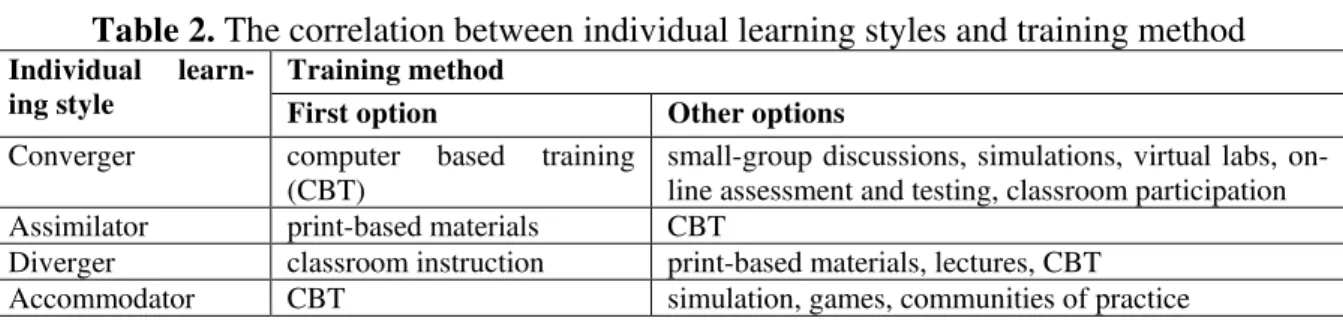
Table 2. The correlation between individual learning styles and training method Individual
learn-ing style
Training method
First option Other options Converger computer based training
(CBT)
small-group discussions, simulations, virtual labs, on-line assessment and testing, classroom participation Assimilator print-based materials CBT
Diverger classroom instruction print-based materials, lectures, CBT Accommodator CBT simulation, games, communities of practice
Also, based on Kolb’s LSI, Simon conducted a study to reveal the existence of a direct link between the individual learning style and the training method. His study showed that this correlation has a direct impact on the user’s performance [7] [29].
In an ERP system implementation it is likely to encounter users with all four learning styles Kolb described. Applying training me-thods that are not correlated with the individ-ual learning styles will probably be rejected by the ERP systems users.
To conclude, the individual learning style and the training method have a significant impact on the organization’s members per-formance during the implementation process of an ERP system and therefore major impli-cations on the quality of use of the ERP sys-tem in general, which can lead to fatal conse-quences to the whole ERP implementation project.
3 ERPTraining system framework
In the attempt to personalize the training and education of ERP system users during the implementation process and after, we state that this cannot be achieved by applying one training method, but several, because the training necessities are diversified from dif-ferent perspectives: time, space, individual learning style and learning content. The mix of training methods has as primary purpose to reach the training program goals by apply-ing technologies that can promote the perso-nalization of the training activity and a prop-er knowledge and skills transfprop-er to the right user at the right time. By mix of training ac-tivities we understand a combination of sev-eral training methods categories: synchron-ous and asynchronsynchron-ous, on-the-job, on-site off-the-job, and off-site off-the-job [10],
in-dividual and collaborative, structured or not. In order to meet the training goals an organi-zation has to possess the means and know-ledge necessary to provide an effective in-struction to his members.
By studying the IS literature we compiled that a major part of the initial investment made in the training activity of an ERP sys-tem implementation project is centered on the end users training, thus this paper focus is to provide a computer based training method that aims to diminish the training activity significant resource consumption.
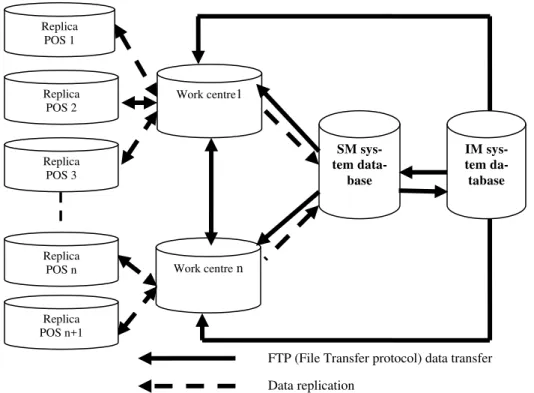
Fig. 1. The data transfer mechanism from the SM to the IM (Inventory management) system.
The system we propose will be developed us-ing the same technology used to develop the SM module and a replication technology to ensure the training data real time access. The replication mechanism [25] will function in an asynchronous manner, bidirectional be-tween the replicas and the SM module data-base and the ERPTraining system datadata-base. We designed the entire ERPTraining system using UML (Unified Modeling Language) technology and created all the necessary models to reinforce the idea that personalized training in a Romanian ERP environment is not a utopia. This system is design to:
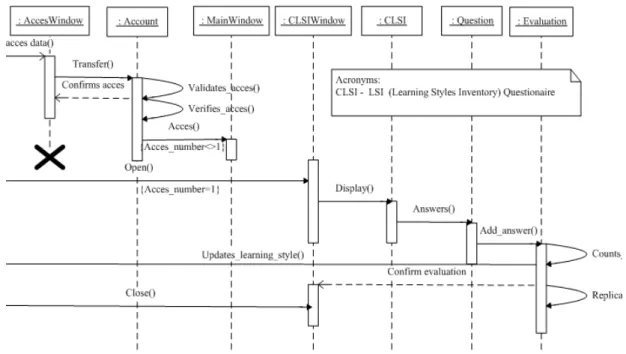
Automatically evaluate the individual learning style of each user by applying Kolb’s Learning Style Inventory as de-picted in Figure 2
Automatically deliver a training method adapted to the user’s role and individual learning style;
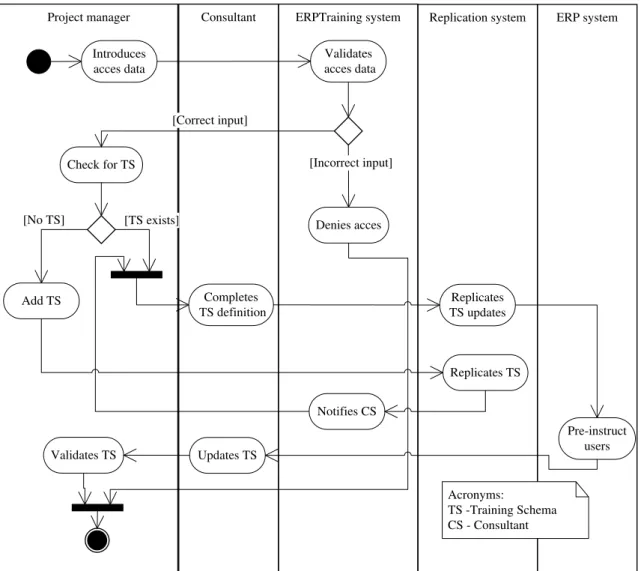
Allow the ERP training project manager to define any training method and attach to it training schemas (TS) for each busi-ness process users should be able to un-derstand;
Allow the user to automatically view the
training schema documentation (made by a consultant and sent via FTP) which will guide him in order to properly select the fix and variables parameters and introduce data in the ERP system in a correct man-ner; a training schema provides a standard that the user should follow while introduc-ing a specific business process data in the ERP system. A training schema is defined by fix and variables parameters. The fix ones represents a mandatory selection that a user should make while introducing data and a variable parameter depend on the selection of one or more fix parameters or other constraints stipulated for a certain business process.
While the user is operating the ERP sys-tem will automatically detect any excep-tions from the training schema the user is generating while introducing data; any document the user is processing will be validated in the ERP system only if the data was introduced in the ERP system according to the training schema standard, otherwise the document will be invali-dated and the user will be informed about the mistakes he made;
SM sys-tem
data-base
IM sys-tem da-tabase Replica
POS 1
Replica POS 2
Work centre1
Work centre n
FTP (File Transfer protocol) data transfer
Data replication Replica
POS 3
Replica POS n
Fig. 2. Applying Kolb’s theory in the ERPTraining system. Automatically evaluate the users learning style.
Allow the exceptions from the training schemas to be replicated from the ERP system database to the ERPTraining data-base using a replication system;
Allow the real time monitoring of the cost and time it takes a consultant to teach an user (for example, if the user wants to par-ticipate in tutorial sessions) or the cost and time a user needs to be trained to use a certain ERP system command;
Provide the ERP training manager and the organization’s management with reports and indicators that show the advances made in the training process in real time. The training schemas will be created by the project manager in the ERPTraining module, and after the replication, will be updated by
ERP system ERPTraining system Replication system
Consultant Project manager
Introduces acces data
Check for TS
Validates acces data
Denies acces [Incorrect input]
[TS exists] [No TS]
Validates TS
Replicates TS Replicates TS updates
Pre-instruct users Updates TS
Notifies CS
Add TS Completes
TS definition [Correct input]
Acronyms:
TS -Training Schema CS - Consultant
Fig. 3. The process of defining a training schema.
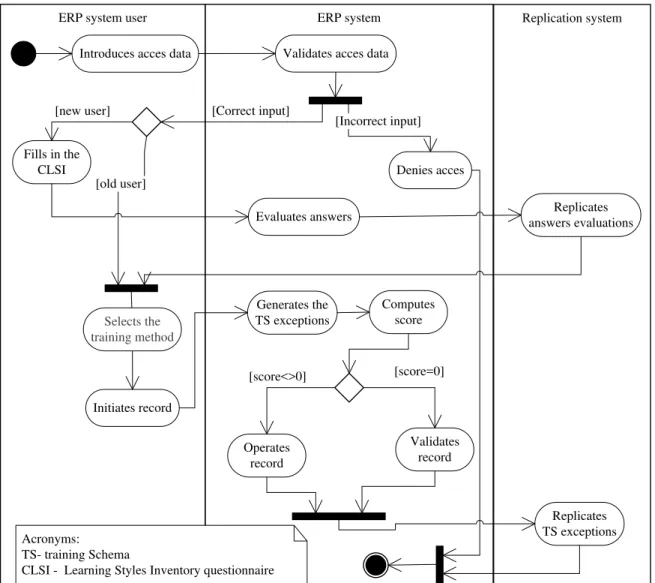
The instruction process takes place as de-scribed in the activity diagram presented in
Replication system ERP system user ERP system
Introduces acces data Validates acces data
[Incorrect input]
Fills in the CLSI
[Correct input] [new user]
Replicates answers evaluations Evaluates answers
Initiates record
Replicates TS exceptions Computes
score
Operates record
Validates record [old user]
[score=0] Generates the
TS exceptions
Selects the training method
Denies acces
Acronyms: TS- training Schema
CLSI - Learning Styles Inventory questionnaire [score<>0]
Fig. 4. The ERPTraining system instruction process.
The ERPTraining system was designed in order to provide the following features when implemented:
• Indicators and reports for the organiza-tion’s management members, that will help them:
− Have a clearer evidence of the person-nel professional quality and efficiency; − Apply training methods adapted to the
individual learning styles of the em-ployees;
− Notice if the personnel manifests resis-tance in approaching new business processes;
− Justify in real time the time and the costs for training each employee to use the ERP system;
− Justify in real time the time and the cost for the entire ERP implementation
project;
• Indicators and reports for the ERP training team and project manager, that will help them to:
− Monitor each consultant daily activi-ties;
− Identify the level of experience each consultant has in a certain domain; − Notice possible inaccuracies in the
consultants professional training;
− Compare the level of professional training of consultants;
− Identify domains in which the company requires additional expertise;
− Identify possible improvements in the user training process;
− Properly evaluate the time and costs for new ERP implementation projects based on previous experience;
4 Conclusions
In this paper we highlighted the importance of providing a personalized training during ERP systems implementations in order to en-force the system’s quality of use and there-fore the individual performance of each member of the organization.
We started by marking out the importance of training as a critical success factor in ERP implementation projects, than we addressed several issues concerning the corporate train-ing methods currently used in ERP imple-mentation projects. By studying the advan-tages and disadvanadvan-tages of these corporate training methods we concluded that a proper ERP system training ca not be achieved by implementing only one training method but a mix of training methods.
Afterwards, in order to meet our purpose of delivering a framework for personalized training we focused our attention on Kolb’s ELT because this model was extensively ap-plied in theoretical and empirical studies. We studied several inferences made in IS litera-ture concerning the link established between the corporate training methods and Kolb’s individual learning styles and as a result we attached to each Kolb learning style a predi-lect training method.
Than we focused our attention on developing an ERPTraining system framework that de-monstrates a real possibility of introducing new features on how to achieve a better knowledge transfer in an ERP implementa-tion environment by applying the concepts mentioned before.
We presented several UML diagrams we de-veloped in order to highlight the most impor-tant concepts of the system.
To conclude, this system proposes a signifi-cantly improved alternative of monitoring the training activity in an ERP implementation environment which creates added value for both organizations involved in the implemen-tation process. As future work we propose to develop and implement this SME’s
ERPTraining system.
References
[1] F. Adam, D. Sammon and F. Carton, “Project management for enterprise im-plementations - a case study of successful implementation,” International Journal of Managing Projects in Business, vol. 1, no. 1, pp. 106 - 124, 2008.
[2] M. Boudreau, “Learning to Use ERP Technology: a Causal Model,” in Proc. The 36th Hawaii International Confe-rence on System Sciences (HICSS’03), vol. 8, track 8, pp. 235.2, 2003.
[3] K. Buch and S. Bartley, “Learning style and training delivery mode preference,”
Journal of Workplace Learning, vol. 14, no. 1, 2002, pp. 5-10.
[4] F. Carton, F. Adam and D. Sammon, “Project management: a case study of a successful ERP implementation,” Inter-national Journal of Managing Projects in Business, vol. 1, no. 1, 2008, pp. 106-124.
[5] She-I Chang, “ERP Life Cycle Imple-mentation, Management and Support: Implications for Practice and Research,” in Proc. The 37th Hawaii International Conference on System Sciences, 2004, vol. 8, track 8, pp. 80227.3.
[6] A. Chapman, “David Kolb's learning styles model and experiential learning theory (ELT),” Available: www.businessballs.com.
[7] E. Desmarais and L. Ritchie, “Pedagogy and ERP: Designing Instructional Me-thods for Different Learning Styles,” in
Proc. The Twelfth Annual Conference of the Production and Operations Manage-ment Society, Orlando, Florida, 2001. [8] T. W. Ferratt, S. Ahire and Prabuddha
De., “Achieving Success in Large Projects: Implications from a Study of ERP Implementations,” Interfaces, vol. 36, no. 5, 2006, pp. 458-471.
[9] H. Henke, “Learning Theory: Applying Kolb’s Learning Style Inventory with Computer Based Training,” Course on Learning Theory, 2001.
practices and organizational performance in small and medium size enterprises,”
Education + Training, vol. 43, no. 8/9, 2001, pp. 437-444.
[11] S.C.L. Koh, A. Gunasekaran and J.R. Cooper, “The demand for training and consultancy investment in SME-specific ERP systems implementation and opera-tion,”
International Journal of Production Eco-nomics, vol. 122, no. 1, 2009, pp. 241-254.
[12] T. Karrer, “Training methods trends – E-learning technologies,” 2008, www.elearningguild.com.
[13] A. Kolb and D. Kolb, “The Kolb Learning Style Inventory—Version 3.1, Technical Specifications,” HayGroup Experience Based Learning Systems, Inc., 2005.
[14] V. Kumar, B. Maheshwari and U. Ku-mar, “An investigation of critical man-agement issues in ERP implementation: empirical evidence from Canadian organ-izations,” Technovation, vol. 23, no.10, 2003, pp. 793-807.
[15] V.A. Mabert, A. Soni and M.A. Venka-traman, “The impact of organizational size on enterprise resource planning (ERP) implementation in the US manu-facturing sector,” Omega vol. 31, 2003, pp. 235–246.
[16] N. Manochehr, “The Influence of Learning Styles on Learners in E-Learning Environments: An Empirical Study,” Computers in Higher Education Economics Review, vol. 18, no. 1, 2006, pp. 10-14.
[17] K. Metaxiotis, I. Zafeiropoulos, K. Ni-kolinakou and J. Psarras, “Goal directed project management methodology for the support of ERP implementation and op-timal adaptation procedure,” Information Management & Computer Security, vol. 13, no. 1, 2005, pp. 55-72.
[18] M. Motter-Hodgson, “Meeting the Needs of Diverse Types of Learners,” CyberCorp Inc's newsletter, 1998.
[19] J. Motwani, D. Mirchandani, M. Ma-dan and A. Gunasekaran, “Successful
implementation of ERP projects: Evi-dence from two case studies,” Interna-tional Journal of Production Economics, vol. 75, 2002, pp. 83–96.
[20] J.R. Muscatello and I. J. Chen, “Enter-prise resource Planning (ERP) Implemen-tations: theory and Practice,” Interna-tional Journal of Enterprise Information Systems, vol. 4, no. 1, 2008, pp. 63-78. [21] A. Noudoostbeni, N. A. Ismail, H. Ss
Jenatabadi and N. M.Yasin, “An Effec-tive End-User Knowledge Concern Training Method in Enterprise Resource Planning (ERP) Based on Critical Factors (CSFs) in Malaysian SMEs,” Interna-tional Journal of Business and Manage-ment, vol. 5, no. 7, 2010, pp.63-76. [22] P. Ifinedo, B. Rapp, A. Ifinedo and K.
Sundberg, “Relationships among ERP post-implementation success constructs: An analysis at the organizational level,”
Computers in Human Behavior, vol. 26, no. 5, 2010, pp. 1136-1148.
[23] D. Robotham, “Self-Directed Learning: The Ultimate Learning Style?,” Journal of European Industrial Training, vol. 19, no. 7, 1995, pp. 3-7.
[24] Scorţa, “Critical success factors in Ro-manian SME’s ERP implementation,” in
Proc. The 3rd International Workshop IE&SI Timişoara, 2006, pp. 308-315. [25] Scorţa, “The replication mechanism in
a Romanian ERP system environment,” Revista Informatica Economică, vol. 12, no.1, 2008, pp. 140-146.
[26] Scorţa, A. Andreescu and A. Uţã, “Ap-plying Blended Learning in ERP Train-ing,” in Proc.The 5th E-Learning and the Knowledge society International Confe-rence, Berlin, Germany, 2009, pp. 121 – 126.
[27] J. E Scott, “Post-implementation usabil-ity of ERP training manuals: the user's perspective,” Information Systems Man-agement, vol. 22, no. 2, 2005, pp. 67-78. [28] S. L. Shivers-Blackwell and A. C.
Charles, “Ready, set, go: examining stu-dent readiness to use ERP technology,”
[29] S. J. Simon, “The Relationship of Learning Style and Training Method to End-User Computer Satisfaction and Computer Use: A Structural Equation Model,” Information Technology, Learn-ing, and Performance Journal, vol. 18, no. 1, 2000, pp. 41-59.
[30] T. Somers and K. Nelson, “The Impact of Critical Success Factors across the Stages of Enterprise Resource Planning Implementations,” in Proc. The 34th Ha-waii International Conference on System Sciences, 2001, vol. 8, pp. 8016.
[31] S. Sternad and S. Bobek, “Factors which have fatal influence on ERP im-plementation on Slovenian organiza-tions,” Journal of information and orga-nizational sciences, vol. 30, no. 2, 2006, pp. 279-293.
[32] W. Tsai and S. Hung, “E-Commerce Implementation: An Empirical Study of the Performance of ERP using the Orga-nizational Learning Model,” Internation-al JournInternation-al of Management, vol. 25, no. 2, 2008, pp. 348-352.
[33] E. Valkanos and I. Fragoulis, “Expe-riential learning – its place in in-house education and training,” Development and Learning in Organizations, vol. 21, no. 5, 2007, pp. 21-23.
[34] A. Vincent and D. Ross, “Personalize training: determine learning styles, per-sonality types and multiple intelligences online,” The Learning Organization, vol. 8, no. 1, 2001, pp. 36-43.
[35] E.T.G. Wang, S.P. Shih, J.J. Jiang and G. Klein, “The consistency among facili-tating factors and ERP implementation success: A holistic view of fit,” Journal of Systems and Software, vol. 81, no. 8, 2008, pp. 1609–1621.
[36] E. Wang and J. Chen, “Effects of internal support and consultant quality on the consulting process and ERP system quality,” Decision Support Systems, vol. 42, 2006, pp. 1029–1041.
[37] J. Wu and Y. Wang, “Measuring ERP success: the ultimate users' view,” Inter-national Journal of Operations & Pro-duction Management, vol. 26, no. 8, 2006, pp. 882-903.
[38] R. E. Yellen, “A New Look at Learning for the Organization,” Information Tech-nology Newsletter, vol. 17, no. 2, 2006, pp. 29-31.
Iuliana DOROBĂŢ has graduated the Faculty of Economic Studies, Uni-versity “Dunãrea de jos”, Galaţi in 2002. She holds a PhD diploma in Ec o-nomics from March 2010. She is an ERP system consultant and from 2005 she joined the staff of the Bucharest Academy of Economic Studies, teach-ing. Currently she is an assistant within the Department of Economic Infor-matics at the Faculty of Cybernetics, Statistics and Economic InforInfor-matics from the Academy of Economic Studies. She is the author of 20 papers in the field of information systems published in national and international journals or conference proceedings. She was a research member in 5 national and international research projects. Her work focuses on the analysis of ERP systems implementations.
Floarea NĂSTASE is a professor at the Economic Informatics Department