(1995-2014): advances and dilemmas
Pedro Cavalcante
Instituto de Pesquisa Econômica Aplicada (Ipea) Brasília / DF — Brazil
Paulo Carvalho
Fundação Oswaldo Cruz (Fiocruz) Brasília / DF — Brazil
he paper analyzes the professionalization process of Brazilian federal bureaucracy, aiming to uncover advances and persistent dilemmas that have been present in Brazil’s recent democratic period, between 1995 and 2014. Following a literature review of the historical evolution of federal bureaucracy, the paper discusses key dimensions related to the professionalization of the public service. It concludes that there was a wide range of advances with regard to recovery and diversiication of the workforce, inancial valuation, and training, among others. However, dilemmas and challenges remain, especially related to the historical gap between careers and positions in federal public administration.
Keywords: bureaucracy; professionalization; reforms; federal government; Brazil.
Profissionalização da burocracia federal brasileira (1995-2014): avanços e dilemas
O objetivo deste artigo é analisar o processo de proissionalização da burocracia brasileira no âmbito da adminis-tração pública federal. Nesse sentido, a pesquisa se propõe a responder quais seriam os avanços e dilemas persis-tentes no período democrático recente, entre 1995 e 2014. Após uma revisão de literatura da evolução histórica da burocracia federal, o trabalho discute dimensões centrais relativas à proissionalização do serviço público no país. Conclui-se que houve um conjunto amplo de avanços no que tange a recomposição e diversiicação da força de trabalho, valorização pecuniária, aumento da qualiicação, entre outros. Todavia, permanecem dilemas e de-saios, sobretudo, no enfrentamento do fosso histórico entre carreiras e cargos na administração pública federal. Palavras-chave: burocracia; proissionalização; reformas; administração pública federal; Brasil.
La profesionalización de la burocracia federal brasileña (1995-2014): avances y dilemas
El objetivo de este trabajo es analizar el proceso de profesionalización de la burocracia brasileña del gobierno federal. En este sentido, la investigación pretende responder cuáles son los avances y dilemas persistentes en el período democrático reciente entre 1995 y 2014. Después de una revisión de la literatura sobre la evolución histórica de la burocracia federal, el articulo analiza las dimensiones clave relacionadas con la profesionalización del servicio público de país. De ello se concluye que existe una amplia gama de avances con respecto a la recuperación y la diversiicación de la fuerza laboral, la valoración inanciera, el aumento de la formación, entre otros. Sin embargo, los dilemas y desafíos permanecen, sobre todo para hacer frente a la brecha histórica entre carreras y puestos en la administración pública federal.
Palabras clave: burocracia; profesionalización; reformas; gobierno federal; Brasil.
DOI: http://dx.doi.org/10.1590/0034-7612144002
1. INTRODUCTION
he main purpose of this article is to analyze the professionalization process of Brazilian federal bureaucracy. he paper discusses the historical formation of the country’s public service focusing foremost on recent changes that have impacted the professionalization of federal bureaucracy. he research attempts to describe the current coniguration of Brazilian federal bureaucracy in order to analyze if changes implemented by democratically elected governments (1995 to 2014) have advanced on the improvement of bureaucracy and if they overcame the history of inequalitiesinside the federal executive personnel.
he word bureaucracy may be understood in many diferent ways. In this paper, bureaucracy refers to the state’s permanent personnel, namely non-elected government agents, career membersor not. Bureaucracy is one of the institutional pillars for the eicient functioning of the democratic system and for the enforcement of the rule of law, because it enables continuity, coherence and relevance in public policies and reassures greater impartiality and objectivity to public authority (Stein et al., 2006). On the other hand, its fragility lead to inefectiveness and misuse of public funds, commonly seen in Latin American countries.
In such context, the seminal work by Evans and Rauch (1999) analyzes the relation between bureaucracy, using a ‘Weberian scale’ that measures meritocratic recruitment and career structures, and the economic growth of 35 developing nations between 1970 and 1990. Results suggest a strong correlation between weberian bureaucracy characteristics and higher growth rates in Gross Domes-tic Product (GDP) in analyzed countries. he case of the so-called Asian Tiger nations relects this connection very well, considering that highly professional and meritocratic bureaucracy in strong and independent countries are regarded as decisive factors in the development of these nations (Stein et al., 2006).
It is important to highlight that, despite its fundamental role, bureaucracy is subordinated to the government, elected or not. Nevertheless, its degree of autonomy, which varies according to the merit system — adoption of impersonal and inlexible rules for career admission and advancement —, stability and adequate wage tend to relect on the bureaucratic capacity to develop and implement public policies (Abrucio, Loureiro and Pacheco, 2010). In other words, higher autonomy means lower chances of arbitrary acts or interference of politicization and particularism.
In the three decades that followed the reinstatement of democracy in Brazil, the country has been living a growing strengthening of the attributions of the democratic state, with contradictions and difering levels of maturity between the various areas of public administration, and federal, state and municipal domains.
However, this is not an absolute concept; contrarily, bureaucratic evaluations are relative, es-pecially because the level of development greatly varies between diferent countries and historic moments. Brazil is not an exception. What explains, then, the professional development of federal bureaucracy? If, on the one hand, literature describes Brazilian federal bureaucracy as profession-al, on the other hand, the history of the public service in Brazil points to the old dilemma of the gap in skill and valuation levels within public servants. In order to better understand the current scenario, this article will debate the historic development of federal bureaucracy and investigate the efects of recent changes.
A timeline analysis will demonstrate that, since the beginning of the democratization process (1985), public service has been passing through many and deep transformations. It includes a managerial reform in the 1990’s, and more recently, the restructuring of the state apparatus under a discourse of restoring national development. he period is marked by a relative inancial stability, broader access to public welfare policies (as proposed by the 1988 Constitution) and expansionist policies that strengthened the domestic market and reduced poverty and social inequality.
In order to analyze the evolution of Brazilian federal bureaucracy during this period, the research will focus on the following dimensions: admission and composition of personnel, wage policies, performance evaluation, appointment of non-elected agents and education/skill level. Regarding the latter dimension, it is appropriate to analyze the role of government schools in the improvement of speciic careers in federal public administration and in the technical-managerial development of the wide range of agents engaged in the public policies led by federal government.
Besides this introduction, the article adopts an objective approach to the historic evolution of the professionalization of public service in the country, in order to contextualize the current conigura-tion. Subsequently, key variables are analyzed, from 1995 to 2014, such as the evolution of personnel composition and admission, wage policies, performance evaluation systems, occupancy of political appointments, among others. Lastly, inal considerations on the advancements and dilemmas found in the professionalization process of Brazilian public administration are presented.
2. THE HISTORY OF BUREAUCRACY IN BRAZIL
Evidently, the institutionalization of personnel is not a consequence of a single historic moment or a decision of one particular government. Instead, the complexity inherent to the bureaucratic makeup of a nation involves a broad set of transformations susceptible to socioeconomic changes that will not necessarily converge, from an ideological point of view. herefore, a situational analysis intend-ing to explain the makeup of a bureaucracy should refer to its historic evolution, once it regards a development process with several variables.
It is worth noting that, in spite of the transformations that Brazilian bureaucracy went through, even though it has a positive evaluation in international comparisons, many negative secular aspects are still noticeable today.
Crown, to a great extent, restricted itself to collecting taxes, while leaving the responsibility of public administration to local politicians, as Carvalho (2011:1) exposed very well:
Collection was the basic function of the civil service, which took a delegated form, meaning that the Crown transferred public afairs to the local powerful. hose, in term, regardless of not being Crown oicials, had the power to make political appointments, within boundaries set by the Crown.
he power of the local clans in the conduction of public afairs involved making political appoint-ments, which was considered an honor and also a strategy for coopting the so-called “good man”. Without any merit-based criteria, the structure of public administration was, therefore, an extension of the power that the clans held, along with their economic and military dominance. (Viana, 1999; Leal, 2012).
Despite some changes, introduced by the reforms promoted by the Marquis of Pombal, secretary of state of the Portuguese kingdom between 1750-77, in the XVIII century, it was when the Portu-guese Crown moved to Brazil, in 1808, that the construction of a national state began, especially of a new Brazilian elite. he need for structuring the bureaucracy was the natural consequence of the advancements in construction work and caused the creation of new political agencies, which was intensiied ater the independence, with the challenge of building national unity and sovereignty (Carvalho, 2011).
Over this period, the seeds of the workings of the Brazilian state started to appear. he bureau-cracy of the Empire was little efective and mostly featured as a tool for the practice of grooming and clientelism. he power of the oligarchies in command of the public oices was somewhat altered, relecting on the stable character of oice occupancy, which varied according to the composition of the Parliament and of the State Council, in detriment of factors such as technical skill.
Conversely, the development of a bureaucratic elite selected by merit, with uniform educational background, mostly conducted in Europe, started taking place. However, the small amount of meri-tocracy of the public administration entry method was still very far from the weberian classic model. Essentially, the so-called “literate elite”, comprised mostly by lawyers, engineers and medical doctors (Viana, 1999), became more inluent in the Brazilian state and existed along another segment of bureaucracy, one with a less skilled proile and a strong patrimonial component (Faoro, 1958).
With the proclamation of the Republic, in 1889, there was anticipation of change in the public administration, considering the discourse of revolutionary modernization of the period. However, the First Republic (1889-1930) is marked by the weakening of the Brazilian state, especially in the federal level. With political power in the hands of state governors, the subnational patronage prevails, via leadership of local rulers, known as “colonels” (Leal, 2012), in detriment of the professionalization of bureaucracy, exception made for the military and diplomatic careers.
In terms of proportion of the workforce, in the First Republic, rural population was predominant, with little demand for public services. Governmental action was very limited and relected a period of reduced public employment, as exposed by Carvalho (2011:42):
collection of taxes and maintenance of public order in urban centers were prioritized, granting a secondary place to services such as post oices and telegraphs, schools, hospitals and isolated colleges, in which services provided were very speciic and restricted to large cities.
As an example, between 1872 and 1920, the ratio between public and military servants and the population rose from 0,37% to 0,6%, a very small fraction when compared with current standards or with developed nations (OECD, 2010). Besides the inexistence of swelling in the bureaucratic apparatus, two other characteristics were maintained in the transition between the Empire and the Republic: i) the persistence of public service admission based on personal criteria; and ii) the elitism of highly qualiied and highly remunerated civil servants in top government oice (Graham, 1968).
Ater more than 100 years as a sovereign nation, only in the 1930’s, Brazilian public administration begins its reform process. Societal and governmental changes connected to the transition from a more agricultural to a more industrial country and, consequently, to a nationalist economical development project, demanded the modernization of the state apparatus, in order to introduce the necessary changes (Lustosa, 2008; Torres, 2012).
During the irst term of president Getúlio Vargas, from 1930 to 1945, a wide range of public agen-cies, moreover in the productive sector, such as Vale do Rio Doce and he National Steelworks Com-pany were created. In addition, the State also acted towards restructuring public services. he public administration reform proposal had as a main guideline the professionalization of the bureaucracy following the weberian model. In order to implement such changes, a few rules were adopted, with the intention of valuing merit-based federal government personnel, such as: competitive tendering, job stability and career plans.
A signiicant share of those changes was developed ater the creation of the Public Service Ad-ministration Department (Dasp) in 1938, with the main purpose of promoting bureaucratic ratio-nalization of the public service, having great inluence from the organization of the North American civil service (Carvalho, 2011). According to Abrucio, Loureiro e Pacheco (2010:36), “a bureaucracy was, at once, created aiming development, institutionally linked to merit and universalism, and being the irst one capable of producing public policies in a larger scale”.
However, the efects of the administrative reform in the Estado Novo (1937-45), even though valuable in its eforts to overcome secular patrimonialism in search for more rational and eicient standards of public administration, did not meet their initial goals. Undoubtedly, it meant a signiicant change; nonetheless, many obstacles for implementing a universal merit-based system derived from the ambiguous ways in which president Vargas handled the national oligarchies. he occupancy of public oice via public tender was far inferior to the number of political appointments. Consequently, some careers and agencies became bureaucratic insulations, merit-based and qualiied, very distinct from the majority of the public service.
he main policy, in a context of state economic intervention, involved a wide decentralization process or, more precisely, a dispersal of the activities in direct administration agencies.Strategic planning and coordination activities become priorities, aiming to incentive managerial lexibility, especially for indirect administration. In this regard, some careers were created founded in merit-based principles, besides modifying public service statute from the regimented form to general consolidated labor laws, with labor rules more similar to the private sector (Carvalho, 2011; Torres, 2012).
Despite the advancements in public sector occupancy, this reform reinforced the gap between the technocratic and modern State of indirect administration and the bureaucratic, formal and lagged State of direct administration. Not by chance, the insulation process was intensiied, which was very well characterized by the bureaucratic rings phenomenon. his phenomenon involves the establishment of negotiation liaisons between Government and the interests of certain civil society groups, with the peculiarity of not characterizing genuine and independent lobby groups, but actually taking part in the state apparatus, usually under the leadership of a State employee (Cardoso, 1973).
he re-democratization, started in 1985, brought some important advances regarding the pro-fessionalization of the public service. Among them, it’s worth highlighting the universalization of the public tender principle as means for admission in public service and the establishment of the
RJU (Single Judicial System), both instituted by the Federal Constitution of 1988. he latter extends to autarchies and foundations the stability already existing for the servants in direct administration. Furthermore, the creation of governance schools, such as Enap (National School of Public
Adminis-tration) and Cedam (Center for the Development of Public Administration), both linked to the Human
Resources Secretariat, indicating a growing concern with the training and qualiication of State per-sonnel, previously never treated as a priority.
Ater a period of few relevant changes in the Fernando Collor (1990-92) and Itamar Franco (1002-94) administrations, the Fernando Henrique Cardoso mandate begins with a reformist discourse, associating the continuity of inancial stability and economic growth recovery with a process of ad-ministrative reform geared towards more eiciency in the public sector (Souza, 2001).
Based on the internationally widespread propositions of the new public management (NPM), especially in developed nations, the reformist project proposed a rearranging of the State’s interven-tion scope and the overrun of the bureaucratic public administrainterven-tion model, allegedly ineicient and surpassed by crony and not enough universal interests, by the managerial model. In short, Carneiro and Menicucci (2011:10) described the new public management (NPM) as:
A label, given by consultants to deine the reforms in the public sector in order to emphasize the common elements with a model that attacked the core of the basic progressive public admin-istration principles, especially substituting the emphasis on general rules by the emphasis on results. hese transformations are attached to the political and ideological movement, with roots in economy concepts, of proposals and actions in the sense of a Government reform.
was a State crisis. Besides reducing State activities, via privatizing and publicizing some sectors, the operation of the so-called strategic core was intended to have a regulatory role and be guided by the management model of public administration (Matias-Pereira, 2008; Brazil, 1995). herefore, instead of the inlexibility and ineiciency that were a mark of the administrative machinery, the public service would turn to a result based management format, similar to that of the private sector.
In practical terms, the central axis of the institutional changes was embodied in the no 19 Consti-tutional Amendment from 1998, except for the privatizing endeavors and the deriving establishment of regulatory agencies, in institutional terms (Carvalho, 2011), the results of the other changes proposed by the State reform were less efective, especially in the structural evaluation (rationalization) and in the creation of executive agencies (lexibility) and social organizations (publicization).
Similarly to other international experiences (Pollit and Bouckaert, 2011), the Brazilian management reform did not transform the workings of the state apparatus, as the PDRAE announced. he project lead by the Minister of Federal Administration and State Reform, Bresser-Pereira, is defended as a broad strategy for strengthening the composition of the State’s permanent personnel (Bresser-Pereira, 1996; Pacheco, 2010). Regarding the professionalization of the public service, the Plan focused on promoting the strategic core, in other words, strengthening State careers, in both qualiication and wages (Pacheco, 2010).
Ater approving the 1995 reform and the presidential alternation, in 2003, the government did not present a irm proposal of administrative reform. On the contrary, the period was marked by constant critique of the reformist wave, especially of the idea that a reduced state machinery was necessary to overcome the State iscal crisis. he debate meant to go beyond the dichotomy between minimal and maximal State. he constant demand for economic development, overcoming historic infrastructure obstacles, the pressure towards social security and the discourse of the paying the Brazilian “social debt” — to address poverty and inequality — required a bureaucracy not only quantitatively, but also qualitatively, able to face those challenges. As in the Lula government (2003-10), the Dilma Roussef mandates (2011-14) also did not adopt an oicial reformist discourse, although both implemented a set of measures regarding personnel management. During this period, however, the topic remained present in the public agenda, especially due to a strong pressure from public servant trade unions for personnel restitution and better wage conditions.
In this respect, the present work seeks to deepen the understanding of the result, in terms of bureaucracy professionalization, of the policies of ive presidential administrations (FHC, Lula and Dilma), from 1995 to 2014, and thereby answer the following question: what are the advancements and dilemmas from the period that remain in federal public administration?
In order to approach the professionalization process of the bureaucracy in the period, this article analyzes the following variables: i) personnel and admission; ii) wage policies in the public sector; iii) performance evaluation; iv) political appointments; and v) education and qualiication.
2.1 EVOLUTION IN PERSONNEL AND ADMISSION
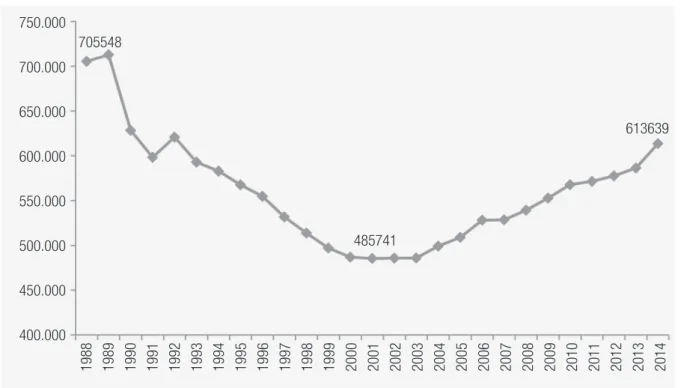
he irst relevant variable to examine personnel is the quantitative analysis of active civil servants in the Executive Power. Considering the crucial role that the 1998 Federal Constitution played in the structuring of personnel, Graphic 1 illustrates this evolution from this date until de end of 2014.
GRAPHIC 1 QUANTITATIVE EVOLUTION OF ACTIVE CIVIL SERVANTS IN THE EXECUTIVE POWER (1998-2014)
750.000
700.000
650.000
600.000
550.000
500.000
450.000
400.000
1988 1989 1990 1991 1992 1993 1994 1995 1996 1997 1998 1999 2000 2001 2002 2003 2004 2005 2006 2007 2008 2009 2010 2011 2012 2013 2014
705548
485741
613639
Source: Brazil (2015). Speciically developed.
he data clearly portray a strong quantitative reduction process in federal government between 1989 and 2000, declining from 700 thousand servants to less than 500 thousand servants. Among the main explanations, it is worth highlighting the intensiication of the privatizing eforts and the subnational government decentralization process in several public policy areas. Furthermore, there is a strong pressure form retirements, considering that between 1995 and 2003 it surpasses the number of 20 thousand retirements per year, exactly in the two periods of social security re-form (1998 and 2003) which caused a “rush” to retirement due to the uncertainty regarding the alteration of established rules. he phenomenon is dampened from 2004, when the average drops by half (Brazil, 2015).
annual admission rate between 2003 and 2014 is higher than 21 thousand, meanwhile between 1995 and 2000 the average quantitative of entering servants revolved around 8,5 thousand1 (Brazil, 2015).
he argument, frequently fostered by public opinion, of swelling of the public machinery, does not ind and empirical basis, considering that, even with the process of personnel replacement ater 2003, the current quantitative amount is still very far from what it was 25 years ago. It is important to point out that, in the meantime, the federal government expanded its activity scope, especially in social policies, in agreement with what is disposed in the Federal Constitution. In addition to that, OECD data demonstrate that public employment in Brazil, considering the three government levels, revolves around 11%, while this average revolves around twice this percentage in countries that are members of the organization.2
Another interesting aspect of the period involves the distinct changes in the career and position proiles that have been accepted since 1995. Data from the Personnel Statistic Report (Brazil, 2015) conirm that, during the process of implementing the management reform (1995-2000), admission in careers inside the strategic core were prioritized,3 in consonance with the PDRAE (Directive Plan for the Reform of the State Apparatus). hose careers correspond to around 25% of all admissions, while the average for the period from 2003 to 2014 is around 10%. However, if in the irst moment admission was restricted to only 14 careers/positions, in a second moment there was signiicant di-versiication. Besides the aforesaid number, another 34 careers/positions weather formerly or recently created, received new admissions.
In sum, two diferent moments can be in fact observed regarding the structuring of the workforce in the federal Executive, which relect diferent political strategies and the inluence of the economic environment as well as the changes in the social security rules. he reconstitution of personnel ater 2003 is, to a certain extent, inluenced by the government’s expansionist policies that relected on measures to intentionally strengthen State capacity in order to face the challenges of national de-velopment, what can justify, for example, the creation of the careers of infrastructure analyst, social policies analyst and regulation specialist.
2.2 WAGE POLICIES IN THE PUBLIC SECTOR
Wage policies in the public sector are a deining aspect in the understanding of the professionaliza-tion of bureaucracy. Besides being the greatest pecuniary incentive, the salary can also be analyzed in regards to the valuation of the public servant. An adequate wage policy tends to play a fundamental role in attracting good professionals, competing with the private sector.
Due to the complexity of the public sector, especially in the Brazilian Federal Executive power, dozens of diferent positions coexist. herefore, it is natural for a salary hierarchy to exist (wage framework) in the public sector, which, according to Marconi (2010), is usually inluenced by: i) the complexity of the duties; ii) required skills; iii) inherent responsibilities; iv) performance.
1 Given the inconsistencies of the data referring to the years of 2001 and 2002, the choice was to exclude information from BEP regarding
such years.
2 It is important to be cautious about international comparisons whenever considering diferent political and institutional structures
such as the type of government, if unitary or federal, the distinction between civilian and military personnel and what is pertinent to all Powers or speciic to one.
Nonetheless, those variables are rarely precisely and transparently measured and compared. Additionally, inancial and budgetary availability, the political pressure of corporations, weather in large scale or with access to high oice, as well as the strategies for personnel management policies are decisive in determining wage composition.
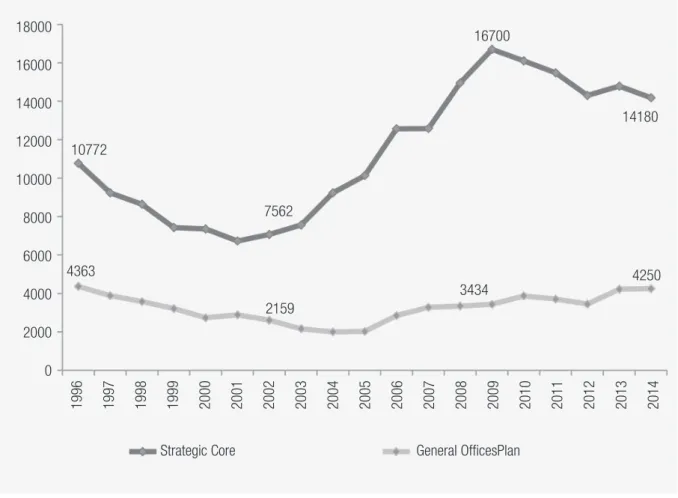
In order to analyze the adopted wage policies, Graphic 2 portrays the evolution of the average income of the two main groups of active civil servants, strategic core careers and PCC (Oices and Careers Pan), later altered to PGPE (Federal Executive General Personnel Plan), using the initial salary as reference. Even though both correspond to higher education careers, they correspond to the two extremes of the federal wage policy.
GRAPHIC 2 EVOLUTION OF AVERAGE WAGE FOR ACTIVE CIVIL SERVANTS IN THE EXECUTIVE POWER, 1996-2014 (R$ ADJUSTED BY THE IPCA)4
18000
16000
14000
12000
10000
8000
6000
4000
2000
0
1996 1997 1998 1999 2000 2001 2002 2003 2004 2005 2006 2007 2008 2009 2010 2011 2012 2013 2014
10772
7562
14180 16700
4363
2159
3434 4250
Strategic Core General OfficesPlan
Sources: Brazil (2015) and IBGE (2016). Speciically developed.
he data indicates very diferent wage policies. he irst relevant aspect is the fact that, in spite of prioritizing recruitment for strategic core careers, in terms of salary, those servants have faced a decrease in purchase power. he reduction, between 1996 and the end of the political term (2002), is of around 35% — ive percent lower than the income loss of the PGC personnel.
he situation changes with governmental wage policies between 2003 and 2009. With a strong valuation of the strategic core careers, also known as typical careers, which obtained an increase of approximately 230% in their actual income igures. Since 2010, however, the nominal increases for those careers haven’t been able to stand up against inlationary depreciation, causing loss in purchase power. On the other hand, civil servants in the PGC careers didn’t have any income readjustment until the year 2005. Yet, in the last 10 years readjustments have exceeded 80%.
he discourse, at this point, involved not only the valuation of the public service, but also the need to meet the incomes in the private sector. It is important to also consider the pressure from the labor unions, historically connected to the Labor Party (PT), in this process of wage increase for federal public servants. Furthermore, the policy of constant wage increase relects, to a great extent, a moment of growth in the GDP, especially between the years of 2004 and 2010.
Regardless of the advancements in the valuation of public servants, the wage gap presents itself as an important dilemma. Until 2002, the average wage of the PGC revolved around 40% of the av-erage wage of the strategic core careers. Nonetheless, this diference has increased substantially in the following years. hat supports the idea of a greater valuation of the typical careers, which also started to receive ixed bonusesinstead of variable salaries, as we will see in the following topic. In the last ive years analyzed, the gap once again decreases, going back to the 29% threshold observed in 2003, due to improvements in the PCG position wages and to the actual depreciation of the wages in the strategic core positions.
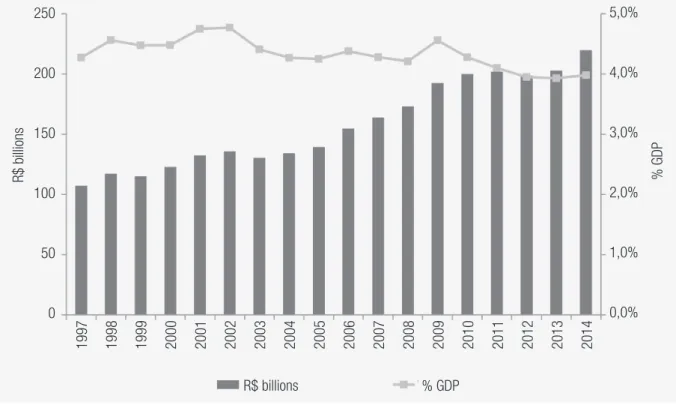
Naturally, wage policy is not only deined by the inancial and budgetary context of public inances and by economy growth, but it also exerts an impact in both of those variables. In this sense, public personnel costs must be analyzed in terms of their sustainability. Graphic 3 demonstrates the evolu-tion of such expenses between 1997 and 2014. With delated values, the bars represent the evoluevolu-tion of expenses in absolute values (R$ billions), while the lines represent the percentage of GDP taken by those expenses.
he irst interesting point is the relative stability of the expenses when using the GDP as ref-erence. During this timeframe, expenses do not go beyond the 5% threshold. It is also possible to observe that an expressive increment in payment, as seen in frame 2, has a strong impact in absolute terms, raising expenses by around 70 billion between 2003 and 2010. However, when compared to the GDP, the percentage remained stable, mostly because of the years with signiicant economic growth. Unlike the last four years, when the decrease in GDP growth is relected in the expenses with personnel.
GRAPHIC 3 EVOLUTION OF FEDERAL EXPENSES WITH PERSONNEL — 1997 TO 2014 (R$ ADJUSTED BY THE IPCA INDEX)
250
200
150
100
50
0
1997 1998 1999 2000 2001 2002 2003 2004 2005 2006 2007 2008 2009 2010 2011 2012 2013 2014
R$ billions
5,0%
4,0%
3,0%
2,0%
1,0%
0,0%
R$ billions % GDP
% GDP
Sources: STN (2016) and IBGE (2016). Speciically developed.
2.3 PERFORMANCE EVALUATION
Inside the public service, performance evaluation is a very complex matter, which relates not only to wage value, but has also a central role in the debate concerning valuation and professionalization of the public administration. he topic becomes even more relevant when considering the recent changes in the settings of public administration discussed in the previous topics. With the processes of recomposing the workforce, reorganizing careers and growing wage adjustments, evaluating the performance of the public worker is an essential management mechanism in order to deal with the many purposes, such as admittance ater probative internship, career development, promotion and gratiications. But what is the concept of performance evaluation? According to Balassiano and Salles (2004:6):
his is of course a very broad perspective, which, logically, is not always seen in a positive way. If on the one hand some say that it has contributed to the achievement of several goals, such as trans-parency in costs and results, improvement on the quality of the services and employee motivation (Goldsmith and Efers, 2006), on the other hand, critics say that simply transferring practices from the private sector might bring more problems than solutions.
Still, like what has been happening in developed nations, the practice has been growing signiicantly in Brazil in the last decades. In the federal government, the initiative that created the foundation for the current performance evaluation system appeared in the 1970’s, with Law 5,645, from 1977, and its regulatory decrees. he regulations established career development guidelines for civil servants in direct administration (Velasco and Silva, 2010).
With Law 8,112, from 1990, the performance evaluation becomes mandatory for admission after the probative internship. The topic is also embedded in the Federal Constitution (Amend-ment no 19, form 1998), which even widens the possibilities of removal from a public servant position, in the event of unsatisfactory performance; however, this provision never advanced as planned.
Starting in 1995, a process of multiplication of the evaluation systems speciically directed to the deinition of bonuses and gratiication of public servants took place. In fact, according to Velasco and Silva (2010), they began to sufer distortions over the years as they started to pay ixed bonuses, due to obstacles in implementing eicient evaluation systems.
In 2008, Law 11,784 establishes a new system for performance evaluation, which proposes a sys-tematic and continuous individual and institutional evaluation of the public servant in the oices and entities that compose the Civil Personnel System of the federal Executive. he new regulation aims to not only subsidize the wage policies, but also to cooperate in training processes, career develop-ment and handling of personnel. he main innovation of the system5 is the introduction of inclusive evaluation mechanisms, namely: the 360º evaluation, the establishment of the CAD (Performance
Evaluation Monitoring and of the Performance Evaluation Managing Commission). Notwithstanding,
the Sidec (Career Development System) is created for the members of those careers, establishing, in general terms, objective and merit-based criteria for career progression and promotion, among them, the presence in special commissions, presence in training activities and technical or academic production. In spite of its principles, aimed at the strengthening of bureaucracy professionalization, Sidec has not been regimented since 2008.
Despite the expansion of bonuses for a speciic group of typical careers, according to the data from the Personnel Statistic Report (Brazil, 2015), around 45% of federal Executive servers (237 thousand) receive variable wages according to their performance evaluation, both individual and institutional. Even with the diversity in evaluations, the comprehensiveness of the evaluation systems and the attempts of improvement of the performance evaluation model introduced since 2008 are beneicial.
5 Decree no. 7.133, from March 19, 2010, regulates criteria and procedures that must be observed in individual and institutional
Notoriously, the establishment of a broader system, that is not restricted to payment, presents itself as the big challenge in this dimension of the professionalization of federal bureaucracy. It is, however, worth highlighting the advancements of the last years, not only in the outreach of the eval-uation practices but also in the institution of formal and innovative rules for performance evaleval-uation in Brazilian federal bureaucracy.
2.4 OCCUPATION OF POLITICAL APPOINTMENTS
As in any democratic regime, Brazilian public administration has political appointment positions to ill. At the federal level, approximately 23,000 DAS (High Level Management and Advisory) posi-tions are allocated within ministries and a few state-owned companies. he system encompasses a set of advisory and management positions that are more abundant at lower levels of responsibility and wages, and are scarcer as the ladder goes up to higher level positions, including the equivalent of “junior ministers”.
he acronym DAS, as we mentioned, refers to High-Level Management and Advisory posi-tions, which are organized and doled out according to a “criteria of trust”, citing Law 5,645/1970, Article 3. DAS-6 are secretaries, directors of public authorities (autarchies) and foundations, and undersecretary positions in the Presidential Oice. DAS-5 positions are ministers’ chiefs of staf, department directors, internal control secretaries, and undersecretaries responsible for organiz-ing budgets and human resources. General coordinators, chiefs of staf of foundations and heads of cabinet advisory ill DAS-4 positions. DAS-3 positions are doled out to coordinators, DAS-2 positions are illed by heads of division and DAS-1 positions are for section chiefs and minor advisories.
Created during the 1967 administrative reform, a number of changes in jurisdiction for DAS positions have since been introduced, but these appointments are still one of the main categories of employment in the federal government (D’Araújo and Lameirão, 2011).
Although the criteria for appointments have changed, DAS positions are still flexible. The Brazilian system is classified as “employee-based” because it allows political appointees to be re-cruited from a pool of outsiders as well as civil servants, unlike the pure “career-based” Weberian model in which only those who pass civil service examinations may fill political appointment positions.
Both models have advantages and shortcomings. In Brazil and in the United States, the lexible personnel system opens a larger space for illing key positions with people from diverse back-grounds and professional experiences. his is especially interesting in policy areas with strong linkages to the private sector and NGOs. From a political point of view, this model allows the president and his ministers to have a certain degree of freedom to reward allies, coopt opponents and to manage power assets. hose aspects are crucial for coalition management in a multiparty democratic system.
pressure, and requires the preservation of a ield of independence and impartiality in its operation, for matters of public interest”.
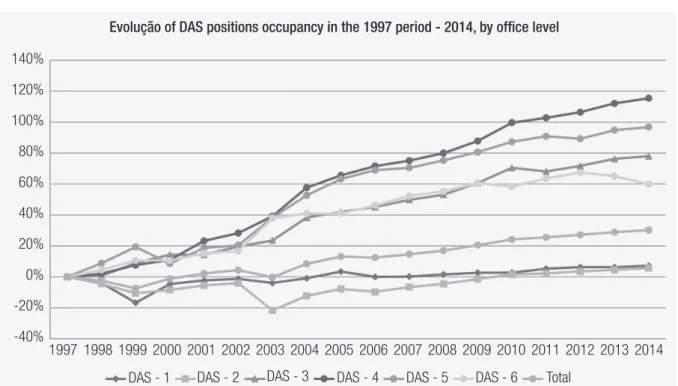
Another important issue about DAS positions is their quantitative coniguration. Graphic 4 shows the proportional evolution of each of the six existing DAS levels, as well as their total between 1997 and 2014:
GRAPHIC 4 PROPORTIONAL DEVELOPMENT OF DAS POSITIONS (1997-2014)
140%
120%
100%
80%
60%
40%
20%
0%
-20%
-40%
1997 1998 1999 2000 2001 2002 2003 2004 2005 2006 2007 2008 2009 2010 2011 2012 2013 2014
DAS - 1 DAS - 2 DAS - 3 DAS - 4 DAS - 5 DAS - 6 Total
Evolução of DAS positions occupancy in the 1997 period - 2014, by ofice level
Sources: Brazil (2015) and IBGE (2016). Speciically developed.
he irst important aspect is the fact that until 2002, stability in the total number of positions was maintained, despite some heterogeneity in the general composition. here was an increase in the number of higher-level DAS positions. he same pattern of growth can be observed with greater intensity from 2003 to 2010.
During this period, DAS positions increased by 27%, especially at the higher level (DAS-4 to 6). his is due to the rise in ministerial portfolios from the beginning of president Lula’s government in 2003. He created ministries and secretariats linked to the Oice of the President in strategic
sectors, especially in the area of social policies — Social Development, Women’s Rights etc. — and
infrastructure — Civil Aviation, Ports etc. he argument for this new ministerial coniguration is
On the other hand, if we analyze from the ratio of DAS positions compared to the total number of active civil servants in the Executive, we see that it is stable. In both 2003 and 2014, this ratio was only 3.6%.
Regarding the professionalization of the bureaucracy, three variables related to the doling out of DAS positions can be analyzed: DAS appointees as civil servants or “outsiders”, their academic expertise, and their gender.
As mentioned before, the Brazilian system is “employee-based” and gives political leaders a lot of discretion to decide who gets political appointments. his subject is highly debated in Brazilian public opinion. According to Pacheco (2008:3), the predominant view in the country is that “political appointment positions have always been illed by clientelist or partisan logics”. In other words, the vast majority of the DAS positions, according to this argument, is occupied by “outsiders”, without any ties to the public administration (without the need for a competitive examination for admission and without job stability), and due to personal ties with the directors.
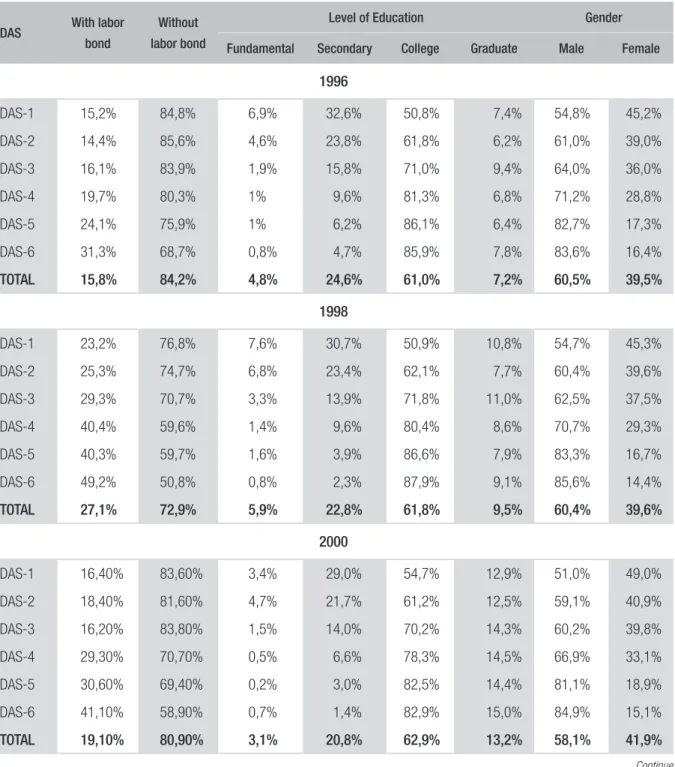
Empirical evidence, however, shows that this is a wrong perception. Civil servants, mainly from the federal government, occupy most of the DAS positions. Table 1 of the Appendix will show this, based on data from the BEP (Statistical Bulletin of Personnel)(Brazil, 2015).
When analyzing the evolution of DAS positions in the last years, we do not observe an increase of “outsiders” in these positions. Since 1988, they correspond to approximately 25% of DAS appointees. We observe, however, diferences within DAS-1 to 3 and DAS-4 to 6 positions. his is due to the diferent competences needed for these positions, entailing higher job complexity. he percentage of “outsiders” in DAS-1 to 3 positions tends to be lower, and this is because their lower salaries are unattractive for people who do not live in Brasília and/or work in the private sector. DAS-4 to 6 po-sitions, on the other hand, are more occupied by outsiders, not only because wages are higher, but also because these positions are politically relevant and entail more responsibility over public policy. For this reason, career civil servants occupy a lower share of high-level DAS positions, but even so, “outsiders” do not hold most high-level DAS positions.
his sort of empirical analysis is the usual approach used by academics to discuss the issue of bureaucratic politicization. Our data converges with the conclusions of many of the scholars who have been writing about this topic. D’Araújo and Lameirão (2011), Praça, Freitas and Hoepers (2011) and Barberia and Praça (2014) show that factors such as professional experience and qualiication are relevant for doling out DAS positions, although their importance varies according to the position’s level. Similar results were identiied in a recent survey, focused on the federal government’s mid-level bureaucrats (DAS-1 to 5) (Cavalcante and Lotta, 2015), which indicate technical competence and professional experience as more important factors than partisanship for the appointment of DAS positions.
a balance between “outsiders” and civil servants is recommended, mainly because appointing civil servants means giving value to the bureaucracy and tends to generate greater continuity, coherence and ensure greater impartiality and objectivity to public policies.
In this sense, it is essential that DAS appointees are qualiied and prepared for their positions. When we analyze the education level of DAS appointees (see table 1 in the Appendix), we observe that a vast majority has college degrees and/or master degrees and PhDs, well above the average for civil servants of the federal public service in general. While in 2014 the average number of appoin-tees with only high school degrees was around 20%, this share in all public servants of the Executive Branch exceeds 40%. On the other hand, the percentage of DAS appointees with at least a college degree is almost 80%, while the average number for federal civil servants in general is less than 50%. Additionally, it is noticeable that higher DAS levels tend to have more qualiied occupants. In other words, there is a direct correlation between the greater degree of complexity and responsibility of DAS appointees with more specialized professionals.
Finally, the gender variable is also a relevant factor in the analysis of the professionalization of the federal bureaucracy, insofar as the development of a society presupposes mechanisms of gender equality between the sexes.
Data from the Statistical Staf Bulletin (Brazil, 2015) indicates that 46% of federal civil servants in the Executive Branch are female, a percentage that has changed little over the last few years but which is very close to what is observed in the private sector.
However, the main problem when analyzing the occupation of political appointment positions is a more discreet participation of women. If, on the one hand, the percentage of female DAS occupants increased proportionally from 1996 to the present days, on the other hand, the disparity increases as the level of the DAS position increases. While in 2014 the percentage of women in DAS-1 to 3 was close to 45%, in line with their share of the Executive’s workforce, for DAS-5 and 6 positions it did not reach 30%.
Nonetheless, it should be noted that the scenario has evolved considerably in the last two decades, especially in positions of greater responsibility. Table 1 reinforces this perception, which is also clear in the analysis of high-level positions during Dilma Roussef ’s government. In 2014, 10 women were ministers, while only 18 women held cabinet positions from 1890 to 2011 (SPM, 2013)
hus, even with a lexible nomination system, the federal bureaucracy has been more valued, which has been relected in the growing share of efective oicials in top management positions, a high degree of qualiication and a growing gender balance.
he most critical point of this system does not involve its high degree of discretion (D’Araújo and Lameirão, 2011; OECD, 2010), but mainly, the fact that there are no selection and recruitment processes for DAS appointees based on impersonal and transparent criteria, fostering meritocracy by relying on certain skills and competences which are deined previously.
2.5 EDUCATION AND TRAINING
It is notorious that, the more prepared, the greater the civil servant’s ability to perform highly complex functions, as well as to develop multiple competencies such as leadership. In this sense, the irst aspect to be analyzed is the level of education of civil servants in the federal Executive. Graphic 5 displays the aforementioned data.
GRAPHIC 5 QUANTITATIVE EVOLUTION OF ACTIVE CIVIL SERVANTS IN THE EXECUTIVE POWER, ACCORDING TO EDUCATIONAL LEVEL
350.000
300.000
250.000
200.000
150.000
100.000
50.000
0
1997 1998 1999 2000 2001 2002 2003 2004 2005 2006 2007 2008 2009 2010 2011 2012 2013 2014
Higher Education Fundamental
Secondary or Technical No information
Sources: Brazil (2015) and IBGE (2016). Speciically developed.
his phenomenon can be interpreted through the point of view of two trends. he irst is that between 1997 and 2002, there was a clear reduction in the number of middle-level employees, which can be explained both by the race for pensions in this period and by the decrease in hiring people of this educational proile due to the option of outsourcing certain administrative activities. he second trend is that, as of 2003, there was a growing process of hiring college-level civil servants for more specialized activities. As we have already discussed, the entry of new civil servants since then has been positive for “older” careers, as well as for a wide range of new positions, especially in the infrastructure and social policy areas.
he trend of higher educational level observed in the civil servants’ proile also relects the changes in higher education policy in Brazil during the period. According to the census of higher education (Inep, 2013), the enrollment rate between 1995 and 2013 had a fourfold increase, with a predominance of private universities and, more recently, more relevance for public universities.
In addition to higher educational level as a prerequisite for admission, it is important to mention that civil service exams for federal government positions are increasingly becoming more compet-itive. By way of illustration, civil service exams for the careers in the management area, considered the strategic core of the state, have more than 100 candidates for each position. In other words, ad-mission to these positions demands not only a good academic background but also a lot of speciic preparation for the exams.
Following the standards of nations considered to be holders of a professional and meritocratic bureaucracy, the federal government has been investing in the continued training of bureaucratic careers since the late 1980s. As in France, Italy and Canada, certain careers incorporate a compul-sory training course (Cruz, 2010) in the last stage of their selection process. Within the federal government, the practice began in the diplomatic area many decades ago, but has since expanded to most of the careers considered typical of state, such as government managers, audit and legal policy areas.
Although it does not follow a rigid coniguration, training plays a central role in the formation, recognition and identity (greater cohesion and greater homogeneity within the category) of civil ser-vants as part of a state bureaucracy. In this process, it is essential to highlight the role of the schools of government, responsible for the initial training of new civil servants, for activities of continuous development, postgraduate training and research, and the dissemination of knowledge about public management. hese are crucial dimensions in professionalization processes and higher valorization of the civil servant.
Despite the growth in demand for qualiication in the Brazilian public service was intensiied ater the process of re-democratization in the 1980s, only in 1998 the government schools were formally included in the Brazilian Federal Constitution. Amendment 19, from 1998, establishes that the federal and state governments must maintain schools of government for the education and improvement of their personnel.
At the federal level, 17 schools make up the Segu (Union Government School System) and are responsible for personnel training. he performance level of such schools has been increasing, and they are not restricted to the initial training of bureaucrats. Most of the schools perform skill devel-opment activities.
More recently, schools have also started providing postgraduate training for more relevant ser-vants in speciic policy areas. Finally, another line of action, fundamental for the professionalization of bureaucracy and for the improvement of public management, is research development and the spreading of knowhow and good practices.
Decree 5.707, published in 2006, is worth mentioning. It establishes the National Policy for Per-sonnel Development (PNDP) for federal civil servants. he measure institutes training as a perma-nent activity throughout the entire professional career. he policy emphasizes the essential role of government schools in the professional development of bureaucracy, in order to improve its duties, with quality and eiciency (Fonseca et al., 2015).
3. FINAL CONSIDERATIONS
his article analyzed the professionalization process of the Brazilian federal bureaucracy using two complementary strategies: a historical analysis and a discussion of recent changes in the federal civil bureaucracy from 1995 to 2014. Along these lines, the article intended to identify the advancements of the period and dilemmas that persist in the federal public administration.
he historical analysis corroborates with the perception that the current setting of the Brazilian public service is a result of continuous transformation processes and not the result of a single his-torical moment or a single government decision. he two major reforms prior to the enactment of the 1988 Federal Constitution, the Dasp Reform and Decree 200 of 1967, introduced innovations that intended to establish a merit-based and professional bureaucracy, closer to the Weberian model. However, both initiatives achieved partial results that reinforced the historical dichotomy of the Brazilian public administration: partly professionalized and qualiied, and partly unprofessional and clientelist.
Considering the ive dimensions that were analyzed, over the last two decades, we observe sig-niicant advances. But there are historical dilemmas and challenges to the professionalization of the federal bureaucracy that need to be addressed.
REFERENCES
ABRUCIO, Fernando; LOUREIRO, Maria Rita; PACHECO, Regina (Org.). Burocracia e política no Brasil: desaios para a ordem democrática no século XXI. Rio de Janeiro: FGV, 2010.
BALASSIANO, Moisés; SALLES, Denise. Ambigui-dades e implicações da avaliação de desempenho funcional em uma carreira típica de Estado. In: ENANPAD, 2004.
BARBERIA, Lorena; PRAÇA, Sérgio. Who gets po-litical appointments? Party loyalty and bureaucratic expertise in Brazil. In: ENCONTRO DA ASSO-CIAÇÃO BRASILEIRA DE CIÊNCIA POLÍTICA, 2014.
BRAZIL. Boletim Estatístico de Pessoal e Informações Organizacionais, Brasília, v. 18. n. 212, jan. 2015.
BRAZIL. Plano diretor da Reforma do Aparelho do Estado. Brasília: Presidência da República, 1995.
BRESSER-PEREIRA, Luís Carlos. Crise econômica e reforma do Estado no Brasil. São Paulo: Ed. 34, 1996.
CARDOSO, Fernando Henrique. O modelo político brasileiro e outros ensaios. 2. ed. São Paulo: Difusão Europeia do Livro, 1973.
CARNEIRO, Ricardo; MENICUCCI, Telma. Gestão
pública no século XXI: as reformas pendentes.
Bra-sília: Ipea, 2011. (Texto para Discussão, n. 1686).
CARVALHO, Eneuton. O aparelho administrativo brasileiro: sua gestão e seus servidores — do período colonial a 1930. In: CARDOSO JR., José Celso (Org.) Burocracia e ocupação no setor público brasileiro. Brasília: Ipea, 2011. cap. 1.
CAVALCANTE, Pedro; LOTTA, Gabriela. Buro-cracia de médio escalão: peril, trajetória e atuação. Brasília: Enap, 2015.
CRUZ, Raquel. Carreiras burocráticas e suas trans-formações: o caso dos gestores governamentais no Brasil. In: ABRUCIO, Fernando; LOUREIRO, Maria Rita G.; PACHECO, Regina (Org.). Burocracia e polí-tica no Brasil: desaios para a ordem democrática no século XXI. Rio de Janeiro: FGV, 2010. p. 307-328.
D’ARAÚJO, Maria Celina; LAMEIRÃO, Camila. Dirigentes públicos federais de alto escalão no governo Lula. In: CARDOSO JR., José Celso (Org.).
Burocracia e ocupação no setor público brasileiro. Brasília: Ipea, 2011. cap. 3.
EVANS, Peter; RAUCH, James E. Bureaucracy and growth: a cross-national analysis of the efects of “weberian” state structures on economic growth. American Sociological Review, v. 64, p. 748-65, 1999.
FAORO, Raymundo. Os donos do poder: formação do patronato políticobrasileiro. Porto Alegre: Glo-bo, 1958.
FONSECA, Diogo et al. Sistemas de escolas de gover-no da União: peril, identidade e desaios para insti-tucionalização. Cadernos Enap, Brasília, n. 40, 2015.
GOLDSMITH, Smith; EGGERS, William. Governar em rede. O novo formato do setor público. Brasília: Enap, 2006.
GRAHAM, Lawrence. Civil service reform in Brazil: principles versus practice. Austin: University of Texas, 1968.
IBGE. Indicadores IBGE: sistema nacional de índi-ces de preços ao consumidor: INPC-IPCA. Rio de Janeiro, IBGE, 2016.
INEP. Censo da educação superior. Brasília, 2013.
LEAL, Victor N. Coronelismo, enxada e voto. São Paulo: Companhia das Letras, 2012.
LONGO, Francisco. Mérito e lexibilidade: a gestão das pessoas no setor público. São Paulo: Fundap, 2007.
LUSTOSA, Frederico. Brasil: 200 anos de Estado; 200 anos de administração pública; 200 anos de reformas. Rev. Adm. Pública, v. 42, n. 5, p. 829-874, set./out. 2008.
MARCONI, Nelson. A gestão de recursos humanos no governo federal: diagnóstico e proposta. Digesto Econômico, v. 457, p. 80-98, 2010.
MATIAS-PEREIRA, José. Administração pú-blica comparada: uma avaliação das reformas administrativas do Brasil, EUA e União Europeia. Rev. Adm. Pública, v. 42, n. 1, p. 61-82, jan./fev. 2008.
OCDE. Avaliação da gestão de recursos humanos no
governo — relatório da OCDE. Brasília, 2010.
Profe-sionalización del empleo público en América Latina. Barcelona: Fundación Cidob, 2008. p. 141-164.
PACHECO, Regina. Proissionalização, mérito e proteção da burocracia no Brasil. In: ABRUCIO, Fernando; LOUREIRO, Maria Rita; PACHECO Regina (Org.). Burocracia e política no Brasil: desaio para o Estado democrático no século XXI. Rio de Janeiro: Editora da Fundação Getulio Vargas, 2010. p. 233-255.
POLLITT, Christopher; BOUCKAERT, Geert. Public
management reform: a comparative analysis — new
public management, governance, and the neo-webe-rian state. New York: Oxford University Press, 2011.
PRAÇA, Sérgio; FREITAS, Andrea; HOEPERS, Bruno. Political appointments and coalition mana-gement in Brazil, 2007-2010. Journal of Politics in Latin America, v. 3, n. 2, p. 141-172, 2011.
SOUZA, Celina. A nova gestão pública. In: FUNDAÇÃO LUÍS EDUARDO MAGALHÃES (Org.). Gestão pública: desaios e perspectivas. Sal-vador: Fundação Luís Eduardo Magalhães, 2001. p. 43-68.
SPINK, Peter. Modernización de la administración pública en América Latina: evaluacion de los
re-centes cambios en la gerencia de los ministerios y las agencias reguladores. In: SPINK, P. et al. (Org.). Nueva gestión pública y regulación en América Latina: balances y desaios. Caracas: Clad — Centro Latinoa-mericano de Administración para el Desarollo, 2001.
SPM. Secretaria de Políticas para as Mulheres. Rela-tório anual socioeconômico da mulher. Brasília, 2013.
STEIN, Ernesto et al. A política das políticas públicas: progresso econômico e social na América Latina. Relatório 2006. 2. ed. Rio de Janeiro: Campus, 2006.
STN. Secretaria do Tesouro Nacional. Resultado do Tesouro Nacional, Brasília, v. 22, n. 9, out. 2016.
TORRES, Marcelo Douglas. Fundamentos de ad-ministração pública brasileira. Rio de Janeiro: FGV Editora, 2012.
VELASCO, Simone; SILVA, Marcela. Sistemática da avaliação de desempenho na administração pública federal. In: CONGRESO INTERNACIONAL DEL CLAD, XV, 2010, Santo Domingo.
VIANA, Oliveira. Instituições políticas brasileiras. Brasília: Senado Federal, 1999. (Biblioteca Básica Brasileira)
Pedro Cavalcante
PhD in Political Science and researcher at the Institute for Applied Economic Research (Ipea). E-mail: [email protected].
Paulo Carvalho
Continue
APPENDIX
TABLE 1 DAS OCCUPANCY RATES, ACCORDING TO LABOR BOND, EDUCATIONAL LEVEL AND GENDER
DAS With labor
bond
Without labor bond
Level of Education Gender
Fundamental Secondary College Graduate Male Female
1996
DAS-1 15,2% 84,8% 6,9% 32,6% 50,8% 7,4% 54,8% 45,2%
DAS-2 14,4% 85,6% 4,6% 23,8% 61,8% 6,2% 61,0% 39,0%
DAS-3 16,1% 83,9% 1,9% 15,8% 71,0% 9,4% 64,0% 36,0%
DAS-4 19,7% 80,3% 1% 9,6% 81,3% 6,8% 71,2% 28,8%
DAS-5 24,1% 75,9% 1% 6,2% 86,1% 6,4% 82,7% 17,3%
DAS-6 31,3% 68,7% 0,8% 4,7% 85,9% 7,8% 83,6% 16,4%
TOTAL 15,8% 84,2% 4,8% 24,6% 61,0% 7,2% 60,5% 39,5%
1998
DAS-1 23,2% 76,8% 7,6% 30,7% 50,9% 10,8% 54,7% 45,3%
DAS-2 25,3% 74,7% 6,8% 23,4% 62,1% 7,7% 60,4% 39,6%
DAS-3 29,3% 70,7% 3,3% 13,9% 71,8% 11,0% 62,5% 37,5%
DAS-4 40,4% 59,6% 1,4% 9,6% 80,4% 8,6% 70,7% 29,3%
DAS-5 40,3% 59,7% 1,6% 3,9% 86,6% 7,9% 83,3% 16,7%
DAS-6 49,2% 50,8% 0,8% 2,3% 87,9% 9,1% 85,6% 14,4%
TOTAL 27,1% 72,9% 5,9% 22,8% 61,8% 9,5% 60,4% 39,6%
2000
DAS-1 16,40% 83,60% 3,4% 29,0% 54,7% 12,9% 51,0% 49,0%
DAS-2 18,40% 81,60% 4,7% 21,7% 61,2% 12,5% 59,1% 40,9%
DAS-3 16,20% 83,80% 1,5% 14,0% 70,2% 14,3% 60,2% 39,8%
DAS-4 29,30% 70,70% 0,5% 6,6% 78,3% 14,5% 66,9% 33,1%
DAS-5 30,60% 69,40% 0,2% 3,0% 82,5% 14,4% 81,1% 18,9%
DAS-6 41,10% 58,90% 0,7% 1,4% 82,9% 15,0% 84,9% 15,1%
Continue
DAS With labor
bond
Without labor bond
Level of Education Gender
Fundamental Secondary College Graduate Male Female
2002
DAS-1 21,10% 78,90% 2,8% 31,5% 53,2% 12,5% 49,8% 50,2%
DAS-2 22,50% 77,50% 3,5% 23,9% 60,7% 11,9% 56,7% 43,3%
DAS-3 19,20% 80,80% 1,1% 15,0% 70,7% 13,2% 59,4% 40,6%
DAS-4 29,70% 70,30% 0,4% 6,6% 81,4% 11,6% 64,2% 35,8%
DAS-5 33,80% 66,20% 0,1% 3,0% 84,7% 12,2% 76,9% 23,1%
DAS-6 36,60% 63,40% 0,0% 0,6% 84,8% 14,6% 81,7% 18,3%
TOTAL 22,80% 77,20% 2,3% 22,2% 63,1% 12,3% 56,5% 43,5%
2004
DAS-1 27,40% 72,60% 4,7% 35,0% 47,8% 12,5% 52,2% 47,8%
DAS-2 24,40% 75,60% 1,3% 24,4% 60,9% 13,4% 53,9% 46,1%
DAS-3 23,40% 76,60% 1,0% 16,9% 70,3% 11,8% 55,6% 44,4%
DAS-4 35,50% 64,50% 0,6% 7,4% 82,3% 9,6% 63,9% 36,1%
DAS-5 40,20% 59,80% 1,0% 5,4% 83,4% 10,1% 77,4% 22,6%
DAS-6 45,50% 54,50% 0,5% 5,3% 81,3% 12,9% 83,4% 16,6%
TOTAL 27,70% 72,30% 2,3% 23,4% 62,1% 12,1% 56,3% 43,7%
2006
DAS-1 24,7% 75,3% 4,8% 33,6% 49,1% 12,5% 53,2% 46,8%
DAS-2 23,6% 76,4% 1,2% 25,2% 60,7% 12,9% 53,9% 46,1%
DAS-3 21,0% 79,0% 1,0% 16,5% 71,3% 11,2% 53,2% 46,8%
DAS-4 32,1% 67,9% 0,4% 7,6% 83,2% 8,8% 61,7% 38,3%
DAS-5 36,9% 63,1% 0,3% 4,2% 86,2% 9,3% 76,1% 23,9%
DAS-6 42,3% 57,7% 0,0% 5,2% 82,5% 12,4% 82% 18%
TOTAL 25,6% 74,4% 2,2% 22,8% 63,3% 11,7% 56% 44%
2008
DAS-1 25,6% 74,4% 4,4% 30,8% 51,9% 13,0% 54,5% 45,5%
DAS-2 22,9% 77,1% 1,0% 22,6% 62,8% 13,6% 55,0% 45,0%
DAS-3 24,4% 75,6% 0,9% 15,7% 72,4% 11,0% 54,9% 45,1%
DAS-4 32,2% 67,8% 0,5% 7,5% 83,2% 8,7% 62,9% 37,1%
DAS-5 34,4% 65,6% 0,4% 4,2% 86,3% 9,1% 77,1% 22,9%
DAS-6 41,5% 58,5% 1,5% 6,8% 80,0% 11,7% 80,0% 20,0%
DAS With labor bond
Without labor bond
Level of Education Gender
Fundamental Secondary College Graduate Male Female
2010
DAS-1 26,3% 73,7% 3,2% 31,6% 49,7% 15,5% 54,5% 45,5%
DAS-2 24,9% 75,1% 0,9% 23,0% 62,1% 14,0% 54,4% 45,6%
DAS-3 28,2% 71,8% 0,6% 15,6% 73,9% 9,9% 54,6% 45,4%
DAS-4 31,5% 68,5% 0,4% 7,7% 83,6% 8,2% 61,7% 38,3%
DAS-5 34,0% 66,0% 0,2% 4,4% 86,7% 8,6% 74,8% 25,2%
DAS-6 39,2% 60,8% 1% 6,2% 80,9% 12,0% 77% 23%
TOTAL 27,6% 72,4% 1,5% 21% 65% 12,5% 56,8% 43,2%
2012
DAS-1 24,7% 75,3% 3,1% 32,1% 47,5% 17,4% 55,1% 44,9%
DAS-2 24,2% 75,8% 0,9% 22,2% 60,9% 15,9% 54,1% 45,9%
DAS-3 28,9% 71,1% 0,4% 14,3% 72,1% 13,2% 54,0% 46,0%
DAS-4 30,3% 69,7% 0,6% 7,3% 78,8% 13,4% 63,3% 36,7%
DAS-5 28,1% 71,9% 0,2% 4,0% 83,1% 12,7% 71,2% 28,8%
DAS-6 35,4% 64,6% 1% 2,7% 79,4% 17,0% 77,0% 23,0%
TOTAL 26,5% 73,5% 1,4% 21% 63% 15,3% 57% 43%
2014
DAS-1 24,7% 75,4% 3,0% 30,1% 56,1% 9,9% 55,2% 44,8%
DAS-2 24,6% 75,4% 0,8% 21,1% 69,3% 8,3% 54,5% 45,5%
DAS-3 28,6% 71,6% 0,4% 14,4% 76,4% 8,5% 53,5% 46,5%
DAS-4 27,1% 72,9% 0,6% 7,4% 83,4% 8,5% 62,3% 37,7%
DAS-5 25,9% 74,1% 0,1% 3,5% 88,6% 7,9% 70,7% 29,3%
DAS-6 34,1% 65,9% 0,5% 3,3% 89,1% 7,1% 78,2% 21,8%
TOTAL 25,9% 74,1% 1,3% 19,5% 69,8% 8,8% 56,8% 43,2%