An Overview On Social Innovation Research: Guiding
Future Studies
Manuela Rösing Agostini† Instituto Federal do Rio Grande do Sul
Luciana Marques VieiraΩ
UNISINOS
Rosana da Rosa Portella Tondolo¥ Universidade Federal de Pelotas
Vilmar Antonio Gonçalves Tondolo* Universidade Federal do Rio Grande
1. INTRODUCTION
Debates for possible solutions to social problems are increasingly present in the discourse of social actors: groups of individuals,
businesses, government, community, nonproit organizations and
academia. In this context, one may observe that at the global and
national level, a search to ind alternatives for solving economic
crises or historical regional situations is underway.
In the Brazilian context, clearly recognized as a country
whose socioeconomic development induced a context of regional disparities, the government, through the Ministry of Social Integration, set up a program to reduce regional inequalities and
enable the potential development of regions. One of the Brazilian
government’s objectives is to encourage the exploitation of
sub-regional potential arising from the magniicent diversity
socio-economic, environmental and cultural development (BRAZIL, 2012).
This article has a Creative Commons License - Attribution 3.0 Not Adapted. Corresponding author:
† Instituto Federal do Rio Grande do Sul.
E-mail: [email protected]. edu.br
Ω UNISINOS.
E-mail: [email protected]
¥ Faculdade de Administração e de
Turismo da Universidade Federal de Pelotas - UFPEL.
E-mail: [email protected] * Instituto de Ciências Econômicas, Administrativas e Contábeis da Universi-dade Federal do Rio Grande - FURG. E-mail: [email protected]
Received: 09/29/2015. Revised: 02/10/2016. Accepted: 03/21/2016. Published Online: 02/01/2017.
DOI: http://dx.doi.org/10.15728/bbr.2017.14.4.2
ABSTRACT
Social innovation research has been increasing over the last decades in many countries and ields of study. his study understands social innovation (SI) as a way to mitigate social problems, resulting in new or improved solution for a speciic community. his paper analyzes the research in the ield of social innovation in the business management area, understanding its antecedents and trends. herefore, the main goal of this paper is to propose a framework to guide further research in social innovation. hrough a systematic literature review, the paper ofers a preliminary framework with sub-themes of interest, possible contexts and actors involved in social innovation initiatives. he antecedents showed that the SI since the irst concepts presents issues related to social change and has evolved to understand the relationships between diferent actors, between institutions and the social context where it is inserted. he trends link the SI to areas such as institutional theory; social movements theory; power and multi-actors perspective.
BBR
14,4
386
Globally, in a post-recession economic scenario since 2008, much information presagesthe diiculties that many communities have been facing. In this context, numerous discussions on ways to solve such situations may be identiied, the main proposal being to promote entrepreneurship and corporate citizenship values among students in the
educational training process, complementing the standard curriculum with practical lessons that greatly stimulate entrepreneurship and social innovation (JENNER, 2012; SMITH; WOODWORTH, 2012).
Therefore, both international and Brazilian context there is a growing interest in research on the topic of social innovation based on the necessity of inding alternative ways for solving social problems which address regional diferences and pay attention to
the expectations of society. Thus, the main goal of this paper is to propose a framework to guide research in social innovation.
In order to achieve this goal, we carried out four steps: (1) to search for studies in databases
on social innovation issues, analyzing the journals, year of publication, countries and institutions that published regularly the issue, to analyze the antecedents of SI; (2) to identify which methodologies are used by researchers in the ield; (3) to identify the main objectives
and results of a sample of papers in the area; and (4) to raise sub-themes to be studied in a future research agenda on social innovation, therefore identifying the main trends.
Social innovation, in turn, is analyzed at the level of social practice in order to better meet the emerging needs and problems of the social environment to which a social organization
belongs, since this practice should be socially accepted and widespread. Thus, the collective unit learns, invents and puts into practice new rules for the social game of cooperation
and conlict, acquiring in the process a cognitive and rational learning, developing new capabilities within a social organization (HOWALDT; SCHWARZ, 2010).
In this sense, this research is justiied for social and academic reasons. Regarding social
issues, we believe that social innovation is one of the routes to be followed in order to
ensure a more just, egalitarian and zealous society for the rights and essential guarantees of citizens. By doing this study on social innovation, we intended somehow to contribute to social organizations.
Regarding the theoretical contribution, this study adds to the view of social innovation as a new and independent object of management science, helping to tailor its consolidation
and systematization. Silva and Maurer (2014) points out that in the ield of management,
studies in innovation are usually seeing innovation in products or processes. However, internationally the concept of social innovation is already being used by groups of
researchers who seek to ind solutions for human needs. On the other hand, in Brazil, this
kind of studies is emerging, especially in the area of management. These studies could be applied in order to solve out social problems of this country as other emerging and developing countries.
2. SOCIAL INNOVATION
Diferent authors deine innovation as a creative process in the implementation of a new idea. It can be identiied in products, processes, markets or organizational models. Drucker (2002) deines innovation as a tool used by entrepreneurs to exploit a change as an opportunity for a diferent business or a diferent service.
Further, in an established concept, the Oslo Manual (1997), which is one of the documents
prepared by the Organization for Economic Cooperation and Development (OECD), one
of the main collections on the use of data in innovative activities, discusses innovation as
BBR
14,4
387
dimensions of innovation: product innovation, process, marketing and organizational
method. In addition, social innovation, led by corporations, arises as response to pressure
from organizational stakeholders (individual, organizational, national, and transnational)
(GOPALDAS, 2015).
For Schumpeter (1985), innovation may be the supplier of extraordinary proits, as it
occurs in a continuous creative destruction process in which innovation generates monopoly,
which gives rise to proits, which attracts imitators to a return of the normal state, leading
to cycle repetition.
One may realize that the concepts have similarities and complementarities among them,
in which the dimensions and characteristics of innovation that are regarded as prevalent in
each concept deinition may be identiied.
Analyzing the concepts of innovation and identifying the need for their relationship with
economic development theory, innovation may be observed as not necessarily linked only to commercial activity, although much of the existing literature shapes innovation in the context of industries. The Oslo Manual (1997, p. 22) states that “innovation can occur in
any sector of the economy, including government services such as health and education.”
Taken in this way, social innovation should be approached through a new lens. Farfus (2008, p. 36) considers the current cultural and business systems to be failing to meet social demands, allowing the emergence of movements and initiatives to reduce social gaps
experienced in diferent realities. Thus, the same author emphasizes “the design of new
strategies is a necessary condition for overcoming the challenges of post-modern society, considered by many scholars as a moment of historical transition. One of the strategies
to overcome the challenges posed is the concept of social innovation”. In addition, social
innovation is driven by social entrepreneurs (BHATT; ALTINAY, 2013).
O´Byrne et al. (2013, p. 54) deined social innovation as the “successful implementation
of activities, such as ideas, practices, or objects, through new collaborations and partnerships,
in ways that positively impact society by improving the delivery of public services.” Gaps in
public services that involved quality and quantity of service have stimulated the emergence of global social innovations for base-of-the-pyramid markets (VARADARAJAN, 2014).
In this sense, Howaldt and Schwarz (2010) argue that the Schumpeterian theory does
not focus solely on technical innovation but also on the innovation process and underscores the need for social innovation to occur in the economic arena as well as in the culture,
politics and way of life of a society in order to ensure the economic eiciency of technical
innovations.
Silva (2012) identiies studies in the literature on social innovation and its difusion, noting that there is no consensus on the deinition of the term. However, he states that the concept has multiplied in the world, especially in the United States, Canada, Europe and Brazil. In the United States, universities such as Stanford, Harvard and Brown formed study groups to research the topic. In Canada, one of the main groups for social innovation
studies was established, the Centre de Recherche Sur Les Innovations Sociales (CRISIS).
In Europe, INSEAD, the University of Cambridge and projects like EMUDE such as ISESS conduct research and are involved in social actions. In Brazil, the work of the Institute of
Social Technology (ITS) stands out.
Similarly, Bignetti (2011) identiies social innovation as having an extensive range of approaches, methodologies and practices, which has become considered a consistent ield of knowledge. The author also concludes that studies of social innovations difer from studies of technological innovations, and this area, social innovation and it needs new speciic approaches and methodologies. The author also points out that many diferent notions or
concepts on the subject exist with three units of analysis for social innovation: individual,
organizations and movements. In this view, Table 1 presents a compilation of the diferent
BBR
14,4
388
Table 1. Social Innovation Concepts
Social Innovation Concepts
Taylor (1970) Social innovation as the search for answers to social needs through the introduction of a social invention, i.e., a "new way of doing things" a new social organisation.
Cloutier (2003) Social innovation as a new response to an unfavorable social situation, which seeks the
well being of individuals and/or communities through action and sustainable change.
Rodrigues (2006)
Social innovations can occur intentionally or emerge from a process of social change
without prior planning; and can occur at three levels: social actors, organizations
and institutions.
Mulgan et al. (2007)
Innovative activities and services that are motivated by the objective of meeting a
social need and that are predominantly developed and difused through organizations
whose main objectives are social.
Bignetti (2011)
Social innovation is the result of knowledge applied to social needs through participation and cooperation of all stakeholders, creating new and lasting solutions for social groups, communities and society in general.
Centre For Social Innovation (2014)
Social innovation refers to the creation, development, adoption and integration of
new concepts and practices that put people and the planet irst. [...] Solve social, cultural, economic and environmental issues. [...] Are changing systems - they have
permanently altered the perceptions, behaviors and structures that previously gave
rise to these challenges. [...] Social innovations come from individuals, groups or organizations, and can take place in the sectors for-proit, nonproit and public sector.
Crises (2014)
Social innovation is a process initiated by social actors to respond to a desire, a need,
to ind a solution or to seize an opportunity of action to change social relations, to
transform a frame or propose new cultural orientations to improve the quality and community living conditions.
TRANSIT (2015)
Transformative Social Innovation, as “change in social relations, involving new
ways of doing, organizing, framing and/or knowing, which challenges, alters and/ or replaces dominant institutions/structures in a speciic social context”.
Source: Research Data
Based on these diferent authors we can have an understanding of the antecedents of SI. These authors, in diferent stages of the evolution of this concept, show a latent concern for
social change. The concept of Taylor, dated from 1970, addresses the SI as a new form of
social organization, while Cloutier (2003) suggests an evolved concept for an innovative
response that causes a sustainable change. In both concepts, the concern about change in society is visible, but they do not determine who will make this change.
In another study, Tardif and Harrison (2005) identiied at least ive main deinitions
for the concept of social innovation that leads to social change as follows: 1) novelty and character of innovation, 2) objective of innovation, 3) innovation process, 4) relationship between actors and structures, and 5) restrictions on innovation. Thus, these authors adapted
the terminology and proposed, based on the analysis of the papers, ive dimensions of social
innovation, namely transformation, innovative character, innovation, actors and processes. Evolving the concept, Mulgan et al. (2007) and Rodrigues (2006) show that the change process
involves diferent actors. The involvement of social organizations also appears as an important
factor in the evolution of the concept, as the SI is an alternative to the development of communities, but the changes should happen by the community and not only by external actions.
BBR
14,4
389
adopted should be interpreted and transformations in this context must be understood. In this perspective, modern theoretical approaches have been adopted to understand this
phenomenon, such as: Theory on Transformative Change; Social practice theory; power
and multi-actor perspective; narratives approaches; institutional theory, institutional logics and institutional entrepreneurship; and, structuration theory.
These new areas of study in social innovation show that there is a concern of scholars
for the evolution of the ield. New relationships should be discussed with theoretical bases
which are not customarily associated with this issue, and new methods can be adopted to
understand the ield.
As an example of this evolution by new theoretical relationships, Cajaiba-Santana
(2014) sets out a new way to understand how social innovation plays as a source of social
change, and it seeks closer ties with two theories. First, it analyzes the Institutional Theory
“to argue that social innovation is always related to collective social action aiming at social change. The institutional perspective sees social innovation as a result of the exchanges
and application of knowledge and resources by agents mobilized through legitimization activities”. The second theory analyzed is the Structuration Theory “to describe how social
innovation is created as a transformative force through the inter relationship between
agents, institutional structures, and social systems”.
In sum, we realize that new studies are emerging to enhance and improve the ield,
looking for more robust theories foundation for understanding the phenomenal studied in SI and thus seek improvements that contribute to a theoretical consolidation.
Moreover, the principles of social participation are closely related to the development
of human evolution, and social innovation becomes an alternative to minimizing social
gaps. In this perspective, the practice of social innovation may generate local development and may be focused towards learning and collective construction. Accordingly, social innovation may leverage social capital (BHATT; ALTINAY, 2013)
3. RESEARCH METHOD
Social innovation, as previously reported, has attracted attention from researchers in
many areas. This inding suggests a need to generate studies aiming to develop a better understanding of the trajectory of this research stream, as well as a need to analyze the
methodologies that have been used. According to Bento (2012), the aim of this kind of study is to identify topics for future research. We followed this authors´ suggestions as
follows: a) identiication of key-words; b) review of secondary sources (summarized in Table 1 in the previous section); c) search of primary sources and inally d), critical reading
to sum up in the paper.
In order to accomplish our purpose, we carried out an analysis of previous literature
in order to propose a framework to guide further studies speciically in the business
management area. The study started with a search for papers in international databases
given a speciic period of a time. We present the selection criteria for papers below.
The database used was the Web of Knowledge database platform bibliographic reference,
produced by the Institute for Scientiic Information (ISI). The platform consists of several reference databases such as Web of Science, Current Contents Connect, the Derwent Innovations Index (Patent), and other web resources such as the Journal Citation Report, Essential Science Indicators, Scientiic WebPlus, BiologyBrowser, and ResearcherID,
among others, covering thousands of periodicals in several areas of interest: science, social
sciences, arts and humanities. The choice was also inluenced by the fact that this database has tools that assist in the identiication of citation indexes, enabling a more detailed
analysis of historical article citations, including the most relevant journals, impact factor
BBR
14,4
390
The search was conducted in July 2013, being reined as follows:
• Key-word: “social innovation”; a total of 275 results were found;
• In the document type reinement, only papers was chosen, selecting 159 results; • In one more reinement in the categories of Web of Science, we opted for the
areas of “management” and “business” because they are to the search area, and
the result was 35 papers;
• We opted for more current studies, and the analysis period was set from 2006 to 2013, resulting in 29 papers;
• It is important to note that the database utilized does not provide access to the full papers. They had to be extracted from another database. Therefore, in order to get
the full papers, we used the databases EBSCO Host and Google Scholar. At this
stage, 23 papers were found with full access. Thus, for analysis of general data
on publications in the ield we used 29 papers, but to analyze the methodologies
used and contributions of the papers, the sample was limited to the 23 full-text papers available;
• The selected papers base were analyzed using a categorization, which addressed four aspects: (1) analysis of the journals, publication year, countries and institutions
that publish more often on the subject, (2) identiication of the methodologies used by researchers on the subject, (3) identiication of the main objectives and results
of the sample of papers in subject, and (4) provision of a framework proposal for research on social innovation;
• The analysis was performed using the criteria for classiication proposed by
Caldas, Tonelli and Lacombe (2002), which classiied the methodological proile
of the papers as follows. Papers may be (1) Theoretical; (2) Empirical; or, (3) Theoretical and empirical:
• If the paper is classiied as (1) Theoretical, the authors seek to identify four characteristics, based on forums from the Academy of Management Review (1989) and Administrative Science Quarterly (1995): (1.1) theoretical essay
on existent theory; (1.2) theoretical essay of current theory systematization;
(1.3) theoretical essay that builds or proposes a concept or construct; and (1.4) theoretical essay that builds or proposes a theory;
• If the paper is (2) empirical or (3) theoretical and empirical, it can be classiied,
according to Creswell (1998), as: (2.1) qualitative; (2.2) quantitative; (2.3)
survey; or (2.4) hypothetical-deductive method;
• If the paper is (2.1) qualitative, it may be classiied as a singular case or multiple case study (one or multiple objects).
4. DATA ANALYSIS
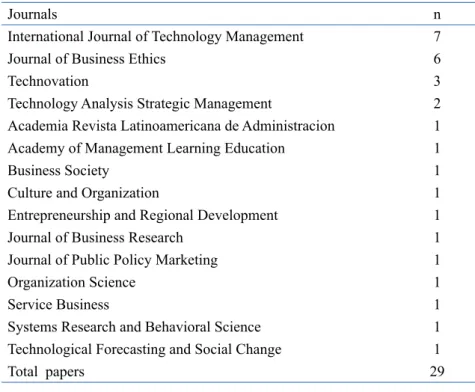
Remarkable ranges of journals publish on the topic of social innovation, whereas the areas of interest are the most diverse within the business and management area. In international journals, a strong tendency to publish papers related to technological themes was noted. In the initial analysis, we determined the journals that publish on social innovation, as shown in Table 2.
When analyzing the topics of interest of the International Journal of Technology Management, a journal that published seven of the analyzed papers, the issues that
had a strong relationship with social innovation such as competitiveness, cooperation,
globalization and relations between businesses and governments, innovation and new
technologies, among others. Another important factor is that in 2010, the same journal published a Special Issue on Social Innovation, publishing nine papers on the subject. Six
BBR
14,4
391
The Journal of Business Ethics published six papers on the subject. This may be related to its interest in discussing the ethical issues connected to business from a wide variety of methodological and disciplinary perspectives, examining moral aspects of production systems, consumption, marketing, advertising, social and economic accounting, labor
relations, public relations and organizational behavior. Speciically, the December 2012,
Volume 111, Number 3 issue was a special issue on social entrepreneurship in theory and
practice. We identiied two papers from that special issue related to the subject, which made
connections among theories of social entrepreneurship and social innovation.
Besides identifying the journals in which the papers were published, we also observed
forty-two diferent institutions, with none of them showing predominance. By analyzing
the institutions, we were able to make an overview of the countries that are publishing more
often on social innovation. Canada topped the list with nine authors, followed by the United
States, with seven authors. Australia and England each appeared with four authors on the subject, followed by the Netherlands and Spain each with three authors. Italy and Scotland had two authors each that published on social innovation. Several other countries have also
had authors publish on the subject: Austria, Colombia, Costa Rica, Denmark, Finland, France and Germany. We also analyzed the papers by year of publication, as shown in Table
3.
It is observed that in 2010 a signiicant number of papers were published since it was
the year of the special issue on social innovation in the International Journal of Technology Management. Another relevant factor is that in 2012 there was a notable growth of publications on the subject, which is not explained by a connection with special journals. Therefore, we may suggest that interest in the subject is growing.
4.1 METHODOLOGICAL ASPECTS
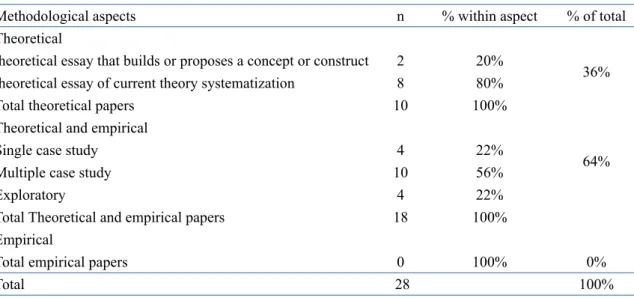
One of the contributions of this research is to analyze the methodological aspects used by the authors who have published on the subject of social innovation in the management ield. Thus, the papers were classiied by researchers following the guidelines of the mentioned
authors, being grouped as shown in Table 4.
Table 2. Journals covered
Journals n
International Journal of Technology Management 7
Journal of Business Ethics 6
Technovation 3
Technology Analysis Strategic Management 2 Academia Revista Latinoamericana de Administracion 1 Academy of Management Learning Education 1
Business Society 1
Culture and Organization 1
Entrepreneurship and Regional Development 1
Journal of Business Research 1
Journal of Public Policy Marketing 1
Organization Science 1
Service Business 1
Systems Research and Behavioral Science 1
Technological Forecasting and Social Change 1
BBR
14,4
392
Table 3. Period of international publication
Year n Year N Year n Year n
2006 1 2008 1 2010 10 2012 9
2007 1 2009 4 2011 2 2013 1
Total 29
SOURCE: Research data
Table 4. Synthesis of methodological aspects
SOURCE: Research data
Methodological aspects n % within aspect % of total Theoretical
theoretical essay that builds or proposes a concept or construct 2 20%
36%
theoretical essay of current theory systematization 8 80%
Total theoretical papers 10 100%
Theoretical and empirical
64%
Single case study 4 22%
Multiple case study 10 56%
Exploratory 4 22%
Total Theoretical and empirical papers 18 100% Empirical
Total empirical papers 0 100% 0%
Total 28 100%
A predominance of theoretical and empirical papers with a qualitative approach is
observed. Internationally, 61% of the items it this proile. Multiple case studies method is the predominant method among empirical papers, analyzing more than one object,
leading to improved research, allowing for comparison among the subjects studied. No article having a methodological design dedicated exclusively to the empirical model was
identiied. Analysis shows that theoretical papers represent 39% of the entire sample. In addition, the highest incidence is in the systematization of existing theory. Only two papers
tried to build or propose a concept or construct.
When performing the analysis of the papers, we came across a new possibility of
categorization and chose to aggregate it to the initially proposed classiication. Papers that were identiied as theoretical and empirical, with qualitative approach, but were not necessarily classiied as case studies, were grouped in a new category called “exploratory.”
They have qualitative approach characteristics but aim to investigate and explore a research
context not yet fully structured, not itting a case study design, for instance.
These results corroborate Edmondson and McManus’s (2007) indings on the importance of the adequacy of itting methodology designs for ield research in organization studies. The same authors classiied research in three maturity levels - nascent, intermediate and
mature - classifying the appropriate methodological approaches to each level of maturity
of the theory. For theories at the “nascent” level, the methodological approach suggested is
qualitative in order to inform or inspire future research on a new phenomenon.
Thus, research on social innovation has mostly utilized qualitative approaches due to
the theory being in the process of evolving, with a need to be explored and consolidated.
In this sense, Collis and Hussey (2009) indicate that exploratory research should be used
when there are few or no previous studies on the subject to be investigated; thus, the focus should be to obtain insight into the subject area for a more thorough investigation at a later
BBR
14,4
393
5. DISCUSSION
After analyzing the goals, theories and results of the literature, we reached a classiication of ive major areas of interest, namely (1) concepts, models and case studies that speciically
address the theories of social innovation; (2) papers that have social responsibility as a major theory but that address social innovation as a synonym of social responsibility or a complement of it; (3) studies that focus primarily on the term social entrepreneurship but have social innovation as a synonym or a complement of it; (4) papers that present
social innovation as a result of cross-sector partnerships (non-proit organizations and for-proit organizations); and, (5) papers that, despite having the term social innovation in the
keywords and references, have no relation with social innovation.
Thus, we analyzed the papers by areas of interest, discussing the aim of the research and key indings. We classiied eight papers in the irst area, those that speciically address the
theories of social innovation. One of the criticisms that we present on these papers is about the fragility that they show to talk about SI. Papers associated with this theme are analogies to social problems and how these are being solved out. However, few papers clearly show the relationship of the term applied to the empirical cases. Incidentally, this has been one
of constant criticism on this new ield. Even though signiicant advances have not been identiied, we present the main contributions of each of the papers analyzed in this area.
Linton (2009) considers the major motivator of his study as the great diversity of
deinitions of the term “innovation.” That is, the author presents concepts and authors that lead to building a framework that enable the ield to better analyze the impact of technological innovation and social innovation through a clariication of its inputs and
outputs, and units and levels of analysis.
Fink, Lang and Harms (2013) investigate the restructuring of the local economy in rural
areas that are afected by disruptive technologies. Relying on an institutional framework, the
authors apply a multiple case study in two rural communities of Austria. The authors seek to identify practices that are crucial for the sustainable development of local communities
and ind that disruptive technologies must be accompanied by social innovations in the afected communities, since the capabilities and local community needs must be met and
then to establish vertical links in regional and national policies.
Witkamp, Raven, and Royakkers, (2011) analyze the applicability of the concept strategic
niche management (SNM) in social innovations. The concept arises from technological radical innovation, but the authors present an alternative to social entrepreneurship, seen as a new business model, which includes a business mindset while creating social value. The main conclusion presented focuses on the assertion that SNM can be adopted in radical social innovations since it is considered to be in the early stages of a social innovation project.
In an exploratory study, Lettice and Parekh (2010) aim to understand the process of social innovation, and to explore the lessons that can be transferred from the innovation theories of the business environment. The authors conducted interviews with ten UK innovators who have created solutions to social problems that were initially seen as remote and unlikely to go well, in areas ranging from job creation for the homeless to the manufacture of electric cars.
Simms (2006) approaches technical and social innovations as relatively new in human history. The article begins by relating that before the innovation, human behavior can
be described and quantiied with the same determinants of the behavior of other living
systems. Thus, he suggests that technical and social innovations are key determinants of
BBR
14,4
394
Maak and Stoetter (2012) report one of the world’s most important cases of socialinnovation, the Fundación Paraguaya, located in Paraguay, a country known for its
long-standing struggle with corrupt governments. The authors studied the case of the irst and oldest non-governmental organization of Paraguay. Despite the foundation’s success being the result of a team efort, its remarkable development can be attributed in large part to
Martin Burt, founder and chief executive.
Weber (2012) developed an article that has as its central focus an interview with author Frances Westley, considered one of the main authors in the area of management and who
has devoted special attention to social innovation for many years. The article emphasizes (1) the importance of clear deinitions in emerging areas of research and programming, (2)
the nature (sometimes not obvious) of adaptations necessary to co-opt or redirect, and (3) the importance of unusual partnerships in order to make innovative things happen.
Bouchard (2012) makes an interesting initial thought, considering the renewed interest in the social economy that has arisen over the past decades, especially in relationship to the employment crisis and the renovation of state interventions. The social economy plays an important role in solving new social problems with innovative solutions, especially in the public services, making it important to better understand its innovative function. The article discusses the concept of social innovation and explains how it can be used as a framework for understanding the social economy. The author uses the case of Quebec on housing as an example of social economy to illustrate this proposition.
Thus, among the main contributions and advances of these papers are the attempt to develop the concept of SI, with the use of case studies and the development of conceptual
frameworks. It is also noted the importance of a leader or social organization that actively
participate in the social innovations. This contribution is important for the development
of the ield, as numerous studies have shown concern about how diferent actors with
complementary objectives can contribute to the development of the SI initiatives.
Incidentally, this is a subject in which the ield must advance, identifying which are the actors involved and what the diferent relationships they play in SI initiatives.
Thus, the collaborative aspect of the SI is one of the possibilities of new studies which may occur seek to understand how the relationships between these actors. In particular, try to understand how internal actors are involved in the process of social innovation, since social innovation “are developed ‘with’ and ‘by’ users and not delivered ‘to’ and ‘for’
them. They can be identiied by the type of relationships create among their beneiciaries” (CAULIER-GRICE et al., 2012, p. 21).
Another contribution is to identify the social innovation process and key partners for the development of social economy. This is another important issue for the development of the
ield, to identify the SI is the result of a systemic process that requires constant changes and
therefore, adaptations and new solutions. Moreover, this process is an empowerment of the people who develop capacity to act (MOULAERT et al., 2005; BEPA, 2010).
Regarding the second area of interest, we classiied two papers as having social
responsibility as the main theory but address social innovation as a synonym or a complementary theory.
Spena and Chiara’s article (2012) has as its central theme corporate social responsibility
and its connection with social innovation, by identifying the process of creating value in networks and relational processes. With a multiple case study in three companies (Timberland, Herman Miller and Mattel), the authors highlight the innovative management patterns that create greater opportunities for companies that perform actions of social responsibility and their social partners.
Hanke and Stark (2009) attribute as the central theme of their article the concepts of
BBR
14,4
395
discussion about the reasons that lead companies to socially responsible action, suggesting a framework from the point of view of the development of meaning and legitimacy in the perspective of the corporate culture, social innovation and civil society.
We classiied four papers in the third area of interest, which focuses primarily on the term
social entrepreneurship but have social innovation as a synonym or as a complementary theory.
Dacin, Dacin and Tracey (2011) propose to identify the agenda of publications on social entrepreneurship. It is important to note that the authors present the term social
entrepreneurship as an area covering a number of theoretical ields, including social innovation and the management of nonproit organizations. The article introduces a number of questions about the ield of study and classiies it as an emerging one. The study also identiies that scholars are trying to develop research questions and research paths. As research opportunities, the authors present ive issues: institutions and social movements,
networks, culture, identity and image, and cognition.
For Perrini, Vurro and Costanzo (2010), the central point is social entrepreneurship
as a process to explore innovation to complex social problems. The authors present a theoretical model that addresses the process characteristics and dimensions involved in
social entrepreneurship such as social-entrepreneurial opportunities identiied, evaluated and employed with consistency among individual, organizational and contextual elements.
Dees (2012) present a theoretical essay on the two diferent types of culture that permeate social entrepreneurship: the ancient culture of “charity” and a more current culture that aims
to solve social problems. The author presents the concepts around the topic and establishes that both cultures can contribute to the development of social entrepreneurship. However, the contribution will depend on the actors involved in the development of action strategies that address the integration of the values of each of these cultures.
Weerawardena and Mort (2012) show that social entrepreneurship has attracted a growing body of research in trying to understand the basis for creating successful value designed to
solve social problems. In an efort to advance social entrepreneurship research beyond its
current focus their article discusses the role of innovation to achieve greater social impact. Using several case studies, the research concludes that the competitive strategies of
non-proit organizations based on social innovation contribute substantially to the achievement
of social value.
An important issue to note in this topic is the relationship between the concepts of social innovation and social entrepreneurship. Many authors have come to understand that the two terms can be seen as synonyms, however, we believe that social innovation should be seen as a process in which the social entrepreneur could be a change agent. It is known
that two ields have been studying these concepts, and the ield of entrepreneurship is more
concerned with the personal characteristics of the agent that promotes these social changes.
And the ield of innovation is concerned with the context in which this initiative is going,
the process, the actors involved and the social problems that these initiatives are addressing.
Thus, we understand in the same sense that European Commission (2013), that are diferent levels of analysis to observe the same phenomenon: a micro level, which analyzes the individual; and a macro level, which analyzes the process. To understand a third level, meso, we can analyze the relationships that occur between social organizations, such as the
papers covered in the fourth area.
We classiied six papers in the fourth area of interest: social innovation as a result of cross-sector partnerships (non-proit organizations and for-proit organizations).
Le Ber and Branzei (2010) analyze the relational processes that support social
BBR
14,4
396
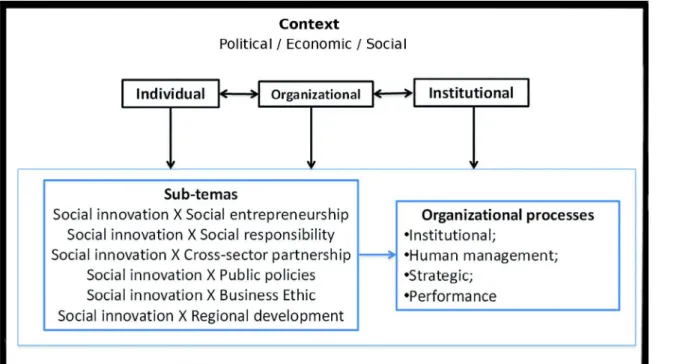
Figure 1. Framework for future research on social innovation. SOURCE: Authors of this study
to understand the duality of success and failure in relationships between for-proit and non-proit organizations. As the main contribution, the authors present a framework that models how organizations may keep up with the success or overcome temporary failures.
In a complementary study published in another journal, the same authors begin the analysis
by pointing out that partnerships between for-proit and non-proit organizations often
have large incompatibilities, mainly on the confrontation between values and identities of
the organizations belonging to diferent sectors of the economy. Thus, organizations are
developing social value as they mature the partnership. Therefore, the main contribution of the paper is related to a framework that addresses four phases of cross-sector partnership: negotiation, elasticity, plasticity and fusion (LE BER; BRANZEI, 2010).
Selsky and Parker (2010) also address the central theme of cross-sector social partnerships
(CSSPs) that produce beneits at individual, organizational, sectorial and social levels. The authors begin with the deinition of platforms for social partnerships developed in previous
studies and set them as ways for constructing meaning in the projects, drawing attention to certain desired characteristics or other underestimated resources. The three platforms are
identiied as the resource dependence platform, social issues platform, and platform of the
social sector.
Raulet (2009) analyzes the experience of so-called “Post-secondary education” at a university in South Africa, realizing that this education model may be a viable solution to
an existing social problem in developing countries. The author presents two contributions:
the irst related to the proposed educational model, and the second to the creation of
partnerships within the business sector.
Austin et al. (2009) present an important contribution that tries to approximate the
non-proit organization to for-non-proit ones. The authors indicate that although non-non-proit and for-proit organizations are more connected than ever, they still have many diferences. Companies must continue to play their fundamental economic functions eiciently because
BBR
14,4
397
It is considered that the identiication of this area was important to understand how these items help the ield of SI in understanding of the relationship management and the characteristics of the relationship between for-proit and nonproit organizations. Usually,
this combination is not carried out studies in SI, but the cross-sector studies may be important to understand the process of social innovation, since most of the initiatives reported in
studies include diferent actors, such as companies, NGOs, communities, associations, etc. To corroborate this issue, there is the deinition of Cloutier (2003) that checks on social
innovation cooperation between a variety of actors as a process of collective learning and
knowledge creation. This process requires the participation of beneiciaries in diferent
degrees of the creation and implementation of social innovation.
Finally, we classiied three papers in the ifth area of interest: those papers that, despite
having the term social innovation in the keywords and references, have no relation at all
with social innovation concept. Menzel, Aaltio and Ulijn (2007) present a theoretical essay on intrapreneurship; Carnera (2012) conducts a theoretical paper on the ambivalence of topics such as “biopolitics,” developed by Michael Foucault, and the “modern labor and management”; and Linton (2008) makes a critical analysis of the reasons why obtaining funding for scientiic research is increasingly diicult for many public and private labs.
6. PROPOSAL FOR A FRAMEWORK FOR FUTURE RESEARCH:
THE TRENDS TO SI
Based on our analysis of the papers, we identiied that more studies are needed on social innovation because unanimity among scholars in the ield on the concept and theme
features does not exist so far. A diversity of understandings on the subject pervades the
ield. Consequently, we present a framework, as shown in Figure 1, with possible sub-themes of interest, research contexts, analytical lenses and organizational processes to be
investigated.
The theme can be analyzed considering the diferent social, political or economic contexts and by using diferent analytical lenses.
For analysis of the context in which social innovation initiatives develop it is important to understand factors such as the political, social and economic systems (MATTEN; MOON, 2008; WHITLEY, 1999; TRANSIT, 2015). These factors are important as the reasons that
inluence the development, creation and maintenance of an SI. The pressure on the political
and economic factors may explain why communities seek social innovations, since often innovations are related to high rates of poverty and problems linked to education, health and employment. Economic and structural crises enable communities to seek alternatives that are not only linked to the aid of the government. Thus, understanding the environment and social conditions are fundamental in order to understand SI initiatives.
In a second level of the framework, we propose a distinction between levels of analysis.
Considering the previous literature, especially those related to diferences between the perspectives of social innovation and social entrepreneurship, as well as the diferent levels of analysis that these diferences allow observe, we have identiied three levels: individual, organization or institution (a more systemic perspective). This view was supported by references to European Commission (2013), Phills Jr., Deiglmeier and Miller (2008) and
Westall (2007).
Based in the literature review and a systematic review of papers, six sub-themes that may
be related to social innovation were identiied and may be studied in speciic organizational
processes, such as institutional theories, human resources management, strategy and
performance. Our frame makes no claim to be exhaustive. Other aspects may be identiied
BBR
14,4
398
7. FINAL CONSIDERATIONS
Social innovation is an essential process for the evolution of society and the search for
sustainable alternatives for the collective well being. In a sense, the observation of diferent
research contexts on social innovation allows future researchers to use this study to identify new opportunities to the area in order to identify and/or constitute economic and social
mechanisms for the growth of organized communities in a democratic society.
This study achieved its main objective by analyzing the aspects that characterize the research in this new form of innovation. In regard to the irst speciic objective, this research
presented an analysis of the 29 papers from research in databases on the theme social innovation, and a diversity of journals and authors who have published on the subject was
identiied, since papers were indexed from 15 diferent journals. Furthermore, the research
on this new innovation area covers a very wide range of institutions and nationalities; the authors are linked to 42 institutions, distributed in 15 countries. Thus, a predominance of a group of researchers, as in other areas of more consolidated knowledge, is observed.
Furthermore, the journals in which future research might be directed to publish on social
innovation were identiied. Multidisciplinary studies on the subject in mainstream journals
were located, presenting an important contribution to research in this area.
In the analysis on the methodologies most used in the ield of social innovation, a signiicant number of papers were found that have the theoretical and empirical methodological proile
of a qualitative approach, with mostly case studies used to support the theories proposed. According to the sample of papers, the studies may evolve into hybrid research (qualitative and quantitative), enabling the advancement of the theory studied (EDMONDSON;
MCMANUS, 2007). Thus, future research might begin the search for constructs and
variables for quantitative research.
In addition, we analyzed the main results and objectives of the analyzed papers, coming to a rating of ive major areas of interest. In particular, the main themes are focused on the
central concepts of social innovation and its relationship with social entrepreneurship, social responsibility and cross-sector partnerships. These related concepts are sometimes used as synonyms, but there is a need to provide more robust empirical data in order to distinguish
these concepts. Another contribution is the identiication of sub-topics, contexts, actors and organizational processes for future research in a framework. Some of these sub-topics and
unit of analysis might prevail in management research in the long term. Further research
could look at the incipient research published from Brazilian researchers to analyze how the
sub-topics have being used in the national context.
Thus, new theoretical perspectives have been identiied for future studies to deepen the ield. The main approaches that can yield future studies are: social movement theories;
theory of transformative change; power and the multi-actor perspective; institutional theory; and, structuration theory.
Some questions/propositions could be raised for further studies. To analyze the irst level of the framework, relating to the context, we propose: a) The context inluences the SI, how
and to what extent? b) How is the interference of political, economic and social factors in
SI initiatives? c) Are there diferences in SI initiatives in diferent social contexts?
To analyze the second level, referring to the level of analysis, we propose: d) How diferent actors act in SI initiatives? e) What is the role of institutions in SI? f) How organizations behave in SI initiatives?
And inally, to relate the SI with other areas of knowledge, we propose: d) How are the
BBR
14,4
399
In conclusion, despite the diversity of concepts and identiied contexts, the theory in social innovation may generate signiicant value for the development of social alternatives,
including an impact that may generate innovative actions for the development of those
involved. In an emerging country such as Brazil, management academics as well as
entrepreneurs should pay attention to the evolution and application of social innovation.
8. REFERENCES
AUSTIN, J. E. et al. Capitalizingonconvergence. Academia-Revista Latinoamericana De Administracion, n. 43, p. 93-106, 2009. ISSN 1012-8255.
BEPA-Bureau of European Policy Advisers. Empowering people, driving change: Social innovation in the
European Union, Luxembourg: Publications Oice of the European Union. 2010.
BHATT, P.; ALTINAY, How social capital is leveraged in social innovations under resource constraints?
Management Decision, v. 51, n. 9, p. 1772-1792, 2013.
BIGNETTI, Luiz Paulo. As inovações sociais: uma incursão por idéias, tendências e focos de pesquisa. Revista das Ciências Sociais, São Leopoldo, v. 47, n. 1, p. 3-14, jan./abr. 2011.
BOUCHARD, M. J. Social innovation, an analytical grid for understanding the social economy: the example
of the Quebec housing sector. Service Business, v. 6, n. 1, p. 47-59, Mar 2012. ISSN 1862-8516.
CAJAIBA-SANTANA, G. Social innovation: Moving the ield forward. A conceptual framework. Technological Forecasting and Social Change, v. 82, p. 42-51, 2014.
CALDAS, M.; TONELLI, M.; LACOMBE, B. Espelho, espelho meu: Metaestudo da Produção cientíica em Recursos Humanos nos ENANPADs da década de 90. In: XXVI Encontro da ANPAD. Anais…2002. Online: http://www.anpad.org.br/diversos/trabalhos/EnANPAD/enanpad_2002/GRT/GRT1976.pdf.. Aces: 17 July 2013.
CARNERA, A. The afective turn: The ambivalence of biopolitics within modern labour and management. Culture and Organization, v. 18, n. 1, p. 69-84, 2012. ISSN 1475-9551.
CAULIER-GRICE, J., DAVIES, A., PATRICK, R., & NORMAN, W. Deining social innovation. A deliverable
of the project: “The theoretical, empirical and policy foundations for building social innovation in
Europe”(TEPSIE), European Commission – 7th Framework Programme, Brussels: European Commission,
DG Research, 2012.
CLEMENTS, M. D. J.; SENSE, A. J. Socially shaping supply chain integration through learning. International Journal of Technology Management, v. 51, n. 1, p. 92-105, 2010. ISSN 0267-5730.
CLOUTIER, J. Qu’est ce que l’innovation sociale? [s.l: s.n.]. v. ET0314
COLLIS, Jill; HUSSEY, Roger. Pesquisa em administração:um guia prático para alunos de graduação e pós-graduação. 2. ed. Porto Alegre: Bookman, 2005.
CRISES – Centre de recherchesur les innovations sociales. ANDREW, Caroline; KLEIN, Juan-Luis. Social Innovation: What is it and why is it important to understand it better. Online: <http://www.crises.uqam.ca/
upload/iles/publications/etudes-theoriques/CRISES_ET1003.pdf>. Aces: 20 July 2013.
CSI – Centre for social innovation. Social innovation. Online: <http://socialinnovation.ca/about/social-innovation>. Aces: 20 July 2013.
DACIN, M. T.; DACIN, P. A.; TRACEY, P. Social Entrepreneurship: A Critique and Future Directions. Organization Science, v. 22, n. 5, p. 1203-1213, Sep-Oct 2011. ISSN 1047-7039.
DAWSON, P.; DANIEL, L. Understanding social innovation: a provisional framework. International Journal of Technology Management, v. 51, n. 1, p. 9-21, 2010. ISSN 0267-5730.
DEES, J. G. A Tale of Two Cultures: Charity, Problem Solving, and the Future of Social Entrepreneurship. Journalof Business Ethics, v. 111, n. 3, p. 321-334, Dec 2012. ISSN 0167-4544.
DRUCKER, Peter F. Inovação e espírito empreendedor. Tradução de Carlos Malferrari. São Paulo: Pioneira
Thomson, 2002.
EBSCO Information Service and EBSCO Publishing. Online: <http://ehis.ebscohost.com/eds/search/
basic?sid=af225d86-9501-4b5b-b7b7-8e409e7c31c2%40sessionmgr111&vid=1&hid=105>. Aces: 16 July 2013.
EDMONDSON, A. C.; MCMANUS, S. E. Methodological it in management ield research. Academy of Management Review, v. 32, n. 4, p. 1155–1179, 2007.
BBR
14,4
400
FARFUS, Daniele. Empreendedorismo social e desenvolvimento local: um estudo de caso no SESI
Paraná. Curitiba: UNIFAE, 2008. Dissertação (Mestrado em Organizações e Desenvolvimento), Centro
Universitário Franciscano do Paraná, 2008.
FINK, M.; LANG, R.; HARMS, R. Local responses to global technological change - Contrasting restructuring
practices in two rural communities in Austria. Technological Forecasting and Social Change, v. 80, n. 2, p. 243-252, Feb 2013. ISSN 0040-1625.
GOLPADAS, A. Creating irm, customer, and societal value: Toward a theory of positive marketing. Journal of Business Research, v. 68, n. 12, p. 2446-2451, 2015.
HANKE, T.; STARK, W. Strategy Development: Conceptual Framework on Corporate Social Responsibility. Journal of Business Ethics, v. 85, p. 507-516, Apr 2009. ISSN 0167-4544.
HOWALDT, Jürgen; SCHWARZ, Michael. Social Innovation: Concepts, research ields and international trends. Online: <http://www.sfs-dortmund.de/odb/Repository/Publication/Doc%5C1289%5CIMO_ Trendstudie_Howaldt_Schwarz_englische_Version.pdf>. Aces: 20 October 2012.
INTERNATIONAL JOURNAL OF TECHNOLOGY MANAGEMENT. Online: <http://www.inderscience.
com/jhome.php?jcode=ijtm>. Aces: 21 July 2013.
JENNER, Caroline. Business and Education: Powerful Social Innovation Partners. Stanford Social Innovation Review. Online: <http://www.ssireview.org/blog/entry/business_and_education_powerful_social_ innovation_partners>. Aces: 20 October 2012.
JOURNAL OF BUSINESS ETHICS. Online: <http://www.springer.com/social+sciences/applied+ethics/
journal/10551>. Aces: 21 July 2013.
KINDER, T. Social innovation in services: technologically assisted new care models for people with dementia and their usability. International Journal of Technology Management, v. 51, n. 1, p. 106-120, 2010. ISSN 0267-5730.
KLEIN, J. L.; TREMBLAY, D. G.; BUSSIERES, D. R. Social economy-based local initiatives and social innovation: a Montreal case study. International Journal of Technology Management, v. 51, n. 1, p. 121-138, 2010. ISSN 0267-5730.
LE BER, M. J.; BRANZEI, O. (Re)Forming Strategic Cross-Sector Partnerships Relational Processes of
Social Innovation. Business & Society, v. 49, n. 1, p. 140-172, Mar 2010a. ISSN 0007-6503.
______. Value Frame Fusion in Cross Sector Interactions. Journal of Business Ethics, v. 94, p. 163-195, 2010b. ISSN 0167-4544.
LETTICE, F.; PAREKH, M. The social innovation process: themes, challenges and implications for practice. International Journal of Technology Management, v. 51, n. 1, p. 139-158, 2010. ISSN 0267-5730.
LINTON, J. D. Why big science has trouble inding big money and small science has diiculties inding small
money. Technovation, v. 28, n. 12, p. 799-801, Dec 2008. ISSN 0166-4972.
______. De-babelizing the language of innovation. Technovation, v. 29, n. 11, p. 729-737, Nov 2009. ISSN 0166-4972.
MAAK, T.; STOETTER, N. Social Entrepreneurs as Responsible Leaders: ‘FundacinParaguaya’ and the Case
of Martin Burt. Journal of Business Ethics, v. 111, n. 3, p. 413-430, Dec 2012. ISSN 0167-4544.
MATTEN, D.; MOON, J. “Implicit” and “Explicit” CSR: A Conceptual Framework for a Comparative Understanding of Corporate Social Responsibility. Academy of Management Review, v. 33, n. 2, p. 404–
424, 1 abr. 2008.
MOULAERT, F., MARTINELLI, F., SWYNGEDOUW, E., & GONZÁLES, S. Towards alternative model(s)
of local innovation. Urban Studies, v. 42, n. 11, p. 1969-1990, 2005
MCLOUGHLIN, I.; PREECE, D. ‘Last orders’ at the rural ‘cyber pub’: a failure of ‘social learning’? International Journal of Technology Management, v. 51, n. 1, p. 75-91, 2010. ISSN 0267-5730.
MENZEL, H. C.; AALTIO, I.; ULIJN, J. M. On the way to creativity: Engineers as intrapreneurs in organizations. Technovation, v. 27, n. 12, p. 732-743, Dec 2007. ISSN 0166-4972.
MULGAN, Geof et al. Social innovation: what it is, why it matters and how it can be accelerated. London: The Young Foundation, 2007. Online: < http://youngfoundation.org>. Aces: 20 July 2013.
MURPHY, M.; PERROT, F.; RIVERA-SANTOS, M. New perspectives on learning and innovation in cross-sector collaborations. Journal of Business Research, v. 65, n. 12, p. 1700-1709, Dec 2012. ISSN 0148-2963.
O’BYRNE, L.; MILLER, M.; DOUSE, C.; VENKATESH, R.; KAPUCU, N. Social innovation in the public
BBR
14,4
401
OECD. Proposed guidelines for collecting and interpreting technological innovation data: Oslo manual 2.
ed. Paris: Organisation for Economic Co-Operation and Development – OECD, 1997. Traduced: Finep,
2004.
PERRINI, F.; VURRO, C.; COSTANZO, L. A. A process-based view of social entrepreneurship: From opportunity identiication to scaling-up social change in the case of San Patrignano. Entrepreneurship and Regional Development, v. 22, n. 6, p. 515-534, 2010. ISSN 0898-5626.
PHILLS JR, J. A.; DEIGLMEIER, K.; MILLER, D. T. Rediscovering Social Innovation. STANFORD SOCIAL INNOVATION REVIEW, v. Fall, p. 34–43, 2008.
RAUFFLET, E. Mobilizing Business for Post-Secondary Education: CIDA University, South Africa. Journal of Business Ethics, v. 89, p. 191-202, Nov 2009. ISSN 0167-4544.
RODRIGUES, Andréa Leite. Modelos de gestâo e inovação social em organizações sem ins lucrativos: um estudo comparativo de casos no Brasil e no Québec. São Paulo: FGV, 2004. Tese (Doutorado em Administração de Empresas), Escola de Administração de Empresas de São Paulo da Fundação Getulio
Vargas, 2004.
SCHUMPETER, Joseph A. A Teoria do desenvolvimento econômico: uma investigação sobre lucros, capital, crédito, juro e ciclo econômico. São Paulo: Nova Cultural, 1985.
SELSKY, J. W.; PARKER, B. Platforms for Cross-Sector Social Partnerships: Prospective Sensemaking Devices for Social Beneit. Journal of Business Ethics, v. 94, p. 21-37, 2010.
SILVA, Silvio Bitencourt da. Inovação Social: um estudo preliminar sobre aprodução acadêmica entre 2001 e 2011. In: AnaisConvibra, 2011. Online: <http://www.convibra.com.br/upload/paper/adm/adm_2597.pdf>. Aces: 27 October 2012.
SILVA, T. N.; MAURER, A. M. Analytical Dimensions for Identifying Social Innovations: evidence from collective enterprises. Brazilian Business Review v. 11, p. 123-145, 2014.
SIMMS, J. R. Technical and social innovation determinants of behaviour. Systems Research and Behavioral Science, v. 23, n. 3, p. 383-393, May-Jun 2006. ISSN 1092-7026.
SIQUEIRA, Marli Aparecida da Silva. Monograias e teses: das normas técnicas ao projeto de pesquisa.
Brasília: Consulex, 2005.
SMITH, I. H.; WOODWORTH, W. P. Developing social entrepreneurs and social innovators: A social identity
and self-eicacy approach. Academy of Management Learning & Education, Vol. 11, No. 3, pp. 390-407, 2012.
SPENA, T. R.; DE CHIARA, A. CSR, innovation strategy and supply chain management: toward an integrated
perspective. International Journal of Technology Management, v. 58, n. 1-2, p. 83-108, 2012. ISSN 0267-5730.
TARDIF, C.;HARRISSON, D. Complémentarité, convergence et transversalité: la conceptualisation del’innovationsociale au CRISES, in CRISES. Centre de Recherche Sur Les Innovations Sociales. Cahiers du CRISES. Québec, 2005.
TAYLOR, J. B. Introducing Social Innovation. The Journal of Applied Behavioral Science, v. 6, n. 1, p.
69–77, 1970.
TRANSIT – Transformative Social Innovation Theory.TRANSIT WP3 deliverable D3.2 – “A irst prototype of TSI theory”, 2015. Online: http://www.transitsocialinnovation.eu/content/original/Book%20covers/
Local%20PDFs/161%20TRANSIT%20WP3%20deliverable%20D3.2%20of%2030%2004%202015%20 v1.1(1).pdf. Aces: 12 Mars 2016.
VARADARAJAN, R. Toward Sustainability: Public policy, global social innovations for base-of-the-pyramid markets, and marketing for a better world. Journal of International Marketing, Vol. 22, No. 2, pp. 1-20, 2014.
VERGRAGT, P. J.; BROWN, H. S. The challenge of energy retroitting the residential housing stock:
grassroots innovations and socio-technical system change in Worcester, MA. Technology Analysis & Strategic Management, v. 24, n. 4, p. 407-420, 2012. ISSN 0953-7325.
WEBER, J. M. Social Innovation and Social Enterprise in the Classroom: Frances Westley on Bringing Clarity and Rigor to Program Design. Academy of Management Learning & Education, v. 11, n. 3, p.
409-418, Sep 2012. ISSN 1537-260X.
BBR
14,4
402
WESTALL, A. How can innovation in social enterprise be understood, encouraged and enabled? UKCabinet Oice, Oice of The Third Sector, , 2007. Disponível em: <http://webarchive.nationalarchives.gov.uk/+/ http:/www.cabinetoice.gov.uk/upload/assets/www.cabinetoice.gov.uk/third_sector/innovation_social_
enterprise.pdf>
WHITLEY, R. Divergent capitalisms: The social structuring and change of business systems. Oxford: Oxford University Press., 1999.
WITKAMP, M. J.; RAVEN, R.; ROYAKKERS, L. M. M. Strategic niche management of social innovations: the case of social entrepreneurship. Technology Analysis&Strategic Management, v. 23, n. 6, p. 667-681, 2011. ISSN 0953-7325.