v. 48 – no.2 – abr./jun. 2011 Arq Gastroenterol 163
COMUNICAÇÃO BREVE / BRIEF COMMUNICA
TON
ARQGA/1554
CELIAC DISEASE SCREENING IN
PATIENTS WITH SCLERODERMA
Renato
NISIHARA
1, Shirley Rosa
UTIYAMA
1, Pedro Ming
AZEVEDO
2and Thelma Larocca
SKARE
2ABSTRACT - Both celiac disease and scleroderma have autoimmune etiology and affect the bowel causing diarrhea. As an association
of autoimmune disease in a single individual is not rare, it is important to know if a patient with scleroderma may also have celiac disease. To analyze this we studied 105 scleroderma patients and 97 volunteers for IgA-EmA by indirect immunoluorescence assay. We could not ind a higher prevalence of this autoantibody in scleroderma patients. The authors conclude that there is no need to screen scleroderma patients with diarrhea for celiac disease unless there is a clear clinical indication for this.
HEADINGS - Celiac disease. Scleroderma, systemic.
INTRODUCTION
Aggregation of autoimmune diseases is frequently observed in clinical practice. There is no clear cut explanation for this although it is noted that autoimmune diseases may share a genetic background. In addition, an exposure to a common etiological trigger agent is also possible(1).
Celiac disease (CD) is a chronic, inlammatory and immunological mediated gluten-dependent enteropathy disease that occurs in genetically susceptible individuals(2). It appears in association with other
organ speciic autoimmune diseases such as thyroiditis, diabetes mellitus, dermatitis herpetiformis, autoimmune miocarditis, Addison disease, autoimmune hepatitis and primary biliary cirrhosis, etc(2).
CD is also associated albeit occasionally with systemic autoimmune disorders such as connective tissue disorders(1). In this context, Sjögren syndrome
is probably the connective tissue disease that bears the more convincing data. Iltanen et al.(1) studying
34 Sjogren’s syndrome patients found that 14.7% had CD, a prevalence of 30 to 40 fold higher than observed in the normal population. It is known that Sjögren’s syndrome shares the HLA DQ2 and DQ8 haplotype with CD. On the other hand, no association has been found with rheumatoid arthritis(1). Association of CD
with polymyositis is less studied and described in case reports(1); as CD is a common disease, this relationship
may be coincidental.
In scleroderma (SSc), association with CD is controversial. Luft et al.(3) studying IgA antitissue
transglutaminase antibody (anti-tTG) in 30 SSc patients found that 2 (7%) of them had this antibody against (2/40) 4% of normal population (P = NS). Rosato et
Financial source: none Conflict of interests: none
1 Immunopathology Laboratory, Hospital de Clínicas;2 Rheumatology Unit Hospital Evangélico, Curitiba, PR, Brazil.
Correspondence: Dr. Thelma L. Skare – Rua João Alencar Guimarães, 796 – 80310-420 – Curitiba, PR, Brasil. E-mail: [email protected]
al.(4) analyzing 50 SSc patients found a prevalence of
anti-tTG in 5/50 of their patients although only 4 (8% of the total sample) had biopsy proven CD a value that is higher than in normal population.
SSc is associated with diarrhea due to loss of peristalsis by ibrous involvement of smooth muscle and intraluminal bacterial overgrowth and the clinical indings of diarrhea and malabsorption mimics CD(5).
Nevertheless, the treatment of these two entities is completely different, which emphasized the need for a correct differential diagnosis.
Nowadays, endomysium antibodies (IgA-EmA) are currently regarded as the most sensitive and speciic immunologic marker of CD(2). IgA-EmA
as well as anti-tissue transglutaminase (anti-tTG) has allowed evaluating the potential risk for CD in individuals with suggestive symptoms and in high risk populations. IgA-EmA antibody has over 90% speciicity and sensibility for CD diagnosis. The titer of these antibodies is related to the degree of intestinal atrophy and symptoms severity(2).
In this context we studied 105 scleroderma patients from Southern Brazil for the presence of EmA-IgA antibodies.
METHODS
Nisihara R, Utiyama SR, Azevedo PM, Skare TL. Celiac disease screening in patients with scleroderma
Arq Gastroenterol
164 v. 48 – no.2 – abr./jun. 2011
After formal consenting, blood was collected and the serum aliquoted and stored at -80o C until performing tests.
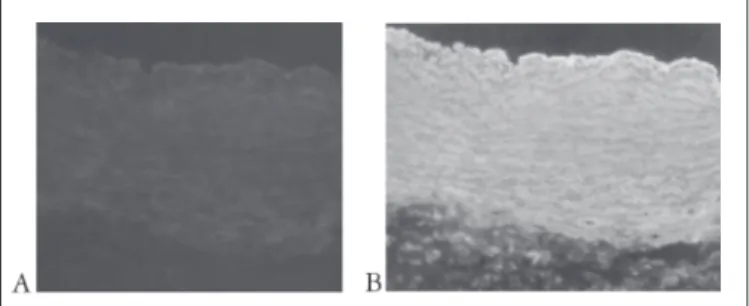
As control, we studied 97 healthy volunteers from the same geographical region matched for age and sex. Tests for IgA-EmA were performed by indirect immunoluorescence assay, using human umbilical cord as substract and luorescein conjugated goat anti-human IgA (GMK, Porto Alegre, RS, Brazil) as conjugate. Positive and negative controls were included in each test battery (Figure 1).
of CD. CD patients classically develop prolonged diarrhea, abdominal pain and weight loss, iron or folate deiciency, osteoporosis, chronic fatigue, milk intolerance, dental problems, neuropathy, dementia and failure to thrive. Subclinical forms are quite common; it is not rare that CD patients with minor gastroenterological symptoms are misdiagnosed as having irritable bowel disease or that CD diagnosis is only detected after the investigation of iron deiciency anemia or low bone mass (osteoporosis/osteopenia)(2).
Bowel disease is the second most common involvement in scleroderma, next to skin, and has a high variable severity. Fibrous iniltration of small bowel results in dilated and often atonic loops that loose their propulsive function. Bacterial overgrowth causes damage of mucous layer causing malabsorption and malnutrition(5).
In our study we could not prove association of SSc and CD. Our results are in contrast with those from Rosato et al.(4). Differences in genetic background may be one
explanation for this inding. Although the prevalence of CD in our geographical region is the same as worldwide (0.3% to 0.5%)(2), we do not have enough knowledge of the
genetic background of scleroderma Brazilian patients. One more data to be taken into account is that our sample had a small proportion of generalized SSc form – that was the only form associated with CD in the previously cited study. Sample size may be another explanation for the discordant results. SSc is a quite rare disorder, affecting 286 per million population and CD, as already mentioned, is a very common one. In this context multicentric studies with larger samples may answer this question.
Concluding, in our sample of 105 Brazilian patients there is no detected association between scleroderma and IgA-EmA presence.
Nisihara R, Utiyama SR, Azevedo PM, Skare TL. Triagem para doença celíaca em pacientes com esclerodermia. Arq Gastroenterol. 2011;48(2):163-4.
RESUMO - Tanto a esclerodermia como a doença celíaca são doenças de autoimunidade que causam diarreia. Como o agrupamento de doenças
autoimunes em único indivíduo não é raro, é importante saber se um individuo com esclerodermia tem maiores chances de ter ou não doença celíaca. Para isso, estudaram-se 105 pacientes com esclerodermia e 97 controles saudáveis para o anticorpo EmA IgA. Não foi possível detectar presença aumentada de EmA IgA em pacientes com esclerodermia. Conclui-se que não existe necessidade de busca ativa de doença celíaca em pacientes com esclerodermia e diarreia, a menos que existam evidências clínicas claras da doença.
DESCRITORES - Doença celíaca. Escleroderma, sistêmico.
FIGURE 1. A - Negative IgA-EmA in cryostatic section of human
umbilical chord (400X). B - Positive IgA-EmA in cryostatic section of human umbilical chord (400X)
RESULTS
All samples, patients and controls were negative for IgA-EmA.
DISCUSSION
Crypt hyperplasia, villous atrophy and intra epithelial lumphocytic iniltration are the main pathological characteristics
REFERENCES
1. Iltanen S, Collin P, Korpela M, Holm K, Partanem J, Polvi A, Mäki M. Celiac disease and markers of celiac disease latency in patients with primary Sjögren’s syndrome. Am J Gastroenterol. 1999;94:1042-6.
2. Kotze LM. Doença celíaca. In: Coelho JCU, editor. Aparelho Digestivo Clínica e Cirurgia. 3ª ed. São Paulo: Atheneu; 2005. v.2, p. 703-24.
3. Luft LM, Barr SG, Martin LO, Chan EK, Fritzler MJ. Autoantibodies to tissue transglutaminase in Sjögren’s syndrome and related rheumatic diseases. J
Rheumatol. 2003;30:2613-9.
4. Rosato E, De Nitto D, Rossi C, Libanori V, Donato G, Di Tola M, Pisarri S, Salsano F, Picarelli A. High incidence of celiac disease in patients with systemic sclerosis. J Rheumatol. 2009;36:965-9.
5. Varga J. Systemic sclerosis: epidemiology, pathology and pathogenesis. In: Klippel JH, Stone J, Crofford LJ, White PH, editors. Primer on rheumatic diseases. 13th
ed. Atlanta: Springer Science-Business Media LLC; 2008. p.351-8.