AR
TIGO ORIGINAL / ORIGINAL AR
TICLE
INTRODUCTION
Inlammatory bowel diseases (IBD) are autoim-mune, chronic and relapsing diseases of unknown
etiology(26). IBD comprises Crohn’s disease (CD)
and ulcerative colitis (UC), a group of debilitating conditions associated with deregulated mucosal im-mune response. These conditions affect up to 0.5% of the population in developed countries(22) and the incidence appears to increase as distance from the equator increases(3).
Vitamin D has an established role in promoting bone health but is emerging as a multifunctional vita-min in IBD. It has recently being linked to a number of other functions like inlammatory and
anti-LOWER LEVELS OF VITAMIN D CORRELATE
WITH CLINICAL DISEASE ACTIVITY AND
QUALITY OF LIFE IN INFLAMMATORY
BOWEL DISEASE
Francisca DIAS DE CASTRO
1, Joana MAGALHÃES
1, Pedro BOAL CARVALHO
1,
Maria João MOREIRA
1, Paula MOTA
2and José COTTER
1,3Received 6/6/2014 Accepted 8/9/2015
ABSTRACT - Background - Inlammatory bowel disease, comprising Crohn’s disease and ulcerative colitis, is a group of debilitat-ing conditions associated with deregulated mucosal immune response. Vitamin D has been implicated in immune response and gastrointestinal function. Objectives - To investigate the correlation between serum vitamin D levels and disease activity and quality of life in patients with inlammatory bowel disease. Methods - This cross-sectional study enrolled ambulatory patients with inlam-matory bowel disease and assessed clinical disease activity and quality of life (Short Inlaminlam-matory Bowel Disease Questionnaire [SIBDQ]). Vitamin D levels were determined via serum 25-hydroxyvitamin D measurement; deiciency was deined as values <20 ng/mL. Statistical analysis was performed with SPSS vs 20.0. Results - A total of 76 patients were enrolled, 19 with ulcerative colitis (25%) and 57 with Crohn’s disease (75%). Overall, mean serum 25-hydroxyvitamin D levels were low (26.0±10.0 ng/mL), while those in patients with Crohn’s disease were signiicantly lower than ulcerative colitis (24.6±8.0 vs 30.0±12.5 ng/mL; P=0.032). Vitamin D deiciency was found in 30% of patients. Patients who were in clinical remission were found to have higher levels of vitamin D than those who were not in remission (28.0±10.3 vs 21.6±6.0 ng/mL, P=0.001). Inlammatory bowel disease patients with SIBDQ scores <50 were found to have signiicantly lower mean vitamin D levels compared with patients who had SIBDQ scores ≥50 (23.4±6.9 vs 27.9±10.8 ng/mL, P=0.041). Conclusions - A high proportion of patients with inlammatory bowel disease were vitamin D deicient, particularly patients with Crohn’s disease. Both clinical disease activity and quality of life correlated signiicantly with lower levels of vitamin D, illustrating a clear need for supplementation in patients with inlammatory bowel disease.
HEADINGS - Inlammatory bowel diseases. Vitamin D. Quality of life.
Declared conflict of interest of all authors: none Disclosure of funding: no funding received
1 Departamento de Gastroenterologia, Centro Hospitalar do Alto Ave, Guimarães, Portugal; 2 Departamento de Patologia Clínica, Centro Hospitalar do Alto Ave, Guimarães, Portugal; 3 Instituto de Investigação em Ciências da Vida e Saúde (ICVS), Escola de Ciências da Saúde, Universidade do Minho, Braga, Portugal.
Correspondence: Francisca Dias de Castro. Rua dos Cutileiros, Creixomil - CEP: 4835-044 - Guimarães, Portugal. E-mail: [email protected]
carcinogenic pathways in the gastrointestinal tract(25). In humans, sun exposure is responsible for up to 95% of vitamin D production(7). Vitamin D deiciency was reported in 63% of patients with CD(30) and has been proposed to play a key role in IBD pathogenesis based on geographic distribution, seasonal variation in onset and exacerbations of IBD(12).
intolerance, malabsorption, reduction of outdoor activities, corticosteroid therapy, bowel resection and circulating cytokines are the consequences of gastrointestinal involvement and may lead to vitamin D deiciency(27).
The most stable measurable form of vitamin D in serum is 25-hydroxyvitamin D (25[OH]D)(7). Screening for vitamin D deiciency requires a blood sample for measurement of serum 25(OH)D levels and is therefore practical and feasible in an outpatient setting(30).
Clinically, increasing 25(OH)D levels through high-dose vitamin D supplementation may have therapeutic potential and prevent relapse in CD(17, 18), although this still warrants conirmation in controlled trials. Several studies have been conducted to demonstrate a correlation between vitamin D status and inlammatory bowel disease activity(6, 14). How-ever, few studies(33) have so far hypothesized that vitamin D deiciency is associated with a lower quality of life (QOL) in patients with IBD.
The aim of this study was to investigate the correlation between serum vitamin D levels and both disease activity and health-related QOL (HRQOL) in a cohort of patients with IBD.
METHODS
This cross-sectional study was performed in Guimarães, Northern Portugal (where the four-season climate provides a large amount of sunshine in summer) and enrolled patients with IBD in ambulatory care (CD and UC, excluding patients with ulcerative proctitis). All samples were collected during the summer months (July and August 2013). Vitamin D sta-tus was obtained thorough measurement of serum 25(OH) D by a fully automated immunoassay (ADVIA Centaur XP®, Siemens)(5), as it was considered the best measure of an individual’s vitamin D status(24). Vitamin D insuficiency was deined as a level between 20 and 30 ng/mL and deiciency was deined as a level <20 ng/mL(15, 28).
Patients were excluded if they presented with comorbid conditions that interfere with vitamin D serum values (i.e. renal failure, liver disease, pregnancy, lactation, medica-tions such as anticonvulsants and vitamin D supplements). Patients under 18 years-old were excluded from the study.
Demographic data, disease location, duration and behav-ior (Montreal Classiication for both CD and UC), medical history and IBD-related surgeries, were obtained from clin-ical records. C-reactive protein (CRP), ferritin, albumin, erythrocyte sedimentation rate (ESR) and hemoglobin levels were also measured (using routine laboratory techniques) as markers for inlammation and disease severity.
The primary outcomes were the association of vitamin D deiciency with disease activity and HRQOL. Disease activity was measured using the Harvey-Bradshaw index (HBI) for CD patients and partial Mayo score for UC patients. The HBI is a simple and validated index of CD activity based on ive items (general wellbeing, abdominal pain, number of liquid stools per day, abdominal mass and complications)(13). The partial Mayo Score incorporates the reported stool frequency,
presence of rectal bleeding and a physician’s global assessment. This partial Mayo score in which the endoscopic component is omitted, has been shown to correlate well with the Mayo
Score(29, 32). HRQOL was quantified using the Short IBD
Questionnaire (SIBDQ)(16), a simple 10-point questionnaire that is a validated measure of HRQOL in CD and UC. The 10 questions are subdivided into bowel-related, systemic, emo-tional and social domains, with each question being answered on a scale ranging from 1 to 7, resulting in a total SIBDQ score between 10 (worst/low HRQOL) and 70 (best/high HRQOL). The scores were analyzed as dichotomous outcomes with a cutoff of 50 for the SIBDQ, ≤3 indicating remission for HBI and ≤2 for partial Mayo Score, with no subscore >1.
Statistical analysis was performed using the SPSS vs 20.0 program. Continuous variables were summarized using means and standard deviations, whereas categorical variables were described using proportions. The chi-square test and the independent-samples t test were used for categorical and
continuous variables, respectively. Binary logistic regression, for disease activity, was adjusted considering as independent variables gender, smoking status, disease location, duration and behavior and laboratory variables (serum hemoglo-bin, CRP, ESR, ferritin, albumin and serum 25(OH)D). Laboratory variables were used as quantitative variables. The variables measured were included if they were selected from bivariate analysis (P<0.05). A P value <0.05 was considered
statistically signiicant.
All patients provided written consent prior to enrollment in this study. The study was performed according to the Dec-laration of Helsinki and approved by the Local Ethics Board of Centro Hospitalar do Alto Ave – Guimarães, Portugal.
RESULTS
Baseline characteristics
A total of 76 patients with IBD were enrolled in this study, 72% were female, mean age was 33.8±10.2 years, 19 had UC (25%) and 57 had CD (75%). The mean duration of disease was 72.0±66.1 months (6–360 months). The demographic characteristics of the study population are presented in Table 1. Most of the patients with CD presented with involvement of the small bowel (93%), L1 (39%) or L3 (54%) by Montreal Classiication, and only 7% had exclusive large bowel disease. More than one third of CD patients had had small bowel surgery (35%). Immunomodulators were being used by 58% of patients, while 37% were receiving anti-TNF therapy and a further 24% were receiving corticosteroids.
Vitamin D levels
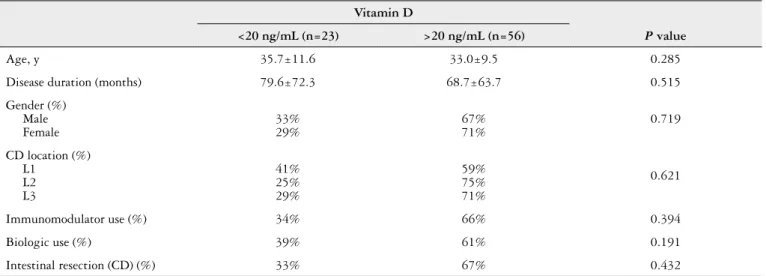
There was no signiicant difference in the prevalence of vitamin D deiciency by age, gender or duration of disease. The use of immunomodulators, biologic therapy or previ-ous history of intestinal resection were not signiicantly as-sociated with vitamin D deiciency. In patients with CD the location of disease did not have an association with serum vitamin D levels (Table 2).
Vitamin D & disease activity
Those patients who were in clinical remission (HBI ≤3 for CD and a partial Mayo Score ≤2 with no subscore >1
for UC) had higher levels of vitamin D compared with those who were not in remission (28.0±10.3 vs 21.6±6.0 ng/mL,
P=0.001). Clinical remission was signiicantly associated with
vitamin D suficiency (P=0.011) (Table 3).
By univariate analysis only lower levels of vitamin D (21.6±6.0 vs 28.0±10.3; P=0.001) and higher levels of CRP
(16.8±31.6 vs 4.9±4.1; P=0.009) were statistically associated
with disease activity, however, in binary logistic regression only lower levels of vitamin D were independently associated with disease activity with a RR of 1.1/ per unit (P=0.018;
95% CI 1.02-1.20).
TABLE 1. Patient demographics
Ulcerative colitis (n=19) Crohn’s disease (n=57) All patients (n=76)
Age, y, mean 35.4±11.3 33.3±9.8
Gender, n (%)
Male 4 (21%) 17 (30%)
Female 15 (79%) 40 (70%)
Disease duration, m, mean 70.7±57.0 72.4±69.4
Disease involving colon only, n (%) 19 (100%) 4 (7%)
Disease involving small bowel only, n (%) Not applicable 22 (39%)
Disease involving colon and small bowel, n (%) Not applicable 31 (54%)
25(OH)D, ng/mL, mean* 30.0±12.5 24.6±8.0
Vitamin D insuficiency (<30 ng/mL), n (%) 11 (58%) 41 (72%) 52 (68%)
Vitamin D deiciency (<20 ng/mL), n (%) 4 (21%) 19 (33%) 23 (30%)
6MP/azathioprine, n (%) 44 (58%)
Inliximab/adalimumab, n (%) 28 (37%)
IBD-related surgery, n (%) 20 (26%)
25(OH)D: 25-hydroxyvitamin D; IBD: inlammatory bowel disease. *P=0.032.
TABLE 2. Demographic features and vitamin D levels
Vitamin D
<20 ng/mL (n=23) >20 ng/mL (n=56) P value
Age, y 35.7±11.6 33.0±9.5 0.285
Disease duration (months) 79.6±72.3 68.7±63.7 0.515
Gender (%) Male Female
33% 29%
67% 71%
0.719
CD location (%) L1
L2 L3
41% 25% 29%
59% 75% 71%
0.621
Immunomodulator use (%) 34% 66% 0.394
Biologic use (%) 39% 61% 0.191
Intestinal resection (CD) (%) 33% 67% 0.432
Vitamin D & HRQOL
IBD patients with SIBDQ scores <50 had signiicantly lower mean vitamin D levels compared with patients who had SIBDQ scores ≥50 (23.4±6.9 vs 27.9±10.8 ng/mL, P=0.041).
However, there was no signiicant difference in the prevalence of vitamin D deiciency between these two groups (Table 3).
Vitamin D & other markers
A signiicantly higher proportion of patients with vitamin D insuficiency had higher levels of CRP (10.7±22.3 vs 4.3±2.9 mg/L, P=0.048), however, there was no difference for vitamin D deiciency (<20 ng/mL). The presence of anemia, lower levels of albumin and higher levels of ferritin and ESR did not correlate signiicantly with lower levels of vitamin D (Table 4).
DISCUSSION
The role of vitamin D is increasingly recognized in immu-nomodulation and in a variety of diseases states, including IBD(24). In a cohort of patients with IBD in an outpatient setting we found 30% of patients had vitamin D deiciency (<20 ng/mL), which increased to 68% when considering vitamin D insuficiency (≥20 but <30 ng/mL). Our results highlight the fact that vitamin D deiciency is common in IBD patients even when the disease is managed in an outpa-tient setting and remain high even in summer. These results were consistent with a large, retrospective study of 504 adult patients with IBD from Wisconsin (UC n=101, CD n=403), in which ~50% of patients had vitamin D deiciency(33).
TABLE 4. Association between Vitamin D levels and serological biomarkers
Vitamin D <20 ng/mL
Vitamin D
>20 ng/mL P value
Vitamin D <30 ng/mL
Vitamin D
>30 ng/mL P value
Hemoglobin 13.5±1.4 13.5±1.4 0.926 13.7±1.4 13.2±1.4 0.171
Albumin 3.9±0.5 4.0±0.4 0.095 4.0±0.4 4.1±0.3 0.297
Ferritin 57.5±62.7 72.0±86.5 0.473 64.6±63.3 74.1±109.0 0.631
ESR 16.4±19.9 15.7±15.3 0.873 15.6±16.9 16.7±16.5 0.782
CRP 11.6±19.6 7.4±18.3 0.366 10.7±22.3 4.3±2.9 0.048
ESR: erythrocyte sedimentation rate; CRP: C-reactive protein.
TABLE 3. Association between Vitamin D levels and disease activity and quality of life
No clinical
remission Clinical remission P value SIBDQ <50 SIBDQ >50 P value
25(OH)D, ng/mL,
mean 21.6±6.0 28.0±10.3 0.001 23.4±6.9 27.9±10.8 0.041
Vitamin D <20 ng/
mL, n 12 11
0.011*
12 11
0.242*
Vitamin D >20 ng/
mL, n 12 41 20 33
25(OH)D, 25-hydroxyvitamin D; SIBDQ, Short Inlammatory Bowel Disease Questionnaire.
Inadequate exposure to sunlight is an important cause of vitamin D deiciency in IBD patients; several studies, particu-larly from northern climates, have consistently demonstrated an association between winter season, a period of low sun-light and UVB exposure, and vitamin D deiciency(10, 23, 30). In this study all samples were collected in the summer to reduce the inluence of lack of UVB exposure in our data, suggesting that the observed low levels of vitamin D were not a result of low sunlight levels.
While most studies have examined the prevalence in pa-tients with well-established IBD, vitamin D deiciency does not appear to be a consequence of long-standing disease alone. In a cohort of newly diagnosed patients from Canada, only 22% were found to have suficient levels of vitamin D(19). Similarly, in our cohort of patients there was no apparent correlation between vitamin D deiciency and duration of the disease.
The association between vitamin D levels in CD of the small bowel and malabsorption of oral vitamin D is yet unclear. It has been suggested that malabsorption of oral vitamin D can occur in CD(10), however, this association has not been demonstrated elsewhere(30). In our study we did not ind an association between vitamin D deiciency and small bowel CD. However, it should be noted that due to the relatively small number of patients with CD had isolated large bowel disease (n=4; 7%), our study was not suficiently powered to determine this effect.
Terminal ileal resection was associated with vitamin D deiciency in some studies(20, 31), which is thought to be a result of the interruption of the enterohepatic circulation in the terminal ileum, reducing the absorption of fats and fat-soluble vitamins, such as vitamin D(24). However, the effect of ileal resection in vitamin D deiciency has not been consis-tently observed(33) and our results did not ind an association between ileal resection and vitamin D deiciency.
Published data supporting a clinical association between vitamin D deiciency and disease activity in IBD are also con-licting. No correlation between vitamin D levels and disease activity was observed in two cross-sectional studies(4, 21) while a retrospective study concluded that vitamin D deiciency was associated with increased disease activity in patients with CD, but not with UC(33). A recent study prospectively analyzed the association between vitamin D deiciency and the need for IBD-related surgery or hospitalizations in a large cohort of 3,217 patients and concluded that vitamin D deiciency was associated with an increased risk of surgery and hospitalization compared with those patients with adequate vitamin D levels(2). In our study the prevalence of patients in clinical remission was signiicantly higher in patients with adequate vitamin D levels. Additionally we found an independent association between lower levels of vitamin D and disease activity and even though the impact was not very high, this could suggest that vitamin D has a protective effect and that low vitamin D levels are probably a risk factor for surgery and hospitalization in IBD patients. The fact that other variables, particularly CRP, did not associate independently with clinical disease activity may be related to the fact that we only included outpatients with mild to moderate disease severity.
In our study, IBD patients with low HRQOL (SIBDQ score <50) had signiicantly lower mean vitamin D levels (in the range of vitamin D insuficiency: ≥20 and <30 ng/mL). Only one comparative study could be found which conclud-ed that vitamin D deiciency was independently associatconclud-ed with lower HRQOL in CD, but not in UC(33). These results highlight the importance of vitamin D insuficiency in IBD patients, as QOL is an important outcome in these patients(9).
In patients with IBD, lower serum vitamin D levels have been associated with increased ferritin and CRP levels(31). However, a recent study demonstrated an inverse correlation between serum vitamin D levels and markers of intestinal inlammation (fecal calprotectin) but no association between vitamin D levels and serological inlammation markers(8). In our study, only CRP was shown to correlate with vitamin D insuficiency and none of the serological inlammation markers correlated with vitamin D deiciency; this may be supported by the theory that serum vitamin D levels may inluence local tissue inlammation more than systemic inlammation(8), but more studies are needed to elucidate the relationship.
There are some limitations to this study: the relatively small number of patients reduced the statistical power to detect a correlation between vitamin D and QOL, while the selection of only outpatients with mild to moderate dis-ease severity may have introduced potential selection bias. Another limitation was non-assessment of anthropometric measurements (weight, height, BMI) and food questionnaire, however, some authors suggest that traditional food sources contribute to less than 200 IU/day to vitamin D intake(34).
Strengths of the study included the use of strict exclusion criteria to remove comorbid confounding factors, as well as the fact that sampling was performed in the summer to ensure that the inluence of daylight hours was consistent.
In conclusion, vitamin D deiciency was common in pa-tients with IBD and appears to be related to clinical disease activity and QOL. However, although there is evidence for a role of vitamin D in IBD pathogenesis, it has been unclear if vitamin D deiciency results from chronic gastrointestinal inlammation(1). Our study allowed us to identify an associa-tion between vitamin D insuficiency, clinical disease activity and QOL, but the causality can only be determined through prospective studies. Given the high prevalence of vitamin D deiciency in patients with IBD, there is a clear need for increased awareness of regular vitamin D screening and ap-propriate supplementation of vitamin D in the management of these patients.
Authors’ contributions
REFERENCES
1. Ananthakrishnan AN, Khalili H, Higuchi LM, et al. Higher predicted vitamin D status is associated with reduced risk of Crohn’s disease Gastroenterology. 2012;142(3):482-9.
2. Ananthakrishnan AN, Cagan A, Gainer VS, et al. Normalization of plasma 25-hydroxy vitamin D is associated with reduced risk of surgery in Crohn’s disease Inlamm Bowel Dis. 2013;19(9):1921-7.
3. Economou M, Pappas G. New global map of Crohn’s disease: genetic, environ-mental, and socioeconomic correlations. Inlamm Bowel Dis. 2008;14(5):709-20. 4. El-Matary W, Sikora S, Spady D. Bone mineral density, vitamin D, and disease
activity in children newly diagnosed with inlammatory bowel disease. Dig Dis Sci. 2011;56(3):825-9.
5. Freeman J, Wilson K, Spears R, Shalhoub V, Sibley P. Inluence of Vitamin D Binding Protein on Accuracy of 25-Hydroxyvitamin D Measurement Using the ADVIA Centaur Vitamin D Total Assay. Int J Endocrinol. 2014;2014:691-7. 6. Fu YT, Chatur N, Cheong-Lee C, Salh B. Hypovitaminosis D in adults with
inlam-matory bowel disease: potential role of ethnicity. Dig Dis Sci. 2012;57(8):2144-8. 7. Garg M, Lubel JS, Sparrow MP, Holt SG, Gibson PR. Review article: vitamin
D and inlammatory bowel disease--established concepts and future directions. Aliment Pharmacol Ther. 2012;36(4):324-44.
8. Garg M, Rosella O, Lubel JS, Gibson PR. Association of circulating vitamin D concentrations with intestinal but not systemic inlammation in inlammatory bowel disease. Inlamm Bowel Dis. 2013;19(12):2634-43.
9. Ghosh S, Mitchell R. Impact of inlammatory bowel disease on quality of life: Results of the European Federation of Crohn’s and Ulcerative Colitis Associations (EFCCA) patient survey. J Crohns Colitis. 2007;1(1):10-20.
10. Gilman J, Shanahan F, Cashman KD. Determinants of vitamin D status in adult Crohn’s disease patients, with particular emphasis on supplemental vitamin D use. Eur J Clin Nutr. 2006;60(7):889-96.
11. Harries AD, Brown R, Heatley RV, Williams LA, Woodhead S, Rhodes J. Vitamin D status in Crohn’s disease: association with nutrition and disease activity. Gut. 1985;26(11):1197-203.
12. Hart AL. Vitamin D and inlammatory bowel disease: chicken or egg? Inlamm Bowel Dis. 2013;19(2):459-60.
13. Harvey RF, Bradshaw JM. A simple index of Crohn’s-disease activity. Lancet. 1980;1(8167):514.
14. Hassan V, Hassan S, Seyed-Javad P, et al. Association between Serum 25 (OH) Vitamin D Concentrations and Inlammatory Bowel Diseases (IBDs) Activity. Med J Malaysia. 2013;68(1):34-8.
15. Holick MF. Vitamin D: a D-Lightful health perspective Nutr Rev. 2008;66 (10 Suppl 2):S182-194.
16. Irvine EJ, Zhou Q, Thompson AK. The Short Inlammatory Bowel Disease Questionnaire: a quality of life instrument for community physicians managing inlammatory bowel disease. CCRPT Investigators. Canadian Crohn’s Relapse Prevention Trial. Am J Gastroenterol. 1996;91(8):1571-8.
17. Jorgensen SP, Agnholt J, Glerup H, et al. Clinical trial: vitamin D3 treatment in Crohn’s disease - a randomized double-blind placebo-controlled study. Aliment Pharmacol Ther. 2010;32(3):377-83.
18. Laverny G, Penna G, Vetrano S, et al. Eficacy of a potent and safe vitamin D receptor agonist for the treatment of inlammatory bowel disease. Immunol Lett. 2010;131(1):49-58.
19. Leslie WD, Miller N, Rogala L, Bernstein CN. Vitamin D status and bone density in recently diagnosed inlammatory bowel disease: the Manitoba IBD Cohort Study Am J Gastroenterol. 2008;103(6):1451-9.
20. Leichtmann GA, Bengoa JM, Bolt MJ, Sitrin MD. Intestinal absorption of cholecalciferol and 25-hydroxycholecalciferol in patients with both Crohn’s disease and intestinal resection. Am J Clin Nutr. 1991;54(3):548-52.
21. Levin AD, Wadhera V, Leach ST, et al. Vitamin D deiciency in children with inlammatory bowel disease Dig Dis Sci. 2011;56(3):830-6.
22. Loftus EV, Jr. Clinical epidemiology of inlammatory bowel disease: Incidence, prevalence, and environmental inluences. Gastroenterology. 2004;126(6):1504-17. 23. McCarthy D, Duggan P, O’Brien M, et al. Seasonality of vitamin D status
and bone turnover in patients with Crohn’s disease. Aliment Pharmacol Ther. 2005;21(9):1073-83.
24. Mouli VP, Ananthakrishnan AN. Review article: vitamin D and inlammatory bowel diseases. Aliment Pharmacol Ther. 2014;39(2):125-36.
25. Narula N, Marshall JK. Management of inlammatory bowel disease with vitamin D: beyond bone health. J Crohns Colitis. 2012;6(4):397-404.
26. Nunes T, Fiorino G, Danese S, Sans M. Familial aggregation in inlammatory bowel disease: is it genes or environment? World J Gastroenterol. 2011;17(22):2715-22. 27. Pappa HM, Grand RJ, Gordon CM. Report on the vitamin D status of adult
and pediatric patients with inlammatory bowel disease and its signiicance for bone health and disease. Inlamm Bowel Dis. 2006;12(2):1162-74.
28. Rosen CJ. Clinical practice. Vitamin D insufficiency N Engl J Med. 2011;364(3):248-54.
29. Schroeder KW, Tremaine WJ, Ilstrup DM. Coated oral 5-aminosalicylic acid therapy for mildly to moderately active ulcerative colitis. A randomized study. N Engl J Med. 1987;317(26):1625-9.
30. Suibhne TN, Cox G, Healy M, O’Morain C, O’Sullivan M. Vitamin D deiciency in Crohn’s disease: prevalence, risk factors and supplement use in an outpatient setting. J Crohns Colitis. 2012;6(2):182-8.
31. Tajika M, Matsuura A, Nakamura T, et al. Risk factors for vitamin D deiciency in patients with Crohn’s disease. J Gastroenterol. 2004;39(6):527-33.
32. Turner D, Seow CH, Greenberg GR, Grifiths AM, Silverberg MS, Steinhart AH. A systematic prospective comparison of noninvasive disease activity indices in ulcerative colitis. Clin Gastroenterol Hepatol. 2009;7(10):1081-8.
33. Ulitsky A, Ananthakrishnan AN, Naik A, et al. Vitamin D deiciency in patients with inlammatory bowel disease: association with disease activity and quality of life. JPEN J Parenter Enteral Nutr. 2011;35(3):308-16.
34. Vatanparast H, Calvo MS, Green TJ, et al. Despite mandatory fortiication of staple foods, vitamin D intakes of Canadian children and adults are inadequate. J Steroid Mol Biol. 2010;121(1-2):301-3.
Dias de Castro F, Magalhães J, Boal Carvalho P, Moreira MJ, Mota P, Cotter J. Correlação entre hipovitaminose D, a atividade clínica da doença e a qualidade de vida na doença inlamatória intestinal. Arq Gastroenterol. 2015,52(4):xxx.
RESUMO - Contexto - A doença inlamatória intestinal, que compreende a doença de Crohn e a colite ulcerosa, é um grupo de entidades incapacitantes associada a uma resposta imunitária desregulada. A vitamina D tem sido associada à resposta imune e funções gastrointestinais. Objetivo - Investigar a correlação entre os níveis séricos de vitamina D, a atividade clínica da doença e a qualidade de vida em doentes com doença inlamatória intestinal.
Método - Estudo transversal que incluiu doentes em ambulatório com doença inlamatória intestinal avaliando a atividade clínica da doença e a qua-lidade de vida (Short Inlammatory Bowel Disease Questionnaire [SIBDQ]). Os níveis séricos de vitamina D foram determinados através dos níveis de 25-hidroxivitamina D; a deiciência de vitamina D foi deinida para valores <20 ng/mL. Resultados - Foram incluídos 76 doentes, 19 com colite ulcerosa (25%) e 57 com doença de Crohn (75%). No global, os valores séricos médios de 25-hidroxivitamina D foram baixos (26,0±10,0 ng/mL), os doentes com doença de Crohn apresentaram níveis mais baixos do que os doentes com colite ulcerosa (24,6±8,0 vs 30,0±12,5 ng/mL; P=0,032). O déice de vitamina D foi identiicado em 30% dos doentes. Os doentes em remissão clínica apresentaram níveis mais elevados de vitamina D (28,0±10,3 vs 21,6±6,0 ng/ mL, P=0,001). Doentes com SIBDQ <50 apresentaram níveis signiicativamente inferiores de vitamina D em comparação com doentes com SIBDQ ≥50 (23,4±6,9 vs 27,9±10,8 ng/mL, P=0,041). Conclusão - Uma percentagem elevada de doentes apresentou deiciência de vitamina D, em particular doentes com doença de Crohn. A atividade clínica e a qualidade de vida dos doentes com doença inlamatória intestinal correlacionou-se com níveis mais baixos de vitamina D, ilustrando uma clara necessidade de suplementação desta vitamina em doentes com doença inlamatória intestinal.