Brazilian Journal of Physics, vol. 39, no. 1, March, 2009 55
A Comparison between Channel Selections in Heavy Ion Reactions
S. Mohammadi∗
Physics Department, Payame Noor University, Mashad 91735, IRAN (Received on 15 October, 2008)
The gamma rays de-exciting the yrast and near yrast states in neutron deficient as well as neutron rich nuclei from fusion-evaporation and deep-inelastic reactions and other emission particles have been recorded using an array of escape suppressed germanium detectors, a BGO ball, a recoil separator, silicon charge particle detectors and an ionization chamber. For each reaction type, we used different combinations of detectors with increasing gamma ay detectors from fusion-evaporation experiments to deep-inelastic experiments to separate different channels. In two experiments related to fusion-evaporation reactions, additional mass and charge particle detectors showed better resolution of spectra with lower statistics and some ambiguities. In the third experiment, which we used only an array of germanium detectors and a BGO ball, the statistics of spectra are relatively good but not sufficient, which means that we must use additional channel separators.
Keywords: Yrast states; Fusion-evaporation; Deep-inelastic; Channel selections; Heavy ion reactions
1. INTRODUCTION
The study of nuclei with very exotic proton to neutron ra-tios compared withβ-stable isotopes has been a subject of long standing nuclear physics interest [1]. Heavy ion reactions have proved to be an invaluable tool in the study of high spin yrast and near-yrast nuclear states. Experimentally, for increasing nuclear masses, it becomes progressively more difficult to in-vestigateN∼Znuclei with stable beam/target combinations. Fusion-evaporation reactions provide the standard mechanism to populate states with high angular momentum in neutron de-ficient nuclei. Neutron-rich nuclei with massA<150 can be studied in spontaneous and induced fission. Projectile frag-mentation has proven to be an efficient method of populating nuclei far from the valley of stability. However, in the case of heavy nuclei this method is still limited to species with isomeric states. Deep-inelastic reactions are another reaction mechanism which can be used to study neutron –rich nuclei and are able to populate relatively high-spin states. In order to study rare reaction channels, some method of channel se-lection must be employed in coincidence with the detection of gamma-rays. This usually takes one of three forms (a) an array of charged particle and neutron detectors; (b) a mass separator to detect the recoiling nuclei and measuring their atomic mass number; and (c) an inner BGO ball which is acting as a multi-plicity filter and a total-energy spectrometer. The first two ones are usually used for fusion-evaporation reactions, and the third one for deep-inelastic reactions. The first one has the disad-vantage that for very weak channels, target contaminants can dominate the gamma spectra. The second one can in principle give spectra with lower background and insensitivity to states below isomers, but is restricted by the transmission efficiency for recoiling nuclei of the mass separator. For the last case, the multiplicity of gamma rays is very important.
Experiments
For the comparison of the different channel selections, some data from three different heavy ion reactions in different labs
∗Electronic address:[email protected]
are used which we will explain in some details.
Experiment A
For this experiment we used the reaction19Ne+40Cawith
beam energy of 70 MeV. The radioactive19Nebeam was pro-duced at Louvain-la-Neuve accelerator laboratory in a two stage process using the isotope separator on line (ISOL) method, which uses two cyclotrons. The first one produced 30 MeV protons which bombards a thick Lithium Fluoride tar-get to produce the radioactive atoms via the19F(p,n)19Ne
re-action. The radioactive19Ne atoms as well as a large num-ber of stable19Fisobaric contaminants were then injected into a second cyclotron, which was tuned as a mass spectrometer so that the intensity of the19F contaminants was reduced far
below the radioactive beam intensity after acceleration. Fi-nally the beam was incident on a thick, 1.6mgcm−2,40Ca
tar-get. Gamma rays were identified from residual nuclei using an array of 8 TESSA [2] (Total Energy Suppression Shield Ar-ray) germanium detectors. Charge particles evaporated in the reaction were detected by an array of 128 silicon strip seg-ments with thickness 300µmarranged in an octagonal shape and placed in the forward direction. The arrangement of the silicon array in the forward hemisphere and the gamma detec-tors in the backward hemisphere was convenient experimen-tally.
In figure 1, the energy spectrum of one of the elements of the silicon detector array clearly shows the proton and alpha particle peaks. Figure 2 shows energy versus energy for two strips of silicon detector array. As can be seen, proton-proton, proton-alpha and alpha-alpha coincidences are clearly sepa-rated. Figure 3 shows channel selections gated on protons and alpha particle multiplicities of 1, 2 and 3. Some results of this experiment about the production of nuclei were published be-fore [3,4].
Experiment B
In this experiment, the fusion-evaporation reaction
24Mg+40Ca with a beam energy of 65 MeV provided by
56 S. Mohammadi
FIG. 1: Energy spectrum of one silicon detector which shows the proton andα-particle peaks.
FIG. 2: Energy versus energy for two silicon detectors, which shows p−p,p−αandα−αcoincidences.
detector array, consisting of 18 germanium detectors of both 20% efficient TESSA type detectors and 70% efficient EU-ROGAM [5] detectors. Isobaric identification of subsequent decay gamma rays was achieved by detecting the recoiling nuclei through the Argonne fragment mass analyzer (FMA) [6]. For a given charge state, the FMA disperses the residual nuclei according to their mass over charge(A/Q)ratio in the X direction at the focal plane, where they are detected by
FIG. 3: Random subtracted spectra gated on protons/α-particle mul-tiplicities of 1, 2 and 3.
a position sensitive parallel grid avalanche counter (PGAC) [6].Some results of this experiment about the production of nuclei were published before [7, 8, 9]. Elemental separation was provided by monitoring the recoil energy loss in a split anode ionization chamber placed behind the focal plane of the FMA. A ring of eleven NE213 scintillation detectors [10] was placed in front of the AYEBALL array, at the entrance of the FMA. These detectors were used to detect neutrons and subsequently select evaporation channels in the analysis, which involved one or more neutrons.
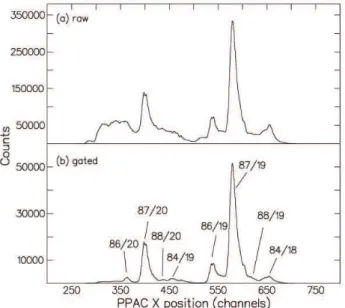
Figure 4 shows a projection of the X-position of the recoils as they pass through the PGAC. Gating on the recoils reduces the amount of scattered beam in the subsequent spectra. For certain masses and charge states, differentAandQvalues can result in the same ratio. For example 88/20≈84/19≈4.40, thus gamma rays from different nuclei will be present in the A/Qgate for that region. However, the fact that the focal plane of the FMA was such that to accommodate only two charge states meant that generally such anomalies could be accounted for by gating on one charge state and subtracting a normalized portion from another. Figure 5 shows PGACX-position versus ∆Efor all recoils, showing the position of the two dimensional gates and itsX-projection.
spec-Brazilian Journal of Physics, vol. 39, no. 1, March, 2009 57
FIG. 4: PGAC X-position (a) raw and (b) gated on the detection of at least oneγ-ray.
FIG. 5: PGACX-position versus∆Efor all recoils in the24Mg+40Ca reaction, showing the position of the 2−Dgates and itsX-projection.
FIG. 6: Ion chamber signals of the isobars.
tra than neutron gating.
Experiment C
In order to obtain information on the ground state bands of neutron rich nuclei aroundA∼190, we used the82Se+192Os deep inelastic reaction at 460 MeV bombarding beam energy to populate the nuclei around192Os. A Thick192Ostarget(>
50mg/cm2)with 0.2 mm Ta backing was used to stop all of the recoils in the target, minimizing the broadening of the lines due to Doppler shift.
indi-58 S. Mohammadi
FIG. 7: Zseparation for obtained nuclei by gating on different parts of the total ion chamber signal.
FIG. 8: Comparison of the effectiveness of using ion chamber and neutron detectors to separate the 3pnchannel from the 4pchannel in theA=86 gated data.
FIG. 9: Gamma ray coincidence spectrum for188Osnucleus gated on 574 keV transition.
FIG. 10: Gamma ray coincidence spectrum for190Osnucleus gated on 589 keV transition.
vidual BGO detector can be recorded. The BGO ball adds a background reduction factor that is reaction dependent, but can be conservatively estimated to be about 2. Two and three dimensional gamma ray matrices were used to construct level schemes of the nuclei of interest. Typical coincidence spectra are shown in figures 9 and 10. Some results of this experiment were also published before [12-14].
2. RESULTS AND CONCLUSIONS
Brazilian Journal of Physics, vol. 39, no. 1, March, 2009 59
channel identification. However, by going to weak channels like 2α, 3p or 3α, the statistics become very poor as can be seen from figure 3.
In the second experiment, the mass and charge of the recoil-ing nuclei can be identified usrecoil-ing the FMA. For certain recoils, a charge state anomaly can cause an isobaric contamination in theA/Qgated spectra. These contaminations can be later re-moved withZ separation, using an energy loss signal from a split anode ion chamber at the focal plane of the instrument. In this experiment, neutron detectors were used to detect neutrons and subsequently select evaporation channels which involve one or more neutrons. However, as figure 8 shows, the neutron evaporation channels could be clearly resolved by deconvolut-ing the spectra with and without the neutron condition. In
gen-eral, the ion chamber gating method was preferred to separate the isobarically gated spectra by an individual element. Here again the statistics becomes poor by using additional detector separators.
In experiment C, deep inelastic reactions are the most gen-eral reaction mechanism which can be used to study neutron rich nuclei in any mass region. In this experiment, although we used only gamma ray detectors with increasing numbers, the statistics of spectra are relatively good but not sufficient, which means that we must use additional channel separators. Thus by using a large number of gamma ray detectors together with other detectors like recoil separators, charge particle detectors and ion chambers , unambiguous channel selections will be possible for both neutron deficient and neutron rich regions.
[1] W Gelletly,Acta Physica Polonica, B26: 323 (1995). [2] P.J. Nolan, et al,Nucl. Instr. and Meth. A236:95 (1985). [3] W.N. Catford, S. Mohammadi, et al,Nucl. Phys. A,616: 303c
(1997).
[4] W.N. Catford., S. Mohammadi, et al,Nucl. Instr. and Meth. A
371:449 (1996).
[5] C.W. Beausang, et al,Nucl. Instr. and Meth., A313:37 (1992). [6] C.N. Davids, et al,Nucl. Instr. and Meth., B70:358 (1992). [7] S.M. Vincent, P.H. Regan, S. Mohammadi, et al,Physical
Re-view C,V60:064308 (1999).
[8] S. Mohammadi, et al,Journal of Physics,G25:909 (1999). [9] S.M. Vincent, P.H. Regan, S. Mohammadi, et al, Journal of
Physics,G25: 941 (1999).
[10] G.F. Knoll,Radiation Detection and Measurement,3rdEdition,
John Wiley and Sons, New York, (2000).
[11] D. Bazzaco,Proc. Of the Int. Conf. on Nuclear Structure at High Angular Momentum, Ottawa,VII: 376 (1992).
[12] S. Mohammadi, et al,Brazilian Journal of Physics, V34(No. 3A): 792 (2004).
[13] Zs. Podolyak, S. Mohammadi, et al,International Journal of Modern Physics E,V13(No. 1): 123 (2004).