Dynamics of Reactant Interfaces in
Irreversible Reaction Systems
EzequielV. Albano
Instituto de Investigaciones Fisicoqumicas Teoricas y Aplicadas, (INIFTA),
CONICET, UNLP, CIC (Bs. As.). Sucursal 4, Casilla de Correo 16, (1900) La Plata. Argentina FAX : 0054-221-4254642, E-mail : [email protected]
Received 15 November 1999
Recent progress in the study and understanding of the properties of interfaces between reactants in irreversible reaction systems, gained from Monte Carlo simulations, is reviewed and discussed. The displacement of unstable phases by stable ones causes the formation of interfaces. This mechanism is particularly relevant close to rst-order irreversible phase transitions, where phase coexistence is observed. Dierent variants of the monomer-momomer and the monomer-dimer models exhibit such transitions, and they are therefore suitable for the study of interfacial properties. More specically, due to stimulating experimental ndings, the monomer-dimer model, which mimics the catalytic oxidation of carbon monoxide, has been the subject of extensive studies, which are discussed in detail.
I Introduction
The study of far-from-equilibrium systems has become one of the most challenging elds of multidisciplinary research [1, 2] . While nonequilibrium phenomena are ubiquitous in nature and play a crucial role in many areas of science and technology, they are far from being understood at a fundamental level, as their equilibrium counterparts are. This is partly due to their richness and complexity. Examples of far-from-equilibrium sys-tems beyond those in physics and physical chemistry include markets [3], weather [4], collective behaviour of living organisms [5], earthquakes, and fault dynamics [6]; etc.
Within a physical chemistry context, the study of nonequilibriumsurface chemical reactions has attracted growing attention, motivated by both technical appli-cations and scientic interest. Examples of the former are: the large-scale fabrication of chemicals via hetero-geneously catalyzed reactions; the treatment of auto-motive exhaust, reducing environmental pollution; co-ating, corrosion and passivation of surfaces; synthesis and renement of hydrocarbons. Furthermore, scien-tic interest in the study of these processes is due to the emergence of a rich and complex variety of physical chemistry phenomena including, e.g., chaos, bistability, critical phenomena and irreversible phase transitions, propagation and interference of chemical waves of ad-sorbed reactants, and chemical oscillations.
Recent development of experimental techniques such as scanning tunneling microscopy (STM), low energy electron diraction (LEED), high resolution
electron energy loss spectroscopy (HREELS), ultravi-olet photoelectric spectroscopy (UPS), and photoelec-tron emission microscopy (PEEM) [7, 8], among others, allows scientists to gather detailed physical and chemi-cal information about surfaces, adsorbates and reac-tion products. Perhaps the most dramatic example of this progress is the recent STM-based measurement of reaction-rate parameters at a microscopic level for the catalytic oxidation ofCO[9]. Remarkably, these para-meters agree very well with those previously obtained by means of macroscopic measurements.
Also, surface reaction systems are certainly a cha-llenging scientic eld for the development and appli-cation of analytical methods and theories, including re-cent advances in the area of nonlinear dynamics [10]. Complementing these very well established experimen-tal and analytical approaches, computer simulations have recently become a powerful tool for the study of a great variety of processes occurring in nature in gene-ral [11, 12, 13], as well as surface chemical reactions in particular [14].
essen-tially at. Under these circumstances Monte Carlo si-mulation has become a powerful tool for the study of reaction interfaces.
It should be mentioned that the propagation of con-centration fronts, involving the interface between reac-tants in far-from-equilibrium heterogeneous reactions, has recently been very well documented in various ex-perimental systems (see [16, 17, 18, 19] and references therein). The observed spatio-temporal patterns also include trigger waves, rotating spirals and turbulence.
Within this context, the aim of this work is to of-fer a critical overview of recent progress, mainly due to Monte Carlo simulations, in understanding the dyna-mics of reactant interfaces in irreversible reaction sys-tems. We will restrict ourselves to cases in which the catalyst is in contact with a reservoir which supplies the reacting species, and the rate of reaction at the surfaces is very high, since the formation of reactant interfaces in diusion-limited reactions has been already reviewed [14].
II Brief Phenomenological and
Theoretical Background
For a growing interface, there is a clear distinction bet-ween the growth direction and that perpendicular to it. So it may not be surprising that scaling is die-rent along these two directions. Therefore, an interface lacks of self-similarity but, instead, can be regarded as a self-ane object [20].
Based on general scaling arguments it can be shown that the stochastic evolution of a driven interface along a strip of width Lis characterized by long-wavelength uctuations (w(L;t)) which have the following time-and nite-size-behavior [15] :
w(L;t)/L
F(t=L z)
; (1)
where F(x)/x for
x1 and F(x)!1 forx 1, with z = =, and where and are the roughness and growth exponents, respectively. Thus, for an in-nite system (L ! 1), one has w(t)/ t
, as
t ! 1. Note thatw is also known as the interface width.
It is reasonable to expect that scaling behaviour should still be given correctly after coarse-graining and passing to the continuous limit. In fact, the dynamics of an interface between two phases, one of which is gro-wing into the other, is believed to be correctly described by a simple nonlinear Langevin equation proposed by Kardar, Parisi and Zhang (KPZ) [15, 21] :
_ h=D r
2
h+ (=2)(rh) 2+
(~r ;t) (2) whereh(~r ;t) is the height of the interface at location~r and time t. The rst term of the right hand side of Eq. (2) describes the relaxation of the interface by a surface tension D, while the second term is the lowest-order
nonlinear term that can appear in the interface-growth equation, and accounts for the dependence of the grow rate on the local slope of the interface. In most theo-retical studies the stochastic term(~r ;t) is assumed to be Gaussian and -function correlated.
For a surface-reaction lattice-gas model, an inter-face may exist between two reactant species. So, for a stochastic reactive interface propagation one may ex-pect the exponents to assume KPZ values for a one-dimensional interface, namely = 1=3, = 1=2 and z = 3=2. However, under actual reaction conditions the characteristics of the interface may depend on the specic reaction system.
III Interface Propagation in the
Monomer-Dimer Reaction
System
The lattice-gas version of the reaction 2A+B 2
!2AB, which mimics the oxidation of carbon monoxide (i.e.,A isCO,B
2 is O
2and
AB isCO
2), was proposed by Zi et al. [22]. It is assumed that the reaction proceeds according to Langmuir-Hinshelwood mechanism:
A(g) +S!A(a); (3) B
2(
g) + 2S!2B(a); (4) A(a) +B(a)!AB(g) + 2S; (5) where S is an empty site on the surface, while (a) and (g) refer to the adsorbed and gas phase, respectively.
The monomer-dimer (MD) model uses a square lat-tice to represent the catalytic surface. The Monte Carlo algorithm for the simulation of the MD model is as fo-llows : i)AorB
2molecules are selected randomly with relative probabilities Y
A and Y
B, respectively. These probabilities are the relative impingement rates of both species, which are proportional to their partial pressu-res. Due to the normalization,Y
A+ Y
B= 1, the model has a single parameter, i.e.,Y
A. If the selected species is A, a surface site is selected at random, and if that site is vacant,Ais adsorbed on it [Eq.(3)]. Otherwise, if that site is occupied, the trial ends and a new mole-cule is selected. If the selected species is (B
The model is intrinsically irreversible and it is also assumed that both dissociation of the dimer and reac-tion between a pair of adjacent species of dierent type are instantaneous. The MD model basically retains the adsorption-desorption selectivity rules of the Langmuir-Hinshelwood mechanism. It has no energy parameters, and the only independent parameter isY
A. Obviously, these crude assumptions imply that, for example, diu-sion of adsorbed species is neglected, desorption of the reactans is not considered, and lateral interactions are ignored. Eorts to overcome these shortcomings have led to numerous variants of the MD model, see, e.g., [14].
Figure 1. Plots of the rate of AB production (R
AB) and the
surface coverage with A (
A) and B (
B) species versus Y
A,
for the MD model.
Interest in the MD model also arises due to its rich and complex irreversible critical behavior. In fact, in two dimensions and for the asymptotic regime (t!1), the system reaches a stationary state whose nature de-pends solely on the parameter Y
A. For Y
A
Y
1A = 0.3907 (Y
A Y
2A
= 0.5250) the surface becomes irre-versibly poisoned byB(A) species, while forY
1A <Y
A <Y
2Aa steady state with sustained production of AB is observed. Fig. 1 shows plots of the rate ofAB pro-duction (R
AB) and the surface coverages of A(
A) and B (
B) versus Y
A. Just at Y
1A and Y
2A the MD model exhibits irreversible phase transitions (IPT's) between the reactive regime and poisoned states, which are of second and rst order, respectively. The second-order IPT belongs to the universality class of directed per-colation and is very well understood [24, 25]. Further-more, as is shown in Fig. 1, when Y
A increases toward Y
2Athe catalytic activity increases, but when Y
2Ais re-ached largeAclusters suddenly emerge and cover every lattice site. The transition occurs abruptly, with dis-continuity of the coverages and activity, implying that this is a rst-order IPT. However, just at Y
A = Y
2A, the two adsorbed phases (a B-rich phase, and a solid
A-phase) coexist [22]. Based upon this observation Zi et al. determinedY
2A= 0.525
0.001 [22]. This gure was later improved using the constant-coverage ensem-ble [26] which prevents the occurrence undesired eects due to long-lived metastable states and gives Y
2A = 0.525600.00001 [26].
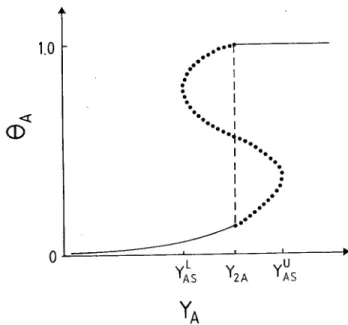
Figure 2. Qualitative phase diagram, close to a rst-order irreversible phase transition. The solid line shows the de-pendence of the coverage ofA-species (A) on the partial
pressure (YA). Just at the critical pointY2Aone has a
dis-continuity in A (dashed line) which indicates coexistence
between a reactive state with no largeA-clusters and anA
-rich phase (likely a largeA-cluster). The dotted line shows
the metastability loop where Y U AS and
Y L
AS are the upper
and lower spinodal points, respectively. BetweenY 2A and Y
U
AS the reactive state is unstable and is displaced by the A-rich phase. On the contrary, between Y
L AS and
Y 2A the
reactive state displaces theA-rich phase.
In order to investigate the properties of the interface between theA-poisoned state and the reactive regime, Brosilow et al. [27] simulated the MD model on the square lattice in a rectangular geometry ofLM sites. The left-most column ofM sites was initially occupied by B-atoms, the right-most L=2 columns were initia-lly occupied byA-species, and the remaining sites were initially vacant. In order to prevent A-poisoning, whe-never aB-species was removed (through reaction) from the left-most column of the lattice, it was immediately replaced by anotherB-species. Running simulations for (Y
A Y
2A), the imposed geometry causes the appea-rance of an interface between the reactive state and an A-poisoned state. The width of the reactive phase () is found to scale withY
A as
=k(Y A
,Y 2A)
,, with
= 0:40 andk = 0:74.
e.g., close to rst-order IPTs, as is shown schematica-lly in Fig. 2, where an explanation of the underlaying mechanism is also given. An interface formed during the coexistence between a reactive state with no large A-clusters and anA-rich phase characterized by a large A-cluster, can clearly be observed in the snapshot con-guration shown in Fig. 3.
Figure 3. Typical snapshot conguration showing the inter-face between an A-rich phase (large cluster shown in black) and the reactive phase. Results obtained for the monomer-dimer model using the constant-coverage ensemble with a lattice of sideL= 512.
Monte Carlo simulations due to Moller et al. [28] demonstrated that a monomer-dimer model, which is intended to describe the catalytic oxidation of carbon monoxide and includes reactant-assisted surface recons-truction, can support the propagation of trigger waves even if surface diusion is not explicitly considered. Ho-wever, after this early work, most simulationshave been performed within the framework of the MD model as proposed by Zi et al. [22].
In fact, Evans and Ray [29] have studied the dis-placement of the reaction interface for Y
A below the A-poisoning transition Y
2A. Within this regime one expects that the reactive state will displace the A -poisoned one (see e.g. Fig. 2), resulting in a propa-gation velocity (V
p) normal to the interface. Studying this case, Evans et al. [29] proposed thatV
pmust vanish as (Y
A !Y
2A), where both states become equistable, so one has
V p
/(Y A
,Y 2A)
,
; (6)
with>0. The limitof high diusivity of the reactants can be well described by mean-eld reaction-diusion equations, which give = 1 [29]. It is interesting to
notice that if diusion is restricted or even suppressed, simulations give values of very close to unity, sug-gesting that the exponent is independent of the surface diusivity of the reactants [29]. In this case the propa-gation of the reaction interface has also been described in terms of the KPZ framework (see Eq. (2)) and sca-ling arguments [29]. From Monte Carlo simulations at the rst-order IPT it is reported that '0:3, i.e., a gure close to the KPZ value ( = 1=3). However, it is expected that the operation of a weak stabilizing ef-fect may play an important role in the reaction system. This eect can be described by introducing correction terms of higher-order in Eq. (2) [29].
Very recently, Chavez et al. [30] studied the dy-namics of front propagation in the catalytic oxidation of CO on Pt(100) by means of a cellular automaton simulation. It is found that the dynamic scaling expo-nents of the interface are well described by Eq. (1) with = 1=2 and = 1=3. It is also reported that in the absence of surface diusion the interface dynamics can successfully be described using the KPZ equation (2).
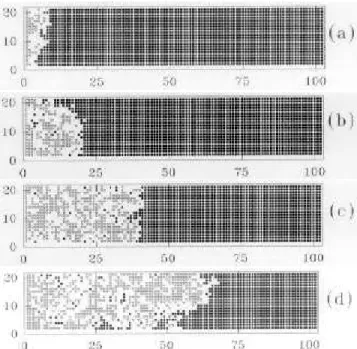
Figure 4. Typical snapshot congurations obtained during the displacement of theA-poisoned phase (right-hand side
of the gures) by the reactive phase (left-hand side of the gures). Results obtained with channels of size L = 20
and M = 100 and taking YA = 0:515. The snapshots are
plotted for dierent times (measured in Monte Carlo Steps (MCS)), from top to bottom: t= 25MCS, t= 100MCS, t= 400MCS andt= 900MCS, respectively.
the boundary between the two, the stable state will dis-place the metastable one and the boundary will move, so this process leads to the propagation of concentra-tion fronts (trigger waves). Goodman et al. [31] found that the velocity of theA-front depends on the diusion rateDofA-species (diusion ofBis neglected), and the sticking probability of A-molecules (Y
A). The velocity of the front vanishes when approaching the poisoning transition at Y
2A(
D) (note that the critical point now depends on D), according to Eq. (6), with '1, in agreement with the results of Evans et al. [29].
As suggested by the experimental work of Haas et al. [18], the propagation of reaction fronts on narrow channels has also been simulated [32], using the ZGB model on the square lattice with rectangular geometries of sides LM (LM). Thus Lis the width of the channel and M its length. Free boundary conditions were taken along the channel while the opposite ends are assumed to be in contact with A and B-sources, respectively. If A or B-species are removed from the ends of the channels (i.e., the "sources"), due to the reaction process, they are immediately replaced. The propagation of the B concentration prole was studied starting with a sample fully covered by A, except for the rst and second columns, which are covered by B (the B-source), and left empty, respectively. The pro-pagation of the A prole was followed using a similar procedure. Under these conditions one always has two competing interfaces along the channel. Fig. 4 shows a set of snapshot congurations, taken at dierent times, obtained using channels of size L= 20 and M = 100, corresponding to the propagation of the reactive phase (left side of the snapshots) into an otherwise fully A -poisoned phase (right side of the snapshots).
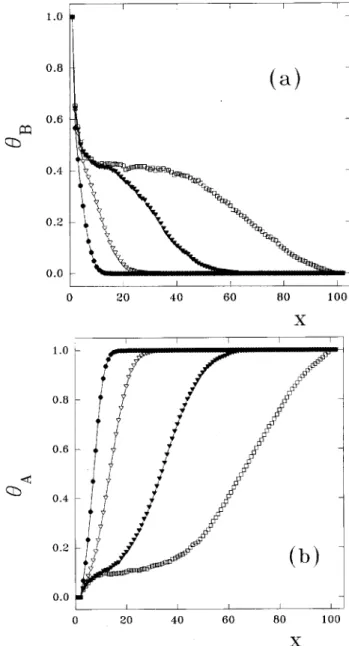
In order to develop a more quantitative description of the propagation, a number of denitions are needed. The concentration proles of the reactants,
A( x) and
B(
x), are measured along the length of the channelx in the M-direction and averaged over each column of lattice sites of length L. Fig. 5 shows a set of con-centration proles obtained for the same times as the snapshots shown in Fig. 4. After determining smooth and well averaged proles one can get insight into the propagation by measuring the moments of the proles, which in subsequent steps can be used to determine the propagation velocity and the width of the proles. In fact, the moments of nth order of the proles can be evaluated according to [33]
<x n
> =
P x
n[
(x+ 1),(x)] P
[(x+ 1),(x)]
: (7)
Using Eq. (7) the uctuation in the position of the prole, i.e., its mean-square width, is given by
w 2= (
<x 2
>,<x> 2)
; (8)
and the velocity of propagation can be obtained from the rst moment:
V =
d<x> dt
; (9)
where distances are measured in lattice units (LU) and time in MCts.
Figure 5. Concentration proles obtained during the dis-placement of theA-poisoned phase by the reactive phase.
Lattice sizeL = 20, M = 100, PA = 0:515. a) B-proles,
b)A-proles. The proles are plotted for dierent times : t= 25,5t= 100,5t= 400 and2t= 900.
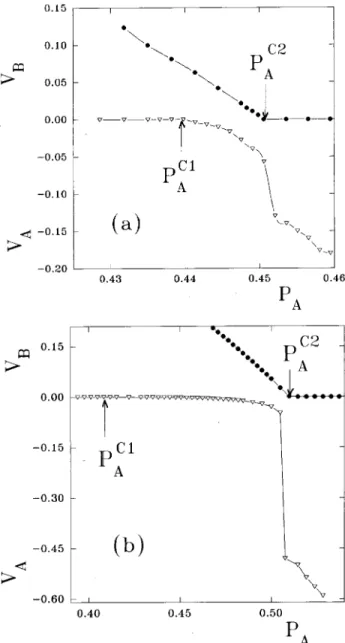
Monte Carlo simulation results show that the front propagation velocity depends on Y
A and the channel width L, as is shown, for example, in Fig. 6. This gure also shows that the displacement of A- and B -poisoned channels by the reactive regime stops at cer-tain (L-dependent) critical values,Y
c2 A (
L) andY c1 A (
values with the critical points of the MD model, na-mely Y
c1 A (
L ! 1) = Y 1A and
Y c2 A (
L ! 1) = Y 2A, respectively. It is also found that close to Y
c2 A , when the propagation of the B-prole ceases, the speed of theA-prole undergoes a sharp change. This behavior can be correlated with the rst-order irreversible phase transition between the stationary reactive regime and theA-poisoned state observed in the MD model atY
2A (see Fig. 1). So far, the main conclusions that can be extracted from Fig. (6) can be summarized as follows: a) there are two critical pressures, Y
c1 A (
L) andY c2 A (
L), which depend on the width of the channel, at which propagation of one prole or the other stops; b) wit-hin these critical values, propagatingA andB proles coexist; c) B-proles propagate faster than A-proles. All these observations appear in qualitative agreement with the experimental results reported in Fig. 2(a) of the paper of Haas et al. [18]. However, the underlying physics is dierent: in the simulations the displacement of a poisoned phase by the invading reactive phase ta-kes place within a range of pressures where the later is unstable, while the former is stable. In contrast, the experiment may show the propagation of coexis-ting phases within a bistable regime [18]. As discussed above, the simulations also show a jump in the velocity of the A-front close to Y
c2 A (
L). In the experiments, A fronts are not studied aboveY
c2
A , so the occurrence of the jump in actual conditions cannot be ruled out. The occurrence of such jump a may be a nice prediction of the (simple) MD model which, in principle, seems to be supported by the fact that the jump can eectively be correlated with the rst-order poisoning transition; rst-order transition-like behavior has already been ob-served experimentally [34].
It is well known that lattice-gas modeling of surface reactions, in contrast to traditional mean-eld treat-ments, provides a realistic description of the uctuati-ons and correlatiuctuati-ons resulting from the adsorption and reaction processes. In a deterministic process described by a set of reaction-diusion equations, the interface between coexisting phases may have a xed width [31]. This width should be of the order of the size of the region near the propagating front. In contrast, in the lattice-gas description one has shot noise in the pres-sure of the incoming reactants, and statistical uctu-ations, as extra sources of broadening, which leads to wandering of the front [31]. Fig. 7 shows the depen-dence of the reaction interface width (see Eq. (8)) as a function of time, obtained for channels of xed width and at various pressures, when the A-poisoned phase is displaced by the reactive phase. Two dierent regi-mes can clearly be observed. For lowA-pressures, well inside the reactive state, the uctuations diverge and
the poisoned state will ultimately be completely dis-placed. For high enough A-pressures, well inside the A-poisoned state, the uctuations saturate, i.e., the re-active state can not displace the stable poisoned state, and the interface remains bounded. The crossover bet-ween these two regimes is observed just at the critical pressure Y
c2 A (
L), where a log-log plot of w 2 L
vs t gi-ves a straight line. Based on general dynamic scaling arguments similar to those used to describe interface uctuations in thin-lm growth (see Eq. (1)), it can be expected that the stochastic evolution of a driven inter-face along a strip of widthL may be characterized by long-wavelength uctuations (w
2 L(
t;Y
A)) which have the following time- and pressure-dependence [32] :
Figure 7. Log-log plots ofw 2versus
tmeasured at dierent
pressures and for channels of dierent width. Data obtained during the displacement of a A-poisoned phase by a
reac-tive phase. a)L= 5, from top to bottom the pressures are:
0.4819, 0.4845, 0.4852, 0.4859 and 0.4872; b)L= 30, from
top to bottom the pressures are: 0.5192, 0.5202, 0.5211, 0.5215 and 0.5238; and c) L = 5, from top to bottom the
pressures are: 0.4852, 0.4872, 0.4898, 0.5000 and 0.5349.
w 2 L(
t;Y A)
/t
F[t(Y A)
]
; (10)
where Y A =
Y A
,Y c2 A (
L), withF(x) =constant for x ! 0 (i.e.,Y
A
!0) and F(x) ! x ,
for x ! 1 (i.e., Y
A
> 0 and t ! 1). Thus, just at the criti-cal pressure the uctuations are given by w
2 L(
t)/t
as t ! 1; while away from criticality, the uctuati-ons may diverge according tow
2 L(
Y A)
/Y , A , with
= ,
. Notice that
=
=2, where has been dened in Eq. (1). It is found that for narrow channels
depends on
L, but increasing the channel width one has
!1 forL!1, that is !1=2, pointing out that the noise should dominate the nonlinear and sur-face tension terms in the KPZ equation. It is also found that is sensitively dependent on the channel widthL, with!3=2 forL!1[32].
If the time and pressure dependences ofw 2 L(
t;Y A) are well described by Eq. (10), one may expect a data collapse in the log-log plots ofw
2 t
,
versust(Y A)
. The excellent quality of the collapse (see Fig. (8) for L = 5 and L = 20) strongly suggests the validity of the scaling hypothesis involved in the derivation of Eq. (10). Furthermore, all these results demonstrate that the standard dynamic formalism developed for the des-cription of a rough interface [15] is suitable for the rationalization of the interface behaviour in far-from-equilibrium reactive systems.
Figure 8. Scaling plots ofw 2
t
, versus t(PA)
obtained
A dierent variant of the monomer-dimer model, namely the reaction AB +C ! 1=2 A
2 +
CB, was proposed by Yaldram and Khan (YK) [35]. This ir-reversible reaction model mimics the reaction between NO and CO over a single-crystal catalyst, i.e., AB is NO, C is CO, A
2 is N
2, and
CB is CO
2. According to the Langmuir-Hinshelwood mechanism, the reaction steps are :
AB(g) + 2S!A(a) +B(a); (11) C(g) +S!C(a); (12) C(a) +B(a)!CB(g) + 2S; (13)
2A(a)!A 2(
g) + 2S; (14)
whereS again represents an empty site on the surface, and (a) and (g) refer to the adsorbed and gas phase, respectively.
Simulations due to Yaldran et al. [35] showed that, in contrast to the MD model already discussed, the YK model has no reactive state on the square lattice. A proof of this nding was later given by Brosilow and Zi [36]. However, increasing the coordination number of the lattice, it was found that the YK model on the hexagonal lattice has a nite reaction window, capable of sustaining a reactive stationary state [35]. On the other hand, Meng et al. [37] have shown that adding a new reaction channel, in order to decrease the possibi-lity of poisoning one may enhance the reactivity of the system and consequently modify the nature of the poi-soning transition. In fact, for simulations on the square lattice, the addition of the side-reaction channel
C(a) +A(a)!CA(g) + 2S; (15) causes the opening of a reaction window with a conti-nuous IPT close to Y
1C
'0:262 and a rst order IPT close to Y
2C
'0:501. This behavior is reminiscent to the MD model discussed above.
Very recently Tamaro et al. [38] studied the reactive removal of unstable mixedCO+NOadlayers using a lattice gas model. Due to the presence of pre-adsorbed species, the steps given by equations (11) and (12) are not considered. Furthermore, in order to account for the diusion of the reactants, the hopping of all spe-cies (except forO-atoms, whose mobility is negligible) is considered. An interesting contribution of this work, which may also be generalized to other systems invol-ving mixed species, is the development of an elaborate treatment for the chemical diusion of mixed adlayers reecting the interference of the adsorbed species on the surface due to co-adsorption. Simulations are started with the surface fully covered by an (AB+C)-adlayer, which constitutes an unstable state, in the sense that vacating a single site may produce the dissociation of
AB and its reaction withC, and the subsequent crea-tion of more vacancies, triggering an autocatalytic reac-tion. Subsequently, a very small number of adspecies is desorbed and the reactive removal of the mixed adlayer is followed. Due to the high mobility of most adsorbed species, initially an exponential increase in the number of highly dispersed vacancies is observed. This is follo-wed by a transition to a reaction interface propagation regime of adlayer removal. In this stage a chemical wave develops that propagates into the (AB +C)-covered (unstable) part of the surface.
IV Brief Oveview of
Inter-face Propagation Studies in
the Monomer-Monomer
Re-action System
The monomer-monomer (MM) model assumes the fo-llowing Langmuir-Hinshelwood reaction scheme :
A(g) +S!A(a); (16) B(g) +S!B(a); (17) A(a) +B(a)!AB(g) + 2S; (18) where S is an empty site on the surface, while (a) and (g) refer, as above, to the adsorbed and gas phases, res-pectively. The Monte Carlo algorithm is similar to that for MD model, but since now both species are mono-mers, adsorption attempts on empty sites are always successful. The impingement rate of A and B-species is Y
A and Y
B, respectively. So, taking Y
A+ Y
B = 1, the MM process has a single parameter, namelyY
A(for more details see [22, 39]).
The phase diagram of the MM model is quite simple: forY
A <Y
1A = 1 =2 (Y
A >Y
1A) the catalyst becomes poisoned by A (B)-species, respectively. So, one has a rst-order IPT where Y
1A = 1
=2 is a trivial critical point given by the stoichiometry of the reaction. In contrast to the MD model, now the reaction window has zero-width. It becomes clear that the dimer de-position mechanism, which requires two adjacent sites for adsorption, causes the occurrence of a nite-width reaction window in the MD model.
Monte Carlo simulations are performed applying peri-odic boundary conditions in the vertical direction and using suciently wide lattices so that the reactive zone does not reach the horizontal edges. A and B-species are selected with equal probability, i.e., just at the cri-tical point of the MM model. In is found that uctuati-ons in the particle density resulting from the formation of clusters in the reactive zone play a signicant role in the interfacial roughening. Overhangs, holes, ngers and clusters are observed. A more quantitative unders-tanding can be obtained by measuring the roughness of the interfacial region between reacting species. Kang et al. [33] use two dierent measures. In the rst one the roughness is obtained considering the distribution of sites forming the external perimeter of each of the A and B domains. This measurewh, known as the diu-sion hull, was introduced to study the diudiu-sion frontier of an interface [40] and it can be obtained using equa-tion (8). For the second measure, the roughness wA considers the external perimeter of the A domain. The interface possitionxAfor each row of sites is dened as the minimum value of x among all the external peri-meter sites in that row. Then wAcan also be obtained using equation (8) replacingxbyxA and taking avera-ges over all the rows of the lattice. A similar denition of wB holds for the interface of B domains, and since both domains are equivalent an average between wA andwB is taken, givengwr, i.e., the average roughness of the surface of the domains. The quantity xA,xB for each row of sites is a measure of the width of the reactive zone for that row, so the average width of the reactive zonewm can be evaluated. It is found that the interface roughness scales as w t, where the expo-nent is equal to 1=2 forwh , wr and wm. Although all measures scale with the same exponents one always haswm >wh >wr.
These results can be compared with previous studies of Gouyet et al. [40] for a pure diusive (nonreactive) system. In this case wm also scales with = 1/2, but wh scales with 0.286, implying that, in the long time limit, the diusion hull is smooth on the length scale of wm. In contrast, for the reaction system the roughness of the external perimeter grows as fast as the width of the reactive zone ( = 1=2 for both me-asures), so the ngers of the A and B domains have the same length scale as the width of the reactive zone. The dierence between the diusion system and the re-action system arises from particle-particle correlations introduced by the reaction mechanism, i.e., it is more likely to nd an AA or a BB nearest-neighbor pair in the reaction system than in the diusion system [33]. Introducing nearest-neighbor repulsive interactions in the reaction system, the interface becomes smoother and large clusters are found to be absent within the zone of vacant sites [33].
The interface properties of another variant of the MM model, proposed earlier by Zi et al. [41], has
also been studied by Kang et al. [42, 43]. In this MM model reaction also occurs between nearest neighbor AB pairs, but adsorption takes place immediately at any site vacated by the reacting particles, with equal probabilities for A and B. As the reaction proceeds, the originally at interface between A and B domains becomes rough. Clusters of one species will be formed in the domain of the other species. It is found that the interface widthwr scales with= 1=2 as in the purely diusive system [40], however the roughness of the ex-ternal perimeterwh scales with 0.455, i.e., a larger value than that expected for a pure diusive system. So, within error bars the exponents of the roughness are the same for both variants of the MM model, sug-gesting that the behavior of the interface should be independent of whether the reaction rate is innitely higher than the adsorption rate or vice versa. Simu-lation results also shown that the fractal dimension of the external perimeter of the reaction front is equal to that of external perimeter of the diusion front, given byDf 1.33 0.01 [42], which is dierent than the fractal dimension of the hull,Dh = 7/4 [40].
V Conclusions
Recent progress in the understanding of interface pro-pagation in surface reaction models has been reviewed and discussed. Particular attention is addressed to the monomer-dimer and monomer-monomer models. Ho-wever, all of the concepts and ideas developed here are expected to hold in more general models exhibiting dis-continuous transitions into absorbing states. In fact, the existence of coexisting phases close to rst-order transitions provides the natural mechanism for the dis-placement of phases, with the consequent formation of interfaces.
All the results reviewed here support the idea that standard dynamic scaling formalism developed for the description of rough interfaces (Eq. (1)), and the sto-chastic Langevin equation due to Kardar, Parisi and Zhang (Eq. (2)), are suitable for the rationalization of interfacial behavior in far-from-equilibrium reactive systems such as the MD and the MM models.
Acknowledgments
This work is supported nancially by CONICET, UNLP, CIC (As. As.), ANPCyT (Argentina) and the Volkswagen Foundation (Germany).
References
[1] See, e.g., a set of very interesting articles recently pu-blished in Science284, 79 (1999).
[2] J. Marro and R. Dickman.Nonequilibrium Phase Tran-sitions in Lattice Models(Cambridge University Press, Cambridge, 1999).
[3] D. Chowdhury and D. Stauer, Eur. Phys. J. B, 8,
477 (1999); T. Lux and M. Marchesi, Nature397, 498
(1999).
[4] D. T. Shindell et al., Nature399, 452 (1999).
[5] E. V. Albano, Phys. Rev. Lett.77, 2129 (1996).
[6] D. D. Oglesky, R. J. Archuleta and S. B. Nielsen, Sci-ence280, 1055 (1998).
[7] K. Christmann,Introduction to Surface Physical Che-mistry(Steinkop Verlag, Darmstadt, 1991), pp. 1-274. [8] J. H. Block, M. Ehsasi and V. Gorodetskii, Prog. Surf.
Sci.,42, 143 (1993).
[9] J. Wintterlin, S. Volkening, T. V. W. Janssens, T. Zam-belli, and G. Ertl, Science,278, 1931 (1997).
[10] V. P. Z. Zhdanov and B. Kasemo, Surf. Sci. Report,20 (3), 111 (1994).
[11] K. Binder, in The Monte Carlo Method in Condensed Matter Physics, edited by K. Binder (Springer-Verlag, Berlin, 1992), pp. 1-22.
[12] Applications of the Monte Carlo method in Statistical Physics, 2nd ed. K. Binder, ed. (Springer-Verlag, Ber-lin 1984), pp. 1-341.
[13] K. Binder and D. Heermann,Monte Carlo simulations in Statistical Physics, Springer Series in Solid State Sci-ences, v. 80. (Springer Verlag, Berlin, 1992), pp 1-129. [14] E. V. Albano, H. Chem. Rev.3, 389 (1996).
[15] A. L. Barabasi and H. E. Stanley, Fractal Concepts in Surface Growth(Cambridge University Press, Cam-bridge, 1995), pp. 1-366.
[16] R. Imbhil, Prog. Surf. Sci.44, 185 (1993).
[17] R. Imbhil and G. Ertl, Chem. Rev.95, 697 (1995).
[18] G. Haas, M. Bar, I. G. Kevrekides, P. B. Rasmussen, H. H. Petermund, and G. Ertl, Phys. Rev. Lett.75,
3560 (1995).
[19] S. Jabubith, H. H. Rotermund, W. Engel, A. von Oer-tzen and G. Ertl, Phys. Rev. Lett.65, 3013 (1990).
[20] Fractal and disordered systems, A. Bunde and S. Havlin edited by (Springer-Verlag, Berlin, 1991).
[21] M. Kardar, G. Parisi, and Y. C. Zhang, Rev. Lett.56,
889 (1986).
[22] R. M. Zi, E. Gulari, and Y. Barshad, Phys. Rev. Lett.
56, 2553 (1986).
[23] J. W. Evans, Langmuir 7, 2514 (1991).
[24] G. Grinstein, Z.-W. Lai, and D. A. Browne, Phys. Rev. A40, 4820 (1989).
[25] I. Jensen, H. C. Fogedby, and R. Dickman, Phys. Rev. A41, 3411 (1990).
[26] R. M. Zi and B. J. Brosilow, Phys. Rev. A46, 4630
(1992).
[27] B. J. Brosilow, E. Gulari, and R. M. Zi, J. Chem. Phys.99, 1 (1993).
[28] P. Moller, K. Wetzl, M. Eiswirth, and G. Ertl, J. Chem. Phys.85, 5328 (1986).
[29] J. W. Evans and T. R. Ray, Phys. Rev. E 50, 4302
(1994).
[30] F. Chavez, L. Vicente, A. Perera and M. Moreau, J. Chem. Phys.110, 8118 (1999).
[31] R. H. Goodman, D. S. Gra, L. M. Sander, P. Leroux-Hugon, and E. Clement, Phys. Rev. E52, 5904 (1995).
[32] E. V. Albano, Phys. Rev. E55, 7144 (1997).
[33] H. C. Kang and W. H. Weinberg, Phys. Rev. E 47,
1604 (1993).
[34] M. Ehsasi et al., J. Chem. Phys.91, 4949 (1989).
[35] K. Yaldram and M. A. Khan, J. Catal.131, 369 (1991)
and136, 279 (1992).
[36] B. J. Brosilow and R. M. Zi, J. Catal.136, 275 (1992).
[37] B. Meng, W. H. Weinberg and J. W. Evans, Phys. Rev. E.48, 3577 (1993).
[38] M. Tammaro and J. W. Evans, J. Chem. Phys. 108,
7795 (1998).
[39] P. Meakin and D. J. Scalapino, J. Chem. Phys.87, 731
(1987).
[40] J. F. Gouyet, M. Rosso, and B. Sapoval, \Fractal surfa-ces and interfasurfa-ces", inFractal and Disordered Systems, edited by A. Bunde and S. Havlin, (Springer-Verlag, Berlin, 1991), p. 229.
[41] K. Fichthorn, E. Gulari and R. Zi, Phys. Rev. Lett.
63, 1527 (1989).
[42] H. C. Kang and W. H. Weinberg, Phys. Rev. E. 48,
3464 (1993).
[43] H. C. Kang and W. H. Weinberg, J. Chem. Phys.100,
1630 (1994).