Short Report
J. Braz. Chem. Soc., Vol. 21, No. 11, 2169-2172, 2010. Printed in Brazil - ©2010 Sociedade Brasileira de Química 0103 - 5053 $6.00+0.00
*e-mail: [email protected]
Stereoselective Synthesis of 2,3-unsaturated-
O
-Glycosides promoted by TeBr
4Juliano C. R. Freitas,*
,aJoão R. de Freitas
band Paulo H. Menezes*
,aa
Departamento de Química Fundamental, Universidade Federal de Pernambuco, CCEN,
50740-540 Recife-PE, Brazil
b
Universidade Federal Rural de Pernambuco, Unidade Acadêmica de Garanhuns,
55292-270 Garanhuns-PE, Brazil
O uso de uma quantidade catalítica de tetrabrometo de telúrio(IV) para promover a O-glicosilação de glicais e levar aos O-glicosídeos insaturados correspondentes é descrita. Os compostos desejados foram obtidos em bons rendimentos e em elevada seletividade α.
The use of a catalytic amount of tellurium(IV) tetrabromide to promote the O-glycosylation of glycals to yield 2,3-unsaturated-O-glycosides is described. The desired compounds were obtained in good yields and high α-selectivity.
Keywords: O-glycosylation, tellurium tetrabromide, 2,3-unsaturated-O-glycosides
Introduction
The development of synthetic methodologies for the
eficient and stereoselective synthesis of glycosides is one
of the main interests in carbohydrate chemistry. In this
context, the synthesis of 2,3-unsaturated-
O
-glycosides
have attracted considerable attention in this ield due to
their importance as intermediates in the synthesis of several
compounds.
1One of the important-
O
-glycosylation method for
producing 2,3-unsaturated-
O
-glycosides, is the Ferrier
rearrangement, originally promoted by BF
3•Et
2
O, which
involves a nucleophilic substitution reaction combined with
an allylic shift in a glycal.
2The orientation of the formed
glycoside bond,
α
or
β,
depends on some combination of
control elements, being the most important the ‘kinetic
anomeric effect’.
3A number of other Lewis acids such as InCl
3,
4montmorillonite-K10,
5SnCl
4
,
6BiCl
3
,
7FeCl
3
,
8
Sc(OTf)
3,
9
ZnCl
2,
10LiBF
4,
11
Dy(OTf)
3,
12
AuCl
3,
13
CeCl
3,
14
and ZrCl
415
can be used in the reaction. In addition, oxidizing agents
such as DDQ,
16NIS,
17iodine,
18I(Coll)
2
ClO
4,
19
CAN
20and
HClO
4on silica gel
21can promote the reaction. Most of
the methods require a large excess of alcohol leading in
some cases to an extensive work up. In addition, some have
drawbacks in generality, yields and diastereoselectivity.
Tellurium tetrahalides (TeCl
4, TeBr
4and TeI
4) have
seen considerable research activity because of their
structural versatility and potential utility as
synthons
in
many chemical reactions.
22They can react with both Lewis
bases and Lewis acids.
23This amphoteric behavior can be
understood in terms of the partially ionic Te-X bonding.
In this way, tellurium(IV) tetrabromide could be the
Lewis acid choice to promote the
O
-glycosylation of glycals
1
to yield 2,3-unsaturated-
O
-glycosides
2
(Scheme 1).
Results and Discussion
Our initial studies have focused on the development of
an optimum set of reaction conditions. In this way, a solution
of glycal
1
(1.0 mmol) and propargyl alcohol (1.2 mmol)
in CH
2Cl
2(10 mL) were treated at room temperature with
different amounts of TeBr
4and the progress of the reaction
was monitored by TLC. The results are depicted in Table 1.
In all cases the reaction proceeded smoothly leading
to the complete conversion into the 2,3-unsaturated-
O
-glycoside
2a
in high yield and with almost exclusive
α
-selectivity (Table 1, entries 1-5). It is also interesting
TeBr4
O
OAc AcO
OAc
ROH
O
AcO OAc
OR +
1 2
Stereoselective Synthesis of 2,3-unsaturated-O-Glycosides promoted by TeBr4 J. Braz. Chem. Soc.
2170
to note that when the amount of TeBr
4was reduced to
0.01 equiv., a signiicant decrease in the yield and anomeric
selectivity was observed (Table 1, entry 6).
Next, we explored the scope of the reaction for the
synthesis of 2,3-unsaturated-
O
-glycosides using glycal
1
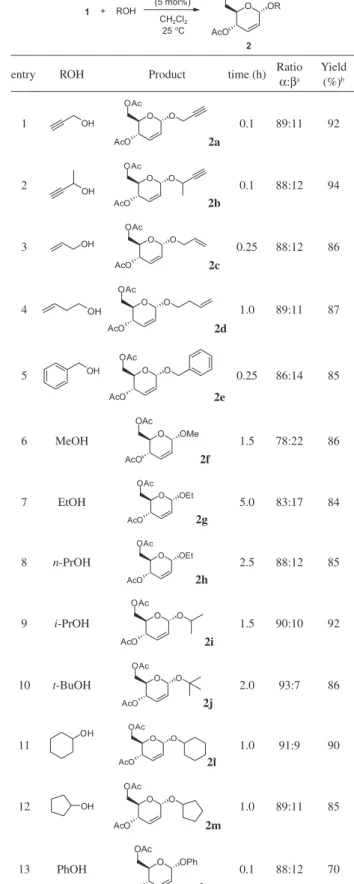
and various alcohols (Table 2).
27In the majority of
the studied examples, the reaction was faster and more
diastereoselective when compared to other literature
described catalysts.
4-21As shown in Table 2, reactions with aliphatic and
alicyclic alcohols required longer reaction times (entries
6-12). This effect was observed before for other catalytic
systems.
21The reaction of glycal
1
with
t
-BuOH is described
to be dificult to proceed,
21but in our case the reaction
gave a clean product in high yield and excellent anomeric
selectivity (Table 2, entry 10). More reactive alcohols
such as allylic, benzylic and propargylic gave better yields
and shorter reaction times if compared with aliphatic and
alicyclic alcohols (Table 2, entries 1, 2, 3 and 5). The
reaction time increased when a homoallylic alcohol was
used (Table 2, entry 4). A lower yield was observed when
phenol was used as the nucleophile (Table 2, entry 13).
This effect was also observed before for other catalytic
systems.
4,21We have also examined the inluence of the temperature
in the reaction. When the reaction was heated under relux,
shorter reaction times were observed if compared with
Table 2, without any loss of diastereoselectivity (Table 3).
Conclusions
In summary, we have demonstrated that the TeBr
4is
useful to carrying out the synthesis of 2,3-unsaturated-
O
-glycosides under mild conditions, excellent yield
Table 1. Influence of the amount of TeBr4 in the synthesis of 2,3-unsaturated-O-glycoside, 2a
entry TeBr4 (equiv.) Ratio α:βa Yield (%)b
1 0.5 89:11 90
2 0.3 91:9 91
3 0.1 93:7 92
4 0.05 87:13 92
5 0.01 50:50 60
aThe anomeric ratios were obtained by 1H NMR and conirmed by gas
chromatography for all reactions; bIsolated yield.
Table 2. TeBr4promoted synthesis of 2,3-unsaturated-O-glycosides 2
entry ROH Product time (h) Ratio
α:βa
Yield (%)b
1
2a
0.1 89:11 92
2
2b
0.1 88:12 94
3
2c
0.25 88:12 86
4
2d
1.0 89:11 87
5
2e
0.25 86:14 85
6 MeOH
2f
1.5 78:22 86
7 EtOH
2g
5.0 83:17 84
8 n-PrOH
2h
2.5 88:12 85
9 i-PrOH
2i
1.5 90:10 92
10 t-BuOH
2j
2.0 93:7 86
11
2l
1.0 91:9 90
12
2m
1.0 89:11 85
13 PhOH
2n
0.1 88:12 70
aThe anomeric ratios were obtained by 1H NMR and conirmed by gas
Freitas et al. 2171 Vol. 21, No. 11, 2010
and good
α
-anomeric selectivity. The methodology is
synthetically useful and could be applied for the synthesis
of more complex glycosides.
Acknowledgments
The authors gratefully acknowledge CNPq, CAPES and
FACEPE for inancial support. J. C. R. F and P. H. M are
also thankful to CNPq for their fellowships.
References
1. Domon, D.; Fujiwara, K.; Ohtaniuchi, Y.; Takezawa, A.; Takeda, S.; Kawasaki, H.; Murai, A.; Kawai, H.; Suzuki, T.; Tetrahedron Lett.2005, 46, 8279; Chambers, D. J.; Evans, G. R.; Fairbanks, A. J.; Tetrahedron: Asymm.2005, 16, 45; Krohn, K.; Gehle, D.; Kamp, O.; Ree, T. V.; J. Carbohydr. Chem.2003, 22, 377; Reddy, B. G.; Vankar, Y. D.; Tetrahedron Lett.2003, 44, 4765; Durham, T. B.; Miller, M. J.; Org. Lett. 2002, 4, 135; Lewis, A.; Stefanuti, I.; Swain, S. A.; Smith, S. A.; Taylor, R. J. K.;
Tetrahedron Lett.2001, 42, 5549; Paterson, I.; Keown, L. E.;
Tetrahedron Lett. 1997, 38, 5727; Dorgan, B. J.; Jackson, R. F. W.; Synlett1996, 859; Borrachero-Moya, P.; Cabrera-Escribano, F.; Gómez-Guillén, M.; Parades-León, M. R.;
Carbohydr. Res.1998, 308, 181; Schmidt, R. R.; Angerbauer, R.; Carbohydr. Res. 1979, 72, 272; Seeberger, P. H.; Bilodeau, M. T.; Danishefsky, S. J.; Aldrichim. Acta1977, 30, 75. 2. Ferrier, R. J.; Prasad, N.; J. Chem. Soc. (C)1969, 570. 3. Marzabadi, C. H.; Franck, R. W.; Tetrahedron2000,56, 8385. 4. Babu, B. S.; Balasubramanian, K. K.; Tetrahedron Lett. 2000,
41, 1271; Nagaraj, P.; Ramesh, N. G.; Tetrahedron Lett. 2009,
50, 3970.
5. Freitas Filho, J. R.; Srivastava, R. M.; da Silva, W. J. P.; Cottier, L.; Sinou, D.; Carbohydr. Res. 2003, 338, 673.
6. Grynkiewicz, G.; Priebe, W.; Zamojski, A.; Carbohydr. Res.
1979, 68, 33; Bhaté, P.; Horton, D.; Priebe, W.; Carbohydr. Res. 1985, 144, 331.
7. Swami, N. R.; Venkateswarlu, A.; Synthesis 2002, 598. 8. Masson, C.; Soto, J.; Bessodes, M.; Synlett 2000, 9, 1281. 9. Yadav, J. S.; Reddy, B. V. S.; Murthy, C. V. S. R.; Kumar, G.
M.; Synlett 2000, 1450.
10. Bettadaiah, B. K.; Srinivas, P.; Tetrahedron Lett. 2003, 44, 7257. 11. Babu, B. S.; Balasubramanaian, K. K.; Synth. Commun. 1998,
29, 4299.
12. Yadav, J. S.; Reddy, B. V. S.; Reddy, J. S. S.; J. Chem.Soc., Perkin Trans. 1 2002, 2390.
13. Balamurugan, R.; Koppolu, S. R.; Tetrahedron 2009, 65, 8139. 14. Yadav, J. S.; Reddy, B. V. S.; Reddy, K. B.; Satyanarayana, M.;
Tetrahedron Lett.2002, 43, 7009.
15. Smitha, G.; Reddy, C. S.; Synthesis 2004, 834.
16. Toshima, K.; Ishizuka, T.; Matsuo, G.; Nakata, M.; Konoshita, M.; J. Chem. Soc., Chem. Commun. 1993, 704.
17. López, J. C.; Gómez, A. M.; Valverde, S.; Fraser-Reid, B.;
J. Org. Chem. 1995, 60, 3851.
18. Koreeda, M.; Houston, T. A.; Shull, B. K.; Klemke, E.; Tuinman, R. J.; Synlett 1995, 90.
19. López, J. C.; Fraser-Reid, B.; J. Chem. Soc., Chem. Commun. 1992, 94.
20. Yadav, J. S.; Reddy, B. V. S.; Pandey, S. K.; New J. Chem. 2001,
25, 538.
21. Agarwal, A.; Rani, S.; Vankar, Y. D.; J. Org. Chem. 2004, 69, 6137.
22. Zeni, G.; Lüdtke, D. S.; Panatieri, R. B.; Braga, A. L.; Chem. Rev. 2006, 106, 1032. For toxicological and pharmacological aspects of organotellurium compounds see: Nogueira, C. W.; Zeni, G.; Rocha, J. B. T.; Chem. Rev. 2004, 104, 6255. 23. Narhi, S. M.; Oilunkaniemi, R.; Laitinen, R. S.; Ahlgren, M.;
Inorg. Chem.2004, 43, 3742; Krebs, B.; Ahlers, F.-P.; Adv. Inorg. Chem. 1990, 35, 235.
24. De, K.; Legros, J.; Crousse, B.; Bonnet-Delpon, D.; Tetrahedron 2008, 64, 10497.
25. Oliveira, R. N.; de Melo, A. C. N.; Srivastava, R. M.; Sinou, D.; Heterocycles2006, 68, 2607.
26. Freitas Filho, J. R.; Srivastava, R. M.; Soro, Y.; Cottier, L.; Descotes, G.; J. Carbohydr. Chem. 2001, 20, 561.
27. Representative procedure for the synthesis of prop-2-ynyl-4,6-di-O-acetyl-2,3-dideoxy- α-D-erythro-hex-2-enopyranoside(2a): To a 25 mL round bottomed lask containing a solution of glucal
1 (272 mg, 1.0 mmol) and the appropriate alcohol (1.2 mmol) in dichloromethane (10 mL) at 0 oC was added TeBr
4 (Aldrich)
(22.4 mg, 5 mol%). The ice bath was removed and the mixture was stirred for the time indicated on Table 2 (or reluxed for the time indicated on Table 3). Brine (5.0 mL) was then added and the
Table 3. TeBr4 promoted synthesis of 2,3-unsaturated-O-glycosides, 2
entry Product time (h) α:βa Yield (%)b
1 2d 0.1 90:10 80
2 2f 0.1 86:14 84
3 2g 0.3 89:11 91
4 2h 0.3 90:10 87
5 2i 0.3 90:10 90
6 2j 0.3 88:12 89
7 2l 0.25 91:9 91
8 2m 0.25 87:13 86
aThe anomeric ratios were obtained by 1H NMR and conirmed by gas
Stereoselective Synthesis of 2,3-unsaturated-O-Glycosides promoted by TeBr4 J. Braz. Chem. Soc.
2172
mixture was stirred until the yellow color disappear. The mixture was extracted with EtOAc (210.0 mL) and the organic phase dried over MgSO4. The solvents were removed under reduced pressure followed by puriication by lash chromatography column [hexanes:EtOAc (95:5)] to yield 246 mg (92%) of the title compound as a white solid. mp: 58-59 oC (lit.24 59 oC). 1H NMR (300 MHz, CDCl
3): d 2.07 (s, 3H, –OCOCH3), 2.09 (s,
3H, –OCOCH3), 2.45 (t, J 2,4 Hz, –C≡CH), 4.04-4.10 (m, 1H, H-5), 4.20 (dd, J 11.2 and 5.1 Hz, 2H, Ha-6, Hb-6), 4.29 (d, J 2,4 Hz, –CH2C≡C), 5.22 (br s, 1H, H-1), 5.30-5.34 (m, 1H, H-4),
5.80-5.85 (m, 1H, H-2), 5.91 (br d, J 10,2 Hz, 1H, H-3); 13C NMR
(75 MHz, CDCl3): d 170.7, 170.2, 129.7, 127.1, 92.7, 79.0, 74.8, 67.1, 65.0, 62.7, 55.0, 20.9, 20.7; LMRS (EI) m/z: 268(1), 213(9), 166(23), 153(16), 124(99), 111(25), 95(9), 85(69), 81(11), 67(5), 57(12), 55(10), 43(100).The spectroscopic data of all synthesized compounds match with the reported values: 2f, 2g;242b, 2c, 2e, 2i;132d, 2h;252j, 2m; 2l,26 and 2n.4
Submitted: March 16, 2010