Evaluation of the fluoride stability of dentifrices sold in Manaus,
AM, Brazil
Estabilidade do fluoreto de dentifrícios comercializados em
Manaus, AM, Brasil
Nikeila Chacon de Oliveira Conde* Maria Augusta Bessa Rebelo** Jaime Aparecido Cury***
ABSTRACT:The minimum requirement for the anti-caries effect of a dentifrice is the presence of available and stable fluoride in the formulation. The concentration of available fluoride in the major dentifrices sold in Brazil has been re-ported, but few data have been published about its stability, which is temperature-dependent. Thus, the aim of this study was to evaluate the concentration and stability of fluoride in dentifrices sold in Manaus, AM, Brazil, which is a typical tropical city. The concentrations of total fluoride, total soluble fluoride, MFP, and of insoluble fluoride of six Brazilian dentifrices and an imported one were analyzed. The analyses were made when the dentifrices were purcha-sed and during a year of storage at room temperature (28.9±1.16°C) and under refrigeration (26.3±0.88°C). The analyses were performed using an ion specific electrode Orion 96-09.At the time of purchase, all the dentifrices analy-zed showed more than 1,000 ppm (mg F-/g; w/w) of soluble fluoride. However, in most of them, this form of fluoride was not shown to be stable. The highest loss of soluble fluoride was found for storage at room temperature, reaching up to 40%. Although all dentifrices comply with the Brazilian guidelines with regard to the concentration of total fluori-de (maximum of 0.15%), the instability of soluble fluorifluori-de observed in some of them can impair their anti-caries effect and this condition is not contemplated in the Governmental rules.
DESCRIPTORS:Dentifrices; Fluorine; Toothpaste; Fluorides.
RESUMO:O requisito mínimo para que um dentifrício tenha potencial anticárie é ele ter uma formulação com fluoreto na forma solúvel e estável. A concentração de fluoreto solúvel nos dentifrícios vendidos no Brasil tem sido descrita, mas pouco é conhecido sobre sua estabilidade, a qual é função da temperatura. Assim, o objetivo deste estudo foi ava-liar a concentração e estabilidade do fluoreto em dentifrícios vendidos em Manaus, AM, Brasil. As concentrações de fluoreto total, fluoreto solúvel total, MFP, e de fluoreto insolúvel de seis dentifrícios nacionais e um importado foram determinadas quando da aquisição e durante um período de 12 meses de armazenamento à temperatura ambiental (28,9±1,16°C) e sob ar refrigerado (26,3±0,88°C). Para a análise foi utilizado eletrodo específico para íon fluoreto Orion 96-09. Os resultados mostraram que todos os dentifrícios tinham uma expressiva concentração(mg F-/g; p/p)
de fluoreto solúvel total quando da aquisição. Entretanto, a maioria deles não se mostrou estável quando do armaze-namento. A maior perda ocorreu à temperatura ambiente, atingindo valores de 40%. Embora a concentração de fluore-to fluore-total encontrada em fluore-todos os dentifrícios esteja de acordo com a portaria da ANVISA, dependendo das condições de armazenamento a perda de fluoreto solúvel pode comprometer o efeito anticárie de alguns dentifrícios e isto não está contemplado pela portaria brasileira em vigor.
DESCRITORES:Dentifrício; Flúor; Creme dental; Fluoretos.
INTRODUCTION
The decline in the prevalence of dental caries observed over the last few decades of the XXth Cen-tury has been attributed largely to the use of denti-frice,which is considered the best method of using fluoride because the teeth are simultaneously
cle-aned with the purpose of promoting oral health10.
However, in order for the dentifrice to be efficient,
*Assistant Professor of Stomatology; **Associate Professor of Stomatology – Department of Dentistry, Federal University of Ama-zonas.
***Professor of Biochemistry, School of Dentistry of Piracicaba, State University of Campinas.
it is important that the fluoride be soluble in the
formulation and regularly present in the oral
ca-vity in order to interfere with the phenomena of enamel-dentine demineralization and reminera-lization21
.
The majority of dentifrices contain fluoride in their composition in the ionic free form (F
forms for controlling caries18. These must be in the
dentifrice in a soluble form to guarantee activity
againstcaries1. However, depending on the
formu-lation, part of the fluoride may be inactive5
and this occurs mainly in the presence of calcium (Ca++) and F−
ions. On the other hand, although MFP is more stable in thepresence of Ca++
, because fluoride is linked covalently to phosphate, MFP undergoes
hydrolysis over time and releases F
-, which reac-ting with Ca++ will form insoluble fluoride that is
inactive against caries5
. It should be emphasized that the dentifrices that represent approximately 90% of the daily Brazilian consumption contain
Ca++ because they are formulated with
MFP/CaCO3
11
.
Thus, in 1989 in Brazil, guidelines were esta-blished by the Secretary for Sanitary Vigilance to regulate the concentration of fluoride in dentifrices and guarantee their quality in caries control. Ho-wever, these rules have undergone changes since 1996, and the Resolution No. 79 of August 28,
20003, which is in force, abolished the need for
dentifriceto show soluble fluoride. This resolution only establishes the maximum fluoride content (0.15%) that is permitted in a dentifrice, without specifying quality. In addition, it admits low solu-bility salts, like calcium fluoride, for example, to be used in dentifrice, which would result in a formu-lation with a maximum of 8.0 ppm soluble fluori-de.
The evaluation of fluoride concentration in den-tifrices sold in Brazil has been followed up since 19804
, and up until 1988 only 25% of those consu-med were fluoridated8
. Currently, 99% of them contain fluoride and although there are over 30 brands, five of them represent 92% of Brazilian consumption. The consumption of dentifrices in Brazil is 1.45 g/day/person9
and if these five denti-frices were adequately fluoridated, the majority of the population would have anti-caries benefits. The majority of the dentifrices are manufactured in the State of São Paulo and an analysis of these five, in samples collected in the five Brazilian regi-ons, showed a significant concentration of soluble fluoride in all ofthem11
, but the stability was not evaluated. Recently these five dentifrices were analyzed and it was found that in the majority of them, the soluble fluoride concentration found was lower than the total reported on the packa-ging17
. In addition, a dentifrice launched on the
marketduring the term of the current
administra-tive ruling was analyzed, and 60% of its total fluo-ride was found to bein insoluble form bound to the
abrasive19
. However, both in a study by Duarteet
al.11
(1999) and in another by Orthet al.18
(2001),
the stability of the fluoride was not evaluated.
Furthermore,with age there is a considerable loss in the soluble fluoride concentration found in
den-tifrices, which is accelerated with the increase of
temperature13 .
This being so, the aim of this study was to eva-luate the availability and stability of fluoride in dentifrices purchased and consumedin Manaus, AM, Brazil, considering the distance from the den-tifrice producer industries, situated in the State of São Paulo, as well as the climatic conditions of this city.
MATERIALS AND METHODS
Samples and experimental design
The five dentifrices most consumed on the Bra-zilian market werepurchasedin the City of Mana-us trading center from two large supermarkets. The imported dentifrice Crestâ
was also acquired, as it is recognized by the American Dental Associa-tion (ADA) as being anti-caries, and also the denti-frice Tandyâ
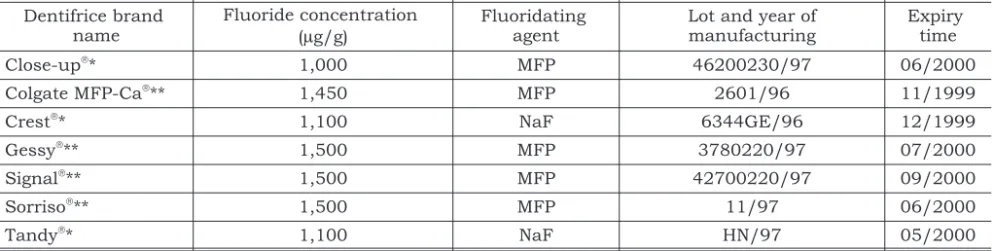
, as being representative among the infantBrazilian public. Table 1 gives the characte-ristics of the dentifrices, as informed on the packa-ging.
For each dentifrice analyzed, 12 tubes were sto-red in two groups. The first group, composed of six tubes of each brand, was kept in an air conditio-ned environment, simulating a large size commer-cial establishment. The second group was stored at a residential ambient temperature. The analy-ses were carried out at the time of acquisition and after 4, 8 and 12 months (August/97 to July/98) for the two groups.
The temperatures were recorded daily at the fol-lowing times: 8:00, 12:00 and 18:00 h, and the monthly averagewascalculated.
Determination of the fluoride concentration in
dentifrices
The analyses were done in duplicate, basically using the procedure described by Cury6
(1987) and modified by Orth et al.17
(2001). In this study cali-bration curves were made with standard fluoride solutions containing from 0.5 to 4.0 µg F−
/ml; an electrode (Orion 96-09) and an ion analyzer (Orion 720A) were used.
insoluble (linked to the abrasive); (2) total soluble fluoride (TSF), representing the ionic free fluoride (F
-) plus the ionizable in the form of MFP and (3-) soluble fluoride in the free form (F-). From these
analyses the MFP and insoluble fluoride (Fins) concentrations were calculated. All the results were expressed in ppm(mg F
-/g; w/w).
Statistical analysis
The experimental design used took into consi-deration the following factors: dentifrice, storage temperature and storage time. Considering the ab-sence of normality through the Shapiro-Wilks test, the non-parametric technique of the part subdivi-ded into time was used. For the multiple compari-sons the level of 5% of significance was considered (p £ 0.05), and the Software Analysis System (SAS)* was used.
RESULTS
During the evaluation period (August/97 to July/98) the ambient temperature ranged from 26.6 to 30.1, an average of 28.9°C. Under air con-ditioning it ranged from 25.6 to 28.7, a mean of
26.3°C.
Graph 1 shows the results (average of n = 6) of total fluoride concentration (TF), total soluble (TSF), ionizable (MFP) and insoluble (Fins) in the dentifrices stored over time in the ambient tempe-rature. With regard to TF concentration there was
no statistically significant change over time
(p > 0.05) and the results are in accordance with the current National Sanitary Vigilance Agency (ANVISA) regulation3.
The TSF concentrations in the dentifrices Clo-se-upâ, Crestâand Tandyâdid not show significant
changes over time (p > 0.05). The dentifrices Colga-te MFP-Caâ, Gessyâ, Signalâand Sorrisoâshowed a decrease of TSF concentration as a result of stora-ge time in ambient temperature (p < 0.05). In Graph 1 it may also be seen that the MFP concen-tration of the dentifrices Colgateâ, Gessyâ, Signalâ and Sorrisoâ
diminishes at the same time that the-re was an incthe-rease in Fins.
Graph 2 shows the results of fluoride concen-tration in the dentifrices when they were stored
over time under airconditioning.With regard to TF
concentration, there was no statistically signifi-cant change as a result of time (p > 0.05). The
to-othpastes Close-upâ
, Crestâ
and Tandyâ
showed the same pattern as that observed for ambient
temperature with regard to TSF, while Colgate
MFP-Caâ
, Gessyâ
, Signalâ
and Sorrisoâ
showed a significant decrease as a result of time. In addition, Graph 2 also shows that the MFP concentration of the dentifrices Colgate MFP-Caâ
, Gessyâ
, Signalâ
and Sorrisoâdiminished at the sametime that
the-re was an incthe-reasein Fins.
With regard to MFP, both at ambient tempera-ture and under air conditioning all the dentifrices containing this type of fluoride showed decrease in concentration as a result of time (Graphs 1 and 2). Comparing this variable between the two ambient conditions, the differences were not significant for Close-upâ at all of the times; in Colgate MFP-Caâ there was a small loss at all times under air condi-tioned temperature, but the differences were only significant at the times of 8 and 12 months; Ges-syâ
, SignalÒ
showed the smallest losses also under air conditioning, these being significant at the ti-mes of 4, 8 and 12 months.
*SAS Institute Inc. SAS User’s Guide Statistics, Version 5 Edition. Cary, NC: SAS Institue Inc.; 1985. 956p. TABLE 1 -Specifications of dentifrices analyzed, as described on packaging.
Dentifrice brand name
Fluoride concentration (mg/g)
Fluoridating agent
Lot and year of manufacturing
Expiry time
Close-upâ* 1,000 MFP 46200230/97 06/2000
Colgate MFP-Caâ** 1,450 MFP 2601/96 11/1999
Crestâ* 1,100 NaF 6344GE/96 12/1999
Gessyâ** 1,500 MFP 3780220/97 07/2000
Signalâ
** 1,500 MFP 42700220/97 09/2000
Sorrisoâ
** 1,500 MFP 11/97 06/2000
Tandyâ
* 1,100 NaF HN/97 05/2000
GRAPH 2 -Concentration (average, SD, n = 6) of the different forms of fluoride in the dentifrices stored over time (months) at air conditioning. TF: total fluoride; TSF: total soluble fluoride; MFP: sodium
The results of F−
concentration (mathematically it is the difference betweenTSF andMFP) were not shown to make the figures clearer, but in the den-tifrices Close-upâ
, Colgate MFP-Caâ
, Gessyâ
, Sig-nalâand Sorrisoâthere was an increase as a result
of storage time and in the dentifrices Crestâ and
Tandyâ
there was no significant alteration.
DISCUSSION
According to Rölla et al.19
(1991), only one met-hod of dental caries prevention is common to all countries that showed a reduction in the prevalen-ce of this disease: the use of fluoridated dentifriprevalen-ce. However, in order for the fluoridated dentifrice to attain its therapeutic effect in terms of caries pre-vention, it is necessary for it to meetminimum re-quirementsin terms of availability and stability of fluoride1
. Thus, in the past, dentifrices were un-able to reduce dental caries due to the formula-tions containing free ionic fluoride and calcium to-gether12
. As a consequence, the formation of low solubility products occurred in the formulation with the inactivation of fluoride in the product16
.
Furthermore, this reaction is fast and in a week
60-90% of the fluoride would be insoluble14 . The first relevant result of this study was to show that storage conditions are important to the stability of fluoride in the dentifrices and for a dif-ference of only 2.6°C between the tested storage conditions, significant losses of soluble fluoride were found (p < 0.05). This leads us to suppose that under more drastic temperature conditions, a greater loss of soluble fluoride would occur in some dentifrices.
With regard to total fluoride (TF) there was no
variation in concentration as a result of storage time under the two conditions studied. In addition, the results are in accordance with the packaging specifications reported by the manufacturer. This non-variation of the total was expected, as the total never changes, but there may be chemical changes from one form of fluoride to another as a result of product instability.
The concentration of total soluble fluoride (TSF) in the dentifrices Close-upâ, Crestâand Tandyâdid not undergo alterations as a result of time. This should be attributed to the fact that these
tooth-pastes have NaF/silica (Crestâ and Tandyâ) and
MFP/silica (Close-upâ) in their formulation. Of the-se dentifrices, Duarte et al.11
(1999) analyzed the dentifrice Close-upâ, and the present result is in agreement with that report. Silica allows the
fluori-de concentration in a fluori-dentifriceto remain stable,
independent of whether it is in F−
form or inMFP.
On the other hand, the decrease of TSF in the den-tifrices Colgate MFP-Caâ
, Gessyâ
, Signalâ
and Sor-risoâ
should be attributed to the fact that these to-othpastes are composed of MFP, which undergoes
hydrolysis over time producing free fluoride (F−
) which in turn is inactivated by the Ca++
of the abra-sive5,13,14.
It should be pointed out that in this study an evaluation was made over the period of one year, but it should be emphasized that the estimated time that dentifrices stay in a supermarket is ap-proximately 3 months. This time would be suffici-ent to prevsuffici-ent a loss of soluble fluoride and thus the manufacturers’ strategy for guaranteeing an anti-caries concentration seems to be to produce dentifrices with 1,500mg F−
/g, which is the
maxi-mum permitted by law3
. Thus, this would compen-sate the fluoride inactivation by the abrasive, and
a soluble concentration of 1,000-1,100 mg F
-/g would be guaranteed by the time that the
tooth-paste is consumed. Nevertheless, although the city
of Manaus has a tropical climate, the maximum average temperature at which the dentifrices were evaluated was 30.1°C. Therefore, under higher temperature conditions one would expect a greater loss of active fluoride in a shorter period of time and this could be relevant for the dentifrices with MFP/CaCO3.
Although the data of this study have shown a decrease of TSF over the storage time, the mini-mum concentration attained has been able to con-tribute towards the decline of dental caries that has occurred in Brazil during the last years15
. Ho-wever, in order for this decline in caries to continue occurring, the control and adequate regulation of
dentifrices is mandatory. The results obtained in
this study showed that all the dentifrices complied with the administrative ruling in force3
, a
maxi-mum of 0.15% of TF. However, as the need for
fluo-ride in the dentifrice to be soluble (active against caries) was abolished, there is no longer any gua-rantee that the population will be using a product
with a minimum concentrationof active fluoride to
reduce caries; a recent publication showed this to be a real risk17
.
air conditioning the increase attained 35% (Graphs 1 and 2). This may be explained by the hydrolysis of MFP that releases free ionic fluoride, which links with the calcium of the abrasive resul-tingin insoluble fluoride. The behavior observed in this study for dentifrices with MFP-Ca has been re-ported in the literature2,5,7,11,13,14,20
.
CONCLUSIONS
1. In terms of fluoride stability, the silica-based dentifrices, either containing NaF or MFP, were shown to be stable whether they were stored at ambient temperature or under air conditioning. 2. The calcium carbonate-based dentifrices
conta-ining MFP showed a decrease in TSF concentra-tion and an increase in the percentage of Fins over time, and this was more evident when
sto-red atambient temperature.
3. However, all the dentifrices analyzed comply with Resolution No. 79/2000 of the ANVISA, Brasília-DF, which needs to be modified becau-se it only requires compliance with regard to the quantity of fluoride in dentifrices and does not consider its quality.
ACKNOWLEDGEMENTS
To Mr. Waldomiro Vieira Filho, technician of the FOP-UNICAMP Oral Biochemical Laboratory, for help with the initial analyses; and to Professor, PhD, Rosana Cristina Pereira Parente, Federal
University of Amazonas (UFAM), for the statistical
analysis; and to Professor, PhD, Jose Nunes Mello, UFAM, for help with drawing up the graphs. This work is part of the dissertation of the first author presented as a requisite for obtaining the title of Master in Tropical Pathology, UFAM.
REFERENCES
1. ADA. Council on Dental Therapeutics. Guidelines for the acceptance of fluoride-containing dentifrices. J Am Dent Assoc 1985;110:545-7.
2. Athanassouli TM, Papastathopoulos DS. A laboratory eva-luation of fluoride dentifrices used in Greece. Community Dent Oral Epidemiol 1978;6:185-90.
3. Brasil, Ministério da Saúde. Secretaria Nacional de Vigi-lância Sanitária. Resolução nº 79 de 28 de agosto de 2000. DO 169 de 31/08/2000. p. 1415-537.
4. Cury JA, Guimarães LOC, Arbex ST, Moreira BW. Análise dos dentifrícios fluoretados: concentração e formas quími-cas de fluoretos encontrados em produtos brasileiros. Rev Assoc Paul Cir Dent 1981;35:142-7.
5. Cury JA. Estabilidade do flúor nos dentifrícios brasileiros. Rev Gaúcha Odontol 1986;34:430-2.
6. Cury JA. Avaliação de um gel dentifrício contendo xilitol e flúor. Rev Bras Odontol 1987;44:36-40.
7. Cury JA. Dentifrícios fluoretados no Brasil. Rev Gaúcha Odontol 1989;37:139-42.
8. Cury JA. Dentifrícios fluoretados no mercado brasileiro e seu potencial como método preventivo. Associação Brasileira de Odontologia Preventiva (ABOPREV – Gestão 89-91), publicação avulsa, 1989. p. 1-8.
9. Cury JA. Cárie e o creme dental. Jornal da ABOPREV Espe-cial, Ano IX, out. 1998. p. 2.
10. Cury JA. Uso do flúor e o controle da cárie como doença. In: Baratieri LN, Monteiro S, Andrada MAC, Vieira LCC, Ritter AV, Cardoso AC. Odontologia Restauradora: fundamentos e possibilidades. São Paulo: Santos; 2001. p. 34-68. 11. Duarte FF, Pisaneschi E, Cury JA. Avaliação do flúor dos
dentifrícios mais consumidos no Brasil e comercializados nas cinco regiões do País. Rev ABOPREV 1999;2:3-10.
12. Ericsson Y. Fluorides in dentifrices: investigations using radioactive fluorine. Acta Odontol Scand 1961;19:41-77. 13. Freitas JF. Fluoride stability in toothpastes. Aust Dent J
1984;29:30-5.
14. Hattab FN. The state of fluorides in toothpastes. J Dent 1989;17:47-54.
15. Narvai PC, Frazão P, Castellanos RA. Declínio na experiên-cia de cárie em dentes permanentes de escolares brasilei-ros no final do século XX. Odontologia e Sociedade 1999;1:25-9.
16. Nören B, Harse C. The stability of the monofluorphosphate and fluoride ions in dentifrice containing calcium carbona-te. J Soc Cosmet Chem 1974;25:3-11.
17. Orth MR, Assaf AV, Zanin L, Mialhe FL, Klein AL, Medina MRJ, et al. Concentração de flúor nos principais dentifrí-cios comercializados no Brasil e impacto da nova portaria de regulamentação. Revista Odonto Ciência 2001; 16:27-33.
18. Richards A, Banting DW. Fluoride toothpastes. In: Fejers-kov O, Ekstrand J, Burt BA. Fluoride in Dentistry. 2nded. Copenhagen: Munksgaard; 1996. p. 352-72.
19. Rölla G, Oggard B, Cruz RA. Clinical effect and mechanism of cariostatic action of fluoride containing toothpaste: a re-view. Int Dent J 1991;41:171-4.
20. Sarmiento RV, Issáo M, Cury JA. Estudio de la disponibili-dad y estabilidisponibili-dad de flúor de los dentífricos comercializa-dos en el Perú. Rev Estomatol Herediana 1994;4:12-20. 21. ten Cate JM, Featherstone JDB. Physicochemical aspects
of fluoride-enamel interactions. In: Fejerskov O, Ekstrand J, Burt BA. Fluoride in Dentistry. 2nd ed. Copenhagen: Munksgaard; 1996. p. 352-72.