Leptin and hypothalamic gene expression in early- and late-maturing
Bos indicus
Nellore heifers
Aline Vaiciunas
1, Luiz L. Coutinho
2, Flávio V. Meirelles
3, Alexandre V. Pires
2and Luis Felipe P. Silva
11
Departamento de Produção e Nutrição Animal, Faculdade de Medicina Veterinária e Zootecnia,
Universidade de São Paulo, Pirassununga, SP, Brazil.
2
Departamento de Ciência Animal, Escola Superior de Agricultura “Luiz de Queiroz”,
Universidade de São Paulo, Piracicaba, SP, Brazil.
3
Departamento de Ciências, Faculdade de Zootecnia e Engenharia de Alimentos,
Universidade de São Paulo, Pirassununga, SP, Brazil.
Abstract
We investigated wether early-maturing or late-maturingBos indicus Nellore heifers produced more leptin mRNA in adipose tissues and altered expression of hypothalamic genes related to leptin signaling. Six prepubertal and six pu-bertal heifers aged about 34 months and weighing 280 kg to 300 kg each were selected from a population of 100 Nellore heifers. Real-time PCR was used to quantify the expression of the leptin gene (LEP) in adipose tissues and the long isoform of the leptin receptor gene (Ob-Rb), the NK2 homeobox 1 hypothalamic marker gene NKX2-1, the suppressor of cytokine signaling 3 gene (SOCS-3), the neuropeptide Y genes (NPY) and the NPY G-protein coupled receptor genesNPY-Y1 and NPY-Y4 in the hypothalamus. Heifers attaining puberty earlier showed significantly greaterLEP expression in adipose tissues (p < 0.05) and there was tissue interaction (p < 0.05). Hypothalamic ex-pression ofOb-Rb, NKX2-1, NPY and SOCS-3 did not differ between groups, but in early-maturing heifers there was a tendency for lower expression ofNPY-Y1 (8.3-fold less) and NPY-Y4 (14.3-fold less) compared to late-maturing heifers (p = 0.1). These results suggest that a combination of higherLEP expression, lower NPY-Y1 and NPY-Y4 ex-pression could be a factor in regulating puberty in early-maturingB. indicus heifers.
Key words: Bos indicus, gene expression, hypothalamus, leptin, neuropeptide Y.
Received: June 6, 2007; Accepted: December 12, 2007.
Introduction
Older age at puberty is responsible for lower slaugh-ter rates in cattle production systems based onBos indicus
(Artiodactyla, Bovidae) breeds raised on pastures (Martin
et al., 1992) because althoughB. indicus cattle are better adapted to harsh tropical conditions thanBos taurusbreeds, they generally reach puberty when they are older and heavier (Thallman et al., 1999; Rodrigues et al., 2002). Thus, selection of early-maturingB. indicusheifers as well as nutritional protocols to advance puberty have received a great deal of interest from the scientific community (Var-gaset al., 1998; Martinez-Velazquezet al., 2003).
The hypothalamic maturation process and the meta-bolic signal involved in regulation of puberty are not well
understood (Kinderet al., 1995). Leptin, a 16 kDa protein hormone coded for by theLEPgene (also called the obese (ob) gene), has a key role in regulating energy intake and expenditure and has been proposed as an indicator of body adiposity and, in rodents, has a permissive role on puberty (Smith et al., 2002). Leptin acts in the hypothalamus through the long isoform of the leptin receptor (Ob-Rb). However, the molecular mechanism by which leptin signal-ing in the hypothalamus might be involved in initiation of puberty has not been elucidated. One possible mechanism is through neuropeptide Y (NPY) signaling, this peptide in-creases dramatically in cerebrospinal fluid during under-nutrition and negatively modulates secretion of luteinizing hormone (LH) when centrally infused into cattle (Gazalet al., 1998). Given the inhibitory role of NPY on sexual mat-uration, leptin-mediated suppression ofNPYexpression in the arcuate nucleus is probably important in controlling pu-bertal development (Pedrazziniet al., 2003).
The action of NPY in the hypothalamus is modulated by a family of G-protein coupled receptors, consisting of at www.sbg.org.br
Send correspondence to Luis Felipe Prada e Silva. Departamento de Produção e Nutrição Animal, Faculdade de Medicina Veterinária e Zootecnia, Universidade de São Paulo, Av. Duque de Caxias Norte 225, 13635-900 Pirassununga, SP, Brazil. E-mail: lfpsilva@ usp.br.
least five distinct members (Y1, Y2, Y4, Y5 and Y6) (Blomqvist and Herzog, 1997). The products ofNPY-Y1
andNPY-Y4mediate the detrimental effects of NPY on the gonadotrope axis through knockout models (Sainsburyet al., 2002; Pedrazzini, 2004). Our hypothesis was that late-maturingB. indicusheifers have lessLEPexpression in ad-ipose tissue and/or less sensitivity to leptin signaling in the hypothalamus. It was our objective to test whether early-maturingB. indicusheifers had greater amounts of leptin mRNA in adipose tissues, and altered expression of hypo-thalamic genes related to leptin signaling.
Material and Methods
Animals and treatments
In November 2003, 100 pasturedBos indicusheifers were selected based on breed attributes (Nellore), month of birth (November-2001), and body weight (between 280 kg and 300 kg), from a population of 500 heifers in a herd at the Hildergard Georgina Von Pritzelwitz experimental sta-tion managed by the University of São Paulo in Londrina, Paraná, Brazil. These 100 heifers were submitted to rectal palpation and scored as prepubertal or postpubertal accord-ing to the presence or absence of a palpable corpus luteum (CL) and ovary size. After scoring, 15 prepubertal heifers and 15 postpubertal heifers, born in the same month with similar body weight and body condition score, were se-lected and given a prostaglandin (PGF2α) injection to
in-duce estrus (Ciosin, Coopers, Brazil). The occurrence of estrus was visually monitored in these 30 heifers on the third and fourth day after the PGF2αinjection, and on the
fourth day all 15 heifers that were previously scored as prepubertal and showed no sign of estrus after PGF2α
injec-tion were weighed and submitted to rectal palpainjec-tion to con-firm an absence of CL. All animal procedures were conducted in accordance with the Guidelines for the Care and Use of Agricultural Animals in Agricultural Research and Teaching (FASS, 1999).
Six heifers that had palpable CL and showed estrus after PGF2αinjection (early-maturing), and six heifers that
had no CL or signs of estrus (late-maturing) were selected for the experiment and slaughtered on the fifth day after PGF2α injection. The prepubertal or postpubertal
condi-tions of the heifers were confirmed at slaughter by dissec-tion of the ovaries. At slaughter, samples from the subcutaneous, omental and perirenal adipose tissues, and hypothalamus were collected, frozen in liquid nitrogen, and stored at -80 °C for subsequent analysis. The optical chiasm and mammilary bodies were used as anatomical markers for collecting the hypothalamus. For statistical purposes, the treatments were defined as the two heifer groups, early-maturing or late-maturing heifers.
Total RNA from tissue samples was isolated using TRIzol® Reagent (Invitrogen, USA) according to
Chom-czynski and Saachi (1987). The quality of isolated RNA was determined by measuring the absorbance at 260 and 280 nm and its integrity was verified as mainly 18S and 28S rRNA by electrophoresis in 1% (w/v) agarose gel.
Reverse Transcription (RT) PCR
We used 5µg of total RNA from each tissue sample
for cDNA synthesis. After denaturing at 70 °C for 10 min, half of the sample (2.5 µg) was reverse-transcribed into
cDNA with 0.5µg of oligo thymidine and 200 units of Su-perscript II reverse transcriptase (RT) (Invitrogen) in a final volume of 20µL, for 60 min at 42 °C. The other half was
in-cubated without reverse transcriptase and used as a nega-tive control in polymerase chain reactions (PCR) to confirm the absence of residual genomic DNA contamina-tion.
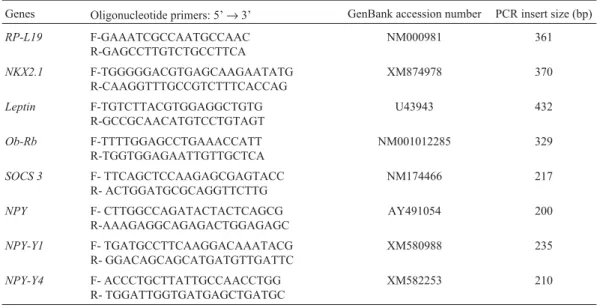
Oligonucleotide primer pairs specific forLEP, Ob-Rb, suppressor of cytokine signaling 3 (SOCS-3), NPY,
NPY-Y1andNPY-Y4were designed based on bovine Gen-Bank sequences (Table 1). OneµL of each RT reaction was
used as template for PCR reactions in a final volume of 50µL with 1.5 mM MgCl2, 0.4 mM of each
deoxynucleo-tide triphosphate (Invitrogen), 0.25 µM of each primer
(Invitrogen), 4 units of Taq polymerase (Invitrogen), and 1× PCR buffer (Invitrogen). The following amplification conditions were used: 95 °C for 5 min followed by 40 cy-cles at 95 °C for 45 s, 55 °C for 60 s and 72 °C for 1 min. Af-ter the last cycle, the reactions were held at 72 °C for 10 min.
Primers specific for the ribosomal protein gene RP-L19(also known asL19) were used as positive controls for all samples to verify the success of the RT reactions, and primers specific for the NK2 homeobox 1 hypothalamic marker geneNKX2-1(also known as TITF1) were used to verify possible sampling variations when dissecting the hy-pothalamus. In addition to incubating the RNA without reverse transcriptase, negative control reactions were per-formed similarly without addition of a template from the RT reaction. Amplified cDNA were visualized by agarose gel electrophoresis and staining with ethidium bromide.
Quantification of gene expression
Quantification of gene expression was performed us-ing the LightCycler Real-Time PCR System (Roche Diag-nostics; Switzerland) based on the second derivative maximum method. Samples without cDNA were used as a negative control. With this method a second derivative maximum within the exponential phase of the amplifica-tion curve is linearly related to the starting concentraamplifica-tion of template cDNA molecules.
A master-mix of the reaction components was pre-pared with 1.1 mM MgCl2, 110 nM forward primer,
110 nM reverse primer, 222µM dNTP, 278 mg/L bovine
poly-merase (Invitrogen) and 45,450-fold diluted nucleic acid stain Sybr Green I (Invitrogen). LightCycler mastermix (18µL) was filled in the LightCycler glass capillaries, and
2µL of cDNA added as PCR template. The capillaries were
closed, centrifuged for 5 s at 700 x g and placed into the LightCycler rotor. The following LightCycler experimen-tal run protocol was used: denaturation program (95 °C for 5 min), amplification and quantification program repeated 40 times (95 °C for 10 s, 55 °C for 15 s, 72 °C for 20 s), melting curve program (75-95 °C with a heating rate of 0.1 °C per second and a continuous fluorescence measure-ment) and a final cooling step to 40 °C.
Statistical analysis
To calculate gene expression, a relative quantifica-tion method was used (Yuanet al., 2006):
Ratio E E
Ct
Ct =
( )
( )
target
RP -L19 target
RP - L19
Δ
Δ
whereEis the amplification efficiency of each gene,Ctthe threshold cycle andΔCtthe late-maturing (LM) threshold
cycle minus the early-maturing threshold cycle (ΔCt=CtLM
-CtEM).
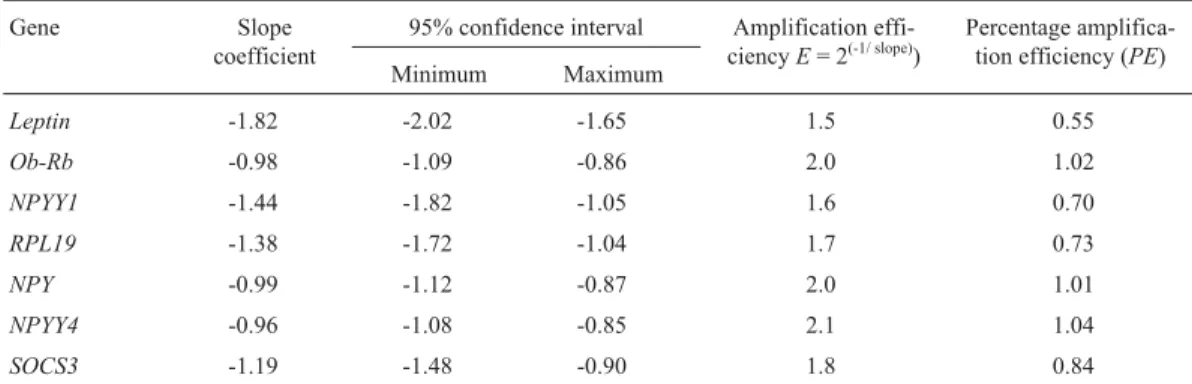
The relative expression method was used to minimize possible variations due to the efficiency of reverse tran-scription and quantity of template utilized. A dilution curve with a series of cDNA concentrations was calculated for each gene to obtain the amplification efficiency. The SAS procedure Proc Mixed (SAS, 2000) was used to perform simple linear regression for each group based on the model described by Yuanet al. (2006). The amplification effi-ciency (E) was calculated asE= 2(-1/slope). If theEvalues were not different than 2, then the gene expression ratio (R) was calculated using the equation R = 2-ΔΔCt
, in which
ΔΔCt = ΔCtRP-L19 - ΔCttarget. When the E values were
different than 2 we adjustedΔΔCtusing the percentage
am-plification efficiency (PE) to giveΔΔCt_adj= PERP-L19* ΔCtRP-L19 -PEtarget*ΔCttargetand the gene expression ratio
was calculated R = 2-ΔΔCt_adj
. Data were analyzed using analysis of covariance (ANCOVA) considering the fixed effects of treatment, gene and the treatment × gene interac-tion, as well as the random effects of the animals (treat-ment) and gene × treatment (animal). Significance was assumed to be p < 0.05 and tendency was assumed to be p < 0.1.
Results
When testing the efficiency of gene amplification, re-gression analysis resulted in rere-gression coefficient (R2) val-ues above 0.96, indicating a linear relationship between starting cDNA concentration andCt. The efficiency of am-plification forLEP,RP-L19andNPY-Y1indicated a slope significantly different than -1, therefore the ratio of gene expression was calculated considering the calculated ciency of amplification (Table 2). For the other genes, effi-ciency was considered to be equal to 2.
Heifers that attained puberty earlier had greater leptin gene expression in adipose tissue (p < 0.05, Table 3), and there was a significant treatment by tissue interaction (p < 0.05, Table 3). After adjusting for differences in the housekeeping gene RP-L19 expression, LEP expression was detected by real-time PCR at 2.1 cycles earlier in the postpubertal heifers than in the prepubertal heifers (ΔΔCT = -2.1, Table 3), which represents an average
in-crease of 4.3-fold inLEPexpression among the three adi-pose tissue depots (Figure 1). Early-maturing heifers had greaterLEPexpression in omental fat depot (10-fold in-crease, p = 0.05) and subcutaneous fat depot (6.9-fold increase, p = 0.01), while there was no effect onLEP
ex-Table 1- Oligonucleotide primer pairs designed for use in polymerase chain reaction (PCR) amplification
Genes Oligonucleotide primers: 5’→3’ GenBank accession number PCR insert size (bp)
RP-L19 F-GAAATCGCCAATGCCAAC R-GAGCCTTGTCTGCCTTCA
NM000981 361
NKX2.1 F-TGGGGGACGTGAGCAAGAATATG R-CAAGGTTTGCCGTCTTTCACCAG
XM874978 370
Leptin F-TGTCTTACGTGGAGGCTGTG R-GCCGCAACATGTCCTGTAGT
U43943 432
Ob-Rb F-TTTTGGAGCCTGAAACCATT R-TGGTGGAGAATTGTTGCTCA
NM001012285 329
SOCS 3 F- TTCAGCTCCAAGAGCGAGTACC R- ACTGGATGCGCAGGTTCTTG
NM174466 217
NPY F- CTTGGCCAGATACTACTCAGCG
R-AAAGAGGCAGAGACTGGAGAGC
AY491054 200
NPY-Y1 F- TGATGCCTTCAAGGACAAATACG R- GGACAGCAGCATGATGTTGATTC
XM580988 235
NPY-Y4 F- ACCCTGCTTATTGCCAACCTGG R- TGGATTGGTGATGAGCTGATGC
pression in the perirenal fat depot (1.4-fold increase, p > 0.60) (Figure 1).
Hypothalamic expression of the long isoform of leptin receptor (Ob-Rb) was not different between heifer groups (p > 0.50, Table 4). Dissection of the hypothalamus was based on anatomical markers and there should have been no difference between the two groups of heifers in the area of the brain that was sampled. This was checked by an-alyzing the expression of the NK2 homeobox 1 hypotha-lamic marker geneNKX2-1(also known asTITF-1) which is only expressed in the hypothalamus and is not involved in reproductive events (Suzukiet al., 1998). We found that
NKX2-1expression was not affected by treatment (p > 0.90, data not shown), demonstrating that there was no difference between the heifer groups in the area of the brain sampled. There was also no treatment effect onSOCS-3expression by the hypothalamus (p > 0.80, Table 4). The expression of
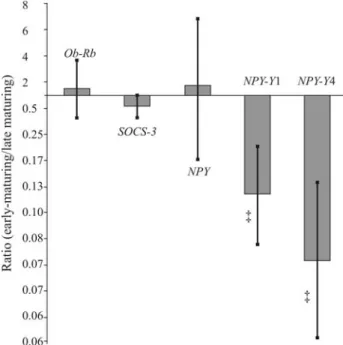
NPY in the hypothalamus was not statistically different (p > 0.7) between heifer groups (Table 4). However, for heifers that reached puberty earlier there was a tendency (p = 0.1) for less expression ofNPY-Y1(8.3-fold less) and
NPY-Y4(14.3-fold less), as shown in Table 4 and Figure 2. When the data for both NPY receptors,NPY-Y1and NPY-Y4were analyzed together, there was a statistically signifi-cant (p = 0.03) 11-fold reduction in expression in early-maturing heifers (data not shown).
Discussion
The increased LEPexpression in adipose tissue of early-maturing heifers supports the idea that the circulating
concentration of leptin is an important signal for the initiation of pubertal processes (Ahimaet al., 1997), and suggests that heifers with greater adipose tissueLEP ex-pression could attain puberty earlier and at lighter body weight. Although well adapted to tropical grazing condi-tions,B. indicuscattle reach puberty at a much later age than most B. taurus breeds, even when both breeds are raised under similar environmental and nutritional condi-tions (Rodrigueset al., 2002). Later puberty results in a later age at first calving and reduces the slaughter rate and
Table 2- Efficiency of gene amplification using real-time polymerase chain reaction amplification.
Gene Slope
coefficient
95% confidence interval Amplification effi-ciencyE= 2(-1/ slope))
Percentage amplifica-tion efficiency (PE)
Minimum Maximum
Leptin -1.82 -2.02 -1.65 1.5 0.55
Ob-Rb -0.98 -1.09 -0.86 2.0 1.02
NPYY1 -1.44 -1.82 -1.05 1.6 0.70
RPL19 -1.38 -1.72 -1.04 1.7 0.73
NPY -0.99 -1.12 -0.87 2.0 1.01
NPYY4 -0.96 -1.08 -0.85 2.1 1.04
SOCS3 -1.19 -1.48 -0.90 1.8 0.84
Table 3- Quantification of gene expression in the adipose tissue depots of early-maturing (EM) and late-maturing (LM)Bos indicusNellore heifers.
Adipose tissue LeptinEM LeptinLM RP-L19EM RP-L19LM Adjusted
threshold cycle*
SEM† p-value
Omental 28.5 36.3 18.1 19.4 -3.34 1.3 0.05
Perirenal 24.6 24.4 18.8 18.0 -0.49 0.9 0.60
Subcutaneous 29.0 34.9 19.6 20.3 -2.78 0.8 0.01
*ΔΔCt_adj=PERP-L19×ΔCtRP-L19-PEtarget×ΔCttarget, whereCtis the threshold cycle,RP-L19is the ribosomal protein gene,PEis the percentage
amplifi-cation efficiency, andΔCt=CtLM-CtEM.†SEM = Standard Error of the Mean.
overall efficiency of cow-calf operations usingB. indicus
breeds in grazing systems.
In bothB. indicusandB. taurusheifers, early stage of sexual maturation is regulated by the maturation of the hy-pothalamus (Evans et al., 1994; Rodrigueset al., 2002). The physiological regulation for maturation of the hypo-thalamus leading to puberty is not well understood, but clearly both body weight and chronological age influence the onset of puberty (Moran et al., 1989; Kinder et al., 1995). Nutrition is also an important element determining reproductive status in cattle and other mammals. A com-plex and controversial relationship between body fatness and the control of the reproductive axis was proposed by Frischet al.(1980).
More recently, it has been postulated that leptin could explain the link between body fat, nutrition and control of the reproductive axis, with plasma concentrations of leptin being permissive to puberty in rodents (Barashet al., 1996). Exogenous administration of leptin in feed restricted beef heifers is able to increase LH concentrations and gonado-tropin-releasing hormone (GnRH) stimulated LH secretion by the pituitary (Amstalden et al., 2002; Maciel et al., 2004a; Ziebaet al., 2004). However, leptin administration for 40 days in well fed heifers was not able to advance pu-berty or increase LH secretion (Macielet al., 2004b; Zieba
et al., 2004). These and other studies suggest that acute or chronic feed restriction can sensitize the reproductive axis to leptin (Dyeret al., 1997; Nagataniet al., 2000). Taken together, these results indicate that in B. indicus heifers raised on pasture, with less body fat, averaging 300 kg at age 36 months, as is very common in grazing systems, the circulating concentrations of leptin should be limiting GnRH secretion and the onset of puberty. Therefore, those heifers with greater adipose tissueLEP expression could reach puberty earlier at a lower body weight.
Our results agree with the findings of other workers showing that amount of leptin mRNA is less in subcutane-ous tissue than in perirenal adipose tissue (Kimet al., 2000; Yanget al., 2003). The reason for the greaterLEP expres-sion in perirenal fat could be explained by a greater adipo-cyte diameter (Yanget al., 2003). Fasting-induced decrease ofLEPexpression occurs predominantly in the
subcutane-ous fat, while there is no effect in either perirenal or omental fat depots (Kimet al., 2000). In our study, attain-ment of puberty was related toLEPexpression in the sub-cutaneous and omental fat depots, but not in the perirenal fat depot.
In humans and rodents, leptin signaling in the hypo-thalamus is essential for sexual maturation and leptin re-ceptor deficient rodents cannot attain puberty (Huszar et al., 1997). This suggests that it is possible that early-ma-turing heifers could have a greaterOb-Rbexpression in the hypothalamus and, therefore, reach puberty with less circu-lating leptin. However, our results do not support this hy-pothesis becauseB. indicus heifers that reached puberty earlier had greaterLEPexpression but equalOb-Rb expres-sion in the hypothalamus. In another study with cattle,
Ob-Rbexpression in the hypothalamus was not different in Holstein and Charolais bulls (bothB. taurus) at 18 months of age, although Holstein cattle reached puberty on average
Figure 2- Ratio of hypothalamic gene expression in early-maturing and late-maturingBos indicusNellore heifers. Lines on bars are standard er-rors. Tendencies for treatment differences (p < 0.10) between means are indicated by the symbol, ‡ bellow the appropriate bars.
Table 4- Quantification of hypothalamic gene expression in early-maturing and late-maturingBos indicusNellore heifers.
Gene TargetEM TargetLM RP-L19EM RP-L19LM Adjusted
threshold cycle*
SEM† p-value
Ob-Rb 31.6 35.1 19.1 22.1 -0.53 -0.77 0.51
SOCS3 32.4 34.5 19.1 22.1 0.85 3.14 0.81
NPY 25.2 28.8 19.1 22.1 -0.68 -2.23 0.77
NPYY1 27.3 27.2 19.1 22.1 -3.14 1.73 0.11
NPYY4 26.7 25.9 19.1 22.1 -3.77 1.91 0.08
*ΔΔCt_adj=PERP-L19×ΔCtRP-L19-PEtarget×ΔCttarget, whereCtis the threshold cycle,RP-L19is the ribosomal protein gene,PEis the percentage
at an earlier age than Charolais cattle (Renet al., 2002). However,Ob-Rbexpression in the hypothalamus of rams was altered by photoperiod, with rams subjected to a long day-length photoperiod being sexually inactive, had similar circulating leptin but greaterOb-Rbexpression than rams exposed to a short-day photoperiod (Clarkeet al., 2003). The expression ofNPYwas also higher in the hypothala-mus of rams subjected to a long-day photoperiod (Clarkeet al., 2003). Because NPY is a potent inhibitor of GnRH se-cretion by the hypothalamus, this could explain why rams under a long-day photoperiod were sexually inactive al-though they had similar plasma leptin concentration and greaterOb-Rbexpression than sexually active rams under a short-day photoperiod (Clarkeet al., 2003).
In mammalian cell lines, SOCS-3 acts as an inhibitor of leptin signaling and leptin administration is capable of increasingSOCS-3 mRNA in the hypothalamus ofob/ob
mouse and other mammals (Bjorbaeket al., 1998; Eycker-man et al., 2000). It is thought that there is a feedback mechanism, by which an increase of leptin inducesSOCS-3
expression and directly inhibits leptin receptor signaling, which would be responsible for creating leptin resistance (Bjorbaeket al., 1998). In our study, although there was greater adipose tissueLEP expression in heifers that at-tained puberty earlierSOCS-3expression in the hypothala-mus was not altered.
The reproductive axis of cattle is very sensitive to leptin when the cattle are malnourished (Maciel et al., 2004a) but leptin fails to stimulate the hypothalamic-ade-nohypophyseal axis of well-nourished sheep and cattle, suggesting that physiological resistance to leptin may occur in animals that are in neutral or positive energy balance (Amstaldenet al., 2005). It was thought that well-fed ani-mals could be resistant to leptin due to increasedSOC-3
expression in the hypothalamus and adenohypophysis, however fasting increased and did not decrease the amounts of SOCS-3 mRNA in the adenohypophysis of cows (Amstaldenet al., 2005). Taken together, these re-sults suggest thatSOCS-3expression is not related to con-trol of the reproductive axis in cattle.
Neurons from the arcuate hypothalamus nucleus pro-duce NPY, one of the most abundant peptides in the hypo-thalamus (Friedman and Halaas, 1998; Williams et al., 2000). The various NPY functions are mediated by a family of NPY receptors (Y1, Y2, Y4, Y5 and Y6) (Gehlert, 1999) and NPY signaling in the hypothalamus regulates the ef-fects of leptin on reproductive activity in rodents and pri-mates (Aubertet al., 1998; Sainsburyet al., 2002). Inob/ob
rats, a lack of leptin inhibition leads to chronically elevated
NPYexpression in the hypothalamus, while treatment with leptin reduces NPY and restores fertility (Sainsburyet al., 2002). Also, when centrally administered, NPY greatly in-hibits sexual function in rats (Pierrozet al., 1996). Based on these observations it is possible that changes in hypotha-lamic NPY signaling could be involved in sexual
matura-tion of heifers. In our study, although hypothalamic expres-sion of NPY was the same in early-maturing or late-maturing heifers there was a tendency for less expres-sion of theNPY-Y1andNPY-Y4receptors in the hypothala-mus of early-maturing heifers.
The importance of NPY-Y1 signaling for the continu-ous maturation of the prepubertal hypothalamus has been demonstrated in knock-out models. Animals deficient in the Y1 receptor have increased pituitary LH and increased seminal vesicle size after 48 h of starvation (Pedrazziniet al., 1998). Daily injections of leptin into juvenileY1-/- fe-male mice causes an advancement in puberty compared to wild-type mice, which is accompanied by an increase in uterus weight. An improved function of the gonadotropic axis is also seen in Y1-/-,ob/ob double knockout mutant mice, which suggests that the permissive role of leptin in at-tainment of puberty is likely mediated by NPY and NPY-Y1 signaling (Pralonget al., 2002). Ablation of the Y4 re-ceptor inob/obmice also restores fertility to 100% in male mice and improves fertility in female double knockout mice by 50% (Sainsburyet al., 2002).
In conclusion,LEPexpression was greater in adipose tissues and expression of NPY receptor genes was less in the hypothalamus of early-maturing heifers. These results suggest that, because of the lower expression of NPY re-ceptor genes, the hypothalamus of heifers reaching puberty earlier could be less sensitive to NPY inhibition. So, there are two detected pathways that could be responsible for hastened puberty in these heifers, greaterLEPexpression by the adipose tissue, and lesser expression of NPY recep-tor genes in the hypothalamus.
Acknowledgments
The authors acknowledge help from the Hildergard Goergina von Pritzelwitz Experimental station and the Bra-zilian agency FAPESP for financial support. Luiz Lehmann Coutinho and Alexandre Vaz Pires are each recipients of a research productivity scholarship provided by the Brazilian agency CNPq.
References
Ahima RS, Dushay J, Flier SN, Prabakaran D and Flier JS (1997) Leptin accelerates the onset of puberty in normal female mice. J Clin Invest 99:391-395.
Amstalden M, Garcia MR, Stanko RL, Nizielski SE, Morrison CD, Keisler DH and Williams GL (2002) Central infusion of recombinant ovine leptin normalizes plasma insulin and stimulates a novel hypersecretion of luteinizing hormone af-ter short-af-term fasting in mature beef cows. Biol Reprod 66:1555-1561.
Amstalden M, Spencer TE, Harms PG and Williams GL (2005) Expression of leptin receptor and suppressor of cytokine sig-naling-3 genes in adenohypophysis of normal-fed and fasted cows. Reprod Biol 5:237-245.
control of sexual function and growth: Role of neuropeptide Y and leptin. Mol Cell Endocrinol 140:107-113.
Barash IA, Cheung CC, Weigle DS, Ren H, Kabigting EB, Kuij-per JL, Clifton DK and Steiner RA (1996) Leptin is a meta-bolic signal to the reproductive system. Endocrinology 137:3144-3147.
Bjorbaek C, Elmquist JK, Frantz JD, Shoelson SE and Flier JS (1998) Identification of SOCS-3 as a potential mediator of central leptin resistance. Mol Cell 1:619-625.
Blomqvist AG and Herzog H (1997) Y-receptor subtypes - How many more? Trends Neurosci 20:294-298.
Chomczynski P and Sacchi N (1987) Single-step method of RNA isolation by acid guanidinium thiocyanate-phenol-chloro-form extraction. Anal Biochem 162:156-159.
Clarke IJ, Rao A, Chilliard Y, Delavaud C and Lincoln GA (2003) Photoperiod effects on gene expression for hypothalamic appetite-regulating peptides and food intake in the ram. Am J Physiol Regul Integr Comp Physiol 284:R101-115. Dyer CJ, Simmons JM, Matteri RL and Keisler DH (1997) Leptin
receptor mRNA is expressed in ewe anterior pituitary and adipose tissues and is differentially expressed in hypotha-lamic regions of well-fed and feed-restricted ewes. Domest Anim Endocrinol 14:119-128.
Evans AC, Adams GP and Rawlings NC (1994) Endocrine and ovarian follicular changes leading up to the first ovulation in prepubertal heifers. J Reprod Fertil 100:187-194.
Eyckerman S, Broekaert D, Verhee A, Vandekerckhove J and Tavernier J (2000) Identification of the Y985 and Y1077 motifs as SOCS3 recruitment sites in the murine leptin re-ceptor. FEBS Lett 486:33-37.
FASS (1999) Guide for the Care and Use of Agricultural Animals in Agricultural Research and Teaching. 1st ed. Federation of Animal Science Societies, Savoy, 164 pp.
Friedman JM and Halaas JL (1998) Leptin and the regulation of body weight in mammals. Nature 395:763-770.
Frisch RE (1980) Pubertal adipose tissue: Is it necessary for nor-mal sexual maturation? Evidence from the rat and human fe-male. Fed Proc 39:2395-2400.
Gazal OS, Leshin LS, Stanko RL, Thomas MG, Keisler DH, An-derson LL and Williams GL (1998) Gonadotropin-releasing hormone secretion into third-ventricle cerebrospinal fluid of cattle: Correspondence with the tonic and surge release of luteinizing hormone and its tonic inhibition by suckling and neuropeptide Y. Biol Reprod 59:676-683.
Gehlert DR (1999) Role of hypothalamic neuropeptide Y in feed-ing and obesity. Neuropeptides 33:329-338.
Huszar D, Lynch CA, Fairchild-Huntress V, Dunmore JH, Fang Q, Berkemeier LR, Gu W, Kesterson RA, Boston BA, Cone RD,et al.(1997) Targeted disruption of the melanocortin-4 receptor results in obesity in mice. Cell 88:131-141. Kim MS, Small CJ, Stanley SA, Morgan DG, Seal LJ, Kong WM,
Edwards CM, Abusnana S, Sunter D, Ghatei MA, et al.
(2000) The central melanocortin system affects the hypo-thalamo-pituitary thyroid axis and may mediate the effect of leptin. J Clin Invest 105:1005-1011.
Kinder JE, Bergfeld EG, Wehrman ME, Peters KE and Kojima FN (1995) Endocrine basis for puberty in heifers and ewes. J Reprod Fertil (Suppl) 49:393-407.
Maciel MN, Zieba DA, Amstalden M, Keisler DH, Neves JP and Williams GL (2004a) Leptin prevents fasting-mediated re-ductions in pulsatile secretion of luteinizing hormone and
enhances its gonadotropin-releasing hormone-mediated re-lease in heifers. Biol Reprod 70:229-235.
Maciel MN, Zieba DA, Amstalden M, Keisler DH, Neves JP and Williams GL (2004b) Chronic administration of recombi-nant ovine leptin in growing beef heifers: Effects on secre-tion of LH, metabolic hormones, and timing of puberty. J Anim Sci 82:2930-2936.
Martin LC, Brinks JS, Bourdon RM and Cundiff LV (1992) Ge-netic effects on beef heifer puberty and subsequent repro-duction. J Anim Sci 70:4006-4017.
Martinez-Velazquez G, Gregory KE, Bennett GL and Van Vleck LD (2003) Genetic relationships between scrotal circumfer-ence and female reproductive traits. J Anim Sci 81:395-401. Moran C, Quirke JF and Roche JF (1989) Puberty in heifers: A
re-view. Anim Reprod Sci 18:1190-1193.
Nagatani S, Zeng Y, Keisler DH, Foster DL and Jaffe CA (2000) Leptin regulates pulsatile luteinizing hormone and growth hormone secretion in the sheep. Endocrinology 141:3965-3975.
Pedrazzini T (2004) Importance of NPY Y1 receptor-mediated pathways: Assessment using NPY Y1 receptor knockouts. Neuropeptides 38:267-275.
Pedrazzini T, Pralong F and Grouzmann E (2003) Neuropeptide Y: The universal soldier. Cell Mol Life Sci 60:350-377. Pedrazzini T, Seydoux J, Kunstner P, Aubert JF, Grouzmann E,
Beermann F and Brunner HR (1998) Cardiovascular re-sponse, feeding behavior and locomotor activity in mice lacking the NPY Y1 receptor. Nat Med 4:722-726. Pierroz DD, Catzeflis C, Aebi AC, Rivier JE and Aubert ML
(1996) Chronic administration of neuropeptide Y into the lateral ventricle inhibits both the pituitary-testicular axis and growth hormone and insulin-like growth factor I secretion in intact adult male rats. Endocrinology 137:3-12.
Pralong FP, Gonzales C, Voirol MJ, Palmiter RD, Brunner HR, Gaillard RC, Seydoux J and Pedrazzini T (2002) The neuro-peptide Y Y1 receptor regulates leptin-mediated control of energy homeostasis and reproductive functions. FASEB J 16:712-714.
Ren MQ, Wegner J, Bellmann O, Brockmann GA, Schneider F, Teuscher F and Ender K (2002) Comparing mRNA levels of genes encoding leptin, leptin receptor, and lipoprotein lipase between dairy and beef cattle. Dom Anim Endocr 23:371-381.
Rodrigues HD, Kinder JE and Fitzpatrick LA (2002) Estradiol regulation of luteinizing hormone secretion in heifers of two breed types that reach puberty at different ages. Biol Reprod 66:603-609.
Sainsbury A, Schwarzer C, Couzens M, Jenkins A, Oakes SR, Ormandy CJ and Herzog H (2002) Y4 receptor knockout rescues fertility in ob/ob mice. Genes Dev 16:1077-1088. SAS (2000) Statistical Analysis System. User’s Guide. Version 8.
SAS Institute Inc., Cary.
Smith GD, Jackson LM and Foster DL (2002) Leptin regulation of reproductive function and fertility. Theriogenology 57:73-86. Suzuki K, Kobayashi Y, Katoh R, Kohn LD and Kawaoi A (1998)
Identification of thyroid transcription factor-1 in C cells and parathyroid cells. Endocrinology 139:3014-3017.
Vargas CA, Elzo MA, Chase CC Jr, Chenoweth PJ and Olson TA (1998) Estimation of genetic parameters for scrotal circum-ference, age at puberty in heifers, and hip height in Brahman cattle. J Anim Sci 76:2536-2541.
Williams G, Harrold JA and Cutler DJ (2000) The hypothalamus and the regulation of energy homeostasis: Lifting the lid on a black box. Proc Nutri Soc 59:385-396.
Yang SH, Matsui T, Kawachi H, Yamada T, Nakanishi N and Yano H (2003) Fat depot-specific differences in leptin mRNA expression and its relation to adipocyte size in steers. Anim Sci 74:17-21.
Yuan JS, Reed A, Chen F and Stewart CN Jr (2006) Statistical analysis of real-time PCR data. BMC Bioinformatics 7:85-97.
Zieba DA, Amstalden M, Morton S, Maciel MN, Keisler DH and Williams GL (2004) Regulatory roles of leptin at the hypo-thalamic-hypophyseal axis before and after sexual matura-tion in cattle. Biol Reprod 71:804-812.
Associate Editor: Pedro Franklin Barbosa