Properties of catechol 1,2-dioxygenase in the cell free extract and immobilized
extract of
Mycobacterium fortuitum
A.S. Silva
1, R.J.S. Jacques
2, R. Andreazza
1, F.M. Bento
3,
L.F.W. Roesch
4, F.A.O. Camargo
11
Departamento de Solos, Universidade Federal do Rio Grande do Sul, Porto Alegre, RS, Brazil. 2
Departamento de Solos, Universidade Federal de Santa Maria, Santa Maria, RS, Brazil. 3
Departamento de Microbiologia, Universidade Federal do Rio Grande do Sul, Porto Alegre, RS, Brazil. 4
Universidade Federal do Pampa, Campus São Gabriel, São Gabriel, RS, Brazil.
Submitted: April 29, 2011; Approved: July 2, 2012.
Abstract
Polycyclic aromatic hydrocarbons (PAH) are carcinogenic compounds which contaminate water and soil, and the enzymes can be used for bioremediation of these environments. This study aimed to evaluate some environmental conditions that affect the production and activity of the catechol 1,2-dioxygenase (C12O) byMycobacterium fortuitumin the cell free and immobilized extract in so-dium alginate. The bacterium was grown in mineral meso-dium and LB broth containing 250 mg L-1of anthracene (PAH). The optimum conditions of pH (4.0-9.0), temperature (5-70 °C), reaction time (10-90 min) and the effect of ions in the enzyme activity were determined. TheMycobacterium culti-vated in LB shown higher growth and the C12O activity was two-fold higher to that in the mineral medium. To both extracts the highest enzyme activity was at pH 8.0, however, the immobilized ex-tract promoted the increase in the C12O activity in a pH range between 4.0 and 8.5. The immobilized extract increased the enzymatic activity time and showed the highest C12O activity at 45 °C, 20 °C higher than the greatest temperature in the cell free extract. The enzyme activity in both extracts was stimulated by Fe3+, Hg2+and Mn2+and inhibited by NH4+and Cu2+, but the immobilization protected the enzyme against the deleterious effects of K+and Mg2+in tested concentrations. The catechol 1,2-dioxygenase ofMycobacterium fortuitumin the immobilized extract has greater stability to the variations of pH, temperature and reaction time, and show higher activity in presence of ions, com-paring to the cell free extract.
Key words:anthracene, enzyme activity, enzyme immobilization, biodegradation, waste treatment.
Introduction
In the current years, a high number of polluting com-pounds have been released into the environment by several anthropogenic activities. In particular, aromatic pollutants have caused the contamination of soil and water with nega-tive impacts on environmental quality and healthy. Further-more, it is already known that many aromatic compounds show high toxicity and cancerous proprieties for human and animals (Constantiniet al., 2009).
Over the last decades, it is increasing the interest in biological methodologies, collectively indicated as
biore-mediation that may help to reduce the risk of organic pollut-ants and effectively remediate polluted sites (Andreoni and Gianfreda, 2007). Liquid effluents contaminated with aro-matic compounds can be efficiently processed with micro-bial enzymes, which compared to microorganisms have the advantage to not be affected by inhibitors of microbial growth; they act in various environmental conditions and are not susceptible to microbial competition (Mateoet al., 2007).
The enzymes catechol dioxygenases add two oxygen atoms to the aromatic ring, disrupting chemical bonds and allowing opening this ring (Whiteley and Lee, 2006). The
Send correspondence to R. Andreazza. Universidade Federal do Rio Grande do Sul, Av. Bento Gonçalves 7712, 91541-000, Porto Alegre, RS, Brazil. E-mail: [email protected].
catechol 1,2-dioxygenase (C12O) (EC 1.13.11.1) contains Fe+3as prosthetic group and belongs to the enzymes that make cleavage of catechol as intradiol (or ortho cleavage), producingcis-cismuconic acid (Tsai and Li, 2007). The use of catechol dioxygenases for bioremediation has been relatively little explored, although, there is a great poten-tial to use these enzymes mainly associated with the use to bioreactors, to clean high amounts of wastewater contami-nated with phenol, benzoate, fluorocatecol, bromocatecol, cholorocathecol, methilcathecol, herbicides (diuron), polychlorinated biphenyls, chloroethanes and others (Du-ran and Esposito, 2000; Macleod and Daugulis, 2005; Shunkova et al., 2009). For using the catechol dioxy-genase on a commercial scale, it is necessary to have large production in laboratory, and to do that, it is necessary to know the environmental conditions that can interfere in its activity.
Despite the many advantages using enzymes in the bioremediation of wastewater, it has been observed that free enzymes tend to show low stability under certain envi-ronmental conditions; so, the immobilization technology has been widely used, improving the activity, stability, specificity, selectivity and decreased inhibition (Fernan-dez-Lafuenteet al., 2000; Iyer and Ananthanarayar, 2008). Some studies have shown many supports that can be suc-cessfully used to enzymes immobilization (Mateo et al., 2007), but using in large-scale, none of them have many qualities such as calcium alginate, which it is an easy, fast, nontoxic, inexpensive, robust, versatile and widely used to enzymes immobilization (Kalogeriset al., 2006).
The majority of C12O enzymes were studied with gram negative bacteria and a small number of studies were with gram positive bacteria, in particular with actino-bacteria (Shumkovaet al., 2009). The latest studies, it was isolated and characterized a powerful microbial consortium that can degrade aliphatic, mono- and poliaromatic hydro-carbons in culture medium and soil (Jacqueset al., 2007, 2008). The Mycobacterium fortuitum, a member of this consortium showed high degradation rates and high meta-bolic versatility. Although, in this study, it was evaluated some environmental conditions that affect the production and activity of the catechol 1,2-dioxygenase from Myco-bacterium fortuitum, in the cell free extract and immobi-lized extract, to further bioremediation use in wastewater treatment.
Materials and Methods
Microorganism
An aromatic hydrocarbon degrading microbial con-sortium was obtained from the enrichment culture of a pet-rochemical landfarm site (Jacques et al., 2007). This consortium is composed by five bacteria (Mycobacterium fortuitum, Bacillus cereus,Microbacterium sp.,Gordonia polyisoprenivorans,Microbacteriaceae bacterium,
Naph-thalene-utilizing bacterium) and a fungus, identified as
Fusarium oxysporum. To this study, it was used the isolate
Mycobacterium fortuitum, a gram-positive bacilli that has capacity to growth using one of the following compounds as unique carbon and energy source when incubated in min-eral medium: anthracene, pyrene, phenanthrene, naphtha-lene, catechol, gentisic acid, toluene, 1-decene, 1-octene, ethanol and gasoline (Jacqueset al., 2007). The isolate was stored at 4 °C on nutritive agar medium (3 g of meat extract, 5 g of peptone, 15 g of agar in 1 L of distilled water, pH 7.0) with 250 mg L-1of anthracene, a polycyclic aromatic hy-drocarbon (PAH) (Kiyoharaet al., 1982).
Media and growth conditions
The isolate was inoculated in Erlenmeyer flasks with Tanner mineral medium (TMM) or Luria Bertani broth (LB), both containing 250 mg L-1 of anthracene as fine crystals (MerckTM, Darmstadt, Germany). The TMM me-dium was composed by 0.04 g L-1CaCl22H2O; 0.1 g L-1 KH2PO4; 0.8 g L-1NaCl; 1.0 g L-1NH4Cl; 0.2 g L-1MgSO4 7H2O; 0.1 g L-1KCl. The micronutrients were prepared as follows: 0.1 mg L-1 CoCl2 6H2O; 0.425 mg L-1 MnCl2 4H2O; 0.05 mg L-1 ZnCl2; 0.015 mg L-1 CuSO4 5H2O; 0.01 mg L-1 NiCl2 6H2O; 0.01 mg L-1 Na2MoO4 2H2O; 0.01 mg L-1Na2SeO42H2O. All solutions were diluted in deionized water. The LB broth medium was composed by 5.0 g L-1of meat extract; 10.0 g L-1of tryptone; 10.0 g L-1of NaCl. The pH was adjusted to 7.0 by adding aliquots of ei-ther HCl or NaOH. The media was sterilized by autoclaving at 121 °C for 20 min. Flasks were incubated at 30 °C with orbital shaking (150 rpm) with three replicates. After growth for 5 days in TMM, or 12 h in LB, an aliquot of 1.0 mL was taken from the cultures and diluted in saline so-lution, plated on agar nutritive medium and incubated for 24 h at 30 °C in the dark. Colonies were directly counted and expressed as cfu mL-1. In these intervals, the C12O ac-tivity was assayed as described below.
Preparation of cell free extract
The cells were harvested from LB or TMM by centri-fugation (10,000 rpm, for 10 min at 5 °C). The pellet was washed twice with phosphate buffer (50 mM, pH 7.0) and re-suspended in 10 mL of same buffer. Suspensions were sonicated with repeated 40 s bursts alternated with 1 min cooling in ice. Cells debris was centrifuged at 12,000 rpm for 15 min. Supernatants were used to enzyme assay and protein estimation.
Enzyme immobilization
solu-tion (pH 8.0). After homogenizasolu-tion of the mixture, the en-zyme was dropped into 100 mL of 0.2 M CaCl2solution, using a pipette. Upon contact with the solution, the drops were gelled to form defined-sized spheres (3 mm of diame-ter) which remained in the solution under gentle agitation to complete gel formation. After 1 h of incubation, the beads were removed, washed twice with sterile distilled water and stored at 4 °C.
Enzyme assay and protein concentration
Activity of the soluble and immobilized catechol 1,2-dioxygenase enzyme was assayed spectrophotometri-cally by measurement the increase in absorbance at l= 260 nm, corresponding to the formation ofcis,cis -mu-conic acid. All determinations were made in duplicate for each sample. The reaction mixtures contained 1 mL of sol-uble or immobilized enzyme preparations; 1 mL of 0.8 mM catechol; 0.8 mL of 50 mM Tris-HCl buffer solu-tion (pH 8.0) and 0.2 mL of 0.1 mM 2-mercaptoetanol (Hegman, 1966). After the addition of the enzyme (in both cell free extract and immobilized form), mixtures were in-cubated at 30 °C in a water-bath. At certain time intervals, aliquots were used to monitor the reaction progress in spectrophotometer. The protein concentration in super-natant cell free extract was estimated with method de-scribed by Bradford (1976), using bovine serum albumin as a standard.
Effect of pH, temperature and ions and maintenance of enzyme activity
The isolate was inoculated in Erlenmeyer flasks with LB broth containing 250 mg L-1of anthracene as fine crys-tals and incubated at 30 °C, 150 rpm, with two replicates. After growth of 36 hours, the C12O activity was assayed in the cell free extract and immobilized extract as described above. The optimum pH was determined by measuring the activity at 30 °C over the pH range from 4.0 to 9.0, using the following buffers: 50 mM acetate (pH 4.0-5.5), 50 mM phosphate (pH 6.0-8.0) and 50 mM Tris-HCl (pH 7.0-9.0). The optimum temperature was determined by assaying the enzyme activity at various temperatures (from 5 to 50 °C) in 50 mM Tris-HCl buffer solution (pH 8.0). The ions tested were Cu2+, Mg2+, Hg2+, Mn2+, Fe2+, K+and NH4+at a concentration of 1.0 mM of each ion and 10 mM for NH4+ in 50 mM Tris-HCl buffer solution (pH 8.0), at tempera-tures of 25 and 50 °C in cell free extract and immobilized extract respectively. Ions were not added to control than those in the buffer. The chemicals used were copper sul-phate, magnesium chloride, mercury chloride, manganese chloride, iron chloride, potassium acetate and ammonium sulphate. The maintenance of activity of C12O was deter-mined by measuring the activity in 50 mM Tris-HCl buffer solution (pH 8.0) during 90 min, at temperatures 25 and 50 °C in the cell free extract and immobilized extract re-spectively.
Results
Media and growth profile
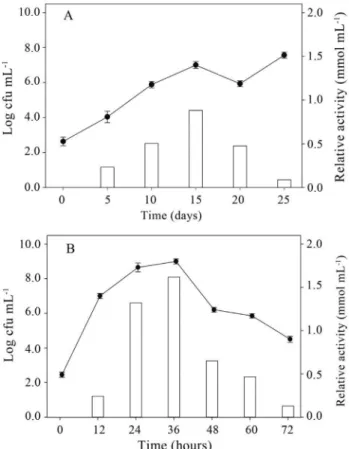
The Mycobacterium growth slowly in the mineral medium and anthracene as only source of carbon and en-ergy (Figure 1A). The growth rate was only 0.0024 h-1and the maximum enzymatic activity (0.88 mM mL-1) was oc-curred after 15 days. To reduce the incubation time, the My-cobacteriumwas cultivated in LB broth with anthracene, which increased the growth rate to 0.0138 h-1and resulted after 36 h of incubation in high cells number and high enzy-matic activity (1.62 mM mL-1), being two-fold higher to that in the mineral medium (Figure 1B).
Effect of pH
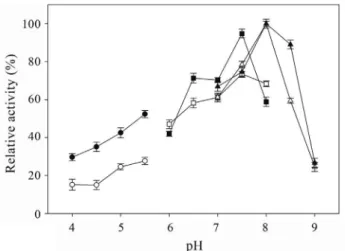
To both cell free extract and immobilized extract the highest C12O enzyme activity was at pH 8.0 (Figure 2). In a range between pH 4.0 and 5.5, the enzyme activity was re-duced, although, the immobilized extract showed two-fold higher than cell free extract, showing that the immobiliza-tion protected the enzyme against the deleterious effects of the low pH. In a range of pH from 6.5 to 7.5, the immobi-lized extract showed the activity 15% higher than cell free extract. This protection also was observed at pH 8.5,
show-Figure 1- Growth profile (lines) and enzyme activity of catechol 1,2-dio-xygenase (bars) of isolateMycobacterium fortuitumgrown for 150 rpm at 30 °C in Tanner mineral medium (A) and in Luria-Bertani broth (B), both containing 250 mg L-1of anthracene (data are mean of three replicates;
ing that this effect is not just restrict to acid pH but also in alkaline pH. However, the activity was substantial reduced at pH 9.0 in the cell free extract as much as in the immobi-lized extract.
Effect of temperature
The cell free extract showed the C12O enzyme rela-tive activity of 16% when incubated at 5 °C (Figure 3). This activity slightly increased until 20 °C, than strongly in-creased until the maximum activity at 25 °C. Above 35 °C, it was drastically reduced the activity achieving values near to zero at temperature 45 °C. Thus, the enzyme activity of the cell free extract was kept above 50% only in a tempera-ture range between 20 and 35 °C. On the other hand, the im-mobilized extract showed zero enzymatic activity in the
temperature range between 5 and 20 °C, than strongly in-creased until maximum activity at 45 °C, 20 °C higher than the greatest temperature in the cell free extract. The immo-bilized extract remained with enzyme activity (above 50%) in a high range of temperature between 35 and 70 °C. How-ever, the extract immobilization promoted a high increase in enzyme activity at temperatures above 35 °C, but re-duced the enzyme activity in temperatures under this value.
Maintenance of activity
The enzyme in the cell free extract showed activity during 70 min (Figure 4). In the first 20 min the C12O en-zyme kept high activity, and then it decreased linearly until 70 min. The C12O enzyme activity in the immobilized ex-tract was detected with more than 90 min, although, it showed a strongly decrease in the enzyme activity in the initial period when compared with cell free extract. Be-tween 20 and 60 min, the activity was near to 50%, than, it decreased until 90 min of incubation. The enzyme immobi-lization increased the enzymatic activity time, where in the last 50 min of incubation, the enzyme activity of the immo-bilized extract showed 24% higher than the cell free extract activity, although, in the first 40 min free extract showed enzymatic activity 24% higher than the immobilized ex-tract.
Effect of the ions
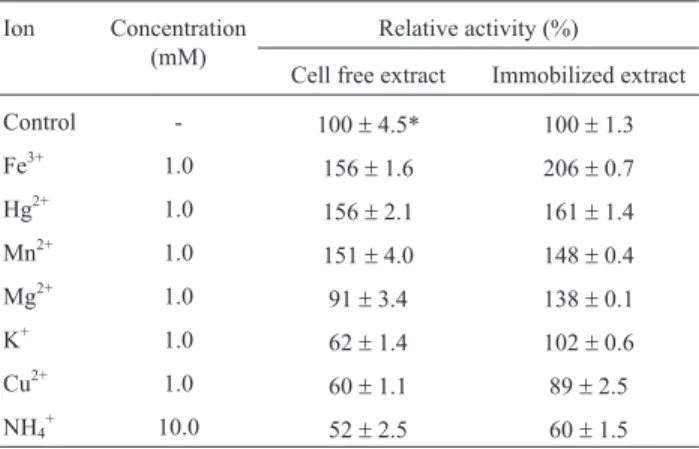
The cell free extract byM. fortuitumshowed C12O activity inhibition by ions presence in the following order: NH4+> Cu2+> K+> Mg2+(Table 1). However, the Mn2+, Fe3+and Hg2+ stimulated the enzyme activity, showing a relative increasing of more than 50%. In the immobilized extract, the C12O enzyme was inhibited only by the copper (11%) and ammonium (40%). The potassium did not affect the reaction; however, the magnesium inhibited the enzyme activity in the cell free extract, and in the immobilized
ex-Figure 2- Effect of pH in the catechol 1,2-dioxygenase activity present in the cell free extract (white symbols) and immobilized extract (black sym-bols) ofMycobacterium fortuitum. Buffers: acetate (pH 4.0 to 5.5 - cycle symbols), phosphate (pH 6.0 to 8.0 - square symbols), and tris-HCl (pH 7.0 to 9.0 - triangle symbols) (data are mean of two replicates; error bars are standard error).
Figure 3- Temperature effect in activity of the catechol 1,2-dioxygenase enzyme in the cell free extract (o) and immobilized extract (•) of Mycobac-terium fortuitum(data are mean of two replicates; error bars represent standard error).
tract was stimulated by this ion with 38% more activity. Fe3+, Hg2+and Mn2+stimulated the enzyme activity of the both cell free and immobilized extract with highlighted ef-ficiency, once, the Fe3+ion showed activity twice higher than others in the immobilized extract.
Discussion
The low growth of theMycobacteriumisolate and the low C12O enzyme activity in the Tanner mineral medium is probably due to carbon limitation to the bacteria. The anthracene has very low solubility in water (0.076 mg L-1), moreover, the carbon transferring rate from the solid phase (anthracene crystals) to the liquid phase (mineral medium) is very low (Johnsenet al., 2005; Wichet al., 2001), which it can limit theMycobacteriumgrowth, and consequently the C12O enzyme activity. However, the source of soluble carbon used in the medium together with the aromatic com-pounds seems that it not affected the C12O enzyme activ-ity. This observation has important biotechnological impli-cations, because it indicates that it is possible to obtain large amounts of cells of Mycobacterium fortuitum and with high activity of C12O from a non expensive culture medium and in a short period of time, since relatively small amounts of aromatic compound were added to the medium.
In a previews study, it was verified that the microbial consortium with the isolatesMycobacterium fortuitum,
Ba-cillus cereus, Microbacterium sp., Gordonia
polyisoprenivorans, they have been degraded 48%, 67%, and 22% of the anthracene, phenanthrene, and pyrene in the mineral medium, respectively, after 30 days of incubation in the soil (Jacqueset al., 2007). In our study, only the iso-lateMycobacterium fortuitumexhibited the pick of the en-zyme activity after 15 days of incubation with 0.9 mmol L-1 of anthracene. It shows the potential use of this kind of bio-technology.
The behavior of the C12O produced by Mycobacte-rium fortuitumin a pH range of 4.0 to 9.0 was similar to that showed by Acinotobacter (Briganti et al., 1997) and
Rhodococcus(Shunkova et al., 2009), which all isolates showed high activity in the pH range between 6.0 and 8.0. The C12O enzyme immobilization with calcium alginate did not modified the optimum pH of enzyme activity (pH 8.0), result also showed by Kalogeriset al.(2006) which immobilized the C12O produced byPseudomonas putida
with calcium alginate. However, the enzyme immobiliza-tion promoted the increase in the activity in a pH range be-tween 4.0 and 8.5, showing that the immobilization with the calcium alginate promoted an microenvironment where the enzyme has a higher activity, because it is partially pro-tected from deleterious effect of the H+and OH- concentra-tion (Matto and Husain, 2009; Quirogaet al., 2011).
The enzyme activity might change with different tem-peratures and some metals soluble in the medium (An-dreazzaet al., 2011). The variation in the C12O activity when changed the temperature occurred in this study was similar to that showed by Kalogeriset al.(19), which the difference of the optimal temperature for C12O activity produced byP. putidabetween the cell free extract and im-mobilized extract was 15 °C. The contrasting behavior of C12O activity in different temperature ranges in cell free and immobilized extract indicates that according to the temperature of the wastewater, there are advantages to use cell free or immobilized extract in the bioremediation treat-ment.
The immobilization can increase molecular stability of the immobilized enzyme, as a result of reduced thermal inactivation (Constantiniet al., 2009; Mateoet al., 2000). Gottschalk and Jaenicke (1991) showed that immobilized enzymes have an increase of the enzyme rigidity, which it is commonly reflected by increasing the stability toward de-naturation. The C12O activity showed higher duration in the immobilized extract than the cell free extract. A com-mon mechanism of a multimeric enzyme (such as most catechol dioxygenases) inactivation is the dissociation of enzyme subunits (Kalogeriset al., 2006). Immobilization of biocatalysts by entrapment in calcium alginate gel beads has been reported to improve significantly enzyme stability (Roy and Gupta, 2004). Under these circumstances, stabili-zation of the quaternary structure of a protein through im-mobilization could promote enzyme stability and improve its activity (Iyer and Ananthanarayan, 2008).
In many proteins, metal ions interactions play catalytic roles; in others, the metals appear to have a purely structural role. The Fe3+was the ion with more stimulation in the activ-ity of the C12O enzyme in the cell free extract and immobi-lized extract. The Fe3+has a catalytic function and also a structural function to enzymes that can cleavage catechol intradiol, which the metal ion withdrawal has influence on the secondary structure of C12O, in particular a reduction of a-helices content (Di Nardoet al., 2004). In relation to the
Table 1- Effect of ions in relative enzymatic activity of catechol 1,2-dio-xygenase present in the cell free extract and immobilized extract of the Mycobacterium fortuitum(the control treatment is the activity in absence of ions).
Ion Concentration (mM)
Relative activity (%)
Cell free extract Immobilized extract
Control - 100±4.5* 100±1.3
Fe3+ 1.0 156±1.6 206±0.7
Hg2+ 1.0
156±2.1 161±1.4
Mn2+ 1.0
151±4.0 148±0.4
Mg2+ 1.0 91±3.4 138±0.1
K+ 1.0 62±1.4 102±0.6
Cu2+ 1.0
60±1.1 89±2.5
NH4+ 10.0 52±2.5 60±1.5
effect of the Mn in the intradiol-cleaving enzymes, Wanget al.(2006) showed that the activity of the C12O produced by
P. aeruginosawas inhibited (only 32% of the relative activ-ity, with 0.5 mM) by the presence of this ion in the mix reac-tion. It was not related that Mn2+promoted the activity of the C12O, although, many enzymes have this ion in their struc-ture and have their catalytic activity depending of Mn+2 (Crowley, 2000). Other wise, the same author have been find 18% of increase in the relative activity with Fe+2ions, and 4% with Mg+2(Wanget al., 2006).
Hg2+was the second ion that promoted the C12O ac-tivity. Some researchers showed that Hg2+ ion decreased the C12O enzyme activity (Matsumuraet al., 2004; Mura-kamiet al., 1998), and in some studies achieved almost 0% of the relative activity in the concentration of the 0.1 mM of Hg+2(Murakamiet al., 1998). In the current study, this ion showed stimulation; however, the stimulation effect by Hg2+ions was observed in other enzymes (Anthony, 1997; Karamitsu, 1968). Cu2+drastically inhibited the C12O en-zyme activity produced byP. putida(Wanget al., 2006),
Geobacillus sp. (Giedraityte and Kalëdienë, 2009) and
Alcaligenes xylosoxidans (Yeom and Yoo, 1999). How-ever, the inhibition was lower than that showed by these au-thors, mainly by the immobilized enzyme. This behavior was observed not only to Cu2+, but also to all ions that showed inhibitory effect in the C12O activity (Mg2+, K+, Cu2+ and NH4+). Krajewska (2004) showed that the ions diffusion through the solid barrier constituted by the sub-strate is low, reducing the inhibitors interference in the im-mobilized enzyme.
The catechol dioxygenases has a fundamental path-way in the carbon biochemical cycle and a high biotechno-logical potential in the treatment of liquid wastes contami-nated with aromatics compounds. Nevertheless, there are few studies with catechol 1,2-dioxygenase from gram-posi-tives and actinobacteria. In this study, it was demonstrated that the immobilization of the C12O enzyme from Myco-bacterium fortuitumwas significantly increased in the cata-lytic activity in the low and high pH conditions, high tem-peratures and in presence of the activity inhibitors. Extreme conditions such as above cited can be in the contaminated wastes, showing that the immobilization with a cheap sub-strate, not toxic and simple manipulation such as calcium alginate can contribute to turn this enzyme an efficient bio-technological alternative to treatment of liquid wastes con-taminated with aromatic compounds.
Acknowledgments
Thanks to CNPq and CAPES by the financial support and scholarships.
References
Andreazza R, Okeke Benedict C, Pieniz P, Brandelli A, Lambais MR, Camargo FAO (2011) Bioreduction of Cu(II) by
cell-free copper reductase from a copper resistantPseudomonas sp. NA. Biol Trace Elem Res 143:1182-1192.
Andreoni V, Gianfreda L (2007) Bioremediation and monitoring of aromatic-polluted habitats. App Microb Biotechnol 76:287-308.
Anthony R (1997) Ashton and Gabriele M. Siegel. Stimulation of spinach (Spinacia oleracea) chloroplast fructose-1,6-bis-phosphatase by mercuric ions. FEBS Lett 408:30-32. Bradford MM (1976) A rapid e sensitive method for the
quan-titation of microgram quantities of protein utilizing the prin-ciple of protein-dye binding. Anal Biochem 72:248-254. Briganti F, Pessione E, Giunta C, Scozzafava A (1997)
Purifica-tion, biochemical properties and substrate specificity of a catechol 1,2-dioxygenase from a phenol degrading Acinetobacter radioresistens. FEBS Lett 416:61-64. Costantini AS, Gorini G, Consonni D, Miligi L, Giovannetti L,
Quinn M (2009) Exposure to benzene and risk of breast can-cer among shoe factory workers in Italy. Tumori 95:8-12. Crowley JD, Traynor DA, Weatherburn DC (2000) Enzymes and
proteins containing manganese: An overview. Met Ions Biol Syst 37:209-278.
Di Nardo G, Tilli S, Pessione E, Cavaletto M, Giunta C, Briganti F (2004) Structural roles of the active site iron(III) ions in catechol 1,2-dioxygenases and differential secondary struc-ture changes in isoenzymes A and B from Acinetobacter radioresistensS13. Arch Biochem Bioph 431:79-87. Durán N, Esposito E (2000) Potencial applicantions of oxidative
enzyme and phenoloxidase-like compounds in wastewater and soil treatment: A review. App Catalysis B 28:83-99. Fernandez-Lafuente R, Guisan, J.M.; Ali, S.; Cowan, D. (2000)
Immobilization of functionally unstable catechol-2,3-dio-xygenase greatly improves operational stability. Enzyme Microb Tech 26:568-573.
Giedraityte G, Kalëdienë L (2009) Catechol 1,2-dioxygenase from a-naphthol degrading thermophilic Geobacillus sp. strain: Purification and properties. Cent Eur J Biol 4:68-73. Gottschalk N, Jaenicke R (1991) Authenticity and Reconstitution of Immobilized Enzymes: Characterization and Denatur-ation/Renaturation of Glucoamylase II. Biotechnol Appl Bioc 14:324-335.
Hegman GD (1966) Synthesis of the enzymes of the mandelate pathway by Pseudomonas putida. J Bacteriol. 91:1140-1154.
Iyer PV, Ananthanarayan L (2008) Enzyme stability and stabiliza-tion - Aqueous and non-aqueous environment. Process Bio-chem 43:1019-1032.
Jacques RJS, Okeke BC, Bento FM, Peralba MCR, Camargo FAO (2007) Characterization of a polycyclic aromatic hydrocar-bon-degrading microbial consortium from a petrochemical sludge landfarming site. Bioremed J 11:1-11.
Jacques RJS, Okeke BC, Bento FM, Teixeira AS, Peralba MC, Camargo FAO (2008) Microbial consortium bioaugmen-tation of a polycyclic aromatic hydrocarbons contaminated soil. Bioresource Technol 99:2637-2643.
Johnsen AR, Wick LY, Harms H (2005) Principles of microbial PAH-degradation in soil. Environ Pollut 133:71-84. Macleod CT, Daugulis AJ (2005) Interfacial effects in a
Kalogeris E, Sanakis Y, Mamma D, Christakopoulos P, Kekos D, Stamatis H (2006) Properties of catechol 1,2-dioxygenase fromPseudomonas putidaimmobilized in calcium alginate hydrogels. Enzyme Microb Tech 39:1113-1121.
Karamitsu HK (1968) Mercury(II) stimulation of malate dehydro-genase activity. The J Biol Chem 243:1016-1021.
Kiyohara H, Nagao K, Yana K (1982) Rapid screen for bacteria degrading water-insoluble, solid hydrocarbons on agar plates. Appl Environ Microbiol 43:454-457.
Krajewska B (2004) Application of chitin and chitosan based ma-terials for enzyme immobilizations: A review. Enzyme Microb Tech 35:126-139.
Mateo C, Palomo JM, Fernandez-Lorente G, Guisan JM, Fernan-dez-Lafuente R (2007) Improvement of enzyme activity, stability and selectivity via immobilization techniques. En-zyme Microb Tech 40:1451-1463.
Mateo C, Abian O, Fernandez-Lafuente R, Guisan JM (2000) In-crease in conformational stability of enzymes immobilized on epoxy-activated supports by favoring additional multi-point covalent attachment. Enzyme Microb Tech 26:509-515.
Matsumura E, Ooi S, Murakami S, Takenaka S, Aoki K (2004) Constitutive synthesis, purification, and characterization of catechol 1,2-dioxygenase from the aniline-assimilating bac-teriumRhodococcussp. AN-22. J Biosci Bioeng 98:71-76.
Matto M, Husain Q (2009) Calcium alginate-starch hybrid sup-port for both surface immobilization and entrapment of bit-ter gourd (Momordica charantia) peroxidase. J Mol Catal. B-Enzym 57:164-170.
Murakami S, Wang CL, Naito A, Shinke R, Aoki K (1998) PuriWcation and characterization of four catechol 1,2-dio-xygenase isozymes from the benzamide-assimilating bacte-rium Arthrobacter species BA-5-17. Microbiol Res 153:163-171.
Quiroga E, Illane S CO, Ochoa NA. Barberis, S. (2011). Perfor-mance improvement ofaraujiain, a cystein phytoprotease, by immobilization within calcium alginate beads. Process Biochem.46:1029-1034.
Roy I, Gupta NM (2004) Hydrolysis of starch by a mixture of glucoamylase and pullulanase entrapped individually in cal-cium alginate beads. Enzyme Microb Technol 34:26-32. Shumkova ES, Solyanikova IP, Plotnikova EG, Golovleva LA
(2009) Phenol degradation byRhodococcus opacusStrain 1G. Appl Biochem Microbiol 45:43-49.
Tsai SC, Li YK (2007) Purification and characterization of a catochel 1,2-dioxygenase from a phenol degradingCandida albicansTL3. Arch Microbiol 187:199-206.
Wang CL, You SL, Wang SL (2006) Purification and character-ization of a novel catechol 1,2-dioxygenase from Pseudo-monas aeruginosa with benzoic acid as a carbon source. Process Biochem 41:1594-1601.
Wick LY, Colangelo T, Harms H (2001) Kinetics of mass trans-fer-limited bacterial grownth on solid PAHs. Environ Sci Tech 35:354-361.
Whiteley CG, Lee JD (2006) Enzyme technology and biological remediation. Enzyme Microb Tech 38:291-316.
Yeom SH, Yoo YJ (1999) Removal of benzene in a hybrid bioreactor. Process Biochem 34:281-88.