Influence of phenolic compounds of Kangra tea [
Camellia sinensis
(L) O Kuntze] on
bacterial pathogens and indigenous bacterial probiotics of Western Himalayas
Aditi Sourabh
1, S.S. Kanwar
1, R.G. Sud
2, Arti Ghabru
2, O.P. Sharma
31
Department of Microbiology, CSK Himachal Pradesh Agricultural University, Palampur, Himachal Pradesh, India.
2
Department of Chemistry and Biochemistry, CSK Himachal Pradesh Agricultural University, Palampur, Himachal Pradesh, India.
3
Biochemistry Laboratory, Indian Veterinary Research Institute, Regional Station Palampur, Himachal Pradesh, India.
Submitted: September 20, 2011; Approved: November 13, 2012.
Abstract
Phenolic compounds of nutraceutical importanceviz.,catechins (C), (-)-epicatechin (EC), (-)-epigal-locatechin (EGC), (-)-epigal(-)-epigal-locatechin-3-gallate (EGCG) and (-)-epicatechin-3-gallate (ECG) were estimated in fresh green tea shoots ofCamellia sinensis(L) O Kuntze cultivar. The total polyphenols and total catechins were in the range of 219.90 to 317.81 and 140.83 to 271.39 g/kg, respectively in monthly samples of tea. The values of C, EC, EGC, EGCG and ECG in tea powders as analyzed through high performance liquid chromatography (HPLC) were in the range of 1.560 to 3.661, 13.338 to 27.766, 26.515 to 39.597, 62.903 to 102.168 and 18.969 to 39.469 mg/g, respectively. Ef-fect of tea extracts and standard flavanols against five pathogenic bacteria viz., Listeria monocytogenes (MTCC-839), Pseudomonas aeruginosa (MTCC-741), Bacillus cereus (MTCC-1272),Staphylococcus aureus(MTCC-96) andEscherichia coli(MTCC-443), and eleven indige-nous potential bacterial probiotics belonging to generaEnterococcus, Bacillus and Lactobacillus spp. obtained from fermented foods of Western Himalayas, was investigated. EGCG, ECG and EGC exhibited antibacterial activity but, C and EC did not show this activity. Tea extracts having high con-centrations of EGCG and ECG were more potent in antibacterial action against bacterial pathogens. Tea extracts and standard flavan-3-ols augmented viability of potential probiotics in an order of EGCG > EGC > ECG > EC > C. Tea extracts and standard flavanols had no antibacterial activity againstEscherichia coli(MTCC-443) but, in combination with probiotic culture supernatants, this activity was seen. The Kangra tea thus, exerts antibacterial effect on bacterial pathogens through EGCG, ECG and EGC constituents while stimulatory effect on growth of indigenous potential probiotics.
Key words:Kangra tea, Western Himalayas, probiotics, catechins, antibacterial activity.
Introduction
Green tea, produced from the leaves of the plant Ca-mellia sinensis, is one of the most popular beverages con-sumed worldwide. It has been reported to be a rich source of dietary flavonoids in human diet (Hollman and Arts, 2000; Sharangi, 2009) and hence regarded as functional food (Wolfram, 2007). Common green tea’s have five
ma-jor flavonoids (flavan-3-ols) which are classified as catechins (C), epigallocatechin-3-gallate (EGCG), (-)-epigallocatechin (EGC), (-)-epicatechin-3-gallate (ECG) and (-)-epicatechin (EC) (Cabrera et al., 2006; Zaveri, 2006). These catechins have been shown to be epimerized to (-)-catechin (c), (-)-gallocatechin (GC), (-)-catechin gal-late (CG), and (-)-gallocatechin galgal-late (GCG), after heat treatment (Ikedaet al., 2005). EGCG accounts for > 50% of
Send correspondence to S.S. Kanwar. Department of Microbiology, CSK Himachal Pradesh Agricultural University, Palampur, 176062 Himachal Pradesh, India. E-mail: [email protected].
the total green tea ingredients, followed by EGC and ECG (Khokharet al., 1997). Tea and some of its polyphenolic and flavanol components have been reported to impart ben-eficial effects such as anticarcinogenic, antimutagenic (Cooperet al., 2005; Chunget al., 2003), preventing car-diovascular (Wolfram, 2007) and neurodegenerative dis-eases (Weinrebet al., 2004), positive effects on bone me-tabolism (Koet al., 2009), antimicrobial (Sajilata et al., 2008; Gordon and Wareham, 2010), anti-oxidant (Zhao, 2003) and hypocholesterolemic effect (Yang and Koo, 1997). (-)-Epigallocatechin gallate and (-) - epicatechin gallate in green tea have been reported to inhibit the growth of Gram-positive and Gram-negative bacteria (Gulatiet al., 2003; Tayloret al., 2005). In addition, green tea extracts are sold at a premium price as health-promoting dietary supple-mentsi.e.nutraceuticals.
Tea [Camellia sinensis(L) O Kuntze] is being grown on the gentle slopes of outer Western Himalayas (elevation 1290 m above mean sea level, latitude 32°27’15.68” N, longitude 76°31’42.26” E) since 1850s. Apart from tea, tra-ditional fermented foods are regularly being consumed by the people of Western Himalayas (Kanwar et al., 2011; Kanwaret al., 2007) and microflora of some of these foods has already been studied (Pathaniaet al., 2010). Eleven po-tential bacterial isolates obtained from these foods have been characterized and studied with respect to their probiotic attributes underin vitro conditions (Sourabh et al., 2010). The lactic acid bacteria (LAB), generally con-sidered as `food grade’ organisms, are mostly acclaimed as the key members of probiotics and are known to be associ-ated with various health promoting traits (Gilliland, 1990).
The interaction studies of probiotics and tea constitu-ents of Western Himalayas are required to be carried out as both are derived from natural products of that area. With this background, the present study was aimed to explore the phytochemicals of nutraceutical significance of Kangra tea [Camellia sinensis(L) O Kuntze] and their interaction with indigenous potential bacterial probiotics obtained from fer-mented foods of Western Himalayas and standard patho-genic bacteria.
Materials and Methods
Sampling
Samples of fresh green tea shoots (two leaves and a bud) were collected from Wah Tea Estate, Rajpura, Palam-pur, Himachal Pradesh, India, at seven days interval during four flush seasons (first flush: April to mid May; second flush: mid May to June; rainy flush or main flush: July to mid September and winter flush: mid September to Octo-ber), in the year 2009. The samples of fresh green tea shoots were always subjected to heat treatment in a microwave oven for three minutes at power 100% (P-HI) in IFB con-vection microwave oven (model: 30SC1, 30 L capacity, microwave 1.4 KW, frequency 2450 MHz), within twenty
minutes of their plucking to inactivate polyphenol oxidase activity and finally dried in a hot air oven maintained at 45±5 °C for 24 h. Inactivation of polyphenol oxidase in tea shoots was done by microwave heat treatment as it has been reported to yield higher levels of total polyphenols com-pared to parching, steaming and oven heating (Gulatiet al., 2003). The dried samples were grounded using MAC Willey Grinder (Arthur H. Thomas Type) to pass through 60 mesh sieve and finally stored in air-tight plastic contain-ers.
Preparation of tea extracts
Dried tea sample (300 mg) was taken in a 250 mL Erlenmeyer conical flask and 100 mL of pre-boiled hot double distilled water was poured into the flask. The flask was covered with aluminum foil and kept in a water bath shaker maintained at 60±5 °C for 20 min. The content of the flask was allowed to cool to room temperature and then filtered through Whatman Grade 1 filter and the final vol-ume was made to 100 mL with double distilled water in a 100 mL volumetric flask.
Estimation of total polyphenols and total catechins
Total polyphenols: Total polyphenols were estimated in freshly prepared tea extracts (Makkar, 2003). Briefly, to 0.025 mL of freshly prepared tea extract, double-distilled water (0.975 mL), 1 N Folin-Ciocalteu’s phenol reagent (0.500 mL) and 20% of sodium carbonate solution (2.500 mL) were added. The contents were mixed thor-oughly by vortexing and incubated at 30 °C for 40 min. Absorbance was recorded at 725 nm with the help of Merck Spectroquant Pharo 100 spectrophotometer. The amount of total polyphenols was calculated by using standard curve prepared with tannic acid.
Total catechins: Total catechins were estimated in freshly prepared tea extracts by standard method (Sun, 1998). Standard curve was prepared by employing 50-250mg concentrations of standard catechins.
Qualitative evaluation of flavan-3-ols
Qualitative evaluation of flavan-3-ols was carried out in monthly pooled tea powders using high performance liq-uid chromatography (HPLC) technique. For this, samples representing a particular month were prepared by pooling equal proportions by weight of weekly samples of dried tea shoots collected in that particular month.
Preparation of tea powders: Tea powders were pre-pared by lyophilizing aqueous extracts of monthly repre-sentative tea samples. For this, 7 g of tea sample was taken in a 250 mL Erlenmeyer conical flask and 100 mL of boil-ing hot water was added. The flask was kept at 50±5 °C for 60 min on water bath shaker (RSB-12 REMI). The content of the flask was allowed to cool at room temperature; fil-tered through muslin cloth, centrifuged at 3000gfor 15 min and finally filtered through Whatman Grade 1 filter paper
to obtain absolutely clear aqueous extract. These extracts were finally dried to powder form with the help of Heto Power Dry LL 3000 freeze dryer. The powders so obtained were immediately transferred into glass tubes fitted with air-tight stoppers and were finally stored in vacuum desic-cator.
High performance liquid chromatography (HPLC): Samples of tea powder were subjected to characterization and quantification of flavan-3-ols profiles by HPLC tech-nique (Zhu and Chen, 1999). WATERS HPLC system with 510 and 515 pumps, Rheodyne injector, Novapak C-18 (4mm, 4.6x 250 mm) column, 490E Multiwavelength de-tector, and Millennium 2010 data manager was employed. Mobile phase constituents used were acetonitrile (ACN), orthophosphoric acid (HPLC grade Merck, Mumbai) and double distilled water. Acetonitrile (ACN) and double dis-tilled water were both acidified with 0.025% H3PO4. Stan-dard solutions (0.5 mg/mL in 2 mL 50% methanol) of each standard flavan-3-ols [(+)-catechin, (-)-epicatechin, (-)-epigallocatechin gallate, (-)-epicatechin gallate and (-)-epigallocatechin] were also used. Sample solutions (10 mg/mL) were prepared by using 0.040 g of tea powder dissolved in 4 mL of double distilled water. An aliquot of 20mL was used for HPLC injection. Concentration of the standard solution injected for analysis was 0.1 mg/mL. The chromatograms were then monitored at 220 nm as standard catechins (SIGMA) and their mixtures showed high resolu-tion of peaks at this particular wavelength in the present solvent system.
Interaction of tea extracts with indigenous potential probiotic bacterial isolates and pathogenic bacteria
Bacterial cultures: Antibacterial activity of aqueous extracts of monthly pooled samples of green tea shoots was evaluated against six pathogenic bacteriaviz., Escherichia coli (MTCC-443), Psuedomonas aeruginosa (MTCC-741), Listeria monocytogenes(MTCC-839), Bacillus ce-reus (MTCC-1272), Staphylococcus aureus (MTCC-96) andStreptococcus mutans(MTCC-890) procured from the Institute of Microbial Technology (IMTECH), Chandigarh, India. Influence of aqueous extracts of green tea shoots was also studied on eleven well characterized potential probiotic bacteria belonging to Enterococcus faecium (AdF1- GU396270; AdF2- GU396271; AdF3- GU396272 and AdF11- GU396279), Bacillus coagulans (AdF4-GU396273),Lactobacillus plantarum(AdF5- GU396274; AdF6- GU396275 and AdF10- GU396278) and Lactobacillus fermentum (AdF7- HQ677597; AdF8-GU396276 and AdF9- GU396277) isolated from fer-mented foods of Western Himalayas (Sourabhet al., 2010).
Agar-well diffusion method for antibacterial activity: The influence of aqueous extracts of monthly pooled sam-ples of green tea shoots and solutions of standard flavan-3-ols, against pathogenic bacteria and probiotic bacteria was evaluated (Todaet al., 1989a). Standard solutions of
flavan-3-ols were prepared by dissolving 2 mg of each in 1 mL of water. For evaluating antibacterial activity, the aqueous extracts of tea samples were prepared using proto-col as described above, however, with a slight modification that 10g of sample was taken for preparation of extract. The extracts/solutions were then filter sterilized and used for determination of effect on pathogenic bacteria and potential probiotic bacteria.
In another experiment, probiotic bacterial isolates were grown anaerobically in MRS broth for 20 h and then centrifuged. A hundred microlitre supernatant of each bac-terium was mixed separately with 100mL of tea extract and standard solutions of flavan-3-ols (2 mg /g in 1 mL of dou-ble-distilled water). Antibacterial activity of 100mL of this mixture on pathogenic bacteria was evaluated by using the same protocol as described above.
Interaction of tea samples with indigenous potential probiotic bacteria: The effect of tea extracts and standard flavan-3-ols on viability of probiotic bacteria was studied by inoculating 106CFU/mL of each probiotic bacteria in MRS broth tubes containing tea extract and different con-centrations of standard flavan-3-ols separately. These tubes were then incubated anaerobically at 37 °C for 24 h in an anaerobic jar system (Hi-Media). After incubation, the number of surviving bacteria in terms of log10CFU/mL was enumerated by standard plate technique on MRS medium. So, 1 mL of culture obtained after incubation was serially diluted in phosphate buffered saline (containing 0.20% of sodium thioglycholate to maintain anaerobic conditions), and then 100mL sample from each dilution was immedi-ately spread plated on MRS medium and incubated anaero-bically at 37 °C for 24 h in an anaerobic jar.
Statistical analysis
Statistical analysis of the data was carried out by us-ing WindoStat software version 8.0. The data were sub-jected to one way Analysis of Variance (ANOVA) at the significance level of 5%. The comparison of mean values was then done with Duncan’s Multiple Range test by using the same software.
Results
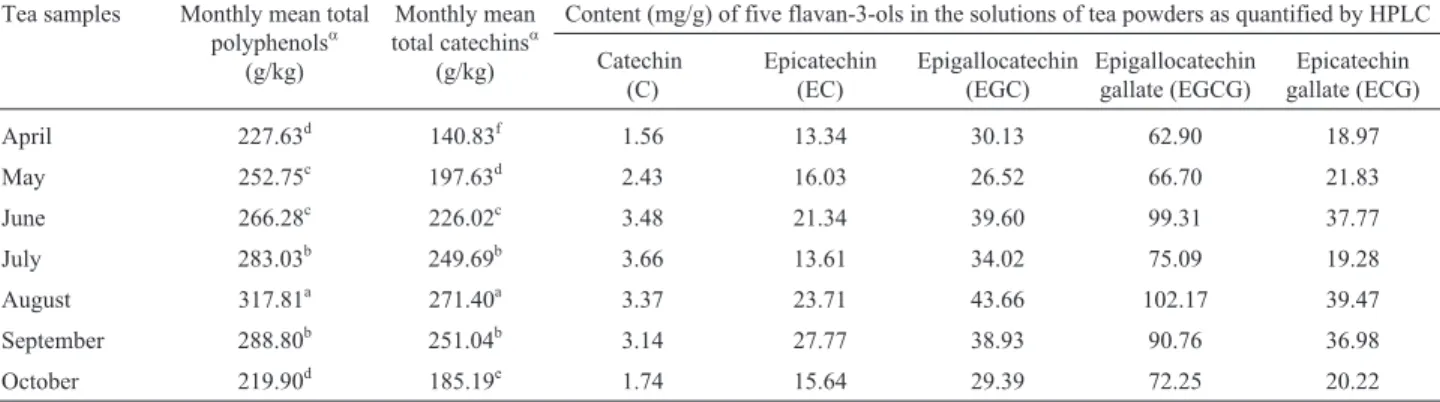
35.80 min, respectively. The content of flavan-3-olsviz.,C, EC, EGC, EGCG and ECG on monthly basis in these tea powders was in the range of 1.56 to 3.66, 13.34 to 27.77, 26.52 to 43.66, 62.90 to 102.17 and 18.97 to 39.47 mg/g, re-spectively (Table 1).
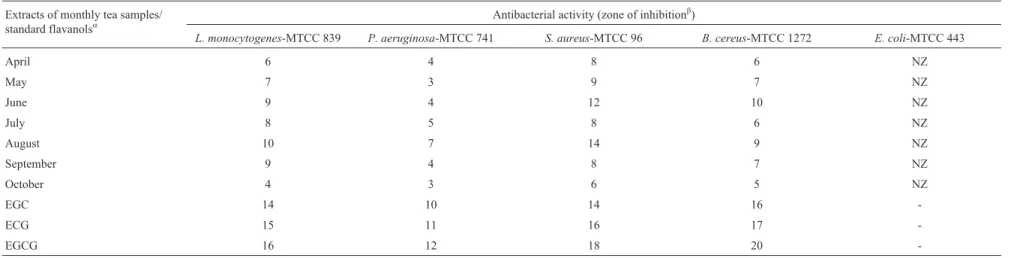
Before evaluating the tea samples for antibacterial ac-tivity, the individual standard catechinsi.e. C, EC, EGC, EGCG and ECG were tested for their antibacterial effect on the selected pathogens. Except catechin and epicatechin, all other standard flavanols showed antibacterial activity against all tested pathogens exceptE. coli. Minimum inhib-itory concentrations (MIC) of EGC, EGCG and ECG forL. monocytogeneswere 550, 275 and 400mg/mL and forP. aeruginosa were 750, 375 and 500 mg/mL, respectively. The minimum inhibitory concentrations (MIC) of EGC, EGCG and ECG forB. cereuswere 375, 50 and 250mg/mL, respectively and forS. aureusandS. mutans,these respec-tive MIC values were 500, 250 and 375mg/mL. Except E and EC, all other standard flavanolsviz.,EGC, EGC and EGCG exhibited antibacterial activity. Standard flavanol solutions showed no antibacterial activity against all the 11 potential probiotic bacteria.
The results of the antibacterial activity of aqueous ex-tracts of tea samples against selected bacterial pathogens are depicted in Tables 2. Among selected pathogenic bacte-ria, Bacillus cereus was the most sensitive and P. aeruginosa was the least sensitive as compared to other bacterial pathogens.Escherichia coliwas resistant to all the samples of fresh green tea shoots and standard flavanol so-lutions. Green tea extracts showed antibacterial activity against pathogenic bacteria but, none of potential probiotic bacteria was affected by these extracts.
Screening for antibacterial activity of combination of indigenous bacterial probiotic and tea extracts (1:1) by well diffusion assay against selected bacterial pathogens was also studied (data not shown). The inhibition noticed at lower dose of green tea extractsi.e.50mL in combination with probiotic supernatant extracts (50mL) was
compara-ble to the inhibition exhibited by 100mL of green tea ex-tracts alone. Tea exex-tracts and standard flavanols showed no antibacterial activity against Escherichia coli (MTCC-443), however, in combination with probiotic culture supernatants, antibacterial activity was recorded with both tea extracts and standard flavanols.
The effect of tea extracts and standard flavan-3-ols on the viability of probiotic bacteria was also determined. In-terestingly, it was found that in the presence of all the stan-dard flavan-3-ols and tea extracts, the viable count of probiotic bacteria increased significantly as compared to control (Table 3). The general trend of increase in viability of probiotic isolates exhibited by standard flavan-3-ols was EGCG > EGC > ECG > EC > C.
Discussion
Fresh tea leaves are rich in flavanols - a group of phe-nolic compounds known as catechins. These catechins are the major class of biologically active ingredients of green tea which account for about 10% of the dry weight of tea (Balentineet al., 1997). Local Kangra tea was evaluated for the presence of these nutraceutical compounds and their in-fluence on indigenous potential bacterial probiotics of Western Himalayas and bacterial pathogens. Considerable variation in the total polyphenols and catechins was seen in monthly tea samples. Information available in the literature suggests that geographical origin, soil composition, differ-ences in the composition of leaves, time of harvesting, postharvest treatments, and physical structure of the differ-ent leaves probably influence the composition of tea (Freidman, 2007). The occurrence of five major flavan-3-ols content in tea samples as determined through HPLC analysis was in the order of EGCG > EGC > ECG > EC > C which corroborate with the observations of other workers reported for tea samples of different regions (Bronner and Beecher, 1998; Karoriet al., 2007).
Beside catechin and epicatechin, all standard flava-nols showed antibacterial activity against tested bacterial
712 Sourabhet al.
Table 1- Total polyphenols, total catechins and five flavan-3-ols contents in monthly samples of fresh green tea. Tea samples Monthly mean total
polyphenolsa (g/kg)
Monthly mean total catechinsa
(g/kg)
Content (mg/g) of five flavan-3-ols in the solutions of tea powders as quantified by HPLC Catechin
(C)
Epicatechin (EC)
Epigallocatechin (EGC)
Epigallocatechin gallate (EGCG)
Epicatechin gallate (ECG)
April 227.63d 140.83f 1.56 13.34 30.13 62.90 18.97
May 252.75c 197.63d 2.43 16.03 26.52 66.70 21.83
June 266.28c 226.02c 3.48 21.34 39.60 99.31 37.77
July 283.03b 249.69b 3.66 13.61 34.02 75.09 19.28
August 317.81a 271.40a 3.37 23.71 43.66 102.17 39.47
September 288.80b 251.04b 3.14 27.77 38.93 90.76 36.98
October 219.90d 185.19e 1.74 15.64 29.39 72.25 20.22
of
phenolic
compounds
on
bacterial
pathogens
713
Table 3- Effect of green tea extracts and standard flavan-3-ols on viability (log10CFU/mL) of indigenous potential probiotic bacteria.
MRS broth+extracts of monthly tea samples/ standard flavanols
log cfu/mL of potential probiotic bacteria
AdF1 AdF2 AdF3 AdF4 AdF5 AdF6 AdF7 AdF8 AdF9 AdF10 AdF11 MTCC 3041
ControlY 7.74 7.66 7.87 7.80 7.55 7.96 7.53 7.83 7.46 7.66 7.85 7.16
April 7.82f 7.73h 8.11d 7.97i 7.62e 8.22g 7.68f 8.01fg 7.59de 7.81d e 8.06f 7.21de
May 7.86e 7.76f g 8.16cd 7.98h i 7.64e 8.31f 7.63g 8.08ef 7.62d 7.83c d 8.10f 7.22de
June 7.95cd 7.78d e 8.20c 8.03g h 7.65e 8.45c 7.69f 8.08ef 7.65c 7.87c 8.18de 7.23de
July 7.96bcd 7.80c d 8.20c 8.07e f 7.74d 8.39d e 7.70f 8.12de 7.67c 7.81d e 8.18de 7.28cd
August 8.12a 7.95b 8.36b 8.23c 7.73d 8.54b 7.88c 8.28b 7.75a 7.96b 8.34c 7.41b
September 7.98bc 7.80c 8.22c 8.09e 7.79c 8.40c d 7.82d e 8.14cde 7.71b 7.83d 8.20d 7.31c
October 7.85e 7.75g h 8.11d 7.95j 7.64e 8.23g 7.69f 7.99g 7.60de 7.82c def 8.07f 7.21de
C 7.86e 7.74g h 8.08d 7.94f 7.74d 8.14h 7.78e 8.01eg 7.67c 7.75f 7.97g 7.23d
EC 7.92d 7.77e f 8.19c 8.05g 7.73d 8.23g 7.85c d 8.15cd 7.75a 7.78ef 8.05f 7.25cd
EGCG 8.15a 8.16a 8.59a 8.43a 8.46a 8.73a 8.28a 8.50a 7.76a 8.16a 8.55b 7.52a
EGC 8.13a 7.94b 8.38b 8.28b 8.13b 8.52b 7.97b 8.30b 7.67c 7.99b 8.37a 7.47ab
ECG 8.01b 7.82c 8.21c 8.18d 7.80c 8.35e f 7.87c 8.21c 7.65c 7.84c d 8.17e 7.27cd
Y
MRS broth containing no added tea extract or standard flavanol but inoculated with different probiotic bacteria. Results are shown as mean of three replications. Mean values of bacterial viability within the same column followed by different superscript letters differ significantly from control when compared by least significant difference (LSD) comparison using one way Analysis of Variance (ANOVA) at the significance level of 5%. C, EC, EGCG, ECG and EGC are standard flavanols.
Extracts of monthly tea samples/ standard flavanolsa
Antibacterial activity (zone of inhibitionb)
L. monocytogenes-MTCC 839 P. aeruginosa-MTCC 741 S. aureus-MTCC 96 B. cereus-MTCC 1272 E. coli-MTCC 443
April 6 4 8 6 NZ
May 7 3 9 7 NZ
June 9 4 12 10 NZ
July 8 5 8 6 NZ
August 10 7 14 9 NZ
September 9 4 8 7 NZ
October 4 3 6 5 NZ
EGC 14 10 14 16
-ECG 15 11 16 17
-EGCG 16 12 18 20
-Results are expressed as mean of three valuesaStandard catechin (C) and epicatechin (EC) showed no inhibition zone against any of the selected pathogenic bacteria;bZone of inhibition is expressed in terms of
pathogens exceptE. coli. Among all the selected patho-gens, B. cereus showed highest sensitivity and P. aeruginosashowed least sensitivity to catechin derivatives and aqueous extracts of tea samples. It has been reported by earlier workers that Gram-positive pathogenic bacteria are more susceptible to tea catechins as compared to the Gram-negative bacteria (Friedmanet al., 2006; Todaet al., 1989b; Todaet al., 1990) probably due to differences in cell wall composition. The various catechin derivatives proba-bly affect the lipid bilayer of cell membrane and finally re-sult in loss of cell structure (Coxet al., 2001). In the present study, standard flavanols with galloyl moiety (EGC, ECG and EGCG) exhibited antibacterial activity whereas those without galloyl moiety (C and EC) did not show this activ-ity. Presence of galloyl group in standard flavanols has been suggested to increase its antibacterial activity (Taguri et al., 2004). This fact is further strengthened by exhibition of high antibacterial activity of tea samples collected in the month of June, July, August and September where galloyl moiety containing flavanols were in higher amount.
One interesting observation that came from this study was that none of the standard flavanol solutions and green tea extracts showed any antibacterial activity against indig-enous potential probiotic bacteria as noticed against patho-genic bacteria. Rather in the presence of tea samples and standard flavanols, a significant increase in viability of probiotic bacteria was observed. The general trend of in-crease in viability of probiotic isolates exhibited by stan-dard flavan-3-ols was EGCG > EGC > ECG > EC > C. From these results it is evident that tea extracts and its flavan-3-ols constituents have positive effect on the growth of indigenous potential probiotic bacteria. Further studies are required to precisely understand the reasons underlying the stimulatory effect on viability of potential probiotic bacteria. In contrary to the present findings, green tea ex-tracts have been reported to exhibit antibacterial activity against probiotic bacteria as well (Suet al., 2008).
Combination of lower dose (50mL) of green tea ex-tracts with probiotic supernatant (50mL) exhibited compa-rable inhibitory activity on pathogenic bacteria, as exhib-ited by double dose (100mL) of green tea extracts. Also, tea extracts and standard flavanols which showed no antibacte-rial activity againstE. coli(MTCC-443), were found to be effective against this pathogen, in combination with biotic culture supernatants. On similar lines, more pro-nounced antibacterial effect of combination of green tea ex-tract and supernatant of probiotic bacteria on Staphylococcus aureus and Streptococcus pyogenes has been reported by other workers (Suet al., 2008). To our knowledge, the antibacterial potential of tea extracts in combination with standard antibiotics on pathogens has been well studied (Tiwariet al., 2005; Shimamuraet al., 2007) whereas, same effect in combination with probiotics is very poorly investigated.
From the present results it can be concluded that the antibacterial potential of aqueous extracts of green tea shoots is mainly due to EGCG, ECG and EGC contents. Samples having high EGCG content exhibit higher antibac-terial activity against pathogenic bacteria. The tested Kan-gra green tea extracts have shown stimulatory effect on viability of indigenous probiotic bacteria. The combina-tions of probiotic bacteria and tea extracts are more effec-tive in exhibiting antibacterial activity. It seems that green tea extracts if taken along with probiotics, may have some positive effect on these bacteria and a negative effect on pathogenic bacteria. Therefore, both can be exploited as components of functional foods to augment their therapeu-tic value but, with the support of properin vivo investiga-tions.
References
Balentine DA, Wiseman SA, Bouwens LC (1997) The chemistry of tea flavonoids. Cri Rev Food Sci Nutr 37:693-704. Bronner WE, Beecher GR (1998) Method for determining the
content of catechins in tea infusions by high performance liquid chromatography. J Chromatogr A 805:137-142. Cabrera C, Artacho R, Gimenez R (2006) Beneficial effects of
green tea - A review. J Am Coll Nutr 25:79-99.
Chung FL, Schwartz J, Herzog CR, Yang YM (2003) Tea and cancer prevention: Studies in animals and humans. J Nutr 133:3268-3274.
Cooper R, Morre DJ, Morre DM (2005) Medicinal benefits of green tea: part II. review of anticancer properties. J Alt Compl Med 11:639-652.
Cox SD, Mann CM, Markham JL (2001) Interactions between components of the essential oil of Melaleuca alternifolia. J Appl Microbiol 91:492-497.
Freidman M (2007) Overview of antibacterial, antitoxin, antiviral, and antifungal activities of tea flavonoids and teas. Mol Nutr Food Res 51:116-134.
Friedman M, Henika PR, Levin CE, Mandrell RE, Kozukue N (2006) Antimicrobial activities of tea catechins and theaflavins and tea extracts against Bacillus cereus. J Food Protect 69:354-361.
Gilliland SE (1990) Health and nutritional benefits from lactic acid bacteria. FEMS Microbiol Rev 87:175-188.
Gordon NC, Wareham DW (2010) Antimicrobial activity of the green tea polyphenol (-)-epigallocatechin-3-gallate (EGCG) against clinical isolates of Stenotrophomonas maltophilia. Int J Antimicrob Agents 36:129-131.
Gulati A, Rawat R, Singh B, Ravidranath SD (2003) Application of microwave energy in the manufacture of en-hanced-quality green tea. J Agri Food Chem 51:4764-4768. Hamilton-Miller JMT (1995) Antimicrobial properties of tea
(Ca-mellia sinensis L.). Antimicrob Agents Chemother 39:2375-2377.
Hollman PCH, Arts ICW (2000) Flavonols, flavones and fla-vanols - nature, occurrence and dietary burden. J Sci Food Agric 80:1081-1093.
Ikeda I, Tsuda K, Suzuki Y, Kobayashi M, Unno T, Tomoyori H, Goto H, Kawata Y, Imaizumi K, Nozawa A, Kakuda T (2005) Tea catechins with a galloyl moiety suppress
prandial hypertriacylglycerolemia by delaying lymphatic transport of dietary fat in rats. J Nutr 135:155-159. Kanwar SS, Gupta MK, Katoch C, Kanwar P (2011) Cereal based
traditional alcoholic beverages of Lahaul and Spiti area of Himachal Pradesh. Indian J Trad Knowl 10:251-257. Kanwar SS, Gupta MK, Katoch C, Kumar R, Kanwar P (2007)
Traditional fermented foods of Lahaul and Spiti area of Himachal Pradesh. Indian J Trad Knowl 6:42-45.
Karori SM, Wachira FN, Wanyoko JK, Ngure RM (2007) Antiox-idant capacity of different types of tea products. Afr J Biotechnol 6:2287-2296.
Khokhar S, Venema D, Hollman PC, Dekker M, Jongen W (1997) A RP-HPLC method for the determination of tea catechins. Cancer Lett 114:171-172.
Ko CH, Lau KM, Choy WY, Leung PC (2009) Effects of tea catechins, epigallocatechin, gallocatechin, and gallo-catechin gallate, on bone metabolism. J Agric Food Chem 57:7293-7297.
Makkar HPS, (2003) Quantification of tannins in tree and shrub foliage- A Laboratory manual. Kluwer Academic Pub-lishers, Sordrecht, Netherlands, pp 43-54.
Pathania N, Kanwar SS, Jhang T, Koundal KR, Sharma TR (2010) Application of different molecular techniques for decipher-ing genetic diversity among yeast isolates of traditional fer-mented food products of Western Himalayas. World J Microbiol Biotechnol 26:1539-1547.
Sajilata MG, Bajaj PR, Singhal RS (2008) Tea polyphenols as nutraceuticals. Comp Rev Food Sci Food Safety 7:229-254. Sharangi AB (2009) Medicinal and therapeutic potentialities of
tea (Camellia sinensis L.) - A review. Food Res Int 42:529-535.
Shimamura T, Zhao WH, Hu ZQ (2007) Mechanism of action and potential for use of tea catechin as an anti-infective agent. Anti-Infect Agents Med Chem 6:57-62.
Sourabh A, Kanwar SS, Sharma PN (2010) Diversity of bacterial probiotics in traditional fermented foods of Western Hima-layas. Int J Probio Prebio 5:193-202.
Su P, Henriksson A, Nilsson C, Mitchell H (2008) Synergistic ef-fect of green tea extract and probiotics on the pathogenic bacteria, Staphylococcus aureus and Streptococcus pyogenes. World J Microbiol Biotechnol 24:1837-1842.
Sun B, Ricardo-da silva JM, Spranger I (1998) Critical factors of vanillin assay for catechins and proanthocyanidins. J Agric Food Chem 46:4267-4274.
Taguri T, Tanaka T, Kouno I (2004) Antimicrobial activity of 10 different plant polyphenols against bacteria causing food-borne disease. Biol Pharm Bull 27:1965-1969.
Taylor PW, Hamilton-Miller JMT, Stapleton PD (2005) Anti-microbial properties of green tea catechins. Food Sci Technol Bull 2:71-81.
Tiwari RP, Bharti SK, Kaur HD, Dikshit RP, Hoondal GS (2005) Synergistic antimicrobial activity of tea & antibiotics. In-dian J Med Res 122:80-84.
Toda M, Okubo S, Hiyoshi R, Shimamura T (1989a) Antibacterial and bactericidal activities of Japanese green tea. Jap J Bac-teriol 44:669-672.
Toda M, Okubo S, Hiyoshi R, Shimamura T (1989b) The bacteri-cidal activity of tea and coffee. Lett Appl Microbiol 8:123-125.
Toda M, Okubo S, Ikigai H, Shimamura T (1990) Antibacterial and anti-hemolysin activities of tea catechins and their struc-tural relatives. Jap J Bacteriol 45:561-566.
Weinreb O, Mandel S, Amit T, Youdim MB (2004) Neurological mechanisms of green tea polyphenols in Alzheimer’s and Parkinson’s diseases. J Nutr Biochem 15:506-516. Wolfram S (2007) Effects of green tea and EGCG on
cardiovascu-lar and metabolic health. J Am Coll Nutr 26:373S-388S. Wu CD, Wei, GX (2002) Tea as a functional food for oral health.
Nutrition18:443-444.
Yang TTC, Koo MWL (1997) Hypocholesterolemic effects of Chinese tea. Pharmacology Res 35:505-12.
Zaveri NT (2006) Green tea and its polyphenolic catechins: Me-dicinal uses in cancer and non cancer applications. Life Sci 78:2073-2080.
Zhao B (2003) Antioxidant effects of green tea polyphenols. Chin Sci Bull 48:315- 319.
Zhu QH, Chen ZY (1999) Isolation and analysis of green tea polyphenols by HPLC. Anal Lab 18:70-72.