ABSTRACT:Objective: To perform a systematic review regarding studies that investigated the association between contextual socioeconomic factors and tooth loss. Methods: MEDLINE, Embase, and LILACS databases were searched and no language or date restrictions were applied for this research. The search was also carried out at the Brazilian Library of Theses and Dissertations (BDTD), with the objective of seeking unpublished studies. We evaluated the bibliographical and methodological characteristics of the studies, as well as the indings. Results: We found 348 articles, out of which only 6 were included in this study after revision by 2 independent researchers. We also identiied an unpublished thesis. In general, these results show that the socioeconomic context interferes in tooth loss. We found an association between the highest number of missing teeth with less favorable contextual variables, despite the weak evidence, due to the fact that all selected studies had a cross-sectional design. Conclusion: We suggest the standardization of outcome formats and exposures in order to favor the comparison between studies and their quantitative analysis.
Keywords: Tooth loss. Socioeconomic factors. Social conditions. Health inequalities. Oral health. Review.
Contextual socioeconomic determinants
of tooth loss in adults and elderly:
a systematic review
Determinantes socioeconômicos contextuais das perdas dentárias
em adultos e idosos: uma revisão sistemática da literatura
Paulo Roberto BarbatoI, Karen Glazer PeresI,II
1Graduate Program in Public Health, Center of Health Sciences, Universidade Federal de Santa Catarina – Florianópolis (SC), Brazil. 2Australian Research Centre for Population Oral Health, Dental School, University of Adelaide – Adelaide, Australia.
Corresponding author: Karen Glazer Peres – Australian Research Centre for Population Oral Health, School of Dentistry, The University of Adelaide, 122, Frome Street, Postal code 5000, Adelaide, Australia. E-mail: [email protected]
Conlict of interests: nothing to declare – Financial support: none.
INTRODUCTION
Tooth loss is caused by the aggravation of some oral conditions. The dental caries, its main cause, afects the adult1,2 and the elderly population3, including root lesions4. Periodontal
disease is also an important cause of tooth loss among elderly men and women1,2,5.
Despite the decreasing prevalence and severity of cavities, in many situations the extraction is still the main alternative of treatment, in extreme cases representing 100% of the procedures ofered by the public network6. Thus, the overtreatment efect7 and the accumulation of
cavities during the life cycle8 may also contribute to the occurrence of tooth loss.
Tooth loss is an outcome resulting directly from oral diseases, for it may also be inluenced by individual social and behavioral factors9, including the use of dental care services10,
habits such as smoking, oral hygiene, inadequate nutrition, as well as psychosocial factors11.
Therefore, tooth loss is a marker of oral conditions, representing a complex interaction between social and biological factors12.
Tooth loss becomes a matter of concern when considering the inequalities in the distribution among the diferent segments of society13. Inequality in oral health is a universal
phenomenon, considering that the highest levels of severity are found in poorer areas, regardless of the development of socioeconomic status14. It is also of great relevance to
understand that the causes of health inequalities are complex and multifactorial, and that the
RESUMO:Objetivo: Realizar revisão sistemática de estudos que investigaram a associação entre os determinantes socioeconômicos contextuais e as perdas dentárias. Métodos: Foram pesquisadas as bases MEDLINE, Embase e LILACS, sem restrição ao tempo de publicação e ao idioma. Também foi realizada busca na Biblioteca Brasileira de Teses e Dissertações (BDTD), com o objetivo de buscar estudos não publicados. Foram avaliadas as características bibliográicas e metodológicas dos estudos, além dos resultados encontrados. Resultados: Foram identiicados 348 artigos. Após avaliação por dois pesquisadores independentes restaram seis artigos incluídos na revisão, além de uma tese com resultados não publicados. Os resultados da revisão indicam que o contexto socioeconômico do local de moradia interfere nas perdas dentárias dos indivíduos, de maneira geral, associando-se ao maior número de dentes perdidos quando as variáveis contextuais são menos favoráveis aos moradores, apesar da fraca evidência, uma vez que todos os estudos selecionados tinham delineamento transversal. Conclusão: Sugere-se a padronização das formas de apresentação do desfecho e exposições, favorecendo a comparação entre os estudos e a análise quantitativa dos mesmos.
efect of the socioeconomic condition is mediated by environmental exposure, psychosocial and behavioral factors and availability of health services15.
As a result, it is necessary to recognize and distinguish which efects on health are a result of where people live in, the so-called contextual efects, and those which are characteristics of individuals living in diferent places, that is, the compositional efects16. The context where people
live in represents much more than just a physical location. It is a result from socioeconomic, cultural and geographic conditions, resulting in risks or beneits to these people’s health. In this logic, the interrelationship between the household and the neighborhood becomes the synthesis of the combination between diferent social, economic, structural, demographic and geographic factors, which may afect the life and health of people17.
Assuming that tooth loss is a relex of socioeconomic inequality, which is very clear in the individual level1,18-24, it is important to know the contextual inluences on this loss,
which has been a theme of studies found in the literature. However, there is no systematic review that provides a qualitative and quantitative synthesis on the subject. The objective of this study was to review the scientiic literature, in order to answer to the question of the research: are the contextual socioeconomic factors associated to dental loss among the adult and elderly population?
METHODS
STUDY DESIGN
It is a systematic review consisting of “a method to locate, evaluate and synthesize the evidence from relevant and valid primary studies in order to obtain safe answers to speciic questions”25.
OUTCOME
In the scientiic literature, we searched for studies presenting partial or total tooth loss as outcomes and approaching the association between these contextual socioeconomic variables.
SEARCH STRATEGY AND SELECTION CRITERIA
According to these criteria, the search key was: ((“adult”[mesh] OR “aged”[mesh]) AND (“residence characteristics”[mesh] OR “neighborhood”[TIAB] OR “environment”[TIAB] OR “contextual”[TIAB] OR “contextual factors”[TIAB]) AND (“tooth loss”[mesh] OR “mouth, edentulous”[mesh] OR “edentulism”[TIAB] OR “edentulousness”[TIAB])). For the advanced search in Embase, search limits were included in the basis itself, once it also performs searches in MEDLINE; in humans and focus ields, restricted to public health, the following format remained: ‘adult’ OR ‘aged’ AND (‘residence characteristics’ OR ‘neighborhood’ OR ‘environment’ OR ‘contextual’ OR ‘contextual factors’) AND (‘tooth loss’ OR ‘mouth, edentulous’ OR ‘edentulism’ OR ‘edentulousness’) AND [public health]/lim AND [human]/lim AND [embase]/lim. For LILACS the search strategy followed the pattern: (“adult” OR “aged” AND “residence characteristics” OR “neighborhood” OR “environment” OR “contextual” OR “contextual factors” AND “tooth loss” OR “mouth, edentulous” OR “edentulism” OR “edentulousness”) AND db:(”LILACS”). There was no restriction of time or language of publication for any of the analyzed bases. After the search, results were stored in the EndNote X5 (Thomson Reuters) software, where a tool to identify Double references was used.
INCLUSION AND EXCLUSION CRITERIA
Inclusion criteria of the studies were: they had to be observational epidemiologic, cross-sectional or longitudinal studies; use the multilevel modeling for data analysis; the researched subjects had to be adults and/or elderly and the study had to approach the relationship between contextual socioeconomic factors and tooth loss. The excluded studies did not use the previewed modeling for data analysis and had dental cavities or DMFT as an outcome.
DATA EXTRACTION AND SYNTHESIS
Data selection was performed by two independent researchers, initially by reading the titles of the studies selected; when the title was not suicient for the inclusion criteria, the abstract was read. The disagreemens in selection was discussed between the researchers, after the full articles were read, and their inclusion or exclusion was deined by consensus.
Additionally, all references of the selected articles were read, in search for possible studies to be included in the review. A search in the Brazilian Library of Theses and Dissertations (BDTD) (http://bdtd.ibct.br) was carried out to ind theses or dissertations whose product had not been published. Using the advanced search tool in the portal, in the subject ‘ield’ the following search criteria was inserted: “perda de dente” OR “tooth loss”.
where we registered: the authors, the institution the irst author was from, the journal that published it, the year of publication, the place and the year of the study. There were also data on the type of study, type of sample, size of the sample, age of the participants, studied outcome, contextual variables, type of statistical analysis, associations found and main conclusions. The information was organized in tables.
From the data extracted, we organized a database with the information, which was analyzed by the software Stata 11.2 (Stata Corp) and presented in frequency and proportion. In a table, we also collected and registered the associations found with the diferent contextual exposures, the association measure, according to the variables selected for each study. The directions of the associations were classiied as positive (when directly proportional) and negative (when inversely proportional). When there was no association, the information was also registered.
EVALUATION OF THE QUALITY OF STUDIES
To verify the quality of the selected studies, the evaluation criteria of Downs and Black26
were used, adapted for cross-sectional studies27, from where the speciic criteria for clinical
trials were extracted, totaling 23 adequacy criteria. Thus, the studies got scores for each criterion, varying from 0 to 1, except for criterion 5, which varied from 0 to 2, with the possibility of receiving the maximum of 24 points.
RESULTS
The search in the databases identiied 348 articles that met the criteria on the search key. There was a consensus between researchers for the exclusion of 340 articles and the inclusion of 5 articles28-32. There was no agreement regarding the inclusion of two articles.
Each research proposed the inclusion of one article, and after the reading of their abstracts and considerations, they decided for the inclusion of a new article33 and consequently
the exclusion of another one34. After the selection by researchers, six articles meeting the
inclusion criteria remained. All references of the articles were veriied in search of possible studies that could be eligible. After the abstracts were read, no other studies were included. Also, a search in the database of theses and dissertations was performed, and a thesis with unpublished results was identiied and included in the review35. The search details are
presented in Figure 1.
Table 2 presents the bibliographic characteristics of the studies. Publications on dental loss and contextual factors in literature are recent (from 2007 onward), considering that 42.8% were published in 2009. As the country of origin of the study, considering the institution the irst author was from, Brazil concentrates most of them (57.1%). The mean of the studied samples was 9,158.1 (SD 8,450.4). Considering the age of the participants, for the 7 studies included in the review, the medians of the minimum and maximum ages were 40 and 44 years of age, respectively.
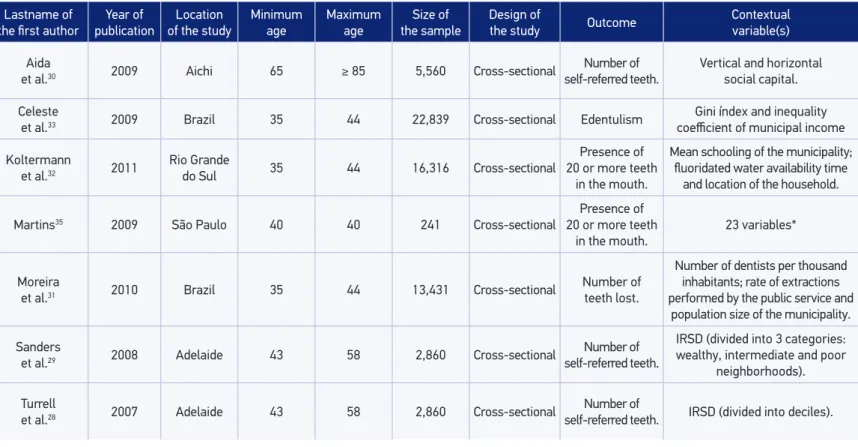
All the studies were cross-sectional and the most common form of outcome presentation was number of teeth reported by the participants. Three studies were populational-based, two for Brazil as a whole and one for the state of Rio Grande do Sul; two others included adults living in Adelaide, Australia. The contextual variables presented great diversity, which were characteristic for each study (Table 3).
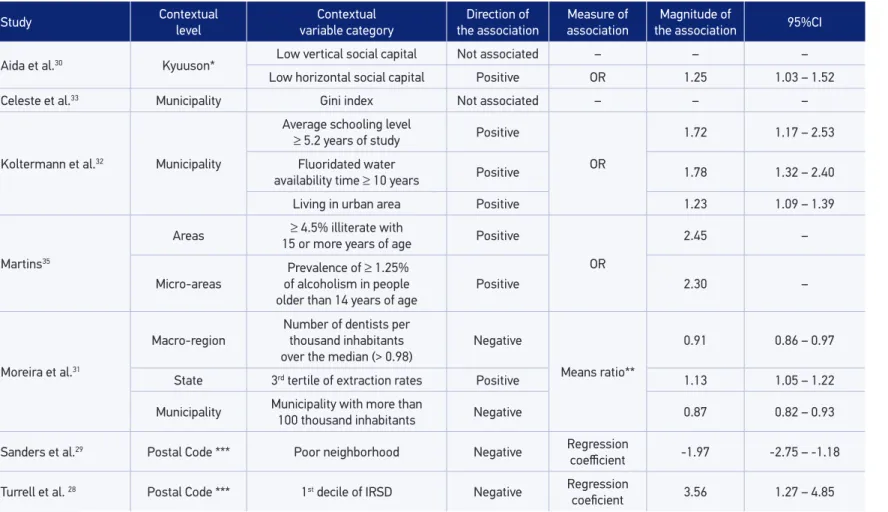
Variations in the contextual level of aggregation of participants were found. With some very speciic characteristics, such as in the study by Aida et al.30, who used their own
spacial unit: the Kyuuson. The studies in Australia28,29 used postal codes as reference for the
neighborhood (Table 4).
Figure 1. Flowchart of study selection.
Analysis of the factors associated with tooth loss among the adults in eastern São Paulo. PhD thesis by Julie Silvia Martins. Dental School. Universidade de São Paulo, 2009.
348 references selected, being: 144 from MEDLINE; 196 from Embase
and 8 from Lilacs
341 references excluded aſter the reading of the titles or abstracts for
not meeting the inclusion criteria
1 duplicate reference removed
7 references included in the review
Reference included in the review aſter the reading of the citations of the previously
Table 1. Proportion of adequacy of the selected study (n = 7) to the quality evaluation criteria, proposed by Downs and Black.
Criterion % of adequacy
Description of the study
Is the hypothesis/objective described with clarity? 100.0 Are the main results to be measured described clearly in the Methods or
Introduction section? 85.7
Well deined inclusion criteria? 71.4
Is the intervention of interest described clearly? 100.0 Are the confounding factors described clearly? 85.7 Are the main conclusions of the study described clearly? 85.7 Does the study provide estimates on the random variability of the data for the main
results? 100.0
Is there description of loss? 71.4
Were the values of real probability reported for the main results? 100.0 External validity
Are the subjects selected for the study representative of the whole population from
which they were selected? 71.4
Are the subjects selected for the study representative of the whole population from
which they were selected? 71.4
Internal validity
Was there an attempt to blind the subjects of the study for the intervention they
have undergone? 100.0
Was there an attempt to blind the evaluators? 100.0 If any of the results of the study was based in “data dredging “, was it clear? 100.0 Was there adjustment for the follow-up time? 100.0 The statistical tests used to evaluate the main results appropriate?
Was the fulilling of the intervention reliable? 85.7 Were the measures used for the main outcomes accurate (valid and reliable)? 85.7 Selection bias
Were the patients from the diferent intervention groups (trials and cohort studies) or the case and control groups (case-control studies) selected in the same
population? 100.0
Were the subjects from the diferent intervention groups (trials and cohort studies) or the case and control groups (case-control studies) selected in the same period
of time? 100.0
Was there appropriate adjustment for the confounding factor in the analysis from
which the main indings were taken? 85.7
Were the losses of patients in follow-up taken into account? 57.1 Power of the study
Table 2. Bibliographic characteristics of the studies included in the review, size of the sample and age of the participants.
Characteristic n %
Year of publication
2007 – 2008 2 28.6
2009 3 42.8
2010 – 2011 2 28.6
Institution of the irst author
Instituto Aggeu Magalhães 1 14.2
Queensland University of Technology 1 14.3
Tohoku University 1 14.3
Universidade Estadual do Rio de Janeiro 1 14.3
Universidade de São Paulo 1 14.3
Universidade do Vale do Rio dos Sinos 1 14.3
University of Michigan 1 14.3
Journal
Acta Odontologica Scandinavica 1 14.3
Cadernos de Saúde Pública 1 14.3
Community Dentistry and Oral Epidemiology 1 14.3
Journal of Dental Research 1 14.3
Social Science & Medicine 2 28.5
Not published 1 14.3
Country of study
Australia 1 14.3
Brazil 4 57.1
United States of America 1 14.3
Japan 1 14.3
Sample size
Minimum – maximum 241 – 22,839
Mean (standard deviation) 9158.1 (8450.4)
Median 5560
Age of the participants
Minimum: mean (Standard deviation) 42.3 (10.6)
Minimum: median 40
Maximum: mean (stanrdar deviation) 53.3 (15.7)*
Maximum: median 44*
*The study by Aida et al.30presents 14 individuals aged 85 years old or older, however without identifying the
Table 3. Characteristics of the study included in the review.
Lastname of
the irst author publicationYear of of the studyLocation Minimum age
Maximum
age
Size of
the sample Design of the study Outcome Contextual variable(s)
Aida
et al.30 2009 Aichi 65 ≥ 85 5,560 Cross-sectional
Number of self-referred teeth.
Vertical and horizontal social capital.
Celeste
et al.33 2009 Brazil 35 44 22,839 Cross-sectional Edentulism
Gini índex and inequality coeicient of municipal income
Koltermann
et al.32 2011
Rio Grande
do Sul 35 44 16,316 Cross-sectional
Presence of 20 or more teeth
in the mouth.
Mean schooling of the municipality; luoridated water availability time
and location of the household.
Martins35 2009 São Paulo 40 40 241 Cross-sectional
Presence of 20 or more teeth
in the mouth.
23 variables*
Moreira
et al.31 2010 Brazil 35 44 13,431 Cross-sectional
Number of
teeth lost.
Number of dentists per thousand inhabitants; rate of extractions performed by the public service and
population size of the municipality.
Sanders
et al.29 2008 Adelaide 43 58 2,860 Cross-sectional
Number of self-referred teeth.
IRSD(divided into 3 categories: wealthy, intermediate and poor
neighborhoods).
Turrell
et al.28 2007 Adelaide 43 58 2,860 Cross-sectional
Number of
self-referred teeth. IRSD (divided into deciles).
Table 4. Characteristics of the contextual level used in the studies associated with tooth loss.
Study Contextual level variable categoryContextual the associationDirection of associationMeasure of the associationMagnitude of 95%CI
Aida et al.30 Kyuuson* Low vertical social capital Not associated – – –
Low horizontal social capital Positive OR 1.25 1.03 – 1.52
Celeste et al.33 Municipality Gini index Not associated – – –
Koltermann et al.32 Municipality
Average schooling level
≥ 5.2 years of study Positive
OR
1.72 1.17 – 2.53
Fluoridated water
availability time ≥ 10 years Positive 1.78 1.32 – 2.40
Living in urban area Positive 1.23 1.09 – 1.39
Martins35
Areas 15 or more years of age≥ 4.5% illiterate with Positive
OR
2.45 –
Micro-areas of alcoholism in people Prevalence of ≥ 1.25% older than 14 years of age
Positive 2.30 –
Moreira et al.31
Macro-region Number of dentists per thousand inhabitants
over the median (> 0.98) Negative
Means ratio**
0.91 0.86 – 0.97
State 3rd tertile of extraction rates Positive 1.13 1.05 – 1.22
Municipality Municipality with more than 100 thousand inhabitants Negative 0.87 0.82 – 0.93
Sanders et al.29 Postal Code *** Poor neighborhood Negative Regression
coeicient -1.97 -2.75 – -1.18
Turrell et al. 28 Postal Code *** 1st decile of IRSD Negative Regression
In general, all studies pointed out the association between worse conditions in the context with higher number of teeth lost, or even with the worst condition, edentulism, conirmed by the direction of outcome associations with the variables of contextual exposure.
DISCUSSION
The results in the review indicate that the socioeconomic outcome of the household may contribute with tooth loss of adults and the elderly, in general, associated to the higher number of teeth lost when contextual variables are less favorable to residents of the location.
The choice of conducting a systematic review on tooth loss and household context resulted in the possibility of accessing, in an orderly and summarized manner, the available evidence. It also constitutes an important tool for public health research36, thus justifying its
use. Another considered aspect was the possibility of identifying the possible generalization of the results between populations or speciic groups37.
Despite the coherence found in the results selected for the review, the quality of the evidence coming from these results is weak, once all studies are cross-sectional, not allowing a temporal evaluation of the sequence regarding how the events in the study occurred. This moderate evidence could be stronger with longitudinal studies presenting association of causes between the socioeconomic characteristics of the household and tooth loss. It is important to consider that the contextual inluence of earlier ages on life38, as well as the
condition of family life39,40, may have an impact on the outcomes of adult life. The possibility
of changing households during their lives, or even changes in the socioeconomic and environmental characteristics of the place itself must be considered41, once all household
contexts are rather sensitive to economic and social policies42. Therefore, the impact of these
situations on the cycle of life could be measured by longitudinal studies.
Studies using fewer variables follow the same premises on multilevel modeling, which is a parsimonious inclusion of variables in the models of analysis, by the need of explanatory hypothesis for each predictive variable, as well as possible cross-level interactions43. In the
study by Martins35 this postulate apparently was not considered, once many variables of
the contextual level seem not to have an explanation. Besides, unlike the remaining studies, the Stepwise Forward Selection Procedure was used with the variables being ordered by statistical signiicance. A theoretical model was not created to deine data entry, considering p-value < 0.20 for the univariate analysis and their inclusion in the inal model.
In general, the associations found between tooth loss and contextual variables, regardless of the aggregation level of the context, maintained the focus when the outcome was more lost teeth or damage. All efect measures were adjusted for potential confounding factors.
Some studies tested cross-sectional interactions. Celeste et al.33 tested the interactions
as the individual one. In a study with the Brazilian population31 the interaction proved that
residents with better socioeconomic conditions living in contexts with worse indicators presented more tooth loss when compared to those with similar socioeconomic conditions, living in places with betters indicators. In another study with the Australian population29,
the interactions point out to the poorer residents in wealthier contexts having fewer lost teeth than their similar ones in poorer contexts.
Even considering the quality of evidence in the studies incorporated in this review, it is noticeable that tooth loss is an indicator of health that is rather sensible to socioeconomic conditions, both individual and contextual ones. It is also worth to mention that the phenomenon occurs regardless of the aggregation level of the contextual information.
Some limitations must be considered for this study. The Brazilian analyses were based on data from the national survey of oral health, from 200331-33 with lack of sample weight;
however, the use of multilevel modeling, when partitioning the variances, minimized this lack. Turrell et al.28 informed a response rate of 69.4%, which may cause bias, afecting the
inference of the results for the population in general. Low response rates were also observed in the studies of Martins35 and Aida et al.30, of 56.8 and 49.9%, respectively, considering that
the irst study also presented bias in the selection of the participants, once they were selected from the records of the Primary Health Care Information System (Sistema de Informação da Atenção Básica – SIAB) in the health units from the researched area. Another aspect that could contribute with selection bias would be possible errors in notifying household addresses. We also have to consider the amplitude of the deinition of contexts, considering that we used large national macro-regions and areas equivalent to contexts that are smaller than neighborhoods, and this makes it diicult to standardize contextual characteristics.
Another limitation was the heterogeneity of variables, both for the characteristics of the context, since there are many ways of approaching socioeconomic status, and in the method used to measure tooth loss: self-reported, teeth counting or use of the functional dentition (more than 20 teeth). Despite being considered a limitation, all forms of tooth loss presented are found in the literature, including the validation of those self-referred ones44-47
and functional dentition9,48-50.
The cross-sectional design also has implications on the results of the review. However, it is important to observe that cross-sectional studies have a simpler design, require shorter execution time and the costs are lower when compared to other designs of epidemiologic studies, which, in some way, would justify their prevalence in the literature researched.
Some positive aspects of the review may be highlighted, such as the search for unpublished references in databases of theses and the selection of studies by two independent researchers, with the objective of minimizing the possible exclusion of relevant analyses. There were no limitations regarding language, as well as time of publication, reducing the possibility of bias.
In order to qualify further studies on the theme of this review, it is suggested that standardization methods be used in the presentation of both the outcome and the exposure variables in the household context, allowing better comparisons between the studies and analyses that allow inference to other populations.
The results of the systematic review indicate that poorer socioeconomic status in the household is positively associated with the higher number of lost teeth by individuals living there. From the characteristics of the studies included in this review, it is important to mention the need for further longitudinal studies with the objective of identifying, in cause-and-efect relationships, if the socioeconomic characteristics of the household location interferes in the pattern of tooth loss, which may subsidize the public policies to modify the life context of the people and, similarly, their oral health conditions.
1. Gilbert GH, Duncan RP, Shelton BJ. Social determinants of tooth loss. Health Serv Res 2003; 38(6 Pt 2): 1843-62. 2. Chrysanthakopoulos NA. Reasons for extraction of
permanent teeth in Greece: a ive-year follow-up study. Int Dent J 2011; 61(1): 19-24.
3. Copeland LB, Krall EA, Brown LJ, Garcia RI, Streckfus CF. Predictors of tooth loss in two US adult populations. J Public Health Dent 2004; 64(1): 31-7.
4. Fure S, Zickert I. Incidence of tooth loss and dental caries in 60-, 70- and 80-year-old Swedish individuals. Community Dent Oral Epidemiol 1997; 25(2): 137-42. 5. Bernabé E, Suominen AL, Nordblad A, Vehkalahti
MM, Hausen H, Knuuttila M, et al. Education level and oral health in Finnish adults: evidence from diferent lifecourse models. J Clin Periodontol 2011; 38(1): 25-32.
6. Narvai PC, Frazão P, Roncalli AG, Antunes JLF. Cárie dentária no Brasil: declínio, polarização, iniqüidade e exclusão social. Rev Panam Salud Publica 2006; 19(6): 385-93.
7. Caldas Junior AF, Silveira RC, Marcenes W. The impact of restorative treatment on tooth loss prevention. Pesqui Odontol Bras 2003; 17(2): 166-70.
8. Broadbent JM, Thomson WM, Poulton R. Progression of dental caries and tooth loss between the third and fourth decades of life: a birth cohort study. Caries Res 2006; 40(6): 459-65.
9. Sanders AE, Lim S, Sohn W. Resilience to urban poverty: theoretical and empirical considerations for population health. Am J Public Health 2008; 98(6): 1101-6.
10. Barbato PR, Muller Nagano HC, Zanchet FN, Boing AF, Peres MA. Tooth loss and associated socioeconomic, demographic, and dental-care factors in Brazilian adults: an analysis of the Brazilian Oral Health Survey, 2002-2003. Cad Saúde Pública 2007; 23(8): 1803-14. 11. Newton JT, Bower EJ. The social determinants of
oral health: new approaches to conceptualizing and researching complex causal networks. Community Dent Oral Epidemiol 2005; 33(1): 25-34.
12. Tu YK, Gilthorpe MS. Commentary: is tooth loss good or bad for general health? Int J Epidemiol 2005; 34(2): 475-6.
13. Williams DM. Reducing inequalities in oral disease. Br Dent J 2011; 210(9): 393.
14. Sisson KL. Theoretical explanations for social inequalities in oral health. Community Dent Oral Epidemiol 2007; 35(2): 81-8.
15. Haugejorden O, Klock KS, Astrøm AN, Skaret E, Trovik TA. Socio-economic inequality in the self-reported number of natural teeth among Norwegian adults – an analytical study. Community Dent Oral Epidemiol 2008; 36(3): 269-78.
16. Diez Roux AV. Investigating neighborhood and area effects on health. Am J Public Health 2001; 91(11): 1783-9.
17. Weden MM, Bird CE, Escarce JJ, Lurie N. Neighborhood archetypes for population health research: is there no place like home? Health Place 2011; 17(1): 289-99. 18. Barbato PR, Peres MA. Tooth loss and associated
factors in adolescents: a Brazilian population-based oral health survey. Rev Saúde Pública 2009; 43(1): 13-25.
19. Esan TA, Olusile AO, Akeredolu PA, Esan AO. Socio-demographic factors and edentulism: the Nigerian experience. BMC Oral Health 2004; 4(1): 3. 20. Cunha-Cruz J, Hujoel PP, Nadanovsky P. Secular
trends in socio-economic disparities in edentulism: USA, 1972-2001. J Dent Res 2007; 86(2) :131-6. 21. Pearce MS, Thomson WM, Walls AW, Steele JG.
Lifecourse socio-economic mobility and oral health in middle age. J Dent Res 2009; 88(10): 938-41. 22. Mundt T, Polzer I, Samietz S, Grabe HJ, Dören M,
Schwarz S, et al. Gender-dependent associations between socioeconomic status and tooth loss in working age people in the Study of Health in Pomerania (SHIP), Germany. Community Dent Oral Epidemiol 2011; 39(5): 398-408.
23. Griin SO, Jones JA, Brunson D, Griin PM, Bailey WD. Burden of oral disease among older adults and implications for public health priorities. Am J Public Health 2012; 102(3): 411-8.
24. Li KY, Wong MC, Lam KF, Schwarz E. Age, period, and cohort analysis of regular dental care behavior and edentulism: a marginal approach. BMC Oral Health 2011; 11(9): 1-14.
25. Marinho VCC, Celeste RK. Revisões sistemáticas da literatura e meta-análise. In: Antunes JLF, Peres MA, editores. Epidemiologia da saúde bucal. 2 ed. São Paulo: Santos; 2013.
26. Downs SH, Black N. The feasibility of creating a checklist for the assessment of the methodological quality both of randomised and non-randomised studies of health care interventions. J Epidemiol Community Health 1998; 52(6): 377-84.
27. Monteiro PO, Victora CG. Rapid growth in infancy and childhood and obesity in later life: a systematic review. Obes Rev 2005; 6(2): 143-54.
28. Turrell G, Sanders AE, Slade GD, Spencer AJ, Marcenes W. The independent contribution of neighborhood disadvantage and individual-level socioeconomic position to self-reported oral health: a multilevel analysis. Community Dent Oral Epidemiol 2007; 35(3): 195-206.
29. Sanders AE, Tur rell G, Slade GD. Affluent neighborhoods reduce excess risk of tooth loss among the poor. J Dent Res 2008; 87(10): 969-73.
30. Aida J, Hanibuchi T, Nakade M, Hirai H, Osaka K, Kondo K. The diferent efects of vertical social capital and horizontal social capital on dental status: a multilevel analysis. Soc Sci Med 2009; 69(4): 512-8.
31. Moreira RS, Nico LS, Barrozo LV, Pereira JC. Tooth loss in Brazilian middle-aged adults: multilevel efects. Acta Odontol Scand 2010; 68(5): 269-77.
32. Koltermann AP, Giordani JM, Pattussi MP. The association between individual and contextual factors and functional dentition status among adults in Rio Grande do Sul State, Brazil: a multilevel study. Cad Saúde Pública 2011; 27(1): 173-82.
33. Celeste RK, Nadanovsky P, Ponce de Leon A, Fritzell J. The individual and contextual pathways between oral health and income inequality in Brazilian adolescents and adults. Soc Sci Med 2009; 69(10): 1468-75. 34. Jimenez M, Dietrich T, Shih MC, Li Y, Joshipura KJ.
Racial/ethnic variations in associations between socioeconomic factors and tooth loss. Community Dent Oral Epidemiol 2009; 37(3): 267-75.
35. Martins JS. Análise dos fatores associados às perdas dentárias em adultos da zona leste do município de São Paulo [Tese de doutorado]. São Paulo: Universidade de São Paulo; 2009.
36. McMichael C, Waters E, Volmink J. Evidence-based public health: what does it ofer developing countries? J Public Health 2005; 27(2): 215-21.
37. Mulrow CD. Rationale for systematic reviews. BMJ 1994; 309(6954): 597-9.
39. Peres KG, Peres MA, Demarco FF, Tarquínio SB, Horta BL, Gigante DP. Oral health studies in the 1982 Pelotas (Brazil) birth cohort: methodology and principal results at 15 and 24 years of age. Cad Saúde Pública 2011; 27(8): 1569-80.
40. Thomson WM, Poulton R, Kruger E, Boyd D. Socio-economic and behavioural risk factors for tooth loss from age 18 to 26 among participants in the Dunedin Multidisciplinary Health and Development Study. Caries Res 2000; 34(5): 361-6.
41. Naess O, Claussen B, Smith GD, Leyland AH. Life course inluence of residential area on cause-speciic mortality. J Epidemiol Community Health 2008; 62(1): 29-34. 42. Diez Roux AV. Neighborhoods and health: where
are we and were do we go from here? Rev Epidemiol Sante Publique 2007; 55(1): 13-21.
43. Kreft IGG, Leeuw J. Introducing multilevel modeling. London: Sage Publications; 1998.
44. Heloë LA. Comparison of dental health data obtained from questionnaires, interviews and clinical examination. Scand J Dent Res 1972; 80(6): 495-9. 45. Unell L, Söderfeldt B, Halling A, Paulander J, Birkhed
D. Oral disease, impairment, and illness: congruence between clinical and questionnaire findings. Acta Odontol Scand 1997; 55(2): 127-32.
46. Gilbert GH, Duncan RP, Kulley AM. Validity of self-reported tooth counts during a telephone screening interview. J Public Health Dent 1997; 57(3): 176-80.
47. Gilbert GH, Chavers LS, Shelton BJ. Comparison of two methods of estimating 48-month tooth loss incidence. J Public Health Dent 2002; 62(3): 163-9.
48. Sanders AE, Slade GD, Turrell G, Spencer AJ, Marcenes W. Does psychological stress mediate social deprivation in tooth loss? J Dent Res 2007; 86(12): 1166-70. 49. Aida J, Kondo K, Yamamoto T, Hirai H, Nakade M,
Osaka K, et al. Oral health and cancer, cardiovascular, and respiratory mortality of Japanese. J Dent Res 2011; 90(9): 1129-35.
50. Hugo FN, Hilgert JB, de Sousa ML, da Silva DD, Pucca Junior GA. Correlates of partial tooth loss and edentulism in the Brazilian elderly. Community Dent Oral Epidemiol 2007; 35(3): 224-32.
Received on: 05/05/2014