Association between depression severity and executive
functioning in late-life depression: a systematic review
Suzana MonteiroI, Bárbara MonteiroI, Maristela CandidaI, Nathalia AdlerI, Carlos CamposI,II, Nuno Barbosa F. RochaII,
Flávia PaesI, Antônio Egidio NardiI, Sergio MachadoI,III
DOI: 10.5935/MedicalExpress.2016.06.01
I Universidade Federal do Rio de Janeiro, Instituto de Psiquiatria, Laboratório de Pânico e Respiração, Rio de Janeiro, RJ, Brasil. II Instituto Politécnico do Porto, Escola Superior de Tecnologia da Saúde, Porto, Portugal
III Universidade Salgado de Oliveira, Programa de Pós-graduação em Ciências da Atividade Física, Laboratório de Neurociência da Atividade Física, Rio de Janeiro, Niterói, Brasil
OBJECTIVE: Late-life depression is an under-diagnosed and under-treated disease that reduces the well-being of older adults. Executive dysfunction is another critical impairment in elderly depressed individuals which further disrupts their everyday functioning. This systematic review aims to analyze the association between executive function and depression severity in elderly individuals diagnosed with major depressive disorder.
METHOD: The studies were retrieved from MEDLINE/PubMed, ISI Web of Knowledge and PsychInfo, after a search strategy combining the terms “depression”, “executive function”, “neuropsychological assessment”, “elderly” and “late life”. Study selection, data collection and quality ratings was performed by two independent raters.
RESULTS: A total of 1,130 articles were found but only 8 studies met the deined eligibility criteria and evaluated the association between depression severity and executive functioning. Six out of 8 studies found an association between depression severity and executive function, with correlations ranging from small to large (r= -0.15 to -0.53). The included reports had several methodological limitations such as selective data reporting, non-comprehensive executive function assessment and not controlling potential biases.
CONCLUSION: Depression severity may be more strongly correlated with a speciic set of executive abilities although it also seems to be a broad-based association with executive functioning as a whole. Future high-quality prospective studies are recommended in order to understand the causal relationship between depression severity and executive functioning taking into account possible mediators such as age-related or neurodegenerative cognitive impairment, educational level and other clinic characteristics (e.g. age of onset, medication).
KEYWORDS: Late-life Depression, Major Depressive Disorder, Executive Function.
Monteiro S, Monteiro B, Candida M, Adler N, Campos C. Rocha NBF, Paes F, Egidio Nardi AE, Machado S. Association between depression severity and executive functioning in late-life depression: a systematic review. MedicalExpress (Sao Paulo, online). 2016;3(6):M160601
Received for Publication on May 06, 2016; First review on May 18, 2016; Accepted for publication on October 21, 2016; Online on November 25, 2016
E-mail: [email protected]
■
INTRODUCTIONLate-life depression is an under-diagnosed and under-treated disease associated to impaired functional status, unwarranted use of health care resources and increased mortality.1,2 Depression rates in elderly subjects vary according to the population, ranging from 9% in community-dwelling elderly to 25% in institutionalized or recently hospitalized individuals.3,4 Late-life depression
is associated with deficits in a wide-range of cognitive
domains including episodic memory, language processing, attention, visual spatial, and executive functioning.5-8
Executive function impairment has been
highlighted as one of the core neurocognitive deficits
in depressed older subjects.9-12 Executive functions
can be defined by abilities that allow individuals to
were also contacted to provide relevant reports. Included reports and previous systematic reviews references were also manually screened for additional relevant studies. Searches were closed on February 10th 2016.
Search
The search was performed combining the following terms: depression, executive function, neuropsychological assessment, elderly, late life.
Selection of studies
Study selection was performed by two independent raters who established consensus regarding study selection. A third rater was also called to address any disagreements between the initial raters. After database searching, the reports were screened based on title and abstract, and were excluded if they did not clearly meet eligibility criteria. Finally, full-text analysis was completed on the remaining
studies in order to assess them based on the defined
eligibility criteria.
Data collection
The following data was extracted from the articles: sample size, participants sociodemographic characteristics (age, gender, and educational level), clinical
information (clinical status, age of first onset, length
of episode, symptom severity, and medication), global cognitive functioning (e.g. Mini-Mental State Examination - MMSE), depression severity scales, neuropsychological instruments used to assess executive functioning,
and main significant findings. These procedures were
performed by two independent investigators, who reached a consensus in case of disagreement. Only articles that used at least one neuropsychological test of executive function and evaluated late life depression severity were selected. Mean weighted averages were also calculated for age, gender, education, MMSE score, age of onset and length of episode, based only on studies which provided clear information regarding these topics.
Risk of bias in studies
For assessing the risk of bias within each included trial we developed the following 5-point quality scale based on the following criteria: 1 point for gold standard diagnosis procedures (e.g. DSM-IV, SCID, ICD, etc); 1 point for complete description of critical clinical information (medication status, age of onset, etc); 1 point for exclusion of major potential cofounders (comorbid mental or neurological disorders, ECT, etc); 1 point for absence of selective reporting; 1 point for comprehensive assessment of executive functioning. The quality scale was completed independently by two raters to ensure reliability of extraction of study characteristics. No discrepancies were found between them.
Over the last decades, several authors have explored the relationship between clinical variables and neurocognitive performance, including the severity of depressive symptoms. Lichtenberg et al.7 found that the severity of depressive symptoms accounted for approximately 8% of cognitive functioning variance in older adults. There have also been reports in adult patients with major depressive disorder (MDD) describing an association between poor executive functioning and severe depressive symptoms.15,16 However,
data regarding the association between cognitive deficits and
depression severity have been quite contradictory, which is most likely explained by several confounding factors such as antidepressant medication, history of electroconvulsive therapy (ECT), education levels, types of neurocognitive tests applied, status of depressed patients, age of onset, among others.
Executive functioning impairment is normally present in elderly patients with depression but there is a need to
further understand how these deficits are related to clinical
outcomes. Thereby, this systematic review aims to analyze the association between executive function and depression severity in elderly individuals diagnosed with MDD.
This review is part of a program17,18 to systematically
review themes of interest to the field of geriatric psychiatry.
■
METHODSEligibility criteria
The present review was performed following the Preferred Reporting Items for Systematic Reviews and Meta-Analyses (PRISMA) recommendations.19 Studies were included if they met the following eligibility criteria: (i) full-text articles in English presenting data from observational (cross-sectional or case–control), longitudinal, retrospective, and prospective studies; (ii) reports describing any kind of association between executive functioning tests scores and depression severity scores (e.g. bivariate correlations, univariate or multivariate regression analyses); (iii) studies including elderly subjects 60 or more years old diagnosed with MDD; (iv) data on standardized neuropsychological measures of executive functioning and validated scales of depressive symptom severity.
Studies were excluded if the sample had other comorbid mental illness or neurological disorders, if the authors did not provide detailed information regarding the statistical procedure applied or did not provide adequate description of the executive functioning assessment procedures.
Sources
■
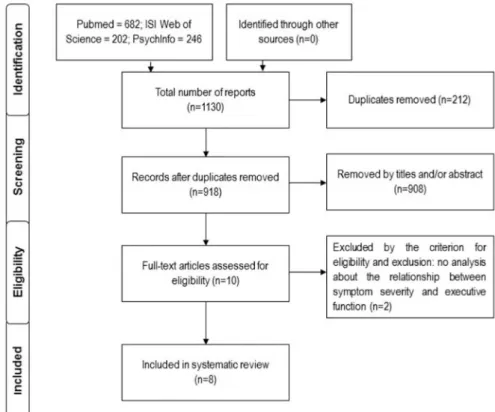
RESULTSBased on the defined strategy, a total of 1,130 articles
were found in the search (682 in Pubmed, 202 in ISI Web of Science, and 246 in PsychInfo); 212 articles were duplicates and 40 articles were not in English language and were therefore excluded, reducing the collection to 918 articles. After the screening, 908 articles were excluded as they were
not related to the defined research question. Ten reports
were screened for full-text and two were excluded as they did not analyze any kind of association between symptom severity and executive functioning, leaving a total of 8 included studies,9,20-26 as illustrated in figure 1.
A summary of the participants’ clinical and sociodemographic characteristics is presented in Tables 1 and 2. Regarding the characteristics of the reviewed studies, participants were mainly outpatients with MDD (n=557; 84.5%). Sexton et al.21 mainly included remitted patients (n=27), although they also included patients with mild and moderate symptoms (n=9). Alexopoulos et al.9 included 43 remitted patients, although 15 had recurrence during the follow-up period. The sample from Jungwirth et al.25 included 13 patients with MDD but the authors performed their analyses using pooled data from patients with subsyndromal (n=9) or minor depressive disorder (n=23). Sample sizes ranged from 21 to 157 participants.
Seven of the studies diagnosed MDD based on the criteria from Diagnostic and Statistical Manual of Mental Disorders, 4th edition (DSM-IV), while only one used DSM-III-R.23 Two studies combined DSM-IV and Research Diagnostic Criteria.9,26 Five of the studies used the Structured Clinical Interview for DSM to determine MDD, while one study opted for the National Institute of Mental Health interview.20 Baudic et al.24 used a non-standardized clinical interview and a cut-off point of the Montgomery and Asberg Depression Rating Scale (MADRS) (>20). Murphy et al.26 used the DSM-IV criteria but assessed included subjects using the Schedule for Affective Disorders and Schizophrenia.
Regarding gender, there was a total of 294 female and 189 male subjects, with a mean proportion of 60,87% of females across studies, although two studies did not report information regarding gender.22,24 Age means ranged from 61.4 to 75.8 years, with an average of 70.6, while education level ranged from 9.6 to 14.9, averaging 13.8 years. Jungwirth et al.25 did not report mean education level but most participants had completed either secondary or vocational school.
Regarding the participants clinical characteristics, the included trials reported several relevant indicators. Only three studies reported mean age of depression onset,21-23 ranging from 45.4 to 54.51, with a 51.38 years average. Only two studies reported data regarding mean
Table 1 - Participants’ sociodemographic and clinical information
Study Sample Population Criteria Diagnos-tic Tool Age
Gender
(F/M) Education MMSE
Age of Onset
Length of
Episode Medication
Alexopoulos
et al.9 43
MDD (remitted)
DSM-IV; RDC
SCID / SADS-L HRDS-24
≥ 18
73.3
(7.6) 27 / 16 13.7 (2.9) 28 (2.7)
67.6% with one
or more previous episode
No info
Maintenance antidepressant
treatment (51.2%) Placebo
(48.8%)
Baudic et
al.24 21
MDD (currently depressed)
DSM-IV
Clinical Interview
MADRS >20
71.8
(8.8) No info 9.6 (3.3) 28.1
(1.4) No info No info Unmedicated
Boone et
al.23 73
MDD (currently depressed)
DSM-III-R SCID 61.4
(8.6) 38/35 14.9 (3.2) No info
47.7 (19.72)
26.3 (37.27)
Unmedicated (≥ 2 weeks)
Jungwirth et al.25 * 45
MDD currently depressed
(n=13) + ssD (n=9) +
mD (n=23)
DSM-IV SCID 75.78 (0.42) 36/9
88.9%
comple-ted se-condary
or vo-cational
school No
info No info No info
Antidepressants (33%)
Benzodiazepi-nes (24.4%)
Murphy et
al.26 157
MDD (currently depressed)
DSM-IV; RDC
SADS HRDS-24
≥ 19
72
(6.9) 93 / 64 13.21 27.61 No info No info No information
Sair et al.20 129
MDD (currently depressed)
DSM-IV
NIMH Diag-nostic Interview Schedule
73.4 76/53 14.2 27.51
# episo-des 5.6 (10.3)
25.2
(29.1) No information
Sexton et
al.21 36
MDD (mainly remitted)
DSM-IV SCID 71.8
(7.7) 24/12 13.9 (3.7) 29.9
(1.4) 45.4 (19) No info
Antidepressants (92%) Unmedicated
(6%) Other
medica-tions (2%)
Sheline et
al.22 155
MDD (currently depressed)
DSM-IV SCID 68.72 (7.28)
No ac-curate info
14.04 (3.12)
≥21 No info on mean
54.51
17.05 No info Unmedicated
MDD: Major Depressive Disorder; DSM: Diagnostic Statistics Manual; RDC: Research Diagnosis Criteria: SCID: Structured Clinical Interview for DSM; HRDS: Hamilton Depression Rating Scale; MADRS: Montgomery and Asberg Depression Rating Scale; ssD: Subsyndromal Depression; mD; Minor Depressive Disorder; NIMH: National Institute of Mental Health. *demographic and clinical data is regarding the pooled sample including MDD, ssD and mD participants
Table 2: Summary of sample characteristics (mean weighted average)
Mean N studies Studies N participants
Age 70.65 8 9, 20-26 659
Gender (% female) 60.87 6 9, 20,21,23,25,26 483
Education (number of schooling years)
13.78 7 9, 20-24,26 614
Mini Mental State Examination 27.86 5 9, 20,21,24,26 386
Age of Onset (years) 51.38 3 21-23 264
■
DISCUSSIONThe aim of this systematic review was to analyze the association between depression severity and executive functioning. Eight studies were included in the analysis and four of them reported statistically significant associations between these two variables. Across the included studies it is possible to identify associations with several depression severity scales, including HRDSD-17 and 24, MADRS and GDS-15. Boone et al.23 found worse executive functioning on moderately depressed subjects (HRDS-17>19) in comparison to
mildly depressed elderly (HRDS≤18). Interestingly,
Baudic et al.24 found several significant correlations with MADRS but did not find any association to the GDS-30 score. When applying MADRS the examiner him/herself evaluates symptom severity, in contrast to GDS-30 which is a self-administered test. Patients may not be able to accurately assess themselves or may underestimate their depressive disorder, which may explain why there were no significant associations.
As most included studies provided cross-sectional data on elderly patients with MDD, one cannot assume a causal relationship between symptom severity and executive functioning. Current neurobiological models of depression postulate that the frontostriatal neural pathways are compromised during depressive episodes, which may possibly explain the relationship between symptom severity and executive impairment.27 Executive functions are heavily dependent on the frontostriatal circuitry28,29 and may be a strong indicator of the degree of frontostriatal compromise.30 Neuroimaging studies
suggest that neuropsychological deficits in depression
may be considered within a framework of frontostriatal
disruption. There is evidence of significantly reduced regional cerebral blood flow in the medial prefrontal cortex
of depressed patients with severe cognitive impairment. Although these circuits seem to play a role on the interaction between depression and executive functioning a question still remains: does impaired executive performance result from frontostriatal abnormalities induced by a depressive state or does a persistent frontostriatal dysfunction which
underlies executive impairment influence the course of
depressive symptoms? To this day, there is not enough evidence to validate the direction of the causal relationship between these constructs.
Two of the included studies used prospective designs
and add interesting findings to this debate.9,26 The
one-year prospective study by Murphy et al.26 also found that improvement in executive function was associated with amelioration of depression, although subjects received uncontrolled treatment according to clinical indication which can act as a potential cofounder. Alexopoulos et al.9 length of illness with values ranging from 25.2 to 26.3
years.20,23 Sair et al.9 also reported a mean of 5.6 MDD episodes within their sample, while Alexopoulos et al.26 noted that 67.6% of the sample had at least one previous episode of MDD.
Regarding pharmacological treatment three studies included only unmedicated patients22-24 and two had no information regarding medication status.20,26 Jungwirth et al.25 included a total of 33.3% of patients on antidepressants,25 while the sample collected by Sexton et al. was mainly on antidepressants (92%).21 In the study by Alexopoulos et al.9 patients completed a continuation (16 weeks) and maintenance nortriptyline treatment during the 2 year prospective study, although 21 patients had placebo during the maintenance treatment.9 Moreover, five studies also reported mean MMSE score, with values ranging from 27.51 to 29.9 and an average score of 27.86.
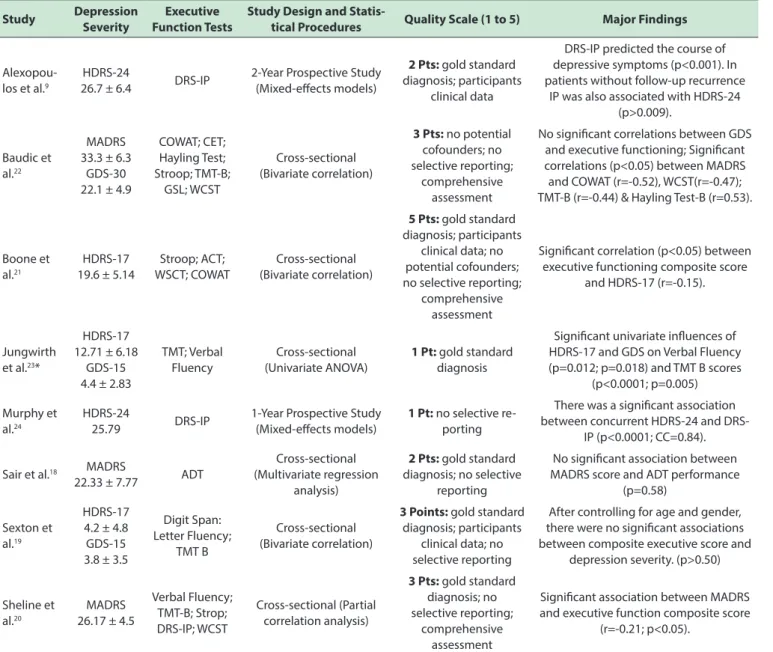
Assessment procedures, methodological
considera-tions and major findings are presented at table 3. Depres
-sion severity was assessed with several different scales including the MADRS, the 17 and 24 item version of the Hamilton Depression Rating Scale (HRDS-17 and HRDS-24) and/or the long and short version of the Geriatric Depres-sion Scale (GDS-30 and GDS-15, respectively). Mean MADRS score ranged from 22.33 to 33.3, HDRS-17 from 4.2 to 19.6, HDRS-24 from 25.79 to 26.7 and GDS-15 from 3.8 to 4.4. Only one study reported data regarding the full version of GDS, with a mean score of 22.1.
Executive functioning assessment encompassed the Trail Making Test B (TMT-B) in half the studies, while three also applied the Wisconsin Card Sorting Test, the Stroop test, Verbal Fluency Tasks and/or the Initiation and Preservation Domain of the Matis Dementia Rating Scale (DRS-IP). Other applied executive functioning tasks included the Controlled Oral Word Association Test (COWAT), the Cognitive Estimates Test (CET), the Hayling Test, the Graphic Sequences of Luria, the Auditory Consonant Trigrams, the Ascending Digits Task and the Digit Span.
Table 3: Methodological Considerations and Major Findings
Study Depression Severity
Executive Function Tests
Study Design and
Statis-tical Procedures Quality Scale (1 to 5) Major Findings
Alexopou-los et al.9
HDRS-24
26.7 ± 6.4 DRS-IP
2-Year Prospective Study (Mixed-efects models)
2 Pts: gold standard diagnosis; participants
clinical data
DRS-IP predicted the course of depressive symptoms (p<0.001). In patients without follow-up recurrence
IP was also associated with HDRS-24 (p>0.009).
Baudic et al.22
MADRS 33.3 ± 6.3
GDS-30 22.1 ± 4.9
COWAT; CET; Hayling Test; Stroop; TMT-B; GSL; WCST Cross-sectional (Bivariate correlation)
3 Pts: no potential cofounders; no selective reporting;
comprehensive assessment
No signiicant correlations between GDS and executive functioning; Signiicant correlations (p<0.05) between MADRS and COWAT (r=-0.52), WCST(r=-0.47); TMT-B (r=-0.44) & Hayling Test-B (r=0.53).
Boone et al.21
HDRS-17 19.6 ± 5.14
Stroop; ACT; WSCT; COWAT
Cross-sectional (Bivariate correlation)
5 Pts: gold standard diagnosis; participants
clinical data; no potential cofounders; no selective reporting;
comprehensive assessment
Signiicant correlation (p<0.05) between executive functioning composite score
and HDRS-17 (r=-0.15).
Jungwirth et al.23*
HDRS-17 12.71 ± 6.18
GDS-15 4.4 ± 2.83
TMT; Verbal Fluency
Cross-sectional (Univariate ANOVA)
1 Pt: gold standard diagnosis
Signiicant univariate inluences of HDRS-17 and GDS on Verbal Fluency (p=0.012; p=0.018) and TMT B scores
(p<0.0001; p=0.005)
Murphy et al.24
HDRS-24
25.79 DRS-IP
1-Year Prospective Study (Mixed-efects models)
1 Pt: no selective re-porting
There was a signiicant association between concurrent H24 and
DRS-IP (p<0.0001; CC=0.84).
Sair et al.18 MADRS
22.33 ± 7.77 ADT
Cross-sectional (Multivariate regression
analysis)
2 Pts: gold standard diagnosis; no selective
reporting
No signiicant association between MADRS score and ADT performance
(p=0.58)
Sexton et al.19
HDRS-17 4.2 ± 4.8 GDS-15 3.8 ± 3.5
Digit Span: Letter Fluency;
TMT B
Cross-sectional (Bivariate correlation)
3 Points: gold standard diagnosis; participants
clinical data; no selective reporting
After controlling for age and gender, there were no signiicant associations between composite executive score and
depression severity. (p>0.50)
Sheline et al.20
MADRS 26.17 ± 4.5
Verbal Fluency; TMT-B; Strop; DRS-IP; WCST
Cross-sectional (Partial correlation analysis)
3 Pts: gold standard diagnosis; no selective reporting;
comprehensive assessment
Signiicant association between MADRS and executive function composite score
(r=-0.21; p<0.05).
HDRS: Hamilton Depression Rating Scale; DRS-IP: Initiation and Preservation Domain of the Mattis Dementia Rating Scale Trail Making; COWAT: Controlled Oral Word Association Test; CET: Cognitive Estimates Test; Stroop: Color-Interference subtest; TMT-B: Trail Making Test B; GSL: Graphic Sequences of Luria; WCST: Wisconsin Card Sorting Test; ACT: Auditory Consonant Trigrams; ADT: Ascending Digits Task; CC: Concordance Correlation
found that initiation and preservation deficits significantly
predicted depressive symptom severity, even in patients that did not relapse during the two years of follow-up. However, this study only followed patients which initially achieved remission after an antidepressant treatment, which does not allow us to understand the proposed association in treatment-resistant patients. There is preliminary evidence about the association of depression severity and executive functioning across time although
the studies have significant biases. Future research should
take into account several factors which can mediate this association. We can even consider that executive impairment may result from the interaction between
There were only two studies which did not find any
association between depression severity and executive functioning score.20,21 Sexton et al.21 found no significant association between composite executive score and depression severity. However, 75% of the sample was composed by remitted patients (mean HRDS-17=4.2; mean GDS-15=3.8). Thereby, and because few patients had active
symptoms, it would have been difficult to find a connection
between depressive severity and executive functioning. However, this study also found impaired executive function in unremitted MDD patients in comparison to healthy controls. It has been reported that elderly depressed
patients with symptom remission show more difficulty in
executive tasks when compared to healthy subjects.32 Thus it seems that executive function does not return to
pre-illness levels after remission and deficits may be augmented
during acute depressive states.
The second study showing no association was developed by Sair et al.20 who found no relationship between ascending digits task performance and depression severity. The task was developed to assess working memory
but this was the first study to use it to evaluate executive
dysfunction in depressed elderly patients. Because the
authors only applied this specific test it seems reasonable to assume they found no significant association. As previously
stated, executive functioning assessment encompasses a wide-range of tests and using only the ascending digits task is a poor approach in comparison to comprehensive evaluation procedures. Furthermore, there are studies that found no relationship between working memory and depression severity.33,34
The positive associations described in the included studies should also be debated taking into account the executive functioning measures computed for analyzes by the authors. As previously described, the included studies used a wide range of tests to assess executive functioning,
making it difficult to objectively compare the reported findings. However, it is interesting to notice that two studies reported small significant correlations between
depression severity and composite executive functioning score,22,23 which can suggest a broad-based association between both domains. In contrast, Baudic et al.24 reported moderate to large positive associations between depression severity and several executive functioning subtest (r=-0.44 to -0.53). Taking these data together, it is reasonable to suggest that depression severity may be more strongly
correlated with a specific set of executive abilities. This can
explain why correlations with composite executive scores
were lower or even non-significant. It is also important to
highlight that the construct of executive function is very wide and encompasses several subdomains.35 Patients with depression may display heterogeneous executive
profiles, being compromised on one aspect of executive
functioning and not on others.36 In our review, three of the
studies did not apply a comprehensive executive functioning
assessment which further limits their findings. Future studies should provide further understanding on specific
executive function measures, exploring constructs such as
cognitive flexibility, inhibitory control, working memory,
planning, problem-solving, etc. Moreover, studies should also concurrently address other neurocognitive domains such as language and memory in order to verify if symptom
severity is specifically associated to executive function or
if other cognitive functions relevant to effective executive performance also play a role.
There are also several sociodemographic and clinical factors such as age of onset and education levels which
can limit the findings reported by the included trials. For
instance, the presence of late-life depression symptoms37
and low levels of education are significant predictors
for development of dementia.38,39 Several of the included studies lack information regarding MMSE and just one of the studies prospectively assures that the included patients did not develop any kind of dementia.25 Education levels were also mainly high in the reported samples, which leaves room to speculate whether depression severity and executive functioning in subjects with lower education years follows a different course.
Pharmacological treatment can also act as a potential cofounder for the results of some of the reported studies.
Out of the four studies which reported a significant
association between depression severity and executive functioning, three included only unmedicated patients; the fourth study only included one third of the patients on antidepressants. Conversely, Sexton et al.21 reported no
significant findings and more than 90% of their patients
were on antidepressants. There is some evidence suggesting that some antidepressive treatments may attenuate cognitive impairment in MDD patients.40 A recent trial by Shilyansky et al.41 suggested otherwise as the authors did not
find any cognitive effects of three distinct antidepressants.
Regardless, when addressing the relationship between symptom severity and cognitive performance researchers should contemplate the role of pharmacological treatment
as it may attenuate depressive state induce deficits. The
history of electroconvulsive therapy is another critical factor that should be contemplated by researchers and it was only assessed by two of the included studies.24 The meta-analysis of Semkovska et al.42 found that electroconvulsive therapy can induce short-term cognitive abnormalities on executive
functioning which return to baseline over the first 3 days
and can even improve beyond baseline levels 15 days after the treatment.
studies should also make efforts to identify potential moderators of this interaction such as age of onset, length of episode, age-related or neurodegenerative cognitive impairment, education level, among others.
■
CONCLUSIONThere is some evidence supporting the relationship between depression severity and executive functioning in late-life depression. This relationship seems to encompass
specific executive domains as well as executive function
as a whole. Cross-sectional evidence suggests small to large correlations between depressive symptoms and executive performance but there is a need to develop more longitudinal trials which can analyze this relationship over time while controlling for critical cofounders such as antidepressant treatment, number of MDD episodes, previous clinical history (age of onset, length of episode, history of ECT), subclinical dementia indicators, among others. Researchers should also make efforts to explore comprehensive executive assessment procedures in order
to pinpoint which cognitive domains specifically relate and
predict depression severity, so that clinicians can develop more accurate evaluation and treatment procedures to address the needs of these patients.
■
CONFLICT OF INTERESTAuthors report no conflict of interest regarding this
study.
■
AUTHOR PARTICIPATIONMonteiro S, Monteiro B, Candida M, Campos C, Paes F and Machado S developed the project, discussed the data,
wrote the first draft of the article, and reviewed its final
form; Adler N, Rocha NBF, Nardi AE, discussed the data and
reviewed the final form of the article.
ASSOCIAÇÃO ENTRE A SEVERIDADE DOS
SINTOMAS DEPRESSIVOS E O FUNCIONAMENTO EXECUTIVO DE IDOSOS COM DEPRESSÃO: UMA REVISÃO SISTEMÁTICA
OBJETIVO: A depressão de início tardio é uma doença subdiagnosticada e subtratada que reduz o bem-estar da pessoa idosa. A disfunção executiva é outra alteração crítica em idosos deprimidos, perturbando ainda mais o seu funcionamento diário. Esta revisão sistemática tem como objetivo analisar a associação entre o funcionamento executivo e a severidade dos sintomas depressivos em idosos diagnosticados com transtorno depressivo major.
MÉTODOS: Foi realizada uma busca nas bases de dados MEDLINE/PubMed, ISI Web of Knowledge e PsychInfo utilizando os termos “depression”, “executive function”, “neuropsychological assessment”, “elderly” e “late
life”. A seleção, classificação dos estudos e coleta de dados
foram realizadas por dois avaliadores independentes.
RESULTADOS: Foram encontrados 1130 artigos, mas apenas 8 estudos preencheram os critérios de elegebilidade. Três avaliaram a associação entre a severidade dos sintomas e o funcionamento executivo. Seis dos 8 estudos encontraram uma associação entre a severidade dos sintomas e o funcionamento executivo, com correlações de diversas magnitudes (r= -0,15 a -0,53). Os artigos incluídos apresentaram várias limitações metodológicas, tais como descrição seletiva de dados, avaliação não compreensiva do funcionamento executivo e falha no controlo de possíveis vieses.
CONCLUSÃO: A severidade dos sintomas depressivos pode ser fortemente correlacionada com um conjunto
específico de habilidades executivas, embora pareça também
existir uma associação mais ampla com o funcionamento executivo como um todo. Recomenda-se a realização de
estudos prospetivos com o fim de compreender a relação
causal entre a severidade dos sintomas depressivos e o funcionamento executivo, tendo em conta possíveis
mediadores tais como défices cognitivos associados ao
envelhecimento ou outros processos neuro-degenerativos, nível de escolaridade e outras características clínicas (idade de início da doença, medicação).
PALAVRAS-CHAVE: depressão de início tardio, depressão geriátrica, transtorno depressivo maior, funcionamento executivo.
■
REFERENCES1. Rogers JC, Holm MB, Raina KD, Dew MA, Shih MM, Begley A, et al. Disability in late-life major depression: patterns of self-reported task abilities, task habits, and observed task performance. Psychiatry Res. 2010;178(3):475-9. http://dx.doi.org/10.1016/j. psychres.2009.11.002.
2. Wilkins CH, Mathews J, Sheline YI. Late life depression with cognitive impairment: evaluation and treatment. Clin Interv Aging. 2009;4:51-7. 3. Teresi J, Abrams R, Holmes D, Ramirez M, Eimicke J. Prevalence
of depression and depression recognition in nursing homes. Soc Psychiatry Psychiatr Epidemiol. 2001;36(12):613-20. http://dx.doi. org/10.1007/s127-001-8202-7
4. Lebowitz BD, Pearson JL, Schneider LS, Reynolds CF, Alexopoulos GS, Bruce ML, et al. Diagnosis and treatment of depression in late life. Consensus statement update. JAMA. 1997;278(14):1186-90. http:// dx.doi.org/10.1001/jama.278.14.1186
5. Lockwood KA, Alexopoulos GS, Kakuma T, Van Gorp WG. Subtypes of cognitive impairment in depressed older adults. Am J Geriatr Psychiatry. 2000;8(3):201-8. http://dx.doi.org/10.1176/appi. ajgp.8.3.201
7. Lichtenberg PA, Ross T, Millis SR, Manning CA. The relationship between depression and cognition in older adults: a cross-validation study. J Gerontol B Psychol Sci Soc Sci. 1995;50(1):P25-P32. http:// dx.doi.org/10.1093/geronb/50B.1.P25
8. Morimoto SS, Alexopoulos GS. Cognitive deficits in geriatric depression:
clinical correlates and implications for current and future treatment. Psychiatr Clin North Am. 2013;36(4):517-31. http://dx.doi. org/10.1016/j.psc.2013.08.002
9. Alexopoulos GS, Meyers BS, Young RC, Kalayam B, Kakuma T, Gabrielle M, et al. Executive dysfunction and long-term outcomes of geriatric depression. Arch Gen Psychiatry. 2000;57(3):285-90. http://dx.doi. org/10.1001/archpsyc.57.3.285
10. Alexopoulos GS. Role of executive function in late-life depression. J Clin Psychiatry. 2003;64 Suppl 14:18-23.
11. Alexopoulos GS, Kiosses DN, Heo M, Murphy CF, Shanmugham B, Gunning-Dixon F. Executive dysfunction and the course of geriatric depression. Biol Psychiatry. 2005;58(3):204-10. http://dx.doi. org/10.1016/j.biopsych.2005.04.024
12. Lockwood KA, Alexopoulos GS, van Gorp WG. Executive dysfunction in geriatric depression. Am J Psychiatry. 2002;159(7):1119-26. http:// dx.doi.org/10.1176/appi.ajp.159.7.1119
13. Alves MR, Yamamoto T, Arias-Carrión O, Rocha NB, Nardi AE, Machado S, et al. Executive function impairments in patients with depression. CNS Neurol Disord Drug Targets. 2014;13(6):1026-40.
14. Pimontel MA, Rindskopf D, Rutherford BR, Brown PJ, Roose SP, Sneed JR. A Meta-Analysis of Executive Dysfunction and Antidepressant Treatment Response in Late-Life Depression. Am J Geriatr Psychiatry. 2016;24(1):31-41. http://dx.doi.org/10.1016/j.jagp.2015.05.010 15. Paelecke-Habermann Y, Pohl J, Leplow B. Attention and executive
functions in remitted major depression patients. J Affect Disord. 2005;89(1-3):125-35. http://dx.doi.org/10.1016/j.jad.2005.09.006
16. Degl’Innocenti A, Agren H, Bäckman L. Executive deficits in major
depression. Acta Psychiatr Scand. 1998;97(3):182-8. DOI: 10.1111/ j.1600-0447.1998.tb09985.x
17. Lattari E, Paes F, Machado A, Rocha NBF, Nardi AE, Machado S. Chronic effects of aerobic exercise on panic disorder: a systematic review of randomized and non-randomized trials. MedicalExpress (São Paulo, online). 2015;2(6)M150602. http://dx.doi.org/10.5935/ MedicalExpress.2015.06.02.
18. Santos LAA, Campos C, Bento T, Lattari E, Nardi AE, Rocha NBF, Machado S. Effects of dual-task interventions on gait performance of patients with Parkinson’s Disease: A systematic review. MedicalExpress (São Paulo, online). 2016;3(4):M160401. http://dx.doi.org/10.5935/ MedicalExpress.2016.04.01
19. Moher D, Liberati A, Tetzlaff J, Altman DG, Group P. Preferred reporting items for systematic reviews and meta-analyses: the PRISMA statement. PLoS Med. 2009;6(7):e1000097. http://dx.doi. org/10.1371/journal.pmed.1000097
20. Sair HI, Welsh-Bohmer KA, Wagner HR, Steffens DC. Ascending digits task as a measure of executive function in geriatric depression. J Neuropsychiatry Clin Neurosci. 2006;18(1):117-20. http://dx.doi. org/10.1176/appi.neuropsych.18.1.117
21. Sexton CE, McDermott L, Kalu UG, Herrmann LL, Bradley KM, Allan CL, et al. Exploring the pattern and neural correlates of neuropsychological impairment in late-life depression. Psychol Med. 2012;42(6):1195-202. http://dx.doi.org/10.1017/S0033291711002352
22. Sheline YI, Barch DM, Garcia K, Gersing K, Pieper C, Welsh-Bohmer K, et al. Cognitive function in late life depression: relationships to depression severity, cerebrovascular risk factors and processing speed. Biol Psychiatry. 2006;60(1):58-65. http://dx.doi.org/10.1016/j. biopsych.2005.09.019
23. Boone KB, Lesser IM, Miller BL, Wohl M, Berman N, Lee A, et al. Cognitive Functioning in Older Depressed Outpatients: Relationships of Presence and Severity of Depression to Neuropsychological Test Scores. Neuropsychology. 1995;9(3):390-8. http://dx.doi.org/10.1037/0894-4105.9.3.390
24. Baudic S, Tzortzis C, Barba GD, Traykov L. Executive deficits in elderly
patients with major unipolar depression. J Geriatr Psychiatry Neurol. 2004;17(4):195-201. http://dx.doi.org/10.1177/0891988704269823
25. Jungwirth S, Zehetmayer S, Hinterberger M, Kudrnovsky-Moser S,
Weissgram S, Tragl KH, et al. The influence of depression on processing
speed and executive function in nondemented subjects aged 75. J Int Neuropsychol Soc. 2011;17(5):822-31. http://dx.doi.org/10.1017/ S135561771100083X
26. Murphy CF, Alexopoulos GS. Longitudinal association of initiation/ perseveration and severity of geriatric depression. Am J Geriatr Psychiatry. 2004;12(1):50-6. http://dx.doi.org/10.1176/appi. ajgp.12.1.50
27. Alexopoulos GS, Kiosses DN, Choi SJ, Murphy CF, Lim KO. Frontal white matter microstructure and treatment response of late-life depression: a preliminary study. Am J Psychiatry. 2002;159(11):1929-32. http:// dx.doi.org/10.1176/appi.ajp.159.11.1929
28. Fuster JM. Network memory. Trends Neurosci. 1997;20(10):451-9. http://dx.doi.org/10.1016/S0166-2236(97)01128-4
29. Petrides M, Pandya DN. Comparative cytoarchitectonic analysis of the human and the macaque ventrolateral prefrontal cortex and corticocortical connection patterns in the monkey. Eur J Neurosci. 2002;16(2):291-310. http://dx.doi.org/10.1046/j.1460-9568.2001.02090.x
30. Chepenik LG, Cornew LA, Farah MJ. The influence of sad mood
on cognition. Emotion. 2007;7(4):802-11. http://dx.doi. org/10.1037/1528-3542.7.4.802
31. Alexopoulos GS, Kiosses DN, Klimstra S, Kalayam B, Bruce ML. Clinical presentation of the “depression-executive dysfunction syndrome” of late life. Am J Geriatr Psychiatry. 2002;10(1):98-106. http://dx.doi. org/10.1176/appi.ajgp.10.1.98
32. Osorio R, de Lózar BG, Ramos I, Agüera L. [Executive function in patients with late onset depression]. Actas Esp Psiquiatr. 2009;37(4):196-9. 33. Harvey PO, Le Bastard G, Pochon JB, Levy R, Allilaire JF, Dubois B, et al.
Executive functions and updating of the contents of working memory in unipolar depression. J Psychiatr Res. 2004;38(6):567-76. http:// dx.doi.org/10.1016/j.jpsychires.2004.03.003
34. Hall JR, O’Bryant SE, Johnson LA, Barber RC. Depressive symptom clusters and neuropsychological performance in mild Alzheimer’s and cognitively normal elderly. Depress Res Treat. 2011;2011:396958. http://dx.doi.org/10.1155/2011/396958
35. Alvarez JA, Emory E. Executive function and the frontal lobes: a meta-analytic review. Neuropsychol Rev. 2006;16(1):17-42. http://dx.doi. org/10.1007/s11065-006-9002-x
36. Snyder HR. Major depressive disorder is associated with broad impairments on neuropsychological measures of executive function: a meta-analysis and review. Psychol Bull. 2013;139(1):81-132. http:// dx.doi.org/10.1037/a0028727
37. Diniz BS, Butters MA, Albert SM, Dew MA, Reynolds CF. Late-life depression and risk of vascular dementia and Alzheimer’s disease: systematic review and meta-analysis of community-based cohort studies. Br J Psychiatry. 2013;202(5):329-35. http://dx.doi. org/10.1192/bjp.bp.112.118307
38. Sharp ES, Gatz M. Relationship between education and dementia: an updated systematic review. Alzheimer Dis Assoc Disord. 2011;25(4):289-304. http://dx.doi.org/10.1097/WAD.0b013e318211c83c
39. Letenneur L, Gilleron V, Commenges D, Helmer C, Orgogozo JM, Dartigues JF. Are sex and educational level independent predictors of dementia and Alzheimer’s disease? Incidence data from the PAQUID project. J Neurol Neurosurg Psychiatry. 1999;66(2):177-83. http:// dx.doi.org/10.1136/jnnp.66.2.177
40. Papakostas GI. Antidepressants and their effect on cognition in major depressive disorder. J Clin Psychiatry. 2015;76(8):e1046. http://dx.doi. org/10.4088/JCP.13086tx5c.
41. Shilyansky C, Williams LM, Gyurak A, Harris A, Usherwood T, Etkin A. Effect of antidepressant treatment on cognitive impairments associated with depression: a randomised longitudinal study. Lancet Psychiatry. 2016;3(5):425-35. http://dx.doi.org/10.1016/S2215-0366(16)00012-2