Guimarães AGDP, Araujo JR, Andrade RV, Costa CM, Galvão RS, Hada AL, Ferreira LCL. Coinfection of Epstein-Barr virus, cytomegalovirus, herpes simplex virus, human papillomavirus and anal intraepithelial neoplasia in HIV patients in Amazon, Brazil. J Coloproct, 2012;32(1): 18-25.
AbstrACt: Objective: The prevention of anal cancer is a goal of worldwide Aids support centers. Despite the efforts that have been
made and progress in the antiretroviral therapy, effective disease control remains elusive. Dificulty in preventing anal cancer may result
from the ineffectiveness of highly active antiretroviral therapy on the human papillomavirus (HPV) since the coinfection with HIV and HPV appears to increase the risk of HPV-infected cells, becoming cancerous. Methods: We evaluated 69 HIV-positive and 30 HIV-neg-ative male patients who underwent cytological evaluation by RT-PCR for the presence of HPV, Epstein-Barr virus, cytomegalovirus and herpes virus types (HSV) 1 and 2, and histopathology analysis of the anal canal. results: The prevalence of anal intraepithelial neoplasia was 35% and it was restricted to HIV-positive patients. Patients infected with high-risk HPV and with fewer than 50 TCD4 cells/μL showed an anal intraepithelial neoplasia rate of 85.7% compared to those with TCD4 cells >200 cells/μL (p<0.01). The rate of viral coinfection was 16.9% of the sexual transmitted diseases cases and it was correlated with HIV-1 viral load of more than 10.001 copies/mL (p=0.017). The rate of AIN in coinfected patients was 36.4% (p=0.047). Conclusions: In this study, at the main institution for the treatment of HIV/ AIDS in the Amazon region of Brazil, anal coinfection with HPV, cytomegalovirus, HSV-1, HSV-2 and Epstein-Barr virus occurred only
in HIV-positive patients and it was directly inluenced by the viral load of HIV-1. In this study, anal viral coinfection showed no additional
risk for the development of anal intraepithelial neoplasia.
Keywords: sexually transmitted disease; anal coinfection; human papillomavirus; Epstein-Barr virus; cytomegalovirus; herpes simplex virus; anal intraepithelial neoplasia; anal cancer.
resuMO: Objetivo: A prevenção do câncer anal tem sido aplicada pelos centros de apoio a pacientes com Aids em todo o mundo.
Ape-sar dos esforços empregados, o eicaz controle da doença permanece distante. A diiculdade na prevenção do câncer anal pode resultar, em parte, da ineicácia da ação da terapia antirretroviral sobre o papilomavírus humano (HPV), pois a coinfecção com HIV e HPV parece
aumentar o risco das células infectadas pelo HPV em tornarem-se cancerosas. Métodos: Foram avaliados 69 HIV-positivos e 30 pacientes HIV-negativos do sexo masculino, que foram submetidos à avaliação citológica anal por real time-PCR para a presença de HPV, vírus Epstein-Barr, citomegalovírus e herpes vírus tipos (HSV) 1 e 2 além da análise histopatológica de fragmento de mucosa do canal anal.
resultados: A prevalência de neoplasia intraepitelial anal foi de 35% e foi restrita a pacientes HIV-positivos. Os pacientes infectados com
Coinfection of epstein-barr virus, cytomegalovirus, herpes simplex
virus, human papillomavirus and anal intraepithelial neoplasia in
HIV patients in Amazon, brazil
Adriana Gonçalves Daumas Pinheiro Guimarães1, José Ribamar de Araujo2,
Rosilene Viana de Andrade3, Carolina Marinho da Costa4, Renata da Silva Galvão4,
Aline Lury Hada5, Luiz Carlos de Lima Ferreira6
1PhD; Adjunct Professor at the Universidade Federal do Amazonas, Department of Surgery – Manaus (AM),
Brazil. 2MsC; Laboratory Manager of the Pathological Anatomy of Fundação de Medicina Tropical Dr. Heitor
Vieira Dourado – Manaus (AM), Brazil. 3MsC; Pathologist of the Pathological Anatomy Laboratory of Fundação
de Medicina Tropical Dr. Heitor Vieira Dourado – Manaus (AM), Brazil. 4Postgraduate students of Fundação de
Medicina Tropical Dr. Heitor Vieira Dourado – Manaus (AM), Brazil. 5Graduate Medical Student at Universidade
do Amazonas – Manaus (AM), Brazil. 6PhD; Associate professor at Universidade Federal do Amazonas and the
Laboratory of Fundação de Medicina Tropical Dr. Heitor Vieira Dourado – Manaus (AM), Brazil.
Financing source: FAPEAM-PPSUS. Conlict of interest: nothing to declare.
INtrODuCtION
The human papillomavirus (HPV) is the most prevalent sexually transmitted disease (STD) of the perianal region1,2, and it is associated with a
broad spectrum of benign and malignant lesions3.
In HIV-positive men, who have sexual relations with men, there is frequent association between multiple HPV types3, increasing the risk of anal
intraepithelial neoplasia (AIN) and anal cancer by at least 60.1 times4.
Among immunosuppressed patients, cytomega-lovirus (CMV) has been established as a cause of ano-rectal disorders5, ulcers, vesicles and perianal warts,
which are often associated with herpes simplex vi-rus6. Coinfection by multiple pathogens is not
uncom-mon auncom-mong immunocompromised patients. Davis and Goldstone7 described 86% of STD in patients with
proctitis, and three cases of multiple infections. The association between viral and bacterial coinfections has also been described8.
The presence of coinfections appears to increase the risk of HPV-infected cells progressing to malig-nancy. These pathogens act synergistically to induce anogenital epithelial lesions, particularly in HIV-posi-tive patients9. The Epstein-Barr virus (EBV) infection
has also been studied in genital warts and perianal in-traepithelial lesions for which the role of synergism in the etiology of cancer has also suggested10,11.
Developing a more detailed understanding of the relationship between viral coinfections and the devel-opment of anal cancer, particularly in HIV-positive patients, is of critical importance. This study aims to assess the prevalence of viral coinfection with AIN in the main institution for the treatment of HIV/AIDS in the Amazon region of Brazil.
MetHODs
Ninety-nine male patients were evaluated from July, 2010 to June, 2011. Sixty-nine patients were HIV-positive and 30 were HIV-negative, who had no known risk factors for anal cancer. This study received authorization from the Research Ethics Committee. Volunteer patients, who met the eligibility criteria, were submitted to the collection of cytological material for the detection of EBV, HPV, CMV, HSV-1 and HSV-2 as well as anal in-spection, digital rectal examination, anoscopy
mag-niication imaging, and biopsies of the suspected ar -eas. If there were no injuries or clinical suspicion, a biopsy was performed at the three o’clock position along the dentate line.
Hybrid capture was used to detect the main types of HPV with either low or high oncogenic po-tential12. The samples were processed according to
the manufacturer’s recommended protocols. Levels of HPV 16 ≥1 pg/mL relative lights unit (RLU) were designated as positive.
Molecular diagnoses of HSV-1, HSV-2, CMV and EBV were performed by real-time PCR (RT-PCR) using the 7500 Fast Real-Time PCR System, manufac-tured by Applied Biosystems. The samples were ex-tracted with a QIAamp DNA Mini Kit according to the manufacturer’s instructions. H1P32/H1M32, H2M40/ H2P4, HSV-GF/CMV-R and HSV-GF/EBV-R prim-ers were purchased from Invitrogen Life Technologies
with Maxima® SYBR Green/ROX qPCR Master Mix
(2X). The cycling conditions were 50°C for two min-utes, 95°C for ten minmin-utes, 40 cycles at 95°C for 30 seconds and 60°C for one minute13.
In this study, to calculate rates of coinfection ano-rectal, isolated HPV-HIV infection was not considered.
o HPV de alto risco e com contagem inferior a 50 células TCD4/μL mostraram taxa de neoplasia intraepitelial anal de 85,7%. A diferença
foi signiicativa quando comparado a pacientes com células TCD4 >200 células/μL (p<0,01). A taxa de coinfecção viral foi de 16,9% dos
casos de doenças sexualmente transmissíveis e diretamente correlacionada à carga viral HIV-1 superior a 10,001 cópias/mL (p=0,017). A
taxa de neoplasia intraepitelial anal em pacientes coinfectados foi de 36,4% (p=0,047). Conclusões: Neste estudo, realizado na principal
instituição para o tratamento de HIV/Aids na região amazônica do Brasil, a coinfecção anal com HPV, citomegalovírus, HSV-1, HSV-2 e vírus Epstein-Barr ocorreu somente em pacientes HIV-positivos e foi inluenciada pela carga viral do HIV-1. Neste estudo, a coinfecção
viral anal não representou risco adicional ao desenvolvimento da neoplasia intraepitelial anal.
Palavras-chave: doenças sexualmente transmissíveis; coinfecção anal; papilomavírus humano; Epstein-Barr vírus; citomegalovírus;
resuLts
Overview
In this study, the mean age of HIV-positive patients was 34.3 years-old; the mean age in the Control Group (HIV-negative) was 47.4 years-old (p<0.001). The av-erage duration of HIV infection was 44 months, and the average under treatment with highly active antiretrovi-ral therapy (HAART) was 34 months. The prevalence of AIN in HIV-positive patients was 35%, and AIN was absent in the Control Group (p<0.001) as determined by histopathological analysis. 45.8% (n=11/24) of patients presented with low-grade AIN (AIN I), and 54.2% of the patients presented with high-grade AIN (AIN II/III), with p<0.001, (data are not shown).
the impact of stDs
Patients were evaluated for the presence of a STD, either alone (n=65) or in the form of coinfec-tion (n=11). Twenty-three patients, all HIV-negative, did not show any STD. The rates of STD infections were as follows: low-risk HPV, 73.8% (n=48); high-risk HPV, 90.8% (n=59); HSV-1, 7.7% (n=5); HSV-2,
16.9% (n=11); EBV, 7.7% (n=5); CMV, 1.5% (n=1) –data not shown. Of the patients with at least one type of STD, 57 out of 65 were HIV-positive (p<0.01). The
term ‘HPV total’ was deined as an infection with ei -ther high or low oncogenic potential HPV, which oc-curred in 60.6% (n=60) considering all patients and in 81.2% (n=56) of HIV-positive patients (RR=26.6; p<0.001). Similar results were found in the analysis of HPV oncogenic risk (OR=29.5 and 26.2 for the occur-rence of HPV infection, high and low risk in HIV-pos-itive patients, respectively, n=97; p<0.001, Fisher’s exact test) – data not shown.
the prevalence of AIN in HPV infected patients
Patients were evaluated to assess the inluence
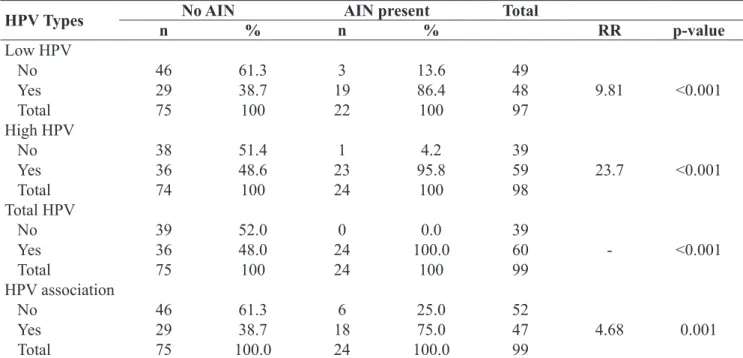
of HPV infection on the occurrence of AIN. It was found that 86.4% (19/22) of patients diagnosed with AIN were infected with low-risk HPV (OR=9.81; p<0.001), and 95.8% were infected with high-risk HPV (OR=23.7; p<0.001), as in Table 1. Patients without HPV infection were not present with AIN (n=39), as seen in Table 2; all patients with severe AIN
HPV types No AIN AIN present total
n % n % rr p-value
Low HPV
No 46 61.3 3 13.6 49
Yes 29 38.7 19 86.4 48 9.81 <0.001
Total 75 100 22 100 97
High HPV
No 38 51.4 1 4.2 39
Yes 36 48.6 23 95.8 59 23.7 <0.001
Total 74 100 24 100 98
Total HPV
No 39 52.0 0 0.0 39
Yes 36 48.0 24 100.0 60 - <0.001
Total 75 100 24 100 99
HPV association
No 46 61.3 6 25.0 52
Yes 29 38.7 18 75.0 47 4.68 0.001
Total 75 100.0 24 100.0 99
Table 1. The association of AIN with oncogenic HPV.
(n=13) were infected with high-risk HPV, and the rate of association between high- and low-risk HPV was 83.3% (p<0.001 for all analyses in Table 1). To assess the potential for a single infection with low-risk HPV to cause AIN, 39 patients with AIN, who were found to be negative for high-risk HPV, were analyzed; and only one of these patients was positive for low-risk HPV and was infected with low-grade squamous in-traepithelial lesion – LSIL (data not shown).
Patients with severe AIN (n=13) began the study presenting a median duration of HIV-1 infection of 54 months (with a range of 3 to 144 months); 76.9% of the patients (n=10) were using HAART and showed a
sig-niicant increase in the average duration of HAART use compared to patients with normal histology or inlam -matory or mild AIN (p=0.041), as seen in Table 2.
The inluence of HIV-1 viral load and TCD4 cell concentration
Patients infected with HPV had a signiicantly
higher viral load of HIV-1 than those not infected (41,540 and 17,693 copies/μL, respectively; p=0.03)
(data not shown). We also evaluated the potential of CD4 + T cells of causing AIN in patients infected with HPV-H. In this analysis, patients infected with high-risk HPV with TCD4 cell concentrations of <50 cells/μL presented AIN at a rate of 85.7% (n=6), as follows: four cases of AIN III and two of AIN I. Of the patients with high-risk HPV infection and levels of TCD4 cells >250 cells/μL, 70.3% did not present AIN (n=22; p<0.01), as seen in Table 3.
Viral coinfection
We evaluated the occurrence of anal viral coinfec-tion, which was detected in 11 of 65 patients (16.9%) with a STD. Of the 11 coinfected patients, 6 (55%) presented a coinfection of high-risk HPV with HSV-2; 3 (27%) were coinfected with both low- and high-risk HPV and EBV; 1 (9%) patient presented with a triple coinfection of low- and high-risk HPV, HSV-2 and EBV; and the last case was coinfected with all patho-gens tested (Figure 4). 100% (n=11) of anal coinfec-tions occurred in HIV-positive patients (p=0.01) and 60% in man who has sex with man (MSM).
TCD4 (cells/μL) AIN p-value
No AIN AIN I AIN III total
<50 1 2 4 7
<0.01
>250 22 5 4 31
Total 23 7 8 38
Table 3. The occurrence of AIN in relation to the peripheral levels of TCD4 cells in HIV-positive individuals infected with high-risk HPV.
AIN: anal intraepithelial neoplasm; HPV: human papillomavirus; data were analyzed using Fisher’s exact test. Figure 4. Rates of anal viral coinfection.
HPV: human papillomavirus; HSV: herpes simplex virus; EBV: Epstein-Barr virus; CMV: cytomegalovirus.
55% 27%
9% 9%
Anal viral co-infection
HPV-H+HSV-2
HPV-H+HPV-L+EBV
HPV-H+HPV-L+HSV-2+EBV
HPV-H+HPV-L
+HSV-1+HSV-2+EBV+CMV
Duration of HAArt use
Histopathology
p-value NeG AIN
(+) AIN I AIN III
Average 2.23 5.34
0.041
Standard deviation 2.59 6.3
Median 0.82 2.84
n 27 10
Table 2. The relationship between AIN severity and the duration of HAART use.
The average TCD4 cell concentration in coin-fected patients was 141 cells/μL and 35,500 copies/
μL of HIV-1 viral load. There were signiicant differ -ences found when comparing patients to a viral load of either less than or greater than 10,000 copies/μL (p=0.01) (data no shown). In patients with viral load lower than 10,000 copies/μL, there were only simple coinfections; in the group with higher viral loads, there were eight patients with coinfections: six are cases of simple coinfection, one case of triple coinfection, and another patient infected with all four types of investi-gated STDs. There was no difference in the duration of HAART use in HIV coinfected patients (p=1.0 and p=0.81, respectively) (data not shown).
AIN and coinfection
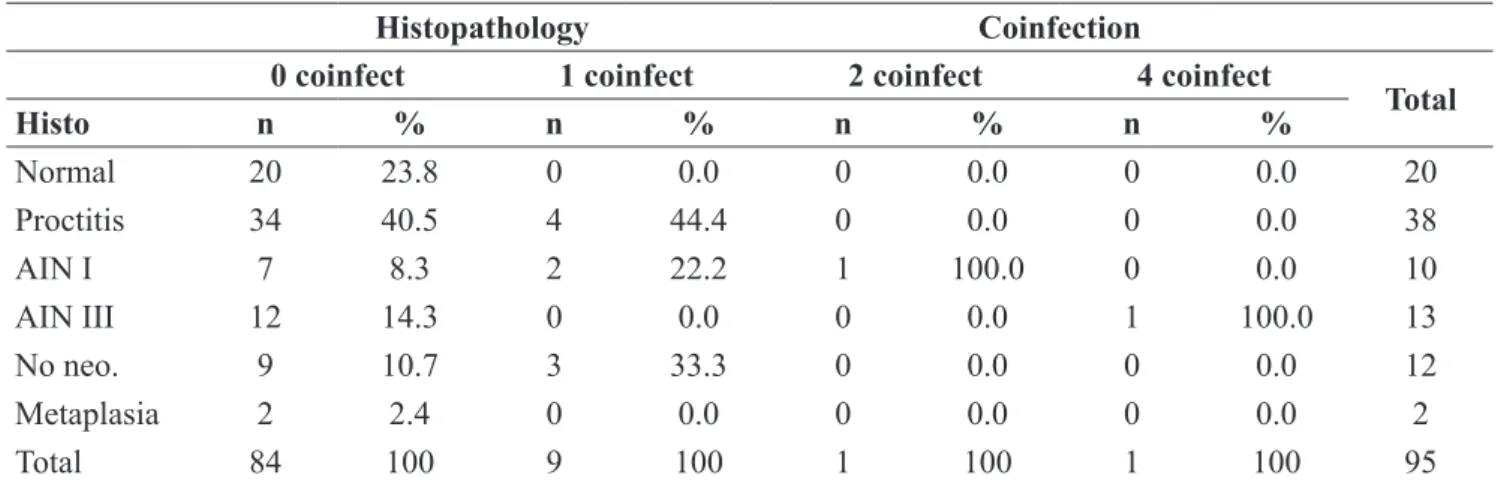
Among the 11 coinfected patients, there were four cases of AIN (36.4%), one of AIN III and three of AIN I. Therefore, no correlation was found between the incidence of AIN and viral anal coinfection (Table 5). Among coinfected patients, there were also three
condyloma cases and four nonspeciic inlammatory
changes in these patients (Table 5).
DIsCussION
In this study, we addressed viral coinfection in HIV-positive patients and its relationship with AIN and HAART patient and immune status. We began the
analysis with an evaluation of the inluence of HIV on
HPV infection rates. A 26.6-fold greater risk of infec-tion by high and/or low oncogenic HPV types in
HIV-positive patients was observed. These indings cor -roborate those of previous studies14-16. Sobhani et al.17
and Kreuter et al.18 highlighted the greater multiplicity
of high- and low-risk HPV in anal margin carcinomas compared to carcinomas of the anal canal, which are mostly associated with HPV 16.
An increased risk of severe high-grade squamous intraepithelial (HSIL) has been described in patients infected with oncogenic HPV, particularly HPVs 16 and 18, when associated with low TCD4 cell con-centrations before HAART initiation (OR=14.18)19.
These data are similar to those found in the present study in patients infected with high-risk HPV and a current TCD4 cell count of <50 cells/μL. The risk of AIN in patients with low TCD4 cell counts has also been previously reported20,21.
A recent study described the possible protec-tive effect of HAART on the development of severe AIN when HAART was administered for more than four years, and the analysis was adjusted for TCD4 nadir cells19. According to Crum-Cianlone22, the
ben-eicial effect of HAART may be less pronounced for
individuals with moderate or severe AIN as a result of the already severe degree of HIV-related immune depletion. In those cases, either the immune
restora-tion promoted by HAART was insuficient to restore
Histopathology Coinfection
0 coinfect 1 coinfect 2 coinfect 4 coinfect
total
Histo n % n % n % n %
Normal 20 23.8 0 0.0 0 0.0 0 0.0 20
Proctitis 34 40.5 4 44.4 0 0.0 0 0.0 38
AIN I 7 8.3 2 22.2 1 100.0 0 0.0 10
AIN III 12 14.3 0 0.0 0 0.0 1 100.0 13
No neo. 9 10.7 3 33.3 0 0.0 0 0.0 12
Metaplasia 2 2.4 0 0.0 0 0.0 0 0.0 2
Total 84 100 9 100 1 100 1 100 95
Table 5. Histopathological studies of coinfected patients.
speciic immunity to HPV-infected cells or, in cases
with a more severe degree of AIN, patients may have
accumulated suficient genetic alterations to lead the
failure of HAART22. Other authors argue that the
dura-tion of HIV infecdura-tion is of primary importance, since patients infected with more than 15 years had 12 times greater chance of developing anal cancer (p<0.001)23.
The average time of HIV infection in this study was much higher than that of our patients with HSIL.
Regarding the anal coinfection, we did not de-tect coinfection in HIV-negative subjects, probably as a result of the strict selection criteria employed for the Control Group that did not involve MSM. Anal coinfection occurred in 40% of patients who had not declared themselves adherents of receptive anal sex, highlighting the potential for the acquisi-tion of STDs regardless of the sexual practice, as previously noted24,25, and emphasizing the
impor-tance of prevention programs that encompass het-erosexual patients.
Our rate of anal STDs are similar to the indings
of Sobhani et al.26, who described an 8% rate of EBV
coinfection, a 12% rate of CMV anal infection and a 24% rate of HSV anal infection. However, this study found lower prevalence of EBV (7.7%) and CMV
(1.5%) infection compared to the indings of Löwha -gen et al.27 and Rodrigues et al.9, who reported a
prev-alence of HSV and EBV of over 30%. Because we used RT-PCR as a means of diagnosis, and the method is known to be higher than conventional PCR and the culturing of samples28; therefore, we do not consider
our results to be contradictory with previous indings,
but as features of our study population.
The presence of HSV-EBV coinfection as a risk factor for the development of anal cancer among pa-tients of both sexes coinfected with HPV-HIV has al-ready been described9-11. In the present study, we
re-port ive cases of coinfection with EBV. Three cases
had severe AIN, and one patient was coinfected with all the viruses studied and presented very low levels of peripheral TCD4 cells. In a study conducted in Rio de Janeiro, Brazil9, HPV-EBV coinfection occurred in
21% of HIV-positive patients and in 7% of HIV-nega-tive patients (p=0.017). These data are similar to those from a study conducted in Skovde, Sweden27, which
found HSV rates similar to ours but with signiicantly
higher percentages of EBV.
Regardless of geographical area, a consider-ably high rate of anal coinfection in immunocom-promised patients has been found, highlighting the importance of STD surveillance and the monitoring of clinical progression in terms of AIN occurrence and anal cancer. In Botswana, Africa, an increase has been seen in ocular surface squamous neoplasia
pathology with signiicant rates of coinfection with
HPV, HSV, CMV and EBV, particularly in HIV-pos-itive patients, but in percentages much higher than those reported here29.
Despite the limited number of coinfected evaluated individuals and the limitations inher-ent in cross-sectional studies, these results show that patients with anal viral coinfection by HPV, HSV-1, HSV-2, EBV or CMV showed no addition-al risk for the development of AIN and that coin-fection seems to be directly related to high HIV-1 viral load. New follow-up studies are needed to confirm the findings revealed in this study regard-ing the incidence of AIN and anal cancer in coin-fected individuals.
CONCLusIONs
This study was conducted in the main institu-tion for the treatment of HIV/AIDS in the Amazon region of Brazil. The rate of AIN was associated with severe infection with high and low risk HPV, low levels of TCD4 cells, and a high HIV-1 viral load. Anal coinfection by HPV, CMV, HSV and EBV oc-curred only in HIV-positive patients, it was directly
inluenced by the HIV-1 viral load. In this study, vi -ral anal coinfection showed no additional risk for the development of AIN.
ACKNOWLeDGMeNts
reFereNCes
1. Koutsky L, Galloway D, Holmes K. Epidemiology of genital human papillomavirus infection. Epidemiol Rev 1988;10:122-63. 2. Nadal SR, Manzione CR. Rastreamento e Seguimento dos
Portadores das Lesões Anais Induzidas pelo Papilomavírus
Humano como Prevenção do Carcinoma Anal. Rev Bras Coloproctol 2009;2(29):250-3.
3. Kreuter A, Brockmeyer NH, Weissenborn SJ, Gambichler T, Stucker M, Altmeyer P, et al. Penile Intraepithelial Neoplasia Is Frequent in HIV-Positive Men with Anal Dysplasia. J Invest Dermatol 2008;128:2316-24.
4. Kreuter A, Brockmeyer NH, Hochdorfer B, Weissenborn SJ, Stücker M, Swoboda J,et al. Clinical spectrum and virologic characteristics of anal intraepithelial neoplasia in HIV infection. J Am Acad Dermatol 2005;4(52):603-8.
5. Lee PK, Wilkins KB. Condyloma and other infections
including human immunodeicieny virus. Surg Clin North
Am 2010;90(1):99-112.
6. Dauden E, Fernández-Buezo G, Fraga J, Cardenoso L, García-Díez A. Mucocutaneous Presence of Cytomegalovirus Associated With Human Immunodeiciency Virus Infection
Discussion. Arch Dermatol 2001;137:443-8.
7. Davis TW, Goldstone SE. Sexually transmitted infections as a cause of proctitis in men who have sex with men. Dis Colon Rectum 2009;52(3):507-12.
8. Snoek VDEM, Niesters HG, Mulder PG, Doornum VGJ, Osterhaus AD, Meijden VDWI. Human papillomavirus infection in men who have sex with men participating in a Dutch gay-cohort study. Sex Transm Dis 2003;30(8):639-44. 9. Rodrigues FR, Miranda NL, Fonseca EC, Pires ARC, Dias
EP. Investigação da LMP1 do EBV e a coinfecção do HPV em lesões genitais de pacientes infectados ou não pelo HIV. J Bras Patol Med Lab 2010;46(50):415-20.
10. Santos NBM, Villanova FE, Andrade PM, Ribalta J, Focchi J, Otsuda AY, et al. Epstein-Barr virus detection in invasive and pre-invasive lesions of the uterine cervix. Oncol Reports 2009;21:403-5.
11. Sobhani I, Walker F, Rodout-Thoraval F, Abramowitz L, Johanet H, Hérnin D, et al. Anal carcinoma: incidence and effect of cumulative infecctions. AIDS 2004;18:1561-9. 12. Roka F, Roka J, Trost A, Schalk H, Zagler C, Kimbauer R,
et al. Anal human Papillomavirus testing with Digene’s hybrid capture 2 using two different sampling methods. Dis Colon Rectum 2008;(51):61-6.
13. Aldea C, Alvarez CP, Folgueira L, Delgado R, Otero JR. Rapid detection of herpes simplex virus DNA in genital ulcers by Real-time PCR using SYBR Green I Dye as the detection signal. J Clin Microbiol 2002;60:1060-2.
14. Palefsky JM, Elizabeth AH, Jimmy TE, Maria C, Naomi J, Teresa MD. Anal intraepithelial neoplasia in the highly active therapy era among HIV-positive men who have sex with men. AIDS 2005;13(19):1407-14.
15. Wong AK, Chan RC, Aggarwal N, Singh MK, Nichols WA, Bose S. Human Papillomavirus genotypes in anal intraephitelial neoplasia and anal carcinoma as detected in tissue biopsies. Modern Pathol 2010;23:144-50.
16. Abramowitz L, Benabderrahmane D, Ravaud P, Walker F, Rioux C, Jestin C, et al. Anal squamous intraepithelial lesions and condyloma in HIV-infected heterosexual men, homosexual men and women:prevalence and associated factors. AIDS 2007;21:1457-65.
17. Sobahi I, Vuagnat A, Walker F, Vissuzaine C, Mirin B, Hervatin F, et al. Prevalence of high-grade dysplasia and cancer in the anal canal in human papillomavirus-infected individuals. Gastroenterology 2001;120(4):857-66.
18. Kreuter A, Potthoff A, Brockmeyer NH, Gambichler T, Swoboda J, Stücker M, et al. Anal carcinoma in human
immunodeiciency virus-positive men: results of a prospective
study from Germany. Brit J Dermatol 2010;162:1269-77. 19. Pokomandy A, Rouleau D, Ghattas G, Trottier H, Vezina S,
Cote P, et al. HAART and progression to high-grade anal intraepithelial neoplasia in men who have sex with men and are infected with HIV. Clin Infect Dis 2011;52(9):1174-81. 20. Scott H, Khoury J, Moore BA, Weissman S. Routine anal
cytology screening for anal squamous intraepithelial lesions in a urban HIV clinic. Sexually Trans Dis 2008;35(2):197-2002.
21. Palefsky JM, Holly EA. Immunosupression and co-infection with HIV. J Nat Cancer Inst Monogr 2003;31:41-6.
22. Bratcher J, Palefsky J. Anogenital human Papillomavirus coinfection and associated neoplasia in HIV-positive men and women 2008. [Internet] [cited 2011 Sept 25]. Available from: http://www.prn.org/index.php/coinfections/article/anogenital_ hpv_neoplasia_hiv_positive502/.
23. Crum-Cianlone NF, Hullsiekc KH, Marconia VC, Ganesana
A, Weintroba A, Barthela RV, et al. Agana anal cancer among HIV-infected persons: HAART is not slowing rising incidence. AIDS 2010;24:535-43.
24. Piketty C, Darragh TM, Costa M. High prevalence of anal human Pappilomavirus infection and anal cancer precursors among HIV-infected persons in the absence of anal intercourse. Ann Intern Med 2003;6(138):253-9.
25. Wilkin TJ, Palmer J, Brudney JK, Chiasson MA, Wright TC. Anal intraepithelial neoplasia in heterosexual and homosexual HIV-positive men with acess to antiretroviral therapy. JID 2004;(190):1685-91.
26. Sobhani I, Walzer F, Aparicio T, Abramowitz L, Henin D, Cremieux AC, et al. Effect of anal epidermoid cancer-related viruses on the dendritic (Langerhans’) cells of the human anal mucosa. Clin Cancer Res 2002;(8):2862-9.
27. Löwhagen GB, Bergbrant IM, Bergström T, Ryd W, Voog E.
28. Wald A, Huang ML, Carrell D, Selke S, Corey L. Polymerase chain reaction for detection of herpes simplex virus (HSV) DNA on mucosal surfaces: comparison with HSV isolation in cell culture. J infect Dis 2003;9(188):1345-51.
29. Simbiri OK, Murakami M, Feldman M, Steenhoff AP, Nkomazana O, Bisson G, Robertson GE. Multiple oncogenic
viruses identiied in ocular surface squamous neoplasia
in HIV-1 patients. Infectious agents and cancer 2010.
[Internet] [cited 2010 Sept 25]. Available from: http://www. infectagentscancer.com/content/5/1/6.
Correspondence to:
Adriana Gonçalves Daumas Pinheiro Guimarães Avenida Jacira Reis, 549/603