The experience of the research ethics commitee at a
public university in the state of Minas Gerais, Brazil
Patrícia Alves Paiva 1, Simone de Melo Costa 2, Orlene Veloso Dias 3, Vânia Silva Vilas Bôas Vieira Lopes 4, Dardânia Glayce Barbosa Souto 5,
Daniele Lopes da Silva 6
Abstract
The aricle reports the experience of the Research Ethics Commitee at the State University of Montes Claros, MG, Brazil, in the period from 2000 to 2009. Desk research, case study method were employd, and the signii
-cance level was set at p < 0.05. Of 1,751 projects, 95.8% were approved. Problems in preparing the statement of informed consent were among reasons for disapproval. The health sciences area of knowledge stood out at 60.8%. The average ime between submission and ethical review was 11 days. The area of knowledge in
-luenced the average ime between submission and ethical assessment (p < 0.05), but did not afect the ime
to approval of the research project. Conclusion: the local commitee followed the standards for ethical asses
-sment in accordance with Resoluion 466/2012, in view of the fact that it rejected projects with shortcomings in the statement of informed consent, thus protecing the subjects of the research.
Keywords: Ethics. Research. Research ethics commitees.
Resumo
Experiência do comitê de éica em pesquisa de uma universidade pública de Minas Gerais, Brasil
O arigo relata experiência do Comitê de Éica em Pesquisa da Universidade Estadual de Montes Claros, MG, Brasil, no período entre 2000 e 2009, com base em pesquisa documental, na modalidade estudo de caso, com nível de signiicância p < 0,05. De 1.751 projetos, 95,8% foram aprovados e, entre os moivos de reprovação,
estão problemas na elaboração do termo de consenimento livre e esclarecido (TCLE). A área de conhecimen
-to mais destacada foi ciências da saúde (60,8%). O tempo médio entre submissão e avaliação éica foi de 11 dias. A área de conhecimento inluiu no tempo decorrido entre a submissão e a apreciação éica (p < 0,05),
mas não na aprovação do projeto. Concluiu-se que o comitê local segue as normas de apreciação éica de modo a atender a Resolução 466/2012, uma vez que reprovou projetos com falhas no TCLE, protegendo os sujeitos pesquisados.
Palavras-chave: Éica. Pesquisa. Comitês de éica em pesquisa.
Resumen
Experiencia del comité de éica en invesigación de una universidad pública de Minas Gerais, Brasil El arículo informa sobre la experiencia del Comité de Éica de Invesigación de la Universidad Estadual de Mon
-tes Claros, MG, Brasil, en el período del 2000 a 2009, con base en invesigación documental, en la modalidad de estudio del caso, con un nivel de signiicación p < 0,05. De los 1.751 proyectos, 95,8% fueron aprobados y,
entre las razones de la desaprobación, están los problemas en la elaboración del Término de Consenimiento Informado. El área de conocimiento más destacada fue el de las ciencias de la salud (60,8%). El iempo pro
-medio entre la presentación y la evaluación éica fue de 11 días. El área de conocimiento inluyó en el iempo pasado entre la presentación y la valoración éica (p < 0,05), pero no en la aprobación del proyecto. Se concluyó
que el comité local sigue las normas para la consideración éica para cumplir con la Resolución 466/2012, una vez que reprobó proyectos con fallas en el Término de Consenimiento Informado, protegiendo a los sujetos.
Palabras-clave: Éica. Invesigación. Comités de éica en invesigación.
Aprovação CEP Unimontes 1.661/2009
1. Graduada [email protected] 2. Doutora [email protected] 3. Mestre [email protected] 4. Mestre [email protected] 5. Especialista [email protected] 6. Graduada [email protected] – Universidade Estadual de
Montes Claros (Unimontes), Montes Claros/MG, Brasil.
Correspondência
Patrícia Alves Paiva – Rua Tiago Andrade Amaral, 203, Vila Atlânida CEP 39401-145. Montes Claros/MG, Brasil.
Declaram não haver conlito de interesse.
R
esear
Research Ethics Commitees (REC) have shown that ethical advances in the evaluaion of researches involving human beings. They represent the inter
-ests of the society in establishing ethical criteria for research, regulaing the ethics in research in order to avoid abuse to the physical, psychic and moral integrity of people who paricipate in the studies. The approval by local commitees in insituions aims at protecing the individuals in the research, who may require clariicaions about the studies they take part in, or even complain about their par
-icipaion 1,2. By approving the research project, the
commitee becomes responsible for ethical aspects, however, without exemping the researchers of their ethical responsibility, which is inalienable and non-transferable 3.
REC is a muli- and transdisciplinary. It includes the paricipaion of professionals of several areas such as health, social sciences, human sciences and community representaives. Being independent, it manifests itself on behalf of the society to analyze and guarantee that the paricipaion in a research does not cause any harm or impairment to the in
-dividual. The commitee insures respect to the individuals, considering their needs and rights. Therefore, it is an organized way of social control of scieniic pracices, based on internaionally accept
-ed standards.
Thus, this work has the purpose of describing the experience of REC of Universidade Estadual de Montes Claros (Unimontes), MG, Brazil, from 2000 to 2009, aiming at analyzing insituional experi
-ences during this period, as well as esimulaing the improvement of the process to protect the invesi
-gated individuals.
Materials and Methods
By Reading the aricle “Ethical conduct in re
-search involving human beings in Brazil: Diagnosis of research ethics commitee”, writen by Novaes, Guilhem and Lolas, came the interest to develop a similar research in the university where the re
-searchers came from, considering the importance of this topic in the scieniic scenario 4.
Therefore, this study was conducted by the Research Ethics Commitee of Universidade Estadu
-al de Montes Claros (Unimontes), located in Montes Claros, in important city in the north of the state of Minas Gerais, Brazil. The design of the study was transversal and documental, in the form of a “case study”.
The research was conducted by means of eval
-uaing documents iled in the REC of Unimontes, substaniated opinions and itle pages of protocols of research projects submited to the evaluaion of REC from January 2000 to December 2009. The research project follow the recommendaions of the resoluion 196/1996 of “Conselho Nacional de Saúde” (Naional Health Council) exising at that ime. The opinions on research projects was eval
-uated to idenify both the percentage of projects approved and also the projects that were reproved, in addiion to idenifying the reasons for reproval of the researches.
From the itle pages, it was possible to iden
-ify the area and the sub-area of knowledge of the studies. The evaluaion of both documents allowed the ideniicaion of the proposed seing to conduct the study (research seing) and the ime required, in days, between the submission of the proposal to the REC and the conclusion of the ethical eval
-uaion. For the data collecion, a proper form was developed, previously tested in a pilot study with 10 research projects which were not part of the sample for this study.
The collected data were released in the pro
-gram SPSS, version 18.0, for staisical analysis. For the descripive analysis, measures of central tenden
-cy were used (such as arithmeic means, standard deviaion and quariles), as well as calculaing ra
-ios. For the associaion among the variables of the study, the variable “area of knowledge” is classiied in three categories: exact sciences, sciences of the earth and engineerings; human sciences, applied social sciences, linguisics, languages and arts; health sciences and biological sciences. The variable “sub-area” is classiied in two categories: health and others. Finally, the variable “seing” – that is, the one proposed for the scieniic invesigaion – was classiied in two categories: “hospital” and “other seings”.
Tests used to compare the mean imes – ime between the submission and the analysis of the projects, of diferent groups –were Mann-Whiin
-ey’s test and Kruskal-Wallis’s test, considering that there was no normality of the analysis variable by the Kolmogorov-Smirnov’s test (p < 0.001). For the
associaion among variables, Pearson’s chi-square test and its alternaive test, the likelihood raio test, were used. The later was used when over 25% of the cases had a score that was lower than 5. In all of the staisical tests, p < 0.05 was considered as the level of signiicance and the conidence interval was 95% (CI 95%).
R
esear
Results
One thousand seven hundred and ity-seven documents of REC of Unimontes, from 2000 to 2009, were used. The mean ime between the submission and the ethical evaluaion was 11.07 (± 5.413) days, median and mode 11 days, percenile 25% equal to 9 days and percenile 75% equal to 14 days. The maximum period was 26 days.
Most substaniated opinions (95.8%) received ethical approval for the study to be conducted. This is because the scieniic method did not compromise ethical principles of the research involving human beings. Thus, only a small percentage of projects (4.2%) was reproved by the REC of Unimontes, ac
-cording to Chart 1.
Chart 1. Distribuion of studies according to approval
by the REC of Unimontes, 2000/2009
0
20
40
60
80
100
Aprovação no CEP
Yes
No
The reasons to reprove a Project are due to several problems. Among them, the most promi
-nent are those related to the elaboraion of a free and informed consent form, corresponding to 1.4% of the projects; problems in the formaion on the research schedule (1.7%); in the informed consent and in the schedule simultaneously (0.3%); in the informed consent and in the methodology simulta
-neously (0.2%); in the itle page (0.3%); and in the methodology (0.2%) of research projects.
Projects evaluated by the REC corresponded to several areas of knowledge: exact sciences and Earth sciences, biological sciences, engineerings, health sciences, applied social sciences, human sci
-ences and linguisics, languages and arts. The most highlighted one was the health sciences (60.8%).The condiion to approve projects was not associated with the areas of knowledge, falling into three cat
-egories: exact sciences, health sciences and human sciences (p = 0.415).
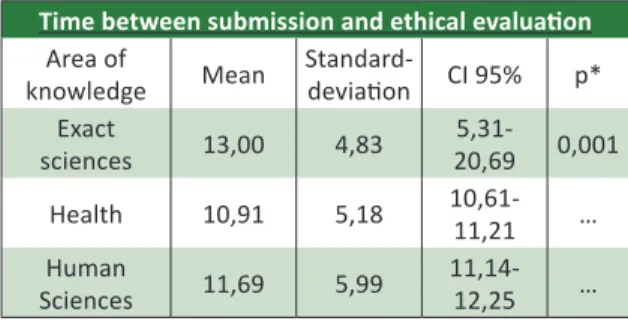
When the three categories of the areas of knowledge were associated to the ime between the submission and the evaluaion of the project, it was veriied that the mean ime for exact sciences was 13.00 (± 4.83) days, for health sciences it was 10.91 (± 5.18) days and for human sciences it was 11.69 (± 5.99) days, with a signiicant diference in the ime needed for the analysis of projects ac
-cording to the area of knowledge (p = 0.001), as it is
shown in Table 1.
Table 1. Mean, standard deviaion and conidence
interval of 95% (CI 95%) of ime between submission and evaluaion, according to the area of knowledge of the study. REC Unimontes, 2000/2009
Time between submission and ethical evaluaion
Area of
knowledge Mean Standard-deviaion CI 95% p* Exact
sciences 13,00 4,83 20,695,31- 0,001 Health 10,91 5,18 10,61-11,21 …
Human
Sciences 11,69 5,99 11,14-12,25 …
* Kruskal-Wallis’s test.
Out of the 40 sub-areas highlighted in the documentaion evaluated, the most frequent ones were nursing (25.4%), social service (13.1%), denis
-try (9%), collecive health (6.5%), physical educaion (8.0%) and medicine (3.6%).
Among places where the studies were car
-ried out, the hospital was the most common one, represening 414 (23.6%) scieniic researches; “Es
-tratégia Saúde da Família” (Family Health Strategy) was the seing of 187 (10.6%) projects; diferent educaional insituions had 139 (7.9%) studies; and the higher educaion insituion (Unimontes) was the seing of data collecion of 139 (7.9%) studies. There was no signiicant diference (p = 0.089) be
-tween the means of days equivalent to the period of submission and the ethical evaluaion of projects according to the proposed seing for the research (research seing).
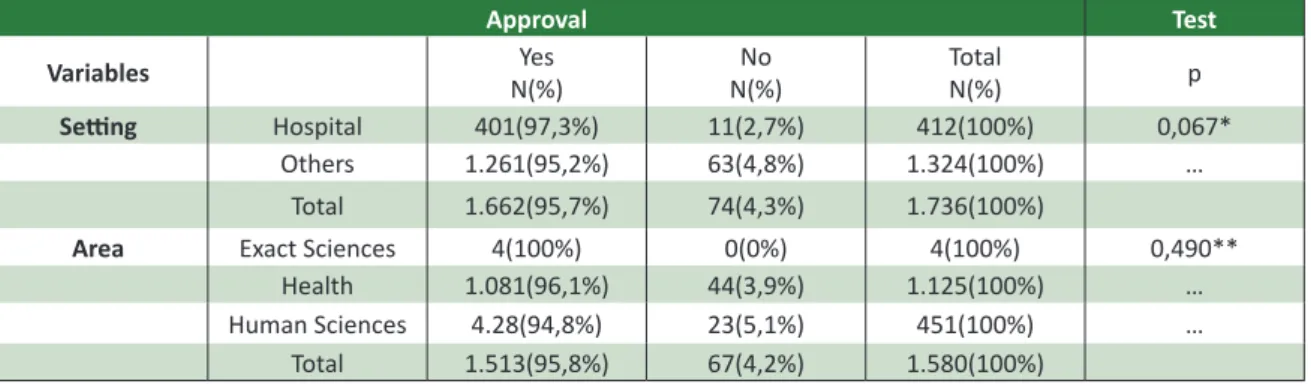
The condiion to approve research projects of the REC was associated with the proposed seing for the research, as well as the area of knowledge of the study. The approval of the studies was seen not to be associated with neither the seing nor the area of knowledge (p > 0.05), as shown in Table 2.
R
esear
Table 2. Bivariate associaion between the conditon of approval of a research project and the seing and the
area of knowledge. REC Unimontes, 2000/2009
Approval Test
Variables Yes
N(%) N(%)No TotalN(%) p
Seing Hospital 401(97,3%) 11(2,7%) 412(100%) 0,067*
Others 1.261(95,2%) 63(4,8%) 1.324(100%) …
Total 1.662(95,7%) 74(4,3%) 1.736(100%)
Area Exact Sciences 4(100%) 0(0%) 4(100%) 0,490**
Health 1.081(96,1%) 44(3,9%) 1.125(100%) …
Human Sciences 4.28(94,8%) 23(5,1%) 451(100%) …
Total 1.513(95,8%) 67(4,2%) 1.580(100%)
*Pearson’s test. ** Likelihood raio.
Discussion
The large number of projects analyzed by REC of Unimontes depicts the importance of the local commitee to preserve reference ethical principles, which are fundamental to the research involving human beings. The results was higher than that of the study that evaluated the experience of the Re
-search Ethics Commitee of “Secretaria de Estado de Saúde” (State Health Department) of Distrito Federal – REC/SHD/DF, Brazil, from 1997 to 2007, analyzing 1,129 projects 4, corresponding to 64.48% of the projects evaluated in the current study, at the same ime interval.
The role of the REC is important in the regula
-ion and supervis-ion of the produc-ion of researches in Brazil, but it is important to point out that the role of the government and of editors of scieniic jour
-nals, who, as those in charge of the disseminaion of research results, should establish detailed ethical recommendaions. Thus, REC, the government and editors need to realize the extent of their respon
-sibiliies to the general community, paricularly the scieniic community. Because of the exising in
-equaliies in Lain America and in the Caribbean, it would be up to the database in health sciences to promote acions aiming to comply with the laws of each country, protecing the science, individuals and animals against inadequate scieniic pracices 5.
The short ime period to submit a research project to appreciaion shows the commitment of the local commitee to evaluate all documents re
-ceived in this instance. Meeings of the REC studied take place monthly and are previously scheduled every year. Dates are published on the website of Unimontes. The deadlines to send documents need
-ed to submit a research project to be evaluat-ed by the local commitee are also published on the web
-site. Thus, researchers may organize the delivery of all the material imely for the ethical analysis in the following meeing of the commitee.
The ime between submission and the evalu
-aion of projects at Unimontes was less than that presented by the study carried out at CEP/SES/DF, whose ime to approve projects varied from 30 to 60 days 4. As for the fact that the highest mean of ime for the approval of projects related to exact sciences, has the jusifying hypothesis of having less representaiveness of this area in the local commit
-tee, which would demand more ime to analyze the Project by professionals with degrees in other areas.
Most research projects received a favorable opinion to carry out the proposal, which means they respected research ethical principles involv
-ing human be-ings. This result corresponds to that found in the study of CEP/SES/DF, which presented a percentage of approval of 90.4% of the projects evaluated 4. It is important to highlight that every research ethics commitee becomes responsible for the research projects they approve 6.
For the approval if projects, the evaluaion of the informed consent is extremely important, since its document ensures the understanding of the study by each paricipant, insuring respect to the autonomy, ethical principle that arose as a reference to self-man
-agement or to the self-government. Currently, the informed consent comprises the rights of freedom, privacy, individual choice, individual choice and the freedom will. It includes some rules as for the respect to privacy; the protecion of conidenial informaion and obtaining consent for the intervenion in the pa
-ients. The research in human beings should always have to protect people in their signiicance, respect their autonomy and defending its vulnerability 7-10.
In this study, the reproval of projects occurred for several reasons, among them laws in the elab
-R
esear
oraion of the informed consent. It is also observed that the reproval of some projects occurred be
-cause of more than one problem, with laws in the informed consent and in the schedule or laws in the informed consent and in the methodology. In gen
-eral, the most notable law was that related to the informed consent. This result was also veriied in the study of CEP/SES/DF, which considered the consent term was the most frequent pendency among the projects evaluated 4.
The informed consent was also considered as the main reason of the reproval of research protocols in projects analyzed by the CAPPesq (Comissão de Éica para Análise de Projetos de Pesquisa) (Ethics Commit
-tee for the Analysis of Research) of the complex of Hospital das Clínicas of Faculdade de Medicina of Uni
-versidade de São Paulo, with about 25% of reprovals. It is responsibility of the REC to audit the conducion of the research and the review the informed consent based on the results of the research 11.
The consent, in addiion to being informed, has to be free, with no type of limitaion to the decision made by the individual to consent, and informed because the commitment with the inves
-igated individual is not only to inform him/her but also to clarify them. REC should be extra careful with the protecion of vulnerable groups, those with a reduced self-determinaion capacity, as in the case of those who are under 18 years of age, pregnant women, socioeconomically disadvantaged, indige
-nous people, prison inmates, employees, students, disabled people and elderly. In the report issued, the commitee evaluates if the project is feasible, verifying the adequacy of the free and informed consent and eventual conlicts of interest 6. Thus, the capacity of the individual of the research to give his/her consent becomes an important factor to approve projects, which is why doubts should be cleared up by the researcher of the study, in order to avoid laws in the process of understanding and consent by the paient 12.
The researcher should do his/her best for its elucidaion, using a language that is colloquial and understandable for the paricipant, so that the consent is, actually, free and informed. The dis
-approval of projects by issues related to informed consent in the current study may be linked to the use of inadequate language for the target popula
-ion of the research. In addi-ion, the large number of researchers that are carried out in the health area and in hospitals requires the members of the local commitee to be very careful in the ethical review of the informed consent, since individuals admited
to hospitals ate in a situaion of vulnerability, even if temporarily.
The informed consent is a document that is adopted worldwide. In a study carried out in 40 local ethics commitees in medical sciences universiies in Iran, supported by the World Health Organizaion (WHO), it was veriied that in 95% of the commitees evaluated, the informed consent was maintained available to the researchers 13. The REC of Unimon -tes also provides a model of informed consent to researchers, having the recommendaions of “Comi
-tê Nacional de Pesquisa” (Conep) (Naional Research Commitee) as a base. The availability of models of this document helps the researcher to build a free and informed consent according to current ethical guidelines, such as informaion on the objecives of the study, risks and beneits.
The process of free and informed consent has the purpose of allowing the individual invited to take part in the research to understand procedures, risks, discomforts, beneits and rights involved in the study, leading him/her to make an autonomous de
-cision. Obtaining a free and informed consent is the researcher’s duty and it is a sign of respect for the people involved in the project 14. Therefore, the in -formed consent is a document, which authorizes the paricipaion of the individual in the research 1. The individual, when adequately informed, makes his/ her choice freely between either paricipaing or not paricipaing in the study 15. That is why an informed consent in disagreement with ethical principles leads the project to receiving an unfavorable opin
-ion, that is, being disapproved by the commitee. In this study, as previously shown, most disapprovals ahaven been due to problems ideniied in the in
-formed consent.
Researchers should guarantee that data will be used just for scieniic purposes, thus preserving the privacy and reliability of the research individ
-ual. Images will be only ideniied and used with the authorizaion of the invesigated individual 14. Regarding the research, both for the biomedical and the social research, terms “anonymous” and “conidenial” are commonly used as synonymous, although they have diferent meanings. Both have in common the fact that they refer to a certain piece of informaion that should be protected so it does not harm its holder. In several cases, invesigated individuals are promised to be kept anonymous in the research, but it is impossible that this promise is honored 16.
Other ethical principles, in addiion to the respect to the autonomy, are considered for the ap
-R
esear
proval of projects, among them are the principle of non-maleicence that determines the obligaion of not harming intenionally. That principle is closely related to norm according to which no one should be harmed, or that potenial damages should be prevented. Another principle menioned is be
-neicence, for which it is not enough to just treat the individual as an autonomous one, but also to contribute to his/her well-being. This principle, in addiion to compassion, benignity, altruism, and love, should be considered so that it includes all forms of acions that beneit other people. Risks and beneits should be evaluated, both real and po
-tenial ones, as well as individual or collecive ones, and search for the maximum of beneits and the minimum of risks as possible. The principle of jus
-ice comprises equality, merit (what is merited) and prerogaive (what someone has the right to). It im
-plies in a fair, equitable and appropriate treatment. It is important to consider what is someone’s right. According to this principle, the research should have social relevance, with signiicant advantages to the invesigated individuals, and to minimize the burden for the vulnerable ones 7-10.
In this study, most projects are in the area of health sciences, among them the most common ones were from the nursing area, which may explain the largest number of researches conducted in hospitals.
We may state that the ethical evaluaion of a project in the health area, and also in other areas is based on at least four key points: 1) qualiicaion of the team of researches and of the project; 2) evalua
-ion of the risk-beneit raio; 3) informed consent; 4) previous evaluaion by an ethics commitee 14. The previous evaluaion of research projects carried out by a REC aims at ensuring the adjustment of ethical and methodological aspects of the study. Due to its social and academic independence and representa
-iveness, the commitee will guarantee that studies have an insituional endorsement, in addiion to the liability insured by the researchers 17.
Based on the above menioned, we may state that the role of the REC is inserted into the mechanisms of social control, to enable a human
-ized treatment to the invesigated individuals. The mission of REC is to protect people involved, guar
-anteeing their interests have priority over scieniic or societal interests 3.
Although Brazil currently occupies a prominent posiion in Lain America by having a well-deined regulaions about research in human beings, such as resoluion 466/2012 of “Conselho Nacional de Saúde” (Naional Health Council) (NHC), study pub
-lished in 2010 veriied that most studies presented in the “XVIII Congresso Pernambucano de Cardio
-logia” (XVIII Congress of Cardiology in the state of Pernambuco), in 2008, did not conform to the res
-oluion of NHC 196/1996, exising at that ime 18.
Ethical review in research is an important process, intended to protect paricipants in a medical re
-search. Nevertheless, it is criicized for not meeing objecives 19.
In a research carried out in two universiies of denistry in the Middle East to evaluate the knowl
-edge, consciousness and aitudes of the faculty regarding ethics in research and in ethics commit
-tees, it was veriied that almost half (44.0%) of the interviewees considered that ethics commitees delayed the scieniic research, and only 36.8% of the interviewees had had previous training in ethics in research 20. These results have shown the ex
-istence of gaps in knowledge of ethics in research even among professionals of higher educaion in
-situions. And, in the present study, the lack of knowledge on the part of the researcher may have been the factor responsible for laws in the method
-ology and make an informed consent.
In a research carried out in denistry schools in Brazil, it was veriied that 31.3% of them had the dis
-cipline of Bioethics in their curriculum. In general it is taught in the irst or in the last year of the course 21. This discipline is appropriate to introduce ethical di
-lemmas included in the research with human beings, in the Brazilian regulaions, in the role of the REC, in the bioethical principles of the research, among other topics related to the invesigaion involving humans, as well as animals.
The paricipant, as a paient of health care services, may supply the needs and interests of the invesigator in health research. This may generate evident conlicts, such as what happens in research projects involving clinical assays in developing coun
-tries. The paricipaion of target-populaions of developing countries in a research project may be a strategy from the poor access to health care ser
-vices, litle understanding of the risks involved in the studies, as well as the litle ability of the populaion to legally claim for some kind of compensaion in situaions of impairment 22. In this context, the eth -ics commitee plays a fundamental role of ethically evaluaing a health research project, thus prevent
-ing the exploitaion of paricipants, paricularly those who are more vulnerable and live in develop
-ing countries.
In developed countries, the informed consent is based on the autonomy, being authenicated by
R
esear
the signature of the paricipant and supervised by research ethics commitees. In developing coun
-tries, the decision-making iniiaive to obtain the informed consent is usually invested in the com
-munity, rather than in the individual. Challenges of developing countries are exacerbated by the fact that people at a higher risk of disease are usually illiterate, have litle experience with the Western medicine and litle understanding of the scieniic raionale for the studies proposed23. In his study, Lorenzo argues that, in addiion to the informed consent, it is necessary to expand strategies to ob
-tain informed consent for the research, considering that illiteracy is common in these countries, thus, limiing the value of signatures in the documents 24. In response to the growing number of re
-searches undergoing today in developing countries, several research ethics commitees have been es
-tablished; but, in certain countries, the quality of the system of ethical review remains unknown. Ac
-cordingly, researches proposed a tool aimed at ta self-evaluaion of the commitees, with the purpose of reviewing their policies as for internaionally rec
-ognized ethical standards. Developed and evaluated by REC members and researchers from the Middle East, the self-evaluaion tool relects pragmaic aspects of protecion of human beings, based on in
-ternaional standards 25.
A study conducted in the Dominican Repub
-lic also aimed at describing the situaion of seven research ethics commitees, as for the organizaion and composiion, as well as aciviies and needs to train their members and following recommenda
-ions provided by Internaional Ethical Guidelines for Biomedical Research involving Humans. Results have shown the complexity of the situaion of com
-mitees in the Dominican Republic and the eforts needed to beter follow the internaional recom
-mendaions 26. In a certain way, results from this study contribute to the relecion of local commit
-tee members, to idenify that most projects in the health area show the importance of permanent ed
-ucaion acions aimed at REC members.
By being funded by transnaional corpora
-ions, the research is oten subjected to standards imposed by the market, in the name of merely eco
-nomic interests, which ends up compromising the integrity and the relevance of the scieniic research, in addiion to interfering with the inal results of the study. The economic interest condiions the in
-vesigaion, which should be conducted with total neutrality and always guided towards the collecive good 27. This reinforces the importance of the REC to
carefully evaluate research projects, before they are carried out.
This study has the limitaion of being conduct
-ed from secondary data; thus, although data are in accordance with records observed in the documents assessed, the risk of bias in the obtained informaion should be considered. The absence of informaion in one part of the documents is another limitaion inherent to any study based on documents. Howev
-er, researchers have atempted to compensate for these limitaions by data being collected by only one researcher, concomitant evaluaion in more than one type of document and percentage adjustments of results disregarding missing informaion.
Final consideraions
With this study, it is concluded that, by re
-proving research projects due to laws in the informed consent, methodology and schedule, the local commitee of Unimontes judgment was built on guidelines based on research involving hu
-man beings. Ethical evaluaion was established on fundamental principles of bioethics: autonomy,
be-neicence, non-maleicence and jusice. Therefore,
the local commitee skillfully played its role to pro
-tect the ethics and the paricipant of the research. In addiion, results from this study have shown that REC of Unimontes was resoluive in the evaluaion of projects, once it required litle ime from submis
-sion to the inal report.
Referências
1. Edgar H, Rothman DJ. The insituional review board and beyond: future challenges to the ethics of human experimentaion. Milbank Q. 1995;73(4):489-506.
2. Graf HP, Cole D. Ethics commitee authorizaion in Germany. J Med Ethics. 1995;21:229-33. 3. Freitas CBD, Hossne WS. O papel dos comitês de éica em pesquisa na proteção do ser humano.
Revista Bioéica. 2002;10(2):129-46.
4. Novaes MRG, Guilhem D, Lolas F. Ethical conduct in research involving human beings in Brazil: Diagnosis of research ethics commitee. Arq Med. 2009;23(4):145-50.
R
esear
5. Tavares-Neto J, Azevêdo ES. Destaques éicos nos periódicos nacionais das áreas médicas. Rev Assoc Med Bras. [Internet]. 2009 [acesso 15 nov 2011];55(4):40-1. DOI: htp://dx.doi. org/10.1590/S0104-42302009000400013
6. Alves EMO, Tubino P. Conlito de interesses em pesquisa clínica. Acta Cir Bras. [Internet]. 2007 [acesso 15 nov 2011];22(5):402-5. DOI: htp://dx.doi.org/10.1590/S0102-86502007000500015 7. Beauchamp TL, Childress JF. Princípios de éica biomédica. São Paulo: Loyola; 2002.
8. Hossne WS. A regulamentação de pesquisa com seres humanos como instrumento de controle social. In: Fortes PAC, Zoboli ELCP, organizadores. Bioéica e saúde pública. São Paulo: Loyola; 2003. p. 95-111.
9. Zoboli ELCP. Referências de análise em bioéica: o desaio de traçar sua interface com a saúde pública. In: Fortes PAC, Zoboli ELCP, organizadores. Op. cit. p. 25-34.
10. Emanuel EJ, Crouch RA, Arras JD, Moreno JD, Grady C, editors. Ethical and regulatory aspects of clinical research. Balimore: The Johns Hopkins University Press; 2004.
11. Casilho EA, Kalil J. Éica e pesquisa médica: princípios, diretrizes e regulamentações. Rev Soc Bras Med Trop. [Internet]. 2005 [acesso 15 nov 2011];38(4):344-7. DOI: htp://dx.doi.org/10.1590/ S0037-86822005000400013
12. Silva LMP, Oliveira F, Muccioli C. O processo de consenimento na pesquisa clínica: da elaboração à obtenção. Arq Bras Otalmol. [Internet]. 2005 [acesso 15 nov 2011);68(5):704-7. DOI: htp:// dx.doi.org/10.1590/S0004-27492005000500026
13. Fakour Y, Etekhari MB, Haghighi Z, Mehr NK, Hejazi F. Situaion analysis of local ethical commitees in medical sciences in Iran. J Res Med Sci. 2011;16(3):310-5.
14. Clotet J. O consenimento informado nos comitês de éica em pesquisa e na práica médica: conceituação, origens e atualidade. Revista Bioéica. 1995;3(1):51-9.
15. Goldim JR, Pithan CF, Oliveira JG, Raymundo MM. O processo de consenimento livre e esclarecido em pesquisa: uma nova abordagem. Rev Assoc Med Bras. 2003;49(4):372-4.
16. Anguita M, Sotomayor M]. ¿Conidencialidad, anonimato?: las otras promesas de la invesigación. Acta Bioeth. [Internet]. 2011 [acesso 10 maio 2012];17(2):199-204. Disponível: htp://www. scielo.cl/scielo.php?script=sci_artext&pid=S1726-569X2011000200006&lng=pt
17. Goldim, JR, Francisconi CF. Os comitês de éica hospitalar. Rev Med ATM. 1995;15(1):327-34. 18. Lima SG, Lima TAG, Macedo LA, Sá MPBO, Vidal ML, Gomes RAF et al. Éica em pesquisas
com seres humanos: do conhecimento à práica. Arq Bras Cardiol. [Internet]. 2010 [acesso 15 nov 2011];95(3):289-94. Disponível: htp://www.scielo.br/scielo.php?pid=S0066-782X2010001300003&script=sci_artext
19. Fistein E, Quilligan S. In the lion’s den? Experiences of interacion with research ethics commitees. J Med Ethics. [Internet]. 2 nov 2011. [Epub ahead of print]. DOI: htp://dx.doi.org/10.1136/ medethics-2011-100124.
20. El-Dessouky HF, Abdel-Aziz AM, Ibrahim C, Moni M, Abul Fadl R, Silverman H. Knowledge, awareness, and aitudes about research ethics among dental faculty in the Middle East: A pilot study. Int J Dent. 2011; 694759. DOI: htp://dx.doi.org/10.1155/2011/694759
21. Gonçalves PE, Saliba GCA, Isper GAJ, Adas SN. Análise qualitaiva do conteúdo ministrado na disciplina de Bioéica nas faculdades de odontologia brasileiras. Acta Bioeth. [Internet]. 2010 [acesso 15 nov 2011];16(1):70-6. Disponível: htp://www.scielo.cl/scielo.php?script=sci_artex t&pid=S1726-569X2010000100010&lng=pt
22. Cabral MML, Schindler HC, Abath FGC. Regulamentações, conlitos e éica da pesquisa médica em países em desenvolvimento. Rev Saúde Pública. [Internet]. 2006 [acesso 15 nov 2011];40(3):521:7. DOI: htp://dx.doi.org/10.1590/S0034-89102006000300022
23. Krogstad DJ, Diop S, Diallo A, Mzayek F, Keaing J, Koita OA, Touré YT. Informed consent in internaional research: The raionale for diferent approaches. Am J Trop Med Hyg. 2010;83(4):743-7.
24. Lorenzo C. O consenimento livre e esclarecido e a realidade do analfabeismo funcional no Brasil: uma abordagem para a norma e para além da norma. Rev Bioéica. 2007;15(2):268-82
25. Sleem H, Abdelhai RA, Al-Abdallat I, Al-Naif M, Gabr HM, Kehil ET et al. Development of an accessible self-assessment tool for research ethics commitees in developing countries. J Empir Res Hum Res Ethics. 2010;5(3):85-96.
26. Arturo CGJ. Comités de éica de invesigación en República Dominicana: un análisis desde las pautas éicas internacionales para la invesigación biomédica con seres humanos. Acta Bioeth. [Internet]. 2011 [acesso 15 maio 2012];17(2):257-64. Disponível: htp://www.scielo.cl/scielo. php?script=sci_artext&pid=S1726-569X2011000200012&lng=pt
27. Páez MR. La invesigación de la industria farmacéuica: ¿condicionada por los intereses del mercado? Acta Bioeth. [Internet]. 2011 (acesso 15 maio 2012);17(2):237-46. Disponível: htp:// www.scielo.cl/scielo.php?script=sci_artext&pid=S1726-569X2011000200010&lng=pt Paricipaion of the authors
The authors paricipated equally in all phases of the research and producion of this paper. All of them approved the inal version of the aricle and are equally responsible for all the aspects of the work, including the assurance of its accuracy and integrity.
Recebido: 29. 5.2014 Revisado: 13. 8.2014 Aprovado: 6.11.2014