DOI: http://dx.doi.org/10.5007/1980-0037.2015v17n3p300
original article
Licence Creative Commom CCRBCDH
1 Universidade Federal de Juiz de Fora. Programa de Pós-Graduação Stricto-Sensu em Educação Física. Juiz de Fora, MG. Brasil. 2 Universidade Federal de Juiz de Fora. Departamento de Desporto. Juiz de Fora, MG. Brasil. 3 Universidade Federal de Sergipe. Centro de Ciências Biológicas e da Saúde. Aracaju, SE. Brasil 4 Scientiic Sport. Espanha.
Received: 19 November 2014 Accepted: 15 March 2015
Comparison of the perceived subjective
exertion and total load lifted response in
resistance exercises performed on stable
and unstable platforms
Comparação da resposta da percepção subjetiva
do esforço e da carga total levantada nos exercícios
resistidos em plataforma estável e instável
Liliane Cunha Aranda1
Marcelly Mancini1
Yuri Almeida Costa Campos1
Elder Dutra Sousa1
Jeferson Macedo Vianna2
Marzo Edir Da Silva-Grigoletto3,4
Abstract– his study aimed to compare the perceived subjective exertion (PSE) and total load lited in resistance exercises performed on stable platforms (SP) and unstable platforms (UP). Participants were 20 men (24.6 ± 3.4 years, 179 ± 0.1 cm, 80.6 ± 9.1 kg and 11.8 ± 3.4% fat). Each subject performed a 15 maximum repetition test in half squat exercises (soil and balance discs), pronated barbell row (soil and bosu) and biceps curl (soil and balance discs) in both conditions. PSE was measured using the OMNI-RES scale and the load lited value (kg). To verify the normality of data, the Shapiro-Wilk test was used. Possible diferences related to loads and PSE on the platforms were performed by the paired t test. Signiicance level of p <0.05 was adopted. No signiicant diferences between PSE values on SP and UP were respectively observed in the half squat (8.2 and 8.5 / p = 0.8), pronated barbell row (8.4 and 8.4 / p = 0.7) and biceps curl (8.6 and 8.7 / p = 1.0). Higher load values on SP and UP were respectively found in half squat (83.9kg and 70.3kg / p <0.001) and pronated barbell row exercises (53.2kg and 48.6kg / p = 0.01) on SP. However, biceps curl showed dissimilar behavior (48.2kg and 47.4kg / p = 0.5). It was concluded that UP does not promote diferences in PSE responses even working with smaller load or similar load.
Key words: Instability; Perceived exertion; Resistance strength.
Artifacts that can cause instability have been commonly added to resist-ance training protocols (RT) aiming to improve muscular balresist-ance and joint
stability1. RT on UP is widely used in rehabilitation and neuromuscular
itness. UP is used to produce body oscillations and trigger a rapid motor response, improving muscle reactivity and neuromuscular recruitment
pattern2,3. hus, training on UP promotes disorders in the sensory system,
causing involuntary dynamic motor reactive responses to generate
neuro-muscular control in a given joint3.
For these objectives to be achieved, implements as Swiss balls, Dyna disc,
BOSU and balance cone4-7 are used in diferent exercises. Considering that
in many everyday activities, as well as in sports, no muscle operates in
isola-tion6, the importance of using instability in some period of training becomes
increasingly evident due to both preventive5 and rehabilitative8 -10 beneits.
For the monitoring and control of intensity during resistance exercise, perceived subjective exertion (PSE) has great support from the scientiic com-munity, specially due to its close relationship with key physiological stress
mark-ers during exercise such as electromyographic activity and blood lactate11,13.
Marshall and Murphy14 found higher PSE in push-up and double leg
hold exercises, both on the Swiss ball compared to stable surfaces. In this sense and taking into account that changes in the surfaces of exercises are susceptible to changes in motor pattern by increasing the participation of
stabilizing muscles and core during the performance of movements5,7,15,
we believe that they might be able to change the nature of physiological responses, thus afecting perceived exertion.
Another peculiarity of exercises performed on unstable surfaces is related to a probable loss of ability to generate force compared to stable
sur-faces, which is elucidated in several experiments7,8,16. Paradoxically,
Good-man et al.17 reported no diferences between surfaces, showing that these
changes appear to be dependent on the type of exercise used, the muscles involved in these movements and the devices used to generate instability.
hus, based on the above, further studies should be carried out to inves-tigate the application of unstable bases in RT in order to verify the existence of probable diferences in PSE responses and on the load values in diferent exercises and platforms. hus, the aim of this study was to compare the per-ceived subjective exertion and total load lited in resistance training in stable and unstable platforms. he initial hypothesis of the study is that instability could lead to lower load lited values; however, it could lead to higher PES response due to the increased degree of diiculty in performing the exercise.
METHODOLOGICAL PROCEDURES
Sample
PSE and total load lifted: diferent platforms Aranda et al.
(6.2 ± 4.6 years). he sample was selected in a non-probabilistic manner, in which volunteers that met the inclusion and exclusion criteria were selected. Subjects who met the following criteria were included in the study: (a) males aged 19-30 years, (b) not having sufered any kind of musculoskel-etal injury in the upper or lower limbs in the last six months, (c) negatively responding to all items in the Physical Activity Readiness Questionnaire
/ PAR-Q18, (d) be familiar for more than twelve months with RT (regular
physical activity> three times a week). he following individuals sample were excluded who: (a) those making use of medications, alcohol and / or tobacco, (b) those reporting musculoskeletal disease and / or injury, (c) those with previous experience in RT on unstable platforms. he research project was approved by protocol No. 204 521/2013 of the Ethics Committee of Research with Human Beings of the Federal University of Juiz de Fora. All subjects signed the Informed Consent Form according to Resolution 196/96 of the National Health Council.
Experimental design
In the 1st session, subjects were informed about the study purposes and
procedures to which they would be submitted. hey were instructed not to perform physical activities 48 hours before the day of tests on the platforms and to feed at least 2 hours before the test and hydrate. Subjects signed the Informed Consent Form and then completed two questionnaires whose application aimed to evaluate the inclusion or exclusion of individuals in the sample: the PAR-Q; and an anamnesis. Ater the measurement of anthropometric variables, individuals underwent a series of familiariza-tion on UPs, performing 2-3 sets of 15 repetifamiliariza-tions at approximately 60% of maximum perceived efort to be guided on motor coordination and movement pace. Also, they were clariied on the PSE deinition through the
OMNI-RES scale19. In the 2nd, 3rd, 4th and 5th sessions, subjects underwent
strength 15MR tests and retests with an interval of 48 hours between days on both platforms randomly.
Collection of total load lifted for 15MR
Strength tests were applied in the following order: half free squat, pronated row and elbow lexion. he procedures were: a) warm up with 15 repetitions at 40-60% maximum perceived load for 15 MR; b) ater one minute of rest, subjects performed ive repetitions at 60-80% maximum perceived load for 15 MR; c) ater one minute of rest, the load test took place, in which each individual performed a maximum of three attempts for each exercise with a ive minute interval between attempts; d) when the participant could no longer perform the movement correctly, the test was stopped, being recorded as maximum total load lited (MTLL) for 15 repetitions that obtained in
the last full execution of the concentric muscular failure20. As in the
In order to reduce the margin of error in the MTLL test for 15 MR, the following strategies were adopted: a) familiarization before test, informing the participant about the data collection procedures; b) instructions on the execution techniques and speed (EMT-888 Tuner® metronome, with one second in the concentric phase and 2 seconds in the eccentric phase or 40 bpm = 20 repetitions per minute) of exercises; c) use of verbal encourage-ment; d) use of weights previously calibrated in precision scale. he retest application aimed to assess the load reliability. he greatest weight obtained on both days (test and retest) with diference lower than 5% was considered.
Collection of perceived subjective exertion
To assess perceived subjective exertion, individuals had to select a number in the OMNI-RES scale that represented the efort of the exercised muscles (peripheral fatigue) immediately ater MTLL strength test for 15MR, since its anchoring was not performed. he PSE used in the search results was that obtained for the 15 MR test with the highest load lited value.
Description of exercises
• Half Squat (free bar)
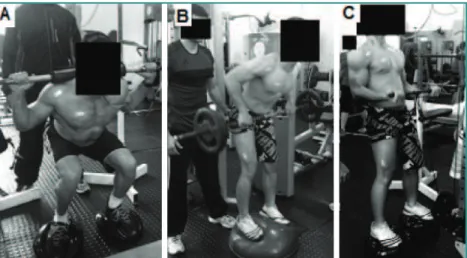
he volunteer is in the standing position facing the bar support of the “Righetto Fitness Equipment®, squat cage, São Paulo, Brazil” apparatus with bar resting on the shoulders, feet parallel spaced at the same distance from the shoulders and hands ixed on the bar. Lower limbs were lexed simultaneously up to reaching an angle of 90° between thigh and loor, (amplitude limiter) and returning to the starting position in a controlled manner. his exercise on UP was performed on two balance discs “Pretorian®, Balance Cushion, São Paulo, Brazil” one under each foot as identiied in the igure below.
Figure 1: Exercises performed. A = Half squat exercise (free bar); B = Pronated barbell row exercise (free bar); C = Elbow lexion exercise (biceps curl)
PSE and total load lifted: diferent platforms Aranda et al.
45° with the loor. he volunteer pulled the bar vertically until it touches the bottom of the chest, keeping the vertebral spine straight and knees slightly bent. he volunteer returned the bar to the starting position up to complete elbow extension. his exercise on UP was held at “Bosu®, Sport Balance Trainer - 55cm, San Diego, USA” being inlated up to 25 cm of height to carry out all tests according to manufacturer identiied in the igure below.
With feet facing the “Righetto Fitness Equipment®, Cross Over, São Paulo, Brazil” apparatus and maintaining the lateral spacing of shoulder width, the volunteer was positioned, having the elbow joint, both segments, near the side of the body and hands in supination to grab the bar, performing full elbow lexion movement, with subsequent return in a controlled manner to the initial position. his exercise on UP was performed on two balance discs from Pretorian®, Balance Cushion, São Paulo, Brazil identiied in the igure below.
Statistical analysis
Based on a pilot study carried out by our group (n = 4) and on available literature, calculation was performed to determine the appropriate sample size. To achieve 80% statistical power, it was calculated that a sample of 20 subjects would be required to detect a diference of 5 kg in the half squat MTLL among groups (Granmo 5.2, IMIM, Barcelona, Spain). Data were submitted to descriptive analysis using mean and standard deviation. To verify normal distribution of all variables, the Shapiro-Wilk test was used. Possible diferences related to loads and PSE on the diferent platforms were assessed using the paired t test. For data analysis, the SPSS sotware (version 17.0) was used. he level of signiicance was set at p <0.05.
RESULTS
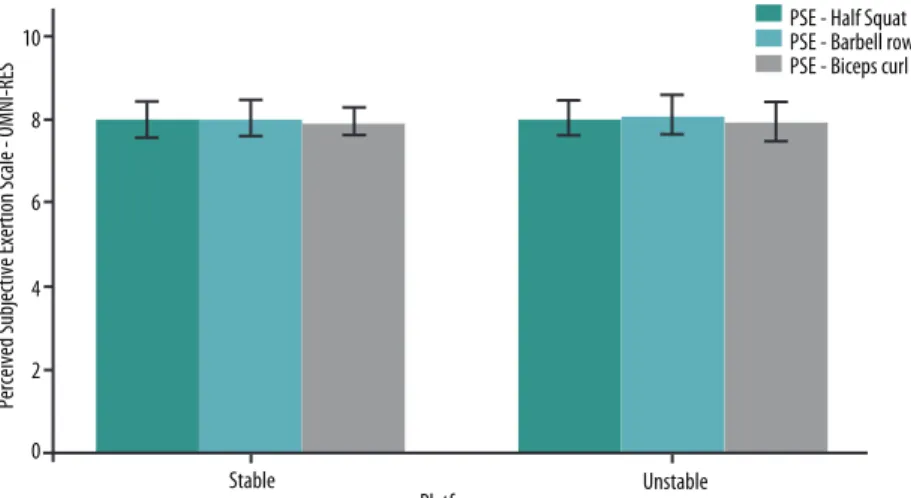
No significant differences were found among PSE OMNI-RES values in half squat exercises (p = 0.8), barbell row (p = 0.7) and biceps curl (p = 1.0), comparing stable and unstable platforms, as illustrated in Figure 2.
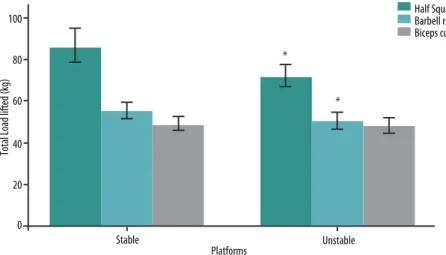
row exercises (p = 0.0). In contrast, for the biceps curl exercise, signiicant diferences were found (p = 0.5) as shown in Figure 3.
Figure 3 - Graphical representation of the mean and conidence interval (95%) for load values (kg) in half squat, barbell row and biceps curl exercises in stable and unstable platforms. * Signiicant diference in relation to the stable surface condition (p ≤ 0.05).
DISCUSSION
he aim of this study was to compare the response of perceived subjective exertion and total load lited in resistance exercises performed on stable and unstable surfaces. he main indings of this study show that for half squat and barbell row exercises, the use of UP caused lower load raised values compared to SP, conirming the initial hypothesis of this study that movement instability promotes a decrease in strength produced. However, in biceps curl exercise, signiicant diferences were found in MTLL values. Regarding PSE, no signiicant diferences were observed between SP and UP, which results are contradictory to the hypothesis of this study.
he lower load lited in half squat and barbell row exercises on UP would be related to the efect of instability on force production, since UP can
pro-mote greater challenge to the neuromuscular system when compared to SP2.
Previous studies have found a decrease of the dynamic force production
in bench press exercise on UP compared to SP7,8,16. Behm et al.21 also found
loss of isometric strength of quadriceps and plantar lexors compared to SP.
According to Marinkovic et al.22, diferences in maximal strength of 1MR in
bench press (Swiss ball and bench) and half squat exercises (bosu and soil) ater eight weeks of training (50% of 1MR) are no longer efective to improve maximum muscle strength of inexperienced individuals, as compared to ex-ercises performed on SP, although 1MR strength increased in both conditions. he biceps curl exercise did not show signiicant diferences in strength parameters between platforms, which is in agreement with indings of
Good-man et al.17 and Melo et al.23, but in other resistance exercises. hese authors
also reported that the nature of these responses can be altered by factors such
PSE and total load lifted: diferent platforms Aranda et al.
as type of exercise and muscle groups involved in the performance of these movements. Additionally, it could be inferred that although UP imposes an imbalance situation, which is likely to culminate in smaller MTLL values, this response has become attenuated due to the fact that we used the biceps
curl exercise on the cable, which has a crucial role on movement stability24,25.
Such factors could be determinant for similarities found in the MTLL values.
Corroborating these indings, Panza et al.26 also found no signiicant
diferences in the number of maximum repetitions performed in bench press (Swiss ball and bench), but with the use of the free bar with load at 80% of 1MR and strength test applied only on SP.
Regarding PSE, few studies were found in literature with SP, and among
them the study by Marshall and Murphy27 stand out, which included 14
trained volunteers. hey performed bench press exercise at 60% of 1MR on UP (Swiss ball) and on SP (right bench). PSE was checked ater each series using the Borg scale and, in conclusion, the authors found perceived exer-tion signiicantly greater in exercise performed on UP. In another study, these authors found greater PSE in push-up and double leg hold exercises,
both in the Swiss ball, compared to stable surfaces 28. It is noteworthy that
unlike the present study, other resistance exercises were analyzed and the Borg scale for PSE collection was used.
Panza et al.26 compared PSE in horizontal bench press and Swiss ball
in 10 trained men. Only one series at 80% of 1MR up to muscle fatigue was performed and the OMNI-RES scale was used. he results showed no signii-cant diferences between them, pointing out a small sample size of the study. hese factors explain, in part, the results found in this study. Although the absolute load in exercises was statistically diferent, PES was probably similar due to a stress in the mechanoreceptors from the instability
pro-moted by UP, which stood out over other peripheral mechanisms 29.
Moreo-ver, there were no diferent values in the PSE responses when comparing exercises involving large body muscles (half squat), medium musculature (pronated barbell row) and small muscles (biceps curl).
In this sense, future studies should be conducted for a better under-standing of how variables (types of surfaces, types of exercises and load percentage) can be adjusted and combined to obtain better performance and practical applicability.
One limitation of the study was the absence of biochemical markers to more efectively justify the PSE response, although maximum strength tests are closely related to the perceived efort of volunteers. In addition, analysis of the electromyographic activity was not used to verify power production, since only the comparison of MTLL was performed. Other limitations were the lack of values in literature related to the calibration of balance discs, lack of extrapolation of data to other populations (sedentary, women, elderly, etc.) and lack of PSE anchoring.
CONCLUSIONS
however, free half squat and pronated barbell row exercises on SP showed signiicantly higher values compared to UP. hus, RT on UP with lower total maximum load lited causes similar PSE response; thus, it would be an auxiliary tool in the load control applicability in resistance training.
REFERENCES
1. Norwood JT, Anderson GS, Gaetz MB, Twist PW. Electromyographic activity of the trunk stabilizers during stable and unstable bench press. J Strength Cond Res 2007;21(2):343–7.
2. Fitzgerald GK, Axe MJ, Snyder-mackler L. he eicacy of perturbation training in nonoperative anterior cruciate ligament rehabilitation programs for physically active individuals. Physical herapy 2000;80(2):128-40.
3. Hurd WJ, Chmielewski TL, Snyder-Mackler L. Perturbation-enhanced neuromus-cular training alters muscle activity in female athletes Knee Surg Sports Traumatol Arthrosc 2006;14(1):60-9.
4. Wahl MJ, Behm DG. Not all instability training devices enhance muscle activation in highly resistance-trained individuals. J Strength Cond Res 2008;22(4):1360–70. 5. Uribe BP, Coburn JW, Brown LE, Judelson DA, Khamoui AV, Nguyen, D. Muscle
activation when performing the chest press and shoulder press on a stable bench vs. a Swiss ball. J Strength Cond Res 2010;24(4):1028-33.
6. Kohler JM, Flanagan SP, Whiting WC. Muscle activation patterns while liting stable and unstable loads on stable and unstable surfaces. J Strength Cond Res 2010;24(2):313–21.
7. Saeterbakken AH, Finland MS. Muscle force output and electromyographic activity in squats with various unstable surfaces. J Strength Cond Res 2013;27(1):130–6. 8. Anderson KG, Behm DG. Maintenance of EMG activity and loss of force output
with instability. J Strength Cond Res 2004;18(3):637–40.
9. McBride JM, Cormie P, Deane R. Isometric squat force output and muscle activity in stable and unstable conditions. J Strength Cond Res 2006;20(4):915–8. 10. Saeterbakken AH, Van Den Tillaar R, Fimland MS. A comparison of muscle activity
and 1-RM strength of three chestpress exercises with diferent stability require-ments. J Sports Sci 2011;29(5):533–8.
11. Bartonietz K, Strange D. he use of swiss balls in athletic Training – an efective combination of load and fun. New Stud Athletics 1998;13(1):35–44.
12. Lagally KM, Robertson RJ, Gallagher KI, Goss FL, Jakicic JM, Lephart SM, et al. Perceived exertion, electromyography, and blood lactate during acute bouts of resistance exercise. Med Sci Sports Exerc 2002;34(3):552–9.
13. Robertson RJ, Goss FL, Rutkowski J, Lenz B, Dixon C, Timmer J, et al. Concurrent validation of the OMNI perceived exertion scale for resistance exercise. Med Sci Sports Exerc 2003;35(2):333-41.
14. Marshall P, Murphy B. Changes in muscle activity and perceived exertion during exercises performed on a swiss ball. Appl Physiol Nutr Metab 2006;31(4):376-83. 15. Nuzzo JL, McCaulley Go, Cormie P, Cavill MJ, McBride JM. Trunk muscle activity
during stability ball and free weight exercises. J Strength Cond Res 2008;22(1):95-102.
16. Koshida S, Yukio U, Koji M, Kanzunori I, Aya K. Muscular outputs during dy-namic bench press under stable versus unstable conditions. J Strength Cond Res 2008;22(5):1584-8.
PSE and total load lifted: diferent platforms Aranda et al.
Corresponding author
Liliane Cunha Aranda
Rua Dr. Albertino Gonçalves Vieira, 145, Teixeiras,
Juiz de Fora, MG, Brasil. CEP: 36033-180
E-mail: [email protected]
18. Shephard RJ. Par-q Canadian Home Fitness Test and exercise screening alterna-tives. Int J Sports Med 1988;5(3):185-95.
19. Robertson RJ, Goss FL, Rutkowski J, Lenz B, Dixon C, Timmer J, et al. Concurrent validation of the OMNI perceived exertion scale for resistance exercise. Med Sci Sports Exerc 2003;35(2):333–41.
20. Bacurau RFP, Monteiro GA, Ugrinowitsch C, Tricoli V, Cabral LF, Aoki MS, et al. Acute efect of a ballistic and a static stretching exercise bout on lexibility and maximal strength. J Strength Cond Res 2009;23(1):304-08.
21. Behm DG, Anderson K, Curnew RS. Muscle force and activation under stable and unstable conditions. J Strength Cond Res 2002;16(3):416-22.
22. Marinković M, Bratić M, Ignjatović A, Radovanović D. Efects of 8-Week instability resistance training on maximal strength in inexperienced young individuals. Serb J Sports Sci 2012;6(1):17-21.
23. Melo B, Pirauá A, Beltrão N, Pitangui AC, Araújo R. A utilização de superfície instável aumenta a atividade eletromiográica dos músculos da cintura escapular no exercício cruciixo. Rev Bras Ativ Fis Saúde 2014;19(3):342-50.
24. Haf GG. Roundtable Discussion: Machines Versus Free Weights. Strength Cond J 2000; 22(6):18–30.
25. Lyons TS, McLester JR, Arnett SW, homa MJ. Speciicity of training modalities on upper-body one repetition maximum performance: free weights vs. hammer strength equipment. J Strength Cond Res 2010; 24(11):2984-8.
26. Panza P, Vianna JM, Damasceno VO, Aranda LC, Bentes CM, Novaes JS, et al. Energy Cost, Number of Maximum Repetitions, and Rating of Perceived Exertion in Resistance Exercise with Stable and Unstable Platforms. JEPonline 2014;17(30):77-87.
27. Marshall PW, Murphy BA. Increased deltoid and abdominal muscle activity during Swiss ball bench press. J Strength Cond Res 2006;20(4):745-750.
28. Marshall PW, Murphy BA. Changes in muscle activity and perceived exertion dur-ing exercises performed on a swiss ball. Appl Physiol Nutr Metab 2006;31(4):376-383. 29. Gibson AC, Lambert EV, Rauch LH, Tucker R, Baden DA, Foster C, et al. he role