Identification of the severity and use of interventions in neonates
with perinatal asphyxia
Identificação da gravidade e do uso de intervenções em recém-nascidos com asfixia
perinatal
Jéssica Lourenço Carneiro1, Igor Cordeiro Mendes1, Priscila Pereira de Souza Gomes2, Edgla Graciela Ferreira
Moreira de Brito2, Cristiana Brasil de Almeida Rebouças1, Ana Kelve de Castro Damasceno1
Objective: to identify the severity and the use of interventions in neonates with perinatal asphyxia. Methods: this is a documentary study carried out with 48 records of newborns with perinatal asphyxia in the Neonatal Intensive Care Unit, based on the neonatal therapeutic intervention score system. Data were analyzed using descriptive and inferential statistics. Results: preterm newborns presented complications such as presumed neonatal infection (63.2%), respiratory failure (59.1%), sepsis (38.7%) and seizure (39.7%). During hospitalization, 35.4% of them died. The most used interventions were transport and vital signs (100.0%), thermoregulated environment (97.9%), invasive mechanical ventilation (91.6%), antibiotics (77.0%), intubation (75.0%), phlebotomy (72.9%) and central venous catheter (68.7%). Conclusion: the mean score of the Neonatal Therapeutic Intervention Scoring System was 19.9, with statistically different means verified between the categories of variables Duration of hospitalization, Clinical outcome and Mother’s education.
Descriptors: Neonatal Nursing; Intensive Care Units, Neonatal; Asphyxia Neonatorum; Neonatology.
Objetivo: identificar a gravidade e o uso de intervenções em recém-nascidos com asfixia perinatal. Métodos:
estudo documental, realizado com 48 prontuáriosde recém-nascidos com asfixia perinatal em Unidade de Terapia Intensiva Neonatal, baseado no sistema de escore para intervenção terapêutica neonatal. Dados analisados por meio de estatística descritiva e inferencial. Resultados: os recém-nascidos avaliados apresentaram complicações como infecção neonatal presumida (63,2%), insuficiência respiratória (59,1%), sepse (38,7%) e convulsão (39,7%).Durante a internação, 35,4%foram a óbito. As intervenções mais utilizadas foram transporte e sinais vitais (100,0%), ambiente termorregulado (97,9%), ventilação mecânica invasiva (91,6%), antibióticos (77,0%), intubação (75,0%), flebotomia (72,9%) e cateter venoso central (68,7%). Conclusão: a média de pontuação do escore Neonatal Therapeutic Intervention Scoring System foi de 19,9, sendo verificadas médias estatisticamente
diferentes entre as categorias das variáveis Duração da internação, Desfecho clínico e Escolaridade da mãe.
Descritores: Enfermagem Neonatal; Unidades de Terapia Intensiva Neonatal; Asfixia Neonatal; Neonatologia.
1Universidade Federal do Ceará. Fortaleza, CE, Brazil. 2Hospital Infantil Albert Sabin. Fortaleza, CE, Brazil.
Corresponding author: Jéssica Lourenço Carneiro
Introduction
Perinatal asphyxia is a common clinical condi-tion in the public health service. It is one of the most important causes of illness and death in children un-der two months old. It is associated with the percen-tage of preterm infants with low birth weight, consti-tuting a threat to survival and health of children in the Americas(1). Also, it can progress to hypoxic-ischemic
encephalopathy, responsible for high neurological morbidity(2). Thus, infants with perinatal asphyxia
need special care from the neonatal period and it can be lifelong(3).
In the context of maternal and child care, in spite of the significant decrease in the infant mortality rate in Brazil, perinatal asphyxia is one of the causes that did not accompany this trend of marked reduc-tion, which resulted in its rise from the fourth to the third cause of death in 2015 (1.93 per thousand live births)(4).
In the hospital environment, regarding the use of new technologies, the assistance in neonatal inten-sive care units has been modified, contributing to the increase in the survival of newborns. Due to this ne-cessity, objective gravity measurement systems and specific prognostic methods have been developed.
The Neonatal Therapeutic Intervention Sco-ring System (NTISS) is a predictive model of neonatal in-hospital mortality and morbidity, which also esti-mates the use of resources, particularly the nursing workload. It is unique because it uses treatments, ra-ther than clinical factors. NTISS was constructed from the Therapeutic Intervention Scoring System, a sys-tem of severity measurement of adult patients hospi-talized in the Intensive Care Unit, which quantifies the therapeutic interventions of medical and nursing pro-cedures, based on that the more procedures the pa-tient receives, the greater its severity and, consequen-tly, more time spent by the nursing. It was validated in the United States, with 1,643 admitted newborns in neonatal intensive care units, considered a severity score with good accuracy and prognostic value,
inclu-ding estimates of risk and hospital mortality rate(5-6).
The study on the use of care technologies allo-ws the detection of variations in care practices, which reflect in operational costs and may guide the allo-cation of resources in neonatal intensive care(6). For
that, there is a need to use specific instruments by the nursing, aiming to know the demand for care to better planning, optimization of resources and consequent improvement of care.
Thus, it was intended to answer the following question: what are the severity and the need for inventions of newborns with perinatal asphyxia in a ter-tiary neonatal intensive care unit? The relevance lies in the fact that although there is a lack of knowledge about the mortality rate, there is a lack of knowledge about the severity they reach the tertiary hospital and consequent use of care interventions during hospita-lization.
Thus, the objective was to identify the severity and the use of interventions in neonates with perina-tal asphyxia.
Methods
This is a documentary study, carried out in me-dical records from January to August of 2016, in a Ter-tiary Neonatal Intensive Care Unit of a reference pe-diatric hospital in the State of Ceará, Brazil. Data were extracted from records of newborns with perinatal as-phyxia, hospitalized from January to December 2015, at that institution. There was no sample calculation since it was decided to work with all cases since it was a specific clinical condition. Therefore, the inclusion criterion adopted was to be newborn with a diagno-sis of perinatal asphyxia and to have been admitted in 2015 in the Unit of Neonatal Intensive Care, excluding only those who did not have NTISS completed in the medical record.
developed by the researcher, with variables of the mo-ther, childbirth, newborn, hospitalization and NTISS score in the first 24 hours of admission. Data were collected from hospital standardized records, such as admission, discharge, and NTIS, in the evolutions and declarations of live births and death.
The NTISS score consists of eight dimensions related to the type of care: respiratory, monitoring, cardiovascular, drug therapy, metabolic/nutrition, transfusions, procedures and vascular access. Each of these has items that correspond to interventions used in neonatal intensive care units. The quantity of items in the dimensions is varied. They score from one to four, where the value one is attributed to less invasive therapy; and the value four is attributed to the most invasive therapy, adding up to 62 as the maximum score. A value of zero is assigned when the item is not used in the patient in that period(5-6).
The data were organized into tables in Mi-crosoft Excel 2010, expressed in absolute and relati-ve frequencies and submitted to statistical analysis (Mann-Whitney test), through the program Statistical Package for the Social Sciences, version 20.0.
The study complied with the formal require-ments contained in the national and international regulatory standards for research involving human beings.
Results
A total of 63 medical records were evaluated, but 15 of them did not have completed NTISS and were excluded from the study. Thus, there were 48 records of newborns with perinatal asphyxia present, with most males (58.3%) coming from the interior of Ceará (83.3%), children of multiparous mothers (54.1%), aged between 20 and 35 years old (65.9%).
As for perinatal aspects, most of the babies had more than six prenatal consultations (67.3%), they were born from normal delivery (54.1%), the gesta-tional age was above 37 weeks (66.6%) and they had an average weight of 2768 g, ranging from 800g to
4715g. The means of the Apgar Index in the first mi-nute was 3.5, being 84.4% inferior to seven; and in the 5th minute, it was 5.7, with 64.4% less than seven.
The age at admission prevailed between zero (45.8%) and one day of life (31.2%). The mean dura-tion of hospitalizadura-tion at the Neonatal Intensive Care Unit was 17.1 days, with a minimum of one and a ma-ximum of 95 days, and the mean hospital stay was 42.2 days, ranging from one to 450 days.
Regarding the outcome, 35.4% died in the Ne-onatal Intensive Care Unit, 64.5% transferred to the medium risk group, 12.9% of them came from the me-dium risk unit to other sectors, such as resuscitation, neurology, cardiology, mechanically ventilated pa-tients and neonatal and pediatric intensive care unit. Only 4.1% of the patients were transferred to other hospitals and one continued in the unit of patients de-pendent on ventilation for more than one year.
Besides to perinatal asphyxia, 50.0% presen-ted up to three complications and 50.0% from four to seven complications, such as presumed neonatal infection (63.2%), respiratory failure (59.1%), sepsis (38.7%), seizure (39.7%), jaundice (26.5%), prema-turity (26.5%), pulmonary hypertension (16.32%), heart disease (12.2%) and others. The mean NTISS score was 19.9, ranging from 7 to 48 and the median 19. In the first 24 hours of the Neonatal Intensive Care Unit, the decreasing order of means was: respiratory (4.7), monitoring (4.4), cardiovascular (2.5), medica-tion (2.4), procedures (2.2), metabolic/nutrimedica-tion (1.8), vascular access (1.7), transfusions (0.4).
lipid and amino acid and potassium infusion (20.8%), among others. A mean of 12.6 interventions per pa-tient was calculated.
Some interventions were not used during the first 24 hours of hospitalization such as mechanical and relaxing ventilation, high frequency mechanical ventilation, tracheostomy care, tracheostomy, extra-corporeal oxygenation, invasive blood pressure mo-nitoring, indomethacin, Standby cardiac pacemaker, use of cardiac pacemaker, gamma globulin, arterial catheter, partial and total exsanguine, red blood cell transfusion> 15 ml/kg, dialysis, pericardial drain, pe-ricardiocentesis, oral diuretic and corticoid.
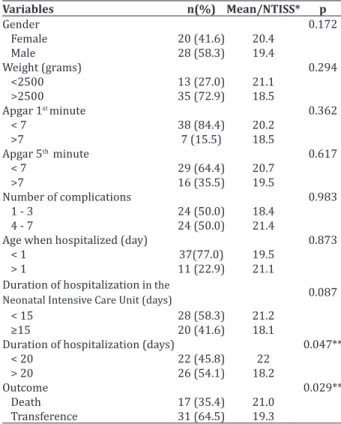
Table 1 shows the comparison of means of the NTISS score, according to the categories of each varia-ble related to the newborn and hospitalization, which showed statistically significant differences in the ca-tegories of variables Duration of hospitalization and Clinical outcome.
Table 1 –Mean of NTISS, according to variables rela-ted to the newborn and hospitalization
Variables n(%) Mean/NTISS* p
Gender 0.172
Female 20 (41.6) 20.4
Male 28 (58.3) 19.4
Weight (grams) 0.294
<2500 13 (27.0) 21.1
>2500 35 (72.9) 18.5
Apgar 1st minute 0.362
< 7 38 (84.4) 20.2
>7 7 (15.5) 18.5
Apgar 5th minute 0.617
< 7 29 (64.4) 20.7
>7 16 (35.5) 19.5
Number of complications 0.983
1 - 3 24 (50.0) 18.4
4 - 7 24 (50.0) 21.4
Age when hospitalized (day) 0.873
< 1 37(77.0) 19.5
> 1 11 (22.9) 21.1
Duration of hospitalization in the
Neonatal Intensive Care Unit (days) 0.087
< 15 28 (58.3) 21.2
≥15 20 (41.6) 18.1
Duration of hospitalization (days) 0.047**
< 20 22 (45.8) 22
> 20 26 (54.1) 18.2
Outcome 0.029**
Death 17 (35.4) 21.0
Transference 31 (64.5) 19.3
*NTISS = Neonatal Therapeutic Intervention Scoring System; **p≤0,05, signifi-cant (Mann-Whitney Test)
Table 2 shows the comparison of means of the NTISS score for each category of variables related to mother and childbirth, observing a statistically signi-ficant difference in the categories of the mother’s edu-cation level variable.
Table 2 – Mean of NTISS score according to variables related to mother and childbirth
Variables n(%) Mean/NTISS* p
Maternal age (years) 0.955
10 - 19 8 (17.0) 19.1
> 20 39 (82.9) 20.2
Marital status 0.647
Single 16 (40.0) 18.9
Married/stable marriage 24 (60.0) 20.3
Education (years of study) 0.050**
< 9 15 (34.8) 21.6
>9 28 (65.1) 18.8
Previous deliveries 0.788
Primparent 21 (43.7) 19.2
Multiple deliveries 26 (54.1) 20.2
From 0.824
Fortaleza 8 (16.6) 18.8
Interior 40 (83.3) 20.1
Prenatal consultation number 0.715
< 6 15 (32.6) 18.9
> 6 31 (67.3) 20.5
Way of delivery 0.917
Vaginal 26 (54.1) 20.8
C-section 22 (45.8) 18.8
Gestational age (weeks) 0.249
<37 15 (32.6) 21
>37 31 (67.3) 19.3
*NTISS = Neonatal Therapeutic Intervention Scoring System; **p≤0.05,
signifi-cant (Mann-Whitney Test)
Discussion
health care. This is an unpublished research with pa-tients with perinatal asphyxia, which brings the pro-file of the use of care interventions in health for this specific population as a scientific contribution.
Regarding the variables Mother´s Education, Duration of hospitalization and Outcome of hospitali-zation, a significant statistical difference was verified when correlated with NTISS, demonstrating its validi-ty as an important tool in the direction of nursing care. This significance can also alert to the consequences of quality maternal and child health care, motivating re-flections on cross-sectoral policies and specific health actions, both locally and broadly, improving the high costs of hospital services and indicators of health care. The reduction of neonatal mortality due to avoidable gravel is highlighted among these markers.
Regarding the Apgar Index, the patients obtai-ned an average of 3.5 in the first minute, with 84.4% lower than seven. At the fifth minute, the mean was 5.7, with 64.4% lower than seven. When correlating the Apgar Index with the NTISS score, no significant statistical significance was obtained. However, the mean NTISS score was higher in the patients presen-ting Apgar less than seven in the first and fifth minu-tes, with 20.2 and 20.7, respectively, demonstrating that Apgar less than seven may generate a greater need for interventions.
Regarding the maternal education, statistical significance (p=0.050) was found when correlating with NTISS, which allows inferring that the mother ´s education may interfere in the need for interventions and, therefore, in the prognosis of the newborn. These results demonstrate the importance of care for mo-thers with low education since it can cause problems, such as a low number of prenatal consultations, or as-sociated (p≤0.001) with the mortality rate, presenting four times more chances for neonatal death(7-8).
Regarding the hospitalization variables, the meantime in the neonatal intensive care unit was 17.1 days, lower than in another study (36 days)(9).
Howe-ver, mean hospital admission was 42.2 days, showing a statistically significant relationship, when
associa-ted with the NTISS value (p=0.047), allowing to infer that the NTISS value influences the length of hospitali-zation. In this way, the importance of its application as a planning, care, and management tool(5) is concluded.
The outcome was also statistically significant (p=0.029), confirming the direct relationship with the patient’s prognosis, that is the higher the score, the worse the prognosis(6). A population cohort in
São Paulo identified that 3,247 (22.0%) of the 14,597 early neonatal deaths were associated with perinatal asphyxia(10), which corroborates the high frequency
of death outcome of the newborns evaluated in the present study (35.4%), with a mean NTISS value of 21 and an average of 12 days of hospitalization, ranging from one to 42 days.
Regarding the NTISS, the mean value found (19.9) during the first day of hospitalization did not vary widely than a study carried out to evaluate the severity of critically ill newborns in Ukraine (22.4), as well as compared to other types of studies, showing similarity in the severity and use of interventions in neonatal care in different localities, such as Londrina (17.2), performed with 81 newborns; in Mato Gros-so do Sul (18), with 83 newborns; in Mexico (20.4), with 505 newborns; and Taiwan (20.3) with 172 new-borns(6,11-14).
A study with the objective of evaluating the complexity of nursing care, classifying it as low, me-dium and high complexity, through NTISS, indicated that scores between 13 and 40 indicate high comple-xity care, which represented 91.6% of newborns -chil-dren with perinatal asphyxia in this study(15).
Regarding the dimensions assessed by NTISS, respiration obtained the highest mean (4.7), followed by monitoring (4.4). This result differs from a study with newborns, which found monitoring (5.5), with an upper respiratory rate (2.5)(6). Despite being a
intuba-tion (75.0%) in the first 24 hours. This fact can also be explained by the indication of continuous monitoring of respiratory rate, heart rate, arterial oxygen satura-tion and blood pressure of these patients, and therefo-re, mechanical ventilation is recommended(3).
Cardiovascular dimension was the third (2.5) highlighting the following interventions: expander <15 ml/kg (35.4%), use of a vasopressor drug (20.8%) and resuscitation (22.9%), which shows the severi-ty in the first 24 hours of admission. In a study that analyzed the evolution of perinatal asphyxia, 70.0% of the newborns had a record of resuscitation at bir-th, 76.0% required vasoactive drugs at admission and 44.0% resuscitation at admission(16).
The newborns in this study needed transporta-tion soon after birth and they were more likely to pre-sent changes in the clinical outcome due to the greater exposure to possible complications such as orotrache-al intubation or initiorotrache-al treatment, by a team that does not have experience with critical newborns. Thus, in the procedures dimension, the fourth score, all pre-sented the item transportation, because it is a pedia-tric referral hospital without maternity, and most of the patients arrived with less than 24 hours (45.8%) or one day of life (31.2%).
About the drugs dimension, in which the most used medications were antibiotics - one drug (77.0%), other drugs (47.9%), anticonvulsants (35.4%), intra-venous diuretics (4.5%) and bicarbonate (10.4%), is in line with the main systemic alterations found in asphyxia. These include systemic infection, metabo-lic acidosis, bleeding, bradycardia, and hypoglycemia, with the premature convulsive crisis being the most frequently presented neurological manifestation (55.0%) and the reference motif on the first day of life (70.0%), receiving phenobarbital as the first drug(16).
Also, the mean of the dimension (2.4) was similar to the study standard in Londrina (2.3)(6).
In the metabolic/nutrition dimension, the fifth most scored, the interventions presented the follo-wing proportion: gavage (33.3%), phototherapy, lipid, potassium and endovenous amino acid (20.8%) and
insulin (4.1%). It is pointed out the absence of the fas-ting item, because although it is not characterized as an intervention, it may be related to severity or favor comorbidities, such as acquiring infections, increasing hospitalization time. In some cases, with hemodyna-mic decompensation and the severity of asphyxia, it is indicated in the first days of life until clinical and laboratory stabilization to prevent intestinal compli-cations(17).
In the vascular access dimension, seventh, the presence of central venous access in 68.7% in the first 24 hours of hospitalization is in line with the Agên-cia Nacional de VigilânAgên-cia Sanitária approach on the
indication of central venous access to which a longer duration of hospitalization or intravenous therapy as a way to prevent infection related to health care(18).
Among the limitations found in the score, we had the item Other drugs because there is a great di-versity of medications in the neonatology area, such as vitamin K and nitric oxide. In the transfusion di-mension, eighth, there were records only of red blood cells (4.1%), platelets (2.0%) and leukocytes (2.0%), lacking blood products such as albumin and immuno-globulins. These changes could provide more informa-tion about gravity.
The study shows poor prognosis of patients with perinatal asphyxia admitted to a tertiary hospi-tal, due to the frequency of deaths and the need for the high complexity of nursing interventions. This implies alerting professionals and managers to improve care and strategies to prevent perinatal asphyxia.
The association evidenced between the NTISS and the variables Duration and Outcome of hospitali-zation demonstrate the importance of the application of this tool in nursing practice, aiming its contribu-tion to planning and management of care. Knowledge about the severity and necessary interventions favors an adequate division of tasks among team members, contributing efficiently, not only to good clinical evo-lution but also to the quality of care and early dischar-ge(15).
severity and prognostic scales in the context of know-ledge production for nursing concern the fundamental role that the nursing team plays in the management of care and perception of the clinical changes and needs of the patients since the use of this type of scale based on the needs of nursing interventions can contribute to a critical reflection about the practice and the direc-tion of the professional acdirec-tions and capacities besides favoring care planning for a quality nursing care.
Conclusion
The mean score of the Neonatal Therapeutic Intervention Scoring System score was 19.9, with sta-tistically different means verified between the catego-ries of variables Duration of hospitalization, Clinical outcome and Mother’s education.
Collaborations
Carne JL contributed to design and project, data interpretation and article writing. Mendes IC partici-pated in the analysis of the data. Gomes PPS and Brito EGFM cooperated with the relevant critical review of intellectual content. Rebouças CBA and Damasceno AKC collaborated with the approval of the final ver-sion to be published.
References
1. Ministério da Saúde (BR). Secretaria de Atenção à Saúde. Departamento de Ações Programáticas e Estratégicas. Manual AIDPI neonatal. Brasília: Ministério da Saúde; 2014.
2. Nuñez A, Benavente I, Blanco D, Boix H, Cabañas F, Chaffanel M, et al. Oxidative stress in perinatal asphyxia and hypoxic-ischaemic encephalopathy. An Pediatr (Barc). 2017; 17:30206-0. doi: https:// doi.org/10.1016/j.anpedi.2017.05.005
3. Ministério da Saúde (BR). Secretaria de Atenção à Saúde. Departamento de Ações Programáticas Estratégicas. Atenção à saúde do recém-nascido: guia para os profissionais de saúde. Brasília: Ministério da Saúde; 2014.
4. França EB, Lansky S, Rego MAS, Malta DC, França JS, Teixeira R, et al. Leading causes of child mortality in Brazil, in 1990 and 2015: estimates from the Global Burden of Disease study. Rev Bras Epidemiol. 2017; 20(suppl1):46-60. doi: http:// dx.doi.org/10.1590/1980-5497201700050005 5. Aluvaala J, Collins GS, Maina M, Berkley JA, English
M. A systematic review of neonatal treatment intensity scores and their potential application in low-resource setting hospitals for predicting mortality, morbidity and estimating resource use. Syst Rev. 2017; 6(1):248. doi: http://dx.doi. org/10.1186/s13643-017-0649-6
6. Curan GRF, Rossetto EG. Scoring system for neonatal therapeutic intervention: a descriptive study. Online Braz J Nurs [Internet]. 2014 [cited 2017 Nov 13]; 13(4):622-33. Available from: http://www.objnursing.uff.br/index.php/ nursing/article/view/4632
7. Nascimento IB, Pacheco VC, Souza MLR, Pinheiro EB, Silva TR, Fleig R, et al. Prenatal care and perinatal outcome. Rev Bras Promoç Saúde. 2017; 30(2):187-94. doi: http://dx.doi. org/10.5020/18061230.2017.p187
8. Lansky S, Friche AAL, Silva AAM, Campos D, Bitten-court SDA, Carvalho ML, et al. Birth in Brazil sur-vey: neonatal mortality, pregnancy and childbirth quality of care. Cad Saúde Pública. 2014; 30(Sup-pl1):192-207. http://dx.doi.org/10.1590/0102-311X00133213
9. Oliveira CS, Casagrande GA, Grecco LC, Golin MO. Perfil de recém-nascidos pré-termo internados na unidade de terapia intensiva do hospital de alta complexidade. ABCS Health Sci. 2015;
40(1):28-32. doi: http://dx.doi.org/10.7322/abcshs.
v40i1.700
10. Daripa M, Caldas HMG, Flores LP O, Waldvogel BC, Guinsburg R, Almeida MFB. Perinatal asphyxia associated with early neonatal mortality: populational study of avoidable deaths. Rev Paul Pediatr. 2013; 31(1):37-45. doi: http://dx.doi. org/10.1590/S0103-05822013000100007 11. Yashchenko YB, Buriak OG, Zabolotna IE.
12. Santos SPC, Lansky S, Ishitani LH, França EB. Óbitos infantis evitáveis em Belo Horizonte: análise de concordância da causa básica, 2010-2011. Rev Bras Saúde Mater Infant. 2015; 15(4):389-99. doi: http://dx.doi.org/10.1590/ S1519-38292015000400003
13. Pérez-Cuevas CR, Vladislavovna DS, Jasso-Gutiérrez L, Flores-Hernández S, O’Shea CG, Aranza-Doniz C, et al. Evaluation of the quality of care of neonates with necrotizing enterocolitis affiliated with Seguro Popular in Mexico. Bol Med Hosp Infant Mex [Internet]. 2014 [cited 2017 Dec. 13]; 71(2):76-82. Available from: http://www. scielo.org.mx/pdf/bmim/v71n2/v71n2a3.pdf 14. Wu PL, Lee WT, Lee PL, Chen HL. Predictive power
of serial neonatal therapeutic intervention scoring system scores for short-term mortality in very-low-birth-weight infants. Pediatr Neonatol. 2015; 56(2):108-13. doi: http://dx.doi.org/10.1016/j. pedneo.2014.06.00
15. Hoscheidt LM, Moraes MAP, Witkowski MC. Complexidade dos cuidados de enfermagem em crianças submetidas à cirurgia cardíaca. Rev Pesq Saúde [Internet]. 2014 [citado 2018 fev. 14]; 15(1):203-7. Disponível em: http:// www.periodicoseletronicos.ufma.br/index.php/ revistahuufma/article/view/3049/4080
16. Gois RP, Pinto FJM, Crisóstomo SV. Encefalopatia hipóxicoisquêmica: aspectos clínicos de gravidade. Pediatr Mod [Internet]. 2015 [citado 2017 dez. 13]; 51(2):54-60. Disponível em: http://www. moreirajr.com.br/revistas.asp?fase=r003&id_ materia=6033
17. Carvalho EAA, Costa MHM. Enteral diet in critically ill newborns: a practical protocol. Rev Med Minas Gerais. 2014; 24(2):248-53. doi: http://dx.doi. org/10.5935/2238-3182.20140058