CPD
11, 4917–4942, 2015A generalised reconstruction
technique for palaeoclimate
modelling
M. Baatsen et al.
Title Page
Abstract Introduction
Conclusions References
Tables Figures
◭ ◮
◭ ◮
Back Close
Full Screen / Esc
Printer-friendly Version Interactive Discussion
Discussion
P
a
per
|
Discussion
P
a
per
|
Discussion
P
a
per
|
Discussion
P
a
per
|
Clim. Past Discuss., 11, 4917–4942, 2015 www.clim-past-discuss.net/11/4917/2015/ doi:10.5194/cpd-11-4917-2015
© Author(s) 2015. CC Attribution 3.0 License.
This discussion paper is/has been under review for the journal Climate of the Past (CP). Please refer to the corresponding final paper in CP if available.
A generalised approach to reconstructing
geographical boundary conditions for
palaeoclimate modelling
M. Baatsen1, D. J. J. van Hinsbergen2, A. S. von der Heydt1, H. A. Dijkstra1, A. Sluijs2, H. A. Abels2, and P. K. Bijl2
1
IMAU, Utrecht University, Princetonplein 5, 3584 CC Utrecht, the Netherlands
2
Departement of Earth Sciences, Utrecht University, Heidelberglaan 8, 3584 CS Utrecht, the Netherlands
Received: 3 September 2015 – Accepted: 28 September 2015 – Published: 21 October 2015 Correspondence to: M. Baatsen ([email protected])
CPD
11, 4917–4942, 2015A generalised reconstruction
technique for palaeoclimate
modelling
M. Baatsen et al.
Title Page
Abstract Introduction
Conclusions References
Tables Figures
◭ ◮
◭ ◮
Back Close
Full Screen / Esc
Printer-friendly Version Interactive Discussion
Discussion
P
a
per
|
Discussion
P
a
per
|
Discussion
P
a
per
|
Discussion
P
a
per
|
Abstract
Studies on the palaeoclimate and palaeoceanography using numerical model simula-tions may be considerably dependent on the implemented geographical reconstruc-tion. Because building the palaeogeographic datasets for these models is often a time-consuming and elaborate exercise, palaeoclimate models frequently use reconstruc-5
tions in which the latest state-of-the-art of plate tectonic reconstructions, palaeotopog-raphy and -bathymetry, or vegetation have not yet been incorporated. In this paper, we therefore provide a new method to efficiently generate global geographical recon-structions that are suitable for palaeoclimate modelling. We use a plate-tectonic model to make global masks containing the distribution of land, continental shelves, shallow 10
basins and deep ocean. The use of depth–age relationships for oceanic crust together with adjusted present-day topography gives a first estimate of the global geography at a chosen time frame. This estimate subsequently needs manual editing of areas where existing geological data indicates that the altimetry has changed significantly over time. Certain generic changes (e.g. lowering mountain ranges) can be made rela-15
tively easily by defining a set of masks while other features may require a more specific treatment. Since the discussion regarding many of these regions is still ongoing, it is crucial to make it easy for changes to be incorporated without having to redo the entire procedure. In this manner, a complete reconstruction can be made that suf-fices as a boundary condition for numerical models with a limited effort. This facilitates 20
the interaction between experts in geology and palaeoclimate modelling, keeping the reconstructions up to date and improving the consistency between different studies. Moreover, it facilitates model inter-comparison studies and sensitivity tests regarding certain geographical features as newly generated boundary conditions can be easily incorporated in different model simulations. An example is presented, covering a late 25
CPD
11, 4917–4942, 2015A generalised reconstruction
technique for palaeoclimate
modelling
M. Baatsen et al.
Title Page
Abstract Introduction
Conclusions References
Tables Figures
◭ ◮
◭ ◮
Back Close
Full Screen / Esc
Printer-friendly Version Interactive Discussion
Discussion
P
a
per
|
Discussion
P
a
per
|
Discussion
P
a
per
|
Discussion
P
a
per
|
1 Introduction
As the interest grows in assessing how the climate may change under increasing an-thropogenic forcing, the field of climate modelling is steadily growing and improving. These models are mainly tested by making hindcasts of the present day and pre-industrial climate. Anthropogenic forcing may lead to future climate states that are 5
beyond the range for which models can be validated with observations. Reconstruct-ing the palaeoclimate may help to increase the confidence in predictions by simulatReconstruct-ing episodes in Earth’s history with climatic conditions that were drastically different to that of today. While the number of measurements is generally much more limited than for the present day, a considerable amount of proxies is available to constrain the con-10
ditions of several such periods (e.g. the Paleocene–Eocene thermal maximum, Mid-Eocene climatic optimum, Mid-Eocene–Oligocene transition, Oligocene–Miocene Bound-ary and Eemian). The equable climate problem (Huber and Caballero, 2011) is one nice example showing that models may still be lacking some essential dynamics to explain how the meridional atmospheric (or sea surface; Bijl et al., 2009) temperature 15
gradient can become so small in a greenhouse climate. It is therefore essential to try and simulate the past climate with a similar amount of detail as is done for the present to really expand our understanding of the climate system when it is forced far beyond its present state.
Setting appropriate boundary conditions for deep time palaeoclimate simulations 20
is challenging, as these are often poorly constrained. Next to the atmospheric com-position, solar insolation and land surface properties, the global geography can also be of great importance (Barron and Washington, 1984). The breakup and collision of continents likely caused major climate transitions in the past. For example, the India– Eurasia collision caused a large scale uplift that resulted in regional climate changes 25
CPD
11, 4917–4942, 2015A generalised reconstruction
technique for palaeoclimate
modelling
M. Baatsen et al.
Title Page
Abstract Introduction
Conclusions References
Tables Figures
◭ ◮
◭ ◮
Back Close
Full Screen / Esc
Printer-friendly Version Interactive Discussion
Discussion
P
a
per
|
Discussion
P
a
per
|
Discussion
P
a
per
|
Discussion
P
a
per
|
redistribution of heat, resulting in both changed surface and deep ocean temperatures (Bijl et al., 2013; Sijp et al., 2014). Many of these themes are subject of ongoing stud-ies and the continuous acquisition of new data, either of palaeo-altimetry/bathymetry or from tectonic reconstructions. It is therefore crucial that new relevant insights can be incorporated easily and swiftly in boundary conditions used for palaeoclimate mod-5
elling.
Implementing different geographies is not without issues; the increasing but limited model resolution obscures certain potentially critical features (such as narrow ridges, mountain ranges and straits) and may require some additional manual changes. Ad-ditionally, plate-tectonic reconstructions have their own uncertainties and are continu-10
ously being expanded and improved. This causes large discrepancies between model simulations because different studies use reconstructions of varying age and approach. A simple but striking example is given by Gasson et al. (2014), who used the output of several coupled global atmosphere–ocean models to force an ice sheet model simu-lating the Antarctic glaciation during the Eocene–Oligocene transition (∼34 Ma). Their 15
main conclusion states that it is almost impossible to determine the CO2threshold for
the inception of ice since the models use such different topographies. Geographical reconstructions used in palaeoclimate modelling are often based on older reconstruc-tions that are adjusted for a specific case. These reconstrucreconstruc-tions may thus be based partially on information that is outdated and are usually only made for a specific set of 20
time frames, which greatly limits their application in other studies. Additionally, develop-ments in coding and computer hardware allow for model simulations with a significantly higher resolution that in turn require more detailed boundary conditions.
This calls for a new approach where the latest geological reconstructions can directly be incorporated together with improving constraints on palaeoaltimetry (e.g. Dupont-25
CPD
11, 4917–4942, 2015A generalised reconstruction
technique for palaeoclimate
modelling
M. Baatsen et al.
Title Page
Abstract Introduction
Conclusions References
Tables Figures
◭ ◮
◭ ◮
Back Close
Full Screen / Esc
Printer-friendly Version Interactive Discussion
Discussion
P
a
per
|
Discussion
P
a
per
|
Discussion
P
a
per
|
Discussion
P
a
per
|
steps and methods are demonstrated through a specific example for the late Eocene (38 Ma).
2 Plate tectonic reconstruction
The backbone of our method is a plate-tectonic model that provides a first-order re-construction of palaeogography for the Phanerozoic (Seton et al., 2012). This model is 5
provided in the free plate reconstruction software GPlates (www.gplates.org, Boyden et al., 2011), which is widely used in tectonic research. The reconstruction of Seton et al. (2012) serves as a basis, and can be updated when new reconstructions be-come available. Because we aim to study palaeoclimate, we place our reconstruction in a palaeomagnetic reference frame (Torsvik et al., 2008; Hinsbergen et al., 2015). 10
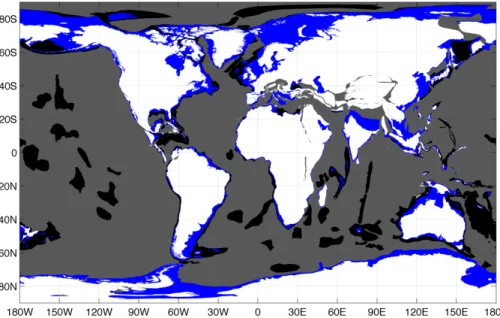
Starting from the present-day topography, the outlines of land, continental shelves and shallower regions such as intra-oceanic ridges and plateaus are defined. Using the re-construction model, these features are then shifted towards their positions at a chosen time frame (here: 38 Ma) and exported as a png image (Fig. 1) to create a rectangular coloured grid with a sufficiently high resolution to satisfy the intended grid of the final 15
reconstruction. The image can be imported by a computational program such as Mat-Lab for easy manipulation and conversion into a numerical grid. For its application as a climate model boundary condition, the final geographical reconstruction should be stored as a gridded (latitude–longitude) topography–bathymetry dataset. To start with, ocean bathymetry is estimated using the ocean floor age grid provided by Müller et al. 20
CPD
11, 4917–4942, 2015A generalised reconstruction
technique for palaeoclimate
modelling
M. Baatsen et al.
Title Page
Abstract Introduction
Conclusions References
Tables Figures
◭ ◮
◭ ◮
Back Close
Full Screen / Esc
Printer-friendly Version Interactive Discussion
Discussion
P
a
per
|
Discussion
P
a
per
|
Discussion
P
a
per
|
Discussion
P
a
per
|
(2006):
(
ZA<90 Ma=2620+330
√ A, ZA>90 Ma=5750,
(1)
whereZ is the basin depth in m andAthe ocean floor age in millions of years.
The method above can only be applied to regions where the ocean floor is still pre-served today, leaving large gaps where oceanic crust has subducted since the recon-5
struction time (e.g. the western and southeastern Pacific Ocean). An estimated palaeo-age grid was already translated into a rastered georeferenced bathymetry dataset by Müller et al. (2008a). This grid is, however, provided in a hotspot reference frame and thus needs to be converted to the palaeomagnetic reference frame used here in the scope of climate modelling (Hinsbergen et al., 2015). We applied this conversion by 10
fixing the entire bathymetry grid to Africa which is the central pole in both of the recon-struction frameworks. First, the movement of Africa in the past 38 Ma is reversed by using an adapted version of the Seton et al. (2012) rotation file such that it moves back to its present position starting from where it was at 38 Ma instead of the opposite. The bathymetry map (defined at 38 Ma) is then shifted to the configuration it would have at 15
the present day, disregarding the individual plate movements relative to Africa. Finally, the same is done using the (unaltered) rotation file of the (Torsvik et al., 2008) palaeo-magnetic framework, moving the bathymetry grid back to its configuration at 38 Ma as if it were made using this reconstruction model. After doing so, the adapted Müller et al. (2008a) depth grid fits within the continental margins of the plate-tectonic reconstruc-20
tion. In addition to the deep ocean, shallow basins and plateaus are adjusted to their present-day depth at the according 38 Ma positions, using the same plate movements of which the resulting boundary masks are shown in Fig. 1. Finally, all of the defined continental shelves are put to a fixed depth (200 m is taken here, values between 50 and 500 m are found in literature) as they mark the outer margins of continental crust, 25
CPD
11, 4917–4942, 2015A generalised reconstruction
technique for palaeoclimate
modelling
M. Baatsen et al.
Title Page
Abstract Introduction
Conclusions References
Tables Figures
◭ ◮
◭ ◮
Back Close
Full Screen / Esc
Printer-friendly Version Interactive Discussion
Discussion
P
a
per
|
Discussion
P
a
per
|
Discussion
P
a
per
|
Discussion
P
a
per
|
time frame (Sømme et al., 2009). Since the late Eocene is a greenhouse climate, a flat and relatively shallow shelf is implemented here but this can easily be done differently for other periods.
The next, more challenging step is creating a realistic land topography for a cho-sen time frame. Good estimates of altimetry are only available for a limited number 5
of locations and time intervals, making the reconstruction of palaeotopography a dif-ficult task that requires a lot of manual input. For example, the global Eocene topog-raphy by Markwick (1998) is still used and referred to regularly in palaeoclimate mod-elling. Our approach here is to first consider the present day topography (using the ETOPO2v2 dataset, http://www.ngdc.noaa.gov/mgg/global/relief/ETOPO2) and adjust 10
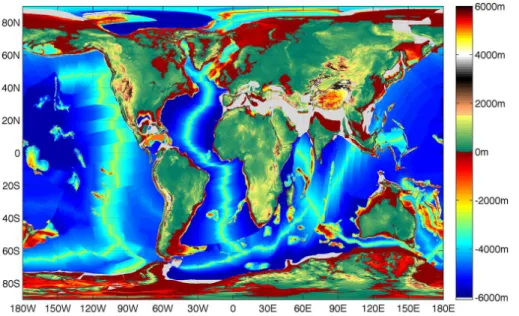
it to the 38 Ma configuration using the plate tectonic model and the land mask shown in Fig. 1. Later on, specific topographical features can be corrected manually, depend-ing on the specific demands of the application and the amount of information that is available. The resulting first stage of the reconstruction is given in Fig. 2.
3 Generic adjustments
15
The geography obtained at this stage (Fig. 2) is not yet accurate and contains a number of gaps that remain to be filled (mainly collision zones and transition regions between continental and oceanic crust). Especially the land topography needs to be adjusted so that it better matches palaeoaltimetry estimates for the considered time frame. Al-though glaciers possibly existed on Antarctica (Scher et al., 2014) and Greenland (El-20
drett et al., 2007), the presence of continental-scale ice sheets in the Eocene is unlikely (Deconto et al., 2008). Therefore, to correct for the effect of isostasy the present-day bedrock topography is raised by 1/3 of the current ice thickness. The changes mainly affect Greenland and Antarctica, although for the time window chosen in our exam-ple a highly detailed palaeotopography of Antarctica is made by Wilson et al. (2012). 25
CPD
11, 4917–4942, 2015A generalised reconstruction
technique for palaeoclimate
modelling
M. Baatsen et al.
Title Page
Abstract Introduction
Conclusions References
Tables Figures
◭ ◮
◭ ◮
Back Close
Full Screen / Esc
Printer-friendly Version Interactive Discussion
Discussion
P
a
per
|
Discussion
P
a
per
|
Discussion
P
a
per
|
Discussion
P
a
per
|
above, the reconstructed Antarctic palaeotopography is fixed to the plates defined in the plate-tectonic model and adjusted towards its 38 Ma configuration. In practice, only the area a.s.l. is incorporated in the reconstruction and combined with the previously determined bathymetry. This is done to avoid possible discrepancies between regions of the ocean floor that are reconstructed using different methods.
5
Although most of the ocean floor has been reconstructed, a large gap is still present in the Neotethyan region between Africa, Eurasia, India and Indochina. While in the circum-Pacifc area the crust lost to subduction was entirely oceanic, the former was characterised by mutliple continental collision and subduction episodes (Stampfli and Borel, 2002). The Neotethys is introduced manually, based on the incorporation of 10
GPlates reconstructions covering the Mediterranean region by Van Hinsbergen et al. (2012, 2014), the Arabia–Eurasia collision zone by McQuarrie and Van Hinsbergen (2013), the Arabia–India plate boundary zone by Gaina et al. (2015) and the India– Asia collision zone by Van Hinsbergen et al. (2011, 2012). A deep ocean basin with a depth of 4500 m is assumed, which is close to the value used in Müller et al. (2008a), 15
representing the Neotethys at 38 Ma.
Next, we adjust the elevation of several mountain ranges towards values that are more representative for the considered time frame. Since most of the current elevated regions underwent a considerable part of their uplift after the late Eocene (such as the Andes, Himalayas and East African Rift) they will have to be lowered, while eroded 20
regions may require some uplifting (for instance large river catchments). More specific changes for the example considered here will be discussed in more detail in Sect. 4, the result of the generic changes is first shown Fig. 3.
4 Specific adjustments for the late Eocene
The example shown thus far is largely representative for the late Eocene (38 Ma) ge-25
CPD
11, 4917–4942, 2015A generalised reconstruction
technique for palaeoclimate
modelling
M. Baatsen et al.
Title Page
Abstract Introduction
Conclusions References
Tables Figures
◭ ◮
◭ ◮
Back Close
Full Screen / Esc
Printer-friendly Version Interactive Discussion
Discussion
P
a
per
|
Discussion
P
a
per
|
Discussion
P
a
per
|
Discussion
P
a
per
|
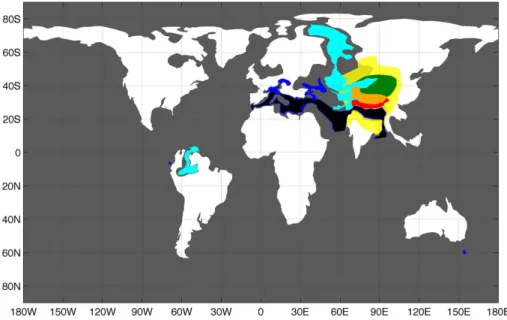
prior to and during the Eocene–Oligocene transition that had an impact on the global climate. A brief overview of these events and how their potential impacts are imple-mented specifically is given below and a map of the masks used to apply the various changes is provided in Fig. 4. The combined effect of these adjustments is indicated by the highlighted areas in Fig. 5, note that the effects of the land mask shown (in white) in 5
Fig. 4 have not yet been implemented. The latter is used to correct the land boundaries after the manipulations discussed in Sect. 5.
The collision between Greater India and Eurasia is causing profound changes to the surrounding geography (Van Hinsbergen et al., 2012). The Neotethys Ocean narrows due to the combined northward propagation of Africa and India, leaving the Mediter-10
ranean Sea and the northern Indian Ocean. Further north, a major intra-continental seaway known as the Paratethys covered much of central Europe and a considerable part of western Asia. This was mainly a shallow basin except for the South Caspian and Black Sea areas, as it was mostly underlain by unextended continental crust. The extent of the Paratethys as well as the distribution of the surrounding continents is 15
determined using the GPlates reconstructions mentioned in Sect. 3. The Neotethyan subduction-collision systems also create a large-scale uplift in southern Asia with pri-marily the formation of the Himalaya mountain range and the Tibetan Plateau. To the north and west, this uplift forces the westward retreat of the relatively shallow Paratethys leaving several isolated basins (Meulenkamp and Sissingh, 2003; Bosboom 20
et al., 2014a). In addition, the formation of a rift between Antarctica and South America causes the opening of the Drake Passage with the first formation of oceanic crust at around 35 Ma (Livermore et al., 2005). A similar process is taking place south of Aus-tralia with the formation of the Tasmanian Gateway. While its opening already occurs around 50 Ma, the Tasmanian Gateway initially remains shallow. Coincident with the 25
CPD
11, 4917–4942, 2015A generalised reconstruction
technique for palaeoclimate
modelling
M. Baatsen et al.
Title Page
Abstract Introduction
Conclusions References
Tables Figures
◭ ◮
◭ ◮
Back Close
Full Screen / Esc
Printer-friendly Version Interactive Discussion
Discussion
P
a
per
|
Discussion
P
a
per
|
Discussion
P
a
per
|
Discussion
P
a
per
|
both sank over time (Stickley et al., 2004; Close et al., 2009). Dependent on which absolute plate reconstruction frame is used, the opening of the Tasmanian Gateway can occur either to the north or south of 60◦S paleolatitude. This can have important consequences for the direction of a possible initial throughflow and again stresses the importance of correct paleogeographies in paleoclimate modelling. The related north-5
ward motion of Australia combined with the rotation and rifting taking place around Indochina also causes a gradual blocking of the Indonesian Throughflow during the Oligocene (Hall, 2002).
As was pointed out before, some smaller geographical features have also been treated individually. Mountain ranges that are believed to have experienced major up-10
lifts since the late Eocene are mainly the Andes, Himalayas, Sierra Nevada (USA), East African Rift and Middle East, which are all lowered significantly. The southern Tibetan Plateau was lowered more than the Himalayas since a narrow yet high ridge was already present while the adjacent plateau was still much lower (Van Hinsbergen et al., 2012). The northern part of the Tibetan Plateau is changed into lowland that 15
surrounds the retreating Paratethys in the Tarim Basin (Dupont-Nivet et al., 2008; Bos-boom et al., 2014b; Sobel et al., 2013). Related to the changes in Eurasia mentioned above, the narrow Tethys is drawn as a deep ocean while the Paratethys consists mainly of shallow seas with the Turgai Strait almost closed (Bosboom et al., 2014a). The latter forms the connection between the Arctic Ocean and the Paratethys and is an 20
important contributor to the water budget in Central Asia. During the Early Eocene, the Arctic Ocean may have been completely isolated as indicated by freshening reported in Brinkhuis et al. (2006). No such events have been documented for the late Eocene so here we assumed several relatively narrow and shallow channels to be open. The western part of the Amazon basin was still flooded during the late Eocene (Hoorn et al., 25
Creta-CPD
11, 4917–4942, 2015A generalised reconstruction
technique for palaeoclimate
modelling
M. Baatsen et al.
Title Page
Abstract Introduction
Conclusions References
Tables Figures
◭ ◮
◭ ◮
Back Close
Full Screen / Esc
Printer-friendly Version Interactive Discussion
Discussion
P
a
per
|
Discussion
P
a
per
|
Discussion
P
a
per
|
Discussion
P
a
per
|
ceous (Boschman et al., 2014). The Ninety-East Ridge (Slotnick et al., 2015) was also enhanced (made wider and higher) as it is a pronounced yet narrow feature in the east-ern Indian Ocean that would otherwise be obscured by smoothing later on. Regarding the areas discussed above, three masks are applied defining ocean (deep oceanic), sea (deep continental) and shallow basins (shallow continental) implying a depth of 5
4500, 1000 and 100 m, respectively.
5 Final modifications and smoothing
All major features of the geological reconstruction are now present but before it can be used as a numerical grid for a climate model simulation, some additional modifications still need to be made. Firstly, to estimate the remaining gaps where the altimetry or 10
bathymetry is still unknown, an interpolation is performed using theinpaintnalgorithm developed in Garcia (2010) and Wang et al. (2012). An additional land mask was made (shown in white in Fig. 4) containing regions that should be a.s.l. to avoid creating arti-ficial basins with this technique. The land mask is based on several global reconstruc-tions such as those made by Dr. R. Blakey (https://www2.nau.edu/rcb7/globaltext2. 15
html) and Dr. C. R. Scotese (http://www.scotese.com/earth.htm).
Secondly, during most of the past climate periods sea level was different from today due to changes in ocean water volume, as influenced by ice sheet volume and steric effects, as well as varying global ocean basin volume, related to the average ocean floor age, shelf depth and continental distribution. In the late Eocene, mean sea level 20
was about 100 m above that of today (Müller et al., 2008b), so we decrease the eleva-tion (and similarly increase the depth) of all data points by 100 m to correct for this. The depths that were implemented before, using the masks shown in Fig. 4, were initially corrected so they end up being the actual values stated above after changing the global sea level (such that an area assigned to be e.g. 1000 m deep does not end up being 25
CPD
11, 4917–4942, 2015A generalised reconstruction
technique for palaeoclimate
modelling
M. Baatsen et al.
Title Page
Abstract Introduction
Conclusions References
Tables Figures
◭ ◮
◭ ◮
Back Close
Full Screen / Esc
Printer-friendly Version Interactive Discussion
Discussion
P
a
per
|
Discussion
P
a
per
|
Discussion
P
a
per
|
Discussion
P
a
per
|
time. For instance, river basins such as the Amazon, Rio de la Plata, Congo and Mis-sissippi were just carved out deeper after the sea level dropped and other depressions were only created during glacial periods (e.g. the Great Lakes).
Finally, the application of the geographical reconstruction will usually be at a lower resolution than the one used until now (0.1◦) and the high level of detail in the present-5
day topography may be misleading with respect to how precise palaeotopography is actually known. The last step is then to apply a squared smoothing mask, performing a 2-dimensional running mean with a 1◦ width for the example, of which the result is shown in Fig. 6. The mask size can be chosen differently and after smoothing, the global geography data is extrapolated onto the desired output grid (e.g., longitude– 10
latitude) to be stored as a NetCDF file.
6 Conclusions
We have presented a new method to create global geographical reconstructions that can be used as boundary conditions in palaeoclimate model simulations. Starting from a plate-tectonic reconstruction, the depth of the ocean floor was estimated and com-15
bined with a reconfigured present day topography. An overview of the different steps making up the procedure is given in Fig. 7. Reconstructed plate trajectories, a back-ground rotational frame and a set of boundary lines are fed into GPlates to make a global plate-tectonic reconstruction for a particular time frame. Within the same setup, present day topography and ocean floor data are manipulated and shifted to fit the 20
same geographical configuration as the rest of the output. The latter is then used in a MatLab script together with some external input (mostly from literature) to create a global gridded altimetry–bathymetry dataset that is stored as a NetCDF file. This re-sults in a highly detailed dataset that needs some time-specific changes, after which it is smoothed and extrapolated onto the desired computational grid.
25
reconstruc-CPD
11, 4917–4942, 2015A generalised reconstruction
technique for palaeoclimate
modelling
M. Baatsen et al.
Title Page
Abstract Introduction
Conclusions References
Tables Figures
◭ ◮
◭ ◮
Back Close
Full Screen / Esc
Printer-friendly Version Interactive Discussion
Discussion
P
a
per
|
Discussion
P
a
per
|
Discussion
P
a
per
|
Discussion
P
a
per
|
tions with limited effort. The primary focus was to use a plate tectonics model not originally designed to create numerical grids as output, that can be altered afterwards without having to run through the entire process again (only some of the masks may need to be redefined). Creating a new grid for a different point in time or a new configu-ration (e.g. using a different rotation framework) should allow the user to make multiple 5
reconstructions in a few days’ time. In case of a time slice experiment, one can also create appropriate boundary conditions for each time frame instead of making some minor adjustments to an average geography, to really try and catch the effect of grad-ual but global changes. The amount of mangrad-ual handling depends on the demands of a specific application and can consequently be very limited but the procedure does not 10
inhibit additional adjustments for further detail and correctness. In the example above, the output grid is defined as having a 0.1◦ resolution but can easily be extrapolated onto a coarser grid, which may require some more elaborate smoothing.
As the procedure starts from a plate tectonic model, most of the features important for modelling applications are quite realistic. The width and depth of ocean basins, 15
presence of oceanic ridges and plateaus, position of continents and opening or closing of gateways are all directly incorporated in the final result. The set of boundaries shown in Fig. 1 are coupled to individual plates and can easily be linked to a different recon-struction framework. When comparing the result (Fig. 6) to other recent reconrecon-structions used in palaeoclimate modelling, several differences quickly become evident. For in-20
stance, the global geography used in Ladant et al. (2014) is coarser and contains less detail in both land topography and ocean bathymetry. The Southern Ocean gateways are also much wider, which is probably a result of both the large grid spacing used for the climate model and the difference in time frame considered as this reconstruction is based on an Oligocene geography Lefebvre et al. (2012). Herold et al. (2014) have 25
CPD
11, 4917–4942, 2015A generalised reconstruction
technique for palaeoclimate
modelling
M. Baatsen et al.
Title Page
Abstract Introduction
Conclusions References
Tables Figures
◭ ◮
◭ ◮
Back Close
Full Screen / Esc
Printer-friendly Version Interactive Discussion
Discussion
P
a
per
|
Discussion
P
a
per
|
Discussion
P
a
per
|
Discussion
P
a
per
|
the contours of an older reconstruction can still be added but changing the relative positions of various land masses is not straightforward.
In summary, the reconstruction method presented here can provide detailed palaeo-geographical datasets with relative ease for climate model studies and permits users to customise the result to their specific needs. This should facilitate the communication 5
between geologists and climate modellers in their efforts to improve the quality and consistency of future palaeoclimate simulations.
The Supplement related to this article is available online at doi:10.5194/cpd-11-4917-2015-supplement.
Acknowledgements. This work was carried out under the program of the Netherlands Earth
10
System Science Centre (NESSC).
The authors would like to thank Nadine McQuarrie, Alexis Licht, Guillaume Dupont-Nivet, Christopher R. Scotese, Dietmar Müller, Mathew Huber and Robert M. DeConto for their advice and help to make the reconstruction presented here.
References
15
Barron, E. J. and Washington, W. M.: The role of geographic variables in explaining paleo-climates: results from Cretaceous climate model sensitivity studies, J. Geophys. Res., 89, 1267, doi:10.1029/JD089iD01p01267, 1984. 4919
Bijl, P. K., Schouten, S., Sluijs, A., Reichart, G.-J., Zachos, J. C., and Brinkhuis, H.: Early Palaeogene temperature evolution of the southwest Pacific Ocean, Nature, 461, 776–779,
20
doi:10.1038/nature08399, 2009. 4919
Bijl, P. K., Bendle, J. A. P., Bohaty, S. M., Pross, J., Schouten, S., Tauxe, L., Stickley, C. E., McKay, R. M., Röhl, U., Olney, M., Sluijs, A., Escutia, C., and Brinkhuis, H.: Eocene cooling linked to early flow across the Tasmanian Gateway, P. Natl. Acad. Sci. USA, 110, 9645–50, doi:10.1073/pnas.1220872110, 2013. 4920, 4925
CPD
11, 4917–4942, 2015A generalised reconstruction
technique for palaeoclimate
modelling
M. Baatsen et al.
Title Page
Abstract Introduction
Conclusions References
Tables Figures
◭ ◮
◭ ◮
Back Close
Full Screen / Esc
Printer-friendly Version Interactive Discussion
Discussion
P
a
per
|
Discussion
P
a
per
|
Discussion
P
a
per
|
Discussion
P
a
per
|
Bosboom, R., Dupont-Nivet, G., Grothe, A., Brinkhuis, H., Villa, G., Mandic, O., Stoica, M., Huang, W., Yang, W., Guo, Z., and Krijgsman, W.: Linking Tarim Basin sea retreat (west China) and Asian aridification in the late Eocene, Basin Research, 26, 621–640, doi:10.1111/bre.12054, 2014a. 4925, 4926
Bosboom, R., Dupont-Nivet, G., Grothe, A., Brinkhuis, H., Villa, G., Mandic, O., Stoica, M.,
5
Kouwenhoven, T., Huang, W., Yang, W., and Guo, Z.: Timing, cause and impact of the late Eocene stepwise sea retreat from the Tarim Basin (west China), Palaeogeogr. Palaeocl., 403, 101–118, doi:10.1016/j.palaeo.2014.03.035, 2014b. 4926
Boschman, L., Hinsbergen, D. V., Torsvik, T., Spakman, W., and Pindell, J.: Kinematic re-construction of the Caribbean region since the Early Jurassic, Earth Sci. Rev., 16, 6829,
10
doi:10.1016/j.earscirev.2014.08.007, 2014. 4926, 4927
Boyden, J. A., Müller, R. D., Gurnis, M., Torsvik, T. H., Clark, J. A., Turner, M., Ivey-Law, H., Wat-son, R. J., and Cannon, J. J.: Next-generation plate-tectonic reconstructions using GPlates, in: Geoinformatics, edited by: Keller, G. R. and Baru, C., Cambridge Books Online, Cam-bridge University Press, CamCam-bridge, 95–114, doi:10.1017/CBO9780511976308.008 (last
ac-15
cess: 12 October 2015), 2011. 4921
Brinkhuis, H., Schouten, S., Collinson, M. E., Sluijs, A., Sinninghe Damsté, J. S., Dickens, G. R., Huber, M., Cronin, T. M., Onodera, J., Takahashi, K., Bujak, J. P., Stein, R., van der Burgh, J., Eldrett, J. S., Harding, I. C., Lotter, A. F., Sangiorgi, F., van Konijnenburg-van Cittert, H., de Leeuw, J. W., Matthiessen, J., Backman, J., and Moran, K.: Episodic fresh surface waters
20
in the Eocene Arctic Ocean, Nature, 441, 606–609, doi:10.1038/nature04692, 2006. 4926 Caves, J. K., Sjostrom, D. J., Mix, H. T., Winnick, M. J., and Chamberlain, C. P.: Aridification of
Central Asia and uplift of the Altai and Hangay Mountains, Mongolia: stable isotope evidence, Am. J. Sci., 314, 1171–1201, doi:10.2475/08.2014.01, 2014. 4919
Close, D. I., Watts, a. B., and Stagg, H. M. J.: A marine geophysical study of the Wilkes Land
25
rifted continental margin, Antarctica, Geophys. J. Int., 177, 430–450, doi:10.1111/j.1365-246X.2008.04066.x, 2009. 4926
Crosby, a. G., McKenzie, D., and Sclater, J. G.: The relationship between depth, age and gravity in the oceans, Geophys. J. Int., 166, 553–573, doi:10.1111/j.1365-246X.2006.03015.x, 2006. 4921
30
CPD
11, 4917–4942, 2015A generalised reconstruction
technique for palaeoclimate
modelling
M. Baatsen et al.
Title Page
Abstract Introduction
Conclusions References
Tables Figures
◭ ◮
◭ ◮
Back Close
Full Screen / Esc
Printer-friendly Version Interactive Discussion
Discussion
P
a
per
|
Discussion
P
a
per
|
Discussion
P
a
per
|
Discussion
P
a
per
|
Dupont-Nivet, G., Krijgsman, W., Langereis, C. G., Abels, H. A., Dai, S., and Fang, X.: Tibetan plateau aridification linked to global cooling at the Eocene–Oligocene transition, Nature, 445, 635–638, doi:10.1038/nature05516, 2007. 4919
Dupont-Nivet, G., Hoom, C., and Konert, M.: Tibetan uplift prior to the Eocene–Oligocene cli-mate transition: evidence from pollen analysis of the Xining Basin, Geology, 36, 987–990,
5
doi:10.1130/G25063A.1, 2008. 4919, 4920, 4926
Eldrett, J. S., Harding, I. C., Wilson, P. A., Butler, E., and Roberts, A. P.: Continental ice in Green-land during the Eocene and Oligocene, Nature, 446, 176–179, doi:10.1038/nature05591, 2007. 4923
Gaina, C., Hinsbergen, D. J. J., and Spakman, W.: Tectonic interactions between India and
Ara-10
bia since the Jurassic reconstructed from marine geophysics, ophiolite geology, and seismic tomography, Tectonics, 34, doi:10.1002/2014TC003780, 2015. 4924
Garcia, D.: Robust smoothing of gridded data in one and higher dimensions with missing values, Comput. Stat. Data Anal., 54, 1167–1178, doi:10.1016/j.csda.2009.09.020, 2010. 4927 Gasson, E., Lunt, D. J., DeConto, R., Goldner, A., Heinemann, M., Huber, M., LeGrande, A. N.,
15
Pollard, D., Sagoo, N., Siddall, M., Winguth, A., and Valdes, P. J.: Uncertainties in the mod-elled CO2threshold for Antarctic glaciation, Clim. Past, 10, 451–466, doi:10.5194/cp-10-451-2014, 2014. 4920
Hall, R.: Cenozoic geological and plate tectonic evolution of SE Asia and the SW Pacific, J. Asian Earth Sci., 20, 353–434, 2002. 4926
20
Herold, N., Buzan, J., Seton, M., Goldner, A., Green, J. A. M., Müller, R. D., Markwick, P., and Huber, M.: A suite of early Eocene (∼55 Ma) climate model boundary conditions, Geosci. Model Dev., 7, 2077–2090, doi:10.5194/gmd-7-2077-2014, 2014. 4929
Hinsbergen, D. J. J. V., Groot, L. V. D., and Schaik, S. J. V.: A paleolatitude calculator for paleoclimate studies, Zenodo, 1–21, doi:10.5281/zenodo.16166, 2015. 4921, 4922, 4942
25
Hoorn, C., Wesselingh, F. P., ter Steege, H., Bermudez, M. A., Mora, A., Sevink, J., Sanmartín, I., Sanchez-Meseguer, A., Anderson, C. L., Figueiredo, J. P., Jaramillo, C., Riff, D., Negri, F. R., Hooghiemstra, H., Lundberg, J., Stadler, T., Särkinen, T., and Antonelli, A.: Amazonia through time: Andean uplift, climate change, landscape evolution, and biodiversity, Science, 330, 927–931, doi:10.1126/science.1194585, 2010. 4926
30
CPD
11, 4917–4942, 2015A generalised reconstruction
technique for palaeoclimate
modelling
M. Baatsen et al.
Title Page
Abstract Introduction
Conclusions References
Tables Figures
◭ ◮
◭ ◮
Back Close
Full Screen / Esc
Printer-friendly Version Interactive Discussion
Discussion
P
a
per
|
Discussion
P
a
per
|
Discussion
P
a
per
|
Discussion
P
a
per
|
Ladant, J.-B., Donnadieu, Y., and Dumas, C.: Links between CO2, glaciation and water flow: reconciling the Cenozoic history of the Antarctic Circumpolar Current, Clim. Past, 10, 1957– 1966, doi:10.5194/cp-10-1957-2014, 2014. 4929
Lefebvre, V., Donnadieu, Y., Sepulchre, P., Swingedouw, D., and Zhang, Z. S.: Deciphering the role of southern gateways and carbon dioxide on the onset of the Antarctic Circumpolar
5
Current, Paleoceanography, 27, 1–9, doi:10.1029/2012PA002345, 2012. 4929
Livermore, R., Nankivell, A., Eagles, G., and Morris, P.: Paleogene opening of Drake Passage, Earth Planet. Sci. Lett., 236, 459–470, doi:10.1016/j.epsl.2005.03.027, 2005. 4925
Markwick, P. J.: Fossil crocodilians as indicators of Late Cretaceous and Cenozoic climates: Implications for using palaeontological data in reconstructing palaeoclimate, Palaeogeogr.
10
Palaeocl., 137, 205–271, doi:10.1016/S0031-0182(97)00108-9, 1998. 4923
McQuarrie, N. and Van Hinsbergen, D. J. J.: Retrodeforming the Arabia-Eurasia collision zone: Age of collision versus magnitude of continental subduction, Geology, 41, 315–318, doi:10.1130/G33591.1, 2013. 4924
Meulenkamp, J. E. and Sissingh, W.: Tertiary palaeogeography and tectonostratigraphic
evolu-15
tion of the Northern and Southern Peri-Tethys platforms and the intermediate domains of the African–Eurasian convergent plate boundary zone, Palaeogeogr. Palaeocl., 196, 209–228, doi:10.1016/S0031-0182(03)00319-5, 2003. 4925
Müller, R. D., Sdrolias, M., Gaina, C., and Roest, W. R.: Age, spreading rates, and spreading asymmetry of the world’s ocean crust, Geochem. Geophy., Geosy., 9, 1–19,
20
doi:10.1029/2007GC001743, 2008a. 4921, 4922, 4924, 4937
Müller, R. D., Sdrolias, M., Gaina, C., Steinberger, B., and Heine, C.: Long-term sea-level fluctuations driven by ocean basin dynamics, Science, 319, 1357–1362, doi:10.1126/science.1151540, 2008b. 4927
Ramstein, G., Fluteau, F., Besse, J., and Joussaume, S.: Effect of orogeny, plate motion and
25
land–sea distribution on Eurasian climate change over the past 30 million years, Nature, 386, 788–795, doi:10.1038/386788a0, 1997. 4919
Scher, H. D., Bohaty, S. M., Smith, B. W., and Munn, G. H.: Eocene glaciation, Paleoceanogra-phy, 29, 628–644, doi:10.1002/2014PA002648, 2014. 4923
Seton, M., Müller, R. D., Zahirovic, S., Gaina, C., Torsvik, T., Shephard, G., Talsma, A.,
Gur-30
CPD
11, 4917–4942, 2015A generalised reconstruction
technique for palaeoclimate
modelling
M. Baatsen et al.
Title Page
Abstract Introduction
Conclusions References
Tables Figures
◭ ◮
◭ ◮
Back Close
Full Screen / Esc
Printer-friendly Version Interactive Discussion
Discussion
P
a
per
|
Discussion
P
a
per
|
Discussion
P
a
per
|
Discussion
P
a
per
|
Sijp, W. P., von der Heydt, A. S., Dijkstra, H. A., Flögel, S., Douglas, P. M. J., and Bijl, P. K.: The role of ocean gateways on cooling climate on long time scales, Global Planet. Change, 119, 1–22, doi:10.1016/j.gloplacha.2014.04.004, 2014. 4920
Slotnick, B. S., Lauretano, V., Backman, J., Dickens, G. R., Sluijs, A., and Lourens, L.: Early Paleogene variations in the calcite compensation depth: new constraints using old borehole
5
sediments from across Ninetyeast Ridge, central Indian Ocean, Clim. Past, 11, 473–493, doi:10.5194/cp-11-473-2015, 2015. 4927
Sømme, T. O., Helland-Hansen, W., and Granjeon, D.: Impact of eustatic amplitude variations on shelf morphology, sediment dispersal, and sequence stratigraphic interpretation: Ice-house versus greenIce-house systems, Geology, 37, 587–590, doi:10.1130/G25511A.1, 2009.
10
4923
Sobel, E. R., Chen, J., Schoenbohm, L. M., Thiede, R., Stockli, D. F., Sudo, M., and Strecker, M. R.: Oceanic-style subduction controls late Cenozoic deformation of the Northern Pamir orogen, Earth Planet. Sci. Lett., 363, 204–218, doi:10.1016/j.epsl.2012.12.009, 2013. 4926 Stampfli, G. M. and Borel, G. D.: A plate tectonic model for the Paleozoic and Mesozoic
con-15
strained by dynamic plate boundaries and restored syntetic ocean isochrons, Earth Planet. Sci. Lett., 196, 17–33, 2002. 4924
Stickley, C. E., Brinkhuis, H., Schellenberg, S. A., Sluijs, A., Röhl, U., Fuller, M., Grauert, M., Huber, M., Warnaar, J., and Williams, G. L.: Timing and nature of the deepening of the Tasmanian Gateway, Paleoceanography, 19, 1–18, doi:10.1029/2004PA001022, 2004. 4926
20
Torsvik, T. H., Mu, R. D., Voo, R. V. D., Steinberger, B., Gaina, C., and Mu, R. D.: Global plate motion frames, Rev. Geophys., 46, 1–44, doi:10.1029/2007RG000227, 2008. 4921, 4922, 4942
Van Hinsbergen, D. J. J., Kapp, P., Dupont-Nivet, G., Lippert, P. C., Decelles, P. G., and Torsvik, T. H.: Restoration of Cenozoic deformation in Asia and the size of Greater India, Tectonics,
25
30, 1–31, doi:10.1029/2011TC002908, 2011. 4924
van Hinsbergen, D. J. J., Lippert, P. C., Dupont-Nivet, G., McQuarrie, N., Doubrovine, P. V., Spakman, W., and Torsvik, T. H.: Greater India Basin hypothesis and a two-stage Cenozoic collision between India and Asia, P. Natl. Acad. Sci. USA, 109, 7659–7664, doi:10.1073/pnas.1117262109, 2012. 4924, 4925, 4926
30
CPD
11, 4917–4942, 2015A generalised reconstruction
technique for palaeoclimate
modelling
M. Baatsen et al.
Title Page
Abstract Introduction
Conclusions References
Tables Figures
◭ ◮
◭ ◮
Back Close
Full Screen / Esc
Printer-friendly Version Interactive Discussion
Discussion
P
a
per
|
Discussion
P
a
per
|
Discussion
P
a
per
|
Discussion
P
a
per
|
Wang, G., Garcia, D., Liu, Y., de Jeu, R., and Johannes Dolman, A.: A three-dimensional gap filling method for large geophysical datasets: application to global satellite soil moisture ob-servations, Environ. Modell. Softw., 30, 139–142, doi:10.1016/j.envsoft.2011.10.015, 2012. 4927
Wilson, D. S., Jamieson, S. S. R., Barrett, P. J., Leitchenkov, G., Gohl, K., and Larter, R. D.:
5
CPD
11, 4917–4942, 2015A generalised reconstruction
technique for palaeoclimate
modelling
M. Baatsen et al.
Title Page
Abstract Introduction
Conclusions References
Tables Figures
◭ ◮
◭ ◮
Back Close
Full Screen / Esc
Printer-friendly Version Interactive Discussion
Discussion
P
a
per
|
Discussion
P
a
per
|
Discussion
P
a
per
|
Discussion
P
a
per
|
CPD
11, 4917–4942, 2015A generalised reconstruction
technique for palaeoclimate
modelling
M. Baatsen et al.
Title Page
Abstract Introduction
Conclusions References
Tables Figures
◭ ◮
◭ ◮
Back Close
Full Screen / Esc
Printer-friendly Version Interactive Discussion
Discussion
P
a
per
|
Discussion
P
a
per
|
Discussion
P
a
per
|
Discussion
P
a
per
|
CPD
11, 4917–4942, 2015A generalised reconstruction
technique for palaeoclimate
modelling
M. Baatsen et al.
Title Page
Abstract Introduction
Conclusions References
Tables Figures
◭ ◮
◭ ◮
Back Close
Full Screen / Esc
Printer-friendly Version Interactive Discussion
Discussion
P
a
per
|
Discussion
P
a
per
|
Discussion
P
a
per
|
Discussion
P
a
per
|
CPD
11, 4917–4942, 2015A generalised reconstruction
technique for palaeoclimate
modelling
M. Baatsen et al.
Title Page
Abstract Introduction
Conclusions References
Tables Figures
◭ ◮
◭ ◮
Back Close
Full Screen / Esc
Printer-friendly Version Interactive Discussion
Discussion
P
a
per
|
Discussion
P
a
per
|
Discussion
P
a
per
|
Discussion
P
a
per
|
CPD
11, 4917–4942, 2015A generalised reconstruction
technique for palaeoclimate
modelling
M. Baatsen et al.
Title Page
Abstract Introduction
Conclusions References
Tables Figures
◭ ◮
◭ ◮
Back Close
Full Screen / Esc
Printer-friendly Version Interactive Discussion
Discussion
P
a
per
|
Discussion
P
a
per
|
Discussion
P
a
per
|
Discussion
P
a
per
|
CPD
11, 4917–4942, 2015A generalised reconstruction
technique for palaeoclimate
modelling
M. Baatsen et al.
Title Page
Abstract Introduction
Conclusions References
Tables Figures
◭ ◮
◭ ◮
Back Close
Full Screen / Esc
Printer-friendly Version Interactive Discussion
Discussion
P
a
per
|
Discussion
P
a
per
|
Discussion
P
a
per
|
Discussion
P
a
per
|
CPD
11, 4917–4942, 2015A generalised reconstruction
technique for palaeoclimate
modelling
M. Baatsen et al.
Title Page
Abstract Introduction
Conclusions References
Tables Figures
◭ ◮
◭ ◮
Back Close
Full Screen / Esc
Printer-friendly Version Interactive Discussion
Discussion
P
a
per
|
Discussion
P
a
per
|
Discussion
P
a
per
|
Discussion
P
a
per
|