HESSD
12, 3319–3348, 2015Moving sociohydrology forward: a synthesis
across studies
T. J. Troy et al.
Title Page
Abstract Introduction
Conclusions References
Tables Figures
◭ ◮
◭ ◮
Back Close
Full Screen / Esc
Printer-friendly Version
Interactive Discussion
Discussion
P
a
per
|
Discussion
P
a
per
|
Discussion
P
a
per
|
Discussion
P
a
per
|
Hydrol. Earth Syst. Sci. Discuss., 12, 3319–3348, 2015 www.hydrol-earth-syst-sci-discuss.net/12/3319/2015/ doi:10.5194/hessd-12-3319-2015
© Author(s) 2015. CC Attribution 3.0 License.
This discussion paper is/has been under review for the journal Hydrology and Earth System Sciences (HESS). Please refer to the corresponding final paper in HESS if available.
Moving sociohydrology forward: a
synthesis across studies
T. J. Troy1, M. Konar2, V. Srinivasan3, and S. Thompson4
1
Department of Civil and Environmental Engineering, Lehigh University, STEPS 9A, 1 W. Packer Ave, Bethlehem, PA 18015, USA
2
Department of Civil and Environmental Engineering, University of Illinois at Urbana-Champaign, 2525 Hydrosystems Laboratory, 205 N. Mathews Ave., Urbana, IL 61801, USA
3
Ashoka Trust for Research in Ecology and the Environment, Royal Enclave Sriramapura, Jakkur Post, Bangalore, 560 064, Karnataka, India
4
Department of Civil and Environmental Engineering, University of California, Berkeley, 661 Davis Hall, Berkeley, CA 94720, USA
Received: 2 March 2015 – Accepted: 6 March 2015 – Published: 25 March 2015
Correspondence to: T. J. Troy ([email protected])
HESSD
12, 3319–3348, 2015Moving sociohydrology forward: a synthesis
across studies
T. J. Troy et al.
Title Page
Abstract Introduction
Conclusions References
Tables Figures
◭ ◮
◭ ◮
Back Close
Full Screen / Esc
Printer-friendly Version
Interactive Discussion
Discussion
P
a
per
|
Discussion
P
a
per
|
Discussion
P
a
per
|
Discussion
P
a
per
Abstract
Sociohydrology is the study of coupled human–water systems with the premise that water and human systems co-evolve, often with two-way coupling. A recent special issue in HESS/ESD, “Predictions under change: water, earth, and biota in the Anthro-pocene,” includes a number of sociohydrologic publications that allow for a survey of
5
the current state of understanding of sociohydrology and the coupled system dynam-ics and feedbacks, the research methodologies available, and the norms and ethdynam-ics in-volved in studying sociohydrologic systems. Although sociohydrology is concerned with coupled human–water systems, it is critical to consider the sociohydrologic system as embedded in a larger, complex social–ecological system through which human–water
10
feedbacks can occur and from which the sociohydrologic system cannot be isolated. As such, sociohydrology can draw on tools developed in the social–ecological and com-plex systems literature to further our sociohydrologic knowledge, and this is identified as a ripe area of future research.
1 Introduction
15
Many of the major improvements in hydrology in the past decades are grounded in the understanding of natural systems. The significant modification of the water cycle by human activity has primarily been treated as an external perturbation to such natural systems. Externalizing the dependencies between human action and the availability, quality and dynamics of water clearly poses limitations to making predictions about
20
water within the Anthropocene (Thompson et al., 2013). To address these limitations, a new generation of studies now focus onsociohydrology, which aims to understand the dynamics and co-evolution of coupled human–water systems (Sivapalan et al., 2012). Within sociohydrology, humans and their activities are considered as part of the water cycle, rather than an external driver (Sivapalan et al., 2012). The interplay of
25
HESSD
12, 3319–3348, 2015Moving sociohydrology forward: a synthesis
across studies
T. J. Troy et al.
Title Page
Abstract Introduction
Conclusions References
Tables Figures
◭ ◮
◭ ◮
Back Close
Full Screen / Esc
Printer-friendly Version
Interactive Discussion
Discussion
P
a
per
|
Discussion
P
a
per
|
Discussion
P
a
per
|
Discussion
P
a
per
|
topic of research interest. Improved understanding of the relationships between human decision-making (as it pertains to water systems) and the condition of the water system itself may lead to better prediction, and thus management, of water systems.
This joint Hydrology and Earth System Sciences/Earth System Dynamics special issue, “Predictions under change: water, earth, and biota in the Anthropocene,”
con-5
tains a number of sociohydrology-focused studies, which can be taken to represent the current state of this emerging field. Here we take the opportunity to use these studies as a basis for a synthesis of the emerging questions and challenges that the research community faces as it grapples with the nature and practice of sociohydrology. Three major themes emerge for further consideration: (i) the state of our understanding of
10
the coupling between human society and hydrology, (ii) the strengths and new oppor-tunities in the suite of research approaches used within sociohydrology, and (iii) the normative and ethical questions that arise in the context of sociohydrologic research, which are often neglected in research on the hydrology of natural systems.
2 State of understanding of sociohydrology: water – society dynamics
15
Sociohydrology is conceptualized as the study of how water systems and human so-ciety develop in tandem. This conceptualization is conditioned on there being con-nections, coupling and feedback between elements of the water cycle and elements of the society being studied. In this sense, sociohydrology isolates a suite of spe-cific processes from within a broader social–ecological system (SES) comprising the
20
resources, users, and governance subsystems relevant to a given society (Ostrom, 2009). An SES is a type of complex system, which can be differentiated from other
dynamical systems by the presence of multiple interacting components, local connec-tions and nonlinear relaconnec-tionships between the components (Levin, 1998; Solé and Bas-compte, 2006). As a consequence of these features, complex systems can display
25
HESSD
12, 3319–3348, 2015Moving sociohydrology forward: a synthesis
across studies
T. J. Troy et al.
Title Page
Abstract Introduction
Conclusions References
Tables Figures
◭ ◮
◭ ◮
Back Close
Full Screen / Esc
Printer-friendly Version
Interactive Discussion
Discussion
P
a
per
|
Discussion
P
a
per
|
Discussion
P
a
per
|
Discussion
P
a
per
pose major challenges to modeling, inference and analysis in general. Sociohydrology therefore faces the challenge of identifying the pathways of influence between water and social responses within a broader and more complex web of cause-and-effect
represented by a society and its dependence on and regulation of the use of natural resources.
5
Isolating the sociohydrologic components of an SES is non-trivial since water re-sources affect many of the other resources within the SES. Thus, a sociohydrologic
relationship may arise directly – for example a direct relationship between reduced wellbeing and water scarcity (Srinivasan, 2015) – or indirectly, for example a relation-ship between economic output from a fishery and water quality. Fundamentally, the
10
presence of multiple pathways for coupling between water and society, and for these pathways to occur indirectly and to be influenced by other components of the system, suggests the study of sociohydrology is prototypical of complex systems science. Typi-cal of complex systems, sociohydrologic systems are likely to exhibit nonlinear dynam-ics and thresholds (Liu et al., 2007) with scale mismatches between the two systems
15
(Cumming et al., 2006). Examples of these effects as revealed by the studies presented
in the Special Issue are outlined below. Methodologically, framing sociohydrology as an SES suggests that techniques used in the SES and coupled natural-human systems research fields should advance sociohydrology (see Sect. 3).
In an idealized sense, sociohydrology aims to understand the co-evolution of
hu-20
man and water systems and thus posits that a two-way coupling exists between these systems. Individual case studies, however, exhibit tremendous variability in terms of strength of the relationships between water and society, in the pertinent response timescales, and in one-way vs. two-way coupling. Two-way coupling becomes evident only when an observation window is long enough to reveal slow changes in either
sys-25
tem, and when the influence of water on society, or vice-versa, is sufficiently direct that
influ-HESSD
12, 3319–3348, 2015Moving sociohydrology forward: a synthesis
across studies
T. J. Troy et al.
Title Page
Abstract Introduction
Conclusions References
Tables Figures
◭ ◮
◭ ◮
Back Close
Full Screen / Esc
Printer-friendly Version
Interactive Discussion
Discussion
P
a
per
|
Discussion
P
a
per
|
Discussion
P
a
per
|
Discussion
P
a
per
|
ence of water→humans and humans→water, and it is possible that in some cases
one-way influences are all that exists.
The spatial scale on which a sociohydrologic system is conceptualized can also influ-ence the way that coupling emerges. For example, national food prices can influinflu-ence the number of acres planted for agricultural production, with flow-on effects on irri-5
gation water demands and streamflow availability. Energy extraction technology and market dynamics have made hydraulic fracking much more attractive in many regions, which may then impact the local sociohydrologic system through water requirements and pollution concerns. While regional or global models can internalize these dynam-ics, smaller-scale models may be forced to treat them as external, and thus one-way,
10
drivers of sociohydrology.
Finally, several examples where human and water systems are tightly coupled, but only develop on an intermittent basis, can be found. Kumar (2011) call this intermit-tency “dynamic connectivity”, arising along a continuum or as threshold behavior. This appears to be particularly true for human–water interactions in the flooding context, but
15
hydrology also appears to be dynamically connected to society under conditions that can lead to conditions of water crisis. The clear challenge, of course, is predicting when such crises – and thus tight sociohydrologic coupling – will arise.
2.1 Feedbacks within a sociohydrologic system
Sociohydrologic systems are embedded within complex socio-ecologic systems, and
20
the clear identification of the pathways by which water influences social change, and social actions alter the water cycle is complicated by separation in timescales, in spa-tial scales, and by the presence of indirect pathways of influence through other compo-nents of the SES. Unsurprisingly, therefore, only a susbet of the studies in the literature describe the idealized, fully-coupled sociohydrologic system (Sivapalan et al., 2012).
25
HESSD
12, 3319–3348, 2015Moving sociohydrology forward: a synthesis
across studies
T. J. Troy et al.
Title Page
Abstract Introduction
Conclusions References
Tables Figures
◭ ◮
◭ ◮
Back Close
Full Screen / Esc
Printer-friendly Version
Interactive Discussion
Discussion
P
a
per
|
Discussion
P
a
per
|
Discussion
P
a
per
|
Discussion
P
a
per
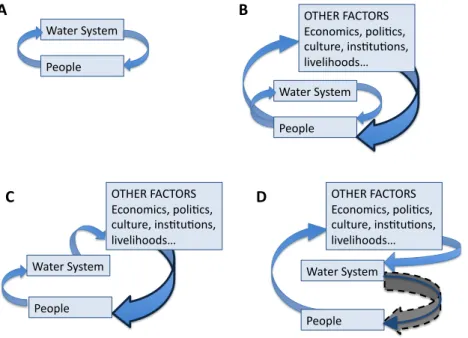
In others, an element of the coupling may be dynamic and the feedback can only oc-cur under certain conditions (Fig. 1d). Table 1 provides a summary of feedbacks in the studies in this Special Issue.
2.1.1 One-directional influence
The majority of the papers in the special issue focus on one-way influences, with many
5
studies remaining within the “natural systems paradigm” in which human action is ex-ternalized and treated as a perturbation to a natural hydrologic regime. For exam-ple, studies considered the effects of land use change altering the hydrologic regime,
through increased irrigation in the Heihe River in China (Zhang et al., 2014), alterations to the water cycle through tile drainage (Yaeger et al., 2013), irrigation from
groundwa-10
ter in the midwestern US (Zeng and Cai, 2013), and deforestation in eastern Mexico (Muñoz-Villers and McDonnell, 2013). The one-way nature of influence in these stud-ies likely results from a timescale separation between the rapid timescales of human intervention in the water cycle, and the longer timescales on which these interventions alter agricultural productivity. It is also possible in water-rich areas that the feedback
15
from water→humans is very weak or non-existent; this remains an open question in
sociohydrology.
The spatial-scale separation challenge also results in some sociohydrologic stud-ies in the special issue focusing primarily on one-way influences. For example, Konar et al. (2013) examined how changing spatial patterns of crop yield would affect the wa-20
ter footprint of trade in the coming decades. However, the separation in spatial scale between international trade and local farmer decision-making highlights the need to understand interactions of human actions at different scales, which remains a
chal-lenge in the fields of micro- and macro-economics. In other words, it is important to evaluate how our understanding of “top-down” (i.e. relatively large spatial scale) and
25
HESSD
12, 3319–3348, 2015Moving sociohydrology forward: a synthesis
across studies
T. J. Troy et al.
Title Page
Abstract Introduction
Conclusions References
Tables Figures
◭ ◮
◭ ◮
Back Close
Full Screen / Esc
Printer-friendly Version
Interactive Discussion
Discussion
P
a
per
|
Discussion
P
a
per
|
Discussion
P
a
per
|
Discussion
P
a
per
|
water infrastructure (Liu et al., 2014). This basin’s extreme aridity limited human set-tlements, and it is reasonable to hypothesize that this has also occurred in other arid regions of the world.
2.1.2 Two-directional coupling
Several studies explored two-way coupling: in Chennai, India (Srinivasan, 2015);
Port-5
land, Oregon in the US (Chang et al., 2014); the Murrumbidgee in eastern Australia (Elshafei et al., 2014; Kandasamy et al., 2014; van Emmerik et al., 2014); the Toolibin catchment in western Australia (Elshafei et al., 2014); and Saskatchewan in Canada (Gober and Wheater, 2014). In the majority of these studies, the focus was on water scarcity due to human water demands, but some studies focused on the human–water
10
systems coupling in the context of flooding (Di Baldassarre et al., 2013b; O’Connell and O’Donnell, 2014). Many of these examples conform to the notion of a sociohydrologic system that is embedded in a larger SES, resulting in an indirect coupling between water and society (Fig. 1c). Identifying the complete suite of interactions that constitute the pathways of influence between changes in water and changes in a social metric
15
remains a significant challenge in these studies. For example, Chang et al. (2014) ex-plored the feedback between water quality and house prices, and land use policy and water quality. Although there is likely to be a relationship between home prices and land use policy as well, which would allow the feedback loop to be “closed”, this relationship is not yet identified, making it difficult to determine the complete set of relationships 20
between land use, house prices and water quality.
Two-way coupling is more evident in studies that outline the history of human–water systems, illustrating how the systems changed together over time. A common inference drawn from these studies is that two-way coupling between the human and water sys-tems has tended to strengthen over time as human water demands grew (analogous to
25
HESSD
12, 3319–3348, 2015Moving sociohydrology forward: a synthesis
across studies
T. J. Troy et al.
Title Page
Abstract Introduction
Conclusions References
Tables Figures
◭ ◮
◭ ◮
Back Close
Full Screen / Esc
Printer-friendly Version
Interactive Discussion
Discussion
P
a
per
|
Discussion
P
a
per
|
Discussion
P
a
per
|
Discussion
P
a
per
along oases and the river; the mean annual precipitation of 50–100 mm yr−1
was insuf-ficient to support human development elsewhere in the basin. During the 19th and 20th centuries, irrigated agriculture and its associated infrastructure allowed human activi-ties to affect the hydrologic regime, with the infrastructure releasing the water resources
constraints previously placed on human settlement. Growing population and water
de-5
mands eventually outpaced the water availability, leading to environmental degradation and a re-prioritization of water resources (Liu et al., 2014), in a situation where water is strongly managed by people and where water limtiations strong limit human activity in the region. Other basins displayed similar transitions. In the Murrumbidgee in Aus-tralia during the first half of the 20th century, human water appropriation for irrigation
10
was the dominant dynamic. Only when water stress and environmental degradation reached an unacceptable threshold were legislative and social norms applied to modu-late water use, resulting in a tightly coupled sociohydrologic system (Kandasamy et al., 2014). Notably, the effect of changing hydrology on social systems in these studies
emerged on decadal to century timescales (Kandasamy et al., 2014), and frequently
15
only manifested in social change in recent years. Typically, these social changes oc-curred in response to some form of social “sensitivity” to the condition of the water system. This sensitivity takes the form of a normative shift towards increased societal valuation of the environment and the water system, typically in response to the experi-ence of degradation or scarcity.
20
Ribeiro Neto et al. (2014) laid out a hypothesized sequence of coupled human–water system development. First human water demands exceed the locally available water supply, leading to infrastructure development to stabilize and/or enhance the local sup-ply. Eventually, the water demands grow beyond the infrastructure capacity, leading to new infrastructure that captures the non-local supplies. They point out that this leads
25
HESSD
12, 3319–3348, 2015Moving sociohydrology forward: a synthesis
across studies
T. J. Troy et al.
Title Page
Abstract Introduction
Conclusions References
Tables Figures
◭ ◮
◭ ◮
Back Close
Full Screen / Esc
Printer-friendly Version
Interactive Discussion
Discussion
P
a
per
|
Discussion
P
a
per
|
Discussion
P
a
per
|
Discussion
P
a
per
|
develops, and the extent to which social uses of water respond to this sensitivity, is strongly socially mediated.
2.1.3 Dynamic connectivity
Dynamic connectivity between human and water systems was evident in several of the studies in the special issue. Gober and Wheater (2014) showed that hydrology is
con-5
tinually modified by human activity, with these modifications increasing as populations grow and water resources become fully allocated. Not until drought revealed the extent of water scarcity crisis was a feedback to decision-making about water activated. Un-der drought crisis conditions, decision-makers were willing to explore changes to the infrastructure and governance used to manage the water resources. Similarly, Di
Bal-10
dassarre et al. (2013a) showed that flooding significantly reduced the floodplain popu-lation density for some years afterwards; however with the fading memory of the flood, the population did eventually return to a state of growth in the floodplain. In this case, there was an immediate feedback (population decline) whose importance diminished over time. O’Connell and O’Donnell (2014) indirectly examined the effects of this inter-15
mittency in floodplains, exploring how flood-rich (when water→society feedbacks are
stronger) and flood-poor periods (when these feedbacks are eroded) might affect the
kinds of decisions made about flood management. Intermittency in coupling appears to arise when thresholds are crossed: thresholds related to changing community val-ues about the environment (Elshafei et al., 2014), water scarcity (Gober and Wheater,
20
2014), infrastructure development (Liu et al., 2014), or acute environmental damage (Di Baldassarre et al., 2013a). This intermittency could be viewed as another manifes-tation of social sensitivity to the state of the water system – but in this case induced by the experience of extreme events, and often non-stationary, decreasing in strength and importance over time (Di Baldassarre et al., 2013b).
HESSD
12, 3319–3348, 2015Moving sociohydrology forward: a synthesis
across studies
T. J. Troy et al.
Title Page
Abstract Introduction
Conclusions References
Tables Figures
◭ ◮
◭ ◮
Back Close
Full Screen / Esc
Printer-friendly Version
Interactive Discussion
Discussion
P
a
per
|
Discussion
P
a
per
|
Discussion
P
a
per
|
Discussion
P
a
per
2.2 What comprises a sociohydrologic system?
The definition of sociohydrology as the study of a two-way coupling between human and water systems is clearly challenged by the observation that sociohydrologic sys-tems are embedded in a broader SES, subject to time and spatial scale separations and to intermittency in the very existence of a two-way coupling. With this background,
5
a case can be made that studies considering exogenous effects of people on
hydro-logic systems, without a consideration of feedback mechanisms, should form part of the scope of sociohydrologic research – and indeed, important insights about the nature of human-imposed change on water systems can be derived from such studies. Clearly, however, sociohydrology cannot be limited to studies within such a “natural systems”
10
paradigm.
It would be equally problematic, however, to confine sociohydrologic studies to con-sideration of situations where consistent, strong two-way human–water feedbacks arise. Based on the studies in the special issue, such “tight coupling” is a special case – arising only in systems with very simple water and social infrastructure – such as
15
irrigated subsistence agriculture in a water-limited region – or in situations where some form of water crisis (or other threshold) is reached. Below such a threshold, most so-ciohydrologic systems appear to be strongly one-way in terms of human influence on hydrology, with little or weak coupling from water to human systems. Thresholds may be stochastically determined – e.g. by drought (Gober and Wheater, 2014) or by flooding
20
(Di Baldassarre et al., 2013b). Moreover, it is not inevitable that thresholds exist – they are presumably a function of the socio-ecological system that is being considered. For example, the Aral Sea retreat that began under the Soviet Union and has since contin-ued imposes significant costs on the communities and environments near the former shoreline, yet this environmental catastrophe has not been sufficient to alter patterns 25
HESSD
12, 3319–3348, 2015Moving sociohydrology forward: a synthesis
across studies
T. J. Troy et al.
Title Page
Abstract Introduction
Conclusions References
Tables Figures
◭ ◮
◭ ◮
Back Close
Full Screen / Esc
Printer-friendly Version
Interactive Discussion
Discussion
P
a
per
|
Discussion
P
a
per
|
Discussion
P
a
per
|
Discussion
P
a
per
|
hydrologic crises may be significantly delayed (Kandasamy et al., 2014), and different
societies and political systems may be more sensitive to certain hydrologic impacts than others. Yet the lack of an evident two-way feedback mechanism should not ex-clude such important examples from being considered sociohydrological. Instead, the framework of viewing sociohydrology as a subset of a broader socio-ecological
sys-5
tem, a complex system in which multiple pathways of influence link hydrological and social dynamics, offers a conceptual model that can encompass many different forms
of influence between human and water systems.
3 Research methodologies
If sociohydrology should be conceived of as a field of study that focuses on one set
10
of components of a complex system, a suite of methodological consequences arise. The field of complex systems science has developed empirical, modeling and analyti-cal techniques that apply to complex systems. Some of these approaches are already being applied by researchers in sociohydrology, while other kinds of methodologies represent new opportunities for discovery. More fundamentally, however,
sociohydrol-15
ogy poses significant challenges for data collection and data generation.
3.1 Sociohydrologic data
Detailed hydrologic data has a finite history, with the majority of the instrumented hy-drological record having been collected in the past 100 years. Longer term analyses typically require the use of proxy data, whether physical (e.g. sedimentology) or
his-20
torical (e.g. tax records, oral histories of flooding). Social datasets are broader in their potential scope, and while they may extend for long periods of time, data availabil-ity is likely to place a strong constraint on the kinds of sociohydrologic questions that can be addressed. Given the observation that evidence of social changes in response to changing water dynamics typically emerges over long timescales, or in response
HESSD
12, 3319–3348, 2015Moving sociohydrology forward: a synthesis
across studies
T. J. Troy et al.
Title Page
Abstract Introduction
Conclusions References
Tables Figures
◭ ◮
◭ ◮
Back Close
Full Screen / Esc
Printer-friendly Version
Interactive Discussion
Discussion
P
a
per
|
Discussion
P
a
per
|
Discussion
P
a
per
|
Discussion
P
a
per
to specific episodes, the availability of long-term records of both water and people’s interaction with water is likely to be essential.
To date two different approaches have been used to address data availability. The
first of these is an attempt to assemble a historical archive of physical and human data over sufficiently long timescales to reveal key dynamics (Dermody et al., 2014). Phys-5
ically, there is a broad suite of proxy data that can be used to extend physical records into historical or even deep time. Even where the data are not speficially hydrologic, a combination of paleoclimatological methods and hydrologic modeling can provide a plausible representation of historical flow regimes and hydrologic behavior (French et al., 2012).
10
Data regarding social dynamics may need to be pieced together from multiple sources, such as narrative information, numerical records (crop planting dates, flood levels), pictorial information, and archaeological information (flood levels and excava-tions) (Brázdil and Kundzewicz, 2006; Brázdil et al., 2012). Parker (2008) refer to the development of these multi-sourced datasets as the creation of a “human archive” for
15
the historical period. Robust and reliable techniques to generate physical and human historical archives represents an important area of methodological development in so-ciohydrology: for example, Ertsen et al. (2014) detail several different ways to collect
data from archaeological data on irrigation systems, including looking at the sedimenta-tion in the canals and climate reconstrucsedimenta-tion with tree-ring data. Similarly, Zlinszky and
20
Timár (2013) laid out a methodology for the analysis of historical maps that specifically addresses the correction of errors resulting from cartography in the pre-photographic era. Even when detailed data are unavailable, historical studies can illuminate sensi-tivity and correlation in a broad sense. For example, social and economic contraction, simplification, and periods of destruction in the Kingdom of Angkor (in present day
25
Cambodia) coincided with droughts of sufficient severity and duration to deplete the
HESSD
12, 3319–3348, 2015Moving sociohydrology forward: a synthesis
across studies
T. J. Troy et al.
Title Page
Abstract Introduction
Conclusions References
Tables Figures
◭ ◮
◭ ◮
Back Close
Full Screen / Esc
Printer-friendly Version
Interactive Discussion
Discussion
P
a
per
|
Discussion
P
a
per
|
Discussion
P
a
per
|
Discussion
P
a
per
|
data sources suggests that methodological questions in the compilation of sociohydro-logic datasets will be a rich and challenging component of the field.
An alternative approach that circumvents the challenges in assembling a long data record is to undertake comparative studies over relatively short time periods but across multiple sites. In the absence of controlled experiments, comparative studies provide
5
opportunities to generate insights based on systematic differences arising in different
locations and watersheds. Comparative studies can be primarily qualitative, investi-gating a limited number of sites in great detail, with the goal of generating conceptual understanding. In this mode, Scott et al. (2014) compared three agricultural catchments to understand the relationship between irrigation efficiency improvements and basin re-10
silience. Across three cases, they find that expanding irrigation efficiency without limits
on use or irrigated area may increase production,but it could worsen resilience to water scarcity. Similarly, Wescoat Jr. (2013) presented a comparative analysis of the “duty of water” concept, a standard governing application of irrigation water. Although the duty of water concept was applied in both British India and the US in order to maximize
15
the utilization of irrigation water, its use evolved in opposite directions, because of the different social conditions prevailing in each nation.
An alternative comparative methodology leverages the greater statitsical power as-sociated with a large number of data points as a technique to overcome the inherent heterogeneity of catchments. Comparative hydrology was initiated in the late 1980s
20
(Falkenmark and Chapman, 1989). For sociohydrologic analysis, the approach is ex-tended to incorporate social variables in addition to environmental and climatic drivers, ideally exploring behavior across important gradients in social factors. Wutich et al. (2014) compared cross-cultural water management choices across gradients of wa-ter scarcity and per capita income. They found that people in less developed sites
25
HESSD
12, 3319–3348, 2015Moving sociohydrology forward: a synthesis
across studies
T. J. Troy et al.
Title Page
Abstract Introduction
Conclusions References
Tables Figures
◭ ◮
◭ ◮
Back Close
Full Screen / Esc
Printer-friendly Version
Interactive Discussion
Discussion
P
a
per
|
Discussion
P
a
per
|
Discussion
P
a
per
|
Discussion
P
a
per
this approach have also been highlighted, such as data availability and sharing pro-tocols (Gupta et al., 2014). Comparative studies may be most effective where they
can be used to test specific hypotheses. For example, the hypothesis proposed for the Murrumbidgee of irrigation moving upstream and then back downstream due to devel-opment and then a re-prioritizing of water usage (Sivapalan et al., 2012; Kandasamy
5
et al., 2014) could be explored across many locations to evaluate if it is an evolutionary pattern specific to the case study or whether it is illustrative of a broader phenomenon arising as a consequence of the intersection of development pathways, water usage priorities, and environmental attitudes during the past century. While potentially power-ful, comparative studies are data intensive, and the generation of appropriately curated,
10
quality assured and meaningful social datasets that could be included in such studies remains a major challenge to widespread use of such aproaches.
3.2 Causal inference
If the data availability and reliability challenges associated with sociohydrology can be overcome, there are a broad swathe of techniques that are available to analyze the
15
data. Of particular interest are the tools available to recognize the complex-systems nature of the problem. Complex system studies have developed a very broad toolkit for data analysis, including techniques to evaluate causal relationships (e.g. information theory, synchronicity and time-delays, and entropy based measures; Thompson et al., 2013), to reconstruct the underlying complex system based on timeseries measures
20
(e.g. attractor reconstruction, recurrence metrics, etc., Shalizi, 2006), and even to an-alyze timeseries based on object-oriented occurrences of “patterns” in the timeseries (an approach that may be suitable to use when quantitative data are unavailable) (Das et al., 1998). This is an enormous and growing field, summarized in both the “big data” and “complex systems science” literature. The key benefits to sociohydrology are likely
25
to be in the determination of the directionality, delays and strenght of the networks of cause and effect between components of a system. The major limitation to these
HESSD
12, 3319–3348, 2015Moving sociohydrology forward: a synthesis
across studies
T. J. Troy et al.
Title Page
Abstract Introduction
Conclusions References
Tables Figures
◭ ◮
◭ ◮
Back Close
Full Screen / Esc
Printer-friendly Version
Interactive Discussion
Discussion
P
a
per
|
Discussion
P
a
per
|
Discussion
P
a
per
|
Discussion
P
a
per
|
An alternative pathway towards the determination of causality can be drawn from the medical science and economic literature. Although randomized controlled trials (RCT) form a gold standard for inference in these fields, they are frequently impossible to implement (Stock and Watson, 2010). Econometric methods – a suite of empirical-statistical techniques to identify causal understanding – are becoming increasingly
im-5
portant as an alternative basis for causal inference (Angrist and Pischke, 2009). The main goal of econometric methods for causal inference is to employ an “identification strategy” to approximate an RTC with real-world, empirical data. When selection is ran-dom (i.e. as in an RCT), the difference in outcomes across treatment groups represents
the causal impact of the treatment. This differs from a statistical regression in that se-10
lection within a regression is not random, meaning that regressions provide information only about correlations but not causation.
Causal inference employs statistical methods in an attempt to try to force random se-lection onto a dataset in which random sese-lection does not clearly exist. In other words, the goal of causal inference is to overcome selection bias (which is present without
ran-15
dom sampling) in order to determine the causal effect of the treatment of interest. The
core econometric techniques are regression discontinuity designs, instrumental vari-ables methods for the analysis of natural experiments, and differences-in-differences
methods that take advantage of changes in policy (Angrist and Pischke, 2009). Econo-metric methods for causal inference were originally developed to gain intuition in
com-20
plex socio-economic systems, which share many similarities with sociohydrologic sys-tems. Econometric methods are not yet widely used in the sociohydrologic studies represented by the special issue, but could potentially provide a powerful alternative to the data-intensive causality metrics developed in nonlinear science fields.
3.3 Modeling
25
HESSD
12, 3319–3348, 2015Moving sociohydrology forward: a synthesis
across studies
T. J. Troy et al.
Title Page
Abstract Introduction
Conclusions References
Tables Figures
◭ ◮
◭ ◮
Back Close
Full Screen / Esc
Printer-friendly Version
Interactive Discussion
Discussion
P
a
per
|
Discussion
P
a
per
|
Discussion
P
a
per
|
Discussion
P
a
per
a few coupled differential equations, to detailed, region-specific models. A broad review
of coupled human-environmental models can be found in Kelly et al. (2013). In most studies, the model was developed or parameterized for a specific location, allowing for specificity but not necessarily generalizability.
Existing models used in the special issue, such as the Soil and Water Assessment
5
Tool (SWAT) (Zhang et al., 2014; Zeng and Cai, 2014), land surface hydrologic models (Kummu et al., 2014), or policy models (van Soesbergen and Mulligan, 2014), can be used to provide detailed descriptions of hydrological response to exogenous human drivers. Clearly these modeling approaches, while informative, do not strictly depart from the current hydrological paradigm.
10
In an effort to treat human systems as part of the water cycle, systems
dynam-ics models have been proposed to describe the sociohydrologic system. Srinivasan (2015) developed a model for how water-human systems developed in Chennai, India. Elshafei et al. (2014) developed a conceptual model that accounted for water demands and evolving community awareness to environmental conditions, testing it over two
15
idealized catchments. A dynamical modeling approach allows for full coupling, either directly between the human and water systems, as in water withdrawals, or indirectly. For example, several models conceptualized a dynamic social awareness of the envi-ronment (Elshafei et al., 2014; Di Baldassarre et al., 2013b; van Emmerik et al., 2014). The representation of complex aspects of a social system is clearly a major challenge
20
to these models, although empirical observations of the modeled system can incorpo-rate specific details of household behavior, the water distribution system, pricing and their influence on water use Srinivasan (2015).
Understanding sociohydrology through the lens of complex systems suggests an expanded role for modeling in future work. Features such as dynamic connectivity,
25
threshold behavior, and multiple stable states are characteristic of nonlinear systems, and models that can reproduce these behaviors are likely to provide useful insights into potential modes of sociohydrologic behavior. To date, modeling studies suffer a
HESSD
12, 3319–3348, 2015Moving sociohydrology forward: a synthesis
across studies
T. J. Troy et al.
Title Page
Abstract Introduction
Conclusions References
Tables Figures
◭ ◮
◭ ◮
Back Close
Full Screen / Esc
Printer-friendly Version
Interactive Discussion
Discussion
P
a
per
|
Discussion
P
a
per
|
Discussion
P
a
per
|
Discussion
P
a
per
|
study – or too general, and thus dependent upon the construction of “environmental sensitivity” metrics, which are challenging to measure, model or describe in concrete terms. In future studies, the use of data analytics to unravel networks of cause and effect, in conjunction with numerical modeling to explore the potential behaviors that
such networks can produce, could provide a robust and generalizable approach to
un-5
derstanding these systems.
4 Norms and ethics
Sociohydrology presents many new challenges for hydrologists, one of which being that sociohydrologic research now explicitly explores and influences the lives of peo-ple within a studied system. Traditionally, hydrologists have tended to view themselves
10
as impartial observers of the systems they study, avoiding the need to address ethi-cal questions about their role as researchers. In at least some sociohydrologic studies, this position is likely to become untenable. Instead, sociohydrologists may need to con-front questions about social norms (collectively held beliefs on how individuals should behave in a particular context), values (benefit derived by an individual from a
par-15
ticular good or service) and their influence in sociohydrologic research (Lane, 2014; Wescoat Jr., 2013; Ertsen et al., 2014). These challenges are most pressing for re-searchers studying contemporary systems at small spatial and temporal scales. These researchers are necessarily both participants and observers, because their research could influence decision-making and policy and therefore social futures. The
poten-20
tial for the research outcomes to directly impact people’s lives raises a clear ethical dimension to sociohydrology. This dimension is less urgent for researchers studying historical sociohydrologic systems over timescales of hundreds or thousands of years can investigate dynamics and feedbacks as impartial observers. Although some would argue that any research reflects the researcher’s own values and biases, in this case
25
HESSD
12, 3319–3348, 2015Moving sociohydrology forward: a synthesis
across studies
T. J. Troy et al.
Title Page
Abstract Introduction
Conclusions References
Tables Figures
◭ ◮
◭ ◮
Back Close
Full Screen / Esc
Printer-friendly Version
Interactive Discussion
Discussion
P
a
per
|
Discussion
P
a
per
|
Discussion
P
a
per
|
Discussion
P
a
per
4.1 Researchers as participant-observers
When researchers study contemporary sociohydrologic systems, the issue of norms arises because the research itself could influence real-world outcomes. The choices hydrologists make on what to study and therefore what information to provide decision-makers are not “scientific” or objective. This raises two concerns: the framing of
re-5
search questions, and the validity and legitimacy of the research undertaken.
4.1.1 Value-laden framing of research questions
Many studies in the hydrologic literature are motivated by studying water problems faced by society, from floods and drought, to the impacts of climate change, to pre-dicting water resource availability. When sociohydrologists engage in research with the
10
objective of informing decision makers, their research outputs could affect the
trajec-tory of the coupled human–water system. Prediction in hydrologic modelling must be thought through carefully because of “the power that it has to shape the landscape” (Lane, 2014). However, despite good intentions, researchers, particularly natural sci-entists, often do not acknowledge the values implicit in their study design.
15
This subjectivity raises ethical questions because decisions on what to study are value laden. This is particularly important when the hydrologist is an outsider to the region of study; there may be a divergence between the hydrologist’s own values and those of the majority of the local community at the research site. For instance, some scholars have critiqued western researchers for imposing their views on large dams on
20
the developing world, arguing that it has constrained them from developing their own infrastructure to developed world levels (Muller, 2010).
There is also a tendency to assume that model equations and variables are “sci-entifically chosen”. However, the model structure and spatial and temporal scale of variables may implicitly privilege some water users. For instance, the decision to focus
25
HESSD
12, 3319–3348, 2015Moving sociohydrology forward: a synthesis
across studies
T. J. Troy et al.
Title Page
Abstract Introduction
Conclusions References
Tables Figures
◭ ◮
◭ ◮
Back Close
Full Screen / Esc
Printer-friendly Version
Interactive Discussion
Discussion
P
a
per
|
Discussion
P
a
per
|
Discussion
P
a
per
|
Discussion
P
a
per
|
disproportionally affect poorer, vulnerable populations. Others may focus on
preserv-ing ecological flows and fail to recognize that dry season flows for agriculture are the biggest constraint. Many researchers do not openly acknowledge the implications of the choice of model variables and the value judgements implicit in them.
4.1.2 Validity and legitimacy of research
5
Most hydrologic research is designed to incorporate data and assumptions in forms that scientists recognize – stream gage data, groundwater level data from water level sen-sors, hydro-climatic data from weather stations etc. But often sociohydrologic knowl-edge is distributed. Scientific studies have no way of incorporating sometimes profound knowledge of the water system that “lay” people have (Lane, 2014). Particularly in data
10
scarce regions, modellers often prefer to use simplistic assumptions that turn out to be incorrect, rather than risk relying on unconventional sources of information.
To address these concerns, Gober and Wheater (2014) suggest that sociohydrology can play a role in considering community values and local knowledge in scientific stud-ies by eliciting the views of stakeholders. Lane (2014) recommends calling on
“non-15
certified” experts; local resources users who have tremendous understanding of the system who could validate and contribute to such assumptions arguing that such “co-production” of knowledge between researchers and society could result in more robust hydrologic prediction. Several previous studies have highlighted how such collabora-tive modelling exercises between stakeholder communities and researchers could be
20
undertaken.
4.2 Researchers as impartial observers
When researchers study the historical dynamics of sociohydrologic systems over long time scales of hundred of years (Pande and Ertsen, 2014; Ertsen et al., 2014; Kan-dasamy et al., 2014; Liu et al., 2014; Di Baldassarre et al., 2013a), the assumption of
25
influ-HESSD
12, 3319–3348, 2015Moving sociohydrology forward: a synthesis
across studies
T. J. Troy et al.
Title Page
Abstract Introduction
Conclusions References
Tables Figures
◭ ◮
◭ ◮
Back Close
Full Screen / Esc
Printer-friendly Version
Interactive Discussion
Discussion
P
a
per
|
Discussion
P
a
per
|
Discussion
P
a
per
|
Discussion
P
a
per
ence the social outcomes observed and so the concerns are more pedantic. Several papers have used stylized or toy models to study the dynamics of sociohydrologic sys-tems. In the majority of these modelling studies norms are not explicitly discussed; rather they are implicit in model equations and derived from secondary literature. Only a few studies have attempted toempiricallyinvestigate social norms using primary data
5
or textual analysis of historical or linguistic records.
4.2.1 Values as model feedbacks
In these studies, social norms express how societies adapt themselves to environmen-tal change. Di Baldassarre (2013a) examine sociohydrologic responses to flood over long periods of time. In their sociohydrological model of flooding, social norms are
ex-10
pressed through the “awareness” variable. The memory of devastation gets imprinted in collective social memory and prevents societies from settling close to the river in the aftermath of a flood. As the memory fades, the norms weaken and societies once again settle closer to the river.
Several studies have highlighted how changing values in favor of the environment
15
have resulted in water being reallocated from human uses to restore ecological flows. In fact, hydrologic flows in these systems could not be predicted without understand-ing how preferences have changed. Kandasamy et al. (2014) analyze the dynamics of the Murrumbidgee over a 100 year time period. They find that social values and norms have shifted in favour of preserving the environment. This has resulted in reductions
20
in anthropogenic water abstractions and more water being reallocated to the environ-ment. Liu et al. (2014) report similar dynamics in the Tarim River Basin in China, where they refer to changing norms as a balancing or restorative force. Elshafei et al. (2014) propose a general model to capture the dynamics in such systems using a “community sensitivity state variable”, which captures the perceived level of threat to a
commu-25
HESSD
12, 3319–3348, 2015Moving sociohydrology forward: a synthesis
across studies
T. J. Troy et al.
Title Page
Abstract Introduction
Conclusions References
Tables Figures
◭ ◮
◭ ◮
Back Close
Full Screen / Esc
Printer-friendly Version
Interactive Discussion
Discussion
P
a
per
|
Discussion
P
a
per
|
Discussion
P
a
per
|
Discussion
P
a
per
|
4.2.2 Values emergent from empirical analysis
In the papers described above, both social values and norms are deduced from the decisions societies make in response to environmental variables (floods or ecosystem decline). However, the norms and values themselves are not the subject of study. Only a few studies have investigated social norms over water empirically. Wescoat Jr. (2013)
5
examines how norms vary, by examining how the same norm – “duty of water” – was applied very differently in colonial India (as a maximum amount of water applicable
to a given amount of land) vs. western USA (as the minimum standard for private water rights appropriation and use.) In a contemporary setting, Wutich et al. (2014) examine how both environmental and socio-economic variables influence community
10
perceptions of what types of infrastructure solutions are feasible. The study finds that community norms and therefore how communities invest in infrastructure are shaped by water resource availability. Chang et al. (2014) take an economic approach (hedonic value estimation) using property sales as a proxy to estimate how people value water quality improvements and consequently enforcement of water quality regulations.
15
The modelling and empirical approaches are somewhat complementary. One weak-ness of many of the toy or stylized models, is the absence of validation against real-world observations. The methods used by these empirical studies could be used by modellers to justify or derive model equations and parameters. For instance, the be-haviour of the “community sensitivity” variable might be verified by analyzing
newspa-20
per articles or government documents over time to analyze the frequency and usage of key words.
5 Discussion and future directions
The special issue provided an unique opportunity to reflect on current research in so-ciohydrology, as well as the state of the field more genereally. The papers in the special
25
HESSD
12, 3319–3348, 2015Moving sociohydrology forward: a synthesis
across studies
T. J. Troy et al.
Title Page
Abstract Introduction
Conclusions References
Tables Figures
◭ ◮
◭ ◮
Back Close
Full Screen / Esc
Printer-friendly Version
Interactive Discussion
Discussion
P
a
per
|
Discussion
P
a
per
|
Discussion
P
a
per
|
Discussion
P
a
per
water systems to address important societal challenges, a key aspect of sociohydrol-ogy. These papers have highlighted some of the important issues that must be explored as the field continues to grow and develop.
Our assessment of the literature highlights two major themes that need to be rec-onciled by future researchers. The first of these relates to the observation that
so-5
ciohydrology cannot focus on two-way feedbacks between human and water systems without acknowledging that these feedbacks are embedded in a complex web of cause and effect represented by socio-ecologic systems. This recognition suggests that the
modes of interaction between hydrologic variables and social variables will be mul-tifaceted, difficult to isolate, variable from system to system, and nested in terms of 10
both spatial and temporal scales. Thus, definitions of sociohydrology that focus on the clear identification of two-way feedbacks between human and water systems are likely to be challenging to work with in practice, because the identification of such two-way feedbacks is a non-trivial problem.
The second consequence of recognizing that sociohydrology arises from a complex
15
system is the opportunity to draw on the huge developments in complex-systems sci-ence and data analysis. While we have not comprehensively reviewed this field, the range of tools for inferring causality and for reconstructing elements of a nonlinear dynamical system from incomplete observations are highly pertinent to analyzing the behavior of sociohydrologic systems – provided data limitations can be overcome.
Al-20
ternative interpretations of causality, as embodied by econometric approaches, offer
further approaches towards analyzing these systems. These data analysis techniques have not been implemented in sociohydrologic studies to date, and they represent a significant opportunity to formalize understanding of the relationship between human activity and hydrologic variability.
25
HESSD
12, 3319–3348, 2015Moving sociohydrology forward: a synthesis
across studies
T. J. Troy et al.
Title Page
Abstract Introduction
Conclusions References
Tables Figures
◭ ◮
◭ ◮
Back Close
Full Screen / Esc
Printer-friendly Version
Interactive Discussion
Discussion
P
a
per
|
Discussion
P
a
per
|
Discussion
P
a
per
|
Discussion
P
a
per
|
implications of their work – particularly work that incorporates intervention and exper-imentation – hydrologists typically lack awareness and a framework for evaluating the ethical consequences of their studies. The human implications of the research choices that hydrologists make may need to be incorporated into the research toolkit of socio-hydrologists.
5
Sociohydrology as a science of people and water has emerged primarily from the hydrological literature. This poses numerous oppositional challenges: the desire to be quantitative but to incorporate (often qualitative and specific) knowledge from social sci-ence disciplines; the challenge of reconciling numerical data with descriptive histories; the need to base analyses on empirical facts but to develop generalizable
understand-10
ing; the desire to observe and predict the behavior of a system while being a part of that system. As Ertsen et al. (2014) lays out, there are two potential approaches to model-ing human agency. One approach is to start at the largest scale possible, society itself, with time steps of years to decades, depending on the time scale of decisions/changes made by society; we can think of this as a top-down approach. The other approach is
15
start at the level of human beings themselves, with institutions developing in the model through personal relationships of the individual humans; this would be a bottom-up approach. These are choices that are going to be confronted in many sociohydrologic studies, particularly those focused on modeling.
The breadth, depth and sheer number of papers contributed to the special issue
20
suggests that sociohydrology is vibrant, exciting and relevant to many authors working at the interface of hydrology and social systems. While data, methodologies, norms, ethics and the hurdles of interdisciplinarity present non-trivial challenges to achieving the vision of understanding coupled human–water systems, there are also tremendous opportunities to be seized by drawing on social–ecological systems thinking, complex
25
HESSD
12, 3319–3348, 2015Moving sociohydrology forward: a synthesis
across studies
T. J. Troy et al.
Title Page
Abstract Introduction
Conclusions References
Tables Figures
◭ ◮
◭ ◮
Back Close
Full Screen / Esc
Printer-friendly Version
Interactive Discussion
Discussion
P
a
per
|
Discussion
P
a
per
|
Discussion
P
a
per
|
Discussion
P
a
per
References
Angrist, J. D. and Pischke, J.-S.: Mostly Harmless Econometrics: An Empiricist’s Companion, 1st Edn., Princeton University Press, Princeton, NJ, USA, 2009. 3333
Brázdil, R. and Kundzewicz, Z. W.: Historical hydrology, Hydrolog. Sci. J., 51, 733–738, doi:10.1623/hysj.51.5.733, 2006. 3330
5
Brázdil, R., Chromá, K., Valášek, H., and Dolák, L.: Hydrometeorological extremes derived from
taxation records for south-eastern Moravia, Czech Republic, 1751–1900 AD, Clim. Past, 8, 467–481, doi:10.5194/cp-8-467-2012, 2012. 3330
Buckley, B. M., Anchukaitis, K. J., Penny, D., Fletcher, R., Cook, E. R., Sano, M., Nam, L. C., Wichienkeeo, A., Minh, T. T., and Hong, T. M.: Climate as a contributing factor in the demise
10
of Angkor, Cambodia, P. Natl. Acad. Sci. USA, 107, 6748–6752, 2010. 3330
Chang, H., Thiers, P., Netusil, N. R., Yeakley, J. A., Rollwagen-Bollens, G., Bollens, S. M., and Singh, S.: Relationships between environmental governance and water quality in a growing metropolitan area of the Pacific Northwest, USA, Hydrol. Earth Syst. Sci., 18, 1383–1395, doi:10.5194/hess-18-1383-2014, 2014. 3325, 3339
15
Cumming, G. S., Cumming, D. H., and Redman, C. L.: Scale mismatches in social–ecological systems: causes, consequences, and solutions, Ecol. Soc., 11, 14, 2006. 3322
Das, G., Lin, K.-I., Mannila, H., Renganathan, G., and Smyth, P.: Rule discovery from time series, Proceedings of the 4th international conference of knowledge discovery and data mining, AAAI Press, 16–22, 1998. 3332
20
Dermody, B. J., van Beek, R. P. H., Meeks, E., Klein Goldewijk, K., Scheidel, W., van der Velde, Y., Bierkens, M. F. P., Wassen, M. J., and Dekker, S. C.: A virtual water network of the Roman world, Hydrol. Earth Syst. Sci., 18, 5025–5040, doi:10.5194/hess-18-5025-2014, 2014. 3330
Di Baldassarre, G., Kooy, M., Kemerink, J. S., and Brandimarte, L.: Towards understanding
25
the dynamic behaviour of floodplains as human-water systems, Hydrol. Earth Syst. Sci., 17, 3235–3244, doi:10.5194/hess-17-3235-2013, 2013a. 3327, 3337, 3338
Di Baldassarre, G., Viglione, A., Carr, G., Kuil, L., Salinas, J. L., and Blöschl, G.: Socio-hydrology: conceptualising human-flood interactions, Hydrol. Earth Syst. Sci., 17, 3295– 3303, doi:10.5194/hess-17-3295-2013, 2013b. 3325, 3327, 3328, 3334
30
HESSD
12, 3319–3348, 2015Moving sociohydrology forward: a synthesis
across studies
T. J. Troy et al.
Title Page
Abstract Introduction
Conclusions References
Tables Figures
◭ ◮
◭ ◮
Back Close
Full Screen / Esc
Printer-friendly Version
Interactive Discussion
Discussion
P
a
per
|
Discussion
P
a
per
|
Discussion
P
a
per
|
Discussion
P
a
per
|
Earth Syst. Sci., 18, 2141–2166, doi:10.5194/hess-18-2141-2014, 2014. 3325, 3327, 3334, 3338
Ertsen, M. W., Murphy, J. T., Purdue, L. E., and Zhu, T.: A journey of a thousand miles begins with one small step – human agency, hydrological processes and time in socio-hydrology, Hydrol. Earth Syst. Sci., 18, 1369–1382, doi:10.5194/hess-18-1369-2014, 2014. 3330, 3335,
5
3337, 3341
Falkenmark, M. and Chapman, T.: Comparative Hydrology: An Ecological Approach to Land and Water Resources, The UNESCO Press, Paris, 1989. 3331
French, K. D., Duffy, C. J., and Bhatt, G.: The hydroarchaeological method: a case study at the
Maya site of Palenque, Lat. Am. Antiq., 23, 29–50, 2012. 3330
10
Gober, P. and Wheater, H. S.: Socio-hydrology and the science–policy interface: a case study of the Saskatchewan River basin, Hydrol. Earth Syst. Sci., 18, 1413–1422, doi:10.5194/hess-18-1413-2014, 2014. 3325, 3327, 3328, 3337
Gupta, H. V., Perrin, C., Blöschl, G., Montanari, A., Kumar, R., Clark, M., and Andréassian, V.: Large-sample hydrology: a need to balance depth with breadth, Hydrol. Earth Syst. Sci., 18,
15
463–477, doi:10.5194/hess-18-463-2014, 2014. 3332
Kandasamy, J., Sounthararajah, D., Sivabalan, P., Chanan, A., Vigneswaran, S., and Siva-palan, M.: Socio-hydrologic drivers of the pendulum swing between agricultural development and environmental health: a case study from Murrumbidgee River basin, Australia, Hydrol. Earth Syst. Sci., 18, 1027–1041, doi:10.5194/hess-18-1027-2014, 2014. 3325, 3326, 3329,
20
3332, 3337, 3338
Kelly, R. A., Jakeman, A. J., Barreteau, O., Borsuk, M. E., ElSawah, S., Hamilton, S. H., Hen-riksen, H. J., Kuikka, S., Maier, H. R., Rizzoli, A. E., van Delden, H., and Voinov, A. A.: Se-lecting among five common modelling approaches for integrated environmental assessment and management, Environ. Modell. Softw., 47, 159–181, 2013. 3334
25
Konar, M., Hussein, Z., Hanasaki, N., Mauzerall, D. L., and Rodriguez-Iturbe, I.: Virtual water trade flows and savings under climate change, Hydrol. Earth Syst. Sci., 17, 3219–3234, doi:10.5194/hess-17-3219-2013, 2013. 3324
Kumar, P.: Typology of hydrologic predictability, Water Resour. Res., 47, W00H05, doi:10.1029/2010WR009769, 2011. 3323, 3348
30
HESSD
12, 3319–3348, 2015Moving sociohydrology forward: a synthesis
across studies
T. J. Troy et al.
Title Page
Abstract Introduction
Conclusions References
Tables Figures
◭ ◮
◭ ◮
Back Close
Full Screen / Esc
Printer-friendly Version
Interactive Discussion
Discussion
P
a
per
|
Discussion
P
a
per
|
Discussion
P
a
per
|
Discussion
P
a
per
Lane, S. N.: Acting, predicting and intervening in a socio-hydrological world, Hydrol. Earth Syst. Sci., 18, 927–952, doi:10.5194/hess-18-927-2014, 2014. 3335, 3336, 3337
Levin, S. A.: Ecosystems and the biosphere as complex adaptive systems, Ecosystems, 1, 431–436, 1998. 3321
Liu, J., Dietz, T., Carpenter, S. R., Alberti, M., Folke, C., Moran, E., Pell, A. N., Deadman, P.,
5
Kratz, T., Lubchenco, J., Ostrom, E., Ouyang, Z., Provencher, W., Redman, C. L., Schnei-der, S. H., and Taylor, W. W.: Complexity of coupled human and natural systems, Science, 317, 1513–1516, 2007. 3322
Liu, Y., Tian, F., Hu, H., and Sivapalan, M.: Socio-hydrologic perspectives of the co-evolution of humans and water in the Tarim River basin, Western China: the Taiji–Tire model, Hydrol.
10
Earth Syst. Sci., 18, 1289–1303, doi:10.5194/hess-18-1289-2014, 2014. 3325, 3326, 3327, 3337, 3338
Micklin, P.: The Aral sea disaster, Annu. Rev. Earth Pl. Sc., 35, 47–72, 2007. 3328
Muller, M.: Fit for purpose: taking integrated water resource management back to basics, Irrig. Drain. Syst., 24, 161–175, 2010. 3336
15
Muñoz-Villers, L. and McDonnell, J. J.: Land use change effects on runoff generation in
a humid tropical montane cloud forest region, Hydrol. Earth Syst. Sci., 17, 3543–3560, doi:10.5194/hess-17-3543-2013, 2013. 3324
O’Connell, P. E. and O’Donnell, G.: Towards modelling flood protection investment as a coupled human and natural system, Hydrol. Earth Syst. Sci., 18, 155–171,
doi:10.5194/hess-18-155-20
2014, 2014. 3325, 3327
Ostrom, E.: A general framework for analyzing sustainability of social–ecological systems, Sci-ence, 325, 419–422, 2009. 3321
Pande, S. and Ertsen, M.: Endogenous change: on cooperation and water availability in two ancient societies, Hydrol. Earth Syst. Sci., 18, 1745–1760, doi:10.5194/hess-18-1745-2014,
25
2014. 3337
Parker, G.: Crisis and catastrophe: the global crisis of the seventeenth century reconsidered, Am. Hist. Rev., 113, 1053–1079, 2008. 3330
Ribeiro Neto, A., Scott, C. A., Lima, E. A., Montenegro, S. M. G. L., and Cirilo, J. A.: Infrastruc-ture sufficiency in meeting water demand under climate-induced socio-hydrological transition
30