BGD
12, 9879–9903, 2015Speciation and distribution of P associated with Fe
and Al oxides
X. Jiang et al.
Title Page
Abstract Introduction
Conclusions References
Tables Figures
◭ ◮
◭ ◮
Back Close
Full Screen / Esc
Printer-friendly Version Interactive Discussion
Discussion
P
a
per
|
Discussion
P
a
per
|
Discussion
P
a
per
|
Discussion
P
a
per
|
Biogeosciences Discuss., 12, 9879–9903, 2015 www.biogeosciences-discuss.net/12/9879/2015/ doi:10.5194/bgd-12-9879-2015
© Author(s) 2015. CC Attribution 3.0 License.
This discussion paper is/has been under review for the journal Biogeosciences (BG). Please refer to the corresponding final paper in BG if available.
Speciation and distribution of P
associated with Fe and Al oxides in
aggregate-sized fraction of an arable soil
X. Jiang1, R. Bol1, S. Willbold2, H. Vereecken1, and E. Klumpp1
1
Institute of Bio- and Geosciences, Agrosphere Institute (IBG-3), Jülich, Germany 2
Central Institute for Engineering, Electronics and Analytics, Analytics (ZEA-3) Forschungszentrum Jülich GmbH, Wilhelm Johnen Straße, 52425 Jülich, Germany
Received: 24 February 2015 – Accepted: 04 June 2015 – Published: 02 July 2015
Correspondence to: X. Jiang ([email protected])
Published by Copernicus Publications on behalf of the European Geosciences Union.
BGD
12, 9879–9903, 2015Speciation and distribution of P associated with Fe
and Al oxides
X. Jiang et al.
Title Page
Abstract Introduction
Conclusions References
Tables Figures
◭ ◮
◭ ◮
Back Close
Full Screen / Esc
Printer-friendly Version Interactive Discussion
Discussion
P
a
per
|
Discussion
P
a
per
|
Discussion
P
a
per
|
Discussion
P
a
per
|
Abstract
To maximize crop productivity fertilizer P is generally applied to arable soils, a signifi-cant proportion of which becomes stabilized by mineral components and in part subse-quently becomes unavailable to plants. However, little is known about the relative con-tributions of the different organic and inorganic P bound to Fe/Al oxides in the smaller
5
soil particles. The alkaline (NaOH-Na2EDTA) extraction with solution 31
P-nuclear
mag-netic resonance (31P-NMR) spectroscopy is considered as a reliable method for
ex-tracting and quantifying organic P and (some) inorganic P. However, any so-called residual P after the alkaline extraction has remained unidentified. Therefore, in the present study, the amorphous (a) and crystalline (c) Fe/Al oxide minerals and related
10
P in soil aggregate-sized fractions (> 20, 2–20, 0.45–2 and < 0.45 µm) were specifi-cally extracted by oxalate (a-Fe/Al oxides) and dithionite (DCB, both a- and c-Fe/Al oxides). These soil aggregate-sized fractions with and without the oxalate and DCB pre-treatments were then sequentially extracted by alkaline extraction prior to solution
31
P-NMR spectroscopy. This was done to quantify the various chemical P forms which
15
were associated with a- and c-Fe/Al oxides both in alkaline extraction and in the resid-ual P of different soil aggregate-sized fractions.
The results showed that overall P contents increased with decreasing size of the soil aggregate-sized fractions. However, the relative distribution and speciation of varying P forms were found to be independent of soil aggregate-size. The majority of alkaline
20
extractable P was in the a-Fe/Al oxide fraction (42–47 % of total P), most of which was orthophosphate (36–41 % of total P). Furthermore, still significant amounts of particu-larly monoester P were bound to the oxides. Intriguingly, however, Fe/Al oxides were not the main bonding sites for pyrophosphate. Residual P contained similar amounts of total P associated with both a- (10–13 % of total P) and c-Fe oxides (10–12 % of total
25
BGD
12, 9879–9903, 2015Speciation and distribution of P associated with Fe
and Al oxides
X. Jiang et al.
Title Page
Abstract Introduction
Conclusions References
Tables Figures
◭ ◮
◭ ◮
Back Close
Full Screen / Esc
Printer-friendly Version Interactive Discussion
Discussion
P
a
per
|
Discussion
P
a
per
|
Discussion
P
a
per
|
Discussion
P
a
per
|
1 Introduction
Phosphorus is after nitrogen the most limiting soil nutrient for agricultural crops and plays an important role in the overall functioning of the agro-ecosystems (Bowman and Moir, 1993; Wei et al., 2014). To increase or maintain crop productivity, P in the form of synthetic and animal based fertilizer is applied to arable soils. However, the long term
5
(over-)application of P in excess of plant crop requirements has increased P in surface and subsurface soils, generally over time transforming it into various unavailable forms (Arai et al., 2005; He, 2009; Sims et al., 2000).
Soil organic and inorganic P are in the majority of cases stabilized by association with mineral components. Negatively charged phosphorus compounds attach
them-10
selves to mineral components such as aluminosilicates minerals and hydrous Fe or Al oxides (Solomon and Lehmann, 2000; Turner et al., 2005). The P reactivity in Fe/Al oxy-hydroxides turns large proportions of soil P into unavailable forms (Arai and Livi, 2013;
Solomon and Lehmann, 2000; Solomon et al., 2002). Different Fe/Al oxides however
have varying P adsorption capacities and some studies showed amorphous Fe/Al
ox-15
ides carried the majority of P in soils, despite higher abundance of crystalline Fe oxides (Arai and Livi, 2013; Arai et al., 2005; Rick and Arai, 2011). Few studies have
distin-guished organic and inorganic P associated with different Fe/Al oxides (i.e. amorphous
and crystalline Fe/Al oxides) (Mahieu et al., 2000), despite the fact that P speciation will ultimately determine the different P bioavailability, mobility and mineralization in soil
20
(Dick and Tabatabai, 1978; Liu et al., 2014). The study by Mahieu et al. (2000) found that amorphous Fe oxides had strong correlations with some organic P forms in the humic acid and calcium humate extracts of lowland rice soils. However, little is known about speciation and distribution of P associated with varying Fe/Al oxides. Additionally, finer-sized soil fractions were found to be enriched in highly active and easily
miner-25
alized organic P than larger particles (Rubæk et al., 1999). Similarly, organic P forms in general increased with decreasing particle size in forest and cropland soils (Cade-Menun, 2005). It seems that smaller soil particles are more reactive and have higher
BGD
12, 9879–9903, 2015Speciation and distribution of P associated with Fe
and Al oxides
X. Jiang et al.
Title Page
Abstract Introduction
Conclusions References
Tables Figures
◭ ◮
◭ ◮
Back Close
Full Screen / Esc
Printer-friendly Version Interactive Discussion
Discussion
P
a
per
|
Discussion
P
a
per
|
Discussion
P
a
per
|
Discussion
P
a
per
|
P retaining capacity due to increased surface area than larger soil particles. In this context, it is important that different soil aggregate-sized fractions are also considered when studying P associated with Fe/Al oxides in soil.
Alkaline extraction and solution 31P-NMR spectroscopy are widely thought as
reli-able methods for quantifying organic phosphorus (Turner, 2008). Inorganic phosphate
5
(Pi) in alkaline soil extracts is assumed to originate from complexes with both Fe and Al (Turner, 2008). However, the distribution of organic P (Po) related to Fe/Al oxides in the alkaline extracts is still unclear. Our study aims to provide a novel method to understand the distribution of Pi and Po on Fe/Al oxides in the alkaline extract of soil. Furthermore, the residual P after alkaline extraction still accounts for significant
propor-10
tion of P for some soils, most apparent in high-pH soil or for unamended soils with low P concentration (Cade-Menun and Liu, 2014; Cheesman et al., 2012; McDowell et al., 2007; Turner et al., 2007, 2003). It is by definition unidentified and is simply presumed to be recalcitrant in the environment (Cheesman et al., 2010). Therefore, an improved understanding of the residual P distribution, its bonding and “true” recalcitrance in soil
15
is important for developing strategies to exploit this P as an “in part-additional” source for plant uptake or microbial usage. This is probably feasible in line with the observation by He et al. (2008), which suggested that most of this residual P could be orthophos-phate.
Our current study did aim (i) to provide a comprehensive insight on the
distribu-20
tion of P bound to amorphous and crystalline Fe and Al (hydr)oxides in different soil
aggregate-sized fractions, (ii) to identify the speciation and distribution of Pi and Po
associated with amorphous and crystalline Fe/Al (hydr)oxides in NaOH-Na2EDTA soil
extracts and (iii) to provide detailed information on residual P distribution after alkaline extraction. It is in order to provide further information on the partition and quantification
25
BGD
12, 9879–9903, 2015Speciation and distribution of P associated with Fe
and Al oxides
X. Jiang et al.
Title Page
Abstract Introduction
Conclusions References
Tables Figures
◭ ◮
◭ ◮
Back Close
Full Screen / Esc
Printer-friendly Version Interactive Discussion
Discussion
P
a
per
|
Discussion
P
a
per
|
Discussion
P
a
per
|
Discussion
P
a
per
|
fractions were then treated by alkaline extraction. Simultaneously, the original bulk soil and various aggregate-sized fractions were also treated with alkaline extraction and
studied by solution31P-NMR spectroscopy.
2 Materials and methods
2.1 Site description and soil fractionation
5
Composite topsoil sample (0–15 cm, pH: 7.64) was collected from a cultivated field in the German Tereno experimental platform site Selhausen (50◦52′08′′N; 6◦26′59′′E; arable soil, luvisol) in March 2013. The field was cultivated with winter wheat in Oc-tober 2011–2012 and winter barley in September 2013. No P fertilization was applied in years 2011–2013. More details about soil physicochemical characteristics and N
10
fertilization of the test field were provided in Supplement Table S1 and Kupisch et al. (2015). The soil sample was fractionated using the soil particle-size fractionation method (Séquaris and Lewandowski, 2003) which explicitly avoids the destruction of small aggregates in soil (Berns et al., 2008). Concisely, 100 g soil sample was sus-pended in 200 mL ultrapure water (Milli-Q) and horizontally shaken at 150 rpm for 6 h.
15
After that, 600 mL ultrapure water was added and mixed allowed to settle. Soil phases containing varying soil-aggregated sizes were collected by the pipette method based on Stoke’s law. The soil fraction > 20 µm (sand-sized aggregates, with mass ratio of 82.3 % of total soil) was obtained by removing supernatant after settling 6 min. The supernatant was sequently settled for 12 h and then remove the new supernatant to
20
obtain soil fraction from 2 to 20 µm (silt-sized aggregates, with mass ratio of 12.9 % of total soil). The obtained new supernatant was subsequently separated into particle size of 0.45–2 µm (with mass ratio of 4.0 % of total soil) by spinning the samples at
2525×g for 4 min (Biofuge, Heraeus), according to Stoke’s law calculations with an
assumed particle density of 2.65 g cm−3. Lastly, < 0.45 µm fraction (with mass ratio of
25
0.57 % of total soil) was obtained by spinning the supernatant at 2525×g for 68 min
BGD
12, 9879–9903, 2015Speciation and distribution of P associated with Fe
and Al oxides
X. Jiang et al.
Title Page
Abstract Introduction
Conclusions References
Tables Figures
◭ ◮
◭ ◮
Back Close
Full Screen / Esc
Printer-friendly Version Interactive Discussion
Discussion
P
a
per
|
Discussion
P
a
per
|
Discussion
P
a
per
|
Discussion
P
a
per
|
(Biofuge, Heraeus). The final supernatant only contained the electrolyte phase as well as a small amount of nanoparticles which has been investigated in our other concur-rent work (Jiang et al., 2015). The soil aggregate-sized fractions were then freeze-dried for the elements analysis (i.e. Fe, Al, P and Ca) by inductively coupled plasma mass spectrometer (ICP-MS).
5
2.2 Oxalate and dithionite-citrate-bicarbonate (DCB) treatments
Acid ammonium oxalate was used to dissolve amorphous, poorly crystalline and organo Fe and Al (hydr)oxides (Kleber et al., 2005; Masiello et al., 2004; Neubauer
et al., 2013). The bulk soil and different aggregate-sized fractions were treated with
acid ammonium oxalate according to the extraction method of Kiem and
Kögel-10
Knabner (2002) and Schwertmann (1964). Briefly, 200 mg soil sample was dispersed in 40 mL of 0.2 M acidic oxalate solution (0.113 M ammonium oxalate and 0.087 M oxalic acid) and shaken for 2 hours in the dark, followed by centrifugation. The supernatants were subsequently analyzed for Fe (Feox), Al (Alox), P (Pox) and Ca (Caox) by ICP-MS. The DCB mainly extracts organically-bound, amorphous and crystalline Fe oxides
15
and only parts of dissolve oxides for Al and Si. For DCB extraction the protocol of Kiem and Kögel-Knabner (2002) was used. Briefly, 200 mg sample was extracted using 30 mL 0.3 M sodium citrate solution, 10 mL 1 M sodium hydrogen carbonate solution and 1 g sodium dithionite. After shaking for 16 h at room temperature, the soil suspen-sion was centrifuged. The residue was then dispersed in 32 mL magnesium sulfate
20
(0.05 M) to exchange the adsorbed Fe with magnesium, and centrifuged a second time. The two supernatant phases were combined and ICP-MS was used to measure Fe (FeDCB), Al (AlDCB), P (PDCB) and Ca (CaDCB).
2.3 Solution31P-NMR spectroscopy
To highlight the chemical composition of inorganic and organic P species in the bulk
25
BGD
12, 9879–9903, 2015Speciation and distribution of P associated with Fe
and Al oxides
X. Jiang et al.
Title Page
Abstract Introduction
Conclusions References
Tables Figures
◭ ◮
◭ ◮
Back Close
Full Screen / Esc
Printer-friendly Version Interactive Discussion
Discussion
P
a
per
|
Discussion
P
a
per
|
Discussion
P
a
per
|
Discussion
P
a
per
|
aggregate-sized fractions without and with oxalate and DCB pre-treatments were
shaken 16 h with a mixture of 0.25 M NaOH and 50 mM Na2EDTA (soil and solution
mass ratio is 1 : 20–25, pH≥13) (Cade-Menun and Preston, 1996) and centrifuged
at 2525×g for 68 min (Biofuge, Heraeus). The P (P-NaOH), Fe (Fe-NaOH), Al (Al-NaOH)
and Ca (Ca-NaOH) were analyzed by ICP-MS for the supernatants. These supernatants
5
were then frozen and subsequently lyophilized. Na2S dissolved in D2O was added to
the lyophilized materials to maintain reducing conditions for the removal of paramag-netic ions (i.e. Fe and Mn) during precipitation (Vestergren et al., 2012). The solution
was centrifuged at 13 400×gfor 20 min (Centrifuge 5415R, Eppendorf). Solution31
P-NMR spectra were obtained using a Bruker Avance 600 MHz spectrometer equipped
10
with a prodigy-probe, operating at 242.95 MHz for31P (Izarova et al., 2014). Extracts
were measured with a D2O-field lock at room temperature. Chemical shifts were
ref-erenced to 85 % orthophosphoric acid (0 ppm). The NMR parameters generally used were: 32 K data points, 0.5 s repetition delay (We tested the bulk soil with 0.5 s and 2 s
repetition delay and no differences for the solution 31P-NMR spectra were observed.),
15
30◦ pulse width, 24000 scans and 0.7 s acquisition time for the Bruker 600 Avance
spectrometers.
2.4 Calculations
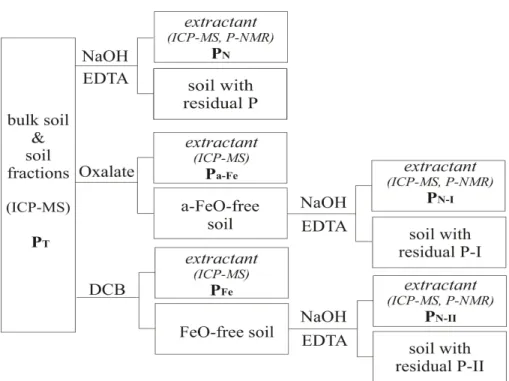
The schematic diagram of whole soil sample preparation is shown in Fig. 1. The P contents in the various extracted fractions were calculated as follows:
20
(Pa-Fe)N=PN−PN-I (1)
(Pc-Fe)N=PN-I−PN-II (2)
(Pother)N=PN-II (3)
where, (Pa-Fe)N=NaOH-Na2EDTA extractable P associated with amorphous Fe/Al
ox-ides;
25
(Pc-Fe)N=NaOH-Na2EDTA extractable P associated with crystalline Fe oxides;
BGD
12, 9879–9903, 2015Speciation and distribution of P associated with Fe
and Al oxides
X. Jiang et al.
Title Page
Abstract Introduction
Conclusions References
Tables Figures
◭ ◮
◭ ◮
Back Close
Full Screen / Esc
Printer-friendly Version Interactive Discussion
Discussion
P
a
per
|
Discussion
P
a
per
|
Discussion
P
a
per
|
Discussion
P
a
per
|
(Pother)N=NaOH-Na2EDTA extractable P associated with other matters;
PN=NaOH-Na2EDTA extractable P in soil samples;
PN-I=NaOH-Na2EDTA extractable P in “amorphous FeO-free” soil samples;
PN-II=NaOH-Na2EDTA extractable P in “FeO-free” soil samples.
Relative distribution of Pi and Po in NaOH-Na2EDTA extracts of soil samples,
a-5
Fe/Al oxides-free and Fe/Al oxides-free soil samples were characterized by solution
31
P-NMR spectroscopy (Fig. 2 and Supplement Fig. S1). Here only orthophosphate, phosphate monoesters and pyrophosphate were scaled to 100 %. Therefore, the
distri-bution of Pi and Po associated with a- and c-Fe/Al oxides in NaOH-Na2EDTA extracts
(Table 1) was calculated with the combination of NaOH-Na2EDTA extraction (Table S2)
10
and corresponding solution31P-NMR spectras (Fig. 2 and Fig. S1).
The residual P after alkaline extraction was separated into P bound to a-Fe oxides, c-Fe oxides and other matters as follows:
(Pa-Fe)resi=Pa-Fe−(Pa-Fe)N (4)
(Pc-Fe)resi=“Pc-Fe
′′
−(Pc-Fe)N=(PFe−Pa-Fe)−(Pc-Fe)N (5)
15
(Pother)resi=PT−PFe−PN-II (6)
where, (Pa-Fe)resi=residual P associated with amorphous Fe oxides;
(Pc-Fe)resi=residual P associated with crystalline Fe oxides; (Pother)resi=residual P associated with other matters;
Pa-Fe=P associated with amorphous Fe/Al oxides (i.e. oxalate extractable P);
20
PFe= P associated with amorphous and crystalline Fe/Al oxides (i.e. DCB
ex-tractable P);
Pc-Fe=P associated with crystalline Fe/Al oxides;
BGD
12, 9879–9903, 2015Speciation and distribution of P associated with Fe
and Al oxides
X. Jiang et al.
Title Page
Abstract Introduction
Conclusions References
Tables Figures
◭ ◮
◭ ◮
Back Close
Full Screen / Esc
Printer-friendly Version Interactive Discussion
Discussion
P
a
per
|
Discussion
P
a
per
|
Discussion
P
a
per
|
Discussion
P
a
per
|
3 Results and discussion
3.1 Total, oxalate and DCB extractable P, Fe, Al and Ca in soil aggregate-sized
fractions
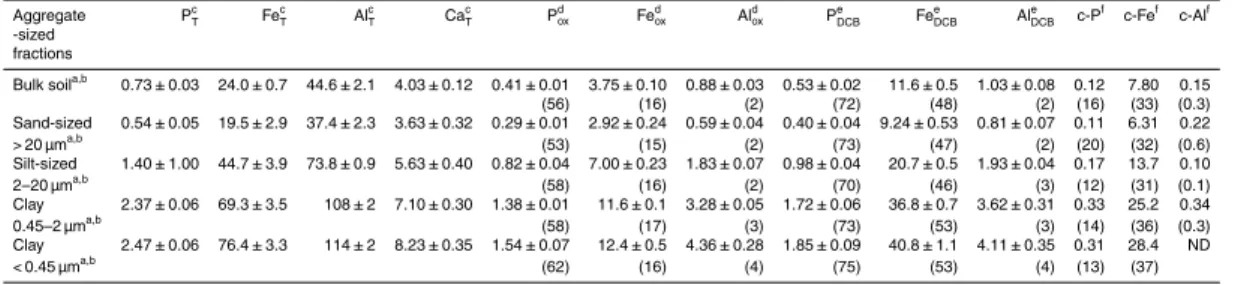
Table 2 represents ICP-MS results of elemental contents (i.e. P, Fe, Al and Ca) in the
bulk soil and different aggregate-sized fractions, and their oxalate and DCB extracts.
5
Total P was 0.73 g kg−1 in bulk soil with a significant increase from large particles to small particles (range between 0.54 and 2.47 g kg−1). Total Fe and Al in different soil aggregate-sized fractions showed the same gradient with total P. Total P had a strong positive relationship with total Fe and Al (R2> 0.99; P < 0.006) in these aggregate-sized fractions, which indicated that P was, to a large extent, associated with Fe and Al in all
10
aggregate-sized fractions. The high correlation also indicated the cause why smaller particles contained more P. There was more Fe and Al in the smaller size fractions, and the minerals containing these elements (i.e. Fe and Al) acted as important P carriers.
Oxalate extractable P, Fe and Al (Pox, Feox and Alox) also had an increasing trend
with smaller particle sizes. Oxalate extractable P corresponded to 53–62 % of the total
15
P in varying soil aggregate-sized fractions, although the amounts of amorphous Fe and Al oxides fractions were low with respect to total Fe (15–17 %) and total Al (2–4 %)
(Table 2). DCB extractable P (PDCB) was 70–75 % of the total P in these
aggregate-sized fractions, which implied that Fe/Al oxides were the major carriers of P in the
soil (Table 2). The differences between DCB extractable Fe and Al oxides and oxalate
20
extractable Fe and Al oxides represent the amounts of extracted crystalline Fe (c-Fe)
and Al (c-Al) oxides. There was a large amount of c-Fe (6.31–28.4 g kg−1, 31–37 %
of total Fe). In contrast, c-Al content was low (only 0–0.34 g kg−1, 0–0.6 % of total Al) in the various aggregate-sized fractions (Table 2). Similarly, high amount of c-Fe and low amount of c-Al were also found in sandy soils (Borggaard et al., 1990). This is
25
probably because organic matter in soil inhibits Al oxides crystallization (Borggaard et al., 1990). Currently there is some ongoing discussion in the literatures (Acebal et al., 2000; Borggaard et al., 1990; Ryan and Gschwend, 1991) with respect to the
BGD
12, 9879–9903, 2015Speciation and distribution of P associated with Fe
and Al oxides
X. Jiang et al.
Title Page
Abstract Introduction
Conclusions References
Tables Figures
◭ ◮
◭ ◮
Back Close
Full Screen / Esc
Printer-friendly Version Interactive Discussion
Discussion
P
a
per
|
Discussion
P
a
per
|
Discussion
P
a
per
|
Discussion
P
a
per
|
extent in which c-Al is extracted by DCB and what reasons for such an incomplete
extraction of this Al are. Only 12–20 % of total P (c-P, the difference between PDCB
and Pox, Table 2) was released with crystalline Fe and Al oxides (Table 2). It shows
that amorphous Fe/Al oxides are more important for P bonding compared to crystalline Fe/Al oxides. Several researchers did already report that P was dominantly associated
5
with amorphous Fe and Al oxides fractions in various soil types in USA (Arai et al., 2005; Rick and Arai, 2011). It was presumed that specific anion adsorption (e.g. P) suppressed the transformation from amorphous to crystalline Fe oxides (Arai et al., 2005; Biber et al., 1994), which could explain the low amount of P associated with crystalline Fe oxides.
10
Oxalate extracted P also had a strong positive linear correlation with oxalate ex-tracted Fe (R2=0.997) and Al (R2=0.976). The similar high correlation between ox-alate extractable P and Fe oxides has already been shown in acidic and neutral soils (Forsmann and Kjaergaard, 2014). Nevertheless, c-Fe and c-Al contents were not
strongly correlated with c-P. Although there was a smaller amount of Ca in different
15
aggregate-sized fractions compared to Fe and Al (Table 2), DCB also dissolved be-tween 48 and 100 % of total Ca in varying aggregate-sized fractions (Supplement Ta-ble S3). Therefore, it could be assumed that a small amount of the measured c-P (Table 2) was related to Ca minerals (Ca-P precipitates) in the soil.
Although there were higher amounts of total Fe, Al and P in smaller particles
com-20
pared with larger particles, there were no clear discernible proportional differences in oxalate and DCB extractable Fe, Al and P fractions with respect to total Fe, Al and P between various aggregate-sized fractions. Therefore, there was a clear indication that the relative proportional distributions of amorphous, crystalline Fe/Al oxides and related P in this soil were independent on the aggregate-size of soil particles a result
25
not found previously. Kiem and Kögel-Knabner (2002) did suggest that there was a sim-ilar Feox/FeDCB ratio across three size separates of arable soil fractions < 6 µm. Fe/Al
(Tis-BGD
12, 9879–9903, 2015Speciation and distribution of P associated with Fe
and Al oxides
X. Jiang et al.
Title Page
Abstract Introduction
Conclusions References
Tables Figures
◭ ◮
◭ ◮
Back Close
Full Screen / Esc
Printer-friendly Version Interactive Discussion
Discussion
P
a
per
|
Discussion
P
a
per
|
Discussion
P
a
per
|
Discussion
P
a
per
|
dall and Oades, 1982). Therefore, these Fe/Al oxides as inorganic binding agents and associated P were distributed on soil aggregates with all varying sizes proportionally.
3.2 Speciation and distribution of P forms in soil aggregate-sized fractions
There was 58–65 % of total P extracted by NaOH-Na2EDTA in different soil size
frac-tions (Table S2). A similar extraction efficiency (average of 63 % of total P) was found in
5
a recent study of dried wetland soil samples (Cheesman et al., 2012). Inorganic and
or-ganic P contents in NaOH-Na2EDTA extracts were characterized by solution
31
P-NMR spectroscopy. Inorganic (orthophosphate and pyrophosphate) and organic (phosphate monoesters, phosphate diesters and phosphonates) P forms were present in our soil aggregate-sized fractions.
10
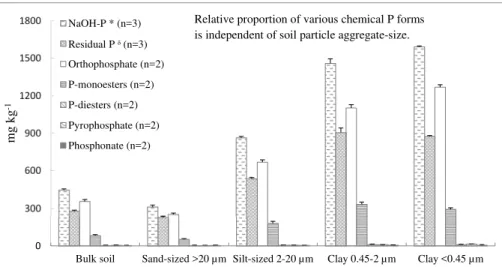
The orthophosphate and phosphate monoesters were major detected inorganic and
organic P forms in all soil aggregate-sized fractions (Fig. 3). NaOH-Na2EDTA
ex-tractable orthophosphate (31P-NMR chemical shift of 5–7 ppm) (Cade-Menun, 2005)
ranged from 0.25 to 1.27 g kg−1, accounting for the majority of P (47–51 % of total P) in all the aggregate-sized fractions (Fig. 3). Phosphate monoesters (3-6 ppm) (Bol et
15
al., 2006; Cade-Menun, 2005; Fuentes et al., 2012) were always the dominant organic
P with the contents of 53–332 mg kg−1(10–14 % of total P) (Fig. 3). Phosphate
mo-noesters are generally the dominant group of organic phosphorus compounds in most soils: they occur mainly as inositol phosphates, a family of phosphoric esters of hex-ahydroxy cyclohexane (inositol) (Turner et al., 2005). The content of pyrophosphate (−4
20
to−5 ppm) (Cade-Menun, 2005) was only up to 15 mg kg−1(less than 1 % of total P).
Phosphonates (12 ppm) and phosphate diesters (2.5 to−1 ppm) (Cade-Menun, 2005)
did only contribute 0.6–1.0 % of total P (Fig. 3). We found that there were only little if any P-diesters in fine particles (Fig. 3). Many microbial products such as teichoic acid P or DNA-P would exhibit these structures (Makarov et al., 2002).
25
All the identified P forms had a larger content in < 2 µm soil fraction when compared to larger sized particles. However, the distributions of different P forms in our study did seem to be independent of soil aggregate-size (Fig. 3). In contrast, some studies have
BGD
12, 9879–9903, 2015Speciation and distribution of P associated with Fe
and Al oxides
X. Jiang et al.
Title Page
Abstract Introduction
Conclusions References
Tables Figures
◭ ◮
◭ ◮
Back Close
Full Screen / Esc
Printer-friendly Version Interactive Discussion
Discussion
P
a
per
|
Discussion
P
a
per
|
Discussion
P
a
per
|
Discussion
P
a
per
|
found that soil size fractions drive the differential P distributions in forest and arable soils (Liu et al., 2014; Solomon et al., 2002). Our novel finding about the similar P distribution in various aggregate-sized fractions of this soil was probably due to the comparable Fe and Al oxides distribution in aggregate-sized fractions when considering that Fe and Al oxides were domain P carriers in the soil.
5
3.3 NaOH-Na2EDTA extractable P associated with Fe and Al oxides in soil
aggregate-sized fractions
The bulk soil and aggregate-sized fractions after oxalate and DCB pre-treatments were
also extracted by NaOH-Na2EDTA for
31
P-NMR analysis. We found that the bulk soil (Fig. 2) and other soil aggregate-sized fractions (Fig. S1) after oxalate pre-treatment
10
revealed a higher phosphate monoesters/orthophosphate ratio in NaOH-Na2EDTA
ex-tracts compared to that without oxalate treatment. The bulk soil (Fig. 2) and other soil aggregate-sized fractions (Fig. S1) after DCB pre-treatment had the highest phosphate monoesters/orthophosphate ratio among the three types of samples. This finding im-plied that relatively high amounts of orthophosphate were removed by oxalate and
15
particularly DCB, i.e., it was mainly orthophosphate that was bound to a- and c-Fe ox-ides in aggregate-sized fractions rather than organic P. Besox-ides, most pyrophosphate still remained in Fe/Al oxides-free aggregate-sized fractions (Fig. 2 and Fig. S1). Py-rophosphate is perceived to be contained within live fungal tissue (Koukol et al., 2008) or sorbed to the mineral soil matrix (Gunary, 1966). However, the present study
sug-20
gested that Fe/Al oxides (part of mineral matrix) were not the main sites for pyrophos-phate adsorption.
Because orthophosphate and phosphate monoesters were the dominant P forms, only they were discussed below (Table 1). The amount of P bound to Fe/Al oxides in
NaOH-Na2EDTA extracts accounted for 49–54 % of total P in various aggregate-sized
25
crys-BGD
12, 9879–9903, 2015Speciation and distribution of P associated with Fe
and Al oxides
X. Jiang et al.
Title Page
Abstract Introduction
Conclusions References
Tables Figures
◭ ◮
◭ ◮
Back Close
Full Screen / Esc
Printer-friendly Version Interactive Discussion
Discussion
P
a
per
|
Discussion
P
a
per
|
Discussion
P
a
per
|
Discussion
P
a
per
|
talline oxides (3–6 and 1–2 % of total P, respectively) in the NaOH-Na2EDTA extracts
(Table 1). The P adsorption experiment from Borggaard (1983) showed that a-Fe ox-ides absorbed more phosphate than c-Fe oxox-ides in soils. Generally, phosphate mo-noesters are commonly assumed to be stabilized in soils by association with
amor-phous metal oxides, which have greater sorption affinity compared to crystalline metal
5
oxides (Celi and Barberis, 2007; Turner and Engelbrecht, 2011).
Noteworthy, only rare amounts of Fe (0–1 % of total Fe) from “untreated” soil
aggregate-sized fractions were dissolved by NaOH-Na2EDTA (Table S3). Although
the presence of Na2EDTA caused some dissolved Fe ions precipitating in humic-iron
compounds, the precipitation was negligible at hydroxide ion concentrations≥100 mM
10
(≥pH 13) (Turner, 2008). Therefore, it indicated that a- and c-Fe oxides associated P
present in NaOH-Na2EDTA extracts was probably attached on the surface of Fe
ox-ides. Alkaline extraction could remove P held to Fe and Al components of soil surface by chemisorption (Hedley et al., 1982; McLaughlin et al., 1977; Ryden et al., 1977).
High contents of dissolved Al were still found in NaOH-Na2EDTA extracts, and which
15
were similar with those in oxalate and DCB extracts of soil aggregate-sized fractions
(Tables 2 and S3). Similarly, high Al and low Fe contents were found in NaOH-Na2EDTA
extracts from a tropical forest soil (Turner, 2008). Considering that little Si was dissolved
in NaOH-Na2EDTA in all aggregate-sized fractions (data not shown), it indicated that
NaOH-Na2EDTA extracted Al mainly stemmed from amorphous Al oxides (rare c-Al
20
oxides in the soil, Table 2) rather than aluminosilicate minerals in the soil. Therefore,
the Al-P in NaOH-Na2EDTA extracts contained P probably both on surface of Al oxides
and occluded in Al oxides.
There was still 8–11 % of total P (including 4–6 % orthophosphate and 4–5 %
phos-phate monoesters) in NaOH-Na2EDTA extracts which were not associated with Fe/Al
25
oxides of different aggregate-sized fractions (Table 1). The NaOH-Na2EDTA
extrac-tion included P contained within microbial cells (Turner and Blackwell, 2013). Besides, inositol phosphate is stabilized mainly through a strong adsorption on the surface of amorphous metal oxides and clay minerals (Celi and Barberis, 2007), so we assumed
BGD
12, 9879–9903, 2015Speciation and distribution of P associated with Fe
and Al oxides
X. Jiang et al.
Title Page
Abstract Introduction
Conclusions References
Tables Figures
◭ ◮
◭ ◮
Back Close
Full Screen / Esc
Printer-friendly Version Interactive Discussion
Discussion
P
a
per
|
Discussion
P
a
per
|
Discussion
P
a
per
|
Discussion
P
a
per
|
that a part of these P compounds were adsorbed on the surfaces of clay minerals. Additionally, it was also believed that there was P associated with Ca minerals in this
NaOH-Na2EDTA extracts considering that 43–98 % of total Ca was dissolved in
NaOH-Na2EDTA extracts of different aggregate-sized fractions (Table S3).
3.4 Residual P in soil aggregate-sized fractions
5
Using our specific separation method, the residual P was separated into P bound to a-Fe oxides, c-Fe oxides and other matters (Eqs. 4–6 and Table 1). The P in residual fractions accounted to 35–42 % of total P in aggregate-sized fractions. We found that
10–13 % of total P in different aggregate-size fractions was bound to a-Fe oxides and
10–12 % of total P was associated with c-Fe oxides (Table 1). The 20–24 % of total P
10
associated with Fe oxides (Table 1) was equivalent to 53–66 % of the P present in the residual fraction. Therefore, the majority of P in residual fraction was associated with Fe oxides (Table 1). The remaining 12–18 % of total P (i.e. 34–47 % of the P present in residual fractions) was bound to other minerals or organic matter which was dissolved or released neither in DCB nor in NaOH-Na2EDTA of different aggregate-sized fractions
15
(Table 1).
We believe our novel results suggested that the a- and c-Fe oxides associated P in the residual P fraction were most likely occluded inside of a- and c-Fe oxides. This
was in contrast to the a- and c-Fe oxides associated P present in NaOH-Na2EDTA
extracts which were absorbed on the surface of Fe oxides. The P associated with Fe
20
oxides in residual fractions probably was held at the internal surfaces of Fe oxides by chemisorption at protonated surface sites or by the replacement of surface hydroxyls in soil aggregates (Hedley et al., 1982; Ryden et al., 1977), or diffused into the bulk of Fe oxides or into pores and defects (McLaughlin et al., 1977). It means that with the changes in soil conditions (e.g. soil anoxic condition, acidic condition, high
concen-25
BGD
12, 9879–9903, 2015Speciation and distribution of P associated with Fe
and Al oxides
X. Jiang et al.
Title Page
Abstract Introduction
Conclusions References
Tables Figures
◭ ◮
◭ ◮
Back Close
Full Screen / Esc
Printer-friendly Version Interactive Discussion
Discussion
P
a
per
|
Discussion
P
a
per
|
Discussion
P
a
per
|
Discussion
P
a
per
|
more orthophosphate and monoesters than c-Fe/Al oxides (Table 1: NaOH-Na2EDTA
extractable P). However, there were similar amounts of occluded P inside of both a-and c- Fe oxides (Table 1: Residual P).
The Ca-P complexes present in residual fractions of soil aggregate-sized fractions should contribute to a proportion of the remaining residual P, ca. 12–18 % of total P.
5
Cheesman et al. (2010) suggested that there were inorganic Ca-phosphates in the residual P from detritus and surface soils. In the present study, 12 % of total P was not associated with Fe oxides in residual P of < 0.45 µm soil fractions (Table 1), despite
that almost all the Ca was already extracted by NaOH-Na2EDTA and DCB (Table S3).
It seemed therefore that the majority of the 12–18 % of total P was bound to other
10
materials. In our other concurrent work (Jiang et al., 2015), we found that some P in the soil nanoparticles after DCB treatment was still bound to Fe bearing phyllosilicate minerals (i.e. Fe structurally embedded into the crystalline structure of phyllosilicate minerals via isomorphic substitution) (Regelink et al., 2014). It is possible that these Fe bearing phyllosilicate minerals may also be responsible for the bonding of the remaining
15
P in the NaOH-Na2EDTA non-extracts. Noteworthy, soil aggregate-sizes do not have a
significant effect on the relative distribution of P forms bond to a- and c-Fe/Al oxides for
NaOH-Na2EDTA extracts and residual soil P (Table 1).
4 Conclusions
We concluded for this arable German soil that: (1) with decreasing aggregate-sized
20
fractions soil P content increased, however the distribution and speciation of varying P
forms were independent of aggregate-size. (2) Most of the NaOH-Na2EDTA extractable
P (Pi and Po) was attached on the surface of amorphous Fe oxides and Al oxides, or alternatively inside of the Al oxides. (3) The majority of P in the residual fraction was occluded within Fe oxides, which implies that this P may be released and become
25
available for plants and microbial communities following the dissolution of Fe oxides in soil.
BGD
12, 9879–9903, 2015Speciation and distribution of P associated with Fe
and Al oxides
X. Jiang et al.
Title Page
Abstract Introduction
Conclusions References
Tables Figures
◭ ◮
◭ ◮
Back Close
Full Screen / Esc
Printer-friendly Version Interactive Discussion
Discussion
P
a
per
|
Discussion
P
a
per
|
Discussion
P
a
per
|
Discussion
P
a
per
|
The Supplement related to this article is available online at doi:10.5194/bgd-12-9879-2015-supplement.
Acknowledgements. X. Jiang thanks the China Scholarship Council (CSC) for financial sup-port and acknowledges C. Walraf for technical assistance and A. Missong for experimental discussion. We gratefully acknowledge the support by TERENO (Terrestrial Environmental Ob-5
servatories) funded by the Helmholtz Association of German Research Centers.
References
Acebal, S. G., Mijovilovich, A., Rueda, E. H., Aguirre, M. E., and Saragovi, C.: Iron-oxide miner-alogy of a mollisol from argentina: a study by selective-dissolution techniques, X-ray diff rac-tion, and mössbauer spectroscopy, Clays Clay Miner., 48, 322–330, 2000.
10
Arai, Y. and Livi, K. J.: Underassessed phosphorus fixation mechanisms in soil sand fraction, Geoderma, 192, 422–429, 2013.
Arai, Y., Livi, K. J. T., and Sparks, D. L.: Phosphate reactivity in long-term poultry litter-amended southern delaware sandy soils, Soil Sci. Soc. Am. J., 69, 616–629, 2005.
Berns, A. E., Philipp, H., Narres, H. D., Burauel, P., Vereecken, H., and Tappe, W.: Effect of 15
gamma-sterilization and autoclaving on soil organic matter structure as studied by solid state NMR, UV and fluorescence spectroscopy, Eur. J. Soil Sci., 59, 540–550, 2008.
Biber, M. V., dos Santos Afonso, M., and Stumm, W.: The coordination chemistry of weathering: IV. Inhibition of the dissolution of oxide minerals, Geochim. Cosmochim. Ac., 58, 1999–2010, 1994.
20
Bol, R., Amelung, W., and Haumaier, L.: Phosphorus-31–nuclear magnetic–resonance spec-troscopy to trace organic dung phosphorus in a temperate grassland soil, J. Plant Nutr. Soil Sci., 169, 69–75, 2006.
Borggaard, O. K.: The influence of iron oxides on phosphate adsorption by soil, J. Soil Sci., 34, 333–341, 1983.
25
BGD
12, 9879–9903, 2015Speciation and distribution of P associated with Fe
and Al oxides
X. Jiang et al.
Title Page
Abstract Introduction
Conclusions References
Tables Figures
◭ ◮
◭ ◮
Back Close
Full Screen / Esc
Printer-friendly Version Interactive Discussion
Discussion
P
a
per
|
Discussion
P
a
per
|
Discussion
P
a
per
|
Discussion
P
a
per
|
Bowman, R. A. and Moir, J. O.: Basic EDTA as an extractant for soil organic phosphorus, Soil Sci. Soc. Am. J., 57, 1516–1518, 1993.
Cade-Menun, B. J.: Characterizing phosphorus in environmental and agricultural samples by 31
P nuclear magnetic resonance spectroscopy, Talanta, 66, 359–371, 2005.
Cade-Menun, B. and Liu, C. W.: Solution phosphorus-31nuclear magnetic resonance spec-5
troscopy of soil from 2005 to 2013: a review of sample preparation and experimental param-eters, Soil Sci. Soc. Am. J., 78, 19–37, 2014.
Cade-Menun, B. J. and Preston, C. M.: A comparison of soil extraction procedures for31P NMR spectroscopy, Soil Sci., 161, 770–785, 1996.
Celi, L. and Barberis, E.: Abiotic reactions of inositol phosphates in soil. in: Inositol Phosphates, 10
Linking Agriculture and the Environment, edited by: Turner, B. L., Richardson, A. E., Mullaney, E. J., CAB International, Wallingford, UK, 207–220, 2007.
Cheesman, A. W., Turner, B. L., Inglett, P. W., and Reddy, K. R.: Phosphorus transformations during decomposition of wetland macrophytes, Environ. Sci. Technol., 44, 9265–9271, 2010. Cheesman, A. W., Turner, B. L., and Ramesh Reddy, K.: Soil phosphorus forms along a strong 15
nutrient gradient in a tropical ombrotrophic wetland, Soil Sci. Soc. Am. J., 76, 1496–1506, 2012.
Dick, W. A. and Tabatabai, M. A.: Hydrolysis of organic and inorganic phosphorus compounds added to soils, Geoderma, 21, 175–182, 1978.
Forsmann, D. M. and Kjaergaard, C.: Phosphorus release from anaerobic peat soils during 20
convective discharge – Effect of soil Fe:P molar ratio and preferential flow, Geoderma, 223– 225, 21–32, 2014.
Fuentes, B., Dixon, E., de la Luz Mora, M., Turner, B. L., and Bol, R.: Dissolved phosphorus composition of grassland leachates following application of dairy-slurry size fractions, J. Plant Nutr. Soil Sci., 175, 78–85, 2012.
25
Gunary, D.: Pyrophosphate in soil; some physico-chemical aspects, Nature, 210, 1297–1298, 1966.
He, Z., Honeycutt, C. W., Cade-Menun, B. J., Senwo, Z. N., and Tazisong, I. A.: Phosphorus in poultry litter and soil: enzymatic and nuclear magnetic resonance characterization, Soil Sci. Soc. Am. J., 72, 1425–1433, 2008.
30
He, Z., Honeycutt, C. W., Tazisong, I. A., Senwo, Z. N., and Zhang, D.: Nitrogen and phosphorus accumulation in pasture soil from repeated poultry litter application, Commun. Soil Sci. Plan., 40, 587–598, 2009.
BGD
12, 9879–9903, 2015Speciation and distribution of P associated with Fe
and Al oxides
X. Jiang et al.
Title Page
Abstract Introduction
Conclusions References
Tables Figures
◭ ◮
◭ ◮
Back Close
Full Screen / Esc
Printer-friendly Version Interactive Discussion
Discussion
P
a
per
|
Discussion
P
a
per
|
Discussion
P
a
per
|
Discussion
P
a
per
|
Hedley, M. J., Stewart, J. W. B., and Chauhan, B. S.: Changes in inorganic and organic soil phosphorus fractions induced by cultivation practices and by laboratory incubations, Soil Sci. Soc. Am. J., 46, 970–976, 1982.
Izarova, N. V., Maksimovskaya, R. I., Willbold, S., and Kögerler, P.: Tetrapalladium-containing polyoxotungstate [PdII4(α-P2W15O56)2]16−: a comparative study, Inorg. Chem., 53, 11778– 5
11784, 2014.
Jiang, X., Bol, R., Nischwitz, V., Siebers, N., Willbold, S., Vereecken, H., Amelung, W., and Klumpp, E.: Phosphorus containing water dispersible nanoparticles in arable soil, J. Environ. Qual., in review, 2015.
Kiem, R. and Kögel-Knabner, I.: Refractory organic carbon in particle-size fractions of arable 10
soils II: organic carbon in relation to mineral surface area and iron oxides in fractions < 6 µm, Organic Geochemistry, 33, 1699–1713, 2002.
Kleber, M., Mikutta, R., Torn, M. S., and Jahn, R.: Poorly crystalline mineral phases protect organic matter in acid subsoil horizons, Eur. J. Soil Sci., 56, 717–725, 2005.
Koukol, O., Novák, F., and Hrabal, R.: Composition of the organic phosphorus fraction in basid-15
iocarps of saprotrophic and mycorrhizal fungi, Soil Biol. Biochem., 40, 2464–2467, 2008. Kraemer, S.: Iron oxide dissolution and solubility in the presence of siderophores, Aquat. Sci.,
66, 3–18, 2004.
Kupisch, M., Stadler, A., Langensiepen, M., and Ewert, F.: Analysis of spatio-temporal patterns of CO2 and H2O fluxes in relation to crop growth under field conditions, Field Crop. Res., 20
176, 108–118, 2015.
Liu, J., Yang, J., Liang, X., Zhao, Y., Cade-Menun, B. J., and Hu, Y.: Molecular speciation of phosphorus present in readily dispersible colloids from agricultural soils, Soil Sci. Soc. Am. J., 78, 47–53, 2014.
Mahieu, N., Olk, D. C., and Randall, E. W.: Analysis of phosphorus in two humic acid fractions 25
of intensively cropped lowland rice soils by31P-NMR, Eur. J. Soil Sci., 51, 391–402, 2000. Makarov, M. I., Haumaier, L., and Zech, W.: Nature of soil organic phosphorus: an assessment
of peak assignments in the diester region of31P NMR spectra, Soil Biol. Biochem., 34, 1467– 1477, 2002.
Masiello, C. A., Chadwick, O. A., Southon, J., Torn, M. S., and Harden, J. W.: Weathering 30
BGD
12, 9879–9903, 2015Speciation and distribution of P associated with Fe
and Al oxides
X. Jiang et al.
Title Page
Abstract Introduction
Conclusions References
Tables Figures
◭ ◮
◭ ◮
Back Close
Full Screen / Esc
Printer-friendly Version Interactive Discussion
Discussion
P
a
per
|
Discussion
P
a
per
|
Discussion
P
a
per
|
Discussion
P
a
per
|
McDowell, R. W., Cade-Menun, B., and Stewart, I.: Organic phosphorus speciation and pedo-genesis: analysis by solution31P nuclear magnetic resonance spectroscopy, Eur. J. Soil Sci., 58, 1348–1357, 2007.
McLaughlin, J. R., Ryden, J. C., and Syers, J. K.: Development and evaluation of a kinetic model to describe phosphate sorption by hydrous ferric oxide gel, Geoderma, 18, 295–307, 1977. 5
Neubauer, E., Schenkeveld, W. D. C., Plathe, K. L., Rentenberger, C., von der Kammer, F., Kraemer, S. M., and Hofmann, T.: The influence of pH on iron speciation in podzol extracts: Iron complexes with natural organic matter, and iron mineral nanoparticles, Sci. Total Envi-ron., 461–462, 108–116, 2013.
Regelink, I. C., Voegelin, A., Weng, L., Koopmans, G. F., and Comans, R. N. J.: Characteriza-10
tion of colloidal Fe from soils using field-flow fractionation and Fe K-Edge X-ray absorption spectroscopy, Environ. Sci. Technol., 48, 4307–4316, 2014.
Rick, A. R. and Arai, Y.: Role of natural nanoparticles in phosphorus transport processes in ultisols, Soil Sci. Soc. Am. J., 75, 335–347, 2011.
Rubæk, G. H., Guggenberger, G., Zech, W., and Christensen, B. T.: Organic phosphorus in 15
soil size separates characterized by phosphorus-31 nuclear magnetic resonance and resin extraction, Soil Sci. Soc. Am. J., 63, 1123–1132, 1999.
Ryan, J. N. and Gschwend, P. M.: Extraction of iron oxides from sediments using reductive dissolution by titanium (III), Clay Clay Miner., 39, 509–518, 1991.
Ryden, J. C., McLaughlin, J. R., and Syers, J. K.: Mechanisms of phosphate sorption by soils 20
and hydrous ferric oxide gel, J. Soil Sci., 28, 72–92, 1977.
Schwertmann, U.: Differenzierung der Eisenoxide des Bodens durch Extraktion mit Ammoniumoxalat-Lösung, Zeitschrift für Pflanzenernährung, Düngung, Bodenkunde, 105, 194–202, 1964.
Séquaris, J. M. and Lewandowski, H.: Physicochemical characterization of potential colloids 25
from agricultural topsoils, Colloids and Surfaces A: Physicochemical and Engineering As-pects, 217, 93–99, 2003.
Sims, J. T., Edwards, A. C., Schoumans, O. F., and Simard, R. R.: Integrating soil phosphorus testing into environmentally based agricultural management practices, J. Environ. Qual., 29, 60–71, 2000.
30
Solomon, D. and Lehmann, J.: Loss of phosphorus from soil in semi-arid northern Tanzania as a result of cropping: evidence from sequential extraction and31P-NMR spectroscopy, Eur. J. Soil Sci., 51, 699–708, 2000.
BGD
12, 9879–9903, 2015Speciation and distribution of P associated with Fe
and Al oxides
X. Jiang et al.
Title Page
Abstract Introduction
Conclusions References
Tables Figures
◭ ◮
◭ ◮
Back Close
Full Screen / Esc
Printer-friendly Version Interactive Discussion
Discussion
P
a
per
|
Discussion
P
a
per
|
Discussion
P
a
per
|
Discussion
P
a
per
|
Solomon, D., Lehmann, J., Mamo, T., Fritzsche, F., and Zech, W.: Phosphorus forms and dy-namics as influenced by land use changes in the sub-humid Ethiopian highlands, Geoderma, 105, 21–48, 2002.
Tisdall, J. M. and Oades, J. M.: Organic matter and water-stable aggregates in soils, J. Soil Sci., 33, 141–163, 1982.
5
Turner, B. and Engelbrecht, B. J.: Soil organic phosphorus in lowland tropical rain forests, Bio-geochemistry, 103, 297–315, 2011.
Turner, B., Condron, L., Richardson, S., Peltzer, D., and Allison, V.: Soil organic phosphorus transformations during pedogenesis, Ecosystems, 10, 1166–1181, 2007.
Turner, B. L.: Soil organic phosphorus in tropical forests: an assessment of the NaOH–EDTA 10
extraction procedure for quantitative analysis by solution31P NMR spectroscopy, Eur. J. Soil Sci., 59, 453–466, 2008.
Turner, B. L. and Blackwell, M. S. A.: Isolating the influence of pH on the amounts and forms of soil organic phosphorus, Eur. J. Soil Sci., 64, 249–259, 2013.
Turner, B. L., Cade-Menun, B. J., and Westermann, D. T.: Organic Phosphorus Composition 15
and Potential Bioavailability in Semi-Arid Arable Soils of the Western United States, Soil Sci. Soc. Am. J., 67, 1168–1179, 2003.
Turner, B. L., Cade-Menun, B. J., Condron, L. M., and Newman, S.: Extraction of soil organic phosphorus, Talanta, 66, 294–306, 2005.
Vestergren, J., Vincent, A. G., Jansson, M., Persson, P., Ilstedt, U., Gröbner, G., Giesler, R., and 20
Schleucher, J.: High-resolution characterization of organic phosphorus in soil extracts using 2D1H–31P NMR correlation spectroscopy, Environ. Sci. Technol., 46, 3950–3956, 2012. Wei, K., Chen, Z., Zhu, A., Zhang, J., and Chen, L.: Application of31P NMR spectroscopy in
determining phosphatase activities and P composition in soil aggregates influenced by tillage and residue management practices, Soil Till. Res., 138, 35–43, 2014.
BGD
12, 9879–9903, 2015Speciation and distribution of P associated with Fe
and Al oxides
X. Jiang et al.
Title Page
Abstract Introduction
Conclusions References
Tables Figures
◭ ◮
◭ ◮
Back Close
Full Screen / Esc
Printer-friendly Version Interactive Discussion
Discussion
P
a
per
|
Discussion
P
a
per
|
Discussion
P
a
per
|
Discussion
P
a
per
|
Table 1.NaOH-Na2EDTA extractable P and residual P distribution (%, with respect to total P of each soil aggregate-sized fraction) associated with amorphous and crystalline oxides, and other matters.
NaOH-Na2EDTA extractable P Residual P
(Pa-Fe)N (Pc-Fe)N (Pother)N (Pa-Fe)resi (Pc-Fe)resi (Pother)resi
Ortho. Mono. Ortho. Mono. Ortho. Mono.
Bulk soil 39 6 5 2 5 4 10 11 18
Sand-sized > 20 µm 36 6 6 1 4 4 12 12 18
Silt-sized 2–20 µm 39 7 3 1 6 5 10 10 18
Clay 0.45–2 µm 37 8 4 1 6 5 13 10 16
Clay < 0.45 µm 41 6 6 1 6 5 11 12 12
Ortho.=orthophosphate; Mono.=P-monoesters. (Pa-Fe)N=NaOH-Na2EDTA extractable P associated with amorphous Fe/Al oxides. (Pc-Fe)N=NaOH-Na2EDTA extractable P associated with crystalline Fe oxides. (Pother)N=NaOH-Na2EDTA extractable P associated with other matters. (Pa-Fe)resi=Residual P associated with amorphous Fe oxides. (Pc-Fe)resi=Residual P associated with crystalline Fe oxides. (Pother)resi=Residual P associated with other matters.
BGD
12, 9879–9903, 2015Speciation and distribution of P associated with Fe
and Al oxides
X. Jiang et al.
Title Page
Abstract Introduction
Conclusions References
Tables Figures
◭ ◮
◭ ◮
Back Close
Full Screen / Esc
Printer-friendly Version Interactive Discussion
Discussion
P
a
per
|
Discussion
P
a
per
|
Discussion
P
a
per
|
Discussion
P
a
per
|
Table 2.The amounts of P, Fe, Al and Ca in bulk soil and soil aggregate-sized fractions, and extracted by oxalate and dithionite (DCB) (g kg−1). Fraction in bracket (%) with respect to total P, Fe, and Al values of each aggregate-sized fraction shown in Table 2 are given in parentheses. Data are the mean values of three replicates with standard deviations.
Aggregate Pc
T Fe
c
T Al
c
T Ca
c
T P
d
ox Fe
d
ox Al
d
ox P
e DCB Fe
e DCB Al
e DCB c-P
f c-Fef
c-Alf -sized
fractions
Bulk soila,b
0.73±0.03 24.0±0.7 44.6±2.1 4.03±0.12 0.41±0.01 3.75±0.10 0.88±0.03 0.53±0.02 11.6±0.5 1.03±0.08 0.12 7.80 0.15 (56) (16) (2) (72) (48) (2) (16) (33) (0.3) Sand-sized 0.54±0.05 19.5±2.9 37.4±2.3 3.63±0.32 0.29±0.01 2.92±0.24 0.59±0.04 0.40±0.04 9.24±0.53 0.81±0.07 0.11 6.31 0.22
> 20 µma,b (53) (15) (2) (73) (47) (2) (20) (32) (0.6)
Silt-sized 1.40±1.00 44.7±3.9 73.8±0.9 5.63±0.40 0.82±0.04 7.00±0.23 1.83±0.07 0.98±0.04 20.7±0.5 1.93±0.04 0.17 13.7 0.10 2–20 µma,b
(58) (16) (2) (70) (46) (3) (12) (31) (0.1) Clay 2.37±0.06 69.3±3.5 108±2 7.10±0.30 1.38±0.01 11.6±0.1 3.28±0.05 1.72±0.06 36.8±0.7 3.62±0.31 0.33 25.2 0.34 0.45–2 µma,b
(58) (17) (3) (73) (53) (3) (14) (36) (0.3) Clay 2.47±0.06 76.4±3.3 114±2 8.23±0.35 1.54±0.07 12.4±0.5 4.36±0.28 1.85±0.09 40.8±1.1 4.11±0.35 0.31 28.4 ND
< 0.45 µma,b (62) (16) (4) (75) (53) (4) (13) (37)
aAmounts increase with decreasing particle size.bRelative proportions of isolated fractions are independent of decreasing particle size.cTotal P, Fe, Al and Ca.dOxalate extractable P, Fe and Al.eDCB extractable P, Fe and Al.fThe c-(P, Fe, Al) means the difference between (P, Fe, Al)
BGD
12, 9879–9903, 2015Speciation and distribution of P associated with Fe
and Al oxides
X. Jiang et al.
Title Page
Abstract Introduction
Conclusions References
Tables Figures
◭ ◮
◭ ◮
Back Close
Full Screen / Esc
Printer-friendly Version Interactive Discussion
Discussion
P
a
per
|
Discussion
P
a
per
|
Discussion
P
a
per
|
Discussion
P
a
per
|
Figure 1.A schematic diagram of the soil sample treatments.
BGD
12, 9879–9903, 2015Speciation and distribution of P associated with Fe
and Al oxides
X. Jiang et al.
Title Page
Abstract Introduction
Conclusions References
Tables Figures
◭ ◮
◭ ◮
Back Close
Full Screen / Esc
Printer-friendly Version Interactive Discussion
Discussion
P
a
per
|
Discussion
P
a
per
|
Discussion
P
a
per
|
Discussion
P
a
per
|
8 6 4 2 0 -2 -4 -6 ppm
P-monoesters
Bulk soil after DCB
Bulk soil after oxalate
Bulk soil Pyrophosphate P-diesters
Orthophosphate
Ĉ Č
Orthophosphate
(%) P-monoesters (%) Pyrophosphate* (%)
Bulk soil 79.4 19.1 1.4
Bulk soil after oxalate 60.8 35.0 4.2
Bulk soil after DCB 51.5 43.0 5.5
*All other P forms are not included.
Ċ
BGD
12, 9879–9903, 2015Speciation and distribution of P associated with Fe
and Al oxides
X. Jiang et al.
Title Page
Abstract Introduction
Conclusions References
Tables Figures
◭ ◮
◭ ◮
Back Close
Full Screen / Esc
Printer-friendly Version Interactive Discussion
Discussion
P
a
per
|
Discussion
P
a
per
|
Discussion
P
a
per
|
Discussion
P
a
per
|
*NaOH-Na2EDTA extractable P. ᵟNaOH-Na2EDTA non-extractable P.
0 300 600 900 1200 1500 1800
Bulk soil Sand-sized >20 µm Silt-sized 2-20 µm Clay 0.45-2 µm Clay <0.45 µm
NaOH-P * (n=3)
Residual P ᵟ (n=3)
Orthophosphate (n=2)
P-monoesters (n=2)
P-diesters (n=2)
Pyrophosphate (n=2)
Phosphonate (n=2)
m
g
kg
-1
Relative proportion of various chemical P forms is independent of soil particle aggregate-size.
Figure 3.Phosphorus forms and contents (mg kg−1) identified by solution phosphorus-31 nu-clear magnetic resonance spectroscopy in the NaOH-Na2EDTA extracts of bulk soil and diff er-ent aggregate-sized fractions. The varying chemical P conter-ents were determined by multiplying the proportion of spectral area by NaOH-Na2EDTA extractable P.