INTRODUCTION
In a recent past, a large number of clayey deposits located on the flood plain nearby the Paranapanema and Paraná rivers were explored. Both rivers are the borderlands between São Paulo and Paraná, as well as Mato Grosso do Sul states corresponding to western region of São Paulo state. These deposits had supplied raw materials to around 150 local structural-ceramic industries being the major industrial plants of small and middle size before the original clayey deposits were flooded by the artificial lake formed by the Porto Primavera hydroelectric power plant (1985), located on the Paranapanema River, and the Rosana hydroelectric power plant (1998), located on the Paraná River. At present, the industrial raw materials deposits are those composed of mixed clays collected previously by CESP (Companhia Energética de São Paulo S.A.) from original deposits on the flood plains. Before of lake filling up some clays from deposits in the Paraná
river area were characterized to determine their physical characteristics and potential as a raw material for structural red ceramic [1]. In addition, several clays extracted from region of the Panorama city, São Paulo state, were also characterized [2]. The structural ceramic industry is an important regional industrial segment consuming about 1.5 million m3/year of raw material [1,3]. Then, it is relevant to study these and other clayey raw materials, which might maintain and/or expand the level of the industrial activity of the region. It is interesting to highlights that as a function of the extraction process from original deposits coordinated by CESP and considering the urgent necessity of creating industrials deposits, several raw materials stemming from distinct areas were mixed together. Then, most of the existing deposits contain two or more distinct raw materials. This has originated a wide range of technical and industrials problems, since the properties of green bodies and ceramics such as, color, mechanical strength, water adsorption, cracks and micro-cracks, lineal contractions during
Physical and mechanical properties of ceramics from clays
of the west of S. Paulo State, Brazil
(Propriedades físicas e mecânicas de cerâmicas conformados com argilas do
Oeste do Estado de S. Paulo, Brasil)
S. R. Teixeira, S. A. de Souza, M. A. L. Nobre
Departamento de Física, Química e Biologia, Universidade Estadual Paulista - UNESP
C.P. 957, Presidente Prudente, SP, Brazil 19060-900
[email protected]
Abstract
Clays and ceramics of interest to the structural ceramic industry were characterized. Some physical properties of ceramic masses formulated from artificial deposits exploited by the local industry were also analyzed. All materials investigated exhibit high contents of fine components (< 2 µm) and significant plasticity that is compatible with the presence of a great amount of clay minerals. Ceramic probes were prepared by dry pressing and fired at around 855 oC. Flexural strength, linear shrinkage, water absorption,
apparent color and weight loss were measured. In addition, the industrial applications of these raw materials were reviewed and newest potential uses proposed.
Keywords: clays, ceramic bodies, mechanical properties, strength, plasticity.
Resumo
Argilas de interesse da indústria de cerâmica estrutural foram caracterizadas. Algumas propriedades físicas de diversas massas cerâmicas, preparadas a partir de material coletado em depósitos artificiais, também foram analisadas. Todas as massas investigadas exibem alta concentração de componentes finos (< 2 µm) e considerável grau de plasticidade, o que é compatível com a presença de elevado teor de argilominerais. Corpos de prova cerâmicos foram preparados por prensagem a seco e queimados em temperaturas ao redor de 855 oC. Os parâmetros resistência mecânica à flexão, retração linear, absorção de água, cor aparente e perda de peso foram medidos. Como resultado, as aplicações industriais destas matérias primas foram analisadas e revistas, bem como novas aplicações foram propostas.
drying and firing cycles are affected by both physical and chemical characteristics as average texture and mineralogical composition. As a whole, these recent features have justified the great interest of the academic and industrial areas on the further characterization of these newest raw materials stemmed from artificial deposits. Besides these materials some of the samples studied came from flood plains in the neighborhood of some ceramic industries 100 km away from the CESP deposits. Samples studied in the present work had several physical parameters such as, mineralogical composition, particle-size distribution and fraction of organic matter, reported in an earlier work [4]. Taking into account the local industry activity, raw materials have been used to produce massive bricks, ceramic blocks and Romana roof tiles. In this work, a deeper insight on the physical and mechanical properties of red ceramics and their correlation with raw materials and some ceramic masses are provided. This aspect is relevant, since these materials have been actually explored by the local ceramic industry. Based on the results, innovative uses for such raw materials are proposed.
MATERIALS AND METHODS
The clays investigated were collected in the deposits tailored by CESP in regions near the Paraná and Paranapanema Rivers, as previously mentioned. These clays are originated from sedimentary deposits on the flood plains, which are
derived from Baurus sandstone [1].
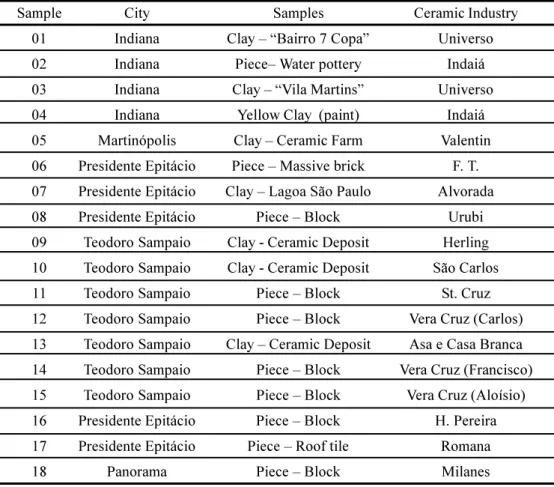
Eighteen samples were collected (Table I) from specific industrial or environmental deposits ranging five cities of the west region of the São Paulo state: Indiana (4), Martinópolis (1), Panorama (1), Presidente Epitácio (5) and Teodoro Sampaio (7). Seven of them are raw materials and the others are ceramic masses (ceramic pieces not fired). These materials are used by the local industry as follows: 7 for structural bricks, 1 for massive brick, 1 for roof tile, 1 for pottery, 1 for paint pigment in pottery and the others 7 for block and/or massive bricks. Indiana and Martinópolis samples were collected from industrial deposits, which were constructed from raw materials from several flood plains in the rural region of these cities.
Particle-size analysis (pipet method), amount of organic matter present (Walkley-Black Method) and the mineralogical compositions (X-ray diffraction and glass slide methods) of all samples were determined in a previous investigation [4]. The criteria for differentiation of phyllosilicate species were based on the mineral diagnostic basal (00l) diffraction maxima of treated samples: Mg saturated and Mg-glycerol-solvated; K saturated, K-heated at 300 oC and 550 oC [5-8]. These references give further explanations into the preparation of samples for x-ray diffraction and interpretation of X-ray diffraction patterns for samples containing clay minerals.
From each sample, three green bodies (60 x 20 x 05 mm3) were uniaxially pressed having each one around 20 g of
Sample City Samples Ceramic Industry
01 Indiana Clay Bairro 7 Copa Universo
02 Indiana Piece Water pottery Indaiá
03 Indiana Clay Vila Martins Universo
04 Indiana Yellow Clay (paint) Indaiá
05 Martinópolis Clay Ceramic Farm Valentin
06 Presidente Epitácio Piece Massive brick F. T. 07 Presidente Epitácio Clay Lagoa São Paulo Alvorada
08 Presidente Epitácio Piece Block Urubi
09 Teodoro Sampaio Clay - Ceramic Deposit Herling 10 Teodoro Sampaio Clay - Ceramic Deposit São Carlos
11 Teodoro Sampaio Piece Block St. Cruz
12 Teodoro Sampaio Piece Block Vera Cruz (Carlos) 13 Teodoro Sampaio Clay Ceramic Deposit Asa e Casa Branca 14 Teodoro Sampaio Piece Block Vera Cruz (Francisco) 15 Teodoro Sampaio Piece Block Vera Cruz (Aloísio) 16 Presidente Epitácio Piece Block H. Pereira 17 Presidente Epitácio Piece Roof tile Romana
18 Panorama Piece Block Milanes
material. All green bodies were dried at 110 oC during 24 hours. In the sequence, ceramics were fired at 855 oC ± 10 oC during 1 hour, in an electric kiln furnace. The complete thermal cycle was completed in 9 hours. The linear shrinkage and humidity degree were determined via a caliper rule and digital balance with analytical sensitivity, respectively. After firing, the loss of mass, probe color, water absorption, total retraction and flexural strength were assessed on all probes according to [12,13]. The results are reported considering the arithmetic average of the measurements for each set of three samples.
RESULTS AND DISCUSSION
A previous investigation [4] showed that all eighteen samples exhibit high clay fractions, ranging from 38.2% to 66.3%. Furthermore, the fraction of silt is in the percentage range from 22.2% to 49.7%, whereas sand is in the range from 3.1% to 34.1%. As expected, the plasticity degree of the clay is in the range from 20.1% to 40.7%, being considered as highly plastic with a plasticity limit parameter, PL, higher than 15%. The magnitude of the parameter PL raises an interesting insight on the potential application of these materials. This potential is
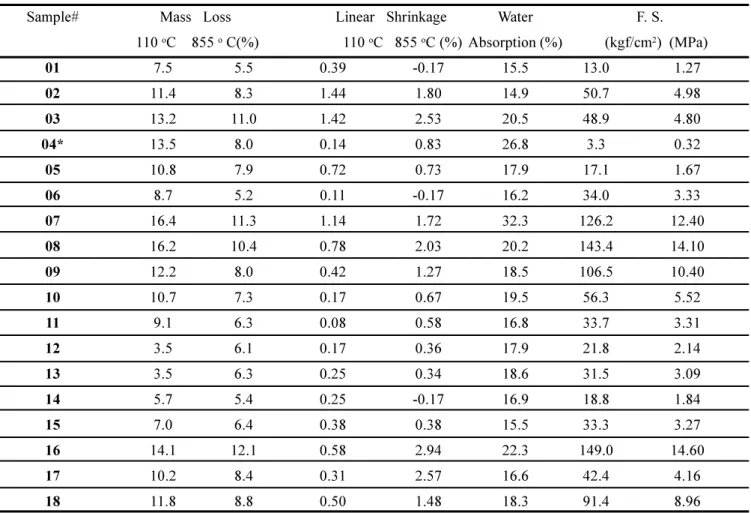
related to PL values between 17.2% and 32%, suggesting applications in the red ceramic area. Furthermore, it is important to have in mind that PL values between 26 and 32% allow ceramic processing and/or conforming via extrusion process [9]. Some properties of the fired ceramic bodies are summarized in Table II. The small values of mass loss (< 14%) after firing indicate that it is not due to the presence of organic matter at high concentration. Only two of the samples (#04 and #07) exhibit water absorption levels higher than 25%. This value is the maximum indicated to industrial applications such as ceramic blocks. Sample #17 has been used to produce roof tiles having a low level of water absorption (16.6%). This value is lower than the limit (20%) suggested for this application [10]. Most of the samples (thirteen) exhibit water absorption smaller than the limit value (Table II) to produce roof tiles, porous plates or floor tiles. As a whole, considering the drying and firing cycles, the total linear shrinkage is smaller than the limit value (6%).
The minimum values of flexural strength (FS) indicated to ceramic pieces fired at 900 oC are: 20 kgf/cm2 to massive bricks, 55 kgf/cm2 to ceramic blocks and 65 kgf/cm2 to roof tiles [11]. Although in this work the samples were fired at 855 oC during 1 hour, according to Table II, five samples show FS values
Sample# Mass Loss Linear Shrinkage Water F. S. 110 oC 855 o C(%) 110 oC 855 oC (%) Absorption (%) (kgf/cm2) (MPa)
01 7.5 5.5 0.39 -0.17 15.5 13.0 1.27
02 11.4 8.3 1.44 1.80 14.9 50.7 4.98
03 13.2 11.0 1.42 2.53 20.5 48.9 4.80
04* 13.5 8.0 0.14 0.83 26.8 3.3 0.32
05 10.8 7.9 0.72 0.73 17.9 17.1 1.67
06 8.7 5.2 0.11 -0.17 16.2 34.0 3.33
07 16.4 11.3 1.14 1.72 32.3 126.2 12.40
08 16.2 10.4 0.78 2.03 20.2 143.4 14.10
09 12.2 8.0 0.42 1.27 18.5 106.5 10.40
10 10.7 7.3 0.17 0.67 19.5 56.3 5.52
11 9.1 6.3 0.08 0.58 16.8 33.7 3.31
12 3.5 6.1 0.17 0.36 17.9 21.8 2.14
13 3.5 6.3 0.25 0.34 18.6 31.5 3.09
14 5.7 5.4 0.25 -0.17 16.9 18.8 1.84
15 7.0 6.4 0.38 0.38 15.5 33.3 3.27
16 14.1 12.1 0.58 2.94 22.3 149.0 14.60
17 10.2 8.4 0.31 2.57 16.6 42.4 4.16
18 11.8 8.8 0.50 1.48 18.3 91.4 8.96
*Sample #04 is a yellow clay (rich in goethite) used to paint pottery.
Table II - Mass loss, linear shrinkage, water absorption and mechanical physical properties of dried and fired ceramic bodies.
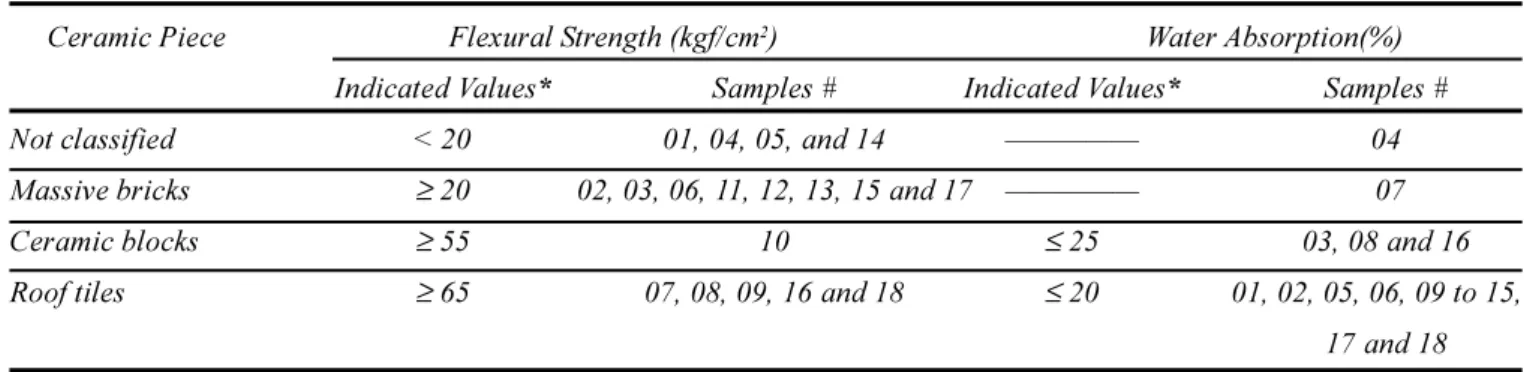
higher than 65 kgf/cm2. Six of them have values above 55 kgf/ cm2. Eight of them show FS values between 20 and 55 kgf/ cm2, including a sample adequate to the production of roof tiles (42.2 kgf/cm2). Only three samples exhibited FS values lower than 20 kgf/cm2. It is interesting to note that the FS limit value to roof tiles (65 kgf/cm2) is reached when the ceramic bodies are fired at temperatures ≥ 950 oC. This behavior is in accordance with previous work [10]. Samples #07, #08, #09, #16 have very high FS values (from 106.5 to 149.0 kgf/cm2) that indicate further application to production of ceramic plates. In Table III samples are classified according to their flexural strength and water absorption.
Fig. 1 shows that besides the clay concentration a low sand concentration is a determining factor to obtain ceramics with high flexural strength. Also, it can be observed that in general samples from the Paraná River margins (P. Epitácio and Panorama) result in ceramics with highest FS. Furthermore, it has been taken into account that different mineral compositions between samples collected in different places influence their final properties. As an example, sample #03 has low sand and high clay concentrations, but its flexural strength is smaller than samples #08 or #18. Sample #04 present very low flexural strength due to their very high iron oxides concentration.
All samples have kaolinite (major phase), mica and 2:1 layered clay minerals, according to a previous work [4]. Some of them were identified as being smectite with variable concentrations leading to distinct degree of heterogeneous shrinkage. Thus, differential shrinkage is exerted on the ceramic body after dry process. As a consequence, a high level of cracks and microcracks can be generated. As expected, these cracks and porosity (due to organic matter) might contribute to the lowest FS values measured. The development of cracks is further correlated with asymmetric shrinkage of ceramic bodies. It seems that the origin of this phenomenon can be assigned twofold. First, a heterogeneous mixture of clays is highlighted. Second, according to previous work [12], the flexural strength is a function of the particle size distribution and clay composition. In particular, the value of rupture tensile increases with decreasing of the average particle size. Taking into account the clays investigated and based on X-ray diffraction data published elsewhere [4], the kaolinite is the major clay mineral present in
Ceramic Piece Flexural Strength (kgf/cm2) Water Absorption(%)
Indicated Values* Samples # Indicated Values* Samples #
Not classified < 20 01, 04, 05, and 14 04
Massive bricks ≥ 20 02, 03, 06, 11, 12, 13, 15 and 17 07
Ceramic blocks ≥ 55 10 ≤ 25 03, 08 and 16
Roof tiles ≥ 65 07, 08, 09, 16 and 18 ≤ 20 01, 02, 05, 06, 09 to 15,
17 and 18
* Indicated values [10,12].
Table III - Sample classification according to flexural strength and water absorption.
[Tabela III - Classificação de cada amostra de acordo com sua resistência mecânica e absorção de água].
all samples with different fractions and crystallization degree. The presence of illites in the clay suggests some influence on the mechanical behavior of the samples investigated. In this sense, the fine quartz fraction observed in all samples might also exert some influence on the samples properties (increase FS and reduce shrinkage) after firing.
It is known [12] that pure clay minerals show a wide range of flexural strength (FS) as follows: 0.7 to 49 kgf/cm2 to kaolinite, 14 to 70 kgf/cm2 to illites and 21 to 56 kgf/cm2 to smectites. These values can be classified as: low (0 to 7 kgf/cm2), lower intermediate (7 to 14 kgf/cm2), middle intermediate (14 to 28 kgf/cm2), upper intermediate (28 to 56 kgf/cm2) and high (at above 56 kgf/cm2). Based on the above benchmarks, the samples can be classified (Table IV) having in mind that low FS values disqualify the raw material for ceramic uses. According to Table IV, only sample #04 (rich in goethite) cannot be used to produce ceramic products, because of low FS values; one sample has lower intermediate value; three samples exhibit middle to intermediate values. Fortunately,
Figure 1: Flexural strength and clay and sand concentrations of the samples.
Classification of FS* Sample #
Low 04
Lower Intermediate 01
Middle 05 12 14
Upper Intermediate 02 03 06 10 11 13 15 17
High 07 08 09 16 18
* FS classification [12].
Table IV -Samples Classification according to flexural strength (FS). [Tabela IV - Classificação das amostras de acordo com sua resistência mecânica FS].
most of the samples have upper intermediate values (eight of them) or high values (five of them). It is interesting to point out that, despite the high fraction of kaolinite at all clays, a great number of FS values listed on Table IV are higher than one reported to pure kaolinite (0.7 to 49 kgf/cm2). These values indicate the influence of other clay minerals on FS values and other physical parameters. In order to improve the comprehension of the ceramic properties investigated here, further firing tests at different temperatures (≥ 855 oC) are required, along with some tests using powders with different particle size distributions. The results of these tests can determine the kind of innovative product in terms of superior application that can be produced from each raw material. Some samples will undoubtedly have their ceramic properties improved by milling the raw material to obtain powders with small particle size and sintering the probes in higher temperatures than those used in this work.
All raw samples exhibit two major colors as observed in a previous work [4]. The first set is gray and its tonality changes from weak to intense, while the second one shows a brownish color with tonality changing between soft and hard intensity, after drying at 110 oC. Ceramics exchange their colors after firing. The brownish bodies exhibit a typical red color after firing at 855 oC, such as samples #08, #17 and #18. Furthermore, some of the samples exchange its colors from black to pale brown suggesting other potential applications as ceramic products. As a matter of fact, samples color changes to light brown (10YR8/3), #3, to light red (10YR6/6) samples #08, #17 and #18, according to Munsells chart [14] used to classify the color of soils. Sample #04 is red (2.5YR5/8) due to the transformation of goethite to hematite after firing. Other samples have several colors ranging from brownish to yellowish and were not classified. As a whole, samples exhibit light or pale colors after firing, including samples #01, #02, #03, #05 and #06. They could be used to produce other products with final prices higher than red ceramics, including light brown or yellowish roof tiles or floor tiles.
CONCLUSIONS
This study leads us to the following conclusions:
1. The results of the physical characterization showed
that after firing the samples present: low mass loss, low water absorption, good linear retraction and flexural strength, having technological features to produce a wide range of red ceramics. 2. After firing, some raw materials depicted light colors or were nearly white, suggesting a possible use to produce materials with superior commercial value, when compared to structural blocks and massive bricks.
3. Some of them have excellent properties (light colors or very high flexural strength) and could be used to produce different kinds of structural ceramics.
AKNOWLEDGMENTS
The authors gratefully acknowledge the partial support of this work granted by FUNDUNESP and FAPESP, as well as CNPq for the students scholarships and to Laboratório de Engenharia Civil - UNESP/FEIS.
REFERENCES
[1] CESP Companhia Energética do Estado de São Paulo, Reservatório de Porto Primavera: Estudo e Relatório de Impacto Ambiental EIA/RIMA, vol. I e II (1992/93). [2] J. J. Almeida, R. C. Valério, E. R. Ninelo, S. R. Teixiera e W. A. Carvalho, Mineralogia da Fração Argila de Materiais Usados na Produção de Tijolos e Telhas na Região de Panorama SP, 47a Reunião Anual da SBPC, São Luis MA, 09 a 14 de julho (1995).
[3] J. F. M. Motta, M. Cabral Jr., L. C. Tanno, Z. Hellmeister Jr., A. Zandonadi, S. Saka e N. H. Saito, Caracterização de argilas do vale do Rio Paraná (SP e MS), visando à aplicação nas industrias de cerâmica vermelha, Anais do 39o Congresso Brasileiro de Cerâmica, Águas de Lindóia - SP, 10 a 13 de junho (1995) 401.
[4] S. R. Teixeira, S. A. Souza e C. A. I. Moura, Mineralogical characterization of clays used in the structural ceramic industry in west of S. Paulo State, Brazil, Cerâmica 47, 304 (2001) 204.
[5] A. Klute (Editor), Methods of Soil Analysis: Physical and Mineralogical Methods, Madison, SSSA Book Series: 5, Second Edition (1986).
[6] J. B. Dixon, G. N. White, Soil Mineralogy Laboratory Manual: Agronomy 626, Texas A & M University (1997). [7] J. B. Dixon, D. G. Schulze, Soil Mineralogy with Environmental Applications, Madison, SSSA Book Series: 7 (2002).
[8] A. P. F. Albers, F. G. Melchiades, R. Machado, J. B. Balbo, A. O. Boschi, Cerâmica 48, 305 (2002) 34-37.
[9] I. S. S. Santos, N. I. W. Silva, H. J. Wildner, M. Boff, Anais do 39o Congresso Brasileiro de Cerâmica, Águas de Lindóia - SP (1995) 401.
[12] P. de S. Santos, Ciência e Tecnologia de Argilas, vol. 1, Ed. Edgard Blücher Ltda, S. Paulo (1989).
[13] A. A. Zanfolim, Caracterização e propriedades físicas da argila
de Ivinhema/MS, Dissertação de Mestrado, UFMS-MS (2002). [14] Munsell Soil Color Charts, Munsell Color Company, Inc., Baltimore, Maryland, USA (1954).