INTRODUCTION
Silicon carbide based ceramics is considered as a promising material for a number of hi-tech applications due to its unique combinations of properties, such as high hardness and strength, chemical an thermal stability, oxidation resistance, etc. Mostly, SiC based ceramics, especially the materials densified by means of liquid phase sintering (LPS-SiC), are manufactured from fine, high grade powders that are rather costly [1]. Such materials can be economically viable in case of advanced applications where high properties, especially mechanical
strength and fracture toughness, are of primary importance. A number of other applications, including a variety of modern refractories, where mass production of parts, sometimes with considerable mass, is required can be cost effective only if a cheaper starting material is used. In this regard an investigation of a possible use of the Brazilian Alcoa 1000 SiC powder of technical grade for LPS-SiC manufacturing is of interest. The powder in question is normally used as an abrasive material and is much cheaper than the fine grade powders produced for advanced SiC ceramics manufacturing.
It is a well established fact that by analogy with silicon nitride, it is possible to tailor the microstructure and the structure-sensitive properties of silicon carbide based ceramics by varying α− to β−SiC ratio in the initial mixtures. If α −SiC
Liquid phase sintered SiC ceramics from
starting materials of different grade
(Cerâmicas à base de SiC sinterizadas via fase líquida a
partir de matérias-primas de diferentes purezas)
V. A. Izhevskyi
1, L. A. Genova, J. C. Bressiani, A. H. A. Bressiani
Instituto de Pesquisas Energéticas e Nucleares - IPEN
Av. Prof. Lineu Prestes, 2242, Cidade Universitária, S. Paulo, SP 05508-000
Abstract
Possibility of high performance ceramics manufactured from commercial SiC powder of technical grade has been shown. Sintering behavior and microstructure formation under conditions of liquid phase sintering (LPS) with oxynitride sintering aids (AlN-Y2O3) of three SiC-based compositions have been investigated. Two of the compositions were based on Alcoa 1000 SiC powder of technical grade, and the third one, which was used as a reference, was based on H.C. Starck UF-15 fine grade commercial powder. Milling process used for Alcoa 1000 SiC powder granulometry improvement has been investigated in detail, while chemical treatment of milled SiC powders has been used for pick-up impurities removal. Dilatometric experiments showed that SiC powder of technical grade after appropriate treatment exhibits sinterability comparable with the fine grade SiC. Microstructural investigations performed on sintered samples showed that the final microstructure of the Alcoa 1000 SiC based materials was practically identical with the H.C. Starck SiC based reference ones. Preliminary investigations of hardness and fracture toughness were carried out revealing excellent results for the materials produced from cheaper, nationally produced starting powder.
Keywords: silicon carbide, liquid phase sintering, commercial powder.
Resumo
Neste trabalho é apresentada a possibilidade de obtenção de cerâmicas de SiC de alto desempenho a partir de matéria-prima comercial de grau técnico. Foi realizado o estudo de sinterização via fase líquida e desenvolvimento microestrutural de três composições à base de SiC tendo como aditivos de sinterização AlN e Y2O3 . Duas destas composições são à base de SiC-1000 da Alcoa, grau técnico, e a terceira, utilizada como referência, à base do UF-15 da H.C. Starck - Alemanha, pó comercial de granulometria fina. O processo de moagem do pó SiC-1000 da Alcoa foi acompanhado por medidas de distribuição granulométrica e posterior ataque químico, para remoção de impurezas. Os pós de grau técnico, após tratamento de moagem apropriado, apresentam sinterabilidade comparável à do pó de referência, em experimentos em dilatômetro. Os materiais sinterizados com matéria-prima à base de SiC da Alcoa apresentam microestrutura bastante similar aos obtidos com o pó de referência, da H.C. Starck. Foi feita análise preliminar das propriedades de dureza e tenacidade à fratura das cerâmicas desenvolvidas e os resultados obtidos para os materiais produzidos com o pó nacional são excelentes.
Palavras-chave: carbeto de silício, sinterização via fase líquida, matéria-prima comercial.
1 Invited scientist, on leave from the Institute for Problems of Materials
is used as a starting powder, the final material is characterized by fine homogeneous microstructure with equiaxial grains, which results in high bending strength and hardness, and moderate fracture toughness [1-3]. If β−SiC powder is used as the main component, and α− SiC is present in some minor quantity (1-10 wt.%) as seeds for more readyβ ¦α SiC transformation, after sintering and application of specially developed post-sintering thermal treatment, an in-situ platelet reinforced material with improved mechanical properties can be obtained [4-7].
In the case of Alcoa 1000 SiC the main phase present in the powder is α−SiC, and the as-received powder is relatively coarse and is not suitable for direct processing by means of LPS. Therefore, the goal of the present work is to investigate the possibility to upgrade the powder in terms of average particle size and impurities content to an acceptable condition, and to explore the viability of the previously used processing route [8-10] for dense ceramics fabrication.
EXPERIMENTAL
The starting materials for this study were purchased from Alcoa (Brazil), and H. C. Starck (Germany), and were characterized for particle size distribution (laser granulometry, Granulometer 1064, CILAS, France), and specific surface area (N2 adsorption isotherms, BET, ASAP 2000, Micrometrics Instrument Corp., USA). The morphology of the powders was analyzed by TEM and SEM. The H. C. Starck α -SiC powder UF 15 was used in the as-received condition, while the Alcoa 1000 SiC powder was subjected to a preliminary treatment in order to upgrade its properties, in particular its mean particle size and impurities content. This treatment included a series of millings in an attritor in distilled water, the maximal milling time being 20 hours. After certain intervals of time a sample of the slurry was taken and analyzed for particle size distribution by means of laser granulometry. After the powder reached the desired granulometry, the slurry obtained after attrition milling was separated from the milling media by passing through a 325 mesh sieve and subsequently dried in a drying box at 140 0
C for 48 hours. The dried powder was passed through a 100 mesh sieve to crush soft agglomerates.
Part of the milled Alcoa powder was subsequently treated with 1N solution of hydrochloric acid for excessive iron impurities removal. Chemical treatment was accomplished at room temperature for 10 hours under conditions of continuous stirring. Afterwards, the remnants of acid and reaction products were washed out from the powder with distilled water. The pH of the slurry was constantly monitored throughout the procedure until neutral values were achieved. The powder was separated by filtration, and then dried in a drying box at 140 0
C for 48 hours. The dried powder was passed through a 100 mesh sieve to crush soft agglomerates.
Three mixtures were prepared from the as-received H. C. Starck UF15 α -SiC powder, milled Alcoa 1000 α -SiC powder, and milled and chemically treated Alcoa 1000 α -SiC powder using AlN (H. C. Starck, Germany, grade C) and Y2O3 (>99.98 % purity, Aldrich Chemical Company, USA) as sintering aids by attrition milling with alumina milling media in isopropyl
alcohol for 4 hours at 500 RPM. The total amount of sintering aids was kept constant at 10 vol.%. The ratio AlN/Y2O3 was kept constant at 3:2, the proportion chosen from the AlNY2O3 phase diagram [11]. The slurry obtained after attrition milling was separated from the milling media by passing through a 325 mesh sieve and subsequently dried in a rotaevaporator. The process of drying was then completed in a drying box (48 hours, 65 0
C). Finally, the powder was passed through an 100 mesh sieve to crush soft agglomerates.
Green bodies in the form of cylindrical pellets 20 mm in diameter and 15 mm height were prepared by consequent uniaxial pressing at 100 MPa, and cold isostatic pressing at 200 MPa. Dilatometric experiments were accomplished in a high temperature dilatometer (DIL 402 E/7, Netzsch GmbH, Germany) with a graphite resistance furnace and working parts in a flowing argon atmosphere. Sintering was accomplished in a gas-pressure furnace (Thermal Technologies, Santa Barbara, USA) with a graphite heating element in argon atmosphere.
Sintered samples were characterized for weight loss, density, phase composition and microstructure. Density was determined by Archimedes method. The theoretical densities of the different compositions were calculated based on the rule of mixtures, by taking the density of SiC (containing 2 wt.% SiO2) as 3.18g/cm
3
, Y2O3 as 5.02 g/cm 3
and AlN as 3.26 g/cm3 . The relative densities were thus available by comparing the measured densities and the theoretical densities. Microstructure was studied by means of scanning electron microscopy (DSM982, Zeiss) and transmission electron microscopy (JEM 4000EX, JEOL). Samples for SEM were prepared according to a standard ceramographic procedure of multistage polishing with diamond tools. Polished samples were subsequently subjected to plasma etching in CF4-10%O2 plasma for structure elements revelation. A standard procedure for TEM sample preparation starting from bulk samples which included cutting, grinding, dimpling and ion milling was used.
Sintered materials were tested for hardness and fracture toughness. Fracture toughness was determined by indentation method. After polishing to a 1 ¼m finish, 10 Vickers indentations per specimen were introduced with a load of 50 N and loading times of 15 s. The fracture toughness KIc was calculated from the length of the edge cracks and indentation diagonals using a formula valid for semi-circular crack system [12]. Youngs modulus was measured by the pulse-echo method and a value of 400(±20) GPa was used for KIc determination.
RESULTS AND DISCUSSION
Powder Pre-treatment Particle size distribution Specific area (m2 g-1
)Mixture
d10 (µm) d50 (µm) d90 (µm)
UF-15 As-received 0.2 0.5 1.0 15.8 SiC-S
Alcoa 1000 As-received 1.6 6.5 17.0 -
-Alcoa 1000 Milled 20 h 0.3 0.9 2.0 14.1 SiC-1
Alcoa 1000 Milled 20 h 0.3 0.9 2.0 14.1 SiC-2
+ HCl treated
Table I - Characteristics of the starting SiC powders and powder mixtures nomenclature.
[Tabela I Características dos pós de SiC e nomenclatura das misturas de pós.]
Figura 1: The results of the granulometry evolution of the Alcoa 1000 α -SiC powder during attrition milling in distilled water.
[Figure 1: Resultados da evolução na distribuição granulométrica do pó α-SiC-1000 Alcoa com a moagem em atritor, em água destilada.]
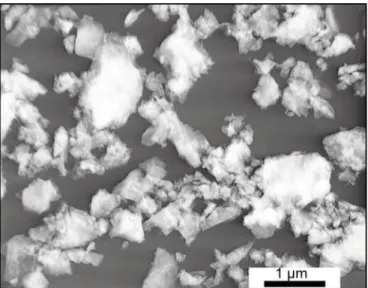
Figura 2: Results of SEM examination of as-received Alcoa 1000 α -SiC powder (a) and of the same powder after 20 h of milling (b).
Figura 4: The results of dilatometric experiments: linear shrinkage vs
temperature (a) and shrinkage rate vs temperature (b).
[Figure 4: Resultados de dilatometria, retração linear em função da temperatura (a) e taxa de retração linear em função da temperatura (b).]
Figura 5: Results of SEM examination of sintered samples produced from H. C. Stark α -SiC powder UF-15 (a), and Alcoa 1000 α -SiCpowder after 20 h of milling (b), and after 20 h of milling followed by chemical treatment (c).
[Figure 5: Micrografias eletrônicas de varredura das amostras sinterizadas utilizando: SiC UF-15 da H.C. Starck (a), SiC-1000 da Alcoa após moagem por 20 h (b) e SiC-1000 da Alcoa após moagem seguida de tratamento químico (c).]
2 and 3. As it can be seen, the Alcoa 1000 α -SiC powder after 20 hours of attrition milling (Fig. 2b) differs significantly both in particle size and particle morphology from the as-received condition (Fig.2a) but is quite similar to the commercial H. C.
Figura 3: TEM image of the commercial H. C. Stark α -SiC powder UF-15.
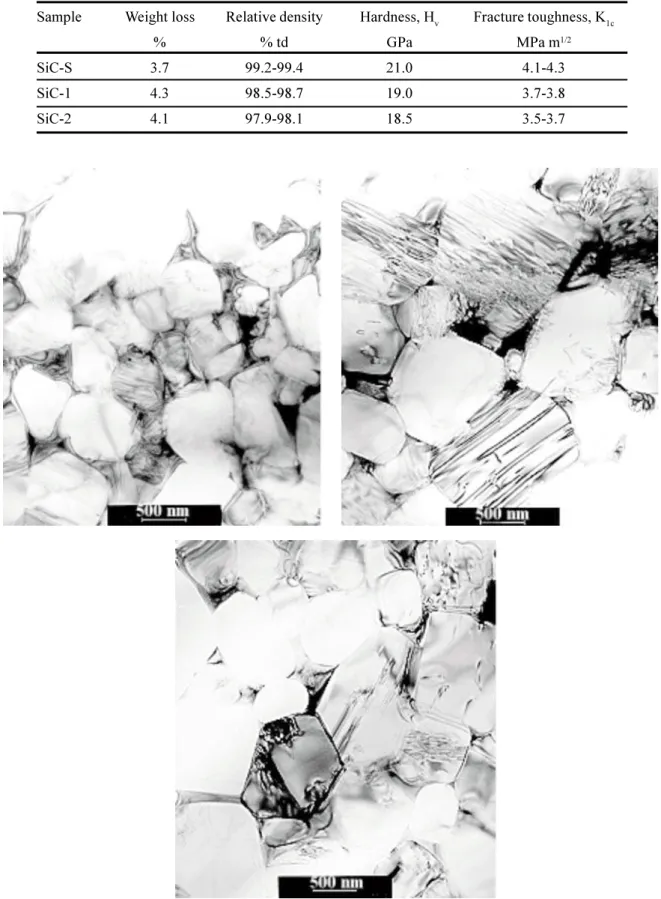
Table II - Characteristics of liquid-phase sintered SiC samples.
[Tabela II Características das amostras de SiC sinterizadas via fase líquida.]
Sample Weight loss Relative density Hardness, Hv Fracture toughness, K1c
% % td GPa MPa m1/2
SiC-S 3.7 99.2-99.4 21.0 4.1-4.3
SiC-1 4.3 98.5-98.7 19.0 3.7-3.8
SiC-2 4.1 97.9-98.1 18.5 3.5-3.7
Figura 6: Results of TEM examination of sintered samples produced from H. C. Stark α -SiC powder UF-15 (a), and Alcoa 1000 α -SiC powder after 20 h of milling (b), and after 20 h of milling followed by chemical treatment (c).
Stark α-SiC powder UF-15 (Fig.3). Only a slight difference in particle morphology can be observed, the particles of the milled powder having less sharply defined geometrical shape. However, the latter fact is not expected to be of importance for sinterability of the powder, and only of minor influence on its compactability. Results of dilatometric experiments are presented in Fig. 4. As it can be seen, the linear shrinkage of materials SiC -1 and SiC-2 differs only slightly. The material prepare from the acid-treated powder does not exhibit the slight initial shrinkage at about 1600 0
C, and the total shrinkage is somewhat lower. Both effects can be explained by the removal of the impurities that can influence the composition and thermal properties of the liquid phase. The difference in sintering behavior between the material prepared from the H. C. Stark α -SiC powder UF-15 and the two materials prepared from the pre-treated Alcoa 1000 α -SiC powder is much more pronounced. The active shrinkage of the former occurs at temperatures lower by about 700
C and proceeds more actively. Moreover, overall shrinkage is significantly higher: 12% and 9%, respectively. Considering that the amount and composition of sintering aids in all materials is identical, the most plausible explanation for the observed differences in sinterability is the differences in the granulometry and some other intrinsic properties of the powders such as the concentration of defects and related internal energy of the powders. The latter needs further detailed investigation by high-precision X-ray analysis.
Some results of furnace sintered samples characterization is given in Table II. As it can be seen, the samples produced from the modified Alcoa 1000 α -SiCpowders exhibit reasonably good properties, although somewhat inferior to the ones of the reference material produced from the H. C. Stark α -SiC powder UF-15. This, of course, should be expected since the powders are of different grade: technical grade and high grade, respectively. However, the developed materials even with the present level of properties can be of interest for commercial applications such as advanced refractories, corrosion and hot corrosion resistance materials, etc., i.e., for applications where advanced mechanical properties are not the limiting factor. The role of chemical pre-treatment of the milled Alcoa 1000α -SiC powder did not result in and pronounced effects during sintering. The almost negligible decrease of the weight loss can be considered as a fact of minor importance, while the slightly inferior sinterability can be attributed to the removal of the impurities responsible for less refractory or/and less abundant liquid phase formation under same sintering conditions.
Microstructural investigations by SEM and TEM presented in Fig. 5 and 6 revealed that for all investigated materials microstructure is fine-grained and globular. In SEM images after plasma etching the so-called core-rim structure of grains can be clearly seen, which presents evidence of grain growth via solution-reprecipitation, and the grain boundary phase is revealed by differential etching of the structural elements. It should be noted that the overall microstructure of materials SiC-1 and SiC-2 is coarser than the one of SiC-S material as a result of the initial difference in the granulometry of the starting SiC powders. Moreover, the microstructure of the material SiC-S is more homogeneous in regard of the secondary phase
distribution which might be responsible for better mechanical properties, in particular for superior fracture toughness. No apparent differences between the microstructure of SiC-1 material and SiC-2 material were observed, which indicates that acid treatment of the milled Alcoa 1000 α -SiC has no pronounced positive effect on its behavior during processing. TEM investigations provided additional evidence of the above described micostructural features for all materials. Moreover, for materials SiC-1 and SiC-2 a representative number of TEM observations indicated that due to the known stereological considerations the average dimensions of the triple points formed by coarse SiC grains are sufficiently larger than the ones observed in SiC-S material. Such tendency may be responsible for partial densification hindrance and consequent properties degradation as a result of inhomogeneous liquid phase distribution over the volume of the sintered body.
In spite of the above described differences in the investigated materials behavior under conditions of sintering, and in their microstructure and properties it has been shown that the materials produced from the Alcoa 1000 α -SiC of technical grade after its pre-processing upgrading are comparable and compatible with the material produced from the high grade the H. C. Stark α-SiC powder UF-15. In order to improve the parameters of the nationally produced raw materials for LPS SiC-based ceramics fabrication further optimization of the upgrading processes, in particular of the granulometry adjustment, are necessary.
CONCLUSIONS
The viability of liquid phase sintered SiC-based ceramics manufacturing from the nationally produced raw materials, namely from the Alcoa 1000 α -SiC powder of technical grade, has been shown. Processes of upgrading of the Alcoa 1000 α -SiC powder by means of attrition milling and chemical treatment were studied, and the possibility of its sufficient properties improvement were demonstrated. LPS SiC based material with sinterability and properties comparable with the ones typical for ceramics manufactured from high grade raw materials was achieved. Further improvement of the Alcoa 1000 α -SiC powder of technical grade is under investigation at present time.
ACKNOWLEDGEMENTS
The financial support of this research by FAPESP, CNPq and PRONEX is gratefully acknowledged. Dr. V. Izhevskyi would like to express his gratitude to FAPESP for financial support of his participation in this research. The authors would like to thank Alcoa-Br for the supplying of silicon carbide SiC-1000 powder. Authors are grateful to the technical staff of PML, Stuttgart, for assistance with microstructural investigations.
REFERENCES
processing, Cerâmica 46 (2000) 4-14.
[2] S. K. Lee, C. H. Kim, Effects of α−SiC versus β−SiC starting powders on microstructure and fracture toughness of SiC sintered with Al2O3−Y2O3 additives, J. Am. Ceram. Soc. 77 (1994) 1655-58. [3] M. Omori, H. Takei, Pressureless Sintering of SiC, J. Am. Ceram. Soc. 65 (1982) C-92.
[4] P. Padture, In-situ toughened silicon carbide, J. Am. Ceram. Soc. 77 (1994) 519-23.
[5] M. Keppeler, H.-G. Reihert, J. M. Broadly, G. Turn. I. Wiedmann, F. Aldinger, High temperature mechanical behavior of liquid phase sintered silicon carbide, J. Eur. Ceram. Soc. 18 (1998) 521-26.
[6] L. S. K. Lee, Y. C. Kim, C. H. Kim, Microstructural development and mechanical properties of pressureless-sintered SiC with plate-like grains using Al2O3-Y2O3 additions, J. Mater. Sci. 29 (1994) 5321-26.
[7] G. Rixecker, K. Biswas, A. Rosinus, S. Sharma, I. Wiedmann, F. Aldinger, Fracture properties of SiC ceramics with oxynitride
additives, J. Eur. Ceram. Soc. 22 (2002) 2669-2675.
[8] V. A. Izhevskyi, L. Genova, J. C. Bressiani, A. H. A. Bressiani, Liquid phase sintering of SiC based ceramics, Key. Eng. Mater. 181-191 (2001) 173-180.
[9] V. A. Izhevskyi, L. Genova, A. H. A. Bressiani, J. C. Bressiani. Liquid phase sintered SiC. Processing and transformation controlled microstructure tailoring, Mater. Res. 3 (2000) 131-138 (eletronic address: www.scielo.br/mr). [10] V. A. Izhevskyi, L. Genova, A. H. A. Bressiani, J. C. Bressiani, Microstructure and properties tailoring of liquid-phase sintered SiC, Int. J. Refract. Met.H. 19 (2001) 409-417. [11] A. Jeutter, Untersuchung der Phasenbezieung im Sysytem Aluminiumnitrid-Yttriumoxid, Diplomarbeit an Universitat Stuttgart, Germany (1993).
[12] G. R. P. Anstis, P. Chanticul, B. R. Lawn, D. B. Marshall, A critical evaluation of indentation techniques for measuring fracture toughness: I. Direct crack measurements, J. Am. Ceram. Soc. 64 (1981) 533- 538.