ISSN 0104-6632 Printed in Brazil
www.abeq.org.br/bjche
Vol. 25, No. 01, pp. 19 - 26, January - March, 2008
Brazilian Journal
of Chemical
Engineering
MASS TRANSFER INSIDE OBLATE SPHEROIDAL
SOLIDS
:
MODELLING AND SIMULATION
J. E. F. Carmo and A. G. B. Lima
Centro de Ciências e Tecnologia, Departamento de Engenharia Mecânica, Universidade Federal de Campina Grande (UFCG),
Phone +(55) (83) 3310-1317, Fax + (55) 83 3310-1272, Cx. P. 10069, CEP 58109-970, Campina Grande-PB, Brazil.
E-mail: [email protected]
(Received: January 3, 2006 ; Accepted: September 17, 2007)
Abstract - A numerical solution of the unsteady diffusion equation describing mass transfer inside oblate spheroids, considering a constant diffusion coefficient and the convective boundary condition, is presented. The diffusion equation written in the oblate spheroidal coordinate system was used for a two-dimensional case. The finite-volume method was employed to discretize the basic equation. The linear equation set was solved iteratively using the Gauss-Seidel method. As applications, the effects of the Fourier number, the Biot number and the aspect ratio of the body on the drying rate and moisture content during the process are presented. To validate the methodology, results obtained in this work are compared with analytical results of the moisture content encountered in the literature and good agreement was obtained. The results show that the model is consistent and it may be used to solve cases such as those that include disks and spheres and/or those with variable properties with small modifications.
Keywords: Mass transfer; Ellipsoid; Oblate spheroid; Drying, simulation; Finite volume.
INTRODUCTION
Rates of heat and mass transfer from a particle of arbitrary shape to an infinitely extended fluid are of considerable importance in certain engineering applications such drying, wetting, heating and cooling. A drying process undergoes different periods such as initial transient, constant rate and falling rate periods. It is well known that moisture (liquid and/or vapor phase) migration in the falling rate period is controlled by diffusion. There are various types of diffusion, namely molecular diffusion, liquid diffusion through solid pores, vapor diffusion in air filled pores and effusion (Knudsen type diffusion).
For many years, intense research on diffusion phenomena in porous bodies using the liquid diffusion model has been applied to different materials by several researchers with great success.
The liquid diffusion model assumes that water migrates through the solid in the liquid phase, and consequently water vaporization occurs at the surface of the porous body. The following recent works can be reported: Rastogi et al. (1997), Derdour and Desmorieux (2004), Lim et al. (2004), Porto and Lisboa (2005) and Rodriguez et al. (2005).
Payne et al. (1986), Farias (2002), Carmo (2004), Lima et al. (2004) and Carmo and Lima (2005).
An especially analytical solution for diffusion in spheroidal bodies is given for products of infinite series and complex integrals. Depending on the initial and boundary conditions, the series are, for example, in Bessel functions and Legendre polynomials, both of a high order. Each series consists of coefficients that are very complex to obtain, presenting in a formidable undertaking (Oliveira, 2001; Oliveira and Lima, 2002). In this case, the numerical solution is recommended because of its simplicity and speed in obtaining results.
The objectives of this investigation are as follows: a) to present a two-dimensional mathematical model to describe moisture transport inside oblate spheroidal solids which will depend only of the particle dimensions and b) to solve numerically the mass transport equation written in the oblate spheroidal coordinate system.
MATHEMATICAL MODELLING Analytical Procedure
In this work, the following assumptions were made: the solid is homogeneous and isotropic; the drying process occurs at a falling drying rate; the heat conduction through the oblate spheroid is negligible; the field of moisture content is symmetric around the z-axis and constant and uniform at the beginning of the process; the thermo-physical properties are constant; the effect of capillarity is negligible; shrinkage is not important; and the process occurs under convective boundary conditions at the surface of the solid.
Fick’s second law in Cartesian coordinates can be written as follows:
M M M M
D D D
t x x y y z z
∂ = ∂ ∂ + ∂ ∂ + ∂ ∂
∂ ∂ ∂ ∂ ∂ ∂ ∂ (1)
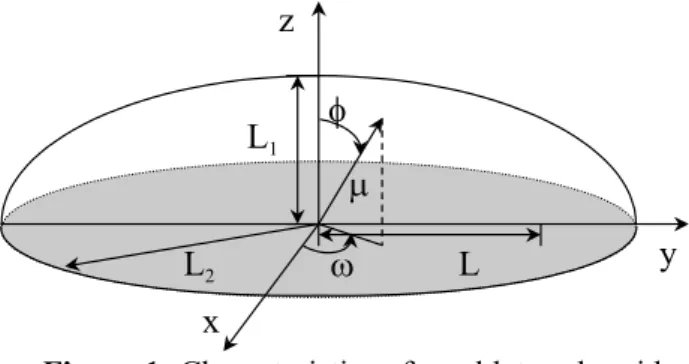
Eq. (1) is an appropriate equation to predict the mass diffusion in bodies with a rectangular shape, such as plates and parallelepipeds. To predict the diffusion phenomenon in oblate spheroids, it is necessary to transform this equation into an appropriate coordinate system, in this case, the oblate spheroidal coordinate system. Fig. 1 shows a body with an oblate spheroidal shape.
z ω y x L2 φ L1 L µ
Figure 1: Characteristics of an oblate spheroid The relationships between the Cartesian (x, y, z) and oblate spheroidal coordinate systems (µ, ϕ, ω) are given by Stratton et al. (1941) and Carmo (2004). By calculating the metric coefficients and Laplacian in the new coordinate system, using the symmetry around the z-axis, and considering the constant diffusion coefficient, Eq. (1) may be written as follows:
(
) (
)
(
) (
)
2
2 2 2
2
2 2 2
1 1 D L t 1 1 D L
∂ ξ + ∂Μ +
ξ +η ∂ξ ∂ξ
∂Μ =
∂ ∂ ∂Μ
∂η − η ∂η
ξ +η
(2)
The following initial, symmetry and boundary conditions are used:
M(ξ; η; 0)=Mo;
(
)
M , 1, t
0; ∂ ξ η =
=
∂η
(
)
M , 0, t
0; ∂ ξ η =
=
∂η
(
)
M 0, , t
0 ∂ ξ = η
= ∂ξ
( )
(
)
(
)
f 2 2 2m f e
1 M
D L
h M , , t M 0
ξ=ξ
ξ + ∂
+ ∂ξ
ξ + η
ξ = ξ η − =
(3a-c)
with ξf=L1/L in the surface.
The average moisture content of the body was calculated as follows:
v
1
M MdV
V
where V is the overall volume in the domain under study.
Defining the following dimensionless parameters:
* * *
2
* * e
3
o e
m
Dt t
L
M M
V
V M
M M
L
h L Bi
D
η = η ξ = ξ =
−
= =
−
=
(5)
we obtain the diffusion model (Eq. (2), Eq. (3a-c) and Eq. (4)) in the dimensionless form.
As a comment, in the models presented in the literature moisture diffusivity is assumed constant over the whole period. However, this consideration is not entirely true. It is valid for certain materials that have a slow drying rate (Lim et al., 2004). So, outside this condition, the model fails to adequately predict the experimental data, and thus a drying model should assume the diffusion coefficient to be a function of moisture content.
On the other hand, it is well known that the mass transfer coefficient depends on the geometry of the solid, velocity and thermo-physical properties of the fluid phase on the surface of the solid. Due to the complexity of the 3D-flow around ellipsoids of revolution (Geissler, 1974; Rosenfeld et al., 1992), it is very difficult to obtain the gradient velocity and concentration at the fluid-particle interface outside
the body, so the mass transfer rate is usually expressed in terms of the overall mass transfer coefficient (Strumillo and Kudra, 1986; Saravacos, 1995). As a result, as an approach the mean convective mass transfer coefficient on the surface of a spheroid can be obtained using either of the following methods: a) agreement between the predicted and experimental data using, for example, the least squares error technique (Queiroz, 1994; Lima et al., 2002; Carmo, 2004; Carmo and Lima, 2005) or b) empirical and theoretical mathematical correlations (Lochiel and Calderbank, 1964; Masliyah and Epstein, 1972; Clift et al., 1978; Coutelieris et al., 1995; Feng and Michaelides, 1997).
Finally, specifically for drying, the proposed mathematical model can be applied to liquid or vapor diffusion inside the solid.
Numerical Procedure
Due to the body symmetry, the computational domain shown in Fig. 2 where the nodal points (P, N, S, W, E) and constant lines of ξ and η are also presented, was adopted. It is possible to verify the existence of the symmetry in the plane that contains the points (x=0, y=0, z=0) and (x=0, y=0, z = L), in particular y≥0 and z ≥0. The numerical solution of the problem utilizing the finite-volume method is obtained by integrating Eq. (2) (in the dimensionless form) with respect to space and time (Maliska, 2004).
δη e
δη w
∆η ∆ξ
δξ s
δξ n
Ε
W S
N P
.E
.W .S
N.
η=cte
ξ=cte
.P
y z
.
PS
.
.
f dVdSξ
s
.
δξ s
Surface
.
E.
Wδξ n
“
Μ
e
.
w
.
8
Figure 2: Control volume used in this work
RESULTS AND DISCUSSIONS
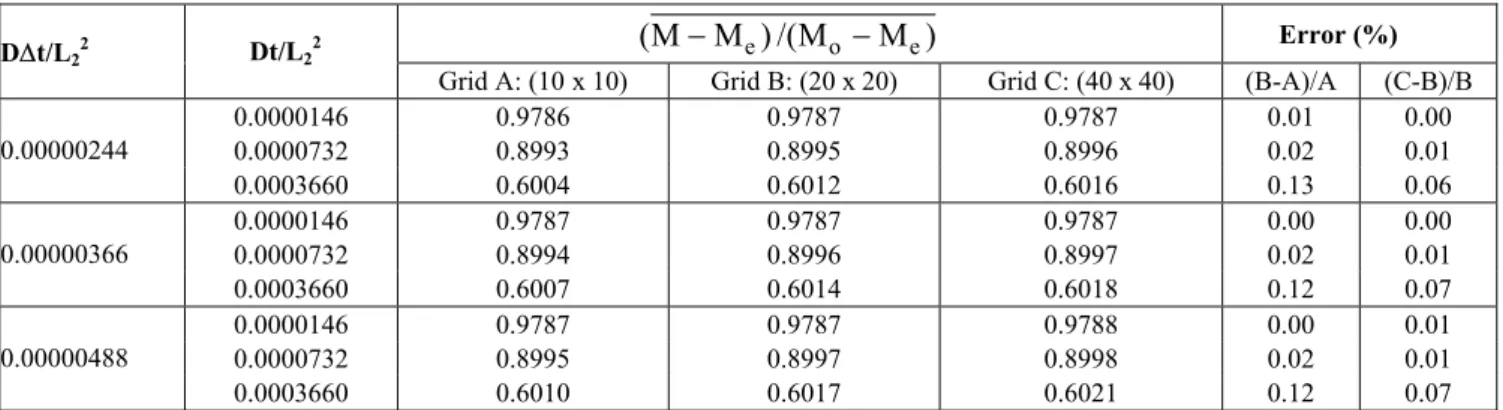
The numerical results using the finite-volume method are seriously affected by the D∆t/L2 values and the number of grid points. In order to verify grid size and time step independence, results were
obtained with three grid sizes and time steps. In the numerical calculations we use L2=1.0x10⁻² m and
table shows that 20x20 nodal points and D∆t/L2=2.44x10-6 provide satisfactory results (with an error less than 0.13%). Based on these parameters, numerical solutions of the mass diffusion equation for an oblate spheroid solid were obtained for various values of the input parameters. Details of this procedure can be found in the literature (Carmo, 2004).
To validate the numerical methodology used in the present work, Fig. 3 illustrates a comparison between the numerical results obtained by the authors and the analytical results reported in the literature (Farias, 2002). As shown, good agreement was obtained for all the cases reported in the literature.
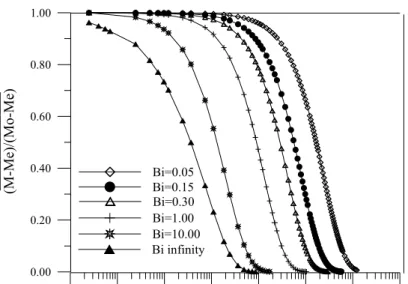
Figs. 4 and 5 show the effect of the Fourier number on the drying kinetics of the solid for fixed values of other parameters. The curves correspond to different Biot numbers and body dimensions. An analysis of the curves indicates that the average moisture content decreases with increasing Fourier number for any Biot number and aspect ratio. For fixed values of aspect ratio, increasing the Bi increases the drying rate of the product, decreasing the Fourier number and consequently the overall drying time. It is possible to verify that solids with higher aspect ratios dry first, due to the area/volume relationship.
Table 1: Dimensionless mean moisture content for several grid sizes and dimensionless times. L2/L1=100.0 and Bi=10.00
e o e
(M−M ) /(M −M ) Error (%)
D∆t/L22 Dt/L22
Grid A: (10x 10) Grid B: (20 x 20) Grid C: (40 x 40) (B-A)/A (C-B)/B
0.0000146 0.9786 0.9787 0.9787 0.01 0.00
0.0000732 0.8993 0.8995 0.8996 0.02 0.01
0.00000244
0.0003660 0.6004 0.6012 0.6016 0.13 0.06
0.0000146 0.9787 0.9787 0.9787 0.00 0.00
0.0000732 0.8994 0.8996 0.8997 0.02 0.01
0.00000366
0.0003660 0.6007 0.6014 0.6018 0.12 0.07
0.0000146 0.9787 0.9787 0.9788 0.00 0.01
0.0000732 0.8995 0.8997 0.8998 0.02 0.01
0.00000488
0.0003660 0.6010 0.6017 0.6021 0.12 0.07
0E+000 1E-001 2E-001 3E-001 4E-001 5E-001 6E-001 Dt/L22
0.0 0.2 0.4 0.6 0.8 1.0
(M
-M
e)
/(M
o
-M
e)
This work L2/L1=1.001 Farias (2002) L2/L1=1.000 This work L2/L1=2.000 Farias (2002) L2/L1=2.000
1E-005 1E-004 1E-003 1E-002 1E-001 1E+000 1E+001 1E+002
Fo=Dt/L22
0.00 0.20 0.40 0.60 0.80 1.00
_______
_____
_
(M
-M
e)/
(M
o-M
e)
Bi=0.05 Bi=0.15 Bi=0.30 Bi=1.00 Bi=10.00 Bi infinity
Figure 4: Dimensionless average moisture content of an oblate spheroid solid as a function of the Fourier number for L2/L1=5.00 and several Biot numbers.
1E-005 1E-004 1E-003 1E-002 1E-001 1E+000 1E+001 1E+002
Fo=Dt/L22
0.00 0.20 0.40 0.60 0.80 1.00
_______
_____
_
(M
-M
e)/
(M
o-M
e)
Bi=0.05 Bi=0.15 Bi=0.30 Bi=1.00 Bi=10.00 Bi infinity
Figure 5: Dimensionless average moisture content of an oblate spheroid solid as a function of the Fourier number for L2/L1=1.43 and several Biot numbers.
The moisture content distribution inside an oblate spheroidal solid with an aspect ratio of L2/L1= 5.00 and
Bi infinity in three Fourier numbers is shown in Figures 6a-b. It can be observed that the moisture content at all the points inside the body decreases with the increase in Fourier number. In these illustrations, the isoconcentration lines are seen along and inside the body. It can be observed that these lines have a confocal elliptic shape. The results indicate that moisture diffusion is initially faster close to the focal point, decreasing with time of drying in the direction of the center of the solid. This behavior is due to the geometrical shape of the body.
High moisture gradients are undesirable because they can result in mechanical stress, cracks and deformations, reducing the quality of the product at the end of the process. As already noted, the bodies
0.00 0.10 0.20 0.30 0.40 0.50 0.60 0.70 0.80 0.90 1.00
y (cm) 0.00
0.10 0.20
z (c
m
)
a) Fo = 0.00366
0.00 0.10 0.20 0.30 0.40 0.50 0.60 0.70 0.80 0.90 1.00
y (cm) 0.00
0.10 0.20
z (
cm
)
b) Fo = 0.01098
0.00 0.10 0.20 0.30 0.40 0.50 0.60 0.70 0.80 0.90 1.00
y (cm) 0.00
0.10 0.20
z (
cm
)
c) Fo = 0.02240
Figure 6: Dimensionless moisture content distribution in an oblate spheroid with an aspect ratio of L2/L1=5.00 and Bi infinity
CONCLUSIONS
A general fully numerical method for the solution of diffusion equation was developed and applied to the diffusion phenomenon in an oblate spheroid. The method uses a system of oblate spheroidal coordinates. With improved treatment of the diffusion equation, convergence is quickly achieved in each iteration and case studied in the nonsteady numerical simulation. The effect of singularity at the symmetry points of the spheroid was minimized using a regular grid. Satisfactory prediction of moisture content kinetics and distribution inside the solid was obtained.
By analysis of the results obtained, the following conclusions were reached: bodies with higher aspect ratios dry first for any Biot number; higher moisture gradients in the solid are found near the surface and around the focal point; and the model may be used in many physical problems of mass transfer, such as diffusion in circular disks, spheres and oblate spheroids and also in cases which include variable diffusion coefficients and other boundary conditions, with small modifications in the numerical procedure.
ACKNOWLEDGEMENTS
The authors would like to express their thanks to CAPES (Coordenação de Aperfeiçoamento de Pessoal de Nível Superior - Brazil) and CNPq (Conselho Nacional de Desenvolvimento Científico e Tecnológico - Brazil) for their financial support of this work.
NOMENCLATURE
Bi Biot number of mass
transfer
(-)
D Diffusion coefficient m2/s
Fo Fourier number of mass
transfer
(-)
L Focal length m
L1, L2 Minor and major axis of the
solid
M
M, M Local and average moisture
content
kg/kg
t Time S
V Volume m3
Greek Letters
ξ, η Angular (⊥ x axis), angular (⊥ z axis) and radial coordinates
(-)
∆,δ Variation (-)
Subscripts
e Equilibrium (-)
e,w,s,n Boundary of the nodal points
(-)
o Initial (-)
Superscripts
* Dimensionless (-)
REFERENCES
Carmo, J.E.F., Nonsteady-State Diffusion Phenomenon in Oblate Spheroidal Solids. Case Studies: Drying of Lentil. Ph.D. diss., Federal University of Campina Grande, Campina Grande, Brazil (2004). (In Portuguese).
Carmo, J.E.F. and Lima, A.G.B., Drying of Lentil Including Shrinkage: A Numerical Simulation. Drying Technology. Vol. 23, No. 9-11, 2005, pp. 1977-1992.
Clift, R., Grace, J.R. and Weber, M.E., Bubbles, Drops and Particles. San Diego: Academic Press, Inc., 1978, 380p.
Coutelieris, F.A., Burganos, V.N. and Payatakes, A.C., Convective Diffusion and Adsorption in a Swarm of Spheroidal Particles. AICHE Journal, Vol. 41, No. 3, pp. 1122-1134 (1995).
Crank, J., The Mathematics of Diffusion. Oxford Science Publications, New York (1992).
Derdour, L. and Desmorieux, H., A Model for Internal Moisture Diffusivity During the Regular Regime. Comparison with Experimental Data
Obtained on Plaster and Spirulina. 14th
International Drying Symposium. São Paulo, Brazil, 2004, Vol. A, pp. 718-725. Editors M.A. Silva and S.C.S. Rocha.
Farias, S.N., Drying of Spheroidal Solids using the Galerkin Method, Master`s thesis, Federal University of Paraiba, Campina Grande, Brazil (2002) (In Portuguese).
Feng, Z. and Michaelides, E.E., Unsteady Heat and Mass Transfer from a Spheroid, AICHE Journal, Vol. 43, No. 3 (1997).
Gebhart, B., Heat Conduction and Mass Diffusion.
McGraw-Hill, Inc., New York (1993).
Geissler, W., Three-dimensional Laminar Boundary Layer Over a Body of Revolution at Incidence and Separation. AIAA Journal. Vol. 12, No. 12, 1974, pp. 1743-1745.
Lim, L. C.; Tasirin, S. M.; Daud, W. R. W., Derivation of New Drying Model from Theoretical Diffusion Controlled Drying Period. 14th International Drying Symposium. São Paulo, Brazil, 2004, Vol. A, pp. 430-435. Editors M. A. Silva and S. C. S. Rocha.
Lima, A.G.B., Diffusion Phenomenon in Prolate Spheroidal Solids. Case Study: Drying of Banana. Ph.D. diss., State University of Campinas, Campinas, Brazil (1999). (In Portuguese).
Lima, D.R.; Farias, S.N. and Lima, A.G.B., Mass Transport in Spheroids Using the Galerkin Method. Brazilian Journal of Chemical Engineering. Vol. 21, No. 04, pp. 667-680 (2004).
Lima, A.G.B., Nebra, S.A. and Queiroz, M.R., Simultaneous Moisture Transport and Shrinkage During Drying of Solids with Ellipsoidal Configuration, Chemical Engineering Journal, Vol. 86, No. 1-2, pp. 85-93 (2002).
Lima, A.G.B., Queiroz, M.R. and Nebra, S.A., Heat and Mass Transfer Model Including Shrinkage Applied to Ellipsoids Products: Case Study: Drying of Bananas, Developments In Chemical Engineering and Mineral Processing, Vol. 10, No. 3-4, pp. 281-304 (2002).
Lochiel, A.C. and Calderbank, P.H., Mass Transfer in the Continuous Phase Around Axisymmetric Bodies of Revolution. Chemical Engineering Science. Vol. 19, 1964, pp. 471-484.
Maliska, C.R., Computational Heat Transfer and Fluid Mechanics, LTC, Rio de Janeiro, Brazil (2004) (In Portuguese).
Masliyah, J.H. and Epstein, N., Numerical Solution of Heat and Mass Transfer From Spheroid in Steady Axisymmetric Flow. Progress in Heat and Mass Transfer, Vol. 6, International Symposium on Two-phase System. Editors. G. Hetsroni, S. Sideman and J.P. Hartnett. Pergamon Press, Oxford, 1972.
Oliveira, V.A.B., Diffusion in Prolate Spheroidal Solids: An Analytical Solution, Master`s thesis, Federal University of Paraíba, Campina Grande Brazil (2001) (In Portuguese).
Products, Campina Grande, Vol. 4, No. 1, pp. 41-50 (2002).
Payne, F.F. Corduneanu, C.C. Haji-Sheikh, A. and Huang, T., Integral Methods in Science and Engineering. Chapter: On Solution of Parabolic Partial Differential Equations using Galerkin Functions, Hemisphere Publishing Corporation, New York, USA (1986).
Porto, P.S.S. and Lisbôa, C.L., Modelling the Drying of a Parallelepiped Oil Shale Particle. Brazilian Journal of Chemical Engineering. Vol. 22, No. 2, 2005, pp. 233-238.
Queiroz, M.R., Theoretical-Experimental Study of the Drying Kinetic of Bananas. Ph.D. diss., State University of Campinas, Campinas, Brazil (1994) (In Portuguese).
Rastogi, N.K., Raghavarao, K.S.M.S. and Niranjan, K., Mass Transfer During Osmotic Dehydration of Banana: Fickian Diffusion in Cylindrical Configuration. Journal of Food Engineering, Vol. 31, pp. 423-432, 1997.
Rodriguez, R., Lobraña, J.I., Kamel, M. and de Elvira, C., Kinetic and Quality Study of
Mushroom Drying Under Microwave and Vacuum. Drying Technology. Vol. 23, No. 9-11, 2005, pp. 2197-2213.
Rosenfeld, M., Wolfshtein, M. and Israeli, M., A Numerical Study of the Laminar Incompressible
Flow Over a 6:1 Prolate Spheroid at 10o
Incidence. International Journal for Numerical Methods in Fluids. Vol. 15, pp. 147-173, 1992. Saravacos, G.D., Engineering Properties of Foods.
New York: Marcel Dekker, Inc., 1995. Chapter: Mass Transfer Properties of Foods, pp. 169-221. Stratton, J.A., Morse, P.M., Chu, L.J., Little, J.D.C.
and Huntner, R.A., Elliptic Cylinder and Spheroidal Wave Functions, The Tech. Press of M. I. T. and John Wiley & Sons, Inc., New York, USA (1941).
Strumillo, C. and Kudra, T., Drying: Principles, Science and Design. New York: Gordon and Breach Science Publishers, 1986, 448 p.