ISSN 0104-6632 Printed in Brazil
www.abeq.org.br/bjche
Vol. 23, No. 04, pp. 443 - 449, October - December, 2006
BrazilianJournal
of Chemical
Engineering
PRODUCTION OF RED PIGMENTS BY
Monascus ruber
IN CULTURE MEDIA
CONTAINING CORN STEEP LIQUOR
P. S. Hamano and B. V. Kilikian
*Escola Politécnica da Universidade de São Paulo, Departamento de Engenharia Química Phone: (55) (11) 3091-2232, Fax: +(55) (11) 3091- 2284, CP 61548 CEP 05424-970
São Paulo - SP, Brazil. E-mail: [email protected]
E-mail: [email protected]
(Received: October 13, 2005 ; Accepted: July 11, 2006)
Abstract - The production of red pigments by Monascus ruber was evaluated utilizing complex culture media composed of glucose or sucrose (10 g/L), corn steep liquor (5 or 10 g/L) and monosodium glutamate (0, 5.0, 7.6, 11.4 or 15.2 g/L). Medium containing 10 g/L glucose, 5 g/L corn steep liquor and 7.6 g/L monosodium glutamate resulted the highest values of extracellular red pigment absorbance (20.7 U) and productivity (0.35 U/h). This medium also produced better results than using semi-synthetic medium with analytical grade
reagents (12.4 U and 0.21 U/h). The cell growth was similar in both media (X ≅ 6.5 g/L), indicating that the
capacity of the cells to produce red pigments was higher in complex culture media. In addition, in the complex culture medium, less of the intracellular red pigments accumulated than in semi-synthetic medium (9.1% and 30%, respectively).
Keywords: fFilamentous fungus; Monascus; Red pigments; Corn steep liquor.
INTRODUCTION
Monascus sp., a filamentous fungus has been used to make rice wine, soy bean cheese and anka (red rice) in many Asian countries (especially Japan and China) for centuries. According to Juslová et al. (1996) this fungus produces at least six types of pigments: two yellow-colored (ankaflavin and monascin), two orange-colored (rubropunctatin and monascorubrin) and two red-colored (rubropunctamine and monascorubramine).
The interest in red pigments produced by
Monascus sp. in the food industry has been growing because of their wide application (meat, fish, ketchup, liquor, etc.) and also due to the carcinogenic and teratogenic effects of some
synthetic colorants, like nitrosamines formed from nitrites and nitrates in cured meats.
Generally, Monascus pigments are intracellular and they are insoluble in water. But appropriate cultivation conditions (mainly the pH and the use of monosodium glutamate as nitrogen source) can result in extracellular and water-soluble pigments (Lin and Demain, 1991; Pastrana et al., 1995; Jung et al., 2003).
Although some authors describe glucose as the most appropriate carbon source for Monascus
Santerre et al., 1995).
Natural raw materials and by-products of industry (sugar cane molasses, corn steep liquor, cheese whey) have wide use as culture media in fermentation processes because of their low cost since the medium components can represent from 38 to 73% of the total production cost, (Schmidell, 2001). Corn steep liquor is a by-product obtained from the corn wet-milling industry, and it is traditionally used for penicillin production by
Penicillium chrisogenum (Ligget and Koffler, 1948) as well as for the production of ethanol by
Zymomonas mobilis (Silveira et al., 2001), β -D-galactosidase by Kluyveromyces marxianus (Furlan et al., 2000) or lactic acid by Lactobacillus rhamnosus
(Rivas et al., 2004). This by-product is almost always utilized as nitrogen source, but it also contains sugars, amino acids, ash and vitamins (Ligget and Koffler, 1948; Stanburry and Whitaker, 1984).
In case of red pigment production by Monascus
sp., the cost of the culture medium cost is certainly a significant fraction of the total cost, because of the low cost of the product and the lack of purification. The raw fermentation medium of semisolid cultures of Monascus sp. in rice, for example, is used directly as the red pigment in foods.
The aim of the work is to develop a suitable complex culture medium for red pigment production by Monascus ruber, based mainly the utilization of corn steep liquor, besides monosodium glutamate (in order to obtain water-soluble red pigments) and sucrose instead of glucose (in order to achieve a
higher specific red pigment production and because sucrose is cheaper than glucose in Brazil).
MATERIALS AND METHODS Microorganism and Conservation
A strain of Monascus ruber LEB A4-5, isolated from Chinese commercial red pigments, was employed. A suspension of vegetative cells was stored at –80°C in cryotubes (10 mL each) containing 20% glycerol, in accordance with Kitamoto et al. (2002).
Culture Media
Medium for inoculum preparation (medium 1) in (g/L): glucose 10.0; meat extract 3.0; peptone 5.0.
Medium 2, for reference experiments (PG or PS) in (g/L): glucose or sucrose 10.0; MgSO4.7H2O 4.8; KH2PO4 1.5; K2HPO4 1.5; ZnSO4.7H2O 0.01; monosodium glutamate 7.6; NaCl 0.4; FeSO4 0.01; yeast extract 1.0.
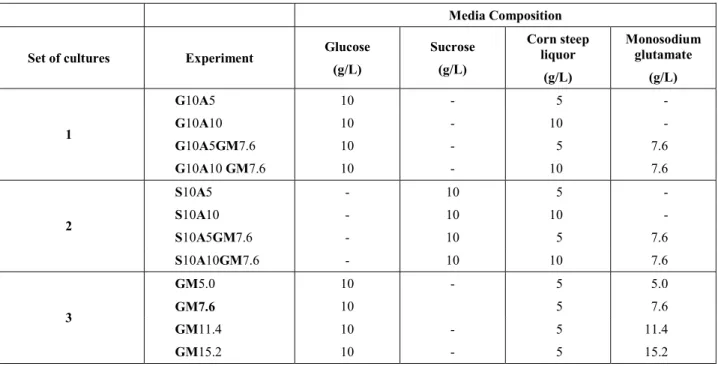
In Table 1 the complete media composition of the experiments with corn steep liquor is given. All the salts described for medium 2 and the yeast extract were excluded.
All media were prepared with distilled water and the pH was adjusted to 5.5 prior to sterilization at 121ºC for 20 minutes. Glucose, sucrose and corn steep liquor were sterilized in a separate solution in order to avoid the Maillard reaction.
Table 1: Composition of complex culture media with corn steep liquor
Media Composition
Set of cultures Experiment Glucose (g/L)
Sucrose (g/L)
Corn steep liquor
(g/L)
Monosodium glutamate
(g/L)
G10A5 10 - 5 -
G10A10 10 - 10 -
G10A5GM7.6 10 - 5 7.6
1
G10A10 GM7.6 10 - 10 7.6
S10A5 - 10 5 -
S10A10 - 10 10 -
S10A5GM7.6 - 10 5 7.6
2
S10A10GM7.6 - 10 10 7.6
GM5.0 10 - 5 5.0
GM7.6 10 5 7.6
GM11.4 10 - 5 11.4
3
Experiments
Erlenmeyer flasks (500 mL) containing 80 mL of media each and 20 mL of defrosted cell suspension were incubated at 30°C, 300 rpm, for approximately 80 h (time required for stabilization of extracellular red pigments production).
Sampling: 5 g samples were collected in duplicate at regular intervals (one for determination of extracellular pigment, cell concentration, glucose or sucrose concentration and pH, and the other for quantification of intracellular pigments).
Analytical Methods
Dry cell concentration (X): each sample was vacuum filtered through weighed membrane filters (ME 28 cellulose ester membranes, Schleicher & Schull, Germany), washed with distilled water, dried in a microwave oven (15 min, 180 W) and maintained in desiccators for 15 min before weighing (Olsson and Nielsen, 1997).
Glucose (G): glucose concentration was obtained by the enzymatic method employing glucose-oxidase (Glucose GOD FS, Diasys, Diagnostic Systems International, Germany) and the results were expressed in grams per liter. The calibration curve ranged from 0.2 to 1.0 g/L.
Sucrose (S): sucrose concentration was obtained by high performance liquid chromatography (HPLC), using a KS802 (SHODEX, Japan) column with water as mobile phase, a flow rate of 0.6 mL/min and a temperature of 35°C. The calibration curve ranged from 0.05 to 10.0 g/L.
Extracellular red pigments: red pigment production was indirectly evaluated by means of absorbance measurements, performed in cell-free samples with a scanning spectrophotometer at 500 nm (Beckman, DU 530 UV/Vis Spectrophotometer, USA).
Intracellular red pigments: the sample was weighed and filtered through a fiberglass membrane. Cellular mass retained on the membrane was blended with 50 mL of ethanol (70 %, v/v) and sonicated (Branson Sonifier, model 250, USA) for 40 min at 120 W; ethanol (70 %, v/v) was then added to the sample volume to obtain 50 mL and the sample was transferred to a flask (50 mL), placed in a water bath (60° C) for 2 h and filtrated under vacuum (ME 25 cellulose ester membranes, Schleicher & Schuell, Germany). Absorbance was measured in the same way as for extracellular red pigments.
Data Analysis
In order to evaluate cell production of red
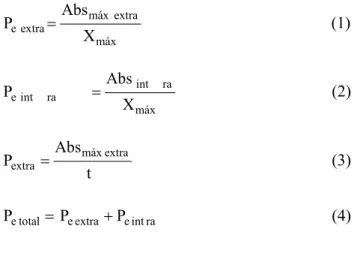
pigment, the following parameters were determined: specific production of extracellular red pigments on cells (Pe extra), specific production of intracellular red pigments on cells (Pe intra), productivity obtained in the maximum extracellular red pigment absorbance (Pextra) and specific production of total (extracellular and intracellular) red pigments on cells\ (Pe total). These parameters were determined according to equations 1, 2, 3 and 4.
máx extra e extra
máx Abs P
X
= (1)
int ra e int ra
máx Abs P
X
= (2)
máx extra extra
Abs P
t
= (3)
e total e extra e int ra
P =P +P (4)
RESULTS AND DISCUSSION
Table 2 shows the results of the three reference experiments – PG – done simultaneously with the three set of experiments identified in Table 1. On the basis of the low standard deviation verified for cell growth and red pigment production, it is possible to conclude that cells are stable and that the experiments are reasonably reproducible. The exception is the time taken to achieve maximum absorbance of extracellular red pigments and, therefore, the productivity in experiment PG3, resulting in standard deviations of around 20%, while other standard deviations vary around 1%.
In the first and second sets of cultures described in Table 1, culture media were composed of glucose or sucrose, different concentrations of corn steep liquor and monosodium glutamate (G10A5,
G10A10, G10A5GM7.6, G10A10GM7.6, S10A5,
S10A10, S10A5GM7.6 and S10A10GM7.6). The medium that resulted in the highest red pigment production was selected for the set of cultures 3, which evaluated the effect of the concentration of monosodium glutamate on red pigment production (GM5.0, GM7.6, GM11.4 and GM15.2).
G10A5GM7.6 0 2 4 6 8 10 12 14
0 20 40 60 80 100
t (h)
X, G ( g /L ), p H 0 4 8 12 16 20 24 Ab s ex tr a ( U )
X pH G Abs extra
G10A10GM7.6 0 2 4 6 8 10 12 14
0 20 40 60 80 100
t (h) X, G ( g /L ), p H 0 4 8 12 16 20 24 Ab s ex tr a ( U )
X pH G Abs extra
S10A5GM7.6 0 2 4 6 8 10 12 14
0 20 40 60 80 100
t (h)
X , S (g /L ), p H 0 2 4 6 8 10 12 Ab s ex tr a ( U )
X pH S Abs ext ra
S10A10GM7.6 0 2 4 6 8 10 12 14
0 20 40 60 80 100
t (h) X, S ( g /L ), p H 0 2 4 6 8 10 12 Ab s ex tr a ( U )
X pH S Abs ext ra
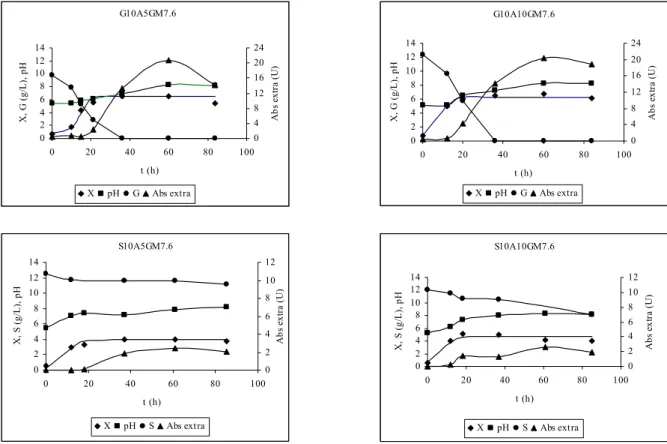
Figure 1: Dry cell concentration, glucose or sucrose concentrations and absorbance of extracellular red pigment, during cultivation of strain M. ruber LEB A4-5 in medium containing glucose or sucrose, corn steep liquor and
monosodium glutamate (sets 1 and 2).
Table 2: Results of reference experiments with glucose, PG (medium 1)
Experiment X max (g/L)
Abs max extra
(U)
Pe extra
(U.L/g)
P extra
(U/h)
t (h)
PG 1 6.0 12.4 2.07 0.21 60
PG 2 5.9 12.3 2.08 0.21 60
PG 3 6.0 12.2 2.03 0.15 84
Mean value 6.0 12.3 2.06 0.19 68
Standard deviation (%) 0.97 0.81 1.29 18.23 20.4
According to Figure 1, the growth phase of M. ruber LEB A4-5 ended after 20 to 30 h of cultivation. Sucrose consumption was low despite cell growth, which was probably because monosodium glutamate was the carbon and energy source.
The production of pigments in media with glucose started after the growth phase ended, therefore depicting a production not associated with growth (Santerre et al., 1995).
Table 3 shows that the rate of cell growth was higher in media with glucose than in media with
sucrose as cell concentration reached average values of 6.5 and 4.8 g/L, respectively. Specific production of extracellular red pigments on cells (Pe extra) and productivity (P) up to 5.9 and 8.8 times higher in media with glucose than in media containing sucrose, were obtained respectively. Sucrose, therefore, is not a suitable source for cell growth or for red pigment production by M. ruber LEB A4-5.
Table 3: Results of experiments in sets 1 and 2
Experiment X max (g/L)
Abs max extra
(U)
Pe extra
(U.L/g)
P extra
(U/h)
t (h)
PG* 6.0 12.3 2.06 0.19 68
G10A5 6.6 14.7 2.23 0.09 156
G10A10 6.7 16.7 2.49 0.20 84
G10A5GM7.6 6.5 20.7 3.18 0.35 60
G10A10GM7.6 6.3 20.3 3.22 0.34 60
PS 5.3 2.0 0.38 0.06 36
S10A5 5.0 4.6 0.86 0.05 84
S10A10 5.4 3.4 0.63 0.06 60
S10A5GM7.6 4.0 2.5 0.63 0.04 61
S10A10GM.6 4.7 2.6 0.55 0.04 61
PG*: mean values for the three experiments reported in Table 2 PS: reference experiment with medium 2 and sucrose
Corn steep liquor and monosodium glutamate are both important for red pigment production, according to the results of the experiments with glucose in Table 3, because the mean absorbance of 12.3U in the reference experiment – PG – increased to 16.7U with corn steep liquor and to 20.7U with both corn steep liquor and monosodium glutamate. Cultures G10A5GM7.6 and G10A10GM7.6 reached values of Pe extra and P extra, respectively up to 42.6% and 288.9% higher than the cultures utilizing media without monosodium glutamate.
The best results were obtained in experiments
G10A5GM7.6 and G10A10GM7.6. Their values for Abs max extra, Pe extra and P extra were almost the same. Therefore, the medium with a lower corn steep
liquor concentration was selected (G10A5GM7.6) for the set of experiments E2, since the aim of the present work was to develop a low-cost medium for
Monascus red pigment production.
As the results of Abs max extra and Pe extra obtained in experiments GM5.0, GM7.6, GM11.4 and GM15.2 did not show any significant variation (Table 4), except the lower productivity – P extra – of medium GM5.0, the best medium for red pigment production was G10A5GM7.6.
Besides a higher total red pigment production (3.50 U.L/g) than medium 2 (2.69 U.L/g), medium G10A5GM7.6 allows an increase in excretion capacity of red pigments, according to the values of specific intracellular red pigments on cells reported in Table 5.
Table 4: Results of experiments in set 3.
Culture medium X max (g/L)
Abs max extra
(U)
Pe extra
(U.L/g)
P extra
(U/h)
t (h)
GM5.0 6.4 27.5 4.29 0.33 84
GM7.6 6.2 27.5 4.41 0.46 60
GM11.4 6.2 28.6 4.61 0.48 60
GM15.2 6.1 29.7 4.87 0.50 60
Table 5: Specific production of extracellular, intracellular and total red pigment on cells, for experiments PG and G10A5GM7.6
Culture medium Peextra (U.L/g)
Peintra
(U.L/g)
Petotal
(U.L/g)
PG 2.07 0.62 2.69
CONCLUSIONS
Corn steep liquor is a suitable source of nitrogen and salts for red pigment production by M. ruber, thereby substituting various salts and yeast extract. The higher red pigment production and productivity (20.7 U and 0.35 U/h) were obtained utilizing 10 g/L glucose, 5 g/L corn steep liquor and 7.6 g/L monosodium glutamate instead of the reference medium, composed of salts and yeast extract, where production and productivity were 12.4 U and 0.21 U/h, respectively. Besides, in the complex culture medium, extracellular pigments represents 90.9 % of the total production, while in the reference medium, they represent 77%.
ACKNOWLEDGEMENT
The authors would like to thank Conselho Nacional de Desenvolvimento Científico e Tecnológico (CNPq, Brazil) for its financial support.
NOMENCLATURE
Abs max extra maximum extracellular red pigments
(U)
G glucose concentration (g/L) Pextra productivity of extracellular red
pigment obtained at the maximum absorbance
(U/h)
P extra productivity obtained in the maximum extracellular red pigments absorbance
(U/h)
Pe extra specific production of extracellular red pigments on cells, obtained at the maximum absorbance for extracellular red pigment
(U.L/g)
Pe intra specific production of intracellular red pigments on cells, obtained at the maximum absorbance for extracellular red pigment
(U.L/g)
Pe total specific production of total (extracellular and intracellular) red pigments on cells, obtained at the maximum absorbance for extracellular red pigment
(U.L/g)
S sucrose concentration (g/L) t cultivation time for the
maximum absorbance for extracellular red pigment
(h)
X cell concentration in time t (g/L) X max maximum cell concentration (g/L)
REFERENCES
Furlan, S.A., Schneider, A.L.S., Merkle, R., Carvalho-Jonas, M.F. and Jonas, R., Formulation of Lactose-free, Low-cost Culture Medium for Production of β-D-galactosidase by
Kluyveromyces marxianus, Biotechnology Letters, 22, 589-593 (2000).
Hajjaj, H., Klaébé, A., Loret, M.O., Tzédakis, T., Goma, G. and Blanc, P.J., Production and Identification of N-glucosylrubropunctamine and N-glucosylmonascorubramine from Monascus ruber and Occurrence of Electron Donor-Acceptor Complexes in These Red Pigments, Applied and Environmental Microbiology, 63, No.7, 2671-2678 (1997).
Jung, H., Kim, C., Kim, K. and Shin, C.S., Color Characteristics of Monascus Pigments Derived by Fermentation with Various Amino Acids, Journal of Agricultural and Food Chemistry, 51, 1302-1306 (2003).
Juslová, P., Martínková, L. and Kren, V., Secondary Metabolites of the Fungus Monascus: A Review, Journal of Industrial Microbiology, 16, 163-170 (1996).
Kitamoto, Y., Suzuki, A., Shimada, S. and Yamanaka, K., A New Method for the Preservation of Fungus Stock Cultures by Deep-freezing, Mycoscience, 43, No. 2, 143-149 (2002).
Liggett, R.W. and Koffler, H., Corn Steep Liquor in Microbiology, Bacteriology Review, 12, No. 4, 297-311 (1948).
Lin, T.F. and Demain, A.L., Effect of Nutrition of
Monascus sp. on Formation of Red Pigments, Applied Microbiology and Biotechnology, 36, 70-75 (1991).
Lin, T.F., Yakushijin, K., Buchi, G.H. and Demain, A.L., Formation of Water-soluble Monascus Red Pigment by Biological and Semi-syntheticP, Journal of Industrial Microbiology, 9, 173-179 (1992).
Olsson, L. and Nielsen, J., On Line and in situ Monitoring of Biomass in Submerged Cultivations, Trends in Biotechnology, 15, 517-522 (1997).
Pastrana, L., Blanc, P.J., Santerre, A.L., Loret, M.O. and Goma, G., Production of Red Pigments by
Rivas, B., Moldes, A.B., Domínguez, J.M. and Parajó, J.C., Development of Culture Media Containing Spent Yeast Cells of Debaryomyces hansenii and Corn Steep Liquor for Lactic Acid Production with Lactobacillus rhamnosus, International Journal of Food Microbiology, 97, 93-98 (2004).
Santerre, A.L., Queinnec, I., Blanc, J.A., A Fedbatch Strategy for Optima Red Pigment Production by
Monascus ruber. Bioprocess Engineering, 13, 245-250 (1995).
Schmidell, W., Microrganismos e meios de cultura para utilização industrial. In: Schmidell, W.,
Lima, U.A., Aquarone, E. and Borzani, W, Biotecnologia Industrial. Editora Edgard Blücher Ltda, São Paulo (2001).
Silveira, M.M., Wisbeck, E., Hoch, I. and Jonas, R., Production of Glucose-Frutose Oxidoreductase and Ethanol by Zymomonas mobilis ATCC 29191 in Medium Containing Corn Steep Liquor as a Source of Vitamins, Applied Microbiology and Biotechnology,55, No. 4, 440-445 (2001).