arXiv:1309.3230v3 [hep-ex] 30 Jan 2014
EUROPEAN ORGANISATION FOR NUCLEAR RESEARCH (CERN)
CERN-PH-EP-2013-126
Submitted to: PLB
Search for new phenomena in photon+jet events collected in
proton–proton collisions at
√ s = 8 TeV
with the ATLAS detector
The ATLAS Collaboration
Abstract
This Letter describes a model-independent search for the production of new resonances in photon
+ jet (
γ +
jet
) events using 20
fb
−1of proton–proton LHC data recorded with the ATLAS detector at a
centre-of-mass energy of
√
s = 8 TeV
. The
γ+
jet
mass distribution is compared to a background model
fit from data; no significant deviation from the background-only hypothesis is found. Limits are set at
95% credibility level on generic Gaussian-shaped signals and two benchmark phenomena beyond
the Standard Model: non-thermal quantum black holes and excited quarks. Non-thermal quantum
black holes are excluded below masses of 4.6
TeV
and excited quarks are excluded below masses of
3.5
TeV
.
Search for new phenomena in photon+jet events collected in proton–proton
collisions at
√s = 8 TeV with the ATLAS detector
ATLAS Collaboration
Abstract
This Letter describes a model-independent search for the production of new resonances in photon + jet (γ + jet)
events using 20 fb−1 of proton–proton LHC data recorded with the ATLAS detector at a centre-of-mass energy of
√
s = 8 TeV. The γ + jet mass distribution is compared to a background model fit from data; no significant deviation
from the background-only hypothesis is found. Limits are set at 95% credibility level on generic Gaussian-shaped signals and two benchmark phenomena beyond the Standard Model: non-thermal quantum black holes and excited quarks. Non-thermal quantum black holes are excluded below masses of 4.6 TeV and excited quarks are excluded below masses of 3.5 TeV.
1. Introduction
Several exotic production mechanisms have been proposed that produce massive photon + jet (γ + jet) final states. They include non-thermal quantum black holes (QBHs) [1–3], excited quarks [4–6], quirks [7–9], Regge excitations of string theory [10–12], and topolog-ical pions [13]. Of the past searches [14–18], the only LHC search for this signature was done using proton– proton (pp) collision data obtained at a centre-of-mass
energy of √s = 7 TeV with the ATLAS detector. It
found no evidence of new physics and placed upper limits on the visible signal cross-section in the range 1.5–100 fb and excluded excited-quark masses up to 2.46 TeV at the 95% credibility level (CL) [18]. The present Letter describes a model-independent search for
s-channel γ + jet production, improved over the
ear-lier search. It presents the first limits on QBHs de-caying to the γ + jet final state and places new limits both on excited quarks and on generic Gaussian-shaped sources which describe other narrow resonant signals such as topological pions. Sensitivity to such signals has been improved compared to the previous search through a combination of an order-of-magnitude larger
data sample (20.3 fb−1), a higher centre-of-mass energy
(√s = 8 TeV), reduced background uncertainties, and
improved selection criteria at high invariant mass. The Standard Model (SM) of particle physics lacks a mechanism whereby pp collisions produce resonances that subsequently decay to a γ + jet final state. Direct
γ +jet production can occur at tree level via Compton
scattering of a quark and a gluon, or through quark– antiquark annihilation. The former process accounts for most of the direct γ + jet production. Events with a high transverse momentum photon and one or more jets can also arise from radiation off final-state quarks, or from dijet or multi-jet processes, where secondary photons, referred to as fragmentation photons, are produced dur-ing fragmentation of the hard-scattered quarks or
glu-ons [19–22]. The γ + jet invariant mass (mγj)
distribu-tion resulting from this mixture of processes is smooth and rapidly falling, and is therefore well suited to re-vealing high-mass resonances decaying to γ + jet.
The mγjdistribution is used to search for a peak over
the SM background, estimated by fitting a smoothly
falling function to the mγjdistribution in the region mγj
>426 GeV. In the absence of a signal, Bayes’ theorem
is used to set limits on Gaussian-shaped signals and on two benchmark models: QBHs and excited quarks.
Models with extra dimensions, such as the Arkani-Hamed–Dimopoulous–Dvali (ADD) model [23, 24], solve the mass hierarchy problem of the SM by
low-ering the fundamental scale of quantum gravity (MD) to
a few TeV. Consequently, the LHC could produce
quan-tum black holes with masses at or above MD[25, 26].
QBHs produced near MD would evaporate faster than
they thermalize, decaying into a few particles rather than high-multiplicity final states [2, 3]. Regardless of the number of extra dimensions n, such a signal would
appear as a local excess over the steeply falling mγj
dis-tribution near the threshold mass (Mth) and would fall
the CMS Collaboration for QBHs with high-multiplicity energetic final states yielded limits in the range of 4.3– 6.2 TeV, for n = 1–6 and different model
assump-tions [27]. This Letter assumes Mth = MDand n = 6,
where the cross-section times branching fraction for
QBH production and decay to γ+jet final states at Mth=
1, 3 and 5 TeV is 200, 0.3 and 6 × 10⁻⁵ pb,
respec-tively [3]. For decays to dijet final states at these same threshold masses, the rates are larger by factors of 11, 39 and 125.
Excited-quark (q∗) states, which the ATLAS and
CMS experiments have also sought in dijet final states [28–30], could be produced via the fusion of a gluon with a quark. The model is defined by one
pa-rameter, the excited-quark mass mq∗, with the
compos-iteness scale set to mq∗. Only gauge interactions are
considered with the SU(3), SU(2), and U(1) coupling
multipliers fixed to fs = f = f′ = 1 [5]. This results in
branching fractions for q∗ → qg and q∗ → qγ of 0.85
(0.85) and 0.02 (0.005), respectively, for q = u (q = d). The leading-order cross-sections times branching
frac-tions combining all flavours of excited quarks for mq∗=
1, 3 and 5 TeV are 4, 2 × 10⁻³and 3 × 10⁻⁶pb,
respec-tively.
Factorization and renormalization scale uncertainties are not used for either signal type, for comparison with earlier analyses [18, 28, 29].
2. Signal and background simulation samples
To cross-check the data-driven background estimates, the SM prompt photon processes are simulated with
pythia8.165 [31] and sherpa 1.4.0 [32]. The pythia
and sherpa prompt photon samples use CTEQ6L1 [33] and CT10 [34] leading-order and next-to-leading-order parton distribution functions (PDFs), respectively. The simulated samples of QBHs are obtained from the
qbh1.05 generator [35] followed by parton showering
using pythia 8.165. The simulated q∗signal samples are
generated with the excited-quark model in pythia 8.165. Both signal generators use the MSTW2008LO [36] leading-order PDF set with the AU2 underlying-event tune [37]. Additional inelastic pp interactions, termed pileup, are included in the event simulation by overlay-ing simulated minimum bias events with an average of 20 interactions per bunch crossing. All the above Monte Carlo (MC) simulated samples are produced using the ATLAS full geant4 [38] detector simulation [39]. Sup-plementary studies of the background shape are also performed with the next-to-leading-order jetphox 1.3.0 generator [19–21] at parton level using CT10 PDFs.
3. The ATLAS detector
A detailed description of the detector is available in Ref. [40], and the event selection is similar to that
described in Ref. [18]. Photons are detected by a
lead–liquid-argon sampling electromagnetic calorime-ter (EMC). The EMC has a pre-sampler layer and three additional, differently segmented, layers; only the first two are used in photon identification. Upstream of the EMC, the inner detector allows an accurate reconstruc-tion of tracks from the primary pp collision point and also from secondary vertices, permitting an efficient re-construction of photon conversions in the inner detector.
For |η| < 1.371an iron–scintillator tile calorimeter
be-hind the EMC provides hadronic coverage. The endcap and forward regions, 1.5 < |η| < 4.9, are instrumented with liquid-argon calorimeters for both the electromag-netic and hadronic measurements. Events for this anal-ysis were collected with a trigger requiring at least one
photon candidate with transverse momentum (pT) above
120 GeV [41]. The integrated luminosity of the data
sample2
is (20.3 ± 0.6) fb−1.
4. Event selection
Each event is required to contain a primary vertex
with at least two tracks each with pT > 400 MeV. If
more than one vertex is found, the primary vertex is
de-fined as the one with the highest scalar summed p2
T of
associated tracks.
Jets are reconstructed from clusters of calorimeter
cells [43], using the anti-kt clustering algorithm [44]
with radius parameter R = 0.6. The effects on jet en-ergies due to multiple pp collisions in the same or in neighbouring bunch crossings are accounted for by a jet-area-based correction [45, 46]. Jet energies are cal-ibrated to the hadronic energy scale using corrections from MC simulation and the combination of several in situ techniques applied to data [47]. Events are
dis-carded if the leading (highest-pT) jet is affected by noise
or hardware problems in the detector, or is identified as
1ATLAS uses a right-handed coordinate system with its origin at the nominal interaction point (IP) in the centre of the detector and the z-axis along the beam pipe. The x-axis points from the IP to the centre of the LHC ring, and the y-axis points upward. Cylindrical co-ordinates (r, φ) are used in the transverse plane, φ being the azimuthal angle around the beam pipe. The pseudorapidity is defined in terms of the polar angle θ as η = − ln tan(θ/2).
2The systematic uncertainty on the luminosity is derived, follow-ing the same methodology as that detailed in Ref. [42], from a prelimi-nary calibration of the luminosity scale derived from beam-separation scans performed in November 2012.
arising from non-collision backgrounds. Only jets with
|ηj| < 2.8 are considered further.
Photon candidates are reconstructed from clusters in the electromagnetic calorimeter and tracking informa-tion provided by the inner detector. Inner detector track-ing information is used to reject electrons and to recover
photons converted to e+e−pairs [48]. Photon candidates
satisfy standard ATLAS selection criteria that are de-signed to reject backgrounds from hadrons [49]. The photon candidates must meet η-dependent requirements on hadronic leakage and shower shapes in the first two sampling layers of the electromagnetic calorimeter. En-ergy calibrations are applied to photon candidates to ac-count for energy loss upstream of the electromagnetic calorimeter and for both lateral and longitudinal shower leakage. The simulation is corrected for differences be-tween data and MC events for each photon shower shape variable. Events are discarded if the leading photon is reconstructed using calorimeter cells affected by noise bursts or transient hardware problems.
These photon identification criteria reduce instru-mental backgrounds to a negligible level, but some background from fragmentation photons and hadronic jets remains. This background is further reduced by re-quirements on nearby calorimeter activity. Energy de-posited in the calorimeter near the photon candidate,
EisolT , must be no larger than 0.011 pγT + 3.65 GeV,
a criterion that provides constant efficiency for all
pileup conditions and over the entire pTrange explored.
This transverse isolation energy is calculated by sum-ming the energy as measured in electromagnetic and hadronic calorimeter cells inside a cone of radius ∆R =
p
(∆η)2+ (∆φ)2= 0.4 centred on the photon cluster, but
excluding the energy of the photon cluster itself, and is corrected on an event-by-event basis for the ambient energy density due to pileup and the underlying event, as well as energy leakage from the photon cluster into the cone. Additionally, the photon is required to have angular separation of ∆R(γ, jet) > 1.0 between the
lead-ing photon and all other jets with pT > 30 GeV, with
the exception of a required photon-matched jet. Such photon-matched jets arise from the fact that photon en-ergy deposits in the calorimeter are also reconstructed as jets. To further suppress background from fragmen-tation photons, where the angular separation between the photon and the corresponding photon-matched jet can be large, the leading photon candidate is required to have exactly one reconstructed jet with ∆R(γ, jet) < 0.1. This photon-matched jet is not considered in any other selection criteria, including those related to photon iso-lation.
Events containing at least one photon candidate and
at least one jet candidate, each with pT >125 GeV, are
selected for final analysis. The photon trigger is fully efficient for these events. In the events where more than
one photon or jet is found, the highest-pTcandidates are
selected to constitute the photon and jet pair to compute
mγj.
The sensitivity of the search is improved by require-ments on photon and jet pseudorapidities. Dijet pro-duction rates increase with jet absolute pseudorapidity whereas rates for an s-channel signal would diminish. Photons are required to be in the barrel calorimeter,
|ηγ| < 1.37, and the distance between the photon and
jet, ∆η = |ηγ− ηj|, must be less than 1.6. The latter
re-quirement was chosen by optimizing the expected sig-nificance of signals, using the ∆η distribution found in QBH and excited-quark signal simulations, with respect to the SM background as predicted by the pythia prompt photon simulation.
The acceptance of the event selection is about 60%. It is calculated using parton-level quantities by impos-ing the kinematic selection criteria (photon/jet |η|,
pho-ton/jet pT, ∆η, ∆R). All other selections, which in
gen-eral correspond to event and object quality criteria, were used to calculate the efficiency based on the events in-cluded in the acceptance. The efficiency falls from 83% to 72% for masses from 1 TeV to 6 TeV for QBH signals and from 85% to 80% for excited-quark signals over the same mass range. There are 285356 events in the data
sample after all event selections. The highest mγjvalue
observed is 2.57 TeV.
5. Background estimation
The combined SM and instrumental background to
the search is determined by fitting the mγj distribution
to the four-parameter ansatz function [50],
f (x ≡ mγj/√s) = p1(1 − x)p2x−(p3+p4ln x). (1)
The functional form has been tested with pythia and
sherpaprompt photon simulations and
next-to-leading-order jetphox predictions with comparable sample size. Two additional control samples in the data are also de-fined to further validate the functional form. The first control sample is defined by reversing two of the
pho-ton identification criteria, ∆E and Eratio [49], that
com-pare the lateral shower shapes of single photons in the first layer of the calorimeter to those of jets with high electromagnetic energy fraction and low particle mul-tiplicity, typical for meson decays. This sample has
a similar mγj shape to the dominant background, SM
by reversing the photon isolation criterion, Eisol
T . This
control sample is enriched in the second largest back-ground, dijet events in which a jet has passed the photon identification cuts.
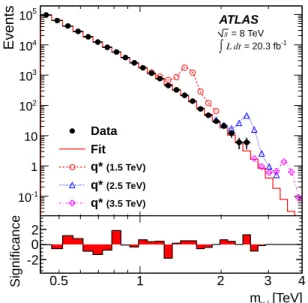
Fig. 1 shows the resulting distribution of the γ + jet invariant mass. The bin widths are chosen to be twice the mass resolution at the centre of each bin. The
rela-tive resolution is about 4% of mγjat 1 TeV, improving
to about 3% at 2 TeV. The fit result is also shown in Fig. 1. The bottom panel of the figure shows the statis-tical significance of the difference between data and the fit in each bin [51]. The fit quality is quantified using a negative log-likelihood test statistic. The probability of the fit quality to be at least as good as the observed fit (p-value) is 74%, indicating that the data are consistent with the functional form.
1 Events -1 10 1 10 2 10 3 10 4 10 5 10 Data Fit (1.5 TeV) q* (2.5 TeV) q* (3.5 TeV) q* ATLAS -1 = 20.3 fb dt L ∫s = 8 TeV [TeV] j γ m 0.5 1 2 3 4 Significance -2 0 2
Figure 1: Invariant mass of the γ + jet pair for events passing the final selections. The bin widths are cho-sen to be twice the mass resolution at the centre of each bin. Overlaid is the fitted background function inte-grated over each bin (solid line), with three examples of
q∗signals, as described in the text. For better visibility
the q∗signals are only drawn for mγjwithin ±25% of the
nominal signal mass. The bottom panel shows the sta-tistical significance of the difference between data and background in each bin.
6. Results 6.1. Search results
The search region is defined to be mγj >426 GeV,
which is the lower edge of the first bin for which
bi-ases due to kinematic and trigger threshold effects are negligible. The γ + jet search is sensitive to new res-onances in the region between 426 GeV and 1 TeV, where the statistics of dijet searches are limited by the higher hadronic trigger thresholds. The bumphunter al-gorithm [52] is used to search for statistical evidence of
a resonance. The algorithm operates on the binned mγj
distribution, comparing the background estimate with the data in mass intervals of varying numbers of adja-cent bins across the entire distribution. For each interval in the scan, it computes the significance of any excess found. The significance of the outcome is evaluated us-ing the ensemble of possible outcomes in any part of the distribution under the background-only hypothesis, obtained by repeating the analysis on pseudodata drawn from the background function. The algorithm identifies the two-bin interval 785–916 GeV as the single most discrepant interval. Before including systematic uncer-tainties, the p-value is 61%, including the trials fac-tor, or “look-elsewhere” effect. Thus, the excess is not significant and the data are consistent with a smoothly falling background.
6.2. Limit results
In the absence of any signal, three types of γ + jet signals are explored: a generic Gaussian-shaped sig-nal with an arbitrary production cross-section, result-ing from resonances with varyresult-ing intrinsic widths con-volved with the detector resolution; the QBH model; and the excited-quark model. For each signal mass con-sidered, the fit to the observed mass distribution is re-peated with the sum of the four-parameter background function (Eq. (1)) and a signal template with a normal-ization determined during the fit. Bayesian limits at the 95% CL are computed as described in Ref. [28] using a prior probability density that is constant for positive values of the signal production cross-section and zero for unphysical, negative values.
Systematic uncertainties affecting the limits on pro-duction of new signals are evaluated. The signal yield is subject to systematic uncertainties on the integrated luminosity (2.8%), photon isolation efficiency (1.2%), trigger efficiency (0.5%), and photon identification effi-ciencies (1.5%). The last of these includes extrapolation
to high pT(0.1%) and pileup effects (0.1%).
Uncertain-ties on the jet and photon energy scale contribute 1.0 – 1.5% and 0.3%, respectively, through their effects on the shape and yield of the signal distribution. The sizes
of the systematic uncertainties are similar for the q∗and
QBH signals. These systematic uncertainties are treated as marginalized nuisance parameters in the limit calcu-lation. Systematic uncertainties on the value and shape
of the signal acceptance due to the PDF uncertainties were examined and found to be negligible. To account for the statistical uncertainties on the background fit pa-rameters, the background function is repeatedly fit to pseudodata for which the content of each bin is drawn from Poisson distributions. The mean of the Poisson distribution for a given bin corresponds to the number of entries actually observed in that bin in the data. The variations in the fit predictions for a given bin, 1% of the background at 1 TeV to about 20% of the background at 3 TeV, are taken as indicative of the systematic uncer-tainty. This bin-by-bin uncertainty is treated in the limit as fully correlated, using a single nuisance parameter that scales the entire background distribution. Several other fit functions from Ref. [50] were tested, and a neg-ligible systematic uncertainty was found.
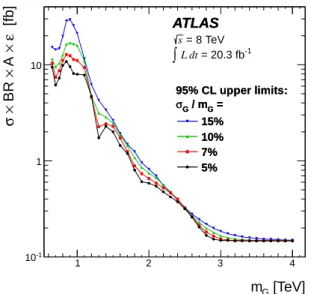
Fig. 2 shows the model-independent limits on the vis-ible section, defined as the product of the cross-section (σ) times branching fraction (BR) times accep-tance (A) times efficiency (ε), of a potential signal as a function of the mass of each signal template, and includes the systematic uncertainties discussed above. The signal line shape is modelled as a Gaussian
dis-tribution, with one of four relative widths: σG/mG =
5%, 7%, 10%, and 15%, where σG (mG) is the width
(mean mass) of the Gaussian. The differences between the limits for different widths are driven by the increased sensitivity to local fluctuations for the narrower signals. Beyond the highest-mass event recorded, 2.57 TeV, the limits begin to converge due to the absence of observed events. At 1 TeV and 4 TeV the limits are 8 fb and 0.1 fb,
respectively, for σG/mG= 5%. At 3 TeV, the new limit
improves the earlier ATLAS result in this channel by an order of magnitude.
The limit on the visible cross-section in the QBH
model is shown in Fig. 3 as a function of Mth. The
ob-served (expected) lower limit on the QBH mass thresh-old is found to be 4.6 (4.6) TeV, at 95% CL. The uncer-tainty on the QBH theoretical cross-section arising from PDF uncertainties moves the uppermost excluded mass by 0.2%.
The limit on the visible cross-section in the
excited-quark model as a function of the q∗mass, assumed to
be the same for u∗and d∗, is shown in Fig. 4. The rise
in the expected and observed limits at high mq∗ is due
to the increased fraction of off-shell production of the
q∗, which alters the signal distribution to lower masses
with a wider peak. The observed (expected) lower limit on the excited-quark mass is found to be 3.5 (3.4) TeV, at 95% CL. With a much lower branching fraction than the dijet channel but also smaller backgrounds, this re-sult improves on the present exclusion limits in the
[TeV] G m 1 2 3 4 [fb] ε × A × BR × σ -1 10 1 10 95% CL upper limits: = G / m G σ 15% 10% 7% 5% 95% CL upper limits: = G / m G σ 15% 10% 7% 5% ATLAS ATLAS -1 = 20.3 fb dt L ∫s = 8 TeV
Figure 2: The 95% CL upper limits on σ × BR × A ×
εfor a hypothetical signal with a Gaussian-shaped mγj
distribution as a function of the signal mass mGfor four
values of the relative width σG/mG.
jet final state: 3.32 TeV from CMS with 5 fb−1of data
at √s = 7 TeV [30], and 2.83 TeV from ATLAS with
4.8 fb−1[28] of data at √s = 7 TeV. The uncertainty on
the q∗theoretical cross-section arising from PDF
uncer-tainties moves the uppermost excluded mass by 0.9%.
7. Conclusions
In conclusion, the γ + jet mass distribution
mea-sured in 20.3 fb−1 of pp collision data, collected at
√
s = 8 TeV by the ATLAS experiment at the LHC,
is well described by the background model and no evi-dence for new phenomena is found. Limits at 95% CL using Bayesian statistics are presented for signal pro-cesses yielding a Gaussian line shape, non-thermal quantum black holes, and excited quarks. The limits on Gaussian-shaped resonances exclude 4 TeV resonances with visible cross-sections near 0.1 fb. Non-thermal quantum black hole and excited-quark models with a
γ +jet final state are excluded for masses up to 4.6 TeV
and 3.5 TeV, respectively. The limits reported here on the production of new resonances in the γ+jet final state are the most stringent limits set to date in this channel.
We thank CERN for the very successful operation of the LHC, as well as the support staff from our institu-tions without whom ATLAS could not be operated effi-ciently.
[TeV] th M 1 2 3 4 5 6 [fb] ε × A × BR × σ -1 10 1 10 QBH prediction 95% CL upper limits: Observed Limit band σ 1 ± Expected Limit band σ 2 ± Expected Limit ATLAS -1 = 20.3 fb dt L
∫
s = 8 TeVFigure 3: The 95% CL upper limits on σ× BR× A×ε for QBHs decaying to a photon and a jet, as a function of
the threshold mass Mth, assuming MD= Mthand n = 6.
The limits take into account statistical and systematic uncertainties. Points along the solid black line indi-cate the mass of the signal where the limit is computed. The black short dashed line is the central value of the expected limit. Also shown are the ±1σ and ±2σ un-certainty bands indicating the underlying distribution of possible limit outcomes under the background-only hy-pothesis. The predicted visible cross-section for QBHs is shown as the long dashed line.
Acknowledgments
We acknowledge the support of ANPCyT, Argentina; YerPhI, Armenia; ARC, Australia; BMWF and FWF, Austria; ANAS, Azerbaijan; SSTC, Belarus; CNPq and FAPESP, Brazil; NSERC, NRC and CFI, Canada; CERN; CONICYT, Chile; CAS, MOST and NSFC, China; COLCIENCIAS, Colombia; MSMT CR, MPO CR and VSC CR, Czech Republic; DNRF, DNSRC and Lundbeck Foundation, Denmark; EPLANET, ERC and NSRF, European Union; IN2P3-CNRS, CEA-DSM/IRFU, France; GNSF, Georgia; BMBF, DFG, HGF, MPG and AvH Foundation, Germany; GSRT and NSRF, Greece; ISF, MINERVA, GIF, DIP and Benoziyo Center, Israel; INFN, Italy; MEXT and JSPS, Japan; CNRST, Morocco; FOM and NWO, Netherlands; BRF and RCN, Norway; MNiSW, Poland; GRICES and FCT, Portugal; MERYS (MECTS), Romania; MES of Russia and ROSATOM, Russian Federation; JINR; MSTD, Serbia; MSSR, Slovakia; ARRS and MVZT,
[TeV] q* m 1 2 3 4 5 6 [fb] ε × A × BR × σ -1 10 1 10 PYTHIA q* prediction 95% CL upper limits: Observed Limit band σ 1 ± Expected Limit band σ 2 ± Expected Limit ATLAS -1 = 20.3 fb dt L
∫
s = 8 TeVFigure 4: The 95% CL upper limits on σ× BR× A×ε for excited quarks decaying to a photon and a jet, as a
func-tion of the signal mass mq∗. The limits take into account
statistical and systematic uncertainties. Points along the solid black line indicate the mass of the signal where the limit is computed. The black short dashed line is the central value of the expected limit. Also shown are the ±1σ and ±2σ uncertainty bands indicating the un-derlying distribution of possible limit outcomes under the background-only hypothesis. The long dashed line shows the predicted visible cross-section for excited-quark production from pythia.
Slovenia; DST/NRF, South Africa; MICINN, Spain; SRC and Wallenberg Foundation, Sweden; SER, SNSF and Cantons of Bern and Geneva, Switzerland; NSC, Taiwan; TAEK, Turkey; STFC, the Royal Society and Leverhulme Trust, United Kingdom; DOE and NSF, United States of America.
The crucial computing support from all WLCG part-ners is acknowledged gratefully, in particular from CERN and the ATLAS Tier-1 facilities at TRIUMF (Canada), NDGF (Denmark, Norway, Sweden), CC-IN2P3 (France), KIT/GridKA (Germany), INFN-CNAF (Italy), NL-T1 (Netherlands), PIC (Spain), ASGC (Tai-wan), RAL (UK) and BNL (USA) and in the Tier-2 fa-cilities worldwide.
References
[1] P. Meade and L. Randall, JHEP 0805 (2008) 003, arXiv:0708.3017 [hep-ph].
[2] X. Calmet, W. Gong, and S. D. Hsu, Phys. Lett. B 668 (2008), arXiv:0806.4605 [hep-ph].
[3] D. M. Gingrich, J. Phys. G 37 (2010) 105008, arXiv:0912.0826 [hep-ph].
[4] S. Bhattacharya, S. S. Chauhan, B. C. Choudhary, and D. Choudhury, Phys. Rev. D 80 (2009) 015014, arXiv:0901.3927 [hep-ph].
[5] U. Baur, M. Spira, and P. M. Zerwas, Phys. Rev. D 42 (1990) 815.
[6] O. C¸ akir and R. Mehdiyev, Phys. Rev. D 60 (1999) 034004. [7] J. Kang and M. A. Luty, JHEP 0911 (2009) 065,
arXiv:0805.4642 [hep-ph].
[8] S. P. Martin, Phys. Rev. D 83 (2011) 035019, arXiv:1012.2072 [hep-ph].
[9] L. B. Okun, Nucl. Phys. B 173 (1980) 1.
[10] L. A. Anchordoqui, H. Goldberg, S. Nawata, and T. R. Taylor, Phys. Rev. D 78 (2008) 016005,
arXiv:0804.2013 [hep-ph].
[11] L. A. Anchordoqui et al., Phys. Rev. Lett. 101 (2008) 241803, arXiv:0808.0497 [hep-ph].
[12] P. Nath et al., Nucl. Phys. B, Proc. Suppl. 200-202 (2010) 185. [13] Y. Bai and A. Martin, Phys. Lett. B 693 (2010) 292,
arXiv:1003.3006 [hep-ph]. [14] CDF Collaboration, F. Abe et al.,
Phys. Rev. Lett. 72 (1994) 3004. [15] H1 Collaboration, C. Adloff et al.,
Eur. Phys. J. C 17 (2000) 567, arXiv:hep-ex/0007035 [hep-ex]. [16] ZEUS Collaboration, S. Chekanov et al.,
Phys. Lett. B 549 (2002) 32,
arXiv:hep-ex/0109018 [hep-ex]. [17] CDF Collaboration, T. Affolder et al.,
Phys. Rev. D 65 (2002) 052006, arXiv:hep-ex/0106012 [hep-ex].
[18] ATLAS Collaboration, Phys. Rev. Lett. 108 (2012) 211802, arXiv:1112.3580 [hep-ex].
[19] S. Catani, M. Fontannaz, J. Guillet, and E. Pilon,
JHEP 0205 (2002) 028,arXiv:hep-ph/0204023 [hep-ph]. [20] P. Aurenche et al., Phys. Rev. D 73 (2006) 094007,
arXiv:hep-ph/0602133 [hep-ph].
[21] Z. Belghobsi et al., Phys. Rev. D 79 (2009) 114024, arXiv:0903.4834 [hep-ph].
[22] R. Ichou and D. d’Enterria, Phys. Rev. D 82 (2010) 014015, arXiv:1005.4529 [hep-ph].
[23] N. Arkani-Hamed, S. Dimopoulos, and G. Dvali, Phys. Lett. B 429 (1998) 263,
arXiv:hep-ph/9803315 [hep-ph].
[24] I. Antoniadis, N. Arkani-Hamed, S. Dimopoulos, and G. Dvali, Phys. Lett. B 436 (1998) 257,
arXiv:hep-ph/9804398 [hep-ph]. [25] S. Dimopoulos and G. L. Landsberg,
Phys. Rev. Lett. 87 (2001) 161602, arXiv:hep-ph/0106295 [hep-ph]. [26] S. B. Giddings and S. D. Thomas,
Phys. Rev. D 65 (2002) 056010, arXiv:hep-ph/0106219 [hep-ph]. [27] CMS Collaboration, JHEP 1307 (2013) 178,
arXiv:1303.5338 [hep-ex].
[28] ATLAS Collaboration, JHEP 1301 (2013) 029, arXiv:1210.1718 [hep-ex].
[29] CMS Collaboration, Phys. Rev. D 87 (2013) 114015, arXiv:1302.4794 [hep-ex].
[30] CMS Collaboration, JHEP 1301 (2013) 013, arXiv:1210.2387 [hep-ex].
[31] T. Sjostrand, S. Mrenna, and P. Z. Skands,
Comput. Phys. Commun. 178 (2008) 852, arXiv:0710.3820 [hep-ph]. [32] T. Gleisberg et al., JHEP 0902 (2009) 007,
arXiv:0811.4622 [hep-ph]. [33] J. Pumplin et al., JHEP 0207 (2002) 012,
arXiv:hep-ph/0201195 [hep-ph]. [34] H.-L. Lai et al., Phys. Rev. D 82 (2010) 074024,
arXiv:1007.2241 [hep-ph].
[35] D. M. Gingrich, Comput. Phys. Commun. 181 (2010) 1917, arXiv:0911.5370 [hep-ph].
[36] A. Martin, W. Stirling, R. Thorne, and G. Watt,
Eur. Phys. J. C 63 (2009) 189,arXiv:0901.0002 [hep-ph]. [37] ATLAS Collaboration, Tech. Rep. ATL-PHYS-PUB-2012-003,
CERN, Geneva, 2012.
http://cds.cern.ch/record/1474107/. [38] GEANT4 Collaboration, S. Agostinelli et al.,
Nucl. Instrum. Meth. A 506 (2003) 250.
[39] ATLAS Collaboration, Eur. Phys. J. C 70 (2010) 823, arXiv:1005.4568 [physics.ins-det]. [40] ATLAS Collaboration, JINST 3 (2008) S08003. [41] ATLAS Collaboration, Eur. Phys. J. C 72 (2012) 1849,
arXiv:1110.1530 [hep-ex].
[42] ATLAS Collaboration, Eur. Phys. J. C 73 no. 8, (2013) 1, arXiv:1302.4393 [hep-ex].
[43] ATLAS Collaboration, Eur. Phys. J. C 71 (2011) 1512, arXiv:1009.5908 [hep-ex].
[44] M. Cacciari, G. P. Salam, and G. Soyez,
JHEP 0804 (2008) 063,arXiv:0802.1189 [hep-ph]. [45] M. Cacciari, G. P. Salam, and G. Soyez,
JHEP 0804 (2008) 005,arXiv:0802.1188 [hep-ph]. [46] M. Cacciari, G. P. Salam, and S. Sapeta,
JHEP 1004 (2010) 065,arXiv:0912.4926 [hep-ph]. [47] ATLAS Collaboration, Eur. Phys. J. C 73 no. 3, (2013) 2304,
arXiv:1112.6426 [hep-ex].
[48] ATLAS Collaboration, Phys. Lett. B 706 (2011) 150, arXiv:1108.0253 [hep-ex].
[49] ATLAS Collaboration, Phys. Rev. D 83 (2011) 052005, arXiv:1012.4389 [hep-ex].
[50] R. M. Harris and K. Kousouris, Int. J. Mod. Phys. A 26 (2011) 5005, arXiv:1110.5302 [hep-ex]. [51] G. Choudalakis and D. Casadei,
Eur. Phys. J. Plus 127 (2012) 15,
arXiv:1111.2062 [physics.data-an].
The ATLAS Collaboration
G. Aad48, T. Abajyan21, B. Abbott112, J. Abdallah12,
S. Abdel Khalek116, O. Abdinov11, R. Aben106,
B. Abi113, M. Abolins89, O.S. AbouZeid159,
H. Abramowicz154, H. Abreu137, Y. Abulaiti147a,147b,
B.S. Acharya165a,165b,a, L. Adamczyk38a,
D.L. Adams25, T.N. Addy56, J. Adelman177,
S. Adomeit99, T. Adye130, S. Aefsky23,
T. Agatonovic-Jovin13b, J.A. Aguilar-Saavedra125b,b,
M. Agustoni17, S.P. Ahlen22, A. Ahmad149,
M. Ahsan41, G. Aielli134a,134b, T.P.A. Åkesson80,
G. Akimoto156, A.V. Akimov95, M.A. Alam76,
J. Albert170, S. Albrand55, M.J. Alconada Verzini70,
M. Aleksa30, I.N. Aleksandrov64, F. Alessandria90a,
C. Alexa26a, G. Alexander154, G. Alexandre49,
T. Alexopoulos10, M. Alhroob165a,165c, M. Aliev16,
G. Alimonti90a, L. Alio84, J. Alison31,
B.M.M. Allbrooke18, L.J. Allison71, P.P. Allport73,
S.E. Allwood-Spiers53, J. Almond83,
A. Aloisio103a,103b, R. Alon173, A. Alonso36,
F. Alonso70, A. Altheimer35, B. Alvarez Gonzalez89,
M.G. Alviggi103a,103b, K. Amako65,
Y. Amaral Coutinho24a, C. Amelung23,
V.V. Ammosov129,∗, S.P. Amor Dos Santos125a,
A. Amorim125a,c, S. Amoroso48, N. Amram154,
C. Anastopoulos30, L.S. Ancu17, N. Andari30,
T. Andeen35, C.F. Anders58b, G. Anders58a,
K.J. Anderson31, A. Andreazza90a,90b, V. Andrei58a,
X.S. Anduaga70, S. Angelidakis9, P. Anger44,
A. Angerami35, F. Anghinolfi30, A.V. Anisenkov108,
N. Anjos125a, A. Annovi47, A. Antonaki9,
M. Antonelli47, A. Antonov97, J. Antos145b,
F. Anulli133a, M. Aoki102, L. Aperio Bella18,
R. Apolle119,d, G. Arabidze89, I. Aracena144, Y. Arai65,
A.T.H. Arce45, S. Arfaoui149, J-F. Arguin94,
S. Argyropoulos42, E. Arik19a,∗, M. Arik19a,
A.J. Armbruster88, O. Arnaez82, V. Arnal81,
O. Arslan21, A. Artamonov96, G. Artoni133a,133b,
S. Asai156, N. Asbah94, S. Ask28, B. Åsman147a,147b,
L. Asquith6, K. Assamagan25, R. Astalos145a,
A. Astbury170, M. Atkinson166, N.B. Atlay142,
B. Auerbach6, E. Auge116, K. Augsten127,
M. Aurousseau146b, G. Avolio30, D. Axen169,
G. Azuelos94,e, Y. Azuma156, M.A. Baak30,
C. Bacci135a,135b, A.M. Bach15, H. Bachacou137,
K. Bachas155, M. Backes30, M. Backhaus21,
J. Backus Mayes144, E. Badescu26a,
P. Bagiacchi133a,133b, P. Bagnaia133a,133b, Y. Bai33a,
D.C. Bailey159, T. Bain35, J.T. Baines130,
O.K. Baker177, S. Baker77, P. Balek128, F. Balli137,
E. Banas39, Sw. Banerjee174, D. Banfi30, A. Bangert151,
V. Bansal170, H.S. Bansil18, L. Barak173,
S.P. Baranov95, T. Barber48, E.L. Barberio87,
D. Barberis50a,50b, M. Barbero84, D.Y. Bardin64,
T. Barillari100, M. Barisonzi176, T. Barklow144,
N. Barlow28, B.M. Barnett130, R.M. Barnett15,
A. Baroncelli135a, G. Barone49, A.J. Barr119,
F. Barreiro81, J. Barreiro Guimar˜aes da Costa57,
R. Bartoldus144, A.E. Barton71, V. Bartsch150,
A. Bassalat116, A. Basye166, R.L. Bates53,
L. Batkova145a, J.R. Batley28, M. Battistin30,
F. Bauer137, H.S. Bawa144, f, S. Beale99, T. Beau79,
P.H. Beauchemin162, R. Beccherle50a, P. Bechtle21,
H.P. Beck17, K. Becker176, S. Becker99,
M. Beckingham139, K.H. Becks176, A.J. Beddall19c,
A. Beddall19c, S. Bedikian177, V.A. Bednyakov64,
C.P. Bee84, L.J. Beemster106, T.A. Beermann176,
M. Begel25, C. Belanger-Champagne86, P.J. Bell49,
W.H. Bell49, G. Bella154, L. Bellagamba20a,
A. Bellerive29, M. Bellomo30, A. Belloni57,
O.L. Beloborodova108,g, K. Belotskiy97,
O. Beltramello30, O. Benary154, D. Benchekroun136a,
K. Bendtz147a,147b, N. Benekos166, Y. Benhammou154,
E. Benhar Noccioli49, J.A. Benitez Garcia160b,
D.P. Benjamin45, J.R. Bensinger23, K. Benslama131,
S. Bentvelsen106, D. Berge30, E. Bergeaas Kuutmann16,
N. Berger5, F. Berghaus170, E. Berglund106,
J. Beringer15, C. Bernard22, P. Bernat77, R. Bernhard48,
C. Bernius78, F.U. Bernlochner170, T. Berry76,
C. Bertella84, F. Bertolucci123a,123b, M.I. Besana90a,
G.J. Besjes105, O. Bessidskaia147a,147b, N. Besson137,
S. Bethke100, W. Bhimji46, R.M. Bianchi124,
L. Bianchini23, M. Bianco30, O. Biebel99,
S.P. Bieniek77, K. Bierwagen54, J. Biesiada15,
M. Biglietti135a, J. Bilbao De Mendizabal49,
H. Bilokon47, M. Bindi20a,20b, S. Binet116, A. Bingul19c,
C. Bini133a,133b, B. Bittner100, C.W. Black151,
J.E. Black144, K.M. Black22, D. Blackburn139,
R.E. Blair6, J.-B. Blanchard137, T. Blazek145a,
I. Bloch42, C. Blocker23, J. Blocki39, W. Blum82,∗,
U. Blumenschein54, G.J. Bobbink106,
V.S. Bobrovnikov108, S.S. Bocchetta80, A. Bocci45,
C.R. Boddy119, M. Boehler48, J. Boek176, T.T. Boek176,
N. Boelaert36, J.A. Bogaerts30, A.G. Bogdanchikov108,
A. Bogouch91,∗, C. Bohm147a, J. Bohm126,
V. Boisvert76, T. Bold38a, V. Boldea26a, N.M. Bolnet137,
M. Bomben79, M. Bona75, M. Boonekamp137,
S. Bordoni79, C. Borer17, A. Borisov129, G. Borissov71,
M. Borri83, S. Borroni42, J. Bortfeldt99,
V. Bortolotto135a,135b, K. Bos106, D. Boscherini20a,
M. Bosman12, H. Boterenbrood106, J. Bouchami94,
J. Boudreau124, E.V. Bouhova-Thacker71,
S. Boutouil136d, A. Boveia31, J. Boyd30, I.R. Boyko64,
I. Bozovic-Jelisavcic13b, J. Bracinik18, P. Branchini135a,
A. Brandt8, G. Brandt15, O. Brandt54, U. Bratzler157,
B. Brau85, J.E. Brau115, H.M. Braun176,∗,
S.F. Brazzale165a,165c, B. Brelier159, J. Bremer30,
K. Brendlinger121, R. Brenner167, S. Bressler173,
T.M. Bristow46, D. Britton53, F.M. Brochu28,
I. Brock21, R. Brock89, F. Broggi90a, C. Bromberg89,
J. Bronner100, G. Brooijmans35, T. Brooks76,
W.K. Brooks32b, E. Brost115, G. Brown83, J. Brown55,
P.A. Bruckman de Renstrom39, D. Bruncko145b,
R. Bruneliere48, S. Brunet60, A. Bruni20a, G. Bruni20a,
M. Bruschi20a, L. Bryngemark80, T. Buanes14,
Q. Buat55, F. Bucci49, J. Buchanan119, P. Buchholz142,
R.M. Buckingham119, A.G. Buckley46, S.I. Buda26a,
I.A. Budagov64, B. Budick109, F. Buehrer48,
L. Bugge118, O. Bulekov97, A.C. Bundock73,
M. Bunse43, H. Burckhart30, S. Burdin73, T. Burgess14,
S. Burke130, E. Busato34, V. B¨uscher82, P. Bussey53,
C.P. Buszello167, B. Butler57, J.M. Butler22,
C.M. Buttar53, J.M. Butterworth77, W. Buttinger28,
A. Buzatu53, M. Byszewski10, S. Cabrera Urb´an168,
D. Caforio20a,20b, O. Cakir4a, P. Calafiura15,
G. Calderini79, P. Calfayan99, R. Calkins107,
L.P. Caloba24a, R. Caloi133a,133b, D. Calvet34,
S. Calvet34, R. Camacho Toro49, P. Camarri134a,134b,
D. Cameron118, L.M. Caminada15,
R. Caminal Armadans12, S. Campana30,
M. Campanelli77, V. Canale103a,103b, F. Canelli31,
A. Canepa160a, J. Cantero81, R. Cantrill76, T. Cao40,
M.D.M. Capeans Garrido30, I. Caprini26a,
M. Caprini26a, D. Capriotti100, M. Capua37a,37b,
R. Caputo82, R. Cardarelli134a, T. Carli30,
G. Carlino103a, L. Carminati90a,90b, S. Caron105,
E. Carquin32b, G.D. Carrillo-Montoya146c,
A.A. Carter75, J.R. Carter28, J. Carvalho125a,h,
D. Casadei77, M.P. Casado12, C. Caso50a,50b,∗,
E. Castaneda-Miranda146b, A. Castelli106,
V. Castillo Gimenez168, N.F. Castro125a, G. Cataldi72a,
P. Catastini57, A. Catinaccio30, J.R. Catmore30,
A. Cattai30, G. Cattani134a,134b, S. Caughron89,
V. Cavaliere166, D. Cavalli90a, M. Cavalli-Sforza12,
V. Cavasinni123a,123b, F. Ceradini135a,135b, B. Cerio45,
A.S. Cerqueira24b, A. Cerri15, L. Cerrito75, F. Cerutti15,
A. Cervelli17, S.A. Cetin19b, A. Chafaq136a,
D. Chakraborty107, I. Chalupkova128, K. Chan3,
P. Chang166, B. Chapleau86, J.D. Chapman28,
J.W. Chapman88, D.G. Charlton18, V. Chavda83,
C.A. Chavez Barajas30, S. Cheatham86, S. Chekanov6,
S.V. Chekulaev160a, G.A. Chelkov64,
M.A. Chelstowska88, C. Chen63, H. Chen25,
S. Chen33c, X. Chen174, Y. Chen35, Y. Cheng31,
A. Cheplakov64, R. Cherkaoui El Moursli136e,
V. Chernyatin25,∗, E. Cheu7, L. Chevalier137,
V. Chiarella47, G. Chiefari103a,103b, J.T. Childers30,
A. Chilingarov71, G. Chiodini72a, A.S. Chisholm18,
R.T. Chislett77, A. Chitan26a, M.V. Chizhov64,
G. Choudalakis31, S. Chouridou9, B.K.B. Chow99,
I.A. Christidi77, A. Christov48,
D. Chromek-Burckhart30, M.L. Chu152, J. Chudoba126,
G. Ciapetti133a,133b, A.K. Ciftci4a, R. Ciftci4a,
D. Cinca62, V. Cindro74, A. Ciocio15, M. Cirilli88,
P. Cirkovic13b, Z.H. Citron173, M. Citterio90a,
M. Ciubancan26a, A. Clark49, P.J. Clark46,
R.N. Clarke15, J.C. Clemens84, B. Clement55,
C. Clement147a,147b, Y. Coadou84, M. Cobal165a,165c,
A. Coccaro139, J. Cochran63, S. Coelli90a, L. Coffey23,
J.G. Cogan144, J. Coggeshall166, J. Colas5, B. Cole35,
S. Cole107, A.P. Colijn106, C. Collins-Tooth53,
J. Collot55, T. Colombo58c, G. Colon85,
G. Compostella100, P. Conde Mui˜no125a,
E. Coniavitis167, M.C. Conidi12, S.M. Consonni90a,90b,
V. Consorti48, S. Constantinescu26a, C. Conta120a,120b,
G. Conti57, F. Conventi103a,i, M. Cooke15,
B.D. Cooper77, A.M. Cooper-Sarkar119,
N.J. Cooper-Smith76, K. Copic15, T. Cornelissen176,
M. Corradi20a, F. Corriveau86, j, A. Corso-Radu164,
A. Cortes-Gonzalez12, G. Cortiana100, G. Costa90a,
M.J. Costa168, D. Costanzo140, D. Cˆot´e8, G. Cottin32a,
L. Courneyea170, G. Cowan76, B.E. Cox83,
K. Cranmer109, S. Cr´ep´e-Renaudin55, F. Crescioli79,
M. Cristinziani21, G. Crosetti37a,37b, C.-M. Cuciuc26a,
C. Cuenca Almenar177, T. Cuhadar Donszelmann140,
J. Cummings177, M. Curatolo47, C. Cuthbert151,
H. Czirr142, P. Czodrowski44, Z. Czyczula177,
S. D’Auria53, M. D’Onofrio73, A. D’Orazio133a,133b,
M.J. Da Cunha Sargedas De Sousa125a, C. Da Via83,
W. Dabrowski38a, A. Dafinca119, T. Dai88, F. Dallaire94,
C. Dallapiccola85, M. Dam36, D.S. Damiani138,
A.C. Daniells18, V. Dao105, G. Darbo50a,
G.L. Darlea26c, S. Darmora8, J.A. Dassoulas42,
W. Davey21, C. David170, T. Davidek128, E. Davies119,d,
M. Davies94, O. Davignon79, A.R. Davison77,
Y. Davygora58a, E. Dawe143, I. Dawson140,
R.K. Daya-Ishmukhametova23, K. De8,
R. de Asmundis103a, S. De Castro20a,20b, S. De Cecco79,
J. de Graat99, N. De Groot105, P. de Jong106,
C. De La Taille116, H. De la Torre81, F. De Lorenzi63,
L. De Nooij106, D. De Pedis133a, A. De Salvo133a,
U. De Sanctis165a,165c, A. De Santo150,
J.B. De Vivie De Regie116, G. De Zorzi133a,133b,
W.J. Dearnaley71, R. Debbe25, C. Debenedetti46,
B. Dechenaux55, D.V. Dedovich64, J. Degenhardt121,
M. Deliyergiyev74, A. Dell’Acqua30, L. Dell’Asta22,
M. Della Pietra103a,i, D. della Volpe103a,103b,
M. Delmastro5, P.A. Delsart55, C. Deluca106,
S. Demers177, M. Demichev64, A. Demilly79,
B. Demirkoz12,k, S.P. Denisov129, D. Derendarz39,
J.E. Derkaoui136d, F. Derue79, P. Dervan73, K. Desch21,
P.O. Deviveiros106, A. Dewhurst130, B. DeWilde149,
S. Dhaliwal106, R. Dhullipudi78,l, A. Di Ciaccio134a,134b,
L. Di Ciaccio5, C. Di Donato103a,103b,
A. Di Girolamo30, B. Di Girolamo30,
S. Di Luise135a,135b, A. Di Mattia153,
B. Di Micco135a,135b, R. Di Nardo47, A. Di Simone48,
R. Di Sipio20a,20b, M.A. Diaz32a, E.B. Diehl88,
J. Dietrich42, T.A. Dietzsch58a, S. Diglio87,
K. Dindar Yagci40, J. Dingfelder21, F. Dinut26a,
C. Dionisi133a,133b, P. Dita26a, S. Dita26a, F. Dittus30,
F. Djama84, T. Djobava51b, M.A.B. do Vale24c,
A. Do Valle Wemans125a,m, T.K.O. Doan5, D. Dobos30,
E. Dobson77, J. Dodd35, C. Doglioni49, T. Doherty53,
T. Dohmae156, Y. Doi65,∗, J. Dolejsi128, Z. Dolezal128,
B.A. Dolgoshein97,∗, M. Donadelli24d, J. Donini34,
J. Dopke30, A. Doria103a, A. Dos Anjos174,
A. Dotti123a,123b, M.T. Dova70, A.T. Doyle53, M. Dris10,
J. Dubbert88, S. Dube15, E. Dubreuil34, E. Duchovni173,
G. Duckeck99, D. Duda176, A. Dudarev30, F. Dudziak63,
L. Duflot116, M-A. Dufour86, L. Duguid76,
M. D¨uhrssen30, M. Dunford58a, H. Duran Yildiz4a,
M. D¨uren52, M. Dwuznik38a, J. Ebke99, W. Edson2,
C.A. Edwards76, N.C. Edwards46, W. Ehrenfeld21,
T. Eifert144, G. Eigen14, K. Einsweiler15,
E. Eisenhandler75, T. Ekelof167, M. El Kacimi136c,
M. Ellert167, S. Elles5, F. Ellinghaus82, K. Ellis75,
N. Ellis30, J. Elmsheuser99, M. Elsing30,
D. Emeliyanov130, Y. Enari156, O.C. Endner82,
R. Engelmann149, A. Engl99, J. Erdmann177,
A. Ereditato17, D. Eriksson147a, G. Ernis176, J. Ernst2,
M. Ernst25, J. Ernwein137, D. Errede166, S. Errede166,
E. Ertel82, M. Escalier116, H. Esch43, C. Escobar124,
X. Espinal Curull12, B. Esposito47, F. Etienne84,
A.I. Etienvre137, E. Etzion154, D. Evangelakou54,
H. Evans60, L. Fabbri20a,20b, C. Fabre30, G. Facini30,
R.M. Fakhrutdinov129, S. Falciano133a, Y. Fang33a,
M. Fanti90a,90b, A. Farbin8, A. Farilla135a,
T. Farooque159, S. Farrell164, S.M. Farrington171,
P. Farthouat30, F. Fassi168, P. Fassnacht30,
D. Fassouliotis9, B. Fatholahzadeh159,
A. Favareto90a,90b, L. Fayard116, P. Federic145a,
O.L. Fedin122, W. Fedorko169, M. Fehling-Kaschek48,
L. Feligioni84, C. Feng33d, E.J. Feng6, H. Feng88,
A.B. Fenyuk129, J. Ferencei145b, W. Fernando6,
S. Ferrag53, J. Ferrando53, V. Ferrara42, A. Ferrari167,
P. Ferrari106, R. Ferrari120a, D.E. Ferreira de Lima53,
A. Ferrer168, D. Ferrere49, C. Ferretti88,
A. Ferretto Parodi50a,50b, M. Fiascaris31, F. Fiedler82,
A. Filipˇciˇc74, M. Filipuzzi42, F. Filthaut105,
M. Fincke-Keeler170, K.D. Finelli45,
M.C.N. Fiolhais125a,h, L. Fiorini168, A. Firan40,
J. Fischer176, M.J. Fisher110, E.A. Fitzgerald23,
M. Flechl48, I. Fleck142, P. Fleischmann175,
S. Fleischmann176, G.T. Fletcher140, G. Fletcher75,
T. Flick176, A. Floderus80, L.R. Flores Castillo174,
A.C. Florez Bustos160b, M.J. Flowerdew100,
T. Fonseca Martin17, A. Formica137, A. Forti83,
D. Fortin160a, D. Fournier116, H. Fox71, P. Francavilla12,
M. Franchini20a,20b, S. Franchino30, D. Francis30,
M. Franklin57, S. Franz61, M. Fraternali120a,120b,
S. Fratina121, S.T. French28, C. Friedrich42,
F. Friedrich44, D. Froidevaux30, J.A. Frost28,
C. Fukunaga157, E. Fullana Torregrosa128,
B.G. Fulsom144, J. Fuster168, C. Gabaldon55,
O. Gabizon173, A. Gabrielli20a,20b, A. Gabrielli133a,133b,
S. Gadatsch106, T. Gadfort25, S. Gadomski49,
G. Gagliardi50a,50b, P. Gagnon60, C. Galea99,
B. Galhardo125a, E.J. Gallas119, V. Gallo17,
B.J. Gallop130, P. Gallus127, G. Galster36, K.K. Gan110,
R.P. Gandrajula62, Y.S. Gao144, f, F.M. Garay Walls46,
F. Garberson177, C. Garc´ıa168, J.E. Garc´ıa Navarro168,
M. Garcia-Sciveres15, R.W. Gardner31, N. Garelli144,
V. Garonne30, C. Gatti47, G. Gaudio120a, B. Gaur142,
L. Gauthier94, P. Gauzzi133a,133b, I.L. Gavrilenko95,
C. Gay169, G. Gaycken21, E.N. Gazis10, P. Ge33d,n,
Z. Gecse169, C.N.P. Gee130, D.A.A. Geerts106,
Ch. Geich-Gimbel21, K. Gellerstedt147a,147b,
C. Gemme50a, A. Gemmell53, M.H. Genest55,
S. Gentile133a,133b, M. George54, S. George76,
D. Gerbaudo164, A. Gershon154, H. Ghazlane136b,
N. Ghodbane34, B. Giacobbe20a, S. Giagu133a,133b,
V. Giangiobbe12, P. Giannetti123a,123b, F. Gianotti30,
B. Gibbard25, S.M. Gibson76, M. Gilchriese15,
T.P.S. Gillam28, D. Gillberg30, A.R. Gillman130,
D.M. Gingrich3,e, N. Giokaris9, M.P. Giordani165a,165c,
R. Giordano103a,103b, F.M. Giorgi16, P. Giovannini100,
P.F. Giraud137, D. Giugni90a, C. Giuliani48,
M. Giunta94, B.K. Gjelsten118, I. Gkialas155,o,
L.K. Gladilin98, C. Glasman81, J. Glatzer21,
A. Glazov42, G.L. Glonti64, M. Goblirsch-Kolb100,
J.R. Goddard75, J. Godfrey143, J. Godlewski30,
M. Goebel42, C. Goeringer82, S. Goldfarb88,
T. Golling177, D. Golubkov129, A. Gomes125a,c,
L.S. Gomez Fajardo42, R. Gonc¸alo76,
J. Goncalves Pinto Firmino Da Costa42, L. Gonella21,
S. Gonz´alez de la Hoz168, G. Gonzalez Parra12,
M.L. Gonzalez Silva27, S. Gonzalez-Sevilla49,
H.A. Gordon25, I. Gorelov104, G. Gorfine176,
B. Gorini30, E. Gorini72a,72b, A. Goriˇsek74,
E. Gornicki39, A.T. Goshaw6, C. G¨ossling43,
M.I. Gostkin64, I. Gough Eschrich164, M. Gouighri136a,
D. Goujdami136c, M.P. Goulette49, A.G. Goussiou139,
C. Goy5, S. Gozpinar23, H.M.X. Grabas137,
L. Graber54, I. Grabowska-Bold38a, P. Grafstr¨om20a,20b,
K-J. Grahn42, E. Gramstad118, F. Grancagnolo72a,
S. Grancagnolo16, V. Grassi149, V. Gratchev122,
H.M. Gray30, J.A. Gray149, E. Graziani135a,
O.G. Grebenyuk122, Z.D. Greenwood78,l,
K. Gregersen36, I.M. Gregor42, P. Grenier144,
J. Griffiths8, N. Grigalashvili64, A.A. Grillo138,
K. Grimm71, S. Grinstein12,p, Ph. Gris34,
Y.V. Grishkevich98, J.-F. Grivaz116, J.P. Grohs44,
A. Grohsjean42, E. Gross173, J. Grosse-Knetter54,
J. Groth-Jensen173, K. Grybel142, F. Guescini49,
D. Guest177, O. Gueta154, C. Guicheney34,
E. Guido50a,50b, T. Guillemin116, S. Guindon2,
U. Gul53, J. Gunther127, J. Guo35, S. Gupta119,
P. Gutierrez112, N.G. Gutierrez Ortiz53, N. Guttman154,
O. Gutzwiller174, C. Guyot137, C. Gwenlan119,
C.B. Gwilliam73, A. Haas109, C. Haber15,
H.K. Hadavand8, P. Haefner21, S. Hageboeck21,
Z. Hajduk39, H. Hakobyan178, D. Hall119,
G. Halladjian62, K. Hamacher176, P. Hamal114,
K. Hamano87, M. Hamer54, A. Hamilton146a,q,
S. Hamilton162, L. Han33b, K. Hanagaki117,
K. Hanawa156, M. Hance15, C. Handel82, P. Hanke58a,
J.R. Hansen36, J.B. Hansen36, J.D. Hansen36,
P.H. Hansen36, P. Hansson144, K. Hara161,
A.S. Hard174, T. Harenberg176, S. Harkusha91,
D. Harper88, R.D. Harrington46, O.M. Harris139,
J. Hartert48, F. Hartjes106, A. Harvey56,
S. Hasegawa102, Y. Hasegawa141, S. Hassani137,
S. Haug17, M. Hauschild30, R. Hauser89,
M. Havranek21, C.M. Hawkes18, R.J. Hawkings30,
A.D. Hawkins80, T. Hayashi161, D. Hayden89,
C.P. Hays119, H.S. Hayward73, S.J. Haywood130,
S.J. Head18, T. Heck82, V. Hedberg80, L. Heelan8,
S. Heim121, B. Heinemann15, S. Heisterkamp36,
J. Hejbal126, L. Helary22, C. Heller99, M. Heller30,
S. Hellman147a,147b, D. Hellmich21, C. Helsens30,
J. Henderson119, R.C.W. Henderson71, A. Henrichs177,
A.M. Henriques Correia30, S. Henrot-Versille116,
C. Hensel54, G.H. Herbert16, C.M. Hernandez8,
Y. Hern´andez Jim´enez168, R. Herrberg-Schubert16,
G. Herten48, R. Hertenberger99, L. Hervas30,
G.G. Hesketh77, N.P. Hessey106, R. Hickling75,
E. Hig ´on-Rodriguez168, J.C. Hill28, K.H. Hiller42,
S. Hillert21, S.J. Hillier18, I. Hinchliffe15, E. Hines121,
M. Hirose117, D. Hirschbuehl176, J. Hobbs149,
N. Hod106, M.C. Hodgkinson140, P. Hodgson140,
A. Hoecker30, M.R. Hoeferkamp104, J. Hoffman40,
D. Hoffmann84, J.I. Hofmann58a, M. Hohlfeld82,
S.O. Holmgren147a, J.L. Holzbauer89, T.M. Hong121,
L. Hooft van Huysduynen109, J-Y. Hostachy55,
S. Hou152, A. Hoummada136a, J. Howard119,
J. Howarth83, M. Hrabovsky114, I. Hristova16,
J. Hrivnac116, T. Hryn’ova5, P.J. Hsu82, S.-C. Hsu139,
D. Hu35, X. Hu25, Y. Huang33a, Z. Hubacek30,
F. Hubaut84, F. Huegging21, A. Huettmann42,
T.B. Huffman119, E.W. Hughes35, G. Hughes71,
M. Huhtinen30, T.A. H¨ulsing82, M. Hurwitz15,
N. Huseynov64,r, J. Huston89, J. Huth57,
G. Iacobucci49, G. Iakovidis10, I. Ibragimov142,
L. Iconomidou-Fayard116, J. Idarraga116, P. Iengo103a,
O. Igonkina106, Y. Ikegami65, K. Ikematsu142,
M. Ikeno65, D. Iliadis155, N. Ilic159, Y. Inamaru66,
T. Ince100, P. Ioannou9, M. Iodice135a, K. Iordanidou9,
V. Ippolito133a,133b, A. Irles Quiles168, C. Isaksson167,
M. Ishino67, M. Ishitsuka158, R. Ishmukhametov110,
C. Issever119, S. Istin19a, A.V. Ivashin129, W. Iwanski39,
H. Iwasaki65, J.M. Izen41, V. Izzo103a, B. Jackson121,
J.N. Jackson73, M. Jackson73, P. Jackson1,
M.R. Jaekel30, V. Jain2, K. Jakobs48, S. Jakobsen36,
T. Jakoubek126, J. Jakubek127, D.O. Jamin152,
D.K. Jana112, E. Jansen77, H. Jansen30, J. Janssen21,
M. Janus171, R.C. Jared174, G. Jarlskog80, L. Jeanty57,
G.-Y. Jeng151, I. Jen-La Plante31, D. Jennens87,
P. Jenni48,s, J. Jentzsch43, C. Jeske171, S. J´ez´equel5,
M.K. Jha20a, H. Ji174, W. Ji82, J. Jia149, Y. Jiang33b,
M. Jimenez Belenguer42, S. Jin33a, O. Jinnouchi158,
M.D. Joergensen36, D. Joffe40, K.E. Johansson147a,
P. Johansson140, S. Johnert42, K.A. Johns7,
K. Jon-And147a,147b, G. Jones171, R.W.L. Jones71,
T.J. Jones73, P.M. Jorge125a, K.D. Joshi83,
J. Jovicevic148, X. Ju174, C.A. Jung43, R.M. Jungst30,
P. Jussel61, A. Juste Rozas12,p, M. Kaci168,
A. Kaczmarska39, P. Kadlecik36, M. Kado116,
H. Kagan110, M. Kagan144, E. Kajomovitz153,
S. Kalinin176, S. Kama40, N. Kanaya156, M. Kaneda30,
S. Kaneti28, T. Kanno158, V.A. Kantserov97,
J. Kanzaki65, B. Kaplan109, A. Kapliy31, D. Kar53,
K. Karakostas10, N. Karastathis10, M. Karnevskiy82,
S.N. Karpov64, V. Kartvelishvili71, A.N. Karyukhin129,
L. Kashif174, G. Kasieczka58b, R.D. Kass110,
A. Kastanas14, Y. Kataoka156, A. Katre49, J. Katzy42,
V. Kaushik7, K. Kawagoe69, T. Kawamoto156,
G. Kawamura54, S. Kazama156, V.F. Kazanin108,
M.Y. Kazarinov64, R. Keeler170, P.T. Keener121,
R. Kehoe40, M. Keil54, J.S. Keller139, H. Keoshkerian5,
O. Kepka126, B.P. Kerˇsevan74, S. Kersten176,