*e-mail: [email protected]
The Effect of Aggregate Aspect Ratio and Temperature on the
Fracture Toughness of a Low Cement Refractory Concrete
Laura Brum Prata, Walter Libardi*, João Baptista Baldo
Departamento de Engenharia de Materiais, UFSCar 13565-905 São Carlos - SP, Brazil
Received: September 5, 2001; Revised: August 29, 2003
This work investigated the influence of the aggregate’s aspect ratio on the fracture behavior of a low cement aluminum silicate refractory castable treated at two different temperatures (110 °C and 1000 °C). The aggregates were cylindrical pellets with an aspect ratio of 1, 2, 3 and 4, pro-duced by extruding a mixture of clay and calcined alumina fired at 1600 °C for 4 h to yield mullite (3Al2O3.2SiO2). The behavior of the R-Curve and other relevant fracture parameters were evalu-ated based on the “Two Parameter Fracture Model” in a three-point flexure test of single-edge straight through notched specimens. The two temperature treatments produced different degrees of matrix-aggregate adhesion. The larger aspect ratio aggregates were found to promote toughen-ing only in the dried condition, at 110 °C, while the specimens fired at 1000 °C for 4 h, regardless of their aggregate aspect ratio, displayed no significant toughening. The best results for fired samples, however, were obtained from specimens containing conventional angular aggregates.
Keywords: aspect ratio, refractory concrete, aggregate, toughness, R-Curve
1. Introduction
Monolithic refractories, due to their attractive cost/ben-efit ratio and good performance under severe thermo-me-chanical applications, have received a great deal of atten-tion in recent years. Their industrial market share today exceeds sixty percent of the world’s commercialized refrac-tory products. Among these refractories, low cement (LC) refractory castables occupy a relevant position.
Due to their low CaO content (< 1,5%), LC refractory castables display high slag corrosion resistance in addition to thermomechanical properties either similar or superior to those of fired refractory bricks of the same class.
Because of the dynamic evolution of these materials’ composite microstructure, the thermal stresses generated may lead to premature or catastrophic failure during the first heat-up and service at high temperatures, particularly in materials exhibiting low toughness and/or nonrising R-Curve behavior.
A refractory castable is composed basically of two phases: a matrix phase containing the cementitious agent
(Calcium Aluminate Cement) plus fine refractory aggre-gates, and a dispersed phase consisting of coarse and me-dium refractory aggregates1. Since the aggregate is, in
prin-ciple, the strongest phase, it plays an important role in con-tributing to the occurrence of toughening mechanisms such as crack deflection2,3 and grain bridging4. These mechanisms
are prone to operate in appropriately tailored structures, particularly the ones in coarse-grained ceramic materials. If a model with a composite-like microstructure is assumed to represent these materials, then it can be inferred that the coarse aggregate may strongly influence the crack propa-gation resistance. This will depend on several parameters, including aggregate morphology and the characteristics of the aggregate/matrix interface.
In this work, which also involved normal angular aggre-gates, a comparative evaluation was made of the influence of coarse cylindrical aggregates with different aspect ratios on the fracture toughness and R-Curve behavior of aluminous low cement refractory castable specimens subjected to two different conditions, i.e., dried at 110 °C/24 h and fired at 1000 °C/4 h. The mass fraction of aggregates in all the com-positions was kept constant at 60 wt.%. In order to deter-mine the R-Curve behavior, the approach used was that of the “Two Parameters Fracture” successfully applied to Port-land concrete by Ouyang and Shah5. The main feature of the
technique is the determination of fracture parameters with-out the need for measuring crack length during testing. Fur-thermore, testing involves only one unloading procedure af-ter peak-load, in a simple Load vs. Crack Mouth Opening Displacement (CMOD) three point bend testing.
2. Materials and Methods
Cylinder-shaped mullite-rich (3Al2O3.2SiO2) 4 and 2 mm diameter refractory pellets with lengths ranging from 1 to 4 times the diameter were produced by extruding a mixture of refractory plastic clay plus calcined alumina and firing the pellets for 4 h at 1600 °C. These pellets were used as the aggregate comprising the coarse fraction of a typical low cement aluminous (65 wt.% Al2O3) refractory castable mix, in which the coarse aggregate mass fraction was kept con-stant at 60 wt.%. The calcium aluminate cement (70% Al2O3) content was set at 5 wt.%, with the intermediate and fine aggregates comprising 30 wt.% of the total mass. Based on the specific aspect ratio of the coarse aggregates (from 1 to 4), the compositions were dubbed AR1, AR2, AR3 and AR4. For the sake of comparison, additional specimens of a typi-cal composition of a low cement refractory castable con-taining regular angular aggregates (C) with a similar chemi-cal/mineralogical composition as that of the cylindrical specimens were prepared. Specimens were also prepared only from the matrix materials constituents (M). Bar-shaped specimens (4 × 4 × 20 cm) were molded under vibration. After curing for 24 h at room temperature, a set of speci-mens were dried at 110 °C/24 h, while another set was fired at 1000 °C for 4 h. The firing temperature of 1000 °C was chosen in order to obtain a weaker matrix than the agggate, thus avoiding extensive matrix/aggregate interface re-actions. These reactions (sintering) could develop strong adhesive effects and drastically limit the toughening followup. Strong matrix/aggregate adhesion can create un-desirable effects in the shear strength of the aggregate/ma-trix interface, rendering the composite excessively brittle.
3. Test Procedures
The specimens were tested by three-point bending, as illustrated in Fig. 1a. A closed-loop testing machine with
crack mouth opening displacement (CMOD) feedback was used to produce a stable fracture. The crack mouth opening displacement and the applied load were recorded continu-ously during the test. A clip gauge was used to measure the CMOD. The loading rate was controlled through a constant CMOD increment rate, enabling the peak load to be reached in about 5 min.
The beam was monotonically loaded up to the maxi-mum load. The applied load was reduced (unloading) manu-ally when it reached approximately 95% of the maximum load, as depicted in Fig. 1b. When the unloading reached a value of almost zero, the single reloading cycle was started.
4. Test Results and Calculations
The modulus of elasticity, E, the critical stress intensity
factor,
K
ICS , and the critical crack tip opening displacement, CTODC, were determined from the Load vs. CMOD curve, using the following correlations6:(1)
where C0 is the initial compliance calculated from the Load-Figure 1. Testing specimen and procedure to determine the values
CMOD curve shown in Fig. 1b and g(α0) is given by:
(2)
where α0 = (α0+HO)/(b+HO) and S, α0, HO, b and t are defined in Fig. 1a.
Based on linear elastic fracture mechanics, an “effec-tive” elastic critical crack length, αc, is defined based on the unloading compliance, Ce, at the peak load. The modulus of elasticity, E, can be calculated based on Eq. 1, using the known parameters C0 and α0. The “effective” elastic criti-cal crack length, αc, can be evaluated, assuming that the modulus of elasticity does not change6 and returning to Eq. 1,
in which C0 is replaced by Ce and α0 by αc.
The critical stress intensity factor can be calculated from the following equation:
(3)
where Pc is the peak load and the function f(αc) is given by:
(4)
The critical crack tip opening displacement, on the other hand, is evaluated by:
(5)
where b0 = α0/αcand g(αc/b) are based on Eq. 2, with α0
being replaced by αc/b.
Equations 3 and 5 do not take into account the self-weight effect of the beam.
5. R-Curve
In the Two Parameter Fracture approach5, the R-Curve
is defined as an envelope of G-curves with different speci-men sizes but with the same notch and specispeci-men geometry. The R-Curve is5 formally written as:
(6)
(7)
Roots d1 and d2 of Eq. 7 are calculated assigning the positive sign to root d1 and the negative sign to root d2. The
γ and ψ parameters can be determined from KIC
S and CTOD
C,
as indicated by Eqs. 8 and 9:
(8)
(9)
where the single edge notched tensile specimen and the sin-gle edge notched three-point bend beam are, respectively, f1 = 1.12 and f2 = 1.45.
It is important to note that the value of R should not
exceed the maximum value of RIC
(
KIC)
ES
= 2/ for α > αc. In addition, parameter, which is formally related to and by, expresses the pre-critical stable crack growth and can be considered a toughening index for the material. This means that, if, the material is considered perfectly brittle and de-void of stable crack growth while, if, the material is consid-ered quasi-brittle with stable crack growth.
6. Results and Discussion
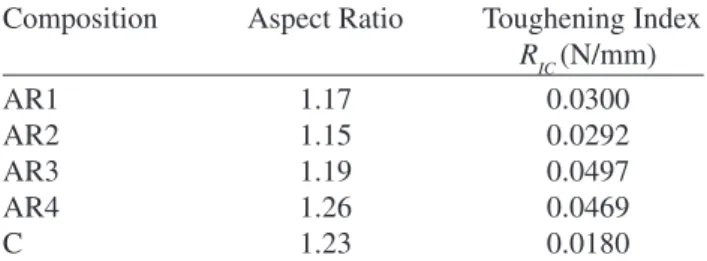
Figure 2 shows a typical load vs. CMOD curve for unfired specimens. The effect of the aspect ratio of unfired specimens on the fracture and parameters defined above are presented comparatively in Table 1 and Fig. 3. This fig-ure reveals that the specimens containing aggregates with
aspect ratios of 1 and 2 display a fracture pattern unlike that of specimens containing aggregates with aspect ratios of 3 and 4. It is clear that fewer fractures occurred in the aggre-gates in specimens AR1 and AR2 than in those of AR3 and AR4 specimens. The consequences of the different fracture patterns on the fracture parameter values and is evident, i.e., more energy was consumed to fracture specimens AR3 and AR4 than for AR1 and AR2. This indicates an increase in fracture energy for aspect ratios exceeding 2. In this case (unfired specimens), the composition containing the regu-lar anguregu-lar aggregates (C) displayed the lowest fracture energy value.
The crack process zone can be estimated from the R vs. Crack Extension plot at the point where the curve reaches a plateau (R assumes a constant value). Hence, based on Fig. 5, one can state that the size of the crack process zone of unfired specimens ranged from 3 to 4.0 mm. The size of the crack process appears to be independent of the aggregate aspect ratio.
An analysis of Table 2 and Fig. 4 reveals that firing the samples at 1000 °C for 4 h caused the fracture behavior to
change drastically in comparison with the unfired speci-mens. In the 1000 °C fired condition, the α and RIC values decreased as the aspect ratio increased.
Moreover, two features are visible, the first involving the lower values of α in the fired specimens in contrast with the unfired ones, although the RIC of fired samples increased, with the exception of the unfired AR3 specimens. The high-est RIC value was displayed by the low cement castable speci-mens containing angular aggregates.
The second feature is the shorter length the crack propa-gated (2 - 2.5 mm) to develop its full process zone in the fired specimens, indicating that a relatively low firing tem-perature sufficed to increase the brittleness of the typical aluminous low cement refractory castable composition in-vestigated.
A clear inversion in the R-Curve behavior was found to occur in the fired condition. In other words, the conven-tional low cement castable composition containing regular angular aggregates displayed a more strongly increasing R-Curve behavior, followed by the composition containing aggregates with lower aspect ratios. The effect of the in-Table 1. Average values of and RICfor each aggregate aspect ratio
in unfired specimens.
Composition Aspect Ratio Toughening Index RIC (N/mm)
AR1 1.17 0.0300
AR2 1.15 0.0292
AR3 1.19 0.0497
AR4 1.26 0.0469
C 1.23 0.0180
C is a conventional low cement aluminous refractory castable con-taining angular aggregates.
Table 2. Average values of and RICfor each aggregate aspect ratio in fired specimens.
Composition Aspect Ratio Toughening Index RIC (N/mm)
AR1 1.13 0.0436
AR2 1.12 0.0373
AR3 1.07 0.0364
AR4 1.07 0.0290
C 1.14 0.0470
M 1.12 0.0399
Figure 4. R-Curve for fired (1000 °C/4 h) specimens of different compositions and coarse aggregate aspect ratios.
Figure 8. Fracture surface of fired (1000 °C/4 h) specimens AR1, AR2, AR3, AR4 and C.
Figure 7. SEM Micrograph of the fracture surface of an unfired specimen – Aspect ratio 3. Longitudinal crack right at the aggre-gate/matrix interface (1000×)
Figure 6. SEM Micrograph of an unfired specimen – Aspect ratio 3. Aggregate protruding from the fracture surface. (30×) Figure 5. Fracture surface of unfired specimens AR1, AR2, AR3, AR4 and C.
creasing/decreasing R-curve followed the order: C > AR1 > AR2 ≅ AR3 > AR4. In this particular situation, the composition containing aggregates of the largest aspect ratio presented an almost flat cleavage-like brittle fracture (Fig. 8).
Interestingly, the global R-Curve behavior of the matrix alone controlled the intermediary situation when compared to the different aspect ratio aggregates containing specimens, as indicated by the data in Table 2.
From Fig. 5 it is evident that the toughening observed in the unfired specimens for the aggregate aspect ratio exceed-ing 2 resulted from grain bridgexceed-ing and aggregate pullout. It is well known that rising R-Curve behavior is significantly influenced by bridging and pulling-out processes. This as-sumption is clearly corroborated by the aggregates protrud-ing from the unfired matrices, resemblprotrud-ing (for an aspect
ratio ≥ 2) the typical fracture surface of a fiber-reinforced composite.
Figures 6 and 7 reveal that the aggregates in the unfired specimens are anchored mostly by mechanical restraint. The aggregate/matrix interface is relatively smooth, with a lon-gitudinal crack located right at the interface, which is free of fracture debris. This indicates pullout without strong dis-ruptive effects on the surrounding matrix.
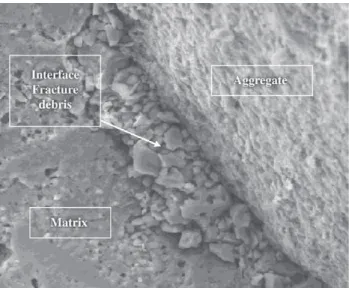
cleavage-like. Figure 9 shows that the aggregate/matrix interface of fired samples is somewhat crumbled, showing a pileup of fracture debris originating from the fracture of strong adhe-sion points formed due to the incipient sintering between matrix and aggregate.
Aggregate fracture rather than pullout, grain bridging or crack deflection obviously took place in this case. Thus, the incipient toughening observed in the fired samples can be credited only to wake zone effects, such as aggregate wedging and debris shielding by means of friction effects. This situation was more evident in the composition con-taining regular angular aggregates.
7. Conclusions
• An increase of the aspect ratio in unfired specimens of low cement refractory castables promotes increased toughness and R-Curve behavior when the aspect ra-tio exceeds 2.
• The increase in the aspect ratio of the coarse ag-gregate in fired specimens of the low cement re-fractory castable investigated here promoted no apparent increase in toughness or rising R-Curve behavior.
• The degree of adhesion between the matrix and the aggregate strongly influences the material’s brittleness, as shown by the fired specimens.
• Due to possible chemical reactions between the ma-trix and aggregate, the assumption of a fiber-like com-posite model for fired refractory castables is inappro-priate unless the aggregate/matrix interface adhesion can be controlled.
• Normal angular aggregates promoted improved toughening in the fired condition, indicating that wedging and friction effects on the wake zone were predominant toughening mechanisms in the fired specimens.
Acknowledgements
The authors would like to thank FAPESP (Process no. 95/0584-2) (State of São Paulo Research Funding Agency) for its financial support of this work, and Prof. Antonio Airton Bortolucci (EESC-USP) and Mr. Benedito O. de Sousa for their help with the testing facilities.
References
1. Homeny, J.; Bradt, R.C. in Conference on Advanced Ma-terials, Ed.S. Mindess, Westerville,Ohio,Am.Cer.Soc., p. 110, 1991.
2. Faber, K.T.; Evans, A.G. Acta Metall., v. 31, n. 565, 1983. 3. Faber, K.T.; Evans, A.G. Acta Metall., v. 31, n. 577, 1983. 4. Hu, X.Z.; Lutz, E.H.; Swain, M.V. J. Am. Ceram. Soc.,
v. 74, n. 1828, 1991.
5. Ouyang, C.; Shah, S.P. J. Am. Ceram. Soc., v. 74, n. 2831, 1991.
6. RILEM Comittee on Fracture Mechanics of Concrete – Test Methods; - “Determination of Fracture Parameters ( and CTODC) of Plain Concrete Using Three-Point Bend Tests” – Mater. Struct., v. 23, p. 457-460, 1990. Figure 9. SEM Micrograph of fracture surface of a fired specimen