*e-mail: [email protected]
Presented at the International Symposium on High Temperature Corrosion in Energy Related Systems, Angra dos Reis - RJ, September 2002.
Received: September 2, 2002; Revised: September 4, 2002
Several commercial scale coal gasification combined cycle power plants have been built and successfully operated during the last 5-10 years. Supporting research on materials of construction has been carried out for the last 20 years by EPRI and others. Emphasis was on metallic alloys for heat exchangers and other components in contact with hot corrosive gases at high temperatures. In this paper major high temperature corrosion mechanisms, materials performance in presently op-erating gasifiers and future research needs will be discussed.
Keywords: coal gasification, syngas coolers, sulfidation, downtime corrosion, stainless steel
1. Introduction
Intensive development of gasification technology has been carried out since the early seventies1,2,3. At present
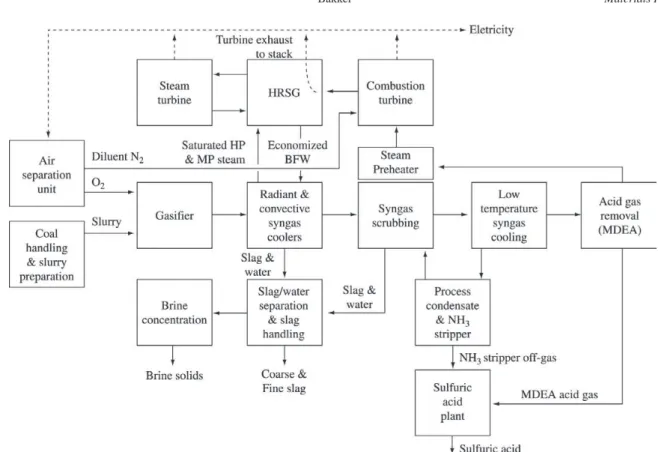
sev-eral commercial or nearly commercial scale coal gasifica-tion combined cycle plants are in operagasifica-tion worldwide. These include plants based on the Texaco and Dow processes in the USA, a plant based on the PRENF10 (Krupp-Koppers) process in Spain and a plant based on the Shell process in the Netherlands. All present plants include entrained slag-ging gasifiers and cold gas cleanup equipment. In this type of gasifier the fuel, coal, petroleum coke or heavy oil bot-toms, are pulverized and fed to the gasifier in dry or slurry form. Gasification is carried out at very high temperatures, above the melting point of the mineral matter in the fuel, usually at 1300-1600 °C. The raw hot gas, consisting mainly of CO and H2, with H2S as the major corrosive impurity, is cooled in syngas coolers and then water quenched to re-move particulates and water soluble impurities such as NH3 and chlorides. After quenching, H2S is removed in one of several commercially available gas purification systems. The purified gas is then fed to a gas turbine combined cycle plant for combustion and electricity generation. Figure 1 shows a schematic of such a plant, which is quite complex. Several corrosion and erosion problems have occurred in various plants, mostly at the pilot plant stage. These include coal slurry erosion and corrosion in feed systems, refractory cor-rosion and ecor-rosion in gasifiers, high temperature corcor-rosion
in syngas coolers and aqueous corrosion in down stream and gas purification equipment. Most of the problems found are not unique to gasifiers, but have been encountered else-where and have been resolved using existing technology. However high temperature corrosion in syngas coolers is unique to gasifiers, especially when coal is used as the fuel, due to interaction between various impurities present in coal. For the above reasons and the fact that this conference is dedicated to high temperature corrosion, this paper will concentrate on high temperature corrosion in syngas cool-ers.
the gases are not in equilibrium at the metal temperature1.
Heat exchanger syngas operating temperatures in present gasifiers are generally less than 450 °C, partly due to high temperature corrosion concerns and partially due to studies indicating that, with the present design, the use of higher heat exchanger temperatures is not cost effective.
2. Corrosion Mechanism/Laboratory Studies
The major corrosion mechanism in syngas coolers is sulfidation. Due to the low PO2 and relatively high PS2 of the raw syngas, the sulfidation rate of carbon and low alloy steels is too high to allow the use of these low cost materi-als. This is shown in Fig. 2, which contains information from laboratory as well as plant studies, with good agreement between the two. It is further observed that the corrosion rate of low alloy steels appears largely independent of the chlorine content of the coal. The plant data in Fig. 2 were obtained from coals or coal derived fuels with chlorine con-tents ranging from 0.05 to 0.3%, resulting in 100-600 ppm HCl in the syngas1. Laboratory tests confirm that HCl
con-tents in this range do not increase corrosion rates, at least not under the highly reducing conditions present in gasifiers. Due to the unacceptably high corrosion rates of low
al-loy boiler steels, stainless steel heat exchanger tubes, coat-ings or claddcoat-ings must be used to provide low corrosion rates. Extensive laboratory corrosion studies on both model and commercial alloys have been reported earlier1,4 and will
be summarized here. All experiments were done under
iso-Figure 1. Process schematic for an integrated gasification combined cycle (IGCC) power plant.
parabolic reaction kinetics are usually observed5,6. SEM/EDS
analysis indicates that at high PS2/PO2 ratios, a somewhat
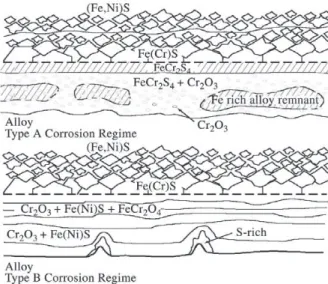
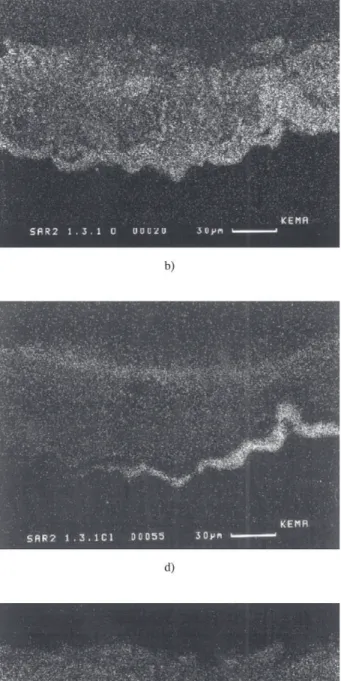
or similar oxide forming alloying elements such as Al or Si are relatively less affected by the addition of HCl to the gas. SEM/EDS analysis of Alloy 800 after exposure to a syngas with a log PS2/PO2 ratio of about 18 and a HCl content of 400 ppm indicated the absence of a protective FeCr2S4 scale. An outward growing FeS rich scale is present on top of an inward growing porous Cr2O3 rich scale containing Fe(Ni)S, which appears non protective. This corrosion mechanism is labeled Type B corrosion and is also shown schematically in Fig. 4. Further studies have shown that the onset of the less desirable Type B corrosion depends on the amount of oxide forming alloying elements in the alloy, the amount of HCl in the syngas and the presence of chlorides in deposits, which probably increases the PCl2 near the metal surface. For instance, the corrosion loss of stainless steel 310 after 164 h exposure to syngas with a log PS2/PO2 ratio of 18.5 and 1200 ppm is about 15 µm. However when a deposit
containing 5% chloride is present the corrosion loss increases to 86 µm and the corrosion mechanism changes from Type
A to Type B as shown in Fig. 6.
Aqueous corrosion during downtime can further increase overall corrosion rates in the presence of chloride contain-ing deposits. Durcontain-ing downtime hygroscopic chlorides can migrate through cracks in the scale to the scale/metal
inter-Figure 3. Corrosion losses of stainless steels as a function of PS2/ PO2 without HCl Laboratory test 540 °C 600 h.
Figure 4. Schematic of scale morphology for Type A and B cor-rosion.
face and form an FeCl3 rich layer beneath the scale. During heat up the FeCl3 layer causes spalling of the protective Cr2O3 rich scale and a new outward growing FeS rich scale and inward growing Cr2O3 rich scale is formed. This sequence repeats itself during each thermal cycle. Figure 7 shows the
Figure 6. Corrosion of SS 310 in syngas with 1200 ppm HCl with and without coating containing 5% chloride.
Area O Si S Cr Mn Fe Ni
1 0 n.d. 58 28 3 11 0
2 30 2 29 34 1 5 1
3 29 2 3 30 0 33 2
a)
Without coating corrosion loss 15 µm EDS Analysis
EDS Analysis (at%)
b)
With coating (5% chlorides) corrosion loss 86 µm EDS Analysis
EDS Analysis (at%)
Area O Si S Cr Mn Fe Ni
1 37 2 4 33 <1 23 1
2 49 2 13 33 1 3 0
3 49 2 10 31 1 6 1
scale microstructure after three 200 h high temperature cy-cles and three 24 h downtime periods in humid air at 400 °C. From the laboratory experiments described above, it is clear that the high temperature corrosion of stainless steels in syngas environments is complex and not readily predict-able from simple gas/solid reaction mechanisms, especially when HCl is present in the gas and/or chlorides in the de-posit.
3. Long Term Performance of Materials in
Service
Laboratory tests are usually conducted at atmospheric pressure under isothermal conditions for a few hundred to a few thousand hours. Materials and components of electric power plants should last at least 100,000 h. In syngas cool-ers they are also exposed to elevated pressures, 40-60 atm, with significant thermal gradients. Thus laboratory tests are useful to determine corrosion mechanisms, and guide alloy selection, but are generally not suitable to predict actual corrosion rates. For this reason, EPRI has cooperated with several gasifier operators to obtain long term corrosion rate data in various pilot and commercial size gasification plants. Several materials have been exposed in various gasifiers for over 50,000 h7,8,9,10. Individual tests have ranged from 2000
to 17,000 h, at temperatures ranging from 300-550 °C. In general, the corrosion mechanisms found in labora-tory tests are also found in service, i.e., Type A corrosion under highly sulfidizing conditions at relatively low HCl levels, Type B corrosion under less sulfidizing conditions, at somewhat higher HCl levels and high rates of corrosion due to scale spallation when chlorides are present in the deposits, Fig. 8 shows an example of pitting and scale spal-lation of 310 stainless steel after 17,000 h exposure in a Texaco process gasification plant.
In the absence of scale spallation stainless steels
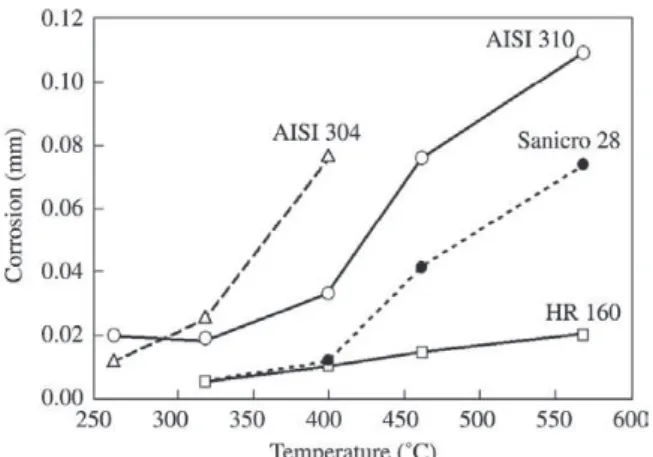
taining at least 20%Cr generally provide a satisfactory cor-rosion rate of about 0.1 mm/yr or less in the 300-400 °C temperature range at which most heat exchanger surfaces in syngas coolers operate (Fig. 9). Corrosion mechanisms ranged from Type B corrosion for the lower Cr steels to Type A corrosion for steels with a higher Cr content such as 310. When scale spallation due to chloride migration to the scale/metal interface occurs, corrosion rates increase con-siderably even at relatively low temperatures. Figure 10 shows the corrosion loss of the 310 stainless steel of Fig. 8, as a function of time. The rate is linear and is about 0.25 mm/yr. Here a Mo containing alloy such as Sanicro 28 (27Cr, 32Ni, 3.5%, Cu) is a better choice because it has a para-bolic corrosion rate, with less than 0.25 mm loss after 17,000 hr exposure. When the fuel gasified has very high Cl levels extremely high corrosion rates are possible. This is illus-trated in Fig. 11, which gives the results of a 5500 h expo-sure tests in a gasifier using a fuel containing 0.2-0.5% Cl. Here stainless steels have completely unacceptable corro-sion rates and Mo containing alloys, preferably with a high Ni content such as Alloy 625 are the only acceptable mate-rials. It is interesting to note that Alloy 625 is also the pre-ferred alloy for waste to energy plants, where chlorine is the major corrodent under oxidizing conditions11.
Field corrosion data from various gasifiers indicate that metal wastage rates experienced so far will not lead to cata-strophically high corrosion rates. When sulfidation is the only or major corrosion mechanism (Type A corrosion) cor-rosion rates less than 0.1 mm/yr are generally experienced for steels with >20% Cr at temperatures below 400 °C. Thus Alloy 800 (20Cr, 32Ni, Al, Ti), which is code approved for boiler service would be an economical choice and is indeed frequently used. However when the Cl content of the fuel is somewhat higher and the syngas is less sulfidizing, Type B corrosion can lead to highly increased corrosion rates. Un-der these conditions Alloy 800 and especially the weld ma-terial used for this alloy, INCO 82 (20 Cr, Ni, Nb) are less suitable and alloys with a higher Cr content are needed. 310 stainless steel has an adequate corrosion resistance, but is not approved for boiler service, due to potential waterside corrosion problems. Sanicro 28 is code approved and is also more resistant to Cl induced scale spallation. It is therefore the logical choice for application where Type B corrosion or scale spallation is likely.
In isothermal laboratory corrosion tests, scale spallation under Cl rich deposits is observed only in tests combining exposure at high temperature, with shorter periods of expo-sure to humid air (downtime corrosion). Similar scale spal-lation is also frequently found in service, but it also occurs when exposure to aqueous corrosion conditions is infrequent, i.e., when the plant operates continuously with only 1 or 2 shutdown year. Recently corrosion tests were carried out under thermal gradients to study waterwall corrosion in
Figure 9. Corrosion loss of stainless steels after 2,000 h exposure in the PRENFLO demonstration plant.
Figure 10. Corrosion of SS 310 and Alloy 28 during exposure in a syngas cooler At 390-420 °C.
Refinery wastes, petroleum coke and heavy oil bottoms have nominally low Cl levels. However “Phantom chlorides” have become a problem in refineries13. In one of our exposure
tests using heavy fuel oil, nominally free of Cl, spallation due to chlorine corrosion was also experienced. The chlo-rine content of most coal is relatively low 0.1% or less. However the resulting HCl levels during gasification are much higher than in boilers and chlorides are frequently found in heat exchanger deposits, when gasifying coals with Cl contents as low as 0.1%.
4. Conclusions
1. Commercial scale gasification power plants have op-erated trouble free for long periods of time and using commercially available steels.
2. Corrosion losses due to high temperature sulfidation alone are generally low enough to provide acceptable long term service, especially when the Cr content is 20% or higher.
3. The presence of chloride rich deposits can cause scale spallation, resulting in accelerated corrosion. When this occurs common stainless steels have linear corro-sion rates and Mo containing steels are preferred. They have more adherent scales and exhibit parabolic cor-rosion rates.
4. Bakker, W.T. The Effect of Chlorine on Mixed Oxidant Corrosion of Stainless Steels, Mat. At High Tempera-ture, v. 14, n. 3, p. 197, 1997.
5. Norton, J. et al., Proc. Heat Resistant Materials II, K. Natesan, P. Ganesan and G. Lai, eds., ASM International, p. 111, 1995.
6. John, R.C. et al., Materials at High Temperatures, 11(1-4), p. 124, 1993.
7. Bakker, W.T.; Stringer, J. Mixed Oxidant High Tempera-ture corrosion in Gasifiers and Power Plants, Materials at High Temperature, v. 14, n. 2, p. 101, 1997.
8. Bakker, W.T.; Kip, J.B.M.; Schmitz, H.P. Materials at High Temperatures 11(1-4), p. 133, 1993.
9. Schellberg, W. et al., Materials at High Temperatures 14(2), p. 159, 1997.
10. Fahrion, M.E. Materials at High Temperatures, 11(1-4), p. 107, 1993.
11. Sorell, G. Materials at High Temperatures, 14 (2,3), p. 37, 1997.
12. Bakker, W.T.; Blough, J.E.; Seitz, W.; Kung, S.C. “The Effect of Deposits on Waterwall Corrosion” to be pub-lished in proc. Materials for Advanced Power Engineer-ing, Liege, 2002.